
DMV Real ID: What It Is, How to Get One, and Deadlines 2026 September
🆕 DMV Real ID guide: what the star means on your license, required documents, how to apply at your state DMV, and the federal enforcement deadline.

A REAL ID is a state-issued driver's license or identification card that meets minimum federal security standards established by the REAL ID Act of 2005. You can identify a REAL ID-compliant card by a gold or yellow star in the upper right corner. Without a REAL ID-compliant license or an alternative federally accepted document like a passport, you cannot board a domestic flight, access a military base, or enter certain secure federal facilities.
The REAL ID Act was passed in response to the 9/11 Commission's finding that the hijackers had used state-issued IDs obtained with minimal verification. The law required all 50 states to verify the identity documents presented when issuing driver's licenses and IDs, check applicants against the federal Social Security database, and store digital copies of the supporting documents. The goal was to prevent fraudulent identity documents from being used to access aviation and federal facilities.
The enforcement deadline has been extended multiple times since the law was passed in 2005. The most recent final deadline took effect in May 2025. After this date, a non-REAL ID compliant license is no longer accepted at airport security checkpoints for domestic flights. Travelers must present either a REAL ID-compliant license, a U.S. passport, a passport card, a military ID, a TSA PreCheck-approved card, or another federally approved document to pass through TSA screening.
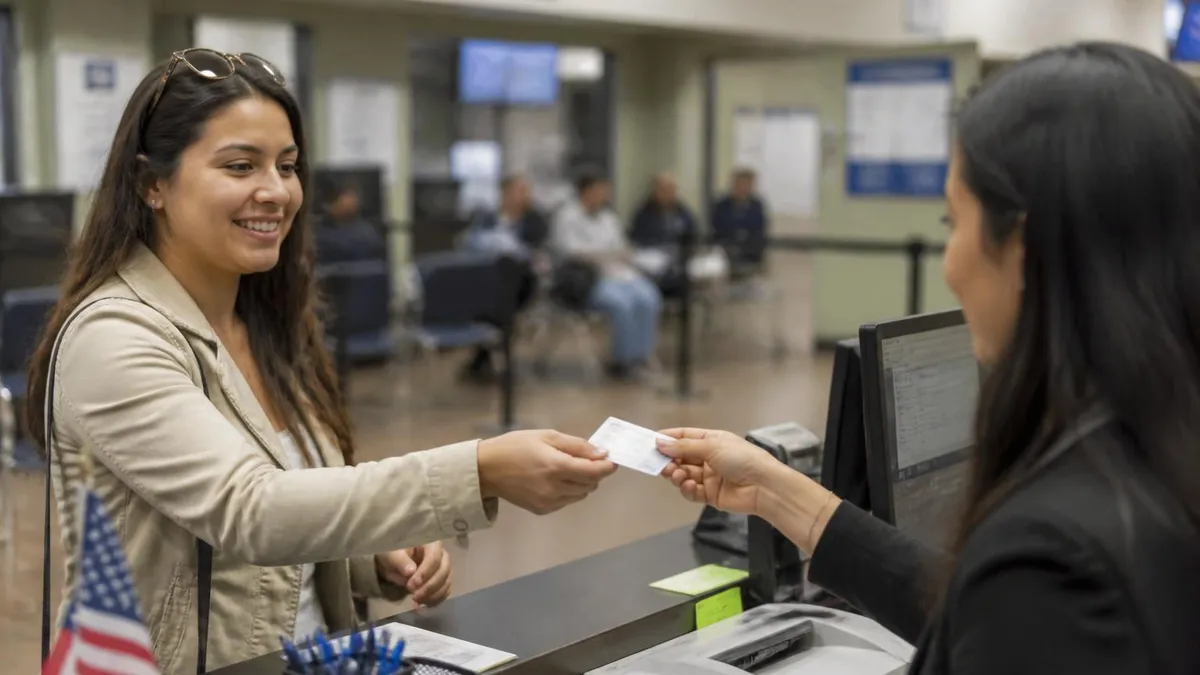
Getting a REAL ID requires a visit to your state's DMV — you cannot apply online or by mail. The in-person requirement is intentional: the REAL ID Act requires states to verify original documents in person before issuing a compliant credential. This means scheduling a DMV appointment, gathering the required documents, and appearing in person at a licensed DMV office.
The specific documents required vary slightly by state, but the federal minimum standards require proof of full legal name, date of birth, Social Security number, two proofs of principal residency, and lawful status in the United States. Most applicants bring a U.S. birth certificate or passport for identity, their Social Security card or a W-2/tax document showing the full Social Security number, and two utility bills or bank statements for residency.
The verification requirements under the REAL ID Act go beyond simply showing a document at the counter. States must scan and store digital copies of every supporting document presented, cross-check the applicant's name and date of birth against the Social Security Administration's database, and check the applicant against state and federal databases for prior licenses before issuing a new credential.
These backend checks are what distinguishes a REAL ID from a standard state license — the physical card looks similar, but the issuance process behind it meets federal standards that most legacy state license programs did not meet before the law took effect.
The star marking on a REAL ID-compliant card is a permanent feature of the credential. It does not need to be renewed separately — when you renew your license through the standard renewal cycle, the REAL ID status carries forward as long as you present the required documents at the renewal visit. In states that require full document re-verification at each renewal, you bring the same categories of documents again.
In states that maintain the digital copies from the original application and only require residency updates, the renewal process is faster. Checking your specific state's renewal policy before your appointment avoids an unnecessary full document assembly at what might otherwise be a simple transaction.
REAL ID at a Glance
The document requirements for a REAL ID break down into five categories. The first is proof of identity — your full legal name and date of birth — which is satisfied by a U.S. birth certificate, U.S. passport, certificate of naturalization, or permanent resident card. The identity document must show your full legal name exactly as it appears on all other documents, including any middle name.
The second requirement is proof of Social Security number. A Social Security card works, but so do tax documents that display the full nine-digit number — a W-2, a 1099, or an SSA benefits letter. Some states also accept recent pay stubs. The DMV verifies the SSN against the Social Security Administration database in real time, so the name on the document must match exactly.
The third requirement is two proofs of principal state residency. These are typically utility bills, bank statements, mortgage or lease agreements, or government-issued documents (voter registration cards, vehicle registration). Each document must show your name and current address, and the documents must be different — two bills from the same utility company don't count as two separate proofs.
The fourth requirement is proof of lawful status in the United States. For U.S. citizens, the birth certificate or passport typically satisfies this. For noncitizens, this requires showing a visa, I-94 arrival/departure record, employment authorization document, or permanent resident card. Limited-term visas require documentation showing the expiration date, and REAL IDs issued to temporary visa holders may carry a star with an expiration date matching the visa term.
Name change documents — marriage certificates, divorce decrees, or court-ordered name change documents — are required if your current legal name differs from the name on your primary identity document. These chain-of-identity documents trace the name from the birth certificate through each legal name change to your current name. Many applicants discover during the REAL ID application process that their state DMV records contain an old name that no longer matches their current legal documents.
The DMV forms and services page covers the specific state forms required for REAL ID applications, including the document checklist that varies by state and the identity verification form that must be completed at the counter during the appointment.
The Social Security verification step catches a significant number of applicants off-guard. If the name on file with the Social Security Administration does not exactly match the name on the identity document presented, the DMV cannot complete the REAL ID verification.
A middle initial omitted on a W-2 but present on a birth certificate, a hyphenated last name stored differently across documents, or a maiden name still on file with the SSA from before a marriage can all cause a mismatch that requires resolution before the REAL ID can be issued. Correcting a name discrepancy with the SSA can take several weeks, which is why gathering and reviewing documents well before the DMV appointment — not the week of — is the recommended approach.
Residency documents require more attention than most applicants expect. A utility bill must be a recent billing statement showing the account holder name and service address — not a confirmation email, not a screenshot of an online account portal, and not a letter that shows only one of the two required fields. Bank statements must include the account holder name and current mailing address.
If you receive paperless statements only, you can typically generate a printable PDF statement from your online banking portal, but some states require a printed original from the bank rather than a self-printed PDF. The specific document standards vary by state, and the DMV website for your state will have the current approved document list, which is worth printing and checking against your actual documents before you leave for your appointment.

After the May 2025 deadline, TSA will not accept a non-REAL ID state license for boarding domestic flights. If you arrive without a compliant document, you can present a U.S. passport, passport card, or military ID instead. Without any federally accepted document, you will not be permitted through security. Keep your passport current as a backup for domestic travel until you have obtained your REAL ID.
New Jersey's DMV (Motor Vehicle Commission, or MVC) processes REAL ID applications at all full-service agencies. New Jersey has specific procedures: residents must use the 6 Points of ID system, which assigns point values to different identity documents. A U.S. birth certificate is worth 4 points, a U.S. passport is worth 4 points, and each additional document adds points until you reach 6. The Social Security number verification and two residency proofs are separate from the point system. New Jersey's MVC website provides an interactive tool to calculate your points before your appointment.
To schedule an appointment for a REAL ID in New Jersey, residents use the online appointment scheduler on the MVC website or call the appointment line. Walk-in service has been limited since the post-pandemic backlog, and appointments typically book out several weeks, particularly at popular agencies in urban areas. Scheduling well in advance is essential — don't wait until the week before a flight to start the REAL ID process. Processing time from appointment to receiving the new card by mail is typically two to four weeks after the in-person visit.
Most states charge a fee for the REAL ID upgrade ranging from $10 to $35 above the standard license renewal fee. Some states absorbed the cost into their normal renewal cycle — if you're renewing at your regular renewal time, there may be no additional charge to upgrade to REAL ID compliance at the same visit. The fee structure varies enough that checking your specific state's DMV website before your appointment is worthwhile.
Digital copies of documents are not accepted for REAL ID applications. The physical original documents — not photocopies, not PDFs on your phone, not certified copies in some states — must be presented in person. Some states accept certified copies of birth certificates from the issuing county, but a photocopy of a birth certificate is never acceptable. Preparing your document packet before the appointment and verifying each document against your state's specific checklist reduces the risk of a wasted trip due to a missing or unacceptable document.
For information about scheduling your REAL ID appointment at your state's DMV, the DMV appointment guide covers the online and phone scheduling process, typical wait times by state, and what to expect at the counter during the in-person visit.
The fee structure for REAL ID upgrades reflects the additional processing time and database verification that states incur when issuing a compliant credential. In states that charge a separate REAL ID upgrade fee, the amount is typically assessed at the counter after documents are verified — it is not always listed as a separate line item on the state DMV website, so calling ahead or checking the state fee schedule in advance prevents surprises at the counter.
Some states waive the upgrade fee for applicants who are renewing their license at the same time, treating the REAL ID compliance as an included feature of the renewal rather than a separate service. Others apply the standard renewal fee plus a fixed REAL ID processing surcharge regardless of whether the license is up for renewal.
After the in-person appointment, the state mails the new REAL ID-compliant card to the address on file. Most states issue a paper receipt or a temporary paper license valid for 30 to 60 days that can be used for driving while the permanent card is in transit. This temporary document is not REAL ID compliant — it is a state driving credential only.
If you have travel scheduled within the 2-4 week window after your DMV appointment, keep a current U.S. passport with you as your federal identification for airport security. The permanent card arrives by mail and does not require a return visit to the DMV to activate or pick up.
Documents Required for REAL ID
U.S. birth certificate, U.S. passport, U.S. passport card, certificate of citizenship, or certificate of naturalization. Must show full legal name and date of birth.
Social Security card, W-2, 1099, SSA letter, or pay stub showing full 9-digit SSN. DMV verifies against SSA database in real time — name must match exactly.
Utility bill, bank statement, mortgage/lease agreement, voter registration card, or government mail. Each from a different source. Must show name and current address.
Satisfied by U.S. birth certificate for citizens. Noncitizens must provide visa, I-94, EAD, or green card. Limited visas may result in limited-term REAL ID.
Marriage certificate, divorce decree, or court order required if current legal name differs from primary identity document. Must trace name from birth certificate to current name.
Photocopies, printed PDFs, screenshots, or expired documents. Physical originals (or state-approved certified copies) required at the DMV counter.
States issue two types of driver's licenses and IDs side by side: REAL ID-compliant versions (marked with a gold star) and non-compliant versions. Non-compliant licenses are still valid for state purposes — driving, voting, opening bank accounts, and most everyday identity verification — but they cannot be used for federal purposes requiring REAL ID. If you choose not to get a REAL ID, you can still use a U.S. passport for flying and other federal access needs.
Some states offer an explicit opt-out: a license clearly marked as NOT FOR FEDERAL PURPOSES or not acceptable for Real ID purposes. This type of license is available in states like California (the standard non-REAL ID option) and is sometimes chosen by individuals who prefer not to submit the additional documentation required for REAL ID compliance. Holding a NOT FOR FEDERAL PURPOSES license means relying on a U.S. passport for domestic flights.
Enhanced driver's licenses (EDLs) are available in a small number of states — Michigan, Minnesota, New York, Vermont, and Washington — and are accepted for land and sea border crossings between the U.S. and Canada or Mexico, in addition to meeting REAL ID requirements. An enhanced driver's license is more expensive than a standard REAL ID but eliminates the need for a passport for border crossings, which is particularly useful for residents in border states who cross frequently.
Children under 18 who are on a parent's domestic flight reservation do not need a REAL ID — TSA does not require identification for minors on domestic flights. Teens 18 and over, however, must present a REAL ID-compliant document or alternative federal ID at TSA checkpoints. High school seniors planning their first solo trip should apply for a REAL ID well before any planned travel, as processing times can be several weeks from application to card delivery.
For more detail on the full range of DMV services and how to navigate the DMV system for licenses, permits, and renewals, the DMV complete guide covers the end-to-end process including permit tests, license types, and renewal procedures that apply across all 50 states.
Applicants who have recently moved and whose residency documents still show a previous address should update their address with utilities and financial institutions before scheduling a REAL ID appointment. The two residency proofs must reflect the current address where you actually live — documents showing a former address will be rejected at the counter.
REAL ID Application Checklist
- ✓Check if your current license already has a gold star — you may already be compliant
- ✓Gather original (not photocopied) identity documents before scheduling
- ✓Locate your original Social Security card or W-2 showing your full SSN
- ✓Prepare two separate proofs of current address from different document sources
- ✓Collect any name change documents if your name has changed since your birth certificate
- ✓Schedule a DMV appointment well in advance — don't wait until the week before travel
- ✓Verify the specific document checklist for your state on your state DMV website
- ✓Keep your U.S. passport current as a backup until your REAL ID card arrives by mail
REAL ID by State
New Jersey uses a 6 Points of ID system. A U.S. birth certificate (4 pts) plus a U.S. passport (4 pts) exceeds the 6-point threshold, but you only need to reach 6 — a birth certificate (4 pts) plus a Social Security card (1 pt) plus a utility bill (1 pt) works. Social Security verification and two residency proofs are separate from the point total. Schedule at njmvc.gov — appointments book several weeks out at busy agencies. Processing time is 2-4 weeks after your appointment.
Getting a REAL ID: Benefits and Considerations
- +Required for domestic air travel after May 2025 enforcement deadline
- +Accepted at all federal facilities requiring REAL ID-compliant identification
- +Eliminates need to carry a passport for domestic flights
- +Same size as a standard license — fits in your wallet with no additional carry
- +One-time process: REAL ID compliant until your next renewal cycle
- −Requires an in-person DMV visit with original documents — cannot be done online
- −Additional documentation requirements may be difficult to satisfy quickly
- −Processing time of 2-4 weeks means you can't get one the day before a trip
- −Fee above standard renewal cost at some states
- −Does not replace a passport for international travel or land border crossings
DMV Questions and Answers
About the Author

Licensed Driving Instructor & DMV Test Specialist
Penn State UniversityRobert J. Williams graduated from Penn State University with a degree in Transportation Management and has spent 20 years as a certified driving instructor and DMV examiner consultant. He has personally coached thousands of applicants through written knowledge tests, skills assessments, and commercial driver licensing programs across more than 30 states.
Join the Discussion
Connect with other students preparing for this exam. Share tips, ask questions, and get advice from people who have been there.
View discussion (9 replies)