
Can CPR Restart the Heart? What Bystanders Need to Know in 2026 October
Can CPR restart the heart? Learn how chest compressions, AEDs, the ACLS algorithm, and infant CPR work — 🧠 plus pass rates and study tips.
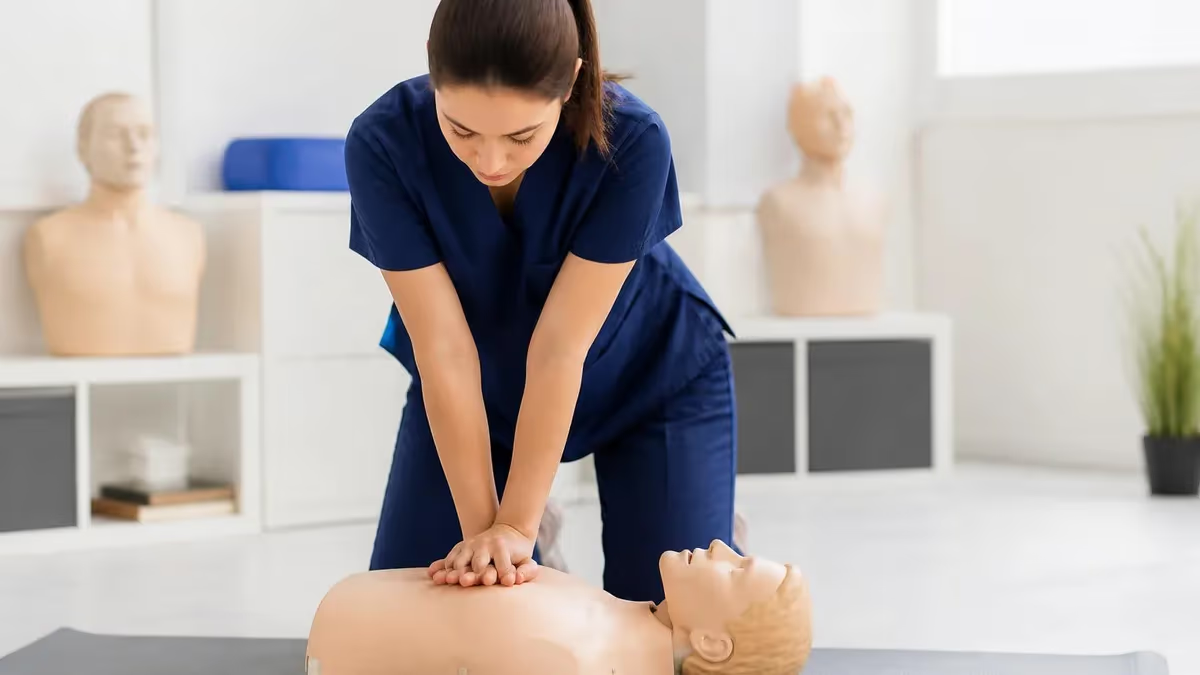
One of the most common questions in every classroom is simple but loaded: can CPR restart the heart on its own? The honest answer surprises most people. Cardiopulmonary resuscitation rarely restarts a stopped heart by itself. What it actually does is buy time — circulating oxygenated blood to the brain and vital organs until a defibrillator, advanced medications, or the body's own electrical system can convert the rhythm back into a functional heartbeat that supports life on its own.
Understanding that distinction changes how you respond in an emergency. Bystanders who expect chest compressions to magically jump-start a pulse often stop too early, switch positions too often, or hesitate to use an automated external defibrillator. Knowing that CPR is a bridge — not a cure — helps you push harder, push faster, and push longer until paramedics arrive with the equipment and protocols, like the acls algorithm, that genuinely have the power to reverse cardiac arrest in the field.
This guide walks through what cardiac arrest actually is, why immediate compressions matter, how AEDs deliver the shock that often does restart the heart, and how programs like the national cpr foundation teach lay rescuers to act inside that critical four-minute window. We will cover infant cpr techniques, recovery positioning, respiratory rate basics, and the differences between BLS, ACLS, and PALS certifications you might hear about in a hospital setting.
Sudden cardiac arrest claims more than 350,000 lives in the United States outside hospitals every year. Survival rates hover near 10 percent nationally, but communities with strong bystander CPR programs see rates climb above 40 percent. That gap is not luck — it is preparation. People who have studied a pals certification course, watched the video demos, and practiced on manikins simply respond faster and with more confidence than untrained witnesses.
You do not have to be a paramedic to make that difference. Hands-only CPR, taught in under an hour, is enough to double or triple survival odds when started within the first two minutes. Add a publicly accessible AED and the math gets dramatically better. The trick is removing the fear of doing something wrong, because in true cardiac arrest the worst possible action is no action at all.
Throughout this article you will find practical numbers, decision checklists, and quiz tiles you can use to test your own knowledge before you ever face a real emergency. Read straight through or jump to a section in the table of contents. Either way, by the end you will have a clear, accurate, and confidence-building picture of exactly what CPR can and cannot do.
CPR Knowledge by the Numbers
How CPR Actually Works: The 6-Step Survival Chain
Recognize Cardiac Arrest
Activate EMS & Get AED
Start Chest Compressions
Deliver Rescue Breaths
Attach the AED
Hand Off to Paramedics
A heart attack and cardiac arrest are not the same emergency, and confusing the two costs lives. A heart attack is a plumbing problem: a blocked coronary artery starves part of the heart muscle of oxygen, causing chest pain, shortness of breath, sweating, and sometimes nausea. The person is usually conscious and talking. Cardiac arrest is an electrical problem: the heart's rhythm suddenly fails, blood stops circulating, and the victim collapses within seconds.
That distinction matters because CPR is reserved for cardiac arrest. You should not start chest compressions on someone who is awake and complaining of chest pain — that person needs aspirin, calm reassurance, and a fast ambulance ride. But the moment they lose consciousness and stop breathing normally, the rules flip. Begin compressions immediately and keep going until help arrives or an AED tells you otherwise.
Heart attacks can trigger cardiac arrest, which is why both topics show up on every CPR curriculum and on practice question sets like the cpr index review banks students use before testing. Roughly 25 percent of heart attack patients progress to arrest, and that risk peaks during the first hour. Knowing how to monitor breathing, count respiratory rate, and recognize agonal gasps can mean catching the transition early.
Respiratory rate gives you an early warning sign. A healthy adult breathes 12 to 20 times per minute at rest. Anything below 10 or above 30 in someone who looks sick is concerning. Children breathe faster — infants normally take 30 to 60 breaths a minute — so what looks alarming in an adult may be normal in a baby. Learning these baselines is part of every basic and advanced life support program.
The position recovery technique, often shortened to recovery position, is used after a victim regains a pulse and starts breathing on their own but remains unconscious. Rolling them onto their side keeps the airway clear, prevents the tongue from blocking the throat, and lets fluids drain instead of pooling in the lungs. Do not use the recovery position while CPR is still in progress — keep the person flat on a firm surface for compressions.
Finally, remember that not every collapse is cardiac. Strokes, seizures, low blood sugar, drug overdoses, and severe allergic reactions can all mimic cardiac arrest in the first moments. Your job as a bystander is not to diagnose. It is to check responsiveness and breathing, call 911, and start compressions if both are absent. Dispatchers will guide you through the rest while paramedics race to your location.
That simple decision tree — unresponsive plus not breathing equals CPR — is the foundation every certification program builds on, from a basic first aid card to a full PALS or ACLS provider course. Master it, and you have the core skill that genuinely saves lives.

CPR Practice Test Questions
Prepare for the CPR Cardiopulmonary Resuscitation Practice exam with our free practice test modules. Each quiz covers key topics to help you pass on your first try.
CPR Basic CPR
CPR Exam Questions covering Basic CPR. Master CPR Test concepts for certification prep.
CPR and First Aid
Free CPR Practice Test featuring and First Aid. Improve your CPR Exam score with mock test prep.
CPR (Cardiopulmonary Resuscitation) Adult ...
CPR Mock Exam on (Cardiopulmonary Resuscitation) Adult CPR and AED Usage. CPR Study Guide questions to pass on your first try.
CPR (Cardiopulmonary Resuscitation) Airway...
CPR Test Prep for (Cardiopulmonary Resuscitation) Airway Obstruction and Choking. Practice CPR Quiz questions and boost your score.
CPR (Cardiopulmonary Resuscitation) Cardio...
CPR Questions and Answers on (Cardiopulmonary Resuscitation) Cardiopulmonary Emergency Recognition. Free CPR practice for exam readiness.
CPR (Cardiopulmonary Resuscitation) Child ...
CPR Mock Test covering (Cardiopulmonary Resuscitation) Child and Infant CPR. Online CPR Test practice with instant feedback.
CPR (Cardiopulmonary Resuscitation) High-P...
Free CPR Quiz on (Cardiopulmonary Resuscitation) High-Performance Team Dynamics. CPR Exam prep questions with detailed explanations.
CPR (Cardiopulmonary Resuscitation) Legal ...
CPR Practice Questions for (Cardiopulmonary Resuscitation) Legal and Ethical Considerations. Build confidence for your CPR certification exam.
CPR for Specific Populations
CPR Test Online for for Specific Populations. Free practice with instant results and feedback.
CPR Airway & Breathing Management
CPR Exam Questions covering Airway & Breathing Management. Master CPR Test concepts for certification prep.
CPR Assessment & Recognition of Cardiac Ar...
Free CPR Practice Test featuring Assessment & Recognition of Cardiac Arrest. Improve your CPR Exam score with mock test prep.
CPR Chest Compressions & Defibrillation
CPR Mock Exam on Chest Compressions & Defibrillation. CPR Study Guide questions to pass on your first try.
CPR Post-Resuscitation Care & Recovery
CPR Test Prep for Post-Resuscitation Care & Recovery. Practice CPR Quiz questions and boost your score.
Adult, Child, and Infant CPR Differences
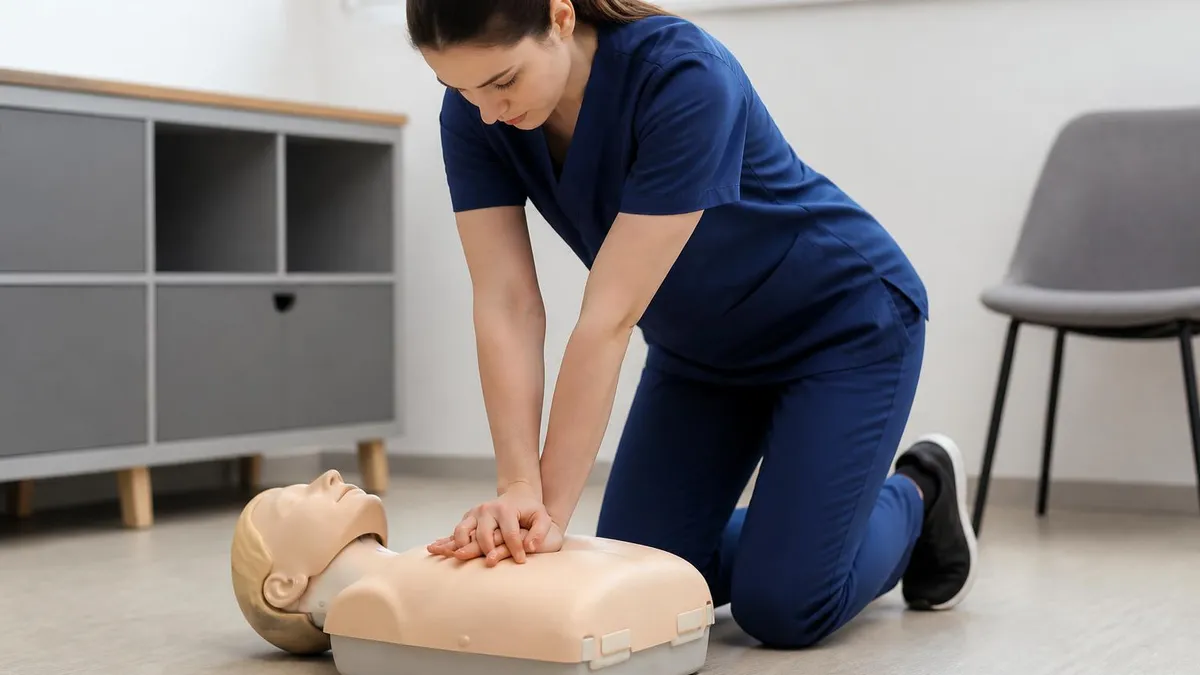
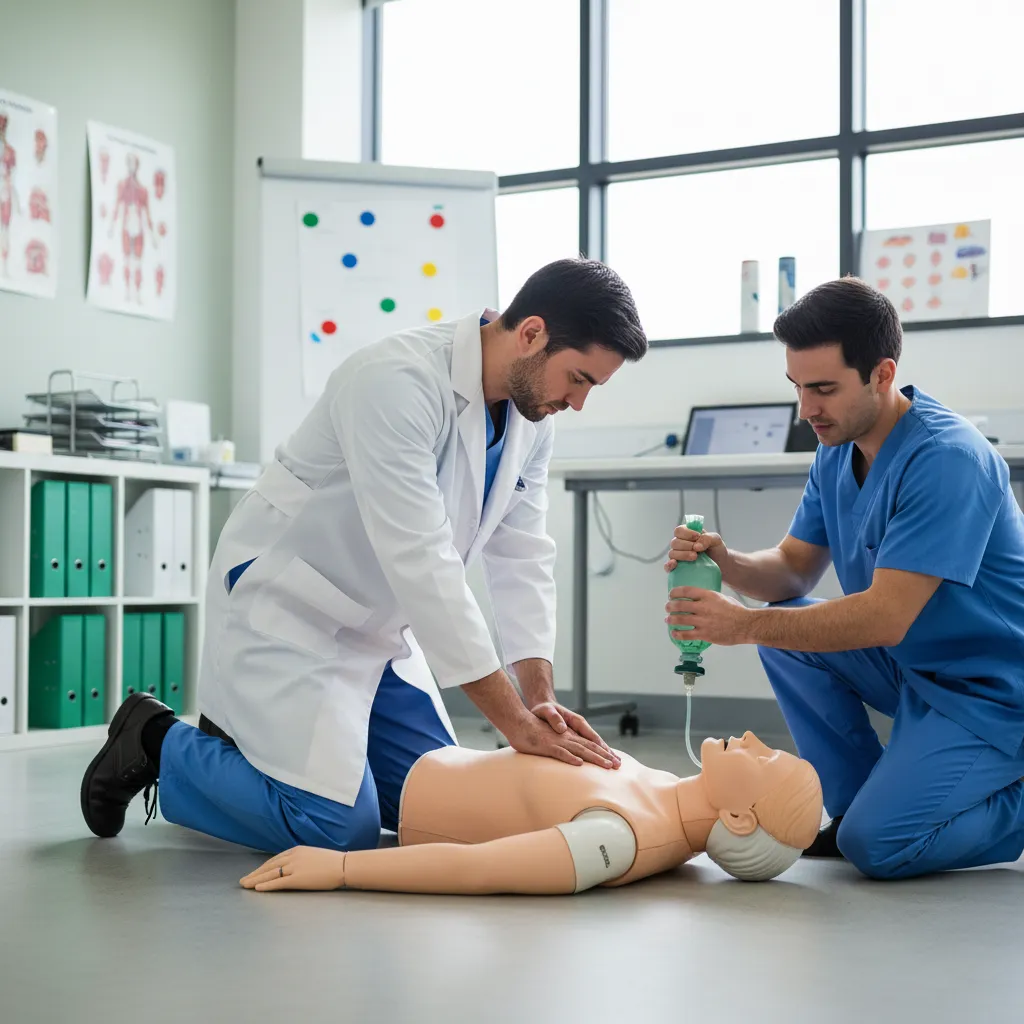
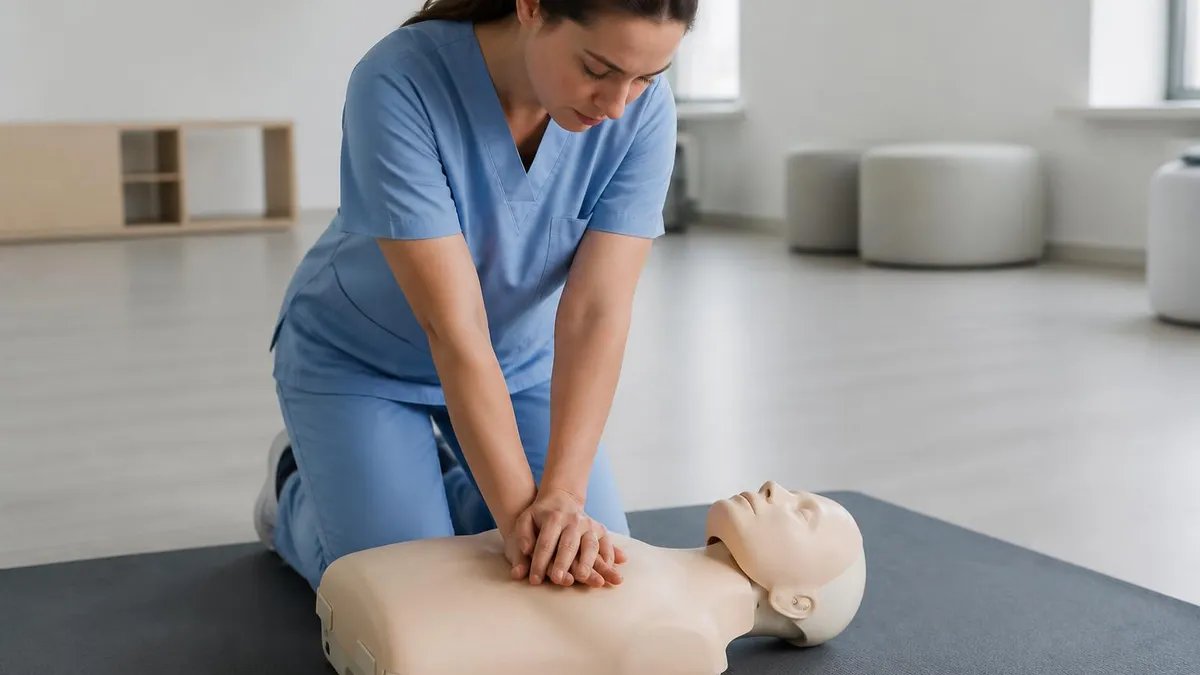
Adult CPR uses two hands stacked on the lower half of the sternum, with compressions at least 2 inches deep and no more than 2.4 inches. The rate stays between 100 and 120 per minute, matching the beat of songs like Stayin' Alive. Allow full chest recoil after every push so the heart can refill.
If you are alone and untrained, hands-only CPR is acceptable and effective for adult sudden collapse. If trained, the ratio is 30 compressions to 2 breaths. Switch rescuers every two minutes when possible because compression quality drops sharply once fatigue sets in. Do not stop unless an AED is analyzing or paramedics take over.
Hands-Only CPR vs. Conventional CPR: Which Should Bystanders Use?
- +Hands-only CPR is easier to learn and remember in a panic
- +Removes the hesitation many people feel about mouth-to-mouth contact
- +Just as effective as conventional CPR for witnessed adult cardiac arrest
- +Allows uninterrupted blood flow to the brain and heart
- +Recommended by the AHA for untrained bystanders
- +Can be coached by 911 dispatchers over the phone in real time
- −Not appropriate for infants, children, or drowning victims who need breaths
- −Less effective for arrests caused by respiratory failure or drug overdose
- −Conventional CPR with breaths is preferred for prolonged resuscitations
- −Healthcare providers are still expected to perform full 30:2 CPR
- −Rescue breaths can improve outcomes when arrest lasts beyond 10 minutes
- −Skipping breaths in pediatric cases may reduce survival significantly
Pros and Cons at a Glance
| Pros | Cons |
|---|---|
| Hands-only CPR is easier to learn and remember in a panic | Not appropriate for infants, children, or drowning victims who need breaths |
| Removes the hesitation many people feel about mouth-to-mouth contact | Less effective for arrests caused by respiratory failure or drug overdose |
| Just as effective as conventional CPR for witnessed adult cardiac arrest | Conventional CPR with breaths is preferred for prolonged resuscitations |
| Allows uninterrupted blood flow to the brain and heart | Skipping breaths in pediatric cases may reduce survival significantly |

Bystander Response Checklist: What to Do in the First 60 Seconds
- ✓Check the scene for safety before approaching the victim
- ✓Tap the shoulders and shout to confirm unresponsiveness
- ✓Look, listen, and feel for normal breathing for no more than 10 seconds
- ✓Call 911 immediately or direct a specific bystander to call
- ✓Ask a second bystander to retrieve the nearest AED
- ✓Place the person flat on their back on a firm surface
- ✓Position the heel of your hand on the lower half of the sternum
- ✓Begin compressions at 100 to 120 per minute, at least 2 inches deep
- ✓Allow complete chest recoil between every compression
- ✓Continue CPR without stopping until the AED arrives or EMS takes over
Every minute without CPR drops survival by 10 percent
After cardiac arrest, the brain begins to die within four to six minutes without circulation. For every minute that passes before CPR and defibrillation, the victim's chance of survival falls by roughly 7 to 10 percent. By minute 10, survival without intervention is nearly zero. Starting hands-only compressions immediately — even imperfect ones — is dramatically better than waiting for trained help to arrive.
Automated external defibrillators are the single technology most responsible for the question "can CPR restart the heart?" being answered with a qualified yes. So what does aed stand for? The acronym stands for automated external defibrillator, a portable device that reads the heart's electrical rhythm and delivers a controlled shock when it detects ventricular fibrillation or pulseless ventricular tachycardia — the two shockable rhythms most likely to be reversed by electricity.
An AED does not shock asystole, the flat-line rhythm popular culture loves to defibrillate on television. That misconception causes real-world hesitation. Modern AEDs are foolproof: they will not deliver a shock unless the rhythm calls for one. Your job is simply to power the unit on, peel off the pad backing, stick the pads on bare skin as shown in the diagram, and stand clear when the device tells you to. The machine handles the analysis and the energy delivery itself.
Beyond bystander tools, the acls algorithm guides hospital and paramedic teams through advanced cardiac life support. ACLS adds intravenous medications like epinephrine and amiodarone, advanced airway management, capnography monitoring, and decision branches for reversible causes — the so-called H's and T's. ACLS providers train for two-year certification cycles and must demonstrate competency in megacode simulations before being signed off.
Pediatric Advanced Life Support, or PALS, is the parallel program for children and infants. PALS uses age-adjusted drug doses, smaller equipment, and weight-based calculations using tools like the Broselow tape. Nurses, paramedics, respiratory therapists, and physicians who work in emergency departments, pediatric ICUs, or labor and delivery units typically maintain current PALS credentials alongside basic life support.
The position recovery — formally called the recovery position — comes back into play after return of spontaneous circulation. Once the person has a pulse and is breathing, gently roll them onto their side with the bottom arm extended, the top hand supporting the head, and the top knee bent for stability. Monitor breathing continuously, because cardiac arrest survivors can re-arrest within minutes and need ongoing observation until paramedics arrive.
The hybrid model became standard after 2020 and now accounts for the majority of new BLS, ACLS, and PALS certifications issued in the United States.
Understanding the full chain — recognition, CPR, AED, ACLS, post-arrest care — is what separates a confident responder from a frozen bystander. You do not need to memorize every drug or dose, but knowing where your role ends and the paramedics' begins gives you permission to act decisively in the seconds that matter most.
Once you start compressions, do not pause to check for a pulse every minute or two. Interruptions longer than 10 seconds dramatically reduce survival. Only stop when the AED is actively analyzing, when the victim begins moving or breathing normally, when another trained rescuer takes over, or when EMS instructs you to step aside. Keep counting and keep pushing.
Certification options can feel overwhelming because the alphabet soup of acronyms — BLS, ACLS, PALS, CPR, FA — overlaps in confusing ways. So what is a bls certification exactly? Basic Life Support is the foundational provider-level course for healthcare workers, covering high-quality CPR for adults, children, and infants, bag-mask ventilation, AED use, and basic team dynamics. It typically runs four hours and certifies you for two years.
A standard community CPR class, sometimes called Heartsaver or layperson CPR, is shorter and aimed at non-medical audiences like teachers, parents, lifeguards, and coaches. It still covers the same compression rate and depth, AED use, and choking response, but skips the team-based and clinical components. Many states require it for childcare licensing, build parenting, and certain workplace safety roles.
The national cpr foundation is one of several online providers offering convenient self-paced certifications accepted by many employers. Before choosing any online-only program, verify that your employer, state board, or licensing agency will accept that specific certificate — some require hands-on skills verification through the American Heart Association or American Red Cross.
Pals certification is the pediatric equivalent of ACLS, required for nurses, paramedics, and physicians who care for critically ill children. Cost ranges from $200 to $300 for the full two-day course and renews every two years.
Cost matters too. A community CPR class typically runs $50 to $90. BLS runs $60 to $110. ACLS sits at $200 to $300, and PALS is similarly priced. Hybrid online courses with in-person skills checks usually save 20 to 30 percent over fully in-person classes, and many hospitals reimburse certification fees for their employees as part of professional development budgets.
If you are pursuing certification for the first time, start with hands-only CPR or community CPR to build muscle memory. Then move to BLS if your career path requires it, and add ACLS or PALS only when your clinical role demands those specific algorithms. Stacking certifications you never use wastes money and makes recertification cycles harder to manage as expiration dates pile up.
Whatever path you choose, remember that the certificate on the wall is not the goal. Confidence to act in those first 60 seconds — when a coworker collapses, a child chokes, or a family member stops breathing — is what every program is ultimately designed to produce.
Practical preparation is the single biggest predictor of whether a bystander actually performs CPR during a real emergency. Research from the American Heart Association consistently shows that people who have practiced on a manikin within the past 12 months are three times more likely to initiate compressions than those whose training is older. Refresh your skills annually, even if your certificate has not expired yet, because muscle memory fades faster than paperwork does.
Pair your formal training with regular self-quizzing. Free question banks covering basic CPR, AED usage, choking, and pediatric emergencies are widely available, and ten minutes a week is enough to keep terminology fresh. Spaced repetition apps work especially well for memorizing the compression rate, depth, ratios, and the recovery position steps that tend to fade between recertification cycles.
Know where the AEDs are in the buildings you spend time in. Walk your office, gym, place of worship, and your kids' schools and note the locations of mounted AED cabinets. The PulsePoint app and Google Maps now show many public AED locations. In a real arrest, sending a specific person to a known location is far faster than asking a panicked crowd if anyone has seen a defibrillator.
Practice the assertive verbal commands that get bystanders moving. Pointing and saying "You in the blue shirt, call 911 right now and put it on speaker" works dramatically better than shouting "Someone call 911!" into a frozen crowd. The same goes for AED retrieval: name a specific person, give them a specific destination, and tell them to come straight back.
Take care of yourself after a real or attempted resuscitation. Even seasoned paramedics struggle emotionally after pediatric arrests or unsuccessful attempts. Most EMS agencies offer critical incident stress debriefings, and lay rescuers can request similar support through hospital chaplaincy services or community grief counselors. Doing CPR on someone — especially someone you know — is genuinely traumatic, and that response is normal.
Finally, advocate for CPR education in your community. Lobby for it in high school graduation requirements, sponsor a CPR class at your workplace, or simply teach hands-only CPR to your family at the kitchen table. Every additional trained bystander measurably moves the survival needle for sudden cardiac arrest in your zip code. The science on this is settled — community-level training saves community-level lives.
The answer to whether CPR can restart the heart is nuanced, but the practical takeaway is not. Start compressions early, push hard and fast, get an AED on the chest as soon as possible, and do not stop until help arrives. That sequence — performed by ordinary people in ordinary places — is responsible for tens of thousands of saves every year.
CPR Questions and Answers
About the Author

Registered Nurse & Healthcare Educator
Johns Hopkins University School of NursingDr. Sarah Mitchell is a board-certified registered nurse with over 15 years of clinical and academic experience. She completed her PhD in Nursing Science at Johns Hopkins University and has taught NCLEX preparation and clinical skills courses for nursing students across the United States. Her research focuses on evidence-based exam preparation strategies for healthcare certification candidates.
Join the Discussion
Connect with other students preparing for this exam. Share tips, ask questions, and get advice from people who have been there.
View discussion (5 replies)