
CPR and First Aid Certification Near Me: 2026 September Complete Guide to Local Classes, Costs, and Credentials
Find CPR and first aid certification near me in 2026 September. ✍🏼 Compare local classes, costs, AHA vs Red Cross, online hybrid options, and employer-accepted
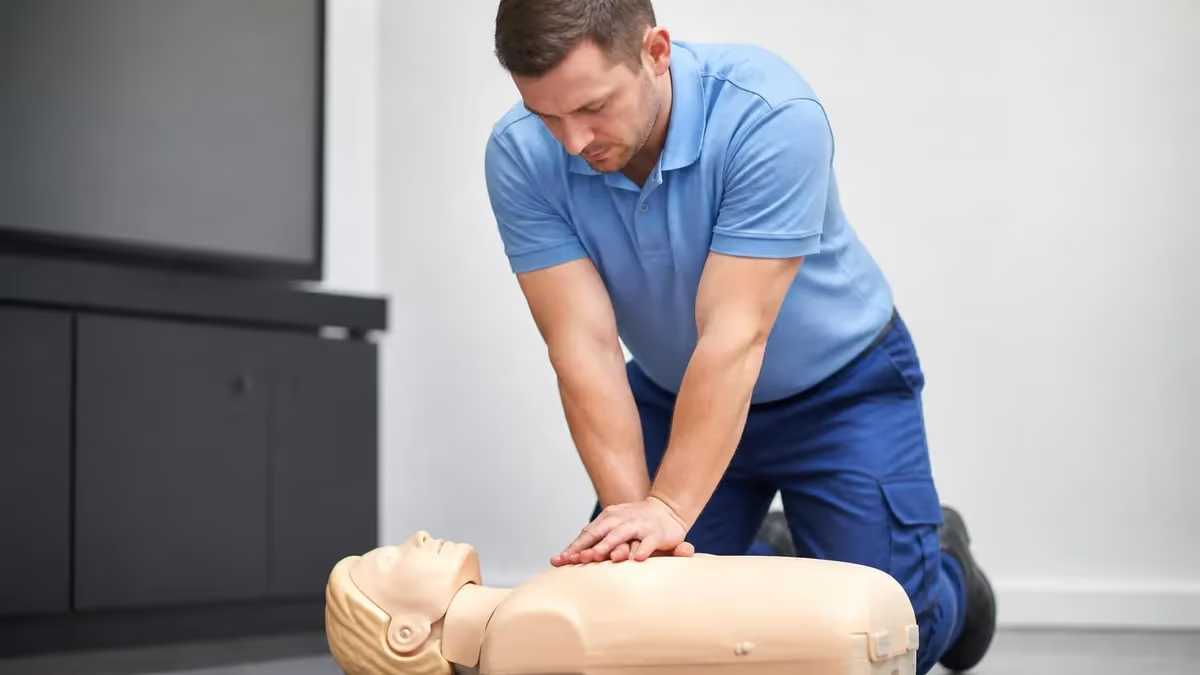
Searching for cpr and first aid certification near me in 2026 means navigating a landscape that has changed more in the past three years than in the previous twenty. Local training centers now blend in-person skills checks with online cognitive modules, employers demand AHA or Red Cross seals on every card, and rural learners can complete a fully accredited hybrid course in a single Saturday morning. Whether you are a new nurse, a daycare worker, a coach, or a retail manager preparing for OSHA compliance, the right local class can be booked within 48 hours.
The decision is no longer just where, but which curriculum. The acls algorithm has trickled down into basic Heartsaver courses, meaning even lay rescuers now learn rhythm recognition language they would not have heard a decade ago. Adult, child, and infant cpr sequences have been updated to reflect 2025 ILCOR guidelines, with stronger emphasis on chest recoil, compression depth measurement, and minimizing pauses for ventilation. Knowing what you will actually be tested on prevents you from paying for a stale curriculum.
Cost transparency has also improved. A standard combined CPR/AED/First Aid course at a community fire department typically runs $65 to $95, while hospital-affiliated training centers charge $110 to $145. The national cpr foundation and similar online-only providers offer cards for as little as $19.95, but acceptance varies dramatically by employer — a topic we address in detail below. Understanding the difference between an accredited card and an unaccredited certificate can save you a job offer.
This guide walks you through every step of finding, comparing, and completing a certification course in your zip code. We cover what providers should be on your shortlist, how to verify accreditation in 90 seconds, what to expect during the skills test, and how to renew before your two-year card expires. We also explain how concepts like position recovery, respiratory rate assessment, and AED pad placement are tested in skills stations.
If you understand the difference between a heart attack vs cardiac arrest, you already grasp the most important conceptual distinction taught in any first-aid course. Everything else — bandaging, splinting, choking response, opioid overdose recognition — is procedural and can be mastered in a single classroom session. The real value of a local class is the hands-on feedback you cannot get from a video.
For most adults, the entire process from search to laminated card takes seven to ten days. Hybrid courses compress that timeline to as little as 48 hours. By the end of this guide you will know exactly which provider to choose, what questions to ask the instructor, and how to verify your card is valid for OSHA, daycare licensing, or healthcare credentialing without wasted hours or wasted money.
We have also included a practical breakdown of refresher and recertification pathways, because most learners search for certification once and renewal four times. Knowing the renewal rules at the start of your two-year cycle saves money, lets you stack credentials strategically, and prevents the panic of a lapsed card discovered the night before a hospital onboarding deadline.
CPR and First Aid Certification by the Numbers

Course Types You Will Find in Your Area
The most common entry-level course, designed for lay rescuers, teachers, coaches, and workplace responders. Covers adult, child, and infant CPR, AED use, choking, bleeding, burns, and shock. Usually 5-6 hours, single session, no prerequisites.
Required for nurses, EMTs, medical assistants, dentists, and respiratory therapists. Faster paced, includes two-rescuer CPR, bag-mask ventilation, and team dynamics. 3-4 hours in person. Often a hospital onboarding requirement before day one.
Tailored for daycare workers, school staff, camp counselors, and parents. Emphasizes infant and child sequences, fever response, allergic reactions, and asthma attacks. Meets state daycare licensing requirements in 47 states.
Designed for general industry and construction sites without nearby EMS access. Covers eye injuries, chemical burns, amputations, and emergency action planning. Includes the documentation employers need for OSHA 1910.151 compliance.
Complete cognitive content online in 2-3 hours, then book a 60-90 minute skills session at a local training center. Same accredited card as full in-person course. Ideal for shift workers, parents, and rural learners with limited weekend availability.
Three organizations dominate the US certification market: the American Heart Association (AHA), the American Red Cross (ARC), and the National Safety Council (NSC). A fourth player, the Health and Safety Institute (HSI) with its ASHI and MEDIC FIRST AID brands, is widely accepted in workplace settings. Knowing which seal your employer or licensing board accepts before you book is the single most important decision you will make. A $19 online-only card from an unaccredited provider can leave you unable to start your job on Monday.
The AHA is the gold standard for healthcare. If you are entering nursing school, EMT training, dental hygiene, or any hospital role, the AHA Basic Life Support (BLS) Provider card is almost always required. AHA cards include a QR code that links to a verifiable eCard portal, meaning your employer can confirm authenticity in under 10 seconds. AHA also publishes the underlying acls algorithm and pediatric advanced life support standards that every other organization adapts.
The Red Cross is the dominant choice for lay rescuers, schools, lifeguards, and corporate workplaces. Red Cross digital certificates are accepted by OSHA, daycare licensing boards, and most state coaching certifications. The curriculum is nearly identical to AHA Heartsaver but uses slightly different terminology and exam questions. If your employer says only Red Cross or AHA, either works for non-healthcare roles.
The National Safety Council and HSI cards are most common in industrial, construction, and manufacturing settings. They emphasize workplace-specific scenarios like crush injuries, electrical contact, and confined-space rescue. NSC cards are fully OSHA compliant but are rarely accepted for healthcare credentialing. Always ask your HR department for the specific seal name before paying.
Online-only providers like the national cpr foundation, ProCPR, and ProTrainings sell cards starting at $19.95 with no in-person skills check. These are valid for many non-regulated workplaces — security, hospitality, retail — but are explicitly rejected by hospitals, daycare licensing in most states, and OSHA-regulated industries that require hands-on skills verification. Read your job description carefully before choosing this path.
The skills practiced in every accredited course are remarkably consistent: compression depth of 2-2.4 inches at 100-120 per minute, rescue breaths over 1 second producing visible chest rise, AED pad placement on bare dry skin, and the recovery position for unresponsive breathing patients. What differs between providers is mostly testing style, instructor-to-student ratio, and card design. The clinical content is built from the same ILCOR consensus.
If you are practicing techniques at home before class, a quiet review of baby cpr sequences is one of the most valuable preparation steps, especially if you have not handled an infant in years. Infant compression depth is roughly 1.5 inches with two fingers or two thumbs encircling, and the head-tilt for rescue breathing is gentler than for adults — these are details instructors will check carefully during the skills station.

CPR Practice Test Questions
Prepare for the CPR Cardiopulmonary Resuscitation Practice exam with our free practice test modules. Each quiz covers key topics to help you pass on your first try.
CPR Basic CPR
CPR Exam Questions covering Basic CPR. Master CPR Test concepts for certification prep.
CPR and First Aid
Free CPR Practice Test featuring and First Aid. Improve your CPR Exam score with mock test prep.
CPR (Cardiopulmonary Resuscitation) Adult ...
CPR Mock Exam on (Cardiopulmonary Resuscitation) Adult CPR and AED Usage. CPR Study Guide questions to pass on your first try.
CPR (Cardiopulmonary Resuscitation) Airway...
CPR Test Prep for (Cardiopulmonary Resuscitation) Airway Obstruction and Choking. Practice CPR Quiz questions and boost your score.
CPR (Cardiopulmonary Resuscitation) Cardio...
CPR Questions and Answers on (Cardiopulmonary Resuscitation) Cardiopulmonary Emergency Recognition. Free CPR practice for exam readiness.
CPR (Cardiopulmonary Resuscitation) Child ...
CPR Mock Test covering (Cardiopulmonary Resuscitation) Child and Infant CPR. Online CPR Test practice with instant feedback.
CPR (Cardiopulmonary Resuscitation) High-P...
Free CPR Quiz on (Cardiopulmonary Resuscitation) High-Performance Team Dynamics. CPR Exam prep questions with detailed explanations.
CPR (Cardiopulmonary Resuscitation) Legal ...
CPR Practice Questions for (Cardiopulmonary Resuscitation) Legal and Ethical Considerations. Build confidence for your CPR certification exam.
CPR for Specific Populations
CPR Test Online for for Specific Populations. Free practice with instant results and feedback.
CPR Airway & Breathing Management
CPR Exam Questions covering Airway & Breathing Management. Master CPR Test concepts for certification prep.
CPR Assessment & Recognition of Cardiac Ar...
Free CPR Practice Test featuring Assessment & Recognition of Cardiac Arrest. Improve your CPR Exam score with mock test prep.
CPR Chest Compressions & Defibrillation
CPR Mock Exam on Chest Compressions & Defibrillation. CPR Study Guide questions to pass on your first try.
CPR Post-Resuscitation Care & Recovery
CPR Test Prep for Post-Resuscitation Care & Recovery. Practice CPR Quiz questions and boost your score.
Cost, Accreditation, and What AED Stands For
A typical combined CPR/AED/First Aid course at a community-based training center costs between $65 and $95. Hospital-affiliated centers and proprietary training schools generally charge $110 to $145, citing higher instructor pay and equipment quality. Hybrid courses save $15 to $30 because cognitive instruction is delivered asynchronously. BLS Healthcare Provider courses average $75 to $110, while ACLS and PALS run $250 to $350 and require existing BLS as a prerequisite. Books and eCards are typically included.
Many learners overlook the hidden costs. A retest fee at most centers is $20 to $40, replacement cards run $15 to $25, and rescheduling fees can hit $35 if you cancel less than 48 hours out. Employer reimbursement is common for healthcare and education jobs, but you usually must front the money. Save your receipt and ask HR about reimbursement policy before booking, especially for higher-tier certifications like PALS or ACLS where the price tag stings.
In-Person Local Class vs Online-Only Certification
- +Hands-on skills practice on real manikins with instructor feedback
- +Card accepted by hospitals, daycare licensing, and OSHA-regulated employers
- +Live answers to scenario questions specific to your workplace
- +Networking with local first responders and fellow professionals
- +Higher confidence retention compared to video-only training
- +Required for healthcare, EMS, lifeguard, and most teaching roles
- −Higher cost — typically $65 to $145 versus $20 to $40 online
- −Requires 4-6 hours of in-person time on a fixed schedule
- −Limited course availability in rural or remote zip codes
- −Cancellation and reschedule fees can add $25 to $40
- −Must travel to training center, sometimes 20-40 miles
- −Less convenient for night-shift or rotating-schedule workers

Pre-Class Checklist for CPR and First Aid Certification Near Me
- ✓Confirm the exact certification name your employer or licensing board requires
- ✓Verify the provider's AHA, Red Cross, NSC, or HSI accreditation before paying
- ✓Choose between full in-person, hybrid, or skills-only refresher format
- ✓Complete any online cognitive modules at least 24 hours before the in-person session
- ✓Wear loose, layered clothing suitable for kneeling on the floor for manikin practice
- ✓Bring a government photo ID and printed online module completion certificate
- ✓Eat a light meal and hydrate — extended kneeling and compressions are physical
- ✓Review compression depth, rate, and rescue breath ratios the morning of class
- ✓Arrive 15 minutes early to check in, get your book, and meet the instructor
- ✓Save the eCard URL and verification code immediately after passing your skills test
The 90-Second Accreditation Test
Before booking any course, paste the provider's name plus the words AHA training center or Red Cross authorized provider into a search engine. A legitimate local center will appear on the official AHA Atlas or Red Cross directory within seconds. If you cannot verify in 90 seconds, walk away. The $19.95 mystery card is the single most common reason new hires get sent home on day one.
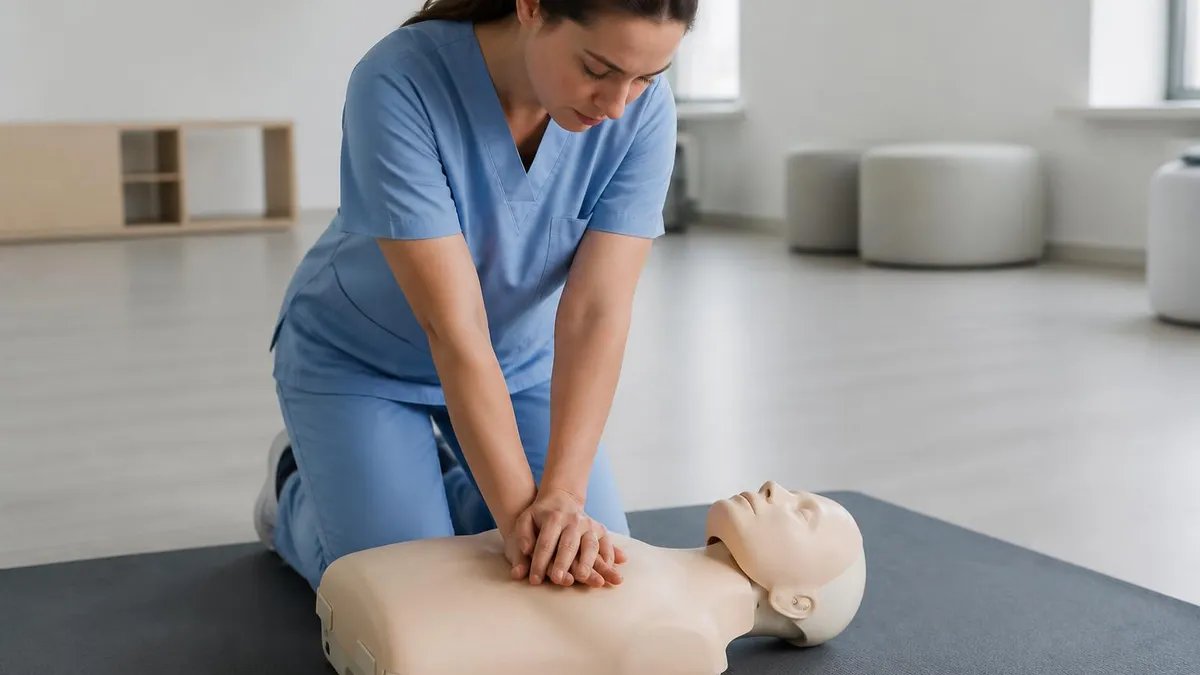
The skills test is the heart of any in-person certification, and knowing exactly what happens removes nearly all anxiety. The instructor places an adult manikin in front of you, calls a scenario, and observes you complete a roughly two-minute sequence. You scan for safety, tap and shout to assess responsiveness, call out for help and an AED, check for breathing for no more than 10 seconds, then begin 30 compressions at 100-120 per minute and 2 inches deep before delivering two breaths.
Most students fail the same three sub-skills: compression depth (too shallow), full chest recoil (resting on the chest between compressions), and minimizing pauses between cycles. The manikin gives the instructor real-time feedback through a small electronic indicator or visual gauge. Practicing on the floor at home with a firm cushion can build the muscle memory needed to hit two inches consistently without burning out your shoulders during the test itself.
For the infant station, the manikin is roughly the size of a six-month-old. You will use two fingers or the two-thumb encircling technique, compress to roughly 1.5 inches, and deliver breaths with the head in a neutral position — not the deep tilt used for adults. The instructor will likely ask you to demonstrate back blows and chest thrusts for a choking infant, alternating five and five, until the object is dislodged or the infant becomes unresponsive.
The first-aid skills station typically covers a bleeding scenario with direct pressure and a pressure bandage, identification of shock symptoms with proper positioning, recognition of a stroke using FAST or BE FAST mnemonic, and evaluation of a possible heart attack. Some instructors add an opioid overdose scenario with naloxone administration, which has become standard in updated 2025 curricula. None of these require memorization beyond the basics taught in the book.
Recovery position appears on nearly every test. For an unresponsive patient who is breathing normally, you roll them onto their side with the head tilted slightly back, the lower arm extended, the upper hand supporting the cheek, and the upper leg bent for stability. Instructors look for smooth execution that protects the airway from vomit and keeps the spine reasonably aligned. Watching leather cpr demonstration videos before class can reinforce the precise sequence visually.
Respiratory rate assessment is straightforward at the lay-rescuer level: look, listen, and feel for normal breathing in no more than 10 seconds. At the healthcare-provider level, you must count breaths for 30 seconds to one minute and recognize abnormal patterns like agonal gasps, which are not normal breathing and require immediate compressions. Knowing the difference between a gasp and a breath is one of the most clinically important skills you will learn.
Finally, every skills station ends with an AED demonstration. Power on, expose and dry the chest, attach pads in the correct positions, ensure no one is touching the patient during analysis and shock, and resume compressions immediately for two minutes. The AED prompts you through every step audibly. Confidence comes from doing it once with hands on a real trainer — which is precisely why hybrid and in-person courses still dominate over video-only options.
An expired CPR card is treated as no card at all by hospitals, schools, and licensing boards. Most employers require an active card on file every day you work — even one expired day can mean being sent home without pay until renewal is complete. Set a calendar reminder 90 days before your expiration date so you can schedule a refresher at your preferred location without panic booking the only available 6 a.m. slot.
Renewal rules are simpler than most learners assume. Both AHA and Red Cross cards are valid for two years from the issue date — not the class date if those differ. AHA allows a one-day grace period; Red Cross technically expires the day before the date printed on the card. Renewal courses are shorter than initial courses because the cognitive portion is condensed, but skills testing remains mandatory for healthcare-provider levels. Plan for 3-4 hours rather than the original 5-6.
BLS Healthcare Provider renewal costs roughly $50 to $80, compared to $75 to $110 for an initial course. Heartsaver and Red Cross First Aid/CPR renewals run $55 to $85. ACLS and PALS renewals cost $200 to $280 and still require passing a written exam plus megacode simulation. If you have allowed your card to lapse beyond the grace period, you will be required to take the full initial course rather than the renewal — another reason to set that 90-day reminder.
Hybrid renewal is the fastest pathway for busy professionals. Complete the AHA HeartCode BLS or Red Cross online module in roughly 90 minutes, then book a 60-minute hands-on skills session at any AHA training center or Red Cross authorized provider. The total time investment can be under three hours, and the credential is identical to an in-person renewal. This format is especially popular for nurses, dental hygienists, and EMTs renewing on their day off.
Stacking credentials strategically saves money and time. If you anticipate needing BLS, ACLS, and PALS — common for ICU and ED nurses — book them within the same two-week window so all three expire together. Many training centers offer 10-15% bundle discounts for combined classes. Even at the lay-rescuer level, combining a CPR/AED renewal with a first-aid renewal in one session saves $25-$40 versus booking them separately.
Out-of-state renewal is generally seamless because AHA and Red Cross are nationally recognized. Healthcare workers moving between states usually only need to verify state-specific scope-of-practice requirements (for opioid response, for example) rather than retaking CPR. The card from California is fully valid for a job in Texas. The only exception is some state-specific lifeguard or coaching certifications that bundle CPR with state-issued addenda.
If you let your card lapse and your job is on the line, walk-in classes are more available than most people realize. Major metropolitan areas typically have at least one private training center offering daily Heartsaver and BLS sessions, sometimes including evenings and weekends. Call before driving over — same-day availability changes hourly. Expect to pay a 10-20% premium for the convenience, but it beats losing income while waiting for a scheduled cohort to fill.
Practicing in the days before any renewal session pays off, especially for compression depth and rate. A simple metronome app set to 110 beats per minute or a familiar 110-BPM track makes excellent rehearsal. Many instructors still teach cpr songs as a memory aid for the correct tempo, and rotating between Stayin' Alive, Baby Shark, and Another One Bites the Dust will keep practice from feeling tedious while drilling the rhythm into muscle memory.
Choosing the right local provider comes down to four factors: accreditation, instructor quality, schedule flexibility, and post-class support. Accreditation gets you the card you need; instructor quality determines whether you can actually perform when it matters. Ask the training center how many years their lead instructor has been teaching and whether they hold clinical credentials like paramedic, RN, or fire-service certification. Experienced instructors run smoother skills stations and answer questions more confidently than newly minted instructors still working from the script.
Schedule flexibility matters more than most learners realize at booking. Look for centers that offer at least three sessions per week, including one evening and one weekend option. Centers that run only Tuesday mornings will eventually force you to choose between work and certification renewal. Some employers will pay overtime or grant paid release for renewal, but most expect you to handle scheduling on your own time. Build a provider relationship you can rely on for the next decade of two-year cycles.
Post-class support is the unsung hero of a good training center. Quality providers send you a digital card within 24 hours, post a confirmation to the AHA or Red Cross verification portal, and respond to email questions within one business day. Lower-quality providers can take two weeks to issue cards, which becomes catastrophic when a new hire is waiting on a credential to start work. Read recent Google reviews and look specifically for complaints about card turnaround time before paying.
If you are coordinating training for a team, ask whether the provider does on-site classes at your workplace. Most centers will travel for groups of 6-10 or more, charging a per-student rate similar to their open-enrollment price. On-site classes are especially valuable for restaurants, daycares, schools, and small medical offices because they eliminate transportation logistics and let employees train together as a real response team. Many also include free re-tests for any employees who do not pass the first attempt.
For pediatric-focused workplaces — daycares, preschools, summer camps, pediatric clinics — choose an instructor with current pediatric experience. Adult CPR is a single sequence; pediatric CPR involves significant adjustments at every age band, and choking response differs substantially between infants and children over one year old. An instructor who has actually treated pediatric emergencies brings detail that no script captures, from how floppy a hypotonic infant feels to how loud a parent will be in the room.
Healthcare workers should specifically request a BLS Healthcare Provider course, not a Heartsaver class. The two are not interchangeable: BLS adds two-rescuer techniques, bag-mask ventilation, pulse checks within 10 seconds, and team-based resuscitation language used in hospital codes. Hospitals routinely reject Heartsaver cards from newly hired clinical staff. Verify the exact course code on your registration before paying — Heartsaver CPR/AED and BLS Provider often appear on the same training center calendar.
One final practical tip: bring water, a small snack, and a sweater. Compressions are physically demanding, kneeling on tile is hard on the knees, and training rooms tend to run cold. Wear athletic shoes or flat-soled comfortable shoes rather than heels or work boots. Skills sessions move quickly once they start, and the students who arrive prepared are noticeably calmer and pass on the first attempt at a higher rate. Small preparation details translate directly to better performance.
CPR Questions and Answers
About the Author

Registered Nurse & Healthcare Educator
Johns Hopkins University School of NursingDr. Sarah Mitchell is a board-certified registered nurse with over 15 years of clinical and academic experience. She completed her PhD in Nursing Science at Johns Hopkins University and has taught NCLEX preparation and clinical skills courses for nursing students across the United States. Her research focuses on evidence-based exam preparation strategies for healthcare certification candidates.
Join the Discussion
Connect with other students preparing for this exam. Share tips, ask questions, and get advice from people who have been there.
View discussion (5 replies)