
BLS vs CPR: Is BLS the Same as CPR? Complete 2026 October Guide
📗 Is BLS the same as CPR? Compare BLS vs CPR certification, scope, cost, and who needs each. Complete 2026 October guide with practice questions.
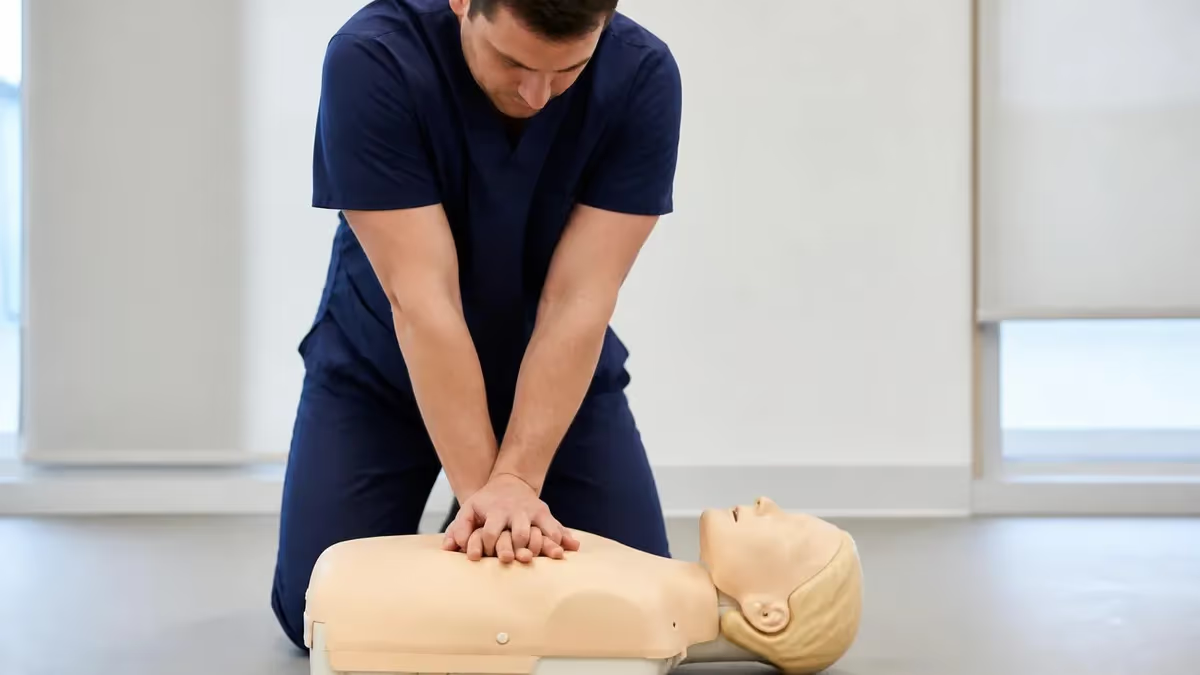
One of the most common questions new healthcare students and concerned citizens ask is: is bls the same as cpr? The short answer is no, but the two are tightly linked. CPR (cardiopulmonary resuscitation) is a single life-saving technique involving chest compressions and rescue breaths. BLS (Basic Life Support) is a broader certification level taught primarily to healthcare providers that includes high-quality CPR, AED use, advanced airway management, two-rescuer techniques, and team-based resuscitation protocols.
Think of it this way: every BLS provider knows CPR, but not every CPR-trained person is BLS certified. A community CPR course, often offered by the national cpr foundation or local Red Cross chapters, teaches a lay rescuer how to recognize cardiac arrest, push hard and fast in the center of the chest, and use an automated external defibrillator. BLS goes deeper, layering on clinical assessment, pulse checks, ventilation ratios for healthcare settings, and integration with the acls algorithm used during hospital resuscitations.
The confusion is understandable because both certifications cover identical core skills for the first few minutes of an emergency. A bystander performing compressions on a collapsed jogger and a nurse running a code in the ICU both rely on the same 2-inch compression depth, the same 100-120 compressions-per-minute rate, and the same 30:2 compression-to-ventilation ratio for single-rescuer adult CPR. Where they diverge is in the surrounding skill set, the patient populations covered, and the professional contexts where each certification is required.
BLS certification is mandatory for nurses, paramedics, medical students, respiratory therapists, dental professionals, and many allied health workers. Plain CPR certification, sometimes called Heartsaver CPR or Citizen CPR, is designed for teachers, daycare workers, fitness trainers, security guards, parents, and anyone who wants the skills without a clinical role. The course length, the depth of testing, and the cost all reflect these different audiences and use cases.
This guide breaks down every meaningful difference between BLS and CPR — from curriculum and price to renewal cycles, employer expectations, and which one you should take based on your career goals. We will also cover related credentials like pals certification for pediatric providers and ACLS for advanced cardiac care, plus how infant cpr techniques appear in both course tracks. If you have ever wondered which certification card belongs in your wallet, you are in the right place.
With that base in place, choosing between BLS and CPR becomes a question of scope and career fit rather than skill level.
By the end of this article, you will know exactly which course to register for, what life support skills you will walk away with, and how to prepare so you pass on the first attempt. Let's start with the numbers that define the BLS-versus-CPR landscape in 2026.
BLS vs CPR by the Numbers

Certification Pathways at a Glance
The lay-rescuer course for teachers, parents, and non-clinical workers. Covers adult, child, and infant CPR plus AED use over roughly 2.5 hours with no pulse check requirement.
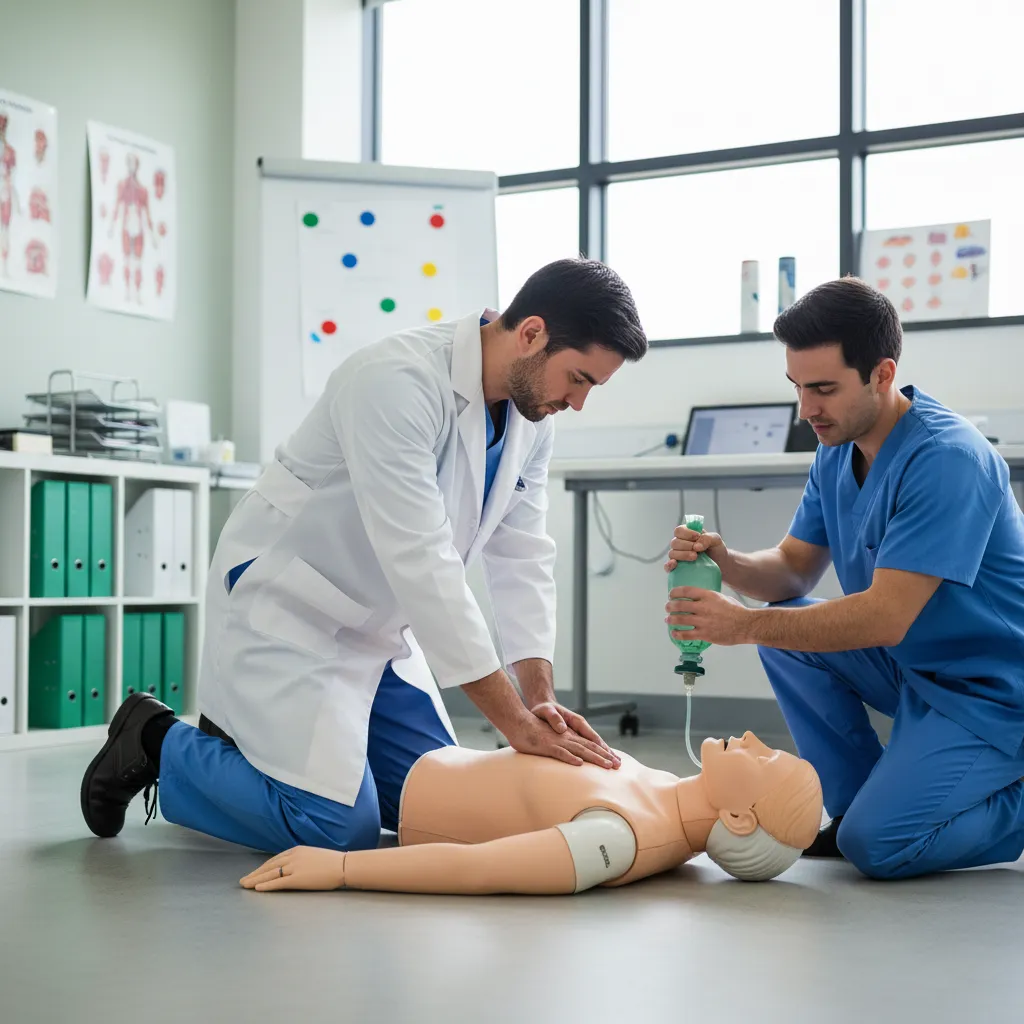
The healthcare-provider standard required by hospitals, nursing schools, and EMS agencies. Adds pulse assessment, bag-mask ventilation, two-rescuer techniques, and team dynamics to baseline CPR skills.
Builds on BLS with rhythm recognition, IV access, code drugs, and the full acls algorithm for cardiac arrest, bradycardia, tachycardia, and post-arrest care. Required for ICU, ER, and code-team members.
The pediatric counterpart to ACLS. pals certification trains providers to recognize and treat respiratory failure, shock, and arrest in infants and children using age-specific algorithms.
Combines basic first aid with Heartsaver CPR for workplaces governed by OSHA. Common for construction, manufacturing, childcare, and gym staff who need broader emergency response skills.
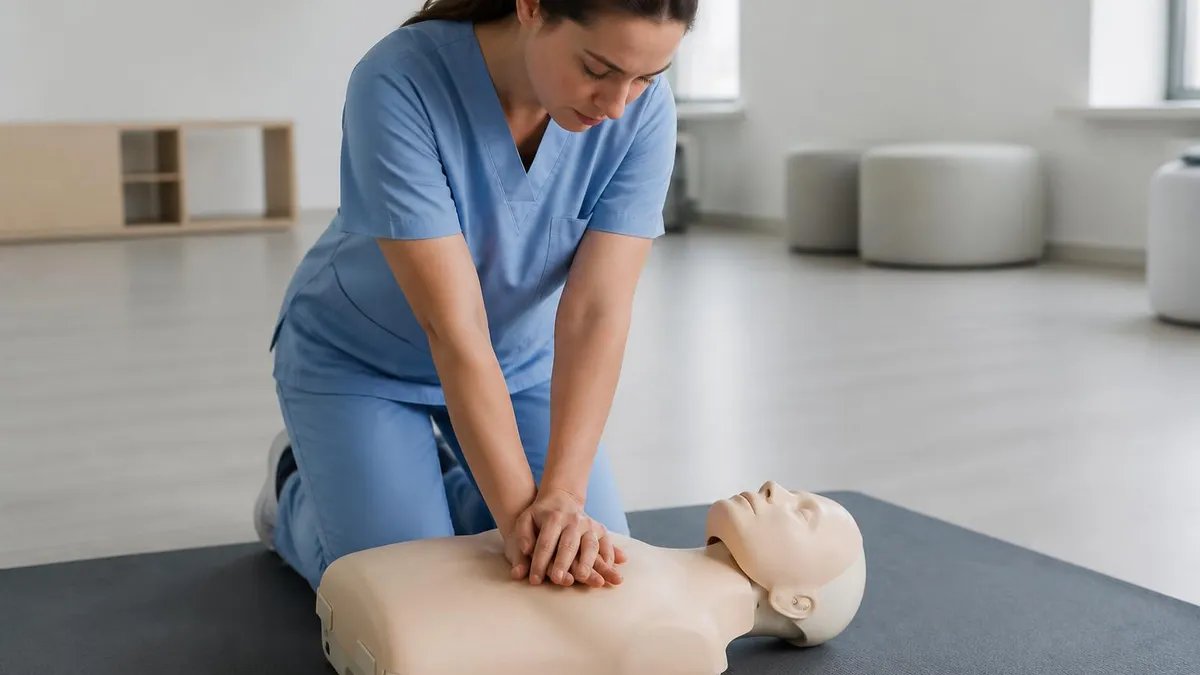
The clearest way to understand BLS versus CPR is to walk through what happens in each classroom. A standard Heartsaver CPR course opens with a short video on chain-of-survival concepts, then moves directly into hands-on practice with an adult manikin. Students learn to check for responsiveness, call 911, push hard and fast, and use an AED — all without ever taking a pulse. The instructor reinforces that lay rescuers should assume cardiac arrest in any unresponsive adult who is not breathing normally.
BLS courses cover that same opening sequence but add several layers within the first hour. Providers practice a 10-second pulse-and-breathing check, learn the difference between agonal gasps and effective breathing, and rehearse switching compressors every two minutes to maintain compression quality. Bag-mask ventilation is taught with a partner, and students drill the 30:2 ratio for single rescuers and the 15:2 ratio used for two-rescuer infant and child resuscitation. The respiratory rate for a patient with a pulse but inadequate breathing is also covered — one breath every six seconds for adults.
Infant cpr is where the two tracks diverge most visibly. Heartsaver teaches a simplified two-finger compression technique on an infant manikin and a basic choking sequence with back slaps and chest thrusts. BLS expands this to include the two-thumb encircling-hands technique used by healthcare teams, plus assessment of brachial pulses and recognition of bradycardia-induced arrest in infants, which has different treatment priorities than primary cardiac arrest.
AED training is identical in both courses for the actual device operation: power on, attach pads, follow voice prompts, deliver shock if advised. However, BLS students also learn to coordinate defibrillation with ongoing compressions, minimizing pauses to less than 10 seconds and resuming compressions immediately after a shock without waiting to reassess. This concept of high-quality CPR with minimal interruption is drilled repeatedly and tested in mega-code simulations at the end of class.
Testing also differs significantly. The Heartsaver course typically ends with a skills demonstration and a brief multiple-choice quiz that most students pass through participation alone. BLS includes a more rigorous 25-question written exam covering pharmacology basics, team dynamics, and special resuscitation scenarios like opioid overdose, drowning, and pregnancy. Skills stations test pulse checks, ventilation timing, and compression depth using feedback manikins that measure performance against AHA standards.
One area where students often need extra study help is the practical scenarios. Our cpr index walks through every scenario type you might see — witnessed adult arrest, unwitnessed child arrest, choking infant, and opioid-associated cardiac event — with step-by-step decision trees that mirror what instructors look for during testing.
Finally, both certifications are valid for two years from the issue date. Renewal courses are shorter — typically 90 minutes for Heartsaver and three hours for BLS — and assume you remember the core skills. Letting either lapse means restarting at the initial course length and full price, so most providers calendar their renewal 60 days before expiration.
CPR Practice Test Questions
Prepare for the CPR Cardiopulmonary Resuscitation Practice exam with our free practice test modules. Each quiz covers key topics to help you pass on your first try.
CPR Basic CPR
CPR Exam Questions covering Basic CPR. Master CPR Test concepts for certification prep.
CPR and First Aid
Free CPR Practice Test featuring and First Aid. Improve your CPR Exam score with mock test prep.
CPR (Cardiopulmonary Resuscitation) Adult ...
CPR Mock Exam on (Cardiopulmonary Resuscitation) Adult CPR and AED Usage. CPR Study Guide questions to pass on your first try.
CPR (Cardiopulmonary Resuscitation) Airway...
CPR Test Prep for (Cardiopulmonary Resuscitation) Airway Obstruction and Choking. Practice CPR Quiz questions and boost your score.
CPR (Cardiopulmonary Resuscitation) Cardio...
CPR Questions and Answers on (Cardiopulmonary Resuscitation) Cardiopulmonary Emergency Recognition. Free CPR practice for exam readiness.
CPR (Cardiopulmonary Resuscitation) Child ...
CPR Mock Test covering (Cardiopulmonary Resuscitation) Child and Infant CPR. Online CPR Test practice with instant feedback.
CPR (Cardiopulmonary Resuscitation) High-P...
Free CPR Quiz on (Cardiopulmonary Resuscitation) High-Performance Team Dynamics. CPR Exam prep questions with detailed explanations.
CPR (Cardiopulmonary Resuscitation) Legal ...
CPR Practice Questions for (Cardiopulmonary Resuscitation) Legal and Ethical Considerations. Build confidence for your CPR certification exam.
CPR for Specific Populations
CPR Test Online for for Specific Populations. Free practice with instant results and feedback.
CPR Airway & Breathing Management
CPR Exam Questions covering Airway & Breathing Management. Master CPR Test concepts for certification prep.
CPR Assessment & Recognition of Cardiac Ar...
Free CPR Practice Test featuring Assessment & Recognition of Cardiac Arrest. Improve your CPR Exam score with mock test prep.
CPR Chest Compressions & Defibrillation
CPR Mock Exam on Chest Compressions & Defibrillation. CPR Study Guide questions to pass on your first try.
CPR Post-Resuscitation Care & Recovery
CPR Test Prep for Post-Resuscitation Care & Recovery. Practice CPR Quiz questions and boost your score.
Who Needs Which Certification
If you work in a clinical setting where patient contact is part of your job description, you need BLS — not standard CPR. This includes registered nurses, licensed practical nurses, medical assistants, paramedics, EMTs, dental hygienists, respiratory therapists, physical therapists, and physicians. Hospital credentialing offices will reject Heartsaver CPR cards even if the underlying skills are similar, because the BLS curriculum aligns with the acls algorithm and team-based resuscitation expectations of clinical environments.
Nursing students typically need BLS before their first clinical rotation, and many programs require it during the application process. The card must be issued by the American Heart Association or a recognized equivalent like the American Red Cross BLS course. Online-only certifications without a hands-on skills check are generally not accepted by accredited healthcare employers, regardless of what the certificate looks like.
BLS Certification: Pros and Cons Compared to Standard CPR
- +Required for virtually every healthcare and allied health job
- +Includes pulse assessment and ventilation skills not taught in Heartsaver
- +Aligns with the acls algorithm for seamless code participation
- +Two-rescuer techniques prepare you for real clinical teams
- +More rigorous testing builds genuine competence
- +Recognized internationally for nursing and medical roles
- +Provides foundation for ACLS and PALS specialty courses
- −Costs roughly twice as much as a Heartsaver CPR course
- −Takes a full afternoon plus pre-course online modules
- −Requires written exam in addition to skills demonstration
- −Renewal every two years is mandatory to keep clinical jobs
- −Overkill for non-clinical workers like teachers or coaches
- −Hospital-specific in-services may still be required on top
- −Pace can be demanding for absolute beginners
Pros and Cons at a Glance
| Pros | Cons |
|---|---|
| Required for virtually every healthcare and allied health job | Costs roughly twice as much as a Heartsaver CPR course |
| Includes pulse assessment and ventilation skills not taught in Heartsaver | Takes a full afternoon plus pre-course online modules |
| Aligns with the acls algorithm for seamless code participation | Requires written exam in addition to skills demonstration |
| Two-rescuer techniques prepare you for real clinical teams | Renewal every two years is mandatory to keep clinical jobs |
| More rigorous testing builds genuine competence | Overkill for non-clinical workers like teachers or coaches |
| Recognized internationally for nursing and medical roles | Hospital-specific in-services may still be required on top |

Pre-Course Checklist: What Is a BLS Certification Going to Require?
- ✓Confirm whether your employer or school requires BLS or Heartsaver CPR specifically
- ✓Verify the course is AHA, Red Cross, or another nationally recognized provider
- ✓Register at least two weeks before any rotation, internship, or job start date
- ✓Complete the online pre-course modules before arriving at the in-person session
- ✓Bring a photo ID and any required pre-payment receipt to the skills check
- ✓Review the 30:2 and 15:2 compression-to-ventilation ratios in advance
- ✓Practice the recovery position for unresponsive but breathing patients
- ✓Memorize the adult respiratory rate of one breath every six seconds with a pulse
- ✓Know what does aed stand for and how to use one before class day
- ✓Plan a renewal reminder for 22 months after your card is issued
BLS includes CPR — but CPR alone is not BLS
Every BLS provider performs CPR, but only some CPR-trained individuals hold BLS credentials. If a job description mentions "BLS required," Heartsaver CPR will not be accepted no matter how recent the card. Always check the exact certification name your employer or school demands before paying for a course.
Cost is one of the most practical differences between BLS and CPR certification. A standard Heartsaver CPR/AED course runs $40 to $65 depending on the provider and region, with combined CPR/First Aid courses topping out around $85. BLS Provider courses cost $65 to $110, with the higher end reflecting hospital-affiliated training centers that include skills evaluation by a registered nurse instructor. Online-blended formats are often $10 to $20 cheaper because they shift the lecture portion to self-paced video modules.
Renewal cycles for both certifications are two years, but the renewal experience differs. Heartsaver renewal can often be completed in a single 90-minute session with minimal testing, while BLS renewal still includes a full written exam and skills check — just compressed into about three hours instead of the original four-and-a-half. Letting either lapse triggers a return to the initial full-length course, so most providers set calendar reminders 60 to 90 days before expiration.
Career impact is where BLS pays for itself many times over. Nursing programs, EMT schools, dental hygiene programs, and physical therapy doctorates all require BLS before clinical rotations begin. Without it, you cannot start the program, regardless of academic standing. On the employment side, hospitals will not allow patient contact without a current BLS card, and many positions require BLS as a baseline with ACLS or pals certification added based on department.
Heartsaver CPR also has real career value, just in different sectors. Personal trainers earning $40,000 to $70,000 are increasingly required to hold current CPR/AED before gym employment. Daycare directors, summer camp counselors, and after-school program leaders need it for state licensing. Even some corporate office buildings now require a percentage of staff to be CPR-trained to comply with insurance and OSHA expectations.
One overlooked factor is portability. Both AHA and Red Cross cards are accepted nationwide and in most US territories. International recognition varies — AHA BLS is widely accepted in Canada, the Caribbean, and US-affiliated overseas hospitals, but European Resuscitation Council credentials may be preferred in Europe. If you plan to work or volunteer abroad, verify acceptance with your specific destination before enrolling.
Time investment matters too. Heartsaver CPR/AED typically requires 2 to 3 hours total. BLS requires 4 to 5 hours for initial certification plus 1 to 2 hours of pre-course online modules. ACLS layers on another 12 to 16 hours, and pals certification adds 12 to 14 hours. Stacking these courses strategically over a quarter is common for new nurses and EMTs entering the field.
Finally, do not confuse legitimate certification with the search-result clutter you might encounter for unrelated services. Searches for terms like cpr cell phone repair will return device-repair franchises rather than resuscitation training, so always verify that any course you enroll in is sponsored by a recognized medical training organization with a verifiable AHA, Red Cross, or NSC affiliation.
Many websites sell BLS or CPR "certification" cards entirely online with no hands-on skills check. These are generally rejected by hospitals, nursing programs, and licensed employers. Always verify that your course includes an in-person or instructor-supervised virtual skills evaluation before paying.
Once you earn BLS certification and step into a clinical environment, the skills take on new dimensions you cannot fully appreciate in a classroom. A nurse on a medical-surgical floor may go months without participating in a code, but when one happens, BLS muscle memory is what carries them through the first crucial 60 seconds while the rapid-response team arrives. Compressions start immediately, the AED is grabbed from the hallway cart, and team roles snap into place around the bed.
BLS providers in hospitals also function as the front line for the broader life support continuum. They initiate the chain of survival, then hand off to ACLS-trained team members who layer on rhythm interpretation, intravenous medications, and advanced airway management. Throughout the code, the BLS provider continues to deliver high-quality compressions, swap out every two minutes, and monitor for return of spontaneous circulation by checking for breathing and a pulse during rhythm checks.
Position recovery is a related skill BLS teaches but often gets overlooked in test prep. When a patient regains a pulse and adequate breathing but remains unresponsive, the recovery position protects their airway from aspiration while you wait for transport or further intervention. The standard technique places the patient on their side with the lower arm extended, upper arm supporting the head, and upper leg flexed to stabilize the body — a position that should be familiar to every BLS provider.
Pediatric scenarios in BLS deserve special attention because infant and child arrests usually stem from respiratory failure rather than primary cardiac events. This means oxygenation and ventilation take priority alongside compressions, and the ratio shifts to 15:2 with two rescuers. Providers planning to work in pediatrics, neonatology, or emergency medicine will need to layer pals certification on top of BLS within their first year of practice.
BLS also covers special resuscitation circumstances that come up regularly in real practice. Opioid-associated cardiac arrest now has a dedicated algorithm that includes naloxone administration alongside standard CPR. Pregnancy-related arrest emphasizes manual left uterine displacement to relieve aortocaval compression. Drowning resuscitation prioritizes ventilations because the precipitating event is hypoxia. Each of these gets a short module in updated BLS curricula.
For test takers preparing to challenge the BLS exam, our what is a bls certification walkthrough breaks down every question category, common trick questions, and the precise compression metrics graders look for during skills stations. Combined with the practice quizzes on this page, most candidates pass on the first attempt with 90%+ scores.
The bottom line is that BLS certification is the operating standard for healthcare providers and the foundation for every advanced resuscitation credential. Standard CPR remains essential for the public and non-clinical workers, but the two are not interchangeable in the eyes of employers, schools, or accrediting bodies. Choose based on your role, not on which course is cheaper or shorter.
Choosing between BLS and CPR comes down to three honest questions: what does your employer or school require, what populations will you respond to, and how much time and money are you willing to invest. If any of those answers point to clinical work, BLS is the only correct choice — Heartsaver CPR will be rejected at hospital onboarding even if you took it last week. If your role is non-clinical, Heartsaver covers everything you need at half the cost.
Once you have picked the right course, preparation is straightforward. Start two to three weeks before your scheduled class by reviewing the compression rate of 100 to 120 per minute, the depth of at least two inches for adults, and the 30:2 single-rescuer ratio. Watch one or two AHA-produced YouTube videos showing the full skill sequence on adult, child, and infant manikins. This visual rehearsal makes the in-person session feel like reinforcement rather than first exposure.
Take at least two timed practice quizzes before your exam day. The quiz tiles on this page cover adult CPR and AED, choking and airway obstruction, cardiopulmonary emergency recognition, and child and infant CPR — the four highest-yield categories on both Heartsaver and BLS exams. Aim for 85% or higher on each before you sit for the real test. If you score below that, identify the missed concepts and review them in a focused 20-minute session.
Day-of preparation is simple. Eat a normal breakfast, hydrate well, and wear comfortable clothes you can kneel and bend in for the skills stations. Bring a photo ID, your registration confirmation, and any pre-course online module completion certificates the provider requires. Most students who fail the first attempt do so because they skipped the online prework, not because the in-person skills are difficult.
During the skills stations, focus on three things: full chest recoil between compressions, minimizing pauses to under 10 seconds, and counting out loud during your compression sets. Instructors are trained to look for these specific behaviors, and they correlate directly with what does aed stand for outcomes in real cardiac arrest. The feedback manikins used in most courses now display compression depth and rate in real time, so you can self-correct as you practice.
For the written portion of BLS, the most-missed questions tend to cluster around special circumstances — opioid overdose, drowning, pregnancy, and pediatric scenarios. Spend extra review time on these even if they feel less central than adult compressions. Pay attention to the respiratory rate for rescue breathing in different age groups: one breath every six seconds for adults, and one breath every two to three seconds for infants and children with a pulse but inadequate breathing.
Finally, plan your renewal before you walk out of the building with your card. Add a calendar reminder 22 months from your issue date, save the training center's contact info, and bookmark the AHA eCard lookup tool so you can verify your card status anytime. Following these simple habits keeps your certification active, your skills sharp, and your career options open across every healthcare and community role that requires resuscitation training.
CPR Questions and Answers
About the Author

Registered Nurse & Healthcare Educator
Johns Hopkins University School of NursingDr. Sarah Mitchell is a board-certified registered nurse with over 15 years of clinical and academic experience. She completed her PhD in Nursing Science at Johns Hopkins University and has taught NCLEX preparation and clinical skills courses for nursing students across the United States. Her research focuses on evidence-based exam preparation strategies for healthcare certification candidates.
Join the Discussion
Connect with other students preparing for this exam. Share tips, ask questions, and get advice from people who have been there.
View discussion (5 replies)