
NYC CDL Practice Test: Complete Guide to Getting Your Commercial License in New York
Pass your NYC CDL practice test in 2026 September. CDL schedule, Class A requirements, dot physical, salary data & free practice questions. 🏆
If you are searching for a reliable nyc cdl practice test resource, you have landed in the right place. New York City is one of the most active commercial trucking hubs in the entire United States, and earning your Commercial Driver's License here opens doors to a wide range of well-paying truck driver positions across the metro area, Long Island, upstate New York, and beyond.
Whether you are aiming for a Class A CDL to haul combination vehicles or a Class B license for straight trucks and buses, the path begins with understanding exactly what the New York DMV expects from you on test day.
The cdl schedule in New York can feel overwhelming at first glance. Between scheduling your written knowledge exam, completing your skills test, passing a DOT physical, and securing your Commercial Learner's Permit, there are multiple appointments to coordinate. New York City applicants often face longer wait times at DMV offices than candidates in rural counties, which makes advance planning especially important. Knowing the sequence of steps — and exactly what to study before each one — can shave weeks off your overall timeline and help you avoid costly retests.
One of the biggest mistakes new applicants make is underestimating the breadth of material covered on the general knowledge exam. The New York State CDL knowledge test draws questions from the official CDL manual and covers everything from pre-trip inspection procedures to hazardous materials regulations, air brake systems, and combination vehicle handling. Many first-time test takers pass the driving skills portion confidently but stumble on the written exam simply because they did not use quality cdl practice test materials during their preparation phase.
Salary is a major motivator for most CDL candidates in New York City. The question of how much do truck drivers make comes up in virtually every CDL forum and Facebook group, and the honest answer in NYC is encouraging. Metropolitan area truck drivers consistently earn above the national median, with experienced Class A operators pulling six-figure incomes when overtime and bonuses are factored in. The high cost of living in the city is real, but so is the premium employers pay to attract qualified drivers who can navigate congested urban streets and comply with local delivery regulations.
Beyond earnings, the sheer variety of cdl jobs near me in New York City is remarkable. You can pursue local delivery routes that bring you home every night, regional hauls that cover the Northeast corridor, flatbed work through the port of Newark and the Brooklyn Terminal Market, or tanker runs supplying fuel to gas stations across the five boroughs. Each endorsement you add to your license — tanker, hazmat, doubles and triples, passenger — expands the job market available to you and typically comes with a pay bump from employers who value versatility.
For immigrants and multilingual communities across New York City, it is worth noting that the knowledge exam is available in Spanish and several other languages through the New York DMV. Many candidates who search for resources under licencia de conducir are specifically looking for CDL preparation materials in Spanish, and our site provides practice questions that support bilingual learners.
The commercial trucking industry in New York is genuinely diverse, and language should never be a barrier to launching a driving career. You can also learn more about the differences between license classes by reviewing our ohio permit practice test comparison guide.
This comprehensive guide walks you through every stage of obtaining your NYC CDL: the written knowledge exam, the skills test components, the DOT medical card requirements, study strategies that actually work, and the salary and job market data you need to make a confident career decision. Read through each section carefully, bookmark the free practice quizzes embedded throughout, and use the study schedule recommendations to build a preparation plan that fits your schedule and learning style.
NYC CDL by the Numbers
NYC CDL Exam: Key Requirements at a Glance
Before taking any CDL skills test, you must hold a CLP for at least 14 days. Obtain it by passing the written general knowledge exam and any endorsement knowledge tests at a New York DMV office. The CLP is valid for 180 days and can be renewed once.
All CDL applicants must pass a DOT physical examination performed by a certified medical examiner listed on the FMCSA National Registry. Your dot medical card must be current before the DMV will issue or renew your CDL. Physicals are typically valid for up to 24 months.
Since February 2022, all first-time Class A and Class B CDL applicants must complete FMCSA-approved entry-level driver training at an accredited provider. Training records are submitted electronically to the FMCSA Training Provider Registry before you can take your skills test.
The skills test has three parts: pre-trip vehicle inspection, basic vehicle control (backing maneuvers), and an on-road driving evaluation. New York State administers skills tests through licensed third-party examiners and DMV-run testing sites. Scheduling in NYC often requires two to three weeks of lead time.
Specialty endorsements like hazardous materials (H), tank vehicles (N), passenger (P), and school bus (S) each require a separate written knowledge exam. The HazMat endorsement also requires a TSA background check and fingerprinting, which adds two to four weeks to your timeline.
Building a solid study plan for the New York CDL written exams starts with obtaining the official New York State CDL Manual from the DMV website or any DMV office. This manual is the single most authoritative source of information for every question on the general knowledge test and all endorsement exams. Many candidates make the mistake of relying solely on third-party summaries or YouTube videos. While these resources can be helpful supplements, the actual test questions are written directly from the manual's language, so familiarity with the official text gives you a significant edge.
Once you have read through the manual at least once, the most effective next step is high-volume practice testing. Research on adult learning consistently shows that active recall — the process of forcing yourself to retrieve information from memory — builds retention far more effectively than re-reading or highlighting. A good nyc cdl practice test session should include at least 50 questions covering general knowledge, and you should aim to score above 90 percent consistently before scheduling your actual exam. Scoring 90 percent in practice builds the buffer you need to handle unfamiliar question phrasing on test day.
Timing your study sessions matters as much as the total hours you invest. Spreading study sessions across multiple weeks in 45-to-60-minute blocks is far more effective than cramming the night before. Cognitive science research on spaced repetition demonstrates that reviewing material at increasing intervals — one day, three days, one week, two weeks — dramatically improves long-term retention. If you have four weeks before your scheduled knowledge exam, aim for daily practice sessions in the first two weeks and then shift to simulated full-length exams in weeks three and four.
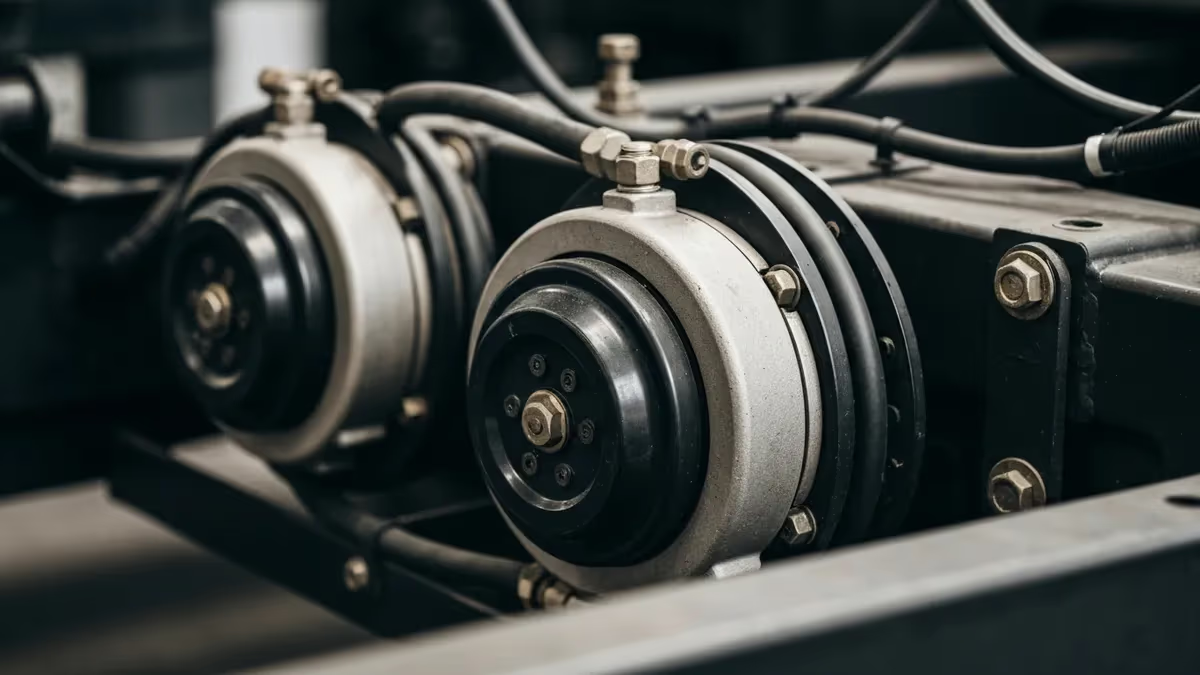
The air brakes section deserves special attention from every CDL candidate, regardless of whether your target vehicle is equipped with air brakes. The air brake knowledge test is required if you want to operate vehicles with air brake systems, and many Class A and Class B vehicles use them. The concepts tested — including brake lag, total stopping distance, the proper use of the parking brake on grades, and inspection of brake components — are technical and require genuine understanding rather than rote memorization. Use the practice questions in this guide specifically designed for air brake content.
Combination vehicle handling is another area that trips up many Class A candidates. Understanding how trailer swing affects lane changes, how the trailer tracks differently than the cab during turns, and how to properly connect and disconnect a fifth wheel are all skills tested both in writing and in the skills evaluation. Spend extra study time on the combination vehicles chapter of the manual, and if possible, visit a CDL training yard to watch or participate in coupling and uncoupling demonstrations before your knowledge exam.
Your road test results will largely depend on how much behind-the-wheel practice you accumulate with your CLP before the skills test date. New York State allows CLP holders to practice on public roads when accompanied by a CDL holder in the appropriate vehicle class. Take advantage of every practice opportunity available to you.
Driving with an experienced trucker who can provide real-time feedback on your backing technique, pre-trip inspection method, and highway merging habits is invaluable preparation that no study guide can fully replicate. Check out our guide on road test results and total cost breakdown to understand what fees to expect throughout this process.
Many candidates in New York City benefit from enrolling in a structured CDL school rather than pursuing independent self-study. While self-study is legally sufficient for the written exams, accredited CDL schools provide the ELDT training now required by federal law, access to training vehicles, and experienced instructors who know the specific backing courses and road routes used at New York State skills testing sites. The upfront cost of a CDL school — typically ranging from $3,000 to $7,000 in the NYC area — is often offset within the first year of employment through signing bonuses and higher starting wages.
CDL Schedule: Class A CDL, DOT Physical & Endorsements Explained
Earning a class a cdl in New York follows a defined sequence: first, pass the general knowledge and combination vehicles written exams to obtain your CLP. Then complete your ELDT training at an FMCSA-registered provider, which typically takes four to eight weeks of classroom and behind-the-wheel instruction. Once your training records appear in the federal registry, you can schedule your three-part skills test at a New York State DMV testing site or through a certified third-party examiner.
After passing all three skills test components — pre-trip inspection, basic control, and on-road driving — the DMV will issue your full Class A CDL, which authorizes you to operate combination vehicles with a gross combination weight rating over 26,001 pounds. Class A licenses also cover Class B and Class C vehicles, making it the most versatile CDL option for drivers who want maximum flexibility in the cdl jobs they can accept across New York State and nationwide.
Is Getting a CDL in NYC Worth It? Pros and Cons
- +NYC truck driver wages consistently exceed the national median, with experienced Class A drivers earning $70,000–$110,000 annually
- +Enormous diversity of cdl jobs available across freight, fuel, food service, construction, waste management, and public transit sectors
- +Local delivery positions allow drivers to return home every night, maintaining work-life balance uncommon in long-haul trucking
- +The CDL credential is federally portable — a New York CDL is valid in all 50 states, giving you career flexibility nationwide
- +Strong union representation through Teamsters Local 804 and other chapters provides competitive wages and benefits for many NYC driver positions
- +Growing e-commerce demand is continuously expanding the number of cdl jobs near me in the New York metro area
- −CDL school costs in NYC range from $3,000 to $7,000, representing a significant upfront investment before earning your first paycheck
- −New York City DMV offices often have multi-week wait times for knowledge exam appointments and skills test scheduling
- −Urban driving conditions — heavy traffic, tight loading docks, pedestrian-heavy streets — create higher stress levels than suburban or rural routes
- −The ELDT requirement added in 2022 means self-study alone is no longer sufficient for first-time Class A and Class B applicants
- −HazMat endorsement seekers face a lengthy TSA background check process that can delay employment start dates by one to two months
- −Parking a commercial vehicle in NYC between shifts is genuinely difficult and expensive, limiting options for owner-operators
NYC CDL Prep Checklist: Everything You Need Before Test Day
- ✓Download and read the full New York State CDL Driver's Manual from the DMV website before starting any practice tests
- ✓Schedule your DOT physical with an FMCSA-certified medical examiner and bring all required medical documentation
- ✓Complete at least 500 practice CDL test questions across general knowledge, air brakes, and combination vehicles modules
- ✓Enroll in an FMCSA-registered Entry-Level Driver Training program and confirm your records will be submitted to the federal Training Provider Registry
- ✓Gather all required documents for your DMV appointment: proof of identity, Social Security card, New York State residency proof, and your DOT medical card
- ✓Schedule your Commercial Learner's Permit knowledge exam appointment at a New York DMV office at least two to three weeks in advance
- ✓Practice backing maneuvers (straight-line, offset, alley dock) in a training yard or supervised environment using your CLP
- ✓Research endorsement exams relevant to your target job type and schedule those knowledge tests alongside or shortly after your CLP exam
- ✓If pursuing a HazMat endorsement, submit your TSA fingerprinting application as early as possible to avoid delays in your overall cdl schedule
- ✓Book your CDL skills test appointment at least three to four weeks before your target employment start date to account for potential rescheduling
You Cannot Take Your Skills Test Immediately After Passing the Written Exam
Federal law requires all CDL applicants to hold their Commercial Learner's Permit for a minimum of 14 calendar days before they are eligible to take the CDL skills test. This waiting period is non-negotiable and applies to all applicants in New York State. Plan your cdl schedule accordingly — do not book your skills test appointment for the same week you plan to take your written knowledge exam, or you will be turned away on test day and lose your scheduling fee.
Understanding how much do truck drivers make in New York City is essential context for anyone weighing the investment of CDL training. According to the Bureau of Labor Statistics and multiple industry salary surveys, heavy and tractor-trailer truck drivers in the New York metropolitan statistical area earn a median annual wage of approximately $68,000 to $75,000. This is roughly 25 to 40 percent higher than the national median of $54,320, reflecting the premium that NYC employers pay to attract and retain qualified drivers in a competitive labor market.
Entry-level Class B drivers — operating straight trucks, delivery vehicles, and dump trucks — typically start in the $45,000 to $55,000 range in the NYC metro area. With two to three years of experience and a clean driving record, those same drivers commonly advance to $60,000 to $70,000. The jump from Class B to class a cdl is where earnings acceleration really becomes visible. Class A drivers handling combination vehicles, especially those with HazMat or tank endorsements, frequently earn $80,000 to $95,000 in base wages, with total compensation including overtime sometimes exceeding $110,000 annually.
The cdl jobs market in New York City is remarkably resilient to economic cycles because so many industries depend on commercial drivers. Even during economic downturns, fuel must be delivered, food must reach distribution centers, construction sites need material deliveries, and waste must be collected. This demand stability makes a CDL one of the more recession-resistant credentials available to working-class New Yorkers. Driver shortages have been persistent in recent years, with the American Trucking Associations estimating a nationwide shortfall of over 60,000 drivers — a gap that gives qualified NYC CDL holders significant negotiating leverage with employers.
Owner-operators who lease or own their own trucks and work on a per-mile or percentage-of-revenue basis can earn substantially more than company drivers, though they also absorb the costs of fuel, maintenance, insurance, and equipment financing. In the New York area, owner-operators serving local drayage routes at ports and rail yards often gross $150,000 to $200,000 annually, though net earnings after expenses are typically 40 to 60 percent of gross. The owner-operator path requires solid business acumen in addition to driving skill, but it represents one of the highest earning ceilings available to CDL holders in the region.
Benefits packages are another dimension of truck driver compensation that salary figures alone do not capture. Many larger trucking companies operating in the NYC area — including UPS Freight, FedEx, XPO Logistics, and unionized grocery and fuel distributors — offer health insurance, dental, vision, 401(k) with employer matching, paid time off, and safety bonuses. Union positions through Teamsters chapters frequently include pension plans in addition to these standard benefits, making the total compensation package significantly more valuable than base salary alone suggests.
For drivers interested in exploring the full landscape of cdl jobs and what different positions actually pay in New York, we have compiled detailed salary and job market data in a dedicated resource. You can also find guidance on selecting the right CDL school to maximize your earning potential in our comprehensive training guide at how do i know if i passed my road test. Choosing the right training provider in the NYC area can meaningfully affect both how quickly you earn your license and what salary you can command when you start job hunting.
The long-term career trajectory for CDL holders in New York City extends well beyond driving. Many experienced truck drivers transition into dispatcher roles, fleet safety positions, driver trainer jobs, or operations management at trucking companies and logistics firms. The industry knowledge and regulatory expertise you build as a commercial driver translates directly into value as a logistics professional. Starting your CDL career in New York gives you access to one of the largest and most complex freight networks in the world, which is an exceptional launching pad for a decades-long transportation industry career.
Since February 7, 2022, all first-time applicants for a Class A CDL, Class B CDL, or school bus/passenger endorsement must complete Entry-Level Driver Training (ELDT) through an FMCSA-registered training provider. Your training records must appear in the federal Training Provider Registry before New York DMV will allow you to take your skills test. Applicants who skip this step will be denied at the testing site regardless of how well they perform. Verify your school is on the FMCSA registry before enrolling and paying tuition.
Selecting the right CDL training program in New York City requires careful research because quality varies enormously across providers. The NYC area has dozens of accredited CDL schools ranging from community college programs at institutions like LaGuardia Community College and Bronx Community College to private commercial driving schools and company-sponsored training programs offered directly by major carriers. Each option comes with different price points, scheduling flexibility, vehicle fleets, and pass rates — all factors worth investigating before you commit your time and money.
Company-sponsored CDL training programs deserve special mention because they offer a path to your license with little or no upfront cost. Large carriers including Werner Enterprises, CRST Expedited, and Roehl Transport have historically offered paid CDL training in exchange for a one to two year driving commitment after graduation. In the New York City market, some regional trucking companies and waste management firms offer similar arrangements. The trade-off is that you are committing to work for that employer at their wage scale for a set period, which may or may not align with your long-term career goals.
The dot physical near me search process in New York City deserves a dedicated strategy. The FMCSA National Registry of Certified Medical Examiners lists all qualified examiners by zip code, and in the NYC area there are hundreds of options. However, wait times and examination quality vary. Many CDL candidates in New York recommend scheduling your DOT physical at occupational health clinics rather than general practice offices because occupational health providers typically have more experience with FMCSA standards and are less likely to incorrectly disqualify drivers for conditions that have existing exemption pathways.
Budgeting accurately for your full cdl schedule in New York City is important so that financial surprises do not derail your progress. The total out-of-pocket cost for a first-time Class A CDL applicant in New York — including CDL school tuition, DMV fees, DOT physical, and endorsement exams — typically ranges from $4,000 to $8,500.
Company-sponsored training programs can reduce this to near zero, while independent self-funded candidates at private schools may reach the higher end of that range. Government workforce development programs, including those administered through the New York State Department of Labor and the NYC Workforce Investment Board, sometimes offer grants or subsidized training for CDL candidates who meet income eligibility requirements.
Once you hold your NYC CDL and begin working, maintaining your license in good standing requires ongoing attention to hours of service regulations, drug and alcohol testing compliance, vehicle inspection requirements, and license renewal timelines. New York State CDL renewals occur on an eight-year cycle, though your DOT medical card must be renewed separately every one to two years depending on your health status. Failing to renew your medical card on time automatically invalidates your CDL, so set calendar reminders well in advance of both expiration dates to avoid any lapse in your driving eligibility.
Employers in the New York City area are increasingly using electronic logging devices and telematics systems to monitor driver behavior, hours of service compliance, and vehicle performance in real time. Familiarizing yourself with ELD operation during your ELDT training is valuable, as is understanding how hours of service rules apply to local versus long-haul operations. New York City delivery drivers operating under the short-haul exemption have different hours of service requirements than over-the-road drivers, and knowing which rules apply to your specific position can save you from unintentional violations that could jeopardize your CDL.
The diversity of New York City's commercial driving workforce is one of its genuine strengths. The industry actively recruits women, veterans, career changers, and candidates from all ethnic and linguistic backgrounds. Veterans in particular benefit from the GI Bill and other military education benefits that can be applied toward FMCSA-approved CDL training programs. Several NYC-area CDL schools have dedicated veterans' assistance coordinators who can help navigate the benefits application process and connect graduates with employers who actively prioritize hiring veterans for their disciplined work ethic and safety record.
In the final weeks before your CDL knowledge exam, the most valuable thing you can do is simulate real test conditions as closely as possible. That means sitting down with a full 50-question practice exam — no pausing, no looking things up, no skipping difficult questions — and grading yourself honestly at the end. Target scores of 90 percent or better across at least five consecutive simulated exams before scheduling your actual test appointment. This buffer protects you against the anxiety and unfamiliar phrasing that can cost you points on test day even when you know the material cold.
The pre-trip inspection portion of the CDL skills test is where many otherwise well-prepared candidates lose unnecessary points. Examiners in New York State use a standardized scoring sheet, and each missed item or incorrect sequence costs you points toward your total allowable errors.
The best preparation strategy is to memorize a systematic inspection sequence — engine compartment, cab interior, front of vehicle, driver's side, rear of vehicle, passenger's side — and practice verbalizing each item clearly and in order. Many CDL instructors recommend filming yourself doing practice pre-trip inspections so you can review your technique and identify gaps in your routine.
Backing maneuvers are the other skills test component that separates candidates who pass on the first attempt from those who need a retest. The three common backing exercises — straight-line back, offset back, and alley dock — require a combination of spatial awareness, mirror use technique, and the ability to use the get-out-and-look (GOAL) rule without excessive delays.
New York State examiners permit a limited number of pull-ups and get-out-and-look maneuvers within the allotted point budget. Knowing exactly how many you are allowed before losing critical points helps you make strategic decisions during the test rather than panicking and pulling up unnecessarily.
On-road driving in New York City CDL skills tests typically involves navigating a combination of surface streets, intersections with traffic signals and stop signs, and where available, limited-access highway entry and exit ramps. Examiners watch for consistent mirror use, smooth lane changes with appropriate signaling distance, proper speed management in school zones and work zones, correct lane positioning during turns, and appropriate use of the vehicle's transmission. City-specific hazards like bicycle lanes, pedestrian crossings, and bus stops require particular attention — examiners note any unsafe interactions with non-motorized road users.
After you pass your skills test and receive your full CDL, the job search process in New York City moves quickly if you approach it strategically. Job boards like CDLjobs.com, Indeed, and Trucking Truth list thousands of positions in the metro area at any given time.
Staffing agencies specializing in commercial drivers — including AlliedUniversal, TransForce, and Ryder — can place you in temporary or permanent positions within days of your license issuance. Many candidates also have success approaching local trucking companies, waste haulers, and food distributors directly, especially if they have contacts in the industry from their training program or personal network.
Professional development does not stop at the CDL. Many New York City truck drivers pursue additional credentials over time: OSHA 10-hour or 30-hour safety certification, forklift operator certification, certified transportation professional (CTP) designation from the National Private Truck Council, or specialized training for oversized load escort and pilot car operation. Each credential adds a line to your resume, signals to employers that you take safety and professionalism seriously, and often translates to a measurable wage premium. The truck driver career path has a genuine skill ladder, and the most successful long-term drivers are those who keep climbing it.
Finally, connect with the broader CDL community in New York. Online forums, local Teamsters chapter meetings, industry trade shows like the Mid-America Trucking Show, and social media groups for NYC-area drivers are all valuable sources of insider information about which employers treat drivers well, which routes pay best, what the current signing bonus landscape looks like, and how to navigate specific regulatory challenges in the metro area. The commercial driving community in New York is large, knowledgeable, and generally generous about sharing information that helps new drivers launch successful careers.
CDL Questions and Answers

About the Author

Licensed Driving Instructor & DMV Test Specialist
Penn State UniversityRobert J. Williams graduated from Penn State University with a degree in Transportation Management and has spent 20 years as a certified driving instructor and DMV examiner consultant. He has personally coached thousands of applicants through written knowledge tests, skills assessments, and commercial driver licensing programs across more than 30 states.
Join the Discussion
Connect with other students preparing for this exam. Share tips, ask questions, and get advice from people who have been there.
View discussion (7 replies)