
ELDT Test: What You Need to Know Before Getting Your CDL 2026
Boost your ELDT exam score with practice questions and detailed answer explanations. Track progress with instant feedback.
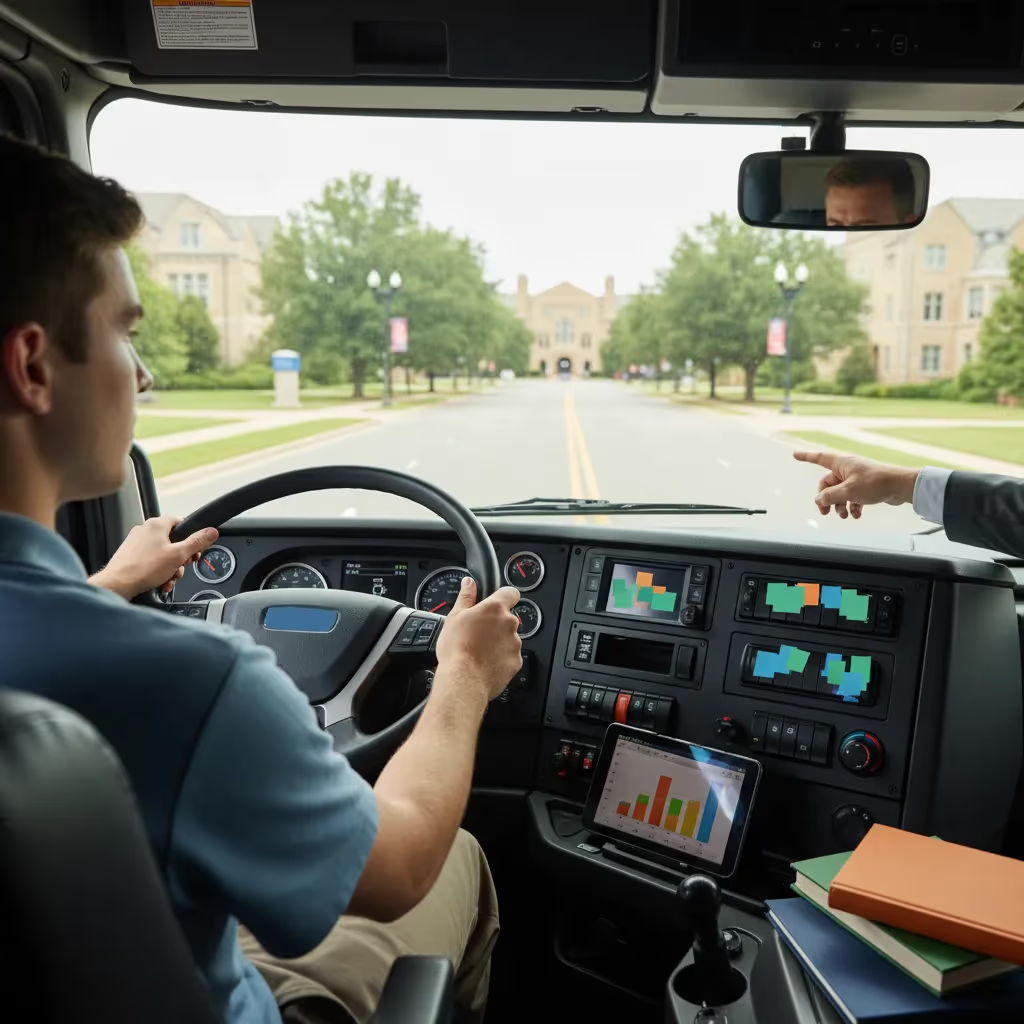
The ELDT test — short for Entry Level Driver Training — became mandatory in February 2022 for anyone applying for a new CDL or upgrading an existing one. If you're planning to drive commercially, you can't skip it. The Federal Motor Carrier Safety Administration (FMCSA) created these requirements after years of data showing that undertrained drivers caused a disproportionate share of crashes. Before the rule took effect, states set their own standards, and some barely had any. Practice with the free CDL practice test on PracticeTestGeeks (32 questions with answer explanations).
Here's the deal: the ELDT test isn't a single exam you walk in and take. It's a structured training program delivered by an FMCSA-registered provider that covers both classroom theory and behind-the-wheel instruction. You'll study topics like vehicle inspection, basic control, and safe driving on public roads. Your provider reports completion to the Training Provider Registry (TPR), and only then can you schedule your CDL skills test at the DMV.
What about hazardous materials? The ELDT hazmat test adds another layer. If you want an H endorsement on your CDL, you'll need to complete a separate hazmat-specific theory curriculum through your registered provider. This covers hazmat classification, labeling, placarding, loading procedures, and emergency response — all critical knowledge for hauling dangerous goods safely. There's no behind-the-wheel component for the hazmat endorsement, but the theory portion is rigorous.
Whether you're going for a Class A, Class B, or just adding endorsements, understanding the ELDT process saves you time and money. Let's break down exactly what's involved.
One quick note on terminology: people often say "ELDT test" as if it's a standalone exam. Technically, it's the training program itself — your provider assesses your competency throughout the course. The CDL skills test at the DMV is a separate event that comes after ELDT completion.
- To pass each Commercial Driver's License (CDL) knowledge test, an applicant must correctly answer at least 80 percent of the questions. (ecfr.gov)
- The TSA fee for a new or renewing Hazardous Materials Endorsement (HME) threat assessment is $85.25, effective January 1, 2025. (tsa.gov)
- The TSA fee for a new or renewing Hazardous Materials Endorsement (HME) threat assessment is reduced to $41.00 for applicants who already hold a valid TWIC card. (tsa.gov)
- A state must use a different version of the test when a Commercial Driver's License applicant retakes a previously failed knowledge test. (ecfr.gov)
- A commercial learner's permit (CLP) is valid for no more than one year from its initial issue date unless the holder retakes the general and endorsement knowledge tests. (ecfr.gov)
- CDL knowledge tests may be given in written form, verbally or in automated format, and in a foreign language as long as no interpreter is used. (ecfr.gov)
- A commercial learner's permit holder must be at least 18 years old and cannot take the CDL skills test in the first 14 days after the permit is first issued. (ecfr.gov)
Facts verified Oct 18, 2026 against Federal Motor Carrier Safety Administration (FMCSA), U.S. DOT; tests administered by each state driver licensing agency. Dates that have passed are removed automatically.
CDL Exam at a Glance
| Item | Detail | Official source |
|---|---|---|
| Passing score | 80% on each knowledge test | ecfr.gov |
| Exam fee (Hazmat endorsement (TSA threat assessment)) | $85.25 | tsa.gov |
| Exam fee (Hazmat endorsement, TWIC holder) | $41.00 reduced rate | tsa.gov |
| Retake policy | Retake must use a different test version | ecfr.gov |
| Validity (Commercial learner's permit) | Max 1 year from initial issuance without retesting | ecfr.gov |
| Delivery | Written, verbal or computer; foreign language allowed, no interpreter | ecfr.gov |
| Eligibility (Commercial learner's permit) | Age 18+; 14-day wait before the skills test | ecfr.gov |
Facts verified Oct 18, 2026 against Federal Motor Carrier Safety Administration (FMCSA), U.S. DOT; tests administered by each state driver licensing agency. Dates that have passed are removed automatically.
Free CDL Study Tools
Interactive CDL resources on PracticeTestGeeks, free to start:
- Class A Driver's License Practice Test -2 — 32 questions with instant scoring and answer explanations
- CDL flashcards — review key terms and concepts card by card
- CDL study guide — topic-by-topic overview of what the exam covers
- CDL cheat sheet — one-page printable summary for last-minute review
The ELDT CDL test requirements apply to several categories of drivers. You'll need ELDT if you're obtaining a Class A or Class B CDL for the first time, upgrading from Class B to Class A, or adding a hazmat (H), passenger (P), or school bus (S) endorsement. The ELDT hazmat test component specifically targets the H endorsement — it's a theory-only curriculum that covers nine hazard classes, shipping papers, and emergency protocols.
One thing that catches people off guard: the ELDT requirement is federal, but your state DMV still controls scheduling and administering the actual CDL skills test. Your training provider submits your completion to the TPR database, and the DMV checks that record before letting you test. If your provider hasn't uploaded your status, you're stuck waiting — so confirm with them before heading to the DMV.
Not everyone needs ELDT. If you held a CDL before February 7, 2022, you're grandfathered in. Military drivers with equivalent training may also qualify for exemptions, though the specifics vary by state. For the ELDT CDL test itself, there's no single national exam — your provider determines when you've met all competencies through their own assessments during training.
The ELDT CDL test training breaks into two main pillars: theory (classroom) instruction and behind-the-wheel (BTW) training. Theory covers everything from federal regulations and cargo securement to trip planning and hours-of-service rules. You'll learn vehicle systems — engine, transmission, brakes, electrical — and how to perform a proper pre-trip inspection that satisfies the examiner.
Behind-the-wheel training is where it gets real. You'll start in a controlled environment — usually a training yard — practicing backing maneuvers, coupling and uncoupling (for Class A), and basic vehicle control. Once your instructor is satisfied, you'll move to public road training covering lane changes, intersections, highway merging, and rural two-lane driving. The FMCSA doesn't set a minimum hour requirement — your provider determines proficiency.
That lack of a minimum hour mandate means training program length varies wildly. Some accelerated programs run three to four weeks, while community college programs stretch over several months. Quality matters more than speed here. A provider who rushes you through might leave you unprepared for the CDL skills test, which has a strict scoring rubric with automatic failure points for things like hitting a cone or failing to check mirrors.
Ask your provider how they structure their ELDT CDL test curriculum. The best programs alternate between classroom and driving days, giving you time to absorb theory before applying it behind the wheel. Some schools front-load all classroom work — that approach can leave you overwhelmed by the time you start driving.
ELDT Training Components
Theory instruction covers the knowledge areas defined by FMCSA in Appendix A to Part 380. For Class A, this includes basic operation, safe driving practices, advanced operating techniques, vehicle systems, and non-driving activities like trip planning and cargo documentation. You'll learn about hours-of-service regulations, weight limits, and how to read a federal bridge formula table. Most providers use a mix of instructor-led sessions and self-paced online modules. Theory assessment is competency-based — you must demonstrate understanding of each topic area before your provider marks you complete.
Finding the right ELDT provider is one of the most important decisions you'll make during your ELDT CDL test journey. The FMCSA maintains the Training Provider Registry (TPR) at tpr.fmcsa.dot.gov, where you can search by state, zip code, and training type. Every legitimate provider must be listed there — if a school isn't on the TPR, their training won't count toward your CDL application.
Look beyond the listing, though. Check how long the school has been operating, read reviews from recent graduates, and ask about their first-time pass rate. A good provider should be transparent about their curriculum, instructor qualifications, equipment condition, and the student-to-truck ratio. You don't want to share a training truck with six other students — you'll barely get any seat time.
Cost is a factor, but it shouldn't be the only one. The cheapest ELDT CDL test program might use outdated trucks, have high student-to-instructor ratios, or rush through the curriculum. Some employers — particularly large carriers like Werner, CRST, and Schneider — offer company-sponsored training where they cover the cost in exchange for a work commitment. Community colleges often have competitively priced programs with newer equipment and experienced instructors.
Money matters — and the ELDT CDL test process isn't cheap. Private CDL schools typically charge between $3,000 and $7,000 for a complete Class A program. Community college programs tend to run $1,500 to $5,000, often with financial aid options including Pell Grants and workforce development scholarships. Some states offer CDL training grants through their department of labor, especially for veterans and unemployed workers transitioning into trucking.
Company-sponsored programs flip the equation. Carriers like Swift, PAM Transport, and Prime Inc. will train you at no upfront cost in exchange for a one- to two-year employment commitment. If you leave early, you'll typically owe a prorated portion of the training cost — usually $3,000 to $6,000. It's not free money; it's a contract. Read the fine print carefully before signing.
Beyond tuition, factor in the total cost of getting your CDL. You'll pay for a DOT physical ($80–$150), a CDL permit fee ($10–$50 depending on your state), the skills test fee ($50–$200), and potentially a TSA background check ($87) if you're adding the hazmat endorsement. Some students also need to budget for housing if the training school isn't local. All in, expect to invest $4,000 to $10,000 from start to finish for the complete ELDT CDL test process.
ELDT Training: Pros and Cons
- +Standardized federal curriculum means consistent training quality nationwide
- +FMCSA registry makes it easy to verify legitimate training providers
- +Behind-the-wheel requirement ensures hands-on experience before testing
- +Company-sponsored options eliminate upfront training costs for many students
- +Hazmat-specific training improves safety for drivers hauling dangerous materials
- +Completion is permanently recorded in TPR — no paperwork to carry or lose
- −No minimum hour requirement lets some providers rush through material
- −Training costs range from $3K to $7K with limited federal financial aid
- −Provider quality varies significantly despite the registration requirement
- −Rural areas may have few nearby FMCSA-registered training schools
- −Students who already drive commercially still must complete full training
- −TPR system occasionally has reporting delays that stall DMV scheduling
Pros and Cons at a Glance
| Pros | Cons |
|---|---|
| Standardized federal curriculum means consistent training quality nationwide | No minimum hour requirement lets some providers rush through material |
| FMCSA registry makes it easy to verify legitimate training providers | Provider quality varies significantly despite the registration requirement |
| Behind-the-wheel requirement ensures hands-on experience before testing | Rural areas may have few nearby FMCSA-registered training schools |
| Company-sponsored options eliminate upfront training costs for many students | Students who already drive commercially still must complete full training |
| Hazmat-specific training improves safety for drivers hauling dangerous materials | TPR system occasionally has reporting delays that stall DMV scheduling |
Passing your ELDT CDL test training is step one. The actual CDL skills test at the DMV is step two — and it's where many people stumble. The skills test has three parts: the pre-trip vehicle inspection, basic vehicle control (backing maneuvers), and the road test. Each section has specific scoring criteria, and certain errors result in automatic failure regardless of your overall score.
For the pre-trip inspection, you'll walk around the vehicle explaining what you're checking and why. Examiners expect you to cover the engine compartment, coupling devices (Class A), brakes, tires, lights, and cab interior in a specific sequence. Missing a critical item — like failing to check the air brake system — can fail you on the spot. Practice this until you can do it from memory in under 15 minutes.
The backing maneuvers test happens in a controlled area. You'll typically perform a straight-line back, offset back (left or right), and either an alley dock or parallel park. Each maneuver allows a limited number of pull-ups (corrections), and hitting a boundary cone is usually an automatic failure. Most training programs emphasize backing because it's where students fail most often during their ELDT CDL test evaluation.
ELDT Completion Checklist
- ✓Obtain your CDL learner's permit from your state DMV before starting training
- ✓Complete a DOT physical examination and receive your medical card (valid 2 years)
- ✓Choose an FMCSA-registered training provider listed on the TPR
- ✓Finish all theory instruction modules and pass the provider's knowledge assessments
- ✓Complete behind-the-wheel range training (backing, coupling, basic control)
- ✓Complete behind-the-wheel public road training (intersections, highway, rural)
- ✓Confirm your provider has submitted completion status to the TPR database
- ✓Verify TPR status shows as 'complete' before scheduling your DMV skills test
- ✓Schedule and pass the CDL skills test (pre-trip, backing, road test)
- ✓If adding hazmat: complete hazmat theory training and pass the state hazmat knowledge test
Studying for the ELDT CDL test theory portions doesn't have to be complicated. Start with the official CDL manual published by your state's DMV — it covers general knowledge, air brakes, combination vehicles, and endorsement-specific material. Most states make this available as a free PDF download. Read it cover to cover at least once, then focus on sections where you're weakest.
Practice tests are your best friend here. They simulate the format and difficulty of actual CDL knowledge tests, and they reveal gaps in your understanding that passive reading misses. Take at least five to ten full-length practice tests before your exam date. Pay special attention to questions about air brake systems, vehicle inspection procedures, and hazmat regulations — these topics trip up the most test-takers.
Don't neglect the hands-on preparation either. If your ELDT CDL test program offers after-hours practice time, take advantage of it. The more hours you spend in the driver's seat, the more comfortable you'll be during the skills test. Some students also benefit from watching YouTube videos of CDL pre-trip inspections and backing maneuvers to reinforce what they learn in the truck. Visual repetition builds muscle memory even when you're not physically driving.
Group study works too. If there are other students in your ELDT CDL test class, form a study group. Quiz each other on air brake components, pre-trip inspection sequences, and hazmat placarding rules. Teaching a concept to someone else is one of the fastest ways to lock it into your own memory.
The timeline for completing your ELDT CDL test training depends on which program format you choose. Accelerated private schools can get you through in three to four weeks of full-time training — that's typically 40 hours per week of combined classroom and driving instruction. Community college semester programs run 8 to 16 weeks but often schedule classes around a part-time friendly schedule.
After training, don't wait too long to take your CDL skills test. The knowledge fades quickly if you let weeks pass between completing your program and testing at the DMV. Most successful students schedule their test within one to two weeks of finishing ELDT. Some DMV offices have wait times of several weeks for CDL testing appointments, so start scheduling before you complete your program.
One more thing about the ELDT CDL test process: your training completion in the TPR doesn't expire, but your CDL learner's permit does. Most states issue permits valid for six months to one year. If your permit expires before you pass the skills test, you'll need to renew it — and in some states, that means retaking the written knowledge test. Plan your timeline to avoid this frustrating setback.
Before heading to the DMV for your CDL skills test, call your training provider and confirm they've uploaded your completion to the Training Provider Registry. DMV computers check TPR in real-time — if your status isn't showing as complete, you'll be turned away and lose your testing appointment. This is the single most common preventable delay in the ELDT CDL test process.
The ELDT CDL test mandate has changed the trucking industry's training landscape significantly since 2022. Before the rule, some states allowed applicants to take the CDL skills test with little or no formal training — you could practice in a friend's truck and show up at the DMV. That era is over. Every new CDL applicant now goes through a structured curriculum delivered by a vetted, registered provider.
Industry data suggests the change is working. The American Trucking Associations reports that post-ELDT CDL holders have fewer violations in their first year compared to drivers licensed under the old system. Insurance companies are also starting to recognize ELDT completion as a positive factor when underwriting new drivers. For you, that could mean lower insurance premiums as an owner-operator or a stronger resume when applying to carriers.
Looking ahead, there's talk of FMCSA adding minimum hour requirements to the ELDT CDL test program — something the regulation currently lacks. Several industry groups have petitioned for a 120-hour minimum for Class A training. Whether that happens remains to be seen, but it signals that the training standards will likely get stricter, not looser. Getting your CDL sooner rather than later avoids potential future requirements.
The driver shortage also works in your favor right now. The American Trucking Associations estimates the industry is short roughly 80,000 drivers, and that number keeps climbing. Completing your ELDT CDL test training puts you in a strong negotiating position with carriers desperate for qualified drivers.
CDL Practice Test Questions
Prepare for the CDL - Commercial Driver's License exam with our free practice test modules. Each quiz covers key topics to help you pass on your first try.
CDL Alabama CDL Combination Vehicles Pract...
CDL Exam Questions covering Alabama CDL Combination Vehicles Practice Test. Master CDL Test concepts for certification prep.
CDL Alabama General Knowledge CDL Practice...
CDL Mock Exam on Alabama General Knowledge CDL Practice Test. CDL Study Guide questions to pass on your first try.
CDL Airbrakes Practice Test
CDL Test Prep for Airbrakes Practice Test. Practice CDL Quiz questions and boost your score.
CDL CLASS A COMMERCIAL DRIVER'S LICENSE PR...
CDL Mock Test covering CLASS A COMMERCIAL DRIVER'S LICENSE PRACTICE TEST. Online CDL Test practice with instant feedback.
CDL Hazmat Practice Test
CDL Test Prep for Hazmat Practice Test. Practice CDL Quiz questions and boost your score.
CDL Tanker Practice Test
CDL Test Online for Tanker Practice Test. Free practice with instant results and feedback.
CDL Class A Commercial Driver's License Pr...
CDL Study Material on Class A Commercial Driver's License Practice Test -1. Prepare effectively with real exam-style questions.
Let's talk about what happens after you pass your ELDT CDL test and get your license. New CDL holders enter a probationary period — the specifics depend on your state, but federal regulations require that your first CDL is valid for no more than eight years before renewal. During this time, certain violations carry heavier consequences than they would for experienced drivers.
Your CDL opens doors to multiple career paths. Long-haul trucking is the most visible option, but local delivery, tanker operations, flatbed hauling, and specialized freight (oversized loads, refrigerated cargo) all require CDL holders. Starting pay for new CDL drivers ranges from $45,000 to $65,000 annually, with experienced drivers in specialized roles earning $80,000 or more. The ELDT CDL test is your entry ticket to this entire industry.
Keep your record clean in the first year. Carriers heavily weight recent driving history when making hiring decisions, and a serious violation (speeding 15+ mph over, reckless driving, DUI) in your first year can derail your career before it starts. Use the safe driving habits your ELDT training instilled — pre-trip inspections, proper following distance, mirror checks, and defensive driving techniques — and you'll build the foundation for a long, profitable career behind the wheel.
Sample CDL Practice Questions
Try these questions from our free CDL practice tests. The correct answer and an explanation follow each question.
On your vehicle inspection test, what should you do to check that your tire is inflated properly?
- A. Kick the tire.
- B. You should not check how inflated the tires are.
- C. Give it a good feel.
- D. Use a tire gauge.
Answer: D. Use a tire gauge.
To accurately check if a tire is properly inflated during a vehicle inspection test, using a tire gauge is the only reliable method. Kicking or visually inspecting a tire can be misleading and does not provide an accurate pressure reading. Proper tire inflation is critical for safety, fuel efficiency, and preventing tire failure.
For your pre-trip vehicle inspection test, your entry doors should be in what condition?
- A. Entry doors should be in working condition.
- B. Entry doors should operate smoothly from the outside.
- C. Your entry doors should be undamaged.
- D. All of the listed answers.
Answer: D. All of the listed answers.
For your pre-trip vehicle inspection test, the entry doors must be thoroughly checked to ensure they are safe and functional. This means they should be undamaged, operate smoothly from both the inside and outside, and be in overall working condition. Proper door function is essential for driver and passenger safety, as well as for securing cargo.
A leaking package of hazardous materials is discovered in your cargo. What should you do?
- A. Stop safely, keep others away, and contact emergency services without touching the package
- B. Wrap the package in plastic and continue to the destination
- C. Open the package to identify the leak source
- D. Place the package outside the vehicle and continue driving
Answer: A. Stop safely, keep others away, and contact emergency services without touching the package
You should not touch the leaking package. Stop at a safe location away from people, water, and ignition sources. Keep others away from the area. Contact emergency services and your dispatcher. Refer to the Emergency Response Guidebook (ERG) for the specific material. Never continue driving with a known leak.
You should use your parking brakes whenever you park except at what time?
- A. All of the listed answers.
- B. The brakes are very hot.
- C. You have just come down a steep grade.
- D. The brakes are wet in freezing temperatures.
Answer: A. All of the listed answers.
While parking brakes are essential for securing a parked vehicle, there are specific situations where their use should be avoided to prevent damage or safety issues. This includes when brakes are very hot, immediately after descending a steep grade (as brakes would be hot), or when brakes are wet in freezing temperatures, which could cause them to freeze solid. In these cases, using wheel chocks is a safer alternative to prevent the vehicle from moving.
Take the full CDL practice test
CDL Questions and Answers
How this page was made: written with AI tools. Exam facts are checked against the official sources listed below. Not reviewed by a subject-matter expert. Editorial policy
Sources & references
Exam facts on this page (fees, format, dates, passing scores) are checked against these official sources; the date is our last check. Editorial policy