
Schedule a Driving Test MN: Complete State-by-State Guide to Booking Your Road Exam (2026 October)
How to schedule a driving test in MN, OH, IN, IL, MI, NY, CA, FL, TX. ✍🏼 What you need, age rules, vehicle requirements, retest policy.
You want to schedule a driving test and you don't have time to wade through a five-tab maze on a state DMV site. Fair. Booking the road exam is supposed to be a five-minute task, yet it eats hours of frustration when a system rejects your permit number or the next available slot is 47 days out. This guide walks you through how to schedule a driving test in Minnesota, Ohio, Indiana, Illinois, Michigan, New York, California, Florida, and Texas, what you must bring, age and hold-period rules, vehicle requirements, and what to do when the portal won't cooperate.
Each state runs its own scheduler. Some use the abbreviation BMV, some DMV, some DPS or SOS — they all mean roughly the same thing: the agency that licenses drivers. The screens differ. The required documents differ. Hold periods after a permit also differ. We will go state-by-state, in plain language, then cover the universal stuff (what to bring, vehicle checks, retest rules) at the end.
One thing first. If you haven't passed the written exam, you can't book the road test. The system blocks you. So before anything else, make sure your permit is on file. If you're still studying, work through a DMV permit test study guide and a DMV knowledge test walkthrough, then come back here once the permit is in hand.
Free BMV Study Tools
Interactive BMV resources on PracticeTestGeeks, free to start:
- BMV flashcards — review key terms and concepts card by card
- BMV study guide — topic-by-topic overview of what the exam covers
- BMV cheat sheet — one-page printable summary for last-minute review
You need a valid learner's permit on file in your state's system. If you just passed the written test today, wait 24 hours before opening the scheduler — most state portals sync overnight, and a same-day attempt usually fails. Have your permit ID, date of birth, and a credit/debit card ready for the road-test fee.
Minnesota: how to schedule a driving test MN (DVS)
Minnesota runs everything through the Department of Vehicle Services (DVS), part of the Department of Public Safety. The scheduler lives at drive.mn.gov. To book, you'll click 'Road Test Schedule', enter your Minnesota permit ID and date of birth, then pick a location. The system shows real-time availability across all Minnesota exam stations — Plymouth, Eagan, Arden Hills, Duluth, Rochester, and the rest. Slots go fast at metro stations. If Plymouth has nothing for three weeks, try Eagan or Anoka; sometimes a station 15 miles farther has next-week openings.
The fee in Minnesota is $15 for Class D (regular passenger), payable online with the booking. You'll also need to be 16 or older, have held the instruction permit for at least six months (longer if you're 17 and didn't complete behind-the-wheel instruction), and have logged 50 hours of supervised driving with 15 of those at night. The hours log goes in the back of your permit booklet — examiners glance at it but rarely audit it line-by-line. Lying about it is a bad idea.
Things that block MN scheduling: an unpaid surcharge from a prior ticket, a permit that hasn't synced from the testing center yet (the 24-hour rule above), or a vehicle that won't pass the pre-test inspection (more on that below).
Average wait times by state (2026)
Ohio BMV: scheduling at BMV.OHIO.gov
Ohio is one of the easier states. Head to BMV.OHIO.gov, choose 'Schedule a Driver Exam', and you'll get a state-wide calendar. Ohio requires a temporary permit held for at least six months if you're under 18, plus a completed driver education certificate (24 hours classroom, 8 hours behind-the-wheel, 50 hours supervised driving — 10 of which must be night driving). Adults 18 and older skip the formal training requirement but still need the permit.
The road test fee runs $9.50. Bring the same vehicle you'll use for the test, plus a licensed driver 21 or older. For a deeper Ohio-specific walkthrough including the dreaded maneuverability box, see the Ohio BMV driving test guide.
Don't show up at the wrong location. Ohio has separate BMV deputy registrar offices and driver exam stations — deputy offices handle plates and renewals, exam stations handle road and knowledge tests. Check the hours too; many exam stations close at 5 PM and skip Sundays. The BMV office hours reference helps if you're trying to squeeze in after work.
Indiana BMV: mybmv.com
Indiana funnels everything through mybmv.com. The scheduler is buried under 'Skills Examination Appointment'. You'll need your Indiana permit number and date of birth. If you're under 18, you've held the permit for at least 180 days, completed a driver-ed course, and logged 50 hours of supervised driving (10 at night). Indiana charges no separate road-test fee — it's bundled. Test locations are at branch offices statewide. Indianapolis (Indianapolis-East, College Park, Greenwood) and Fort Wayne fill up first. Try Carmel or Greenfield if metro slots evaporate.
Indiana lets you reschedule once at no penalty. After that, you're rebooking from scratch.
1. A current, valid learner's permit (not expired, not suspended).
2. A vehicle that's registered, insured, and roadworthy (working brakes, horn, headlights, turn signals, mirrors, plates).
3. Proof of identity — usually a birth certificate, passport, or state ID alongside the permit.
4. A licensed driver 21+ to accompany you to the test site (and sit in the car during the drive over).
5. The road-test fee, paid online during booking or in person at check-in (states differ).
Illinois SOS (drive2thrive): Chicago appointment, downstate walk-in
Illinois is unusual. The Secretary of State (not BMV or DMV in Illinois) runs driver licensing. Cook County and the five collar counties — DuPage, Kane, Lake, McHenry, Will — require an appointment for the road exam. Everywhere else, you can walk in. Appointments go through the drive2thrive portal (linked from ilsos.gov). You'll need your Illinois permit number. The road-test fee is bundled with the license fee at the end.
If you're a teen in Illinois, the rules tighten: 15-and-3-months minimum to start, complete a 30-hour classroom driver-ed course plus 6 hours behind-the-wheel, hold the permit nine months, log 50 hours (10 night), and pass the road test before turning 18. Adults face shorter holds — a permit for 30 days minimum.
Michigan SOS: Michigan.gov/sos
Michigan delegates road tests to third-party driver testing businesses certified by the SOS. You don't book through the state — you book directly with a Michigan Driver Education Provider and Instructor (DEPI). Search the SOS site for testers in your zip code, call or use their site, and pay the tester directly (most charge $40–$80). The actual SOS office only handles the license issuance after you pass.
Michigan also has Segment 1 and Segment 2 driver-ed requirements for under-18 applicants, plus a graduated licensing system (GDL). If you're 18 or older, you still need a Temporary Instruction Permit (TIP) for 30 days before testing.
What to bring to your driving test
Bring your current learner's permit, plus a secondary ID like a birth certificate, U.S. passport, or state ID card. Some states ask for a Social Security number or card.
- ▸Valid learner's permit (not expired)
- ▸Secondary photo ID or birth certificate
- ▸Proof of Social Security number (varies by state)
- ▸Proof of residency — utility bill, lease, bank statement
The car you drive must be legally on the road. Examiners check before letting you start.
- ▸Current registration in the glove box
- ▸Valid proof of insurance (paper or app)
- ▸License plates front and rear (or rear only in plate-rear states)
- ▸Inspection sticker if your state requires one
Cars that fail the pre-test inspection bounce you to the back of the queue. Test these before you leave home.
- ▸Working headlights, brake lights, turn signals
- ▸Horn that actually sounds
- ▸Functional emergency brake
- ▸Mirrors intact and adjustable
- ▸Windshield free of cracks across the driver's view
- ▸Seat belts that latch on both fronts
Under-18 applicants almost always need to show a completion certificate from a state-approved driver-ed course.
- ▸Driver-ed completion certificate (under 18)
- ▸Behind-the-wheel hours log (signed by parent/instructor)
- ▸Night-driving hours log (where required)
Most states require a licensed driver 21 or older to ride with you to the test site. They sit in the car while you drive over and after you finish.
- ▸Licensed driver 21+ with valid ID
- ▸Their license must not be suspended
- ▸Some states require parent/guardian if under 18
Most states take the road-test fee at booking. A few collect it on-site. Bring a backup card just in case.
- ▸Credit or debit card (no AmEx at some sites)
- ▸Cash for sites that don't take cards
- ▸Receipt or confirmation email printed
New York DMV: dmv.ny.gov
New York uses dmv.ny.gov for booking. Click 'Make a Road Test Appointment', enter your client ID number (top of your permit), date of birth, and zip code. The portal shows sites by region — NYC sites (Bronx, Brooklyn, Queens, Staten Island, Manhattan) book out further than upstate.
NY also requires a Pre-Licensing Course (5-hour course) or equivalent driver-ed certificate before the road test. Bring the MV-285 completion certificate. NYC residents who book a Manhattan site often wait 30+ days — Yonkers or White Plains slots are sometimes 10 days. Check New York permit and licensing costs if you're also figuring out the total spend.
California DMV: DMV.ca.gov
California is the slowest state in the list. The DMV.ca.gov scheduler asks for your DL/ID number from the permit, plus date of birth. You'll see appointment availability across all DMV field offices. Bay Area and LA County offices routinely book six to eight weeks out. The fix: try smaller offices (Hollister, Bishop, Auburn) where wait times collapse to a week. If you're under 18, you must hold the provisional permit at least six months, complete driver-ed (30 hours classroom or online) and driver training (6 hours behind-the-wheel with a licensed instructor), and log 50 supervised hours (10 at night).
Florida DHSMV: FLHSMV.gov
Florida uses the FLHSMV.gov portal — click 'Driver License & ID Card' then 'Schedule an Appointment'. Florida requires the Traffic Law and Substance Abuse Education (TLSAE) course before the permit, then a permit hold of 12 months (or until 18, whichever comes first) for under-18 applicants.
The Class E road test fee is $5 in Florida — among the cheapest in the country. Tax collector offices, not DHSMV offices, often handle the road exam — Florida is split between state-run and county tax collector sites, and not every county offers road tests in person. Some counties partner with third-party testers like AAA.
Texas DPS: dps.texas.gov
Texas runs licensing through the Department of Public Safety. Schedule at dps.texas.gov — click 'Driver License', then 'Schedule an Appointment'. Houston, Austin, San Antonio, and Dallas-Fort Worth metro centers book 3–6 weeks out. Smaller offices (Llano, Bastrop, Decatur) are often 2–5 days. Under-18 applicants need a TDLR-approved driver-ed course, a permit held for six months, and 30 hours of supervised driving (10 at night). Bring your VOE (Verification of Enrollment) if you're a student — Texas requires proof of school attendance for under-18 license issuance.
For a fuller set of questions on this topic, see our schedule license test mn resource.
Official scheduling portal by state
Portal: drive.mn.gov → Road Test Schedule.
You need: Permit ID, date of birth, $15 fee.
Hold period: 6 months for under-18 (longer without behind-the-wheel instruction).
Logged hours: 50 total, 15 at night.
Bring: Vehicle with insurance, registration, plates, working safety equipment. Licensed driver 21+ to accompany.
Common reasons your appointment won't schedule
You opened the portal. You entered your permit number. The page either spits out 'no permit on file' or sits there spinning. Here's what's actually happening, and how to fix it.
Your permit hasn't synced yet. If you passed the knowledge test today or yesterday, the system probably doesn't see your permit yet. Wait 24 to 48 hours and try again. Most state databases sync overnight, but some take a full business day. This is the single most common reason new permit-holders can't book.
An unpaid ticket or surcharge is blocking you. A speeding ticket from last year that you forgot to pay, an unpaid red-light camera fine, a court fee — any of these can put a hold on your record that blocks new licensing actions. Check your state's driver record portal (usually under 'My Driving Record' or 'eServices'). Pay the surcharge, wait 24 hours, try again. Sometimes you can also call the DMV/BMV directly to clear it manually.
Your permit is expired. Permits are usually valid 1–2 years. If you've been studying for 18 months, double-check the expiration. If it's expired, you need to retake the knowledge test (and pay the fee again) before booking.
The portal is glitching. Try a different browser. Try mobile if you're on desktop. Clear cookies. State portals run on old infrastructure and sometimes choke during high-traffic windows (Mondays, post-holiday weeks, end-of-month). Try again at 6 AM the next morning.
You haven't held the permit long enough. If you're under 18 and the system rejects your booking with 'eligibility not met', check the hold period for your state (covered above). The portal won't let you book before the calendar day you become eligible. Look at the date stamped on the permit, count forward by the required holding days, and try again on or after that date. For specifics on what your state expects, the driving test requirements guide breaks down every state's hold period side-by-side.
What to expect on test day
Arrive 20 minutes early. Park in the designated lot, not the examiner queue. Bring everything from the checklist above. Walk in, check in at the front desk, and the receptionist will pull your file. They'll ask for your permit, payment confirmation (if you paid online), and your driver-ed certificate where required. Then you wait. Examiners run on tight schedules and an examiner can be 15 minutes behind, especially after lunch.
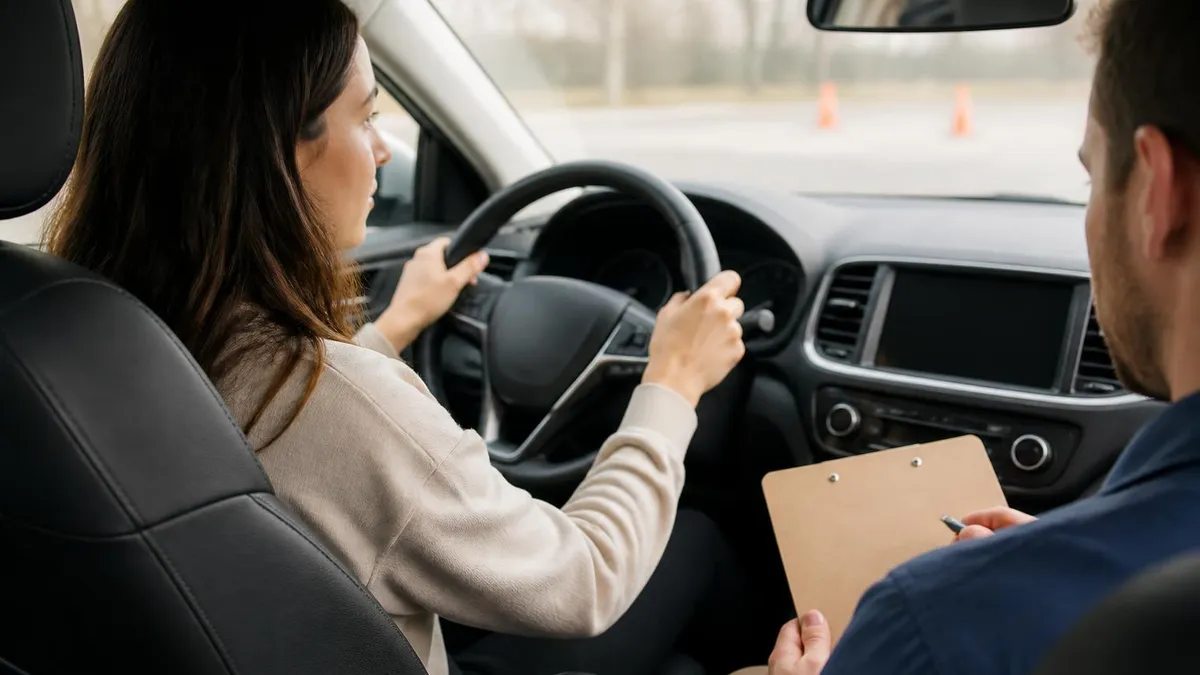
When the examiner calls your name, they'll head to the car with you. The licensed driver who brought you stays behind — they don't ride along. The examiner runs a pre-test vehicle inspection: hand signals, turn signals, brake lights, headlights, horn, emergency brake. Failing this stops the test right there. You reschedule and come back.
Then the drive. Most road tests run 15 to 25 minutes. You'll go through residential streets, make turns, change lanes, possibly enter a higher-speed road. Parallel parking is required in about half the states (CA, NY, IL include it; OH switched to maneuverability box; TX dropped it years ago). Reverse-and-back maneuvers, three-point turns, and lane changes are nearly universal. The examiner marks errors on a scoresheet — minor errors deduct 1–5 points each, major errors (running a stop sign, hitting a curb hard, near-collision, unsafe lane change) are automatic fails.
You'll either pass or fail at the end of the route. They'll tell you immediately — most don't make you wait. If you pass, you go back inside, surrender the permit, and they'll process the actual license. Most states mail the photo license; you get a paper interim license that day. If you'd rather know what the route feels like first, the driving test prep guide walks through the maneuvers in detail. Knowing road signs cold also helps — the DMV sign test practice pulls double duty for the knowledge exam and the road test pre-check.

Morning-of-test checklist
- ✓Set two alarms. Aim to leave 45 minutes before the appointment.
- ✓Run through the vehicle inspection at home: headlights, brake lights, turn signals (both sides), horn, emergency brake, all mirrors.
- ✓Check that the registration and insurance card are in the glove box and current.
- ✓Confirm your supervisor (licensed driver 21+) is awake and ready to ride along.
- ✓Top off windshield washer fluid. A dry washer in a dirty windshield is a points deduction.
- ✓Eat something. Low blood sugar makes you twitchy behind the wheel.
- ✓Arrive 20 minutes early. Use the bathroom before checking in.
- ✓Adjust your mirrors and seat after the examiner gets in — they expect you to do this.
- ✓Take a slow breath. Examiners are looking for safe drivers, not perfect drivers.
- ✓Trust your training. The maneuvers you practiced are the maneuvers they test.
What happens if you fail (and how to retest)
Roughly one in three first-time test-takers fails the road exam. That's not a moral judgment, it's an industry stat. Most states make you wait before retesting — Minnesota is one week, Ohio is one week, Indiana lets you rebook the same day if a slot's open, California requires two weeks, Texas requires the next business day. Florida lets you retest the same day at some county sites. You'll pay the road-test fee again. Two failed attempts in some states (NJ, MD, CA) trigger a mandatory waiting period of 30+ days before you can book attempt three.
What gets people: lane changes without checking the blind spot, rolling stops, hitting the curb during parallel parking, exceeding the speed limit by 5+ mph (yes, even 26 in a 25), getting too close to the car ahead, hesitating at green lights or yielding when you have right-of-way. The fixes are not mysterious — practice the specific maneuver that failed you. If you bombed the parallel park, spend an afternoon doing it twenty times in an empty parking lot with cones. If you blew a stop, drill the full-stop, two-count, scan-and-go pattern at every quiet intersection in your neighborhood.
One tip that the examiner doesn't share: most test routes are the same every day. They rotate between three or four predictable courses around the test site. Drive the area before the test. Notice the school zones, the four-way stops, the on-ramps. If you live an hour from the test site, head over the weekend before and run the streets within a mile of the office. Familiarity buys composure on test day.
If you've failed twice, consider booking a road-test car rental — some testers fail because their car's mirrors are misaligned, the seat doesn't adjust, or the brakes feel mushy. A purpose-built rental removes those variables. Some companies bundle a 30-minute brush-up lesson with the rental.
Online scheduling vs. walking into the office
- +Online scheduling shows real-time availability across every test station in the state
- +You can compare wait times between locations in 30 seconds
- +Payment is handled at booking — no fumbling with a card at the counter
- +You get an email confirmation you can show on your phone at check-in
- +Rescheduling online takes one minute; rescheduling by phone takes 30
- +The portal blocks slots that you're not eligible for, saving wasted trips
- −State portals occasionally glitch — pages fail to load, sessions time out, payment screens hang
- −Same-day appointments after a knowledge-test pass usually fail (24-hour sync delay)
- −Some states limit how many times you can reschedule before charging a fee
- −If you have an unpaid fine, the portal blocks you without explaining why
- −Mobile booking is less reliable than desktop on some state portals
- −Confirmation emails sometimes go to spam — check the folder if it doesn't appear
Pros and Cons at a Glance
| Pros | Cons |
|---|---|
| Online scheduling shows real-time availability across every test station in the state | State portals occasionally glitch — pages fail to load, sessions time out, payment screens hang |
| Payment is handled at booking — no fumbling with a card at the counter | Some states limit how many times you can reschedule before charging a fee |
| You get an email confirmation you can show on your phone at check-in | If you have an unpaid fine, the portal blocks you without explaining why |
| The portal blocks slots that you're not eligible for, saving wasted trips | Mobile booking is less reliable than desktop on some state portals |
Putting it all together
Booking a driving test should be the easiest part of getting licensed. The hard part is studying, the harder part is the road itself. The booking is just clicks. Use the right portal for your state, have your permit ID and a card ready, pick a location with a short wait, and write the date on your calendar. Then spend the days before the test driving the route, drilling the maneuvers, and resting up the night before.
If the knowledge portion is still in front of you, grab a permit test cost overview to budget the full pipeline, then practice with the free BMV practice test. Stack two or three timed practice sessions, fix what you miss, and you'll walk into the knowledge exam ready. Once that's in hand, this guide is here for the road-test side. The driver test appointment walkthrough covers the same scheduling material in alternate state breakdowns if you want a second pass.
One last thing. Don't let nerves blow the day. Examiners want to pass safe drivers. They're not adversaries. Smooth steering, full stops, consistent mirror checks, and the speed limit will pass you. Practice those four things until they're automatic, schedule your test, show up early, and drive the route. The license arrives in the mail two weeks later, and the whole thing fades into the background of your adult life.
Sample BMV Practice Questions
Try these questions from our free BMV practice tests. The correct answer and an explanation follow each question.
When driving in fog, you should use your:
- A. Low-beam headlights
- B. High-beam headlights
- C. Parking lights only
- D. Hazard lights while moving
Answer: A. Low-beam headlights
Low beams reduce glare and give better visibility in fog than high beams.
When driving on a city road without posted speed limit signs, you should not go faster than ___.
- A. 30 mph
- B. 25 mph
- C. 35 mph
- D. 20 mph
Answer: B. 25 mph
In Ohio, if there are no posted speed limit signs on a city road, the default statutory speed limit is 25 mph. This general rule applies to urban districts and helps ensure safety in areas with higher pedestrian traffic and potential intersections. Drivers should always be aware of the default limits when specific signs are absent.
If you are driving at 60 mph, approximately how many feet does your vehicle travel per second?
- A. 44 feet
- B. 60 feet
- C. 88 feet
- D. 120 feet
Answer: C. 88 feet
At 60 mph a vehicle travels roughly 88 feet per second, calculated by multiplying mph by 1.47.
What is the meaning of a solid yellow line on your side of the center of the road?
- A. Passing is permitted
- B. You may make a U-turn only
- C. Passing is not allowed on your side
- D. The road is one-way
Answer: C. Passing is not allowed on your side
A solid yellow line on your side means you may not cross it to pass.
BMV Practice Test Questions and Answers
About the Author
Licensed Driving Instructor & DMV Test Specialist
Penn State UniversityRobert J. Williams graduated from Penn State University with a degree in Transportation Management and has spent 20 years as a certified driving instructor and DMV examiner consultant. He has personally coached thousands of applicants through written knowledge tests, skills assessments, and commercial driver licensing programs across more than 30 states.
Join the Discussion
Connect with other students preparing for this exam. Share tips, ask questions, and get advice from people who have been there.
View discussion (9 replies)