
Ohio BMV Driving Test: Maneuverability, Road and Pass Tips 2026 October
Ohio BMV driving test guide — 🆕 TIPIC, maneuverability test, road test, scoring, what to bring, fees, common failures, and tips to pass on the first try.

The Ohio BMV driving test is the second of two examinations required for an Ohio driver license. After passing the written knowledge test and vision screening at a Deputy Registrar, applicants must pass a behind-the-wheel skills test administered by the Ohio Bureau of Motor Vehicles. The skills test evaluates whether the applicant can operate a vehicle safely on public roads, follow traffic laws, control the vehicle precisely, and respond appropriately to typical driving situations. The pass-on-first-attempt rate hovers around 60% to 65%, which means a substantial number of new drivers need a second try.
The test format depends on age. Applicants under 18 take both the maneuverability test (a controlled exercise on a closed course with cones) and the on-road driving test. Applicants 18 and older typically take the on-road portion only, although some examiners include a brief maneuverability check. The full skills test takes 20 to 30 minutes including pre-test inspection, maneuverability, road driving and post-test debrief. The fee is $24.50 for the skills test in 2026, paid in advance through the BMV scheduling system or at the testing site.
Before scheduling the skills test, applicants under 18 must hold a Temporary Instruction Permit Identification Card (TIPIC) for at least six months, complete a state-approved driver education program (24 hours of classroom plus 8 hours behind-the-wheel instruction), and log 50 hours of supervised driving including 10 hours at night, certified by a parent or legal guardian. Applicants 18 and older may take the test after holding a TIPIC for at least six months without the formal driver education requirement.
This guide walks through every part of the Ohio BMV driving test — the documents you must bring, the maneuverability test layout, the on-road components and scoring, the most common reasons applicants fail, and how to prepare so the first attempt is the only attempt. Test centers are scattered statewide and operated by Ohio State Highway Patrol examiners. The procedures are identical across testing locations, with minor variations in the specific roads used for the on-road portion.
Ohio BMV driving test in 30 seconds
Two parts under 18: maneuverability (cone exercise) plus on-road driving. Age 18+ typically just on-road. Total time 20 to 30 minutes. Fee $24.50. You must bring TIPIC, photo ID, your 50-hour driving log (under 18), driver education completion certificate (under 18), and a registered, insured vehicle in safe operating condition with a licensed adult driver to bring you to the test site.
Required documents are non-negotiable. The examiner will refuse to test you without all of them, and you will lose your scheduled appointment and the $24.50 fee. Bring your TIPIC (the temporary instruction permit you have held for six months), an Ohio photo ID or other government identification, your driver education program completion certificate (form DL-2DE for under-18), your 50-hour driving experience affidavit signed by a parent or guardian, and proof of insurance and registration for the vehicle you are bringing to the test.
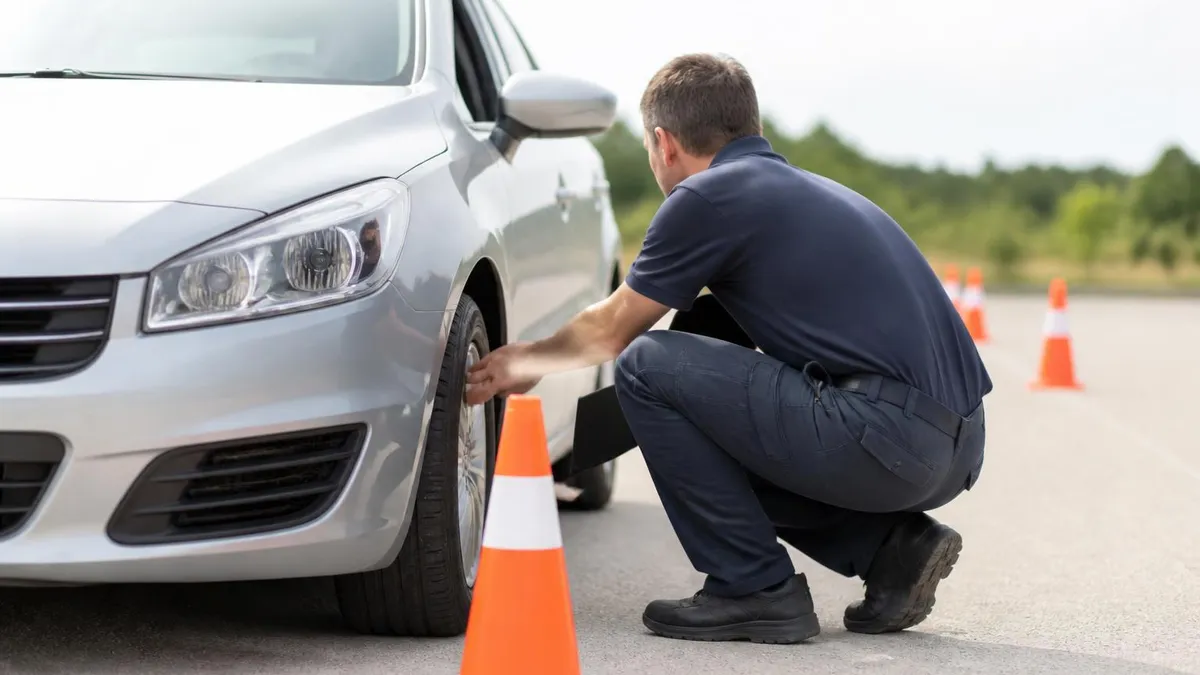
The vehicle itself must be safe to drive. The examiner inspects basic items before the test begins: working brake lights, turn signals, headlights, horn, windshield wipers, mirrors, seat belts and tires with adequate tread. A vehicle with a cracked windshield in the driver's line of sight, a broken signal, a dashboard warning light, or a missing required component will fail the inspection and the test will not proceed. Bring a vehicle you have already driven and confirmed is in good operating condition.
Test centers are operated by the Ohio State Highway Patrol at fixed locations across the state. Schedule the test through the BMV's online appointment system at oplates.com. Most regions have a waiting list of one to four weeks for the next available appointment, so plan ahead. Cancellations free up earlier slots; refresh the system every few days if you need an earlier test date. Walk-in testing is not available at most centers.
Show up at least 15 minutes early. The examiner runs on a tight schedule and applicants who arrive at the appointment time exactly are sometimes pushed to the next available slot or marked as a no-show. Bring all documents in a folder, organized for quick presentation. The examiner will check identification, the TIPIC, the driver education certificate and the 50-hour log, then move directly into the vehicle inspection. Lateness is one of the most common preventable causes of a forfeited fee.
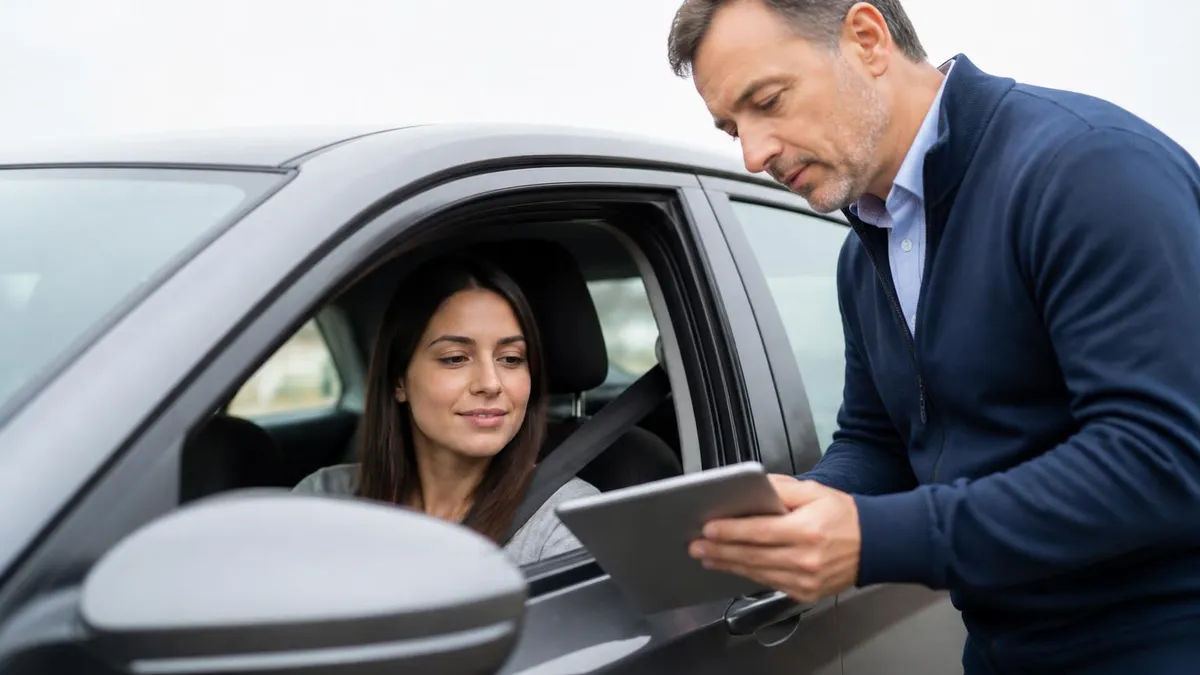
Ohio driving test eligibility
Drivers under 16 cannot test for an Ohio license. The minimum age is 16 with completed driver education, 50 hours of supervised driving, and at least six months of TIPIC holding. Apply for the TIPIC at age 15 years and 6 months to begin the timeline.
Must hold TIPIC for 6+ months, complete 24h classroom + 8h behind-the-wheel driver education, and log 50 hours of supervised driving including 10 night hours, certified by parent or guardian. Skills test includes both maneuverability and on-road portions.
Must hold TIPIC for 6+ months. Driver education is encouraged but not required by state law. Skills test typically includes the on-road portion only. Vision screening and written knowledge test still required prior to scheduling the skills test.
Out-of-state drivers transferring to Ohio with a valid license generally can convert without taking the skills test, although a vision screening, written test and surrender of the prior license at a Deputy Registrar are still required.
The maneuverability test is the controlled-course portion taken by under-18 applicants. The test takes place at the BMV testing site on a paved area marked with cones. The applicant drives forward through a 20-foot lane, around a center cone, then reverses back through the same lane to the starting position. The exercise tests precise vehicle control, reverse driving, and the ability to use mirrors. Hitting any cone, going outside the marked lane, or making more than one correction movement results in a failure on this section.
The setup is consistent across all Ohio test centers. The marked lane is 20 feet long and 9 feet wide for the typical passenger car. A cone in the center of the lane requires the driver to swing around it without contact. The reverse portion is judged on staying within the lane width, controlling speed and using mirrors. The examiner stands outside the vehicle and observes from a vantage point that allows them to see all four corners of the test box.
Practice the maneuverability test before test day. The cones are positioned identically at every BMV testing site, and the dimensions are published; you can recreate the exercise in any large parking lot using traffic cones from a hardware store. Practicing forward and backward in the same lane width as the actual test trains the spatial judgment you need under exam pressure. Most candidates need 10 to 20 practice attempts to develop confident vehicle placement.
If you fail the maneuverability portion, the examiner stops the test before the road portion. You leave with a re-test schedule and another $24.50 fee for the next attempt. Some applicants assume that hitting a cone is grounds for an automatic failure, which is correct, but the more common failure is two or more corrective movements in the reverse — meaning you stopped, started forward, and stopped again to realign. One correction is allowed; two ends the test.
Maneuverability test breakdown
The test box is 20 feet long by 9 feet wide for typical passenger cars, with a single cone positioned in the center of the box. The applicant pulls forward into the box, drives around the center cone (left or right, examiner's choice), continues to the end of the lane, then reverses back through the same lane to the starting position.
The on-road test takes 15 to 20 minutes through a route the examiner directs from the passenger seat. The route covers residential streets, two-lane roads with a posted speed limit of 35 to 55 mph, intersections with traffic lights, intersections with stop signs, an uncontrolled intersection, a parallel parking maneuver (in some test centers), a curve in the road, and a return to the testing facility. The examiner gives directions clearly with adequate notice, but expects you to demonstrate awareness of the road environment without prompting.
Scoring is based on a checklist of skills the examiner observes during the route. Categories include vehicle control (steering, acceleration, braking, lane position), traffic law observance (speed limits, stop signs, signals, right-of-way), observation skills (mirror checks, blind spot checks, scanning), and special maneuvers (parallel parking, three-point turn, hill parking where applicable). Each category has a passing threshold; the examiner deducts points for errors and assigns a final pass or fail at the end.
Automatic failure during the on-road test happens for several specific actions. Failing to stop at a stop sign or red light is automatic failure. Causing the examiner to apply the brake or take control of the wheel is automatic failure. Striking another vehicle, pedestrian or fixed object is automatic failure. Speeding excessively (more than 5 mph over the posted limit through residential areas) is automatic failure. Driving in the wrong lane on a divided road is automatic failure. Anything that creates immediate danger ends the test.
Less serious errors result in deductions rather than automatic failure, and you can accumulate a number of small deductions before failing the test. Common deductions include rolling stops at stop signs, failing to check blind spots before lane changes, riding the brake on downhills, weaving within the lane, accelerating too quickly from intersections, and stopping awkwardly past stop lines. The examiner notes each deduction and totals them at the end. The threshold for pass is set by the BMV at a fixed point score.
Certain actions end the test immediately regardless of how well the rest goes. Failing to stop completely at a stop sign or red light, causing the examiner to apply the brake or take the wheel, exceeding the speed limit by more than 5 mph in a residential zone, striking any object or person, driving on the wrong side of the road on a two-way street, or any moving violation that would warrant a citation are all automatic failures. The examiner will calmly direct you back to the testing center.
The most common reasons applicants fail the on-road test are observable months in advance with focused practice. Rolling stops are the single most common failure: applicants slow down at a stop sign without coming to a complete halt, which the examiner counts as failure to stop. Practice stopping firmly at stop signs and counting one-Mississippi before proceeding. Improper lane changes — failing to check blind spots, signaling too late, or changing lanes without confirming clearance — are the second most common failure. Anxious overreaction in normal traffic situations, like braking sharply when no brake is needed, is the third.
Practice on the actual test route is gold if you can find a friend or family member with experience at the same testing center. Each Ohio BMV testing center uses two or three standard routes. Drive the routes ahead of time in your test vehicle to identify the parallel parking spot, the residential streets, the uncontrolled intersection and any speed-limit transitions. The unfamiliar elements that catch you off-guard during the test become predictable when you have driven the streets before.
Pre-test nerves are universal. Most applicants fail at least once on something they would have done correctly under less pressure. The mental approach that works best is to treat the examiner as a coach rather than a judge, narrate to yourself silently as you drive ("checking left mirror, signaling, looking over shoulder, turning"), and breathe deliberately before starting the engine. Rushing through movements is a sign of anxiety; deliberate slowness is a sign of control.
If you fail, you can re-take the test as soon as the next available appointment slot. Most regions have one to four weeks of waiting. The fee is $24.50 again per attempt. After a failure, the examiner gives a brief debrief noting the categories where you fell short. Use that feedback to focus practice in the days before the next attempt rather than continuing to drive without targeted improvement.
What to bring on test day
- ✓Current TIPIC (held for at least 6 months)
- ✓Photo ID (state ID or birth certificate plus secondary ID)
- ✓Driver education completion certificate (form DL-2DE) if under 18
- ✓50-hour driving experience affidavit signed by parent / guardian
- ✓$24.50 testing fee in cash, check or card
- ✓Valid registration for the vehicle you are using
- ✓Valid proof of insurance covering the vehicle
- ✓Vehicle in safe operating condition with all lights working
- ✓A licensed adult driver to bring you to and from the test
The vehicle inspection at the start of the test is brief but strict. The examiner walks around the vehicle, checks brake lights by asking you to apply the brakes, checks turn signals on each side, checks the horn, checks the windshield wipers, checks the seat belts, checks tires for adequate tread and proper inflation, and checks for any dashboard warning lights when you turn the ignition. A vehicle that fails the inspection ends the test before it begins. Confirm every item the day before.
For the under-18 group, the parent or guardian who certifies the 50-hour driving log must sign and date the affidavit. Pre-printed forms are available on the BMV website. The 10 night hours portion is non-negotiable; an examiner who reviews a log without the night-driving entry will refuse to start the test. Keep a written log throughout the practice period rather than trying to recall hours after the fact, and total it on the affidavit when complete.
For driver education, only state-approved providers are accepted. The completion certificate (form DL-2DE) is issued by the school after you finish 24 classroom hours and 8 behind-the-wheel hours. Online classroom options are now widely available, although the behind-the-wheel hours must be in-person with a state-licensed instructor. Most full programs cost $400 to $700 in 2026, with some scholarship and reduced-price options at high schools.
The TIPIC restrictions matter throughout the practice period. Holders of a TIPIC may drive only with a licensed adult age 21 or older in the front passenger seat. They cannot drive between midnight and 6 AM except to or from work or school. Maximum passenger limits apply (one non-family passenger unless a parent is in the vehicle). Violating TIPIC restrictions can result in extension of the holding period and is a separate concern from the driving test itself.
For the road test itself, defensive driving habits show through more than performance tricks. Examiners are looking for someone who will be a safe driver, not someone who can execute a flashy maneuver. Keep both hands on the wheel at the 9-and-3 position. Maintain a smooth speed without sudden acceleration or braking. Check mirrors every 5 to 8 seconds. Signal every turn and lane change with at least 100 feet of warning. Stop fully behind stop lines. Look both ways at intersections even when you have a green light. These small habits accumulate into a passing score.
If the examiner asks you to make a turn into oncoming traffic that does not exist or to merge into a clear lane, follow the directive promptly. Hesitation when the road is clear suggests indecision, which is a deduction. Equally, if the road condition does not match the directive (the lane is blocked, traffic is heavier than expected), wait until it is safe before proceeding. The examiner will rephrase or redirect; never make an unsafe move just because the examiner said something.
Ohio BMV driving test quick numbers
Key Facts at a Glance
| Item | Value | Details |
|---|---|---|
| Skills test fee per attempt | $24.50 | |
| Total test duration | 20–30 min | |
| Supervised driving required (under 18) | 50 hours | |
| Minimum TIPIC holding period | 6 months |
Top reasons applicants fail
Slowing without coming to a complete stop at stop signs is the single most common cause of failure. Practice stopping firmly with the wheels not moving, counting one-Mississippi, then proceeding only after confirming the way is clear of cross traffic.
Failing to check blind spots, signaling too late, or changing lanes without confirming the adjacent lane is clear. Practice the mirror-signal-shoulder check sequence on every lane change until it is automatic regardless of how clear the road appears.
Hitting a cone in the maneuverability test is automatic failure for under-18 applicants. The 20-by-9 foot box is unforgiving; practice in a parking lot with cones at the same dimensions until the spatial judgment becomes second nature on the first attempt.
Driving more than 5 mph over residential limits is an automatic failure. Driving below the speed limit by more than 10 mph (impeding traffic) is a deduction. Maintain a smooth speed within 5 mph of the posted limit at all times during the road test.
For first-time test takers, treat the day before the exam as a calm preparation day, not a cramming day. Drive the route to the test center the evening before so you arrive with confidence. Get a full night's sleep. Eat a light breakfast. Bring water for the wait. Avoid caffeine if it makes you jittery. Review the documents one more time before leaving home and confirm they are all in your folder. Showing up calm, prepared and rested is half the battle.
For applicants retaking the test after a failure, the targeted practice approach saves the most time and money. Identify the specific category in which you failed (rolling stops, lane changes, parallel parking, maneuverability) and devote your practice sessions to that one area. Generalized continuous driving without focused improvement does not produce the same gains as 30 minutes of stop-sign drills or maneuverability box practice. Set a re-test date two to four weeks out and use the time deliberately.
BMV: Pros and Cons
- +BMV exam preparation strengthens your knowledge across all domains
- +Passing the exam proves competency to employers and clients
- +Study materials and practice tests are widely available
- +Exam-based credentials are portable across states and employers
- +Clear exam objectives help focus your study plan effectively
- −Exam anxiety can affect performance — practice tests help reduce it
- −Registration fees are non-refundable if you miss your test date
- −Limited retake opportunities may apply with waiting periods
- −Exam content updates periodically — use current study materials
- −Testing center availability may require advance scheduling
Sample BMV Practice Questions
Try these questions from our free BMV practice tests. The correct answer and an explanation follow each question.
When driving on a city road without posted speed limit signs, you should not go faster than ___.
- A. 30 mph
- B. 25 mph
- C. 35 mph
- D. 20 mph
Answer: B. 25 mph
In Ohio, if there are no posted speed limit signs on a city road, the default statutory speed limit is 25 mph. This general rule applies to urban districts and helps ensure safety in areas with higher pedestrian traffic and potential intersections. Drivers should always be aware of the default limits when specific signs are absent.
How long must a teen hold a temporary permit before taking the driving test?
- A. 30 days
- B. 3 months
- C. 6 months
- D. 12 months
Answer: C. 6 months
Teens under 18 must hold the permit for at least six months before the road test.
When driving in rain, you should increase your following distance to at least:
- A. 2 seconds
- B. 3 seconds
- C. 4 seconds
- D. 6 seconds
Answer: D. 6 seconds
In wet conditions, stopping distances increase significantly, so you should double your following distance to at least 6 seconds.
It is not permitted for you to pass another car in the opposing lane when you are...
- A. In a school zone
- B. In a no-passing zone
- C. In a residential area
- D. Approaching a hill or curve
Answer: B. In a no-passing zone
You are strictly prohibited from passing another car in the opposing lane when you are in a no-passing zone. These zones are typically marked by solid yellow lines on the pavement or 'DO NOT PASS' signs, indicating areas where visibility is limited, such as hills, curves, or intersections, making passing unsafe. Disregarding these signs and markings is illegal and extremely dangerous.
BMV Questions and Answers
About the Author

Licensed Driving Instructor & DMV Test Specialist
Penn State UniversityRobert J. Williams graduated from Penn State University with a degree in Transportation Management and has spent 20 years as a certified driving instructor and DMV examiner consultant. He has personally coached thousands of applicants through written knowledge tests, skills assessments, and commercial driver licensing programs across more than 30 states.
Join the Discussion
Connect with other students preparing for this exam. Share tips, ask questions, and get advice from people who have been there.
View discussion (9 replies)