
Driving Test Driving: Complete BMV Road Test Preparation Guide 2026 October
Driving test driving guide for BMV applicants. Learn road test maneuvers, 🧠 scoring criteria, vehicle requirements, and how to pass on your first attempt.
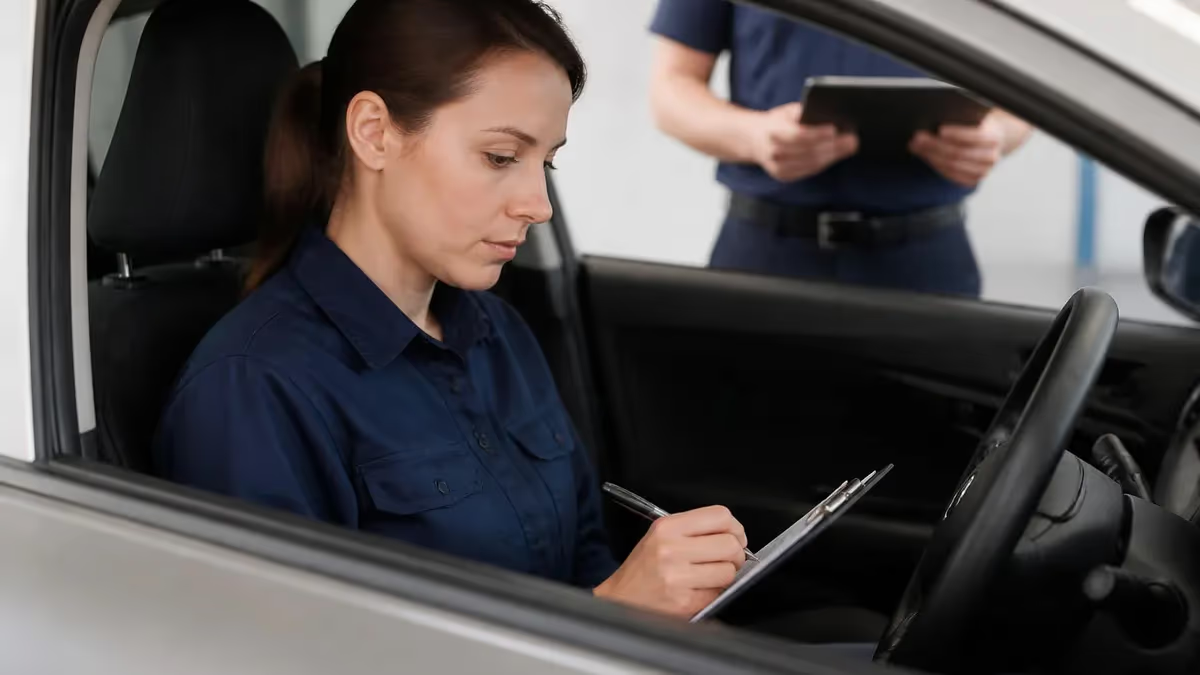
Preparing for dmv road test driving evaluation at the BMV is one of the most significant milestones on the road to becoming a licensed motorist in the United States. The behind-the-wheel portion of the licensing process is designed to measure how safely you can operate a vehicle in real traffic, follow posted rules, and respond to unexpected situations. Most first-time applicants underestimate how much practice the test requires, which is why nearly one in three candidates fails on their first attempt nationwide. This guide walks you through every component so you arrive confident.
The BMV road test typically lasts between fifteen and twenty-five minutes, depending on the state and the examiner's route. During that window, you will be asked to demonstrate basic vehicle control, lane discipline, intersection handling, parking maneuvers, and observation skills. Examiners use a standardized scoring sheet, and each error category carries a specific point deduction. Understanding that scoring system before you step into the vehicle gives you a strategic advantage over candidates who simply hope for the best on test day.
State BMV offices in Indiana, Ohio, and other Midwest jurisdictions follow slightly different procedures, but the core skills tested remain remarkably consistent across the country. You will need to bring a valid permit, proof of insurance, a registered vehicle in safe operating condition, and a licensed adult driver if your state requires one to accompany you. Some locations now require online scheduling, and walk-in slots have become increasingly rare since 2022. Plan ahead by at least three to four weeks during peak summer months when teenage applicants flood the appointment system.
One of the smartest ways to prepare is to combine behind-the-wheel practice with structured knowledge review. Many applicants pass the written knowledge exam months before scheduling their road test, then forget critical rules like right-of-way at four-way stops or proper following distance. A short refresher using a tool like the Basic BMV Practice question set the week before your appointment can reactivate those rules in your memory so you respond automatically when the examiner tests them in real traffic.
Vehicle inspection is often the silent killer of test attempts. Examiners will refuse to begin the evaluation if your turn signals, brake lights, horn, windshield wipers, or seat belts are not fully functional. Check every bulb, fluid level, and tire pressure reading the night before. Bring your most recent registration card and insurance certificate, and make sure both documents reflect the exact vehicle you intend to drive on the test. Borrowed vehicles must carry coverage that lists the test taker as an authorized driver.
Throughout this guide we cover scoring, common mistakes, parking techniques, traffic law refreshers, examiner expectations, and a final-week study plan. By the time you finish reading, you will know exactly what to practice, what to bring, what to avoid, and how to recover gracefully if you make a minor error during the evaluation. The goal is not perfection — it is consistent, defensive, observable driving that demonstrates you can be trusted with a full operator's license in any condition.
Whether you are a teenager taking the test for the first time, an adult immigrant transferring a foreign license, or a senior returning after a lapse, the fundamentals discussed here apply to you. Read each section carefully, take notes on areas where you feel uncertain, and schedule additional supervised practice on those specific maneuvers. Driving test driving success is almost never about luck — it is about preparation, repetition, and a calm mindset on the day of the appointment.
BMV Driving Test by the Numbers
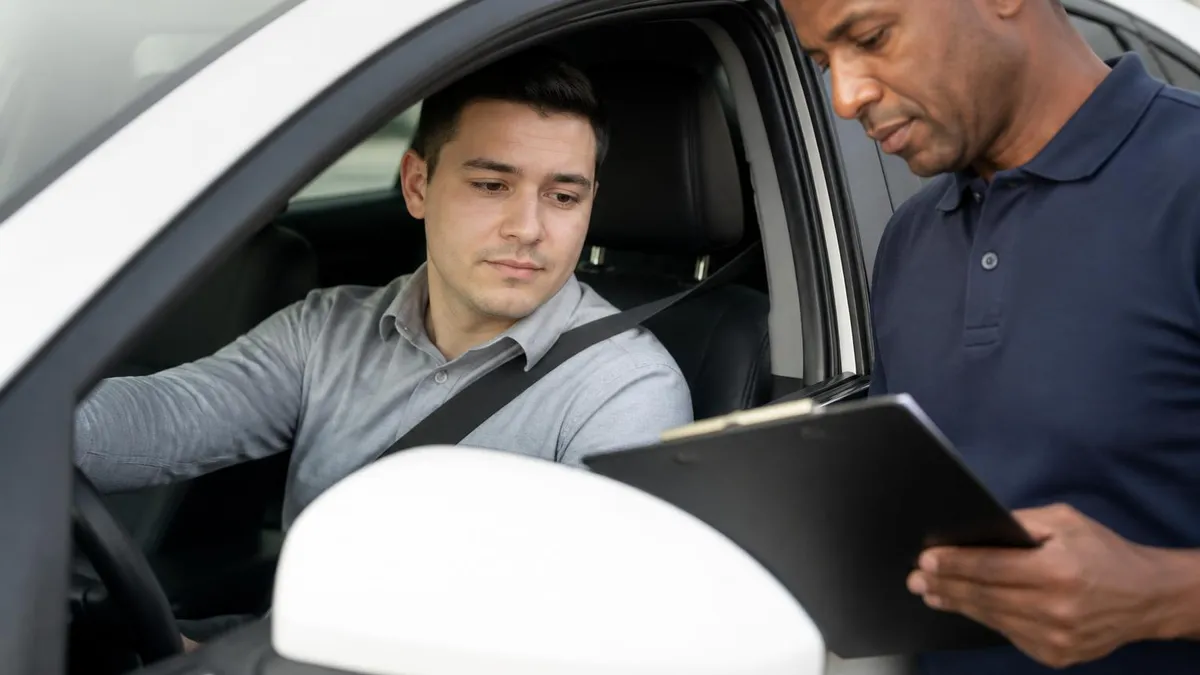
Road Test Format & Structure
The examiner inspects lights, signals, horn, mirrors, brakes, and tires before you start the engine. Any failure here ends the test before it begins, so confirm everything works the night before your appointment.
You demonstrate smooth acceleration, controlled braking, proper steering, and lane positioning on residential streets. The examiner watches for jerky inputs, drifting, and over-correction during this opening segment.
You merge into moderate-traffic roadways, change lanes, and navigate at least one controlled intersection. Observation, signaling at least 100 feet in advance, and maintaining speed are scored heavily here.
Depending on the state, you perform parallel parking, three-point turn, hill parking, or straight-line reverse for fifty feet. Touching curbs, crossing lines, or excessive corrections earn deductions.
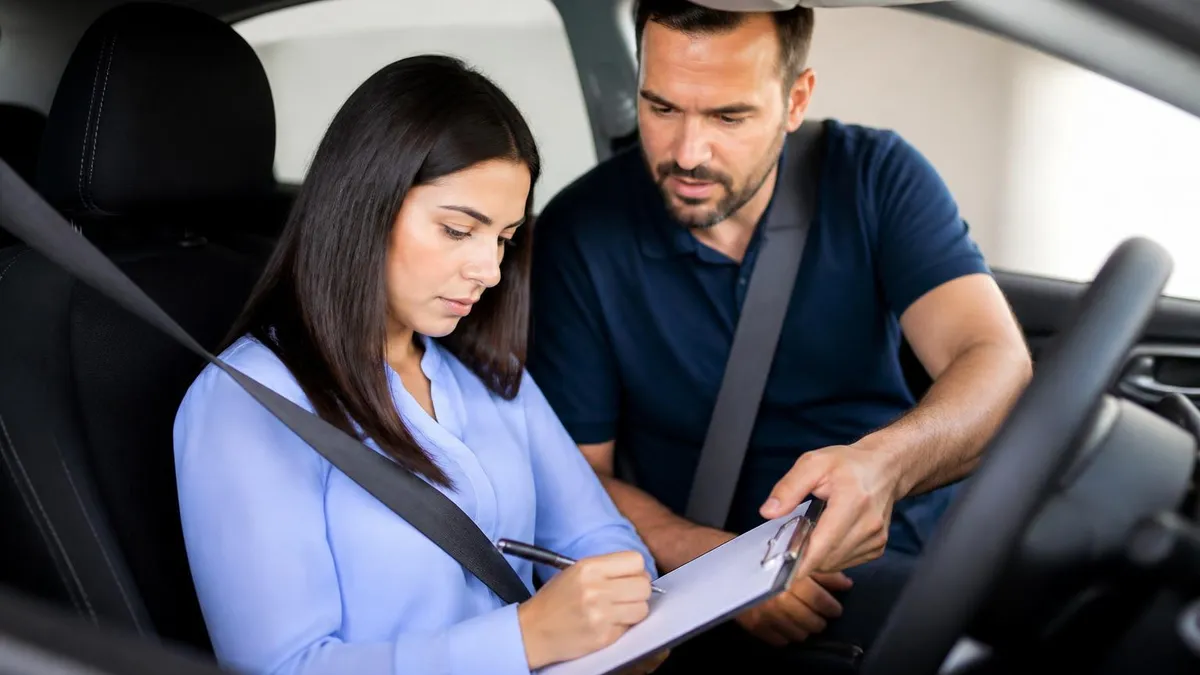
After returning to the BMV lot, the examiner reviews your scoring sheet, explains deductions, and tells you whether you passed. Successful candidates proceed directly to license photo and payment.
Bringing the correct paperwork to your driving test driving appointment is non-negotiable. The BMV will not begin the evaluation if any required document is missing, expired, or inconsistent with your other identification. Start by gathering your learner's permit, which must be valid on the day of the test and must have been held for the minimum supervised period required by your state — typically six months for applicants under eighteen and shorter or waived for adults. Bring the original permit, not a photocopy or photo on your phone.
Proof of insurance is the second non-negotiable document. The policy must cover the specific vehicle you will use during the test, and the declarations page should list either you or the registered owner as a named insured. Print a fresh copy within the past thirty days because some examiners reject digital screens. The vehicle registration must also be current; an expired tag is an instant disqualification. If you are using a parent's or relative's car, bring a signed note authorizing your use of the vehicle for testing purposes.
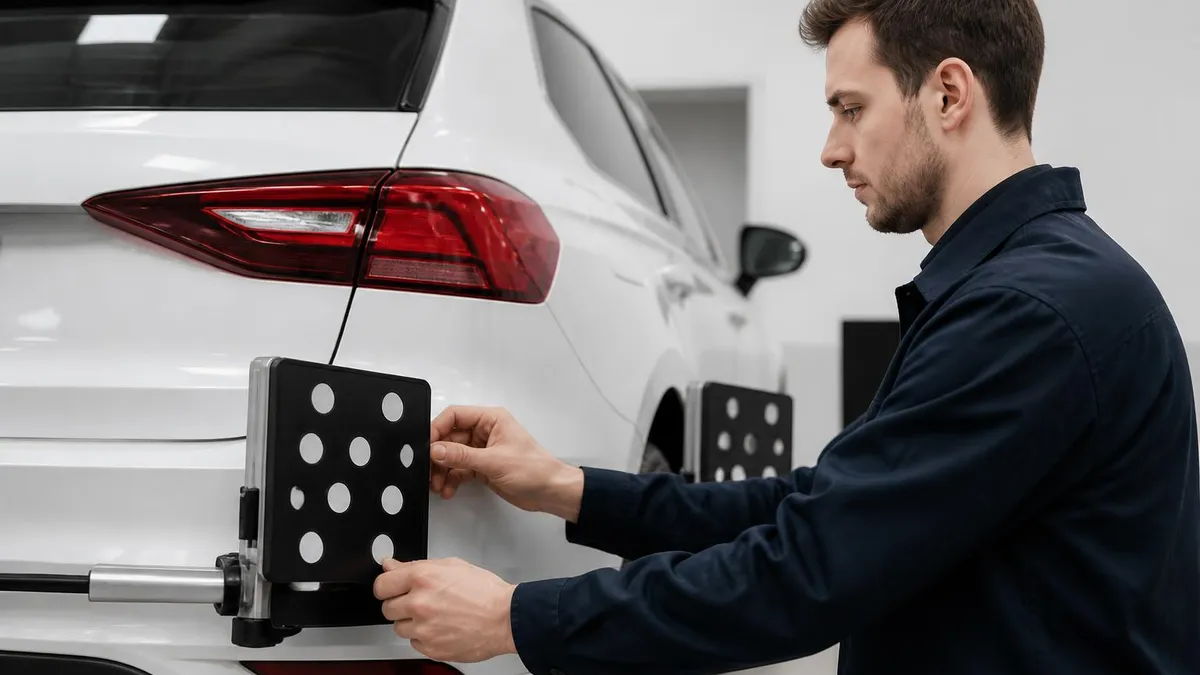
The vehicle itself must pass a brief safety inspection conducted by the examiner before you leave the lot. Headlights, taillights, brake lights, turn signals, hazard flashers, horn, windshield wipers, and the windshield itself are all checked. Cracked windshields in the driver's line of sight will end the test. Tires must have legal tread depth, and the spare must be present if your jurisdiction requires it. Seat belts on both front seats must retract and lock properly when tugged sharply.
Mirror configuration matters more than most candidates realize. Before the examiner enters the car, adjust your driver's seat so you can fully depress the brake pedal with your knee slightly bent, then adjust the inside rearview mirror to frame the entire rear window. Set your outside mirrors so that the side of your own car barely appears at the inner edge of each mirror. This setup minimizes blind spots and shows the examiner that you understand professional driving ergonomics.
Many applicants also forget to clean their vehicle interior. Loose water bottles rolling under brake pedals, sun visors stuck in the down position, and dirty windows can all lead to point deductions or safety concerns. Empty the cabin of unnecessary items, ensure both front and rear seat belts are accessible, and remove anything hanging from the rearview mirror. A tidy car signals to the examiner that you take vehicle responsibility seriously, which subtly influences subjective scoring categories.
If you plan to use a manual transmission vehicle, be aware that your license may be restricted to manual-only operation in some states unless you also test in an automatic. Most candidates choose an automatic for simplicity. Whatever you select, make sure you have logged at least fifteen hours of practice in that exact vehicle.
Borrowing an unfamiliar car the morning of your test is one of the most common avoidable mistakes, since unfamiliar pedal feel and mirror placement can throw off otherwise well-prepared drivers. Some applicants also review related materials like the BMV Practice Test 2026: Indiana & Ohio DMV Permit Study Guide the night before to refresh state-specific rules.
Finally, confirm your appointment time and location twenty-four hours in advance. BMV branches occasionally reschedule due to weather, examiner availability, or facility issues. Arrive at least thirty minutes early to complete check-in paperwork, use the restroom, and calm your nerves. Late arrivals are routinely turned away and forced to rebook, often weeks later. Treat the appointment with the same seriousness as a job interview, and the administrative side of the process will never be the reason you fail.
BMV Practice Test Questions
Prepare for the BMV - Test exam with our free practice test modules. Each quiz covers key topics to help you pass on your first try.
BMV Basic BMV Practice
BMV Exam Questions covering Basic BMV Practice. Master BMV Test concepts for certification prep.
BMV Alcohol, Drugs, and Impaired Driving Laws
Free BMV Practice Test featuring Alcohol, Drugs, and Impaired Driving Laws. Improve your BMV Exam score with mock test prep.
BMV Licensing Requirements
BMV Mock Exam on BMV Licensing Requirements. BMV Study Guide questions to pass on your first try.
BMV Traffic Laws
BMV Test Prep for BMV Traffic Laws. Practice BMV Quiz questions and boost your score.
BMV Vehicle Operations
BMV Questions and Answers on BMV Vehicle Operations. Free BMV practice for exam readiness.
BMV Parking, Right-of-Way, and Intersections
BMV Mock Test covering Parking, Right-of-Way, and Intersections. Online BMV Test practice with instant feedback.
BMV Road Signs and Markings
Free BMV Quiz on Road Signs and Markings. BMV Exam prep questions with detailed explanations.
BMV Safe Driving and Hazard Awareness
BMV Practice Questions for Safe Driving and Hazard Awareness. Build confidence for your BMV certification exam.
Driving Test Maneuvers You Will Be Scored On
Parallel parking remains the maneuver most applicants fear, even though the scoring criteria are surprisingly forgiving in most BMV jurisdictions. You will be asked to park between two cones or two vehicles spaced roughly twenty-five feet apart. Pull alongside the front reference vehicle with about two feet of lateral clearance, align your rear bumper roughly with theirs, then reverse while turning the wheel fully toward the curb until your car is at a forty-five degree angle.
Straighten the wheel briefly, continue reversing, then turn the wheel hard the opposite direction to swing the front of your vehicle in. You are allowed up to two correctional pull-ups in most states without losing points. The car must end up within twelve to eighteen inches of the curb, and you must not touch the curb or the reference cones. Practice this maneuver at least thirty times in varied conditions before test day.
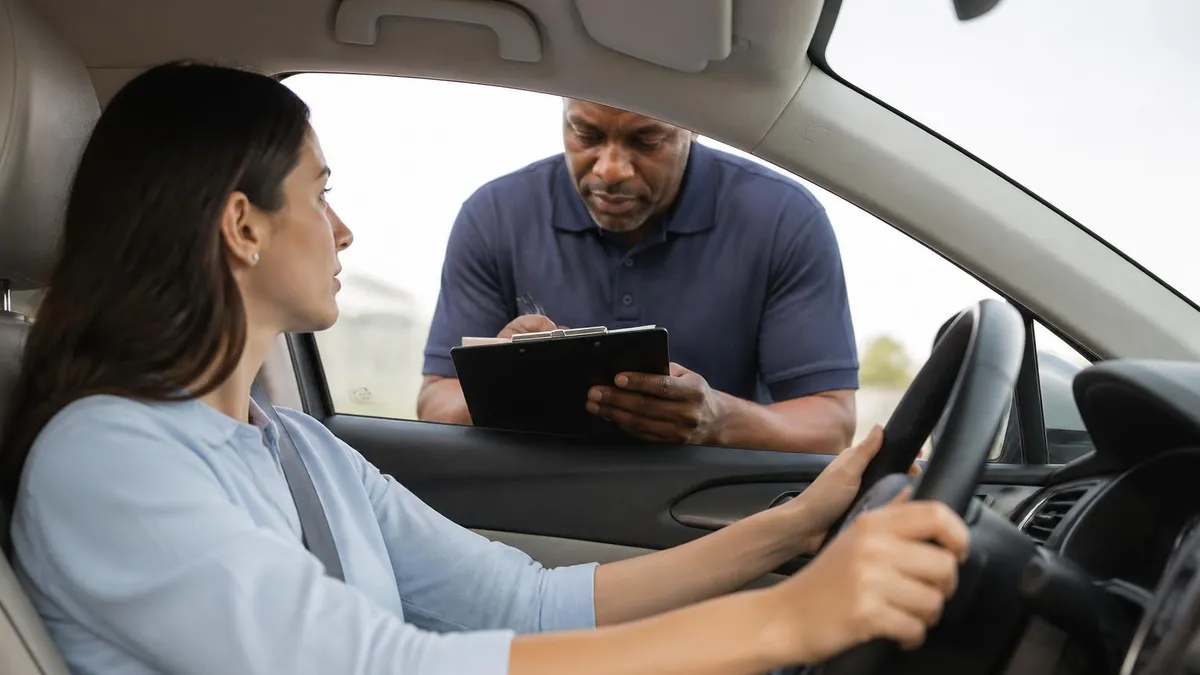
Should You Take the Test in Your Own Car or a Driving School Vehicle?
- +You know your own vehicle's pedal feel and mirror positions intimately
- +No rental fees or driving school surcharges added to test costs
- +You can practice the exact route in your own car beforehand
- +Insurance coverage is already in place and verified
- +Seat, steering wheel, and mirror adjustments stay locked in
- +You arrive without the stress of unfamiliar controls
- −A vehicle failure during inspection ends your test before it starts
- −Older personal cars may lack modern safety features examiners appreciate
- −You bear full responsibility for documentation and registration accuracy
- −No professional instructor available to debrief with afterwards
- −Cluttered or messy interiors can subtly impact examiner perception
- −Manual transmission cars may restrict your final license endorsement
Pros and Cons at a Glance
| Pros | Cons |
|---|---|
| You know your own vehicle's pedal feel and mirror positions intimately | A vehicle failure during inspection ends your test before it starts |
| No rental fees or driving school surcharges added to test costs | Older personal cars may lack modern safety features examiners appreciate |
| You can practice the exact route in your own car beforehand | You bear full responsibility for documentation and registration accuracy |
| Insurance coverage is already in place and verified | No professional instructor available to debrief with afterwards |
| Seat, steering wheel, and mirror adjustments stay locked in | Cluttered or messy interiors can subtly impact examiner perception |
| You arrive without the stress of unfamiliar controls | Manual transmission cars may restrict your final license endorsement |
Driving Test Pre-Appointment Checklist
- ✓Confirm appointment date, time, and BMV branch location 24 hours ahead
- ✓Charge your phone and program the BMV address into navigation
- ✓Bring original learner's permit and a backup photo ID
- ✓Print current vehicle registration and insurance declarations page
- ✓Test all exterior lights including brake, signal, and hazard flashers
- ✓Check tire pressure on all four tires and the spare if required
- ✓Top off windshield washer fluid and verify wipers work on all speeds
- ✓Adjust driver seat, steering wheel, and mirrors before the examiner arrives
- ✓Remove clutter from cabin and trunk, including loose water bottles
- ✓Arrive at the BMV at least 30 minutes before your scheduled time
Narrate your observation skills out loud
Many seasoned BMV examiners have shared that the candidates who pass most easily are those who quietly verbalize what they are checking. Saying "checking mirror, checking blind spot, signaling" under your breath forces you to actually complete each step rather than skip it. Examiners also notice the deliberate head turns and award you visible credit for proper observation technique.
Understanding why candidates fail their driving test driving evaluation is just as important as knowing what to practice. According to data compiled from state BMV offices across the Midwest, the single most common cause of failure is inadequate observation at intersections. Applicants roll through stop signs at two or three miles per hour instead of coming to a complete halt, or they fail to look both directions twice before proceeding. Examiners score this category aggressively because it correlates directly with real-world collision risk.
The second leading cause of failure is improper lane positioning. Candidates either hug the centerline, drift toward the shoulder, or fail to maintain consistent placement during turns. The proper technique is to keep your vehicle centered in the lane with equal space on each side, and to complete turns by ending up in the closest matching lane on the destination roadway. Wide right turns into the far lane and tight left turns that cut corners both earn significant point deductions on the scoring rubric.
Speed management trips up a surprising number of otherwise capable drivers. Going even five miles per hour over the posted limit can result in an automatic failure depending on the state, while driving substantially under the limit signals lack of confidence and earns its own deductions. Pay close attention to speed limit signs throughout the test route, especially when transitioning from residential streets to higher-speed arterials. School zones and construction areas require additional vigilance and are frequently included on test routes.
Examiners also watch closely for proper use of turn signals. The rule in most states is to signal at least one hundred feet before any turn or lane change, and to signal even when you are the only car on the road. Failing to signal, signaling too late, or leaving the signal on after completing a maneuver are all separately scored errors. Modern vehicles with auto-canceling signals make this easier, but you are still responsible for confirming the signal turned off after your turn completed.
Following distance is another silent test-killer. The standard rule is three to four seconds of following distance behind the vehicle in front of you in dry conditions, extending to six seconds in rain or fog. Tailgating is one of the most heavily penalized behaviors because it indicates poor judgment under everyday traffic conditions. Count out the seconds as the car ahead passes a fixed reference like a sign or shadow line until your own bumper reaches the same point.
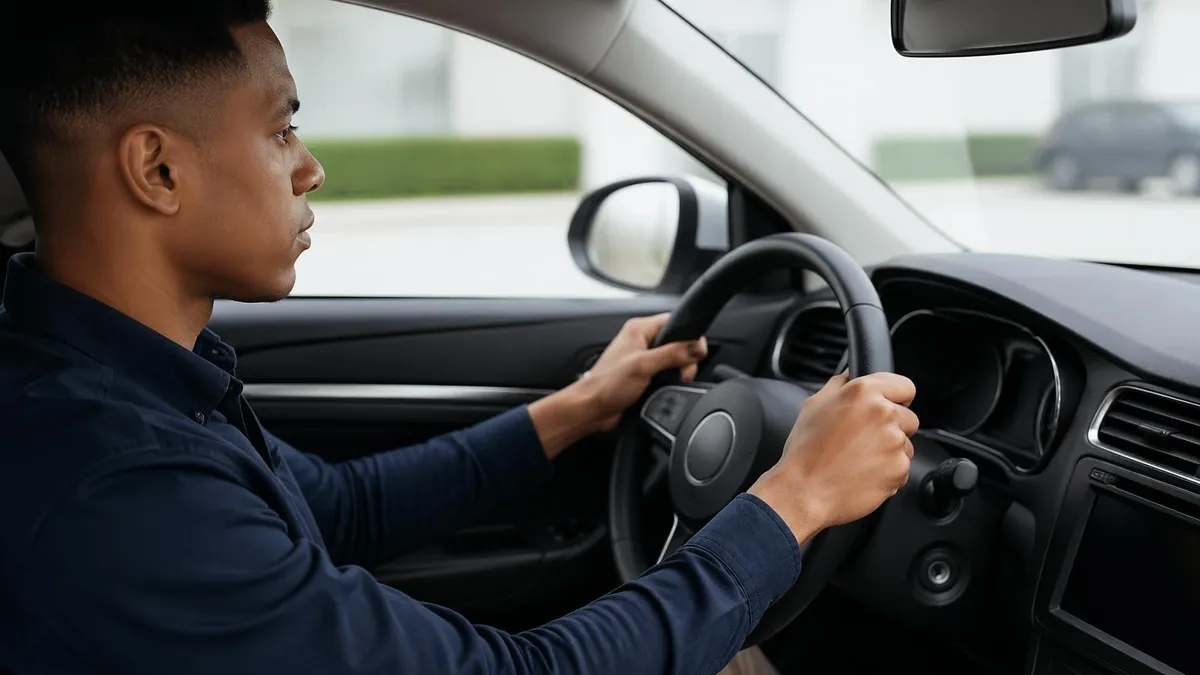
Steering technique receives more scrutiny than most candidates expect. The traditional ten-and-two hand position has largely been replaced by nine-and-three to reduce injury from airbag deployment, but either is acceptable. What examiners specifically watch for is hand-over-hand or push-pull steering during turns, with both hands remaining on the wheel throughout. Palming the wheel, steering with one hand resting on top, or crossing your arms in a way that obscures the airbag are all marked down.
Finally, emotional regulation is the invisible category that affects every other score. Candidates who panic after a small mistake often compound it by making three or four additional errors in the next thirty seconds. Treat each scored event as independent — if you forget a signal, simply complete the maneuver correctly and move on. Examiners are explicitly trained to see how you recover from minor errors, and a calm correction often earns back more points than the original mistake cost you.
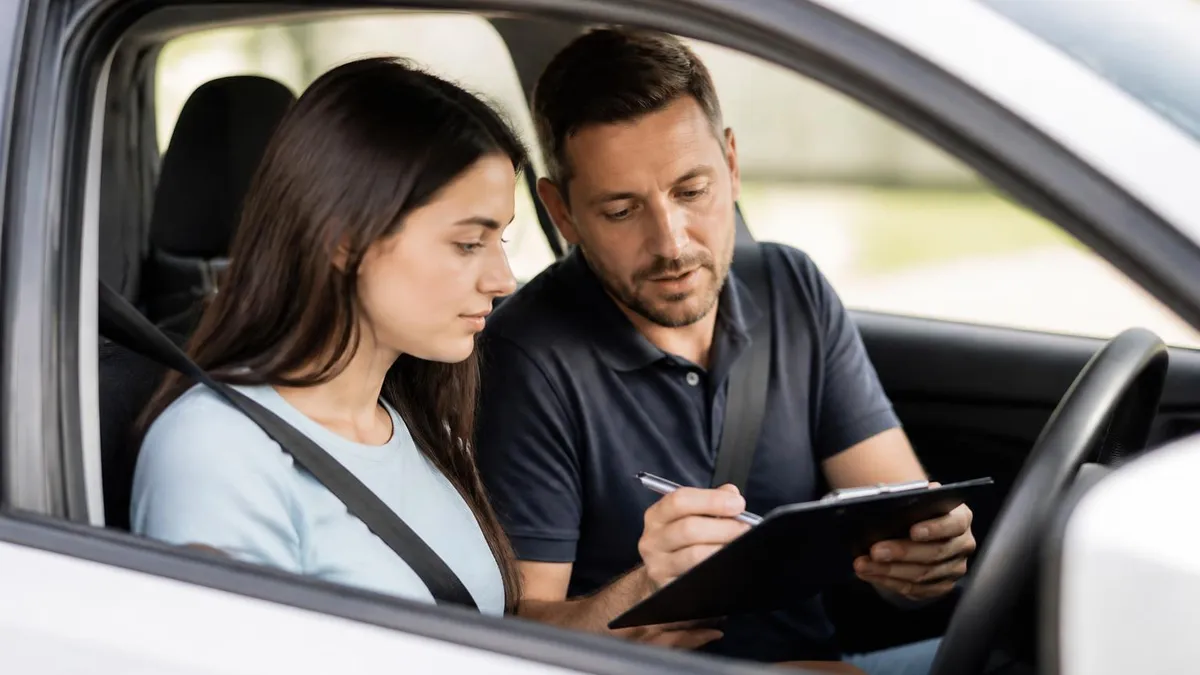
Certain actions end your test instantly regardless of how well you performed up to that point. These include any examiner intervention with the steering wheel or brakes, striking a curb or object, refusing to follow examiner directions, dangerously exceeding the speed limit, or causing another vehicle to brake or swerve to avoid you. Treat every action with care.
Test day strategy begins the night before with adequate sleep and a light, familiar breakfast the morning of. Avoid heavy caffeine if you are prone to jitters, and skip energy drinks entirely. Eat enough to maintain steady blood sugar through a potentially long wait at the BMV. Wear comfortable shoes with thin soles that let you feel the pedals — chunky boots, sandals, and high heels are all poor choices that can subtly impair pedal control during precision maneuvers like parallel parking.
Arrive thirty to forty-five minutes early to give yourself time to acclimate to the BMV branch atmosphere. Use this buffer to walk around your vehicle one more time, confirming all lights work, the registration is in the glove compartment, and your insurance card is easily reachable. Many candidates schedule a brief practice session in the BMV parking lot itself during this window, running through parallel parking on the lot's painted lines or completing a quick three-point turn at the edge of the lot.
When the examiner approaches your vehicle, greet them politely, hand over requested documents, and listen carefully to their instructions about the test route. They will explain how directional commands work — typically "turn right at the next intersection" or "take the second left." Repeat instructions back if you are uncertain. Examiners are not your enemy; they want you to succeed and will give clear, professional guidance throughout the test. Treating them with respect creates a more relaxed dynamic.
During the test itself, drive the way you would in everyday traffic — not faster to impress, not slower to be safe. Maintain the posted speed limit, signal every turn and lane change, scan mirrors every five to eight seconds, and verbalize observation steps quietly. If you make a small error, do not apologize or draw attention to it. Continue driving normally and let the examiner score it without commentary. Excessive apologies signal nervousness and may prompt closer scrutiny on subsequent maneuvers throughout the remainder of the route.
One often-overlooked tip is to florida permit specific BMV branch's typical test routes in advance. Test routes are generally not published officially, but local driving schools and online forums frequently share crowd-sourced maps of common patterns. Driving these streets several times during regular practice helps you anticipate tricky intersections, school zones, and merge points. The familiarity removes a layer of cognitive load on test day, freeing your attention for the actual driving skills being evaluated by the examiner.
If you pass, the examiner will direct you back inside for license processing, photo capture, and fee payment. Some states issue a paper temporary license immediately while mailing the permanent card within two weeks. If you do not pass, ask the examiner to walk through your scoring sheet so you understand exactly which categories cost you points.
Take notes, schedule a retake at the earliest available date — usually one to two weeks later — and target your remaining practice on the specific weaknesses identified. Reviewing the schedule road test mva maryland guide can help you secure the soonest available retake slot.
Above all, remember that the BMV driving test is a snapshot of one twenty-minute window of your driving life. Tens of millions of Americans have passed this exact test, and millions more have failed once or twice before earning their license. A dmv test is not a verdict on your overall ability — it is simply feedback about which specific skills need more repetition before the next attempt. Approach the retake with the same calm preparation, and the second time around will feel dramatically more manageable.
The final week before your driving test driving appointment is when targeted practice yields the biggest gains. Resist the urge to drive aimlessly around your neighborhood — instead, build a structured schedule that hits each scored maneuver at least three times per session. Monday and Tuesday should focus on parallel parking and three-point turns in empty parking lots. Wednesday should shift to residential lane discipline and intersection observation. Thursday should rehearse merging and lane changes on moderate-traffic roads. Friday should be a full mock test with a supervising adult playing examiner.
Recording yourself driving from a smartphone mounted on the dashboard can reveal habits you do not realize you have. Watch for hand placement on the wheel, head movement during mirror checks, foot transitions between pedals, and visible signal timing. Many candidates discover they have been making fast, casual mirror glances that examiners would never count as proper observation. A two-second deliberate mirror check is far more effective than five quick darts of the eye that an examiner sitting beside you cannot see clearly.
Build a list of your three weakest skills and dedicate at least one practice session entirely to those areas. If parallel parking gives you trouble, find an empty curb with traffic cones and run the maneuver twenty times in a row. If lane changes feel rushed, practice on a divided road during off-peak hours, executing one every quarter mile until the five-step sequence becomes automatic. Deliberate repetition of weak areas always beats general practice that reinforces what you already do well.
Mental rehearsal is a surprisingly effective tool the night before your test. Close your eyes and walk through the entire test from arrival at the BMV through driving home with your new license. Visualize the examiner greeting you, the pre-drive inspection, pulling out of the lot, completing each maneuver smoothly, and returning to the lot for the debrief. Sports psychologists have used this technique with elite athletes for decades, and it works equally well for first-time test takers facing performance anxiety on test day.
On the morning of the test, give yourself a final fifteen-minute driving warm-up before heading to the BMV. Drive to a quiet area, complete a parallel park, a three-point turn, two lane changes, and a few stop sign intersections. This warm-up loosens any morning stiffness, reactivates your pedal calibration, and confirms that your vehicle is functioning properly. Arriving at the BMV already in driving mode beats stepping into the car cold after a thirty-minute drive in the passenger seat with a parent at the wheel.
If anxiety is a known issue for you, consider scheduling your test for mid-morning rather than first thing in the morning or late afternoon. The 10 a.m. to 11 a.m. window tends to have the calmest traffic conditions, the most rested examiners, and the least likelihood of weather complications. Avoid Monday mornings and Friday afternoons when BMV staff are either ramping up or winding down. Tuesday, Wednesday, and Thursday consistently report the highest first-time pass rates across multiple states.
Finally, remember to thank your examiner regardless of the outcome. These professionals administer dozens of tests per day under often stressful conditions, and a polite word at the end of the evaluation costs you nothing while leaving a positive impression. If you do need to retake the test, you may end up with the same examiner the second time around, and they will remember candidates who behaved respectfully. Treat the entire experience as a professional interaction, and you will find the process less intimidating than its reputation suggests.
BMV Questions and Answers
About the Author
Licensed Driving Instructor & DMV Test Specialist
Penn State UniversityRobert J. Williams graduated from Penn State University with a degree in Transportation Management and has spent 20 years as a certified driving instructor and DMV examiner consultant. He has personally coached thousands of applicants through written knowledge tests, skills assessments, and commercial driver licensing programs across more than 30 states.
Join the Discussion
Connect with other students preparing for this exam. Share tips, ask questions, and get advice from people who have been there.
View discussion (9 replies)