
DMV Road Test Practice Exam: Complete Guide to Passing Your Driving Test in 2026 October
Master the DMV road test practice exam with our complete 2026 October guide. Real maneuvers, scoring criteria, study schedule, and free practice questions. 💯
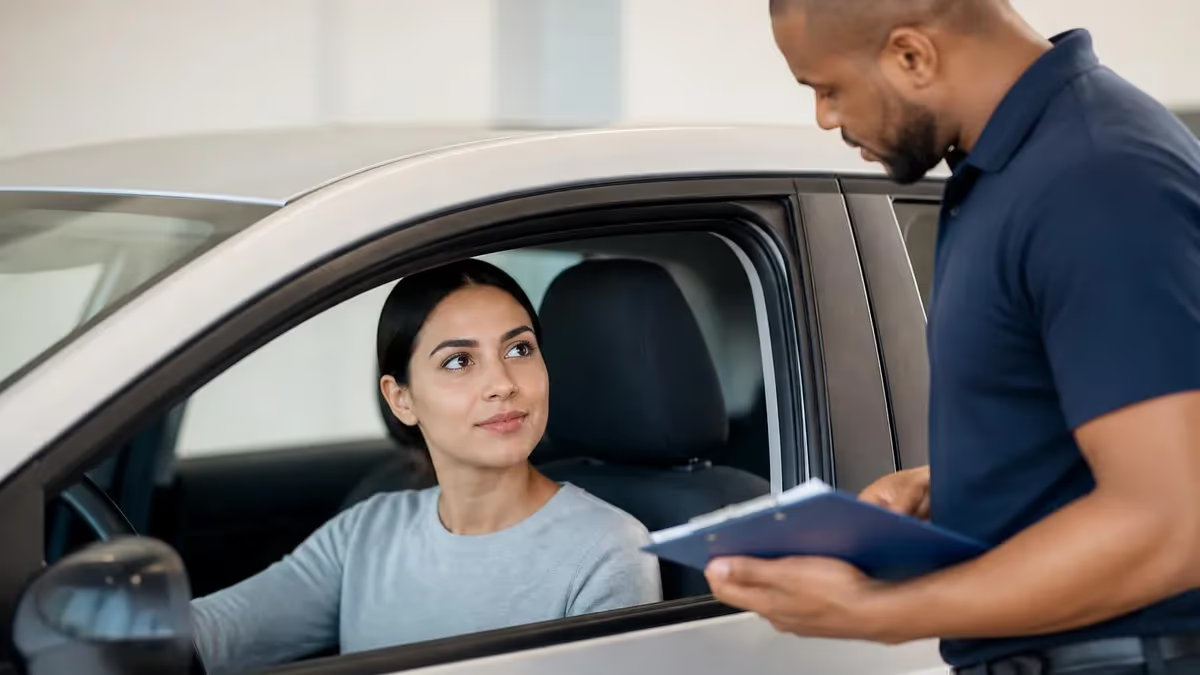
The dmv road test practice exam is the single most important preparation tool standing between you and a driver's license in 2026. Unlike the written knowledge test, the road test evaluates how you actually operate a vehicle in real traffic, under the watchful eye of a state examiner who is grading every lane change, every mirror check, and every parallel parking attempt. Roughly half of first-time test takers fail nationwide, and the reasons are remarkably consistent: nerves, missed mirror checks, rolling stops, and shaky parking maneuvers.
This complete guide walks you through everything you need to know about the behind-the-wheel driving exam, from what examiners look for to how scoring actually works in your state. We'll cover the maneuvers you must perform, the automatic-fail mistakes that end your test in seconds, the documents you have to bring, and the vehicle requirements that catch unprepared applicants off guard at the testing window.
Whether you're a teenager getting your first license, an adult upgrading from a learner's permit, or a new resident transferring an out-of-state credential, the road test follows the same general structure across every state DMV and BMV. Examiners want to see calm, predictable, defensive driving — not racing-school precision. Knowing the rubric is half the battle, and the other half is practice in the exact vehicle you'll test in.
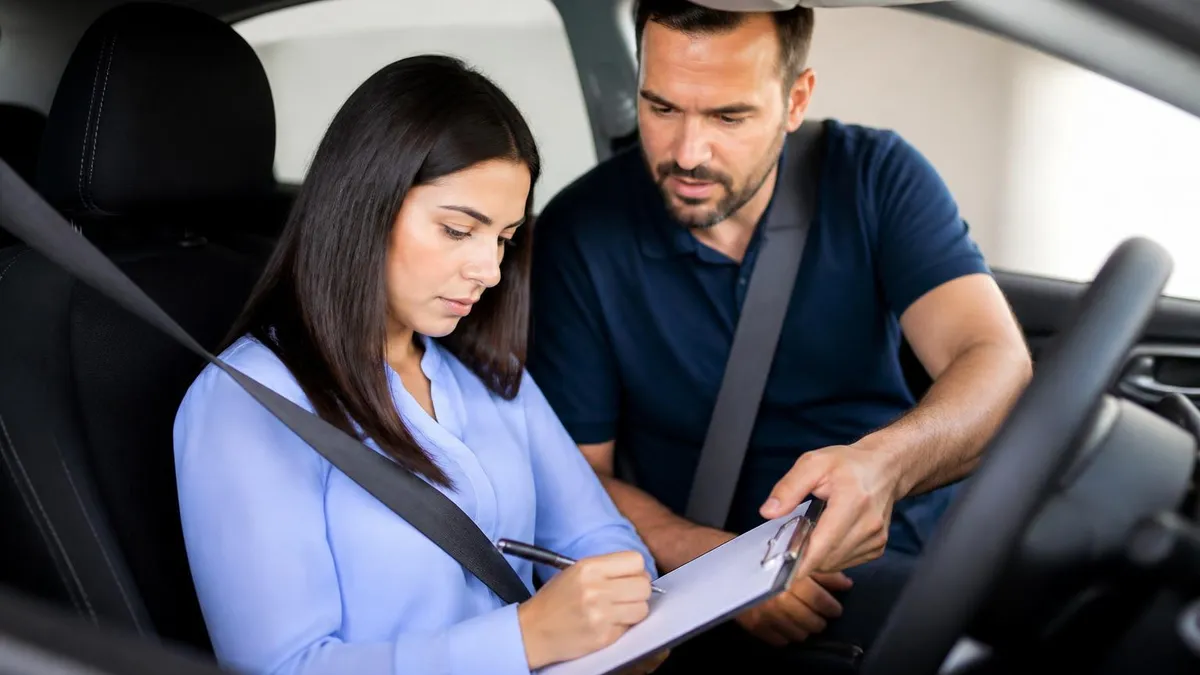
To get oriented, many learners start by reviewing the foundational rules with a BMV Practice Test 2026: Indiana & Ohio DMV Permit Study Guide, which covers the written-exam fundamentals you'll need to demonstrate behind the wheel. The road test assumes you already know the rules of the road; it tests whether you can apply them under pressure while a stranger holds a clipboard in your passenger seat.
You'll learn how the examiner scores your performance on a points-deducted system, why some errors cost you 2 points while others end the test immediately, and how to prepare a study schedule that builds skill without burning you out. We'll also break down regional variations — some states require parallel parking, some require highway driving, and a handful test three-point turns on narrow residential streets.
By the end of this guide, you'll have a clear study plan, a checklist of documents and vehicle items, and the confidence that comes from knowing exactly what to expect when you pull up to the testing center on exam day. Treat this as your roadmap; treat the practice exam as your rehearsal; and treat exam day as the final performance of skills you've already mastered.
One last note before we dive in: every state's specific requirements differ slightly. We'll point out the most common variations, but always confirm with your local DMV or BMV office a week before your appointment so nothing surprises you at the curb.
DMV Road Test by the Numbers
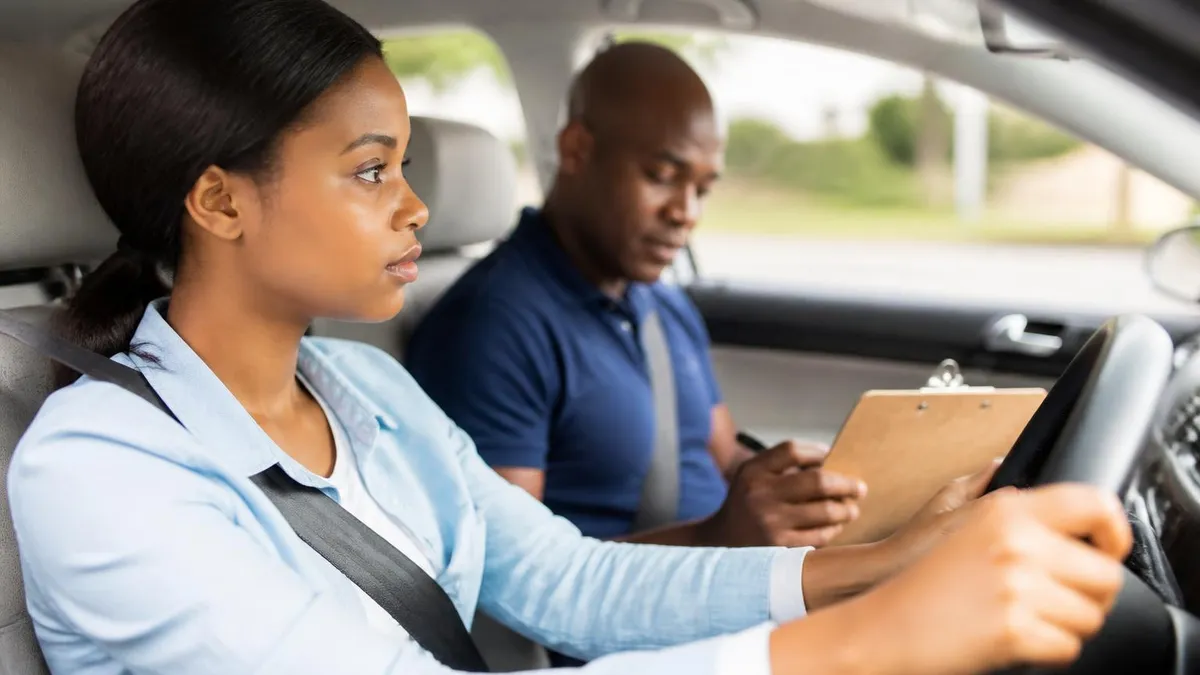
What Happens During Your Road Test
Vehicle Inspection
Pre-Drive Skills
Basic Maneuvers
Parking Skills
Traffic Driving
Return & Debrief
Understanding the required maneuvers is the foundation of any successful dmv road test practice exam strategy. Every state tests a slightly different mix, but the core skills overlap almost universally: controlled stops, proper turns, lane changes with mirror-and-shoulder checks, parking maneuvers, and defensive observation. Mastering these in your practice sessions is far more valuable than memorizing trivia about uncommon road signs.
The controlled stop is deceptively simple. Examiners want to see you slow gradually, come to a complete halt with the front bumper behind the stop line, and pause for two full seconds before proceeding. Rolling stops are one of the top three reasons people fail nationwide. Practice counting "one-Mississippi, two-Mississippi" at every stop sign during your supervised driving hours so the rhythm becomes automatic on test day.
Turns require a coordinated sequence: signal at least 100 feet in advance, check your mirrors, glance over your shoulder for cyclists or pedestrians, slow to an appropriate speed, and execute the turn from the correct lane. Right turns should hug the curb without crossing into oncoming traffic, while left turns should enter the leftmost legal lane of the cross street. Examiners deduct points for wide swings, late signaling, and failure to check blind spots.
Lane changes are where overconfident drivers lose surprising numbers of points. The procedure is signal, mirror, shoulder-check, signal off — in that exact order. Skipping the shoulder check is a near-universal deduction even when no other vehicle is present. Examiners are testing your habits, not just your immediate safety, so perform every check visibly and deliberately even when the road appears empty.
Parallel parking causes more anxiety than any other maneuver, but the geometry is predictable. Pull alongside the front vehicle with about two feet of separation, align your rear bumpers, turn the wheel hard right (in right-hand parking), back up until your front door handle aligns with the rear vehicle's bumper, straighten the wheel, then turn hard left to bring your car parallel to the curb. Practice until you can do it without conscious thought.
Three-point turns and backing maneuvers test your ability to control the vehicle in reverse and handle tight spaces. Use mirrors and turn your head to look directly behind you — never rely solely on the rearview mirror. If your state requires backing 50 feet in a straight line, practice on an empty parking lot until you can keep the vehicle within a 12-foot lane the entire distance. For more detail on how to book and prepare, see our Schedule Road Test: How to Book Your BMV Driving Test walkthrough.
Defensive observation is the invisible maneuver that ties everything together. Examiners watch your eyes. Are you scanning intersections before entering? Checking mirrors every 5-8 seconds? Identifying hazards before they become problems? Visible head movement signals to the examiner that you're processing your environment actively, and many state rubrics specifically grade observation as a separate scored category.
BMV Practice Test Questions
Prepare for the BMV - Test exam with our free practice test modules. Each quiz covers key topics to help you pass on your first try.
BMV Basic BMV Practice
BMV Exam Questions covering Basic BMV Practice. Master BMV Test concepts for certification prep.
BMV Alcohol, Drugs, and Impaired Driving Laws
Free BMV Practice Test featuring Alcohol, Drugs, and Impaired Driving Laws. Improve your BMV Exam score with mock test prep.
BMV Licensing Requirements
BMV Mock Exam on BMV Licensing Requirements. BMV Study Guide questions to pass on your first try.
BMV Traffic Laws
BMV Test Prep for BMV Traffic Laws. Practice BMV Quiz questions and boost your score.
BMV Vehicle Operations
BMV Questions and Answers on BMV Vehicle Operations. Free BMV practice for exam readiness.
BMV Parking, Right-of-Way, and Intersections
BMV Mock Test covering Parking, Right-of-Way, and Intersections. Online BMV Test practice with instant feedback.
BMV Road Signs and Markings
Free BMV Quiz on Road Signs and Markings. BMV Exam prep questions with detailed explanations.
BMV Safe Driving and Hazard Awareness
BMV Practice Questions for Safe Driving and Hazard Awareness. Build confidence for your BMV certification exam.
How the DMV Road Test Practice Exam Is Scored
Most states use a points-deducted scoring system that begins at 100 and subtracts points for each error observed. Minor errors like a late signal or hesitant lane change typically cost 1-3 points each, while moderate errors such as a rolling stop or wide turn cost 5-10 points. The threshold for failure is usually 30 accumulated points, though some states set it at 20 or 25.
Examiners use standardized rubrics, meaning two different examiners scoring the same drive should produce nearly identical scores. This protects applicants from arbitrary failure but also means there's no room to argue minor deductions afterward. Knowing the rubric helps you focus practice on the highest-value categories: observation, control, and parking maneuvers typically carry the heaviest weight.
Should You Use Your Own Car or a Driving School Vehicle?
- +Personal vehicle feels familiar — you know exactly where mirrors, controls, and blind spots are
- +No rental fee, which can save $50-$150 versus a driving school car
- +You can practice in the exact vehicle you'll test in for weeks beforehand
- +Insurance and registration are already verified and current
- +No scheduling conflicts with the driving school's availability
- +Backup camera and parking sensors (if equipped) may aid parking maneuvers
- +You control the seat position, steering wheel angle, and climate settings
- −If your car fails inspection (lights, signals, tires), your test is canceled and rescheduled
- −No instructor brake or steering controls — examiner must use voice commands only
- −Insurance must explicitly cover the test, and some carriers require notification
- −Mechanical breakdown during the test ends the exam with no makeup opportunity
- −Older vehicles may lack features that make parking easier (cameras, sensors)
- −Your insurance rates could rise if any incident occurs during the test
Pros and Cons at a Glance
| Pros | Cons |
|---|---|
| Personal vehicle feels familiar — you know exactly where mirrors, controls, and blind spots are | If your car fails inspection (lights, signals, tires), your test is canceled and rescheduled |
| You can practice in the exact vehicle you'll test in for weeks beforehand | No instructor brake or steering controls — examiner must use voice commands only |
| Insurance and registration are already verified and current | Insurance must explicitly cover the test, and some carriers require notification |
| No scheduling conflicts with the driving school's availability | Mechanical breakdown during the test ends the exam with no makeup opportunity |
| Backup camera and parking sensors (if equipped) may aid parking maneuvers | Older vehicles may lack features that make parking easier (cameras, sensors) |
| You control the seat position, steering wheel angle, and climate settings | Your insurance rates could rise if any incident occurs during the test |
Pre-Test Checklist for Your DMV Road Test Practice Exam
- ✓Bring valid learner's permit and a secondary photo ID such as a passport or school ID
- ✓Verify vehicle registration is current and not expired on test day
- ✓Confirm proof of insurance is in the glove box and lists you or your guardian
- ✓Test all exterior lights: headlights, brake lights, turn signals, hazards, and license-plate lamp
- ✓Check tire pressure and tread depth — bald or underinflated tires can fail inspection
- ✓Clear the dashboard, seats, and trunk of clutter that could distract or shift during driving
- ✓Ensure all seatbelts function properly, including any back-seat belts the examiner may test
- ✓Top off windshield washer fluid and replace worn wiper blades if streaking is visible
- ✓Bring your appointment confirmation, payment for any required fee, and a face covering if local rules require
- ✓Arrive 30 minutes early to settle nerves, locate the testing area, and complete final paperwork
Most states require documented supervised practice
Before scheduling your road test, most state DMVs require teens to log 50 hours of supervised driving — including at least 10 hours at night. Adult applicants may not face this requirement, but the underlying logic still applies: 50 hours of varied practice (highway, residential, rain, dusk) produces dramatically higher first-time pass rates than the bare-minimum preparation most failed applicants attempt.
Automatic-fail mistakes deserve their own deep dive because a single critical error can end a test you were otherwise passing comfortably. The most common automatic disqualifier is a rolling stop at a stop sign or red light — examiners count to two silently, and if your wheels never fully stop, the test ends. Practice stopping with enough force that your passengers feel a slight forward lean, then count two full seconds before checking traffic and proceeding.
Failing to yield to pedestrians is the second most common automatic fail. In crosswalks, marked or unmarked, pedestrians have the right of way absolutely. Even if a pedestrian steps into the street unexpectedly, you must stop and let them pass. Examiners specifically watch your reaction at every crosswalk and uncontrolled intersection. Defensive scanning — head turning, eye movement — should be visible and deliberate, not subtle.
Speeding more than 10 mph above the limit ends the test instantly in most states, but a more common variant is failing to slow down for school zones, construction areas, or residential streets. School zones often drop to 20 mph and are enforced 30 minutes before and after bell times. Examiners may route you intentionally through these zones to test your awareness of posted signs and conditional limits.
Crossing a solid yellow centerline, even briefly during a wide turn, is grounds for immediate failure. So is striking a curb hard enough that the examiner perceives it as loss of control. Tapping a curb gently during parallel parking is usually a point deduction, not an automatic fail, but slamming into one or driving up onto one will end the test. Practice parking until your spatial awareness is precise.
Examiner intervention is the ultimate automatic fail. If the examiner reaches for the wheel, presses an imaginary brake, or verbally instructs you to take an evasive action, the test is over. This rule protects everyone in the vehicle, but it also means your goal is to never put the examiner in a position where intervention seems necessary. Drive as if your passenger is a nervous parent — calm, deliberate, predictable.
Less obvious automatic fails include driving without your seatbelt, using a phone for any reason during the test, and refusing to attempt a required maneuver. Some applicants ask to skip parallel parking when nerves take over — examiners must mark this as a failure even if you'd otherwise pass. Better to attempt the maneuver and take a deduction than to skip it entirely.
Finally, expired documents and uninsured vehicles cause failure before driving even begins. Examiners verify your permit, insurance card, and registration at the curb. If any document is expired, missing, or unmatched to the vehicle, you'll be sent home to reschedule — often with the test fee forfeited. Double-check everything 48 hours before your appointment.

Some auto insurance policies do not cover unlicensed drivers, even with a learner's permit, unless the policyholder has specifically added the driver. Call your insurance company a week before your appointment, confirm in writing that you are covered for the road test, and bring the insurance card to the testing center. Failure to show valid insurance ends your test immediately.
Day-of-test strategy is where preparation meets performance. The night before, get a full eight hours of sleep — fatigue is a silent killer of road test results. Lay out your documents, set the car keys somewhere obvious, and plan your route to the DMV so you arrive 30 minutes early. Rushing into the testing center stresses both you and the examiner, and stress translates directly into mistakes during the first five minutes of your drive.
Eat a real breakfast: protein and complex carbs, not just coffee. Low blood sugar amplifies anxiety and slows reaction time. Avoid excessive caffeine, which can make your hands shake during parallel parking. Hydrate moderately — not so much that you'll need a restroom break mid-test, but enough to keep your focus sharp throughout the 20-minute drive.
When you meet the examiner, introduce yourself, make eye contact, and listen carefully to their instructions. Most examiners give standardized scripts at the start, and missing a key detail (like "pull out when you're ready" versus "pull out immediately") sets a poor first impression. If you don't understand an instruction, ask politely for clarification — examiners would rather repeat than fail you for guessing wrong.
During the drive, narrate your actions silently in your head: "Mirror, signal, shoulder check, lane change, signal off." This internal monologue prevents skipping steps when nerves take over. If you make a small mistake — a late signal, a slightly wide turn — don't dwell on it. Examiners expect a few minor deductions; obsessing over one mistake usually causes two more in the next minute. Reset mentally and drive the next block cleanly.
If the examiner is silent, that's good news. Examiners typically only speak to give directions or correct dangerous behavior. Don't try to make conversation, don't apologize for mistakes, and don't ask how you're doing. Focus entirely on the road. For broader test-prep context, our Learner's Permit Practice Test: Complete Study Guide covers the foundational written-exam topics that directly connect to road-test knowledge requirements.
Handle the toughest maneuvers — usually parallel parking or three-point turns — with extra deliberation. Take a breath before starting, visualize the steps, and execute them slowly. Examiners do not penalize slow, careful maneuvers; they penalize fast, sloppy ones. If you need to pull forward and try again during parallel parking, that's typically a small deduction, not a failure. Better to correct than to leave the car at an unsafe angle.
When you return to the DMV, park where the examiner directs, put the car in park, set the parking brake, and turn off the ignition. These final steps are scored. Wait for the examiner to finish the scorecard before unbuckling. Whether you pass or fail, thank them for their time — professionalism leaves a good impression, and you may see the same examiner again if you need to retest.
Final preparation in the last two weeks before your test should focus on simulation, not new learning. By this point, you've logged your supervised hours and mastered the maneuvers; what remains is replicating test conditions until they feel routine. Have a licensed adult ride with you and grade your performance using a printed copy of your state's actual scoring rubric. Track every deduction over five consecutive drives and target your weakest category for extra practice.
Drive the actual route around your testing DMV if you can identify it. Many testing centers use the same residential streets, the same parking practice areas, and the same routes to nearby parallel parking spots week after week. Local driving schools often share this information freely, and a few practice runs through the actual test area can dramatically reduce day-of anxiety. You'll know which intersections are tricky and which streets have unmarked stop signs.
Practice at the same time of day as your scheduled test. Morning sun glare, afternoon school traffic, and evening dusk all create different driving conditions. If your test is at 10 a.m., practice between 9 and 11 a.m. for the final week so your body adapts to that energy level and traffic pattern. This sounds trivial but produces measurable performance improvements for nervous test takers.
Use mental rehearsal — visualization techniques used by athletes and surgeons — for 10 minutes daily in the final week. Close your eyes and walk through every step of the test from arrival to debrief. See yourself signaling, checking mirrors, completing parallel parking smoothly, and receiving a passing scorecard. Sports psychology research consistently shows visualization improves real-world performance on rehearsed motor tasks.
Run through your vehicle inspection checklist the morning of the test, not the night before. Lights can burn out overnight, tires can lose pressure, and battery issues can develop while the car sits. A morning inspection takes five minutes and catches problems while you still have time to swap vehicles or call your driving school for a backup car. Most failures from vehicle issues are entirely preventable.
Manage your nerves with breathing exercises during the wait at the DMV. Box breathing — inhale four counts, hold four, exhale four, hold four — activates your parasympathetic nervous system and drops your heart rate within two minutes. Repeat the cycle five times before your name is called. This single technique has been used by combat pilots, ER physicians, and Olympic athletes; it works just as well for nervous teenagers in DMV waiting rooms.
Finally, trust your preparation. If you've logged 50+ supervised hours, completed multiple practice exams, and mastered every required maneuver, you've already done the hard work. The road test is simply a 20-minute demonstration of skills you possess. Walk in expecting to pass, drive the way you've practiced, and accept whatever scorecard the examiner produces. Most well-prepared applicants pass on the first attempt — and those who don't usually pass the retest within two weeks.
Sample BMV Practice Questions
Try these questions from our free BMV practice tests. The correct answer and an explanation follow each question.
How many hours of supervised driving must an Ohio teen permit holder complete before the road test?
- A. 20 hours
- B. 40 hours
- C. 50 hours
- D. 60 hours
Answer: C. 50 hours
Ohio requires 50 hours of supervised driving, including 10 hours at night.
When driving in fog, you should use your:
- A. Low-beam headlights
- B. High-beam headlights
- C. Parking lights only
- D. Hazard lights while moving
Answer: A. Low-beam headlights
Low beams reduce glare and give better visibility in fog than high beams.
What does a solid yellow line on your side of the road mean?
- A. No passing — you cannot cross this line to pass another vehicle
- B. Passing is allowed with caution
- C. The lane is for emergency vehicles only
- D. The road is under construction
Answer: A. No passing — you cannot cross this line to pass another vehicle
A solid yellow line on your side means passing is prohibited in your direction. A broken yellow line means passing is allowed if safe. Double solid yellow lines mean no passing in either direction.
If you are driving at 60 mph, approximately how many feet does your vehicle travel per second?
- A. 44 feet
- B. 60 feet
- C. 88 feet
- D. 120 feet
Answer: C. 88 feet
At 60 mph a vehicle travels roughly 88 feet per second, calculated by multiplying mph by 1.47.
BMV Questions and Answers
About the Author

Licensed Driving Instructor & DMV Test Specialist
Penn State UniversityRobert J. Williams graduated from Penn State University with a degree in Transportation Management and has spent 20 years as a certified driving instructor and DMV examiner consultant. He has personally coached thousands of applicants through written knowledge tests, skills assessments, and commercial driver licensing programs across more than 30 states.
Join the Discussion
Connect with other students preparing for this exam. Share tips, ask questions, and get advice from people who have been there.
View discussion (9 replies)