
BMV New Jersey Driver's License Test — Complete Guide (2026 October)
💡 NJ knowledge test guide: 50 questions, 80% to pass, $11 fee. Real topics, sample questions, MVC steps, and free knowledge test practice nj.
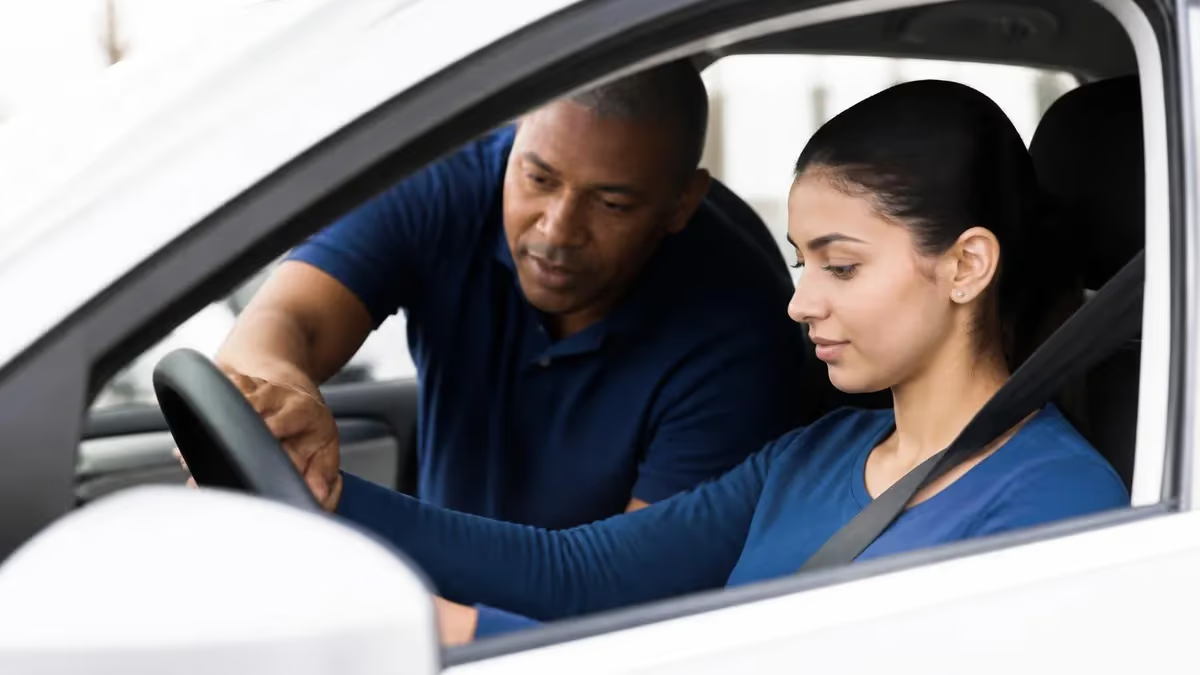
Here's the short version. The New Jersey knowledge test is 50 multiple-choice questions, you need 40 right to pass (that's 80%), and the MVC charges $11 to take it. Miss too many, and you wait at least seven days before retesting. That's the deal — short, strict, and easier to fail than most teenagers expect.
Most people walk in cold. They flip through the manual on the drive over, guess on the road-sign questions, and leave humiliated. The pass rate at busy agencies like Newark, Edison, and Bayonne sits well under 60% on a typical day. The questions aren't trick questions. They're just specific — exact distances, exact fines, exact rules about who yields at a four-way stop with a school bus involved.
This guide walks you through what's actually on the test, the MVC steps before and after, the documents you need (six points of ID — and the MVC does count points), and how to study without burning a weekend. There's also a section on the road test, since most people Google one and end up needing both. If you'd rather drill questions right now, jump to our nj dmv practice test and run through a full timed round before you read any further.
One thing worth knowing up front. New Jersey doesn't call it the DMV anymore — hasn't for years. The agency is the Motor Vehicle Commission, or MVC. People still type "NJ DMV" into Google because the habit dies hard. Both terms point to the same place: the offices that handle licenses, registrations, and the knowledge test you're about to take. Whether you saw it called dmv license test or NJ MVC test, it's the same exam.
If you're under 17, you'll take this as part of the Graduated Driver License (GDL) program — permit at 16 with a driver's-ed course, road test at 17 after six months of supervised driving. Adults (21+) skip the GDL hold periods but still take the same knowledge exam. The questions don't change based on your age. The rules around what you can do with the license you earn — those do.
Questions: 50 multiple choice (covers road signs, safe driving, NJ traffic laws)
Passing score: 40 out of 50 — that's 80%
Fee: $11 (knowledge test + permit, paid at the MVC)
Retake wait: 7 days if you fail
ID required: 6 points of identification — plus proof of address
Time limit: No strict timer, but most finish in under 30 minutes
Where: Any NJ MVC licensing center — no appointment for the test itself, but bring patience for the wait
NJ Knowledge Test by the Numbers
Key Facts at a Glance
| Item | Value | Details |
|---|---|---|
| Multiple-choice questions on the test | 50 | |
| Minimum score to pass (40 out of 50) | 80% | |
| Fee for the permit and knowledge test combined | $11 | |
| Minimum age (with parent consent and driver's ed) | 16+ |
What the NJ Knowledge Test Covers
Stop, yield, regulatory, warning, guide, construction. Color codes matter — orange means construction, yellow means warning, green means guide. About 12-15 of your 50 questions hit this category, and people lose easy points by skipping the manual chapter.
Four-way stops, uncontrolled intersections, emergency vehicles, school buses with flashing reds. NJ-specific: when a bus stops on a divided highway, oncoming traffic may proceed with caution if there's a physical barrier. Know the exceptions cold.
BAC limits (0.08% adult, 0.01% under 21, 0.04% commercial), implied consent, refusal penalties. Expect 4-6 questions. New Jersey has zero tolerance for under-21 drivers — refuse a breathalyzer and you lose your license automatically.
Following distances (3-second rule, doubled in rain, tripled on ice), blind spots, merging, passing on multilane highways, hydroplaning recovery. Practical questions — your driver's-ed videos covered most of this, but the manual phrasing is specific.
How many feet from a fire hydrant (10), from a crosswalk (25), from a stop sign (50). Parallel parking rules. Where you can't park: bridges, tunnels, in front of driveways, on sidewalks. NJ writes these as 'choose the correct distance' questions — memorize the numbers.
Turn signals, headlight use (required dusk-to-dawn and in rain/snow/fog), mirror adjustment, seat belts (required for all occupants in NJ), child restraints (rear-facing under 2, booster until 8 or 57 inches). Detail-heavy, easy points if you read the chapter.
Before you walk into the MVC, you need six points of identification. New Jersey runs a points-based ID verification — different documents are worth different amounts, and the total has to reach six. A passport alone is worth four points. A birth certificate is three. A Social Security card is one. Mix and match until you hit six, then bring proof of New Jersey address on top.
This catches people. A teenager shows up with their school ID (one point) and a learner's permit application form (zero points, since the permit is what you're getting) and gets sent home. Adults sometimes bring an expired out-of-state driver's license (one point) plus a utility bill (proof of address, but not ID points) and get the same treatment. Check the MVC's six-point list the night before. Don't guess. The clerk at the counter won't bend the rules.
Proof of address has to be in your name. A bank statement, a utility bill, a lease, a W-2, recent mail with a postmark. Two separate items. If you live with parents, you can use their utility bill plus a notarized letter from them confirming you live there. The MVC publishes the full list online — verify your specific situation matches before you drive over. For a fuller walkthrough of the prep steps, the dmv permit test overview maps the same flow with photos and screenshots.
If you're under 18, you also need parental consent. There's a form (BA-208) the parent signs in person at the MVC — they have to physically show up. Plan that into your visit. A parent who's at work in Princeton can't sign electronically while you're at the Trenton MVC. Many families schedule the trip together on a Saturday morning to handle this in one visit.
If you've completed driver's ed at your high school or a licensed driving school, bring the certificate. New Jersey requires six hours of behind-the-wheel instruction before you can take the road test, but the certificate itself doesn't affect your knowledge test eligibility — it affects your road test eligibility months later. Still, bring it if you have it. The MVC will note the completion in your file.
Six-Point ID — Document Combos That Work
4 points: Valid U.S. passport or passport card
1 point: Social Security card (must be original, not laminated)
1 point: Auto insurance ID card or college transcript
Total: 6 points
This is the cleanest route for adults. A passport handles most of the ID burden in one document. The Social Security card is required for everyone — there's no substitute for it under NJ's verification rules. Add any single additional document worth one point to finish.
Studying for the NJ knowledge test starts with the manual. Download the current PDF from the MVC website — the 2026 edition runs about 100 pages, but you don't need to memorize all of it. Focus on chapters covering traffic laws, road signs, alcohol/drug rules, and safe driving. Skim the chapters on vehicle maintenance and emergencies. The exam questions follow the manual closely; what's not in the manual won't be on the test.
Read once, then quiz yourself. The MVC publishes sample questions on its site, and several free practice tests mirror the real exam format. A solid 4-6 hours of focused study spread over a week beats one panicked 8-hour cram session the day before. Spaced repetition works for road signs especially — your brain anchors visual content faster when reviewed across multiple days. Try a quick round of permit test questions after every chapter so the concepts stick.
The road-sign chapter is where most failures happen. New Jersey loves to ask about regulatory signs (the white rectangles with black text — speed limits, no-turn rules, lane-use signs) and warning signs (yellow diamonds — curves, intersections, school zones). Learn the shapes too. An octagon always means stop, a triangle pointing down always means yield, a pennant means no passing. The shape alone often tells you the answer even if you can't read the text.
Don't ignore the alcohol section. Even if you're 16 and don't drink, NJ throws BAC questions at every test-taker. Memorize 0.08% as the adult legal limit, 0.04% for commercial drivers, and 0.01% as the zero-tolerance limit for anyone under 21. Know that refusing a breath test in NJ carries the same penalty as testing over the limit (seven months minimum suspension). The questions are specific and the manual covers them clearly — but you have to read that chapter.
Practice tests serve a second purpose beyond knowledge check — they get you comfortable with the question format. NJ exams phrase things in ways the manual doesn't. The manual says "you must stop at least 25 feet from a crosswalk." The test asks "How far from a crosswalk must you park?" with four numeric options. Same fact, different angle. Repetition trains your brain to spot the question pattern. Try the dmv written test practice for full-length timed runs.

Day-Before MVC Prep Checklist
- ✓Six-point ID assembled — verified against the MVC list (not guessed)
- ✓Two proofs of NJ address — different documents, both within validity window
- ✓Social Security card located (original, no lamination, no photocopy)
- ✓$11 fee ready — cash, check, or card (some smaller MVC offices are cash-only on the test fee)
- ✓Reading glasses if you wear them — vision check happens at the counter before the test
- ✓Driver's-ed certificate if completed (smooths road-test eligibility later)
- ✓Parent or guardian arranged if under 18 — they must physically attend
- ✓MVC office hours and location confirmed — closures happen, especially during holidays
- ✓Final practice test scored 90%+ — anything lower means more study, not test day
- ✓Eat breakfast — the wait at busy MVC offices can hit two hours before you even start
Test day moves slower than you expect. The MVC handles everything from license renewals to registration transfers to commercial driver paperwork, so the line you join might have nothing to do with your knowledge test. Pull a ticket from the kiosk for "License Services" or "Initial Permit" — the exact label varies by office. Bigger urban offices like Newark, Bayonne, and Edison routinely run two-hour waits on Saturdays. Smaller offices like Flemington or Cape May Court House clear in 30 minutes most weekdays.
When your number is called, you'll go to a counter. The clerk verifies your six points, takes your photo, processes the $11 fee, and hands you a paper testing slip or routes you directly to a testing terminal. Newer offices use touchscreens; older ones still use paper-and-bubble Scantron sheets. Either way, the test itself runs the same — 50 questions, multiple choice, take as long as you need within reason.
You can't go back and change answers on most NJ MVC terminals. The questions advance one at a time, and once you submit, your selection is locked. If you're not sure, take an extra ten seconds before tapping. Manual scoring on paper tests does allow erasures, but check the proctor's instructions when you sit down — rules vary by office. For an idea of what a similar walk-through process looks like, see our learners permit practice test rundown.
Results print immediately at most offices. Pass, and you walk out with a temporary paper permit that day — the laminated card arrives in the mail within two weeks. Fail, and you're scheduled for a retake at least seven days later. The MVC doesn't tell you which specific questions you missed, just how many. Common feedback: "You scored 35 out of 50. Study chapters 3, 4, and 7." Use that — don't just retake without restudying. The retake fee is another $11.
If your test is in Spanish, the MVC offers it. Other languages including Arabic, Russian, Chinese, Korean, Polish, French, and Portuguese are also available at most offices. Request the language version when you check in. The questions translate directly — same content, same passing score, same retake rules. Audio versions exist for test-takers with reading disabilities; bring documentation to request accommodation.
Studying With the Manual vs Practice Tests
- +Builds genuine understanding of NJ traffic rules — useful once you're driving
- +Catches details that practice questions don't always cover
- +Best for visual learners — diagrams, signs, and illustrations help retention
- +Free PDF from the MVC website — no signup or paywall
- +Covers situations like roundabouts and zipper merges that catch new drivers off guard
- −Faster path to a passing score — drills get you familiar with question style
- −Identifies your weak chapters before you waste time studying what you know
- −Time-pressure simulation helps test-day nerves
- −Most free practice sites pull from the same NJ question bank the real test uses
- −Better for kinesthetic learners — repetition with feedback beats reading
Some questions ambush almost every first-timer. Following distance, for instance. The manual says three seconds in good conditions. Most people remember that. What trips them up is the follow-up: how many seconds in rain? (Six.) On ice? (Nine, or pull over if at all possible.) The test loves the wet-and-icy follow-up because it separates people who memorized the headline from people who actually read the chapter.
Another common ambush — school bus rules on divided highways. On a regular two-lane road, all traffic in both directions stops when a school bus flashes red. On a divided highway with a physical barrier (median strip, guardrail, grass), oncoming traffic may proceed with caution. People answer this wrong because the rule has an exception, and exam-takers default to "always stop, always safer." Read the actual text. Memorize the exception.
Right-of-way at uncontrolled intersections (no stop signs, no traffic lights) is the third question type that catches people. The car on the right has the right of way when two cars arrive at the same time. When one car arrives first, that car goes first regardless of which direction it's facing. Simple-sounding, but the questions throw in three cars at a four-way intersection and ask who goes first. Diagram it on scratch paper if you can — most MVC testing terminals will let you.
Speed limits in different zones get tested too. NJ default urban speed limit is 25 mph. School zones default to 25 mph when children are present. Residential streets without posted signs default to 25 mph. Rural highways default to 50 mph. Interstate highways post their own limits, typically 65 or 70 mph. When in doubt, the test answer is almost always "the posted limit" — but you should know the defaults for when no sign is shown. Anyone who's worked through our drivers permit test rundown sees these patterns repeat across most state DMV exams, NJ included.
And finally, parking distances. These are pure memorization — there's no logic to extract. Fire hydrant: 10 feet. Crosswalk: 25 feet. Stop sign or yield sign: 50 feet. Fire station driveway: 75 feet on the same side, 20 feet on the opposite side. The test loves these because they're factual, easy to score, and you either know them or you don't. Make flashcards if you have to.

From Permit to Full License — The NJ GDL Path
Age 16
Months 1–6
Age 17
Probationary License
Age 18 (or 1 Year After Probationary)
The road test deserves its own conversation since it's the next hurdle after you pass the knowledge exam. NJ runs road tests at MVC inspection facilities — separate locations from the licensing centers where you took the written portion. You schedule the road test online through the MVC portal after you've held the permit for at least six months (under 18) or six months (adults too, technically, though enforcement varies for older applicants).
Bring a registered, insured vehicle with valid inspection — the examiner will check the paperwork and refuse to test you if anything's missing. The car must have working signals, brakes, horn, and seatbelts. Common reasons for road-test cancellation: expired registration, missing insurance card, broken brake light. Verify everything the morning of. Show up 15 minutes early — late arrivals get rescheduled.
The road test takes about 30 minutes. The examiner sits in the passenger seat and gives you turn-by-turn directions. You'll demonstrate parallel parking (between two cones, not real cars), a three-point turn (K-turn), starting on a slight hill if the route allows, and general traffic-law compliance. Major errors fail you on the spot. Minor errors accumulate. Hit too many minor points (varies by examiner, generally 30 demerits) and you fail too.
Common road-test fails: parallel parking too far from the curb (must be within 6 inches), not checking blind spots before lane changes, accelerating too aggressively into intersections, or coming to incomplete stops at stop signs. The examiner watches your head movements — they want to see you visually check mirrors and blind spots before every maneuver. Exaggerated head turns help. The road test guide covers the full scoring rubric and what each examiner watches for.
Pass, and you receive your probationary license immediately (or full license if you're 21+). Fail, and you wait at least two weeks for a retake, with another scheduling fee. NJ doesn't charge a retest fee per se, but you'll need to pay for the road test scheduling slot again. About 60% of first-time road test takers pass.
The numbers improve dramatically when test-takers spent the six-month permit period actually driving — not just letting the calendar tick by. Practice in different conditions. Drive at night. Drive in rain. Take a highway trip with a parent. Try unfamiliar neighborhoods. The examiner won't deliberately throw curveballs, but the test route includes whatever the local traffic does that day — sudden lane closures, aggressive merging from other drivers, construction detours. Drivers who only practiced on empty Sunday-morning streets get rattled when real traffic shows up.
Bring the same car you've been practicing in. A surprise rental or a parent's unfamiliar SUV adds anxiety you don't need. Adjust your mirrors and seat before the examiner gets in — fumbling with controls mid-test loses points. And remember: the examiner wants you to pass. They're not looking for reasons to fail you. Drive how you've been practicing, signal everything, check your mirrors, and you'll be fine.
NJ License Costs — What You'll Pay
NJ requires GDL drivers (under 21 on permit or probationary license) to display reflective decals on both license plates. The decals cost $4 from the MVC and identify you to police as a restricted driver subject to passenger and curfew rules. Driving without them — even on day three of holding your permit — is a $100 ticket. Most teenagers forget about this until pulled over. Buy the decals the day you pick up the permit. Stick them on before you drive home.
Sample BMV Practice Questions
Try these questions from our free BMV practice tests. The correct answer and an explanation follow each question.
A driver who is turning left must yield to:
- A. Pedestrians only
- B. Oncoming traffic and pedestrians
- C. Nobody
- D. Vehicles behind them
Answer: B. Oncoming traffic and pedestrians
When turning left, you must yield to oncoming traffic and to pedestrians crossing.
A driver approaching a hill or curve should:
- A. Not attempt to pass
- B. Pass quickly before the curve
- C. Pass only if going uphill
- D. Straddle the center line
Answer: A. Not attempt to pass
Passing near hills and curves is dangerous because oncoming traffic may be hidden.
Can a driver be charged with OWI for driving under the influence of a legally prescribed medication?
- A. No, only illegal drugs and alcohol count
- B. Yes, if the medication impairs the ability to drive safely
- C. Only if the BAC is also above the legal limit
- D. Only if the medication is a controlled substance
Answer: B. Yes, if the medication impairs the ability to drive safely
Indiana's OWI law applies to any substance — including legal prescription drugs — that impairs a driver's ability to safely operate a vehicle.
How does alcohol primarily affect a driver's ability?
- A. Improves focus by reducing anxiety
- B. Slows reaction time, impairs judgment, and reduces coordination
- C. Only affects vision at very high BAC levels
- D. Has no measurable effect below 0.05% BAC
Answer: B. Slows reaction time, impairs judgment, and reduces coordination
Even small amounts of alcohol slow reaction time, impair decision-making, and reduce the coordination needed for safe vehicle control.
BMV Questions and Answers
More NJ Driving Test Resources
BMV Practice Test 2026: Indiana & Ohio DMV Permit Study Guide
DMV Permit Test: What to Expect and How to Pass It
Drivers Permit Test: Complete Guide to Passing Your BMV Written Test
Road Test: What to Expect and How to Pass Your Driving Exam
DMV Written Test Practice: How to Study and Pass

Learners Permit Practice Test: Format, Topics, and Effective Use
About the Author

Licensed Driving Instructor & DMV Test Specialist
Penn State UniversityRobert J. Williams graduated from Penn State University with a degree in Transportation Management and has spent 20 years as a certified driving instructor and DMV examiner consultant. He has personally coached thousands of applicants through written knowledge tests, skills assessments, and commercial driver licensing programs across more than 30 states.
Join the Discussion
Connect with other students preparing for this exam. Share tips, ask questions, and get advice from people who have been there.
View discussion (9 replies)