
Red Cross BLS Classes: Course Format, Cost, and Certification Guide 2026
Red Cross BLS classes for healthcare providers: format, cost, exam, skills check, and 2-year certification. Book a class today. 🧠
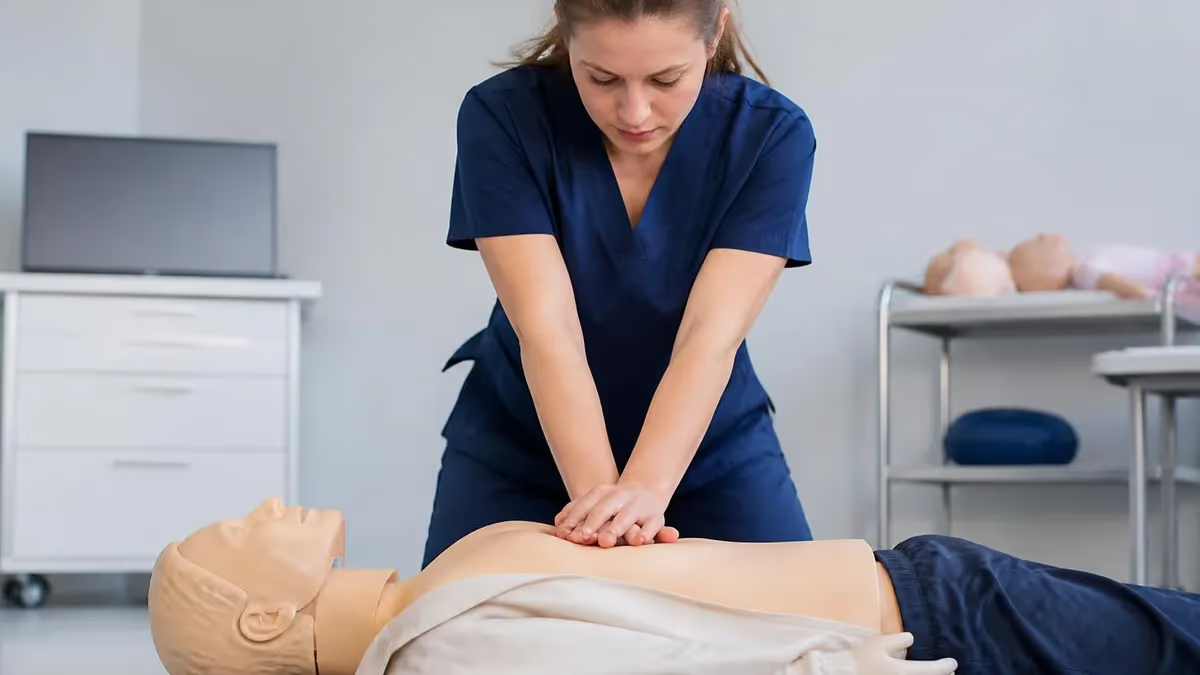
If a manager, recruiter, or instructor told you to "sign up for Red Cross BLS classes," you probably want one straight answer before you spend any money: are these the right classes for your job, and what actually happens once you enroll? This guide walks through the format, the schedule, the cost, the skills you will perform, and the certification you walk out with.
By the end you will know whether to enroll today, where to take a class near you, and how to prepare so the in-person skills check goes smoothly. If you want to compare with other delivery formats, the BLS classes overview covers every common pathway side by side.
Red Cross BLS training is designed for healthcare providers. That is the short version. Nurses, EMTs, paramedics, medical assistants, dental staff, physical therapists, nursing students, respiratory therapists, lifeguards moving into clinical work — these are the people who sit in the room. The course teaches high-quality CPR for adults, children, and infants, two-rescuer team dynamics, bag-valve-mask ventilation, AED use, and relief of choking. It is the same skill set required by hospitals, urgent care chains, and most clinical employers. If your employer's HR portal lists "BLS provider certification" as a hire condition, this class satisfies it.
Classes come in three flavors. The first is a full in-person class, usually four to five hours, where every minute is hands-on or scenario based. The second is a blended course where you complete the lectures, videos, and the multiple-choice exam at home online, then attend a shorter in-person skills session — often two hours. The third is a renewal class for people whose card has not yet expired; it is the shortest path and is also offered as a blended course. All three pathways end the same way: a Red Cross BLS Provider digital certificate valid for two years.
The pricing band is straightforward. Initial blended classes typically run between $80 and $115. Full in-person classes are similar, sometimes a touch higher. Renewals trend $65 to $95. Hospital systems, fire academies, and some employers cover the fee directly or reimburse on submission of the card. If you are paying out of pocket, the blended format gives you the most flexibility because you knock out the cognitive portion at home and only book one short skills appointment in person.
BLS: upcoming dates and official changes
- Mar 1, 2026: AHA required US BLS courses to use the 2025 course materials starting March 1, 2026. (American Heart Association)
Facts verified Oct 15, 2026 against American Heart Association. Dates that have passed are removed automatically.
- The AHA BLS Provider instructor-led course exam contains 25 questions. (American Heart Association)
- The AHA BLS Provider course requires an exam score of at least 84%, alongside successful completion of its practical requirements. (American Heart Association)
- AHA BLS course fees are set by the Training Center offering the training. (American Heart Association)
- American Red Cross BLS course costs vary by course format and location. (redcross.org)
- AHA BLS students are allowed no more than two attempts to pass the online exam administered for the instructor-led course. (American Heart Association)
- The AHA BLS Provider Course Completion Card is valid for two years after all course requirements are completed. (American Heart Association)
- American Red Cross BLS certification is valid for two years. (redcross.org)
- American Red Cross BLS certification is renewed through a BLS recertification course. (redcross.org)
- American Red Cross blended BLS certification combines online coursework with a required in-person skills session. (redcross.org)
Facts verified Oct 15, 2026 against American Heart Association. Dates that have passed are removed automatically.
BLS Exam at a Glance
| Item | Detail | Official source |
|---|---|---|
| Number of questions (AHA BLS Provider — instructor-led) | 25 questions | American Heart Association |
| Passing score (AHA BLS Provider — instructor-led) | At least 84% | American Heart Association |
| Exam fee (AHA BLS Provider) | Set by the Training Center | American Heart Association |
| Exam fee (American Red Cross BLS) | Varies by format and location | redcross.org |
| Retake policy (AHA BLS Provider — instructor-led) | Maximum two attempts for the online exam | American Heart Association |
| Validity (AHA BLS Provider) | Two years | American Heart Association |
| Validity (American Red Cross BLS) | Two years | redcross.org |
| Renewal (American Red Cross BLS) | Complete a BLS recertification course | redcross.org |
| Delivery (American Red Cross BLS — blended learning) | Online coursework plus required in-person skills session | redcross.org |
Facts verified Oct 15, 2026 against American Heart Association. Dates that have passed are removed automatically.

Healthcare Providers and Clinical Students
Nurses, nursing students, EMTs and paramedics, medical and dental assistants, respiratory therapists, physical therapists, physicians, dental hygienists, and lifeguards moving into clinical roles. If your job posting says 'BLS certification required,' a Red Cross BLS Provider card satisfies it. Hospitals, urgent care chains, and outpatient clinics treat Red Cross and AHA BLS cards as equivalent for nearly every clinical role.
Three Class Formats to Choose From
Online lectures, videos, and 25-question exam at home, plus a 2-hour in-person skills check. Most popular pathway. Cost runs $80 to $115. Best for working healthcare staff who need scheduling flexibility around shifts.
Everything in one 4-5 hour session at a training center. Best if you prefer one block of time without homework. Similar price band to blended. Good fit for students who learn better from a live instructor walking through every topic.
For students with a current card. Shorter online portion focused on guideline updates from the past two years, plus an in-person skills check. Cost runs $65 to $95. Renew before expiration to avoid being routed back to the full initial course.
What Class Day Covers
Adult, child, and infant CPR. Two-rescuer team CPR with bag-valve-mask. AED operation including pad placement and clear-to-shock. Choking relief for adults, children, and infants. High-quality compressions at 100-120 per minute, 2 inches deep for adults, with full chest recoil.
What does the day-of look like? Plan for arrival fifteen minutes early with photo ID and, if you took the blended option, your online exam completion certificate either printed or available on your phone. The instructor will check you in, hand out manikins and pocket masks, and start with a quick brief on the day's flow. Almost every minute after that is practice.
You will perform single-rescuer adult CPR, switch to two-rescuer CPR with a bag-valve-mask, run a code on an infant manikin including the two-thumb technique, deliver shocks with a training AED, and clear an obstructed airway on adult, child, and infant. The instructor watches your compression depth, rate, recoil, and ventilation seal. They will correct you in real time — that is the whole point of the in-person session.
The skills you will be graded on are the same skills you would use the very next shift. Adult chest compressions at 100 to 120 per minute, two inches deep, full chest recoil, minimal interruptions. For infants, two thumb-encircling at one and a half inches with the same rate. AED pad placement, "clear" announcements before shock, and immediate resumption of compressions.
For ventilations, a tight mask seal, breaths over one second, visible chest rise without over-inflation. Team dynamics matter: clear role assignment, closed-loop communication, and rotating compressors every two minutes. None of this is memorization. It is reps. If you have not done compressions in two years, expect your arms to feel it, and expect the instructor to push you to deepen and stay on pace.
The written exam is 25 multiple-choice questions. You need 84% to pass, and you may take it online before class (blended path) or at the end of class (full in-person path). The questions are scenario based: someone collapses, a child is choking, an AED arrives, a team member tires — what do you do, in what order, with what depth, at what rate?
If you read the participant manual and watch the official skills videos in the online portion, the test is not a trap. Most students pass on the first attempt. If you miss it, you can retest. Failing the skills check is rare; instructors coach you through it. What does happen occasionally is a student arriving without having watched the online videos for a blended class — the instructor cannot let them perform, and they have to reschedule.

Any course promising a BLS Provider card with zero in-person component is not recognized for healthcare employment. Legitimate Red Cross and AHA pathways always require a live skills check. Hospitals verify card legitimacy through the issuing organization's lookup system — fake cards fail on first inspection. Stick to a Red Cross-issued or AHA-issued program with a real skills session.
Where do these BLS classes actually happen? Red Cross runs them through three channels. Direct Red Cross training locations — chapter offices, partner hospitals, training facilities — appear when you search by ZIP at the official Red Cross site. Authorized Provider organizations are independent training centers licensed to teach the Red Cross curriculum and issue Red Cross cards.
And Licensed Training Providers run programs in-house for their own staff (a hospital training its own nurses, for example). All three issue identical digital cards. The card does not say "from Authorized Provider X" — it says Red Cross BLS Provider with your name, the issue date, and the two-year expiration. The same card type appears whether you arrive through a chapter office or a hospital-based American Red Cross BLS certification session.
Choosing between AHA BLS and Red Cross BLS is a question that comes up almost every week from students. Both are recognized for healthcare provider roles. Both follow consensus guidelines from the International Liaison Committee on Resuscitation. Most US hospitals accept either. The wrinkle: a small number of employers — typically academic medical centers and a few state EMS systems — specify "AHA BLS" in writing.
If your offer letter says "AHA BLS required," do not substitute Red Cross; take the AHA version. If it says "BLS for Healthcare Providers" generically, or simply "BLS certification," Red Cross satisfies it. When in doubt, email HR and ask before you pay. Switching mid-career is not a problem — your next employer accepts whichever current card you carry, as long as it is from an accredited national program.
Card delivery is digital and fast. Once your skills are checked off and the instructor submits the roster, you receive an email with your e-certificate, usually within 24 hours, sometimes within a few minutes. The digital card is QR-verifiable: any employer can scan it and confirm authenticity through the Red Cross certificate lookup. There is no paper card unless you specifically request one. Print a PDF and keep it in your phone wallet; that is what most hospitals expect.
What to Bring to Class Day
- ✓Photo ID for check-in
- ✓Online exam completion certificate (blended path only)
- ✓Comfortable clothes you can kneel in
- ✓Short fingernails (long nails interfere with compressions)
- ✓Watched all skill videos in your online portal
- ✓Skimmed the participant manual
- ✓Practiced compression pace mentally (100-120 per minute)
- ✓Arrived 15 minutes early
How should you prepare? If you booked a blended class, plan two evenings: one to read the participant manual and one to watch the videos. The manual is around 80 pages with diagrams. The videos run roughly 90 minutes total and walk through every skill you will perform on class day. Take the practice questions inside the portal — they are similar to the real exam.
Then take the final 35-question exam when you are ready. If you booked a full in-person class, skim the manual and watch the same videos through your portal if available. Either way, the night before, get sleep and wear comfortable clothes you can kneel and lean over a manikin in. Hospital scrubs are fine. Jeans and a t-shirt are fine. Long fingernails get in the way of compressions; clip them short.
If you are renewing, the work is lighter. Renewal blended classes assume you remember the basics and focus the in-person portion on skills checks and any guideline updates from the past two years. The most recent guideline changes emphasized minimizing interruptions during compressions, refining the post-cardiac-arrest care chain, and clarifying when to use advanced airway devices.
Renewals are usually the same price band as initials or slightly less. You can renew up to your expiration date or shortly after, depending on the location's policy. If your card lapsed more than 30 days ago, some training centers will require you to retake the full initial course rather than a renewal.
Travel a lot, work shifts, live far from a training center? Pure online "BLS certification" courses exist on the open web, but the legitimate Red Cross pathway always requires an in-person skills check. The reason is simple: an employer will not accept a certificate where no human watched you perform compressions on a manikin.
Be skeptical of any course that promises a BLS card without that step. If you see "100% online — no in-person required" on a site claiming to issue a Red Cross or AHA card, that card will not be accepted at a hospital interview. Stick to the blended path: lectures online, skills in person, real card at the end.
Red Cross BLS Pros and Cons
- +Recognized nationally by hospitals, EMS, and clinical employers
- +Blended format means most coursework done at home
- +Two-year validity matches industry standard
- +Digital card delivered fast, QR-verifiable
- +Same scientific guidelines as AHA equivalent
- +Renewals are short and affordable
- −A small number of employers specify AHA only — check the job posting
- −In-person skills check required, no fully online option
- −Class availability varies by ZIP code
- −Lapsed more than 30 days usually means retaking the initial course
Pros and Cons at a Glance
| Pros | Cons |
|---|---|
| Recognized nationally by hospitals, EMS, and clinical employers | A small number of employers specify AHA only — check the job posting |
| Blended format means most coursework done at home | In-person skills check required, no fully online option |
| Two-year validity matches industry standard | Class availability varies by ZIP code |
Booking is simple. Open the Red Cross training search, enter your ZIP, filter to BLS, and the calendar shows every class within a 25-mile radius for the next 60 days. Each entry shows price, format (blended or full in-person), seat count, and the address. Pick a session, pay, and the portal emails you the online portion access immediately if it is blended. Inside the portal, your pre-class work is queued. After class, your digital card lands in the same portal under "Certifications."
If you are working through a hospital, your employer's education department probably runs cohort classes monthly. Ask your charge nurse, clinical educator, or HR. Internal classes often beat the public booking experience because they are scheduled around shifts and paid as work hours. If your facility is a Licensed Training Provider, even better — the class happens on site, you walk down the hall, and the same Red Cross card hits your inbox afterward. Students at nursing programs typically get BLS bundled into a clinical skills semester; your program coordinator will tell you where and when.
Most students who fail their first BLS attempt fail for one of three reasons: compression depth too shallow, compression rate too slow or too fast, or a leaky mask seal during ventilations. Practice on a couch cushion if you have to. Set a metronome at 110 beats per minute and feel that pace. The Bee Gees' "Stayin' Alive" is famous for a reason — it sits inside the 100 to 120 window.
For the mask seal, the E-C clamp is the standard technique: thumb and index finger making a "C" on top of the mask, the other three fingers in an "E" along the jawline. Drill that hand position so it is automatic. The rest of the class — switching roles, using the AED, choking relief — is sequence memorization that the instructor walks you through.
Every Red Cross BLS digital card carries a QR code linking to the official certificate lookup tool. Employers, credentialing offices, and onboarding teams scan or paste your certificate ID to confirm the card is real, current, and issued in your name. There is no need to mail or fax a copy of the card — verification is electronic and instant.
One final note on the certification itself. The Red Cross BLS Provider card is recognized nationally by the major hospital accrediting bodies, state nursing boards, EMS authorities, and federal agencies that require BLS for clinical staff. It satisfies the requirement listed in nearly every healthcare job posting. It is good for two years from the issue date — not from the day you take the class, not from your birthday.
Mark your expiration on a calendar and book the renewal at least four weeks before you lapse, especially if you work in an environment where an expired card means you are pulled from the schedule. Compare the path to other routes like BLS certification online or BLS recertification if your situation calls for something different.
Common scenarios. A new nursing graduate needs BLS before clinical rotations: take the blended initial class, eight to ten days from booking to card. A working RN whose card expires next month: book a blended renewal, three days from booking to renewed card. A medical assistant changing employers and the new system wants a current BLS card: blended initial or renewal depending on whether your old card is still valid.
A dental hygienist switching states: BLS is portable, no need to retake on relocation. A volunteer at a community clinic asked to have a current card: blended initial works fine. A respiratory therapist returning from a parental leave whose card lapsed eight weeks ago: most centers will route you to a full initial rather than a renewal.
What about the exam in more detail? The 25 questions are weighted toward the highest-impact decisions: when to start compressions, when to pause for analysis, when to switch compressors, when to attach the AED, when to ventilate, when to call for advanced support. There is little trivia. There are no obscure pharmacology questions — BLS does not deal with drugs. There are no questions about reading rhythms; rhythm interpretation belongs to ACLS. Stay focused on the BLS algorithms in the manual, the choking flowchart, the high-quality CPR metrics, and the team communication scripts, and the test feels straightforward.
A note on equipment used during the in-person session. Manikins are quality torsos with feedback devices that light up green when your rate and depth are correct. Some centers use older non-feedback manikins; instructors will visually check your performance instead. Training AEDs are non-functional units that simulate the verbal prompts and shock indications without delivering real energy. Pocket masks and bag-valve-masks are sanitized between uses, often with single-use valves swapped per student. Bring your own pocket mask if you prefer, but every training center supplies the equipment included in the fee.
Red Cross BLS classes are the standard healthcare provider pathway delivered through the country's oldest training organization. You complete a blended or full in-person course, pass a 35-question exam and a hands-on skills check, and receive a digital provider card good for two years.
The cost is moderate, the schedule is flexible, and the certification is accepted essentially everywhere a healthcare BLS card is required. If your job calls for it, book a session this week — the calendar always has open seats within a couple of weeks of your ZIP code, and the path from "I need a card" to "card in inbox" usually takes less than ten days.
Booking and Completing the Class
- ✓Open Red Cross training search and filter by BLS + your ZIP
- ✓Choose blended or full in-person format
- ✓Pay and access the online portal immediately for blended classes
- ✓Complete videos, manual reading, and 35-question exam at home
- ✓Attend the in-person skills session at your booked time
- ✓Perform CPR, AED use, choking relief, and bag-valve-mask ventilation
- ✓Receive digital certificate within 24 hours by email
- ✓Set a reminder to renew 4 weeks before the two-year expiration
Sample BLS - Basic Life Support Practice Questions
Try these questions from our free BLS - Basic Life Support practice tests. The correct answer and an explanation follow each question.
What is the main reason BLS courses emphasize simulation and team scenarios during training?
- A. To reduce the number of written tests required for certification
- B. To allow students to practice technical skills only
- C. To build muscle memory and communication habits under realistic stress before real events
- D. To satisfy regulatory requirements for hands-on training hours
Answer: C. To build muscle memory and communication habits under realistic stress before real events
Simulation allows learners to practice both technical skills and team communication under controlled stress, building automatic behaviors that transfer to real emergencies.
A rescuer is performing CPR alone and is too fatigued to continue effective compressions. What is the best course of action?
- A. Switch to rescue breaths only and rest the arms
- B. Continue at a slower rate to conserve energy
- C. Call out for anyone nearby to take over compressions and continue until help arrives
- D. Stop CPR and wait for EMS
Answer: C. Call out for anyone nearby to take over compressions and continue until help arrives
The rescuer should call for someone else to take over while continuing CPR as best they can — stopping CPR significantly reduces survival chances.
You see a teen kid lying on the ground in the hallway where you work at a high school. What is your initial course of action after establishing the safety of the situation?
- A. check for a pulse by palpating a carotid pulse
- B. check for breathing by scanning the victim's chest
- C. begin CPR with chest compressions using two hand technique
- D. check responsiveness by tapping the victim's shoulder and shouting "are you OK?"
Answer: D. check responsiveness by tapping the victim's shoulder and shouting "are you OK?"
After ensuring scene safety, the very first step in assessing an unresponsive person is to check for responsiveness. Tapping the victim's shoulder and shouting 'Are you OK?' helps determine if the person is conscious or unconscious. This initial assessment guides subsequent actions, such as calling for help or initiating CPR.
Although you can tell that the patient DOES have a pulse, you cannot observe any chest movement. The patient doesn't seem to be breathing, unfortunately. What should be the next course of action?
- A. begin rescue breathing 1 breath every 6 seconds
- B. place on the left side in rescue position
- C. begin chest compressions
- D. begin rescue breathing 1 breath every 3-5 seconds
Answer: A. begin rescue breathing 1 breath every 6 seconds
If an adult patient has a pulse but is not breathing, the immediate intervention is to begin rescue breathing. The recommended frequency for rescue breaths in adults is one breath every 5-6 seconds, which equates to about 10-12 breaths per minute. This rate provides adequate oxygenation without causing hyperventilation, which can have negative effects.
BLS Questions and Answers
About the Author

Registered Nurse & Healthcare Educator
Johns Hopkins University School of NursingDr. Sarah Mitchell is a board-certified registered nurse with over 15 years of clinical and academic experience. She completed her PhD in Nursing Science at Johns Hopkins University and has taught NCLEX preparation and clinical skills courses for nursing students across the United States. Her research focuses on evidence-based exam preparation strategies for healthcare certification candidates.