
BLS CPR Course: Complete 2026 October Certification Guide for Healthcare Providers
Complete BLS CPR course guide: AHA and Red Cross certification, exam format, renewal, cost, and free practice tests for healthcare providers. 🎓
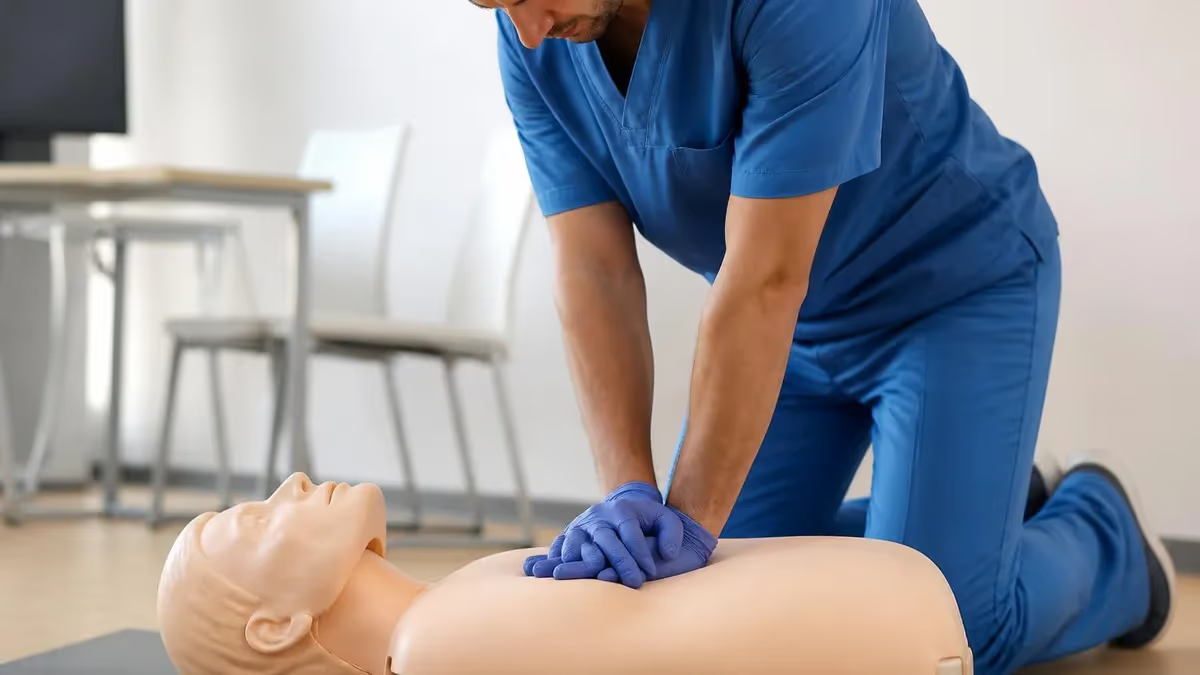
A bls cpr course teaches healthcare providers the foundational skills needed to recognize cardiac arrest, deliver high-quality chest compressions, use an automated external defibrillator, and manage choking emergencies in adults, children, and infants. If you are a nurse, paramedic, dental assistant, medical student, or allied health professional, this certification is almost certainly a condition of employment and a prerequisite for advanced courses like ACLS and PALS. Understanding what is a bls certification before you enroll will help you choose the right provider.
The two major certifying bodies in the United States are the American Heart Association and the American Red Cross. Both issue two-year certifications that are recognized by hospitals, EMS agencies, nursing boards, and dental schools nationwide. The AHA Provider course is the most widely required, particularly in hospital systems, while the is bls the same as cpr question comes up constantly because the curriculum overlaps heavily with community CPR training.
The short answer is that BLS is a professional, more technical version of CPR. While a community CPR course may run 90 minutes and focus on lay rescuer response, a BLS course covers two-rescuer techniques, bag-mask ventilation, pulse checks, team dynamics, and pediatric resuscitation algorithms. The skills are evaluated to a higher standard, and the certification card is what your employer, licensing board, or clinical rotation coordinator will accept.
This guide walks through every component of the modern BLS CPR course: enrollment options, curriculum, exam format, pass rates, cost, renewal, and study strategy. Whether you are testing for the first time as a nursing student or renewing for the fifth time as a seasoned ICU nurse, you will find a clear roadmap to passing the skills check and the written exam on the first attempt.
The 2020 AHA Guidelines, which still govern the current curriculum heading into 2026, emphasize high-quality CPR metrics: compression depth of at least 2 inches in adults, a rate of 100 to 120 per minute, full chest recoil, minimized interruptions, and avoidance of excessive ventilation. Every question on the written exam and every skill on the practical test traces back to these core performance benchmarks.
You will also learn the differences between the in-person classroom course, the blended HeartCode online option, and the Red Cross digital format. Each pathway leads to the same nationally recognized credential, but the time commitment, cost, and learning experience vary significantly. By the end of this guide, you will know exactly which course to book, how to prepare, and how to walk into the testing room confident.
We will also cover the most common reasons candidates fail on their first attempt, including poor compression depth, slow AED pad placement, and confusion about pediatric compression-to-ventilation ratios. With targeted practice and the right study plan, the BLS exam is highly passable. The data shows that candidates who complete at least two full-length practice tests pass at significantly higher rates than those who rely on textbook reading alone.
BLS CPR Course by the Numbers
Key Facts at a Glance
| Item | Value | Details |
|---|---|---|
| Classroom Course Length | 4-5 hr | In-person initial certification |
| Minimum Passing Score | 84% | 25-question written exam |
| Certification Validity | 2 years | Renewal required |

BLS CPR Course Formats and Enrollment Options
A single 4-5 hour session at an AHA Training Center, hospital, or community college. Includes lecture, video, hands-on skills practice on manikins, and the written and practical exams on the same day.
Two-part course: 1-2 hours of self-paced online modules followed by an in-person skills session of about 90 minutes. Ideal for working professionals who need flexibility but still must demonstrate competence in person.
Online cognitive learning paired with a scheduled in-person skills check at a Red Cross authorized provider. The curriculum mirrors AHA standards but uses Red Cross-branded materials and certification cards.
A shortened format for currently certified providers, typically 3-4 hours, focused on skills practice and the exam. Available in classroom or blended formats and required every two years to maintain credentials.
The BLS CPR course curriculum is organized around the chain of survival concept, which links recognition of an emergency to high-quality CPR, rapid defibrillation, advanced resuscitation, post-cardiac-arrest care, and recovery. As a BLS provider, you are responsible for the first three links: recognizing arrest, beginning compressions, and using an AED within minutes. The course breaks each link into measurable skills you must demonstrate on a manikin.
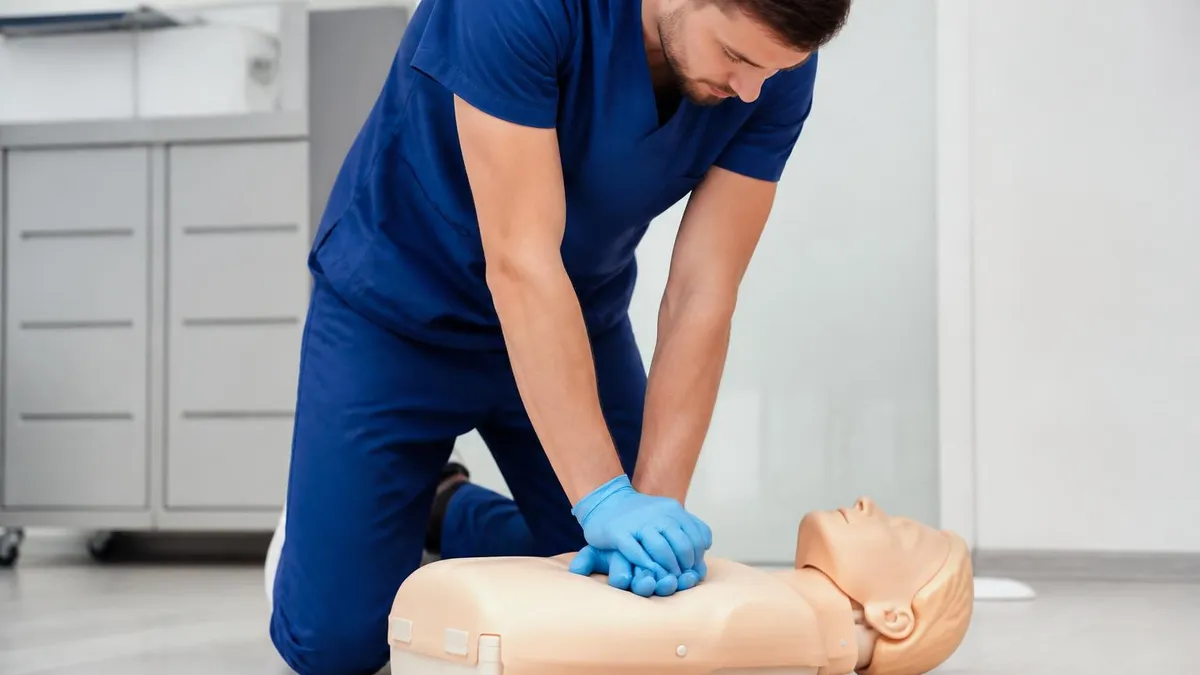
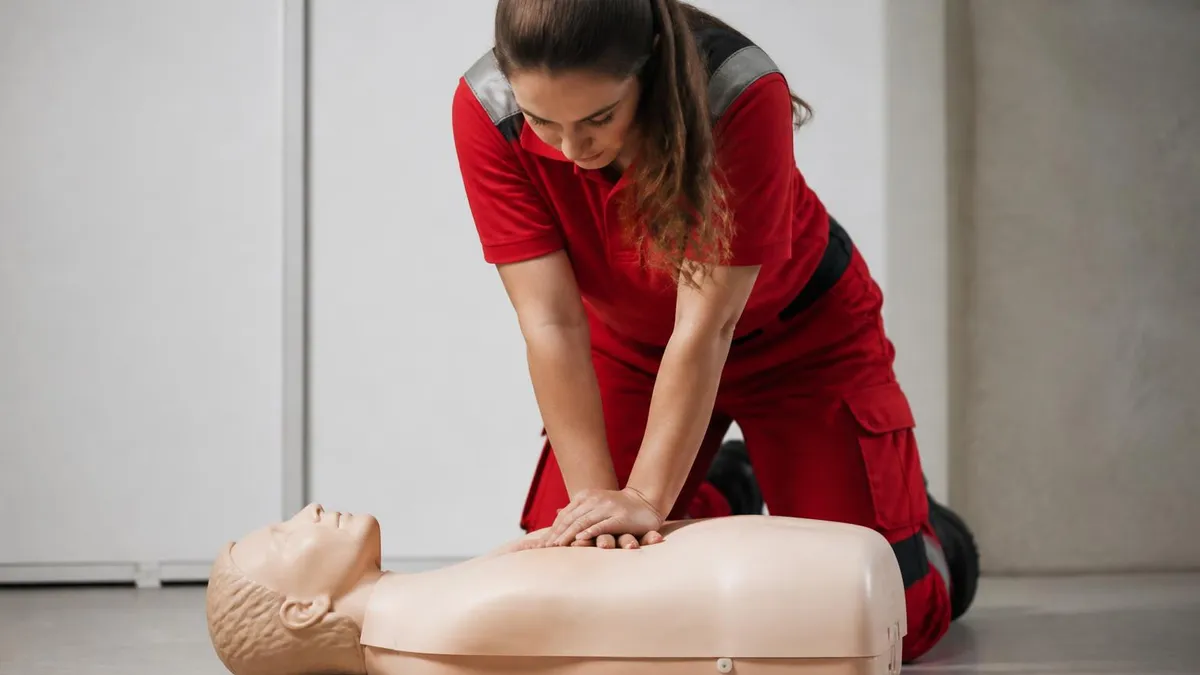
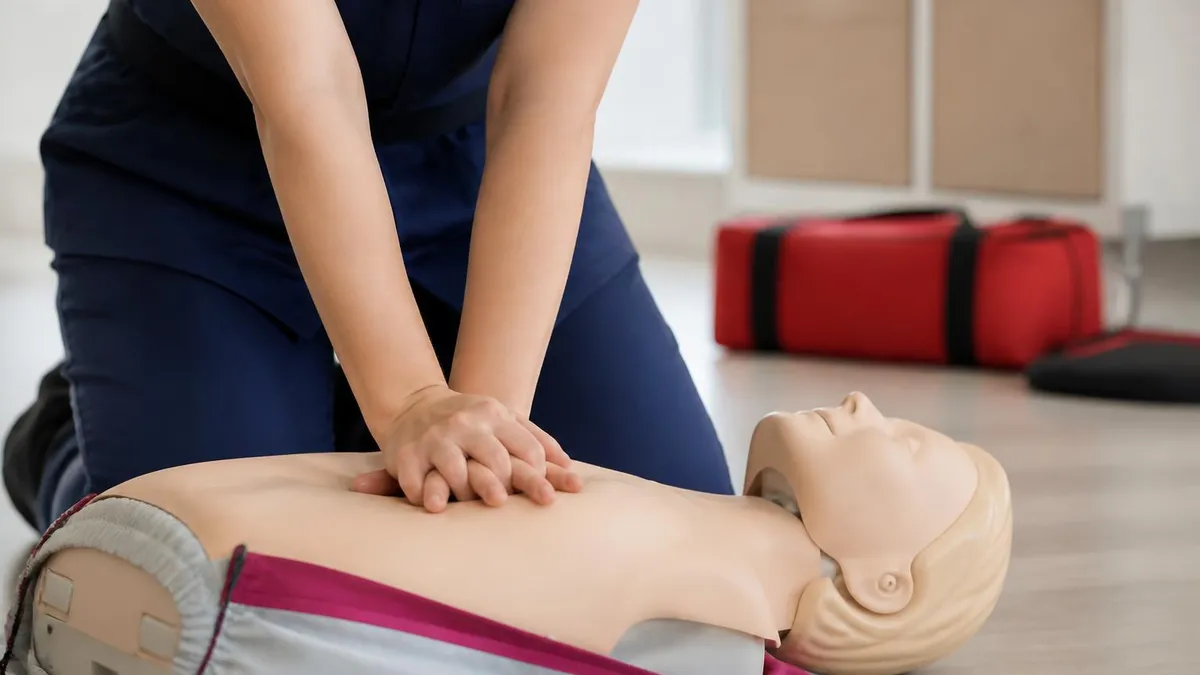
High-quality CPR is the backbone of the course. You will be tested on compression depth, which must reach at least 2 inches in adults but not exceed 2.4 inches. Compression rate should fall between 100 and 120 per minute, monitored by the manikin's electronic feedback system or by the instructor's metronome. Full chest recoil between compressions is non-negotiable because incomplete recoil reduces venous return and lowers coronary perfusion pressure.
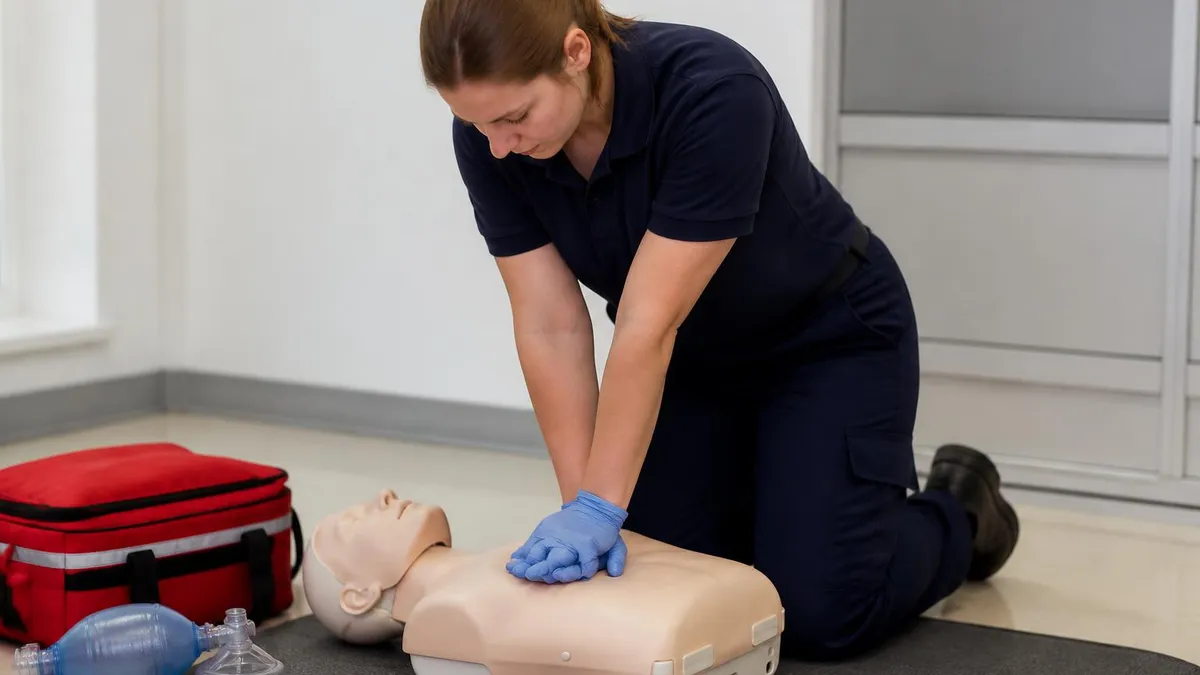
Ventilation technique is another core competency. You will practice mouth-to-mask ventilation, bag-mask ventilation with one rescuer, and bag-mask ventilation with two rescuers. Each breath should last about one second, produce visible chest rise, and avoid hyperventilation. The recommended ratio of compressions to ventilations is 30:2 for single-rescuer adult CPR and 15:2 for two-rescuer pediatric and infant CPR, a distinction the basic life support exam american heart association tests aggressively.
AED operation is taught with hands-on practice. You will learn to power on the device, attach pads to the bare, dry chest in the correct anterolateral position, allow the unit to analyze, deliver a shock if indicated, and resume compressions immediately. The course covers special situations including hairy chests, implanted pacemakers, transdermal medication patches, and wet environments. For infants and small children, pad placement shifts to anterior-posterior or pediatric attenuators are used.
Choking emergencies are covered in detail. Conscious adults and children over one year old receive abdominal thrusts, while infants receive five back blows alternated with five chest thrusts. If the victim becomes unresponsive, you begin CPR and inspect the mouth for the obstruction during each ventilation cycle. The course emphasizes that you should never perform a blind finger sweep, which can push the foreign body deeper into the airway.
Team dynamics receive significant classroom time because real resuscitations rarely involve a single rescuer. You will learn closed-loop communication, clear role assignment, mutual respect, and constructive intervention. The course teaches you how to call out compression depth and rate in real time, how to switch compressors every two minutes, and how to ensure that AED pad placement and rhythm analysis do not interrupt compressions for more than ten seconds.
Finally, the curriculum covers opioid-associated emergencies, which the AHA added in response to the overdose crisis. You will learn to recognize opioid toxidromes, administer naloxone via intranasal or intramuscular routes if available, and continue rescue breathing while waiting for advanced help. These additions reflect the evolving role of BLS providers as first-response clinicians in both clinical and community settings.

BLS Practice Test Questions
Prepare for the BLS - Basic Life Support exam with our free practice test modules. Each quiz covers key topics to help you pass on your first try.
BLS High-Quality CPR & Provider Skills
BLS Exam Questions covering BLS High-Quality CPR & Provider Skills. Master BLS Test concepts for certification prep.
BLS Special Situations & Scenarios
Free BLS Practice Test featuring BLS Special Situations & Scenarios. Improve your BLS Exam score with mock test prep.
BLS Adult, Child & Infant Resuscitation
BLS Mock Exam on Adult, Child & Infant Resuscitation. BLS Study Guide questions to pass on your first try.
BLS Airway Management & Ventilation
BLS Test Prep for Airway Management & Ventilation. Practice BLS Quiz questions and boost your score.
BLS Automated External Defibrillator (AED)...
BLS Questions and Answers on Automated External Defibrillator (AED) Use. Free BLS practice for exam readiness.
BLS Certification: Cardiac Arrest
BLS Mock Test covering Certification: Cardiac Arrest. Online BLS Test practice with instant feedback.
BLS Certification: Choking
Free BLS Quiz on Certification: Choking. BLS Exam prep questions with detailed explanations.
BLS Certification: Respiratory Arrest
BLS Practice Questions for Certification: Respiratory Arrest. Build confidence for your BLS certification exam.
BLS Chain of Survival
BLS Test Online for Chain of Survival. Free practice with instant results and feedback.
BLS CPR Techniques & Procedures
BLS Study Material on CPR Techniques & Procedures. Prepare effectively with real exam-style questions.
BLS Legal & Ethical Considerations
Free BLS Test covering Legal & Ethical Considerations. Practice and track your BLS exam readiness.
BLS Post-Resuscitation Care
BLS Exam Questions covering Post-Resuscitation Care. Master BLS Test concepts for certification prep.
AHA vs Red Cross Basic Life Support Course Comparison
The AHA BLS Provider Course is the most widely recognized certification in U.S. hospitals and EMS systems. The curriculum is built on the AHA Guidelines for CPR and Emergency Cardiovascular Care, which are updated every five years based on the most recent ILCOR evidence reviews. The aha basic life support exam contains 25 multiple choice questions with an 84 percent minimum passing score.
Course delivery happens through more than 4,000 AHA Training Centers across the country. The HeartCode BLS blended option allows you to complete the cognitive portion online in 1-2 hours, then attend an in-person skills session of 90 minutes. The certification card is digital, downloadable from the AHA eCard system, and accepted by virtually every hospital credentialing office.
BLS CPR Course: In-Person vs Blended Learning
- +Blended learning lets you complete cognitive modules at your own pace at home
- +HeartCode BLS adaptive learning targets your weak areas with personalized practice
- +Reduced classroom time means less work absence for busy clinicians
- +Online videos can be paused and replayed for difficult concepts
- +Skills session focuses entirely on hands-on practice rather than lecture
- +Digital certification card is delivered immediately after passing
- +Cost is often comparable or slightly lower than full classroom courses
- −Blended courses require self-discipline to complete online modules before class
- −No instructor to answer questions in real time during the cognitive portion
- −Some learners retain less without classroom group discussion
- −Technical issues with the online platform can delay completion
- −Skills session is shorter, leaving less time for repeated practice
- −Not all employers accept blended-format certifications, though most do
- −Requires reliable internet access and a computer for the online component
BLS CPR Course Exam Prep Checklist
- ✓Memorize adult compression depth (2 to 2.4 inches) and rate (100 to 120 per minute)
- ✓Practice 30:2 single-rescuer and 15:2 two-rescuer ratios until automatic
- ✓Review pediatric compression depth: at least one-third the chest AP diameter
- ✓Learn AED pad placement for adults, children, and infants with pacemakers or patches
- ✓Practice bag-mask ventilation technique to produce visible chest rise without overinflation
- ✓Review choking algorithms for conscious and unconscious adults, children, and infants
- ✓Memorize the chain of survival for in-hospital and out-of-hospital cardiac arrest
- ✓Read the AHA Provider Manual cover to cover at least once before class
- ✓Complete at least two full-length practice exams to identify weak content areas
- ✓Watch the official AHA skills video the night before your in-person session
- ✓Bring a pocket mask if you have one, plus your photo ID and registration confirmation
- ✓Arrive 15 minutes early to settle in and review your skill sheets one final time
Compression Depth and Rate Are the Top Failure Points
The skills check fails most candidates not because of the algorithm but because of mechanical performance. Compressions that are too shallow, too slow, or that lack full recoil account for the majority of remediation. Practice on a feedback-enabled manikin before your test day if possible, and focus on a consistent rate of 110 per minute as your target.
BLS certification is valid for two years from the date you pass your skills check, after which you must complete a renewal course to maintain your credentials. The renewal class is shorter than the initial course, typically 3 to 4 hours, and assumes you already understand the foundational content. The American Heart Association and the Red Cross both offer renewal courses, and most candidates renew with the same provider they originally trained under.
Plan your renewal at least 30 days before your card expires. Many hospitals and EMS agencies enforce strict policies that pull you from the schedule if your certification lapses, even for a single day. Renewal courses fill quickly in the weeks leading up to nursing license renewal cycles in many states, so booking early protects your work schedule and avoids the higher cost of last-minute training.
The renewal exam is the same 25-question written test as the initial course, with the same 84 percent minimum passing score. The skills evaluation covers the same core competencies: high-quality compressions, ventilation, AED use, two-rescuer dynamics, and infant and child resuscitation. Most providers spend more time on the skills practice during renewal than on the lecture content, which is appropriate because muscle memory degrades faster than cognitive knowledge.
If your card has already expired, you are technically required to take the full initial provider course rather than the renewal. In practice, most training centers will still let you take the renewal course if your card has been expired for less than 30 to 60 days, but this is at the discretion of the training center director. Always disclose your expiration date when registering to avoid surprises on class day.
HeartCode BLS for renewal works the same as the initial blended course. You complete the online modules, which adapt to your knowledge gaps, then attend a shorter in-person skills check. The skills session for renewal candidates is often only 45 to 60 minutes because you do not need the introductory practice time. This is the most popular renewal option for experienced clinicians who need maximum schedule flexibility.
Some employers cover the cost of BLS renewal as part of mandatory training and may offer on-site classes during work hours. If your employer does not cover renewal, the cost typically ranges from $50 to $90 for a renewal course, which is generally $20 to $30 less than the initial course. Tax-deductible continuing education credits may apply if you itemize professional expenses on your tax return.
Keep a digital and printed copy of your certification card stored where you can access it during a credentialing audit. Many providers have lost a card mid-shift and had to scramble to download a replacement from the AHA eCard portal or the Red Cross account dashboard. Setting a calendar reminder 90 days, 60 days, and 30 days before expiration is the simplest way to never let your certification lapse.
An expired BLS card can result in immediate removal from clinical duties and may delay credentialing for new positions by weeks. Hospitals do not grant grace periods. Schedule your renewal at least 30 days before your expiration date and confirm the training center will issue your new card before the old one expires.
Passing the BLS CPR course on your first attempt requires a deliberate study strategy that integrates reading, video review, and active practice. The single most predictive factor for a passing score is the number of practice questions you complete before the exam. Candidates who answer at least 100 practice questions across multiple sessions consistently outperform those who rely on the manual alone. Spread your practice across at least three days rather than cramming the night before.
Begin by reading the AHA Provider Manual or the Red Cross participant book straight through, taking notes on numbers, ratios, and algorithms. Compression depths, ventilation rates, AED pad placement, and choking response steps are the most heavily tested content areas. Make flashcards for every numerical value because the written exam is filled with questions that hinge on whether you know that compression rate is 100 to 120 per minute, not just at least 100.
Watch the official AHA or Red Cross instructional videos at least twice. The videos demonstrate exactly the technique your instructor will evaluate, including hand placement, body positioning, and the visual cues that constitute adequate ventilation. Pause the video at each skill demonstration and practice the motion in the air or on a pillow before moving on. This kinesthetic rehearsal accelerates muscle memory before you ever touch a manikin.
Use full-length practice exams to simulate the real testing experience. Time yourself for 25 questions and aim to complete the test in under 25 minutes. Review every incorrect answer carefully and trace each one back to the manual section that explains the concept. Take a second practice test 24 to 48 hours later, focusing on the content areas where you missed questions the first time. The aha basic life support exam follows predictable patterns that practice exposes.
On the day of the course, eat a full breakfast and arrive early. Hydration matters because you will be performing physical work on a manikin for 30 minutes or more. Bring a printed registration confirmation, photo ID, and a notebook. If you have a pocket mask, bring it for the ventilation skill check, although the training center will provide one if needed.
During the skills check, talk through your steps out loud. Verbalizing scene safety, your call for help, your pulse check, and your ventilation count makes it impossible for the instructor to miss a step you completed. Maintain a steady compression rhythm by counting in beats of 30 and switching with your partner at every two-minute cycle. If you feel your depth slipping, lock your elbows and shift more body weight over your hands.
After you pass, download your digital certification card the same day. Save copies to your phone, email, and cloud storage so you can produce it on demand for credentialing. Set calendar reminders for renewal at the 18-month mark and again at 22 months. With a thorough study plan, deliberate practice, and the right course choice, the BLS CPR course is one of the most achievable credentials in healthcare, and the skills you build genuinely save lives.
Beyond the exam itself, building genuine clinical confidence with BLS skills requires repetition that goes beyond the certification course. Many hospitals run mock code drills monthly or quarterly, and participating in those drills is one of the best ways to keep your skills sharp. If your unit does not run regular drills, ask your nurse educator to schedule one. The act of running through a full resuscitation in real time, even with a simulator, reveals weaknesses that classroom practice cannot.
Pay attention to compressor rotation during real codes. Compression quality degrades measurably after 60 to 90 seconds, even though the AHA recommends switching every two minutes. If you notice your partner's depth fading, call for a switch early. Quality matters more than rigid adherence to the time interval. Use the manikin feedback devices that many hospitals now place on crash carts to monitor your own performance in real time during clinical events.
Stay current on guideline updates. The AHA publishes focused updates between major five-year revisions, and these updates sometimes change clinical recommendations such as the role of mechanical CPR devices, the use of point-of-care ultrasound during arrest, or the timing of epinephrine. Subscribe to AHA newsletters and review the most recent ECC focused update annually to stay ahead of practice changes.
Document every BLS-related continuing education activity in your personal CE log. Many state licensing boards count BLS renewal toward continuing education requirements, and some specialty certifications such as CCRN and CEN require documentation of basic resuscitation skills. Keep certificates, attendance records, and renewal cards organized by year so audits never catch you scrambling for paperwork.
Mentor new providers when you can. Teaching a colleague how to find proper hand placement or how to coordinate ventilation timing reinforces your own skills more deeply than any practice session. Many experienced clinicians eventually pursue the BLS Instructor course, which is a separate certification that allows you to teach the provider course at AHA Training Centers. This is an excellent way to deepen mastery while contributing to your profession.
Finally, take care of yourself after participating in resuscitations, especially unsuccessful ones. The emotional toll of cardiac arrest events is real, and processing those experiences with peers, mentors, or formal critical incident stress management programs is part of being a sustainable BLS provider. Skills get sharper with experience, but the emotional weight of the work also accumulates, and acknowledging that reality is part of professional resilience.
The BLS CPR course is the entry point for a lifelong commitment to emergency response competence. Whether you are a brand-new nursing student or a veteran ICU clinician, treating each renewal as an opportunity to refine your skills rather than a box-checking exercise will make you a more effective provider. The patient on the receiving end of your compressions will benefit from every minute of preparation you put in.
Sample BLS - Basic Life Support Practice Questions
Try these questions from our free BLS - Basic Life Support practice tests. The correct answer and an explanation follow each question.
What must a healthcare provider obtain before providing emergency treatment to an adult patient?
- A. Verbal consent
- B. Written consent
- C. Implied consent
- D. Consent from a family member
Answer: C. Implied consent
In emergency situations involving an adult patient who is unconscious, unresponsive, or otherwise unable to give explicit consent, healthcare providers operate under the principle of implied consent. It is assumed that the patient would consent to life-saving treatment if they were able to communicate. This allows for immediate, critical care without delay.
A healthcare provider fails to initiate CPR on a patient with a treatable cardiac arrest and the patient dies. This could constitute:
- A. Assault
- B. Negligence by omission
- C. Battery
- D. Informed consent violation
Answer: B. Negligence by omission
Negligence by omission occurs when a provider fails to perform a duty of care that a reasonably prudent provider would have performed.
What action can a healthcare provider take if they believe they are being sued for providing emergency care?
- A. Consult a lawyer before providing care
- B. Ask the patient for forgiveness
- C. Consult with a legal professional about the Good Samaritan Law
- D. Stop treatment immediately
Answer: C. Consult with a legal professional about the Good Samaritan Law
If a healthcare provider believes they are being sued for providing emergency care, consulting a legal professional is the appropriate action. A lawyer can advise on the specifics of the situation and how Good Samaritan laws may apply to protect the provider from liability. This offers legal guidance and support, helping navigate potential legal challenges.
A healthcare provider is performing rescue breathing on a patient with a suspected opioid overdose and NO pulse oximeter is available. How should they judge the adequacy of ventilations?
- A. Visible chest rise and fall with each breath
- B. Patient's skin color returning to pink within 10 breaths
- C. Absence of any abdominal movement during ventilation
- D. Audible air rushing through the stoma on exhalation
Answer: A. Visible chest rise and fall with each breath
Without monitoring equipment, visible chest rise with each breath remains the primary clinical indicator of adequate ventilation.
BLS Questions and Answers
About the Author

Registered Nurse & Healthcare Educator
Johns Hopkins University School of NursingDr. Sarah Mitchell is a board-certified registered nurse with over 15 years of clinical and academic experience. She completed her PhD in Nursing Science at Johns Hopkins University and has taught NCLEX preparation and clinical skills courses for nursing students across the United States. Her research focuses on evidence-based exam preparation strategies for healthcare certification candidates.
Join the Discussion
Connect with other students preparing for this exam. Share tips, ask questions, and get advice from people who have been there.
View discussion (8 replies)