
BLS Course Near Me: How to Find, Choose, and Pass Your Local Basic Life Support Class in 2026 October
🔎 Looking for a BLS course near me? Compare AHA & Red Cross classes, costs, formats, and renewal options. Free practice tests included.
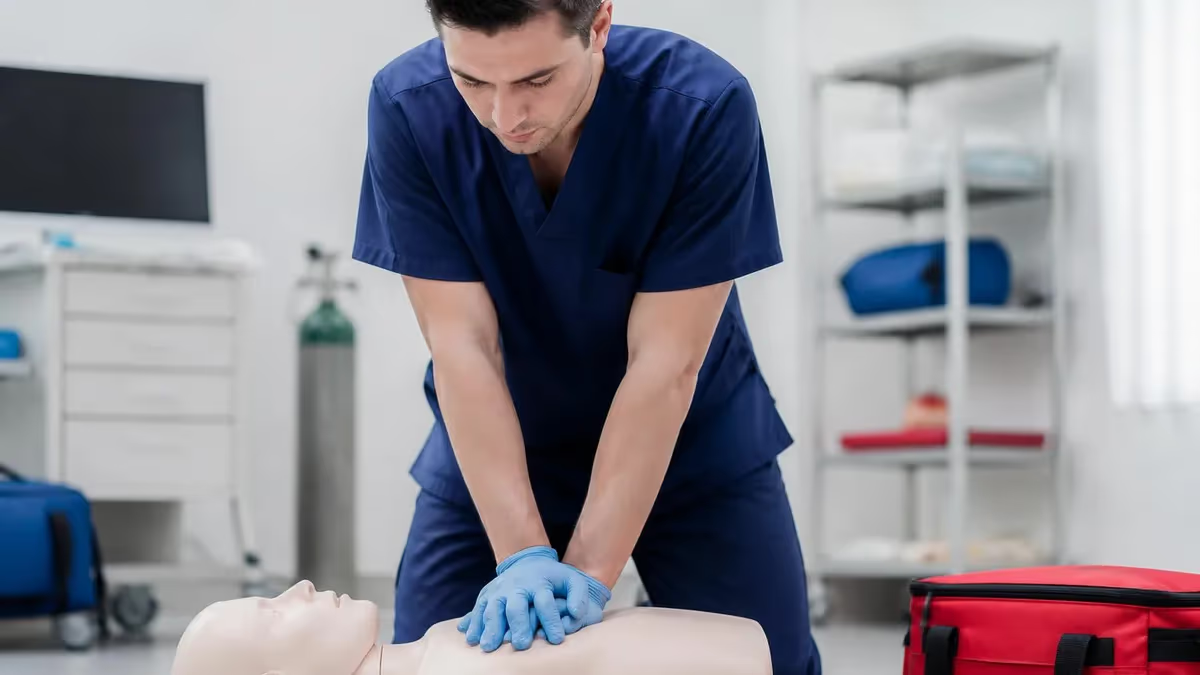
Searching for a BLS course near me usually means one of three things: you just got hired into healthcare and your start date depends on a card, your current certification expires in the next 30 days, or a clinical rotation, nursing program, or job offer added Basic Life Support to your checklist this week. Whatever brought you here, the goal is the same — find a legitimate, accredited class in your zip code, finish it without losing a Saturday you cannot spare, and walk away with a card your employer will actually accept on day one.
So what is a BLS certification, exactly? BLS stands for Basic Life Support, and it is the provider-level CPR credential designed for nurses, EMTs, medical assistants, dental staff, respiratory therapists, paramedics, lifeguards, and anyone else whose job description includes responding to cardiac or respiratory arrest. The two nationally recognized issuers in the United States are the American Heart Association (AHA) and the American Red Cross. Both produce two-year cards, both follow the 2020 ECC Guidelines updated through 2025, and both are accepted by the overwhelming majority of US hospitals and clinical schools.
The difference between a generic CPR class and a BLS class matters more than most people realize. A community CPR course teaches a bystander to push hard and fast and call 911. A BLS course teaches a healthcare provider to run a code — pulse checks, ventilation with a bag-valve mask, AED integration into team-based resuscitation, infant and child algorithms, choking relief for unresponsive victims, and high-performance team dynamics. If your employer asked for BLS, a Heartsaver CPR card will be rejected at HR orientation.
Cost for an in-person BLS course near you typically runs between $60 and $110 in 2026, depending on the metro area and whether the training center is hospital-affiliated, independent, or a community college. Blended classes (online module plus a short hands-on skills check) usually fall in the $70 to $130 range once both pieces are combined. The hands-on portion, regardless of format, is non-negotiable for a valid AHA card — there is no fully online BLS provider certification that meets AHA standards.
The class itself is short. A first-time, in-person AHA BLS Provider course is officially scheduled for about 4 hours and 15 minutes, and renewal classes run roughly 3 to 4 hours. Most training centers run morning, afternoon, and weekend sessions, and many large cities offer same-week availability. The bottleneck is rarely the class — it is the written exam and the hands-on megacode, which is why people search for practice questions before they sign up. You can warm up right now with the basic life support exam american heart association video walkthrough that mirrors the real 25-question test.
This guide walks you through every part of the decision: how to find a real training site in your zip code, which provider (AHA vs. Red Cross) your employer will actually accept, what the class looks like minute-by-minute, how to pass the written exam and the skills test on the first attempt, and how to renew without retaking the full course. By the end, you will know exactly what to book, when to book it, and how to show up prepared enough to leave with a card the same day.
One last note before you start scrolling: the search phrase "BLS course near me" returns a lot of low-quality affiliate sites that sell instant printable cards. Those are not real certifications. Any employer that checks your card against the AHA Atlas roster or the Red Cross digital verification system will spot the fake within seconds, and several states now treat presenting a counterfeit healthcare credential as a misdemeanor. Stick with the real options in this guide and you will be fine.
BLS Courses Near You by the Numbers
Key Facts at a Glance
| Item | Value | Details |
|---|---|---|
| In-Person Course Length | 4.25 hr | First-time AHA Provider |
| Typical Local Class Cost | $60–$110 | 2026 US average |
| Card Validity | 2 years | AHA and Red Cross |
How to Find a Legitimate BLS Course Near You
Use heart.org/cpr and search by zip code. Filter for 'BLS Provider' and choose 'classroom' or 'blended.' Every result is a verified AHA Training Center authorized to issue official eCards.
Visit redcross.org/take-a-class and select 'Basic Life Support for Healthcare Providers.' Filter by date and zip. Both in-person and blended formats are listed with seat availability.
Most large hospitals run public BLS classes through their education departments. Search '[your hospital] BLS class.' These are usually the cheapest and almost always accepted by other regional employers.
Local community colleges, fire departments, and ambulance services frequently offer evening and weekend BLS classes at non-profit pricing. Seats fill quickly during semester start and renewal seasons.
Sites offering 100% online BLS with an instant printable card do not meet AHA or Red Cross requirements. A skills evaluation with a live instructor is mandatory for a valid healthcare-provider card.
The single most important question to answer before you book is which issuer your employer requires. The AHA is the dominant standard in hospital-based healthcare — roughly 80% of US hospitals require an aha basic life support exam card specifically, and many will not even process onboarding paperwork until they can verify the eCard against the AHA Atlas. The Red Cross is widely accepted in outpatient clinics, dental offices, long-term care facilities, school nursing programs, and most state EMS agencies, but a small number of large hospital systems still ask for AHA only.
If your offer letter, school handbook, or clinical site coordinator did not specify, send a one-sentence email asking: "Do you require AHA BLS, or is American Red Cross BLS for Healthcare Providers also accepted?" Save the reply. This single confirmation prevents the most common cost mistake in the entire process — paying for a class, finishing it, and discovering on day one that the card is the wrong brand.
Both providers teach essentially the same clinical content because both follow the International Liaison Committee on Resuscitation (ILCOR) consensus and the 2020 American Heart Association Guidelines, with focused 2023 and 2025 updates folded in. You will learn one-rescuer and two-rescuer adult CPR at a compression rate of 100 to 120 per minute, compression depth of at least 2 inches, full chest recoil, switching compressors every two minutes, integration of an AED within the team flow, bag-valve-mask ventilation at one breath every six seconds with an advanced airway, infant and child modifications, and Heimlich maneuver and back-blow techniques for choking.
The differences are mostly cosmetic. The AHA issues a digital eCard with a unique QR code that employers scan to verify; the Red Cross issues a digital certificate with a verification ID at redcross.org/confirm. Both cards are valid for exactly 24 months from the issue date, not the class date — they are usually the same, but if you took a class in late December and the instructor uploaded rosters in January, your card will reflect the upload month.
A common question we get is, "is bls and cpr the same?" The honest answer is that all BLS includes CPR, but not all CPR is BLS. CPR is the technique — chest compressions and rescue breaths. BLS is a credentialed course that wraps CPR inside team-based resuscitation, AED protocols, ventilation skills, and healthcare-provider documentation. If a job posting says "CPR/BLS," they want the BLS course. If it says "CPR" only and you work in a non-clinical role like coaching or childcare, a Heartsaver-level course is usually enough.
Pricing between AHA and Red Cross is functionally identical in most markets, so price should not be your tiebreaker. Schedule availability often is. The Red Cross runs more standardized public classes weekly, while the AHA depends on independent training centers, so AHA class density varies dramatically by metro area. In Dallas, Houston, Phoenix, or New York, AHA classes run daily. In smaller markets, you may have only one or two AHA options per week and several Red Cross options.
Finally, consider the instructor. Both organizations require instructors to be currently certified, but real teaching quality varies wildly. Read recent Google reviews of the specific training site, not just the brand. A great instructor will get you through the entire class and skills test in under five hours and send your card the same evening. A poor one can drag a four-hour class into seven and delay your eCard by a week — a serious problem if you have an orientation deadline.

BLS Practice Test Questions
Prepare for the BLS - Basic Life Support exam with our free practice test modules. Each quiz covers key topics to help you pass on your first try.
BLS High-Quality CPR & Provider Skills
BLS Exam Questions covering BLS High-Quality CPR & Provider Skills. Master BLS Test concepts for certification prep.
BLS Special Situations & Scenarios
Free BLS Practice Test featuring BLS Special Situations & Scenarios. Improve your BLS Exam score with mock test prep.
BLS Adult, Child & Infant Resuscitation
BLS Mock Exam on Adult, Child & Infant Resuscitation. BLS Study Guide questions to pass on your first try.
BLS Airway Management & Ventilation
BLS Test Prep for Airway Management & Ventilation. Practice BLS Quiz questions and boost your score.
BLS Automated External Defibrillator (AED)...
BLS Questions and Answers on Automated External Defibrillator (AED) Use. Free BLS practice for exam readiness.
BLS Certification: Cardiac Arrest
BLS Mock Test covering Certification: Cardiac Arrest. Online BLS Test practice with instant feedback.
BLS Certification: Choking
Free BLS Quiz on Certification: Choking. BLS Exam prep questions with detailed explanations.
BLS Certification: Respiratory Arrest
BLS Practice Questions for Certification: Respiratory Arrest. Build confidence for your BLS certification exam.
BLS Chain of Survival
BLS Test Online for Chain of Survival. Free practice with instant results and feedback.
BLS CPR Techniques & Procedures
BLS Study Material on CPR Techniques & Procedures. Prepare effectively with real exam-style questions.
BLS Legal & Ethical Considerations
Free BLS Test covering Legal & Ethical Considerations. Practice and track your BLS exam readiness.
BLS Post-Resuscitation Care
BLS Exam Questions covering Post-Resuscitation Care. Master BLS Test concepts for certification prep.
Class Formats for Basic Life Support for Healthcare Providers
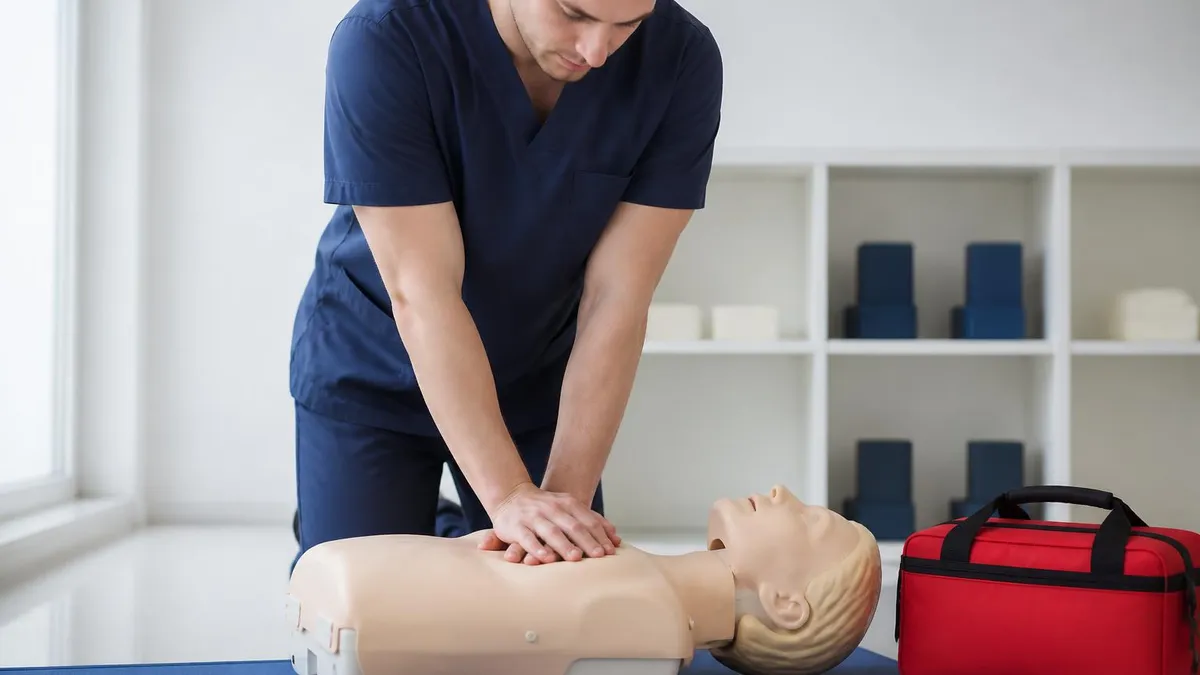
The traditional in-person format is a single 4 to 4.5-hour session that includes lecture, video demonstrations, hands-on practice with manikins, AED scenario stations, and the final skills evaluation. You will work in teams of two to four students under direct instructor supervision. The 25-question written exam is administered at the start or end of the session, depending on the training center's policy.
This format is the safest choice for first-time students, anyone who learns better with live feedback, and anyone whose written English is still developing. You walk out with a temporary card the same day and the official eCard arrives by email within 24 to 72 hours. Hospital-based and community college sessions almost always use this format.
In-Person vs Blended BLS Course Near You
- +In-person classes give you immediate instructor feedback on compression depth and hand placement
- +You walk out the same day with a temporary card you can show your employer at orientation
- +Blended format saves 2 to 3 hours of in-classroom time for busy clinical workers
- +Most training centers schedule blended skills checks within 48 hours of the online module
- +Costs are nearly identical between formats, so you can choose based on schedule, not budget
- +Hospital-based classes are usually the cheapest and almost always accepted by other regional employers
- +Both AHA and Red Cross digital eCards are verifiable online — employers can confirm authenticity instantly
- −Blended online modules must be completed before your skills slot or you forfeit the appointment
- −In-person classes lock you into a 4 to 5-hour block on a specific date with limited rescheduling
- −Some rural areas have only one training center, meaning long drives or month-long wait lists
- −Low-priced classes under $50 are often unaccredited and produce cards employers will reject
- −Skills-only renewal is only available if your current card is unexpired or recently lapsed
- −100% online BLS courses are not valid for healthcare providers despite aggressive marketing claims

What to Bring to Your BLS Course Near Me
- ✓Photo ID — driver's license, passport, or state ID for class roster verification
- ✓Printed or screenshot confirmation of your registration and payment receipt
- ✓Loose-fitting clothing — you will be on the floor doing chest compressions for at least 30 minutes
- ✓Closed-toe shoes — many training centers require them for safety on the skills floor
- ✓A printed copy of the AHA BLS Provider Manual or digital ebook for reference during practice
- ✓Your completion certificate from the online module if you booked the blended format
- ✓Bottled water and a light snack — most classes have a 10-minute break, not a meal break
- ✓A pen for the written exam if your training center still uses paper testing
- ✓Your employer's exact name and address if they require it printed on the card
- ✓Email address you check daily — your digital eCard is delivered electronically within 72 hours
Your eCard Lives in Your Email — Verify Access Before You Leave
Before you walk out of class, confirm the instructor entered your email correctly into the roster and that you can access that inbox on your phone. Roughly 15% of delayed eCards trace back to a typo in the student email field. Catching it the same day means a 24-hour fix instead of a week of back-and-forth with the training center.
The BLS exam itself is more manageable than its reputation suggests. The AHA written test is 25 multiple-choice questions with an 84% passing score, meaning you can miss four and still pass. The Red Cross exam is also 25 questions with the same passing threshold. Questions are scenario-based and cover the algorithms you practiced in class: adult one-rescuer CPR, two-rescuer CPR, infant CPR, AED operation, choking relief, opioid response, and high-performance team dynamics. There are no trick questions and no math.
The most-missed exam items every year fall into the same three buckets. First, compression-to-ventilation ratios — 30:2 for single-rescuer adult and child, 30:2 for single-rescuer infant, 15:2 for two-rescuer child and infant, and continuous compressions with one breath every 6 seconds once an advanced airway is in place. Second, pulse check timing — no more than 10 seconds, every two minutes, during compressor switches. Third, defibrillation interruption time — no longer than 10 seconds for an AED shock cycle.
For the skills test, you will perform two evaluated stations: adult CPR with AED and infant CPR. Each station has a checklist of around 12 to 14 critical action items. You must hit every "critical" item to pass — these include checking for responsiveness, calling for help, opening the airway, delivering compressions at the correct depth and rate, attaching the AED correctly, and clearing the victim before shock delivery. Non-critical items are coaching opportunities and do not fail you.
Practice tests are the single highest-yield prep activity for the written portion. Students who complete two or more full-length practice exams before class score, on average, 15 to 20 percentage points higher on the actual test. The goal is not memorization — it is pattern recognition for how the AHA writes scenarios. Once you have seen 50 to 75 practice questions, the wording of the real exam becomes familiar and obvious.
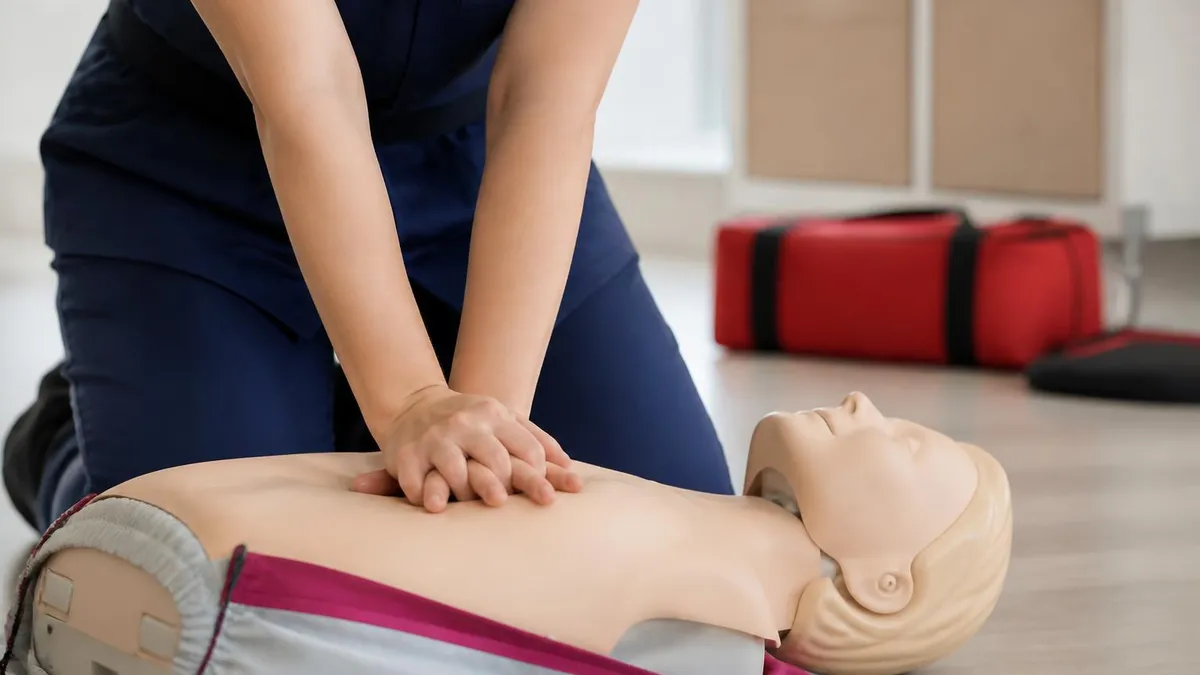
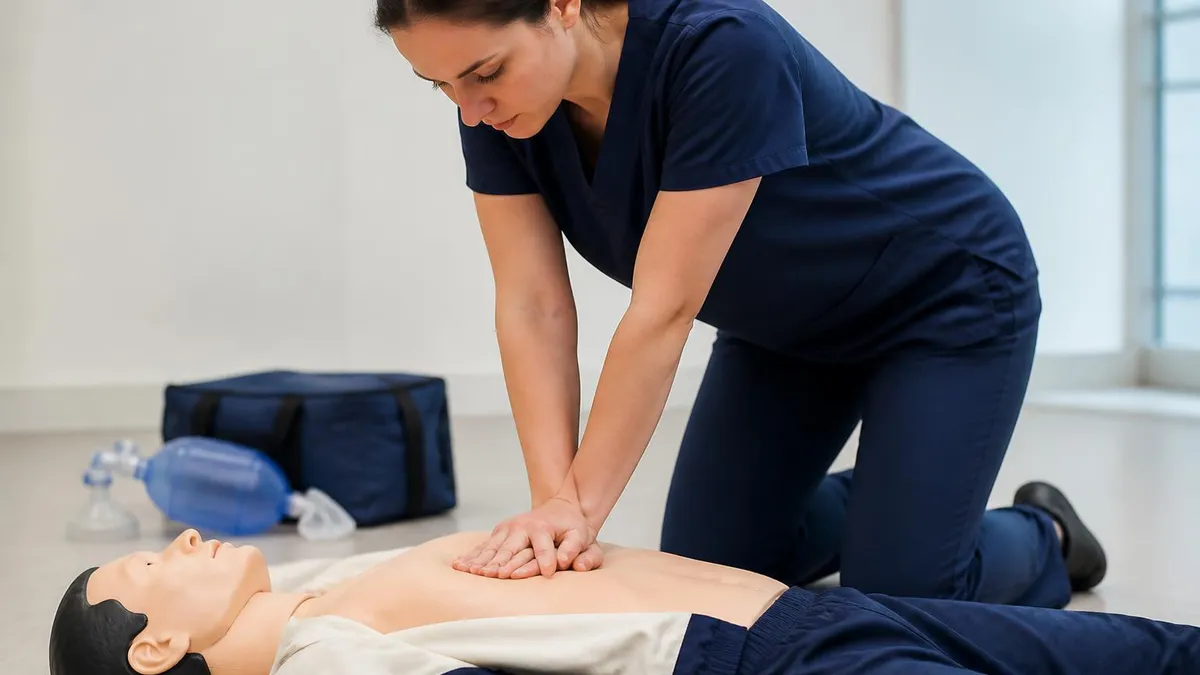
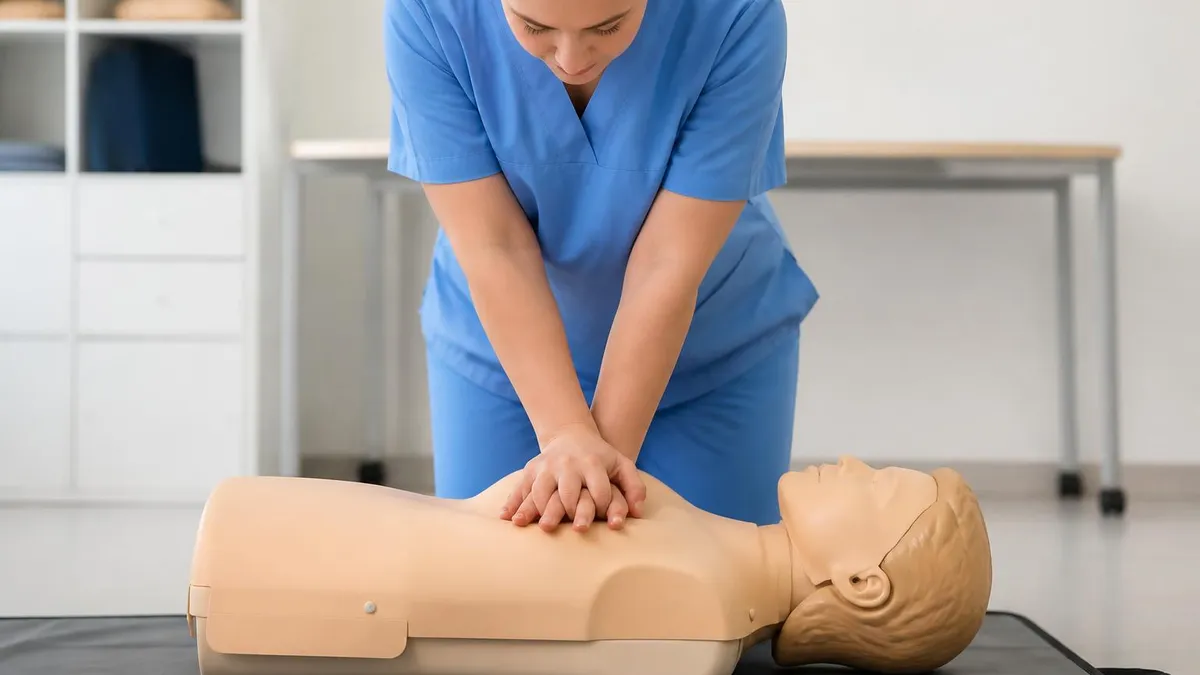
For the skills test, the most useful prep is metronome practice. Set a metronome app to 110 beats per minute and practice 30 compressions on a couch cushion or rolled towel. Pump from the shoulders, not the elbows. Lock your elbows, stack your hands, and let your body weight do the work. Most failures on the skills station are not knowledge problems — they are fatigue and rate problems that disappear with 15 minutes of physical rehearsal at home.
If you fail the written exam, training centers will let you retake it the same day or within 30 days at no extra cost. If you fail a skills station, the instructor will coach you through the missed items and re-evaluate before you leave. Genuine failures requiring a full course retake are rare — under 2% of students nationally — and almost always involve students who skipped the online module or arrived unprepared for an active hands-on session.
One subtle exam tip: when a question describes a patient who is unresponsive but breathing normally with a pulse, the answer is almost always to place them in the recovery position and continue to monitor — not start CPR. CPR is only for victims with no pulse or no normal breathing. The AHA includes several questions specifically to catch students who default to compressions on every unresponsive patient.
BLS certifications expire exactly two years from the issue month printed on your card, and neither the AHA nor the Red Cross sends automatic renewal reminders. Schedule your renewal class 30 to 60 days before expiration. If your card lapses by even one day, many employers require a full course rather than a shorter renewal session, which costs more time and money.
Renewal is the part most providers underestimate. The card prints an expiration date that is exactly two years after the issue month — so a card issued on March 15, 2024 expires on March 31, 2026, not the day before your birthday or the anniversary of your hire date. Renewal classes run shorter than first-time classes because instructors assume you already know the algorithms. A typical AHA renewal is 3 to 3.5 hours and a Red Cross renewal is 2.5 to 3 hours. Both still require a written exam and a hands-on skills evaluation.
To find a renewal class, search the same AHA or Red Cross course locator you used the first time and filter specifically for "renewal" or "recertification." Pricing typically runs $10 to $25 lower than a first-time class. If your card has been expired for more than 30 days, most training centers will require you to take the full provider course instead — this is not a hard rule from the AHA itself, but most centers enforce it for consistency and liability reasons.
Card verification is something every healthcare provider should know how to do. AHA eCards have a unique 9 to 10-character ID printed on them, and any employer can verify them at ecards.heart.org by entering the ID, your first name, and your last name. Red Cross cards are verified at redcross.org/confirm using the certificate ID. Both checks return instantly. If you ever lose access to your eCard, the training center that issued it can resend it free of charge for the full two-year validity period.
An important note for nurses, EMTs, and paramedics whose state licensure depends on continuous BLS: most state boards consider your certification active through the last day of the expiration month, not the first. So a card expiring March 2026 is technically valid through March 31, 2026. That said, never push the deadline — schedule renewal early because training center availability tightens at month-end as everyone else procrastinates.
For students wondering, "is bls the same as cpr?" — the short answer is that BLS is the credential most healthcare employers actually want, even though many of them use "CPR" loosely in job descriptions. If you're not sure, default to BLS because every BLS card satisfies a CPR requirement, but no community CPR card satisfies a BLS requirement. Spending the extra $20 on the higher-tier course up front saves you from paying for two classes later.
Costs over a full healthcare career add up. A nurse working from age 25 to 65 will renew BLS roughly 20 times. At an average renewal cost of $85, that is $1,700 over a career — and most hospitals reimburse it as a covered continuing education expense. Save your receipts, because many tax preparers can deduct them as unreimbursed professional expenses if your employer does not cover the cost.
Finally, if you change employers, never assume your card transfers automatically. New employers run their own roster checks, and some require a brand-specific card (AHA only) even if your current Red Cross card has not expired. Confirm the requirement during the offer stage, not after orientation. The two-hour delay of a same-day skills check costs far less than a delayed start date.
Once you have booked your local class, the next 48 to 72 hours of prep are what separates a smooth same-day pass from a stressful retake. The single most useful thing you can do is read the AHA BLS Provider Manual cover to cover at least once. It is short — about 80 pages of actual content — and every exam question is drawn directly from its algorithms, ratios, and team dynamics chapter. If you bought the digital ebook, you can highlight and search inside it on your phone during the lunch break before class.
The night before, do one full-length practice test under timed conditions. Give yourself 30 minutes for 25 questions and do not look up any answers until you finish. Review every missed question against the manual, not against a forum answer or a YouTube comment. This single 60 to 90-minute prep session is the highest-yield study activity in the entire process. Students who do this score an average of 23 out of 25 on the real exam.
Sleep matters more than people admit. The skills test requires sustained physical effort — five cycles of 30 compressions, switching compressors, and recoil quality scoring. Showing up tired or hung-over leads to weak compressions, shallow depth, and failed evaluations. Eat a real breakfast with protein and complex carbs, drink water consistently in the two hours before class, and avoid heavy caffeine right before the skills station because the shakes will affect your rate.
Arrive 15 minutes early. Training centers run on tight schedules, and late students are often turned away with a forfeit of the registration fee. Use those 15 minutes to introduce yourself to the instructor, confirm your name is on the roster, and ask whether the exam is administered first or last. Knowing the order lets you mentally pace yourself. Some instructors put the written test up front so anyone who passes can relax through skills practice.
During the class, participate aggressively. Volunteer to demonstrate first when the instructor asks. The first volunteer gets the most feedback and corrections, which means everyone else copies your refined technique. By the time it is your turn for evaluation, you will have already practiced the perfect motion multiple times. Students who hide in the back almost always score lower on the skills test, not because they know less but because they practiced less.
When you receive your digital eCard, immediately download both a PDF copy and a phone screenshot. Email the PDF to yourself in two separate inboxes. Print one copy for your wallet or badge holder. Healthcare employers occasionally lose card uploads in their HR systems, and being able to produce proof of certification in 10 seconds prevents delays at orientation, badge issuance, and clinical rotation start dates. Set a calendar reminder for 60 days before expiration.
If you ever respond to a real cardiac arrest at work, in public, or at home — the muscle memory from this class is what carries you. Take it seriously. Push hard, push fast, do not stop, and let the AED do what it was designed to do. The single biggest predictor of survival from sudden cardiac arrest in the United States is whether a trained bystander started high-quality CPR in the first three minutes. Your BLS card is not paperwork — it is a credential that says you are that bystander.
Sample BLS - Basic Life Support Practice Questions
Try these questions from our free BLS - Basic Life Support practice tests. The correct answer and an explanation follow each question.
After determining that the kid is not breathing, you call for help in finding an AED and calling 911. While one man starts to call 911, another woman is rushing to find an AED. There are those who are willing to help. What is your next course of action?
- A. begin CPR with chest compressions
- B. give two rescue breaths
- C. check for a pulse and breathing simultaneously
- D. wait for the defibrillator
Answer: C. check for a pulse and breathing simultaneously
After determining unresponsiveness and sending someone to activate emergency services and retrieve an AED, the next immediate action is to assess the victim's condition. This involves simultaneously checking for both breathing and a pulse for no more than 10 seconds. This assessment guides whether to start CPR or provide rescue breaths.
What is the main reason BLS courses emphasize simulation and team scenarios during training?
- A. To reduce the number of written tests required for certification
- B. To allow students to practice technical skills only
- C. To build muscle memory and communication habits under realistic stress before real events
- D. To satisfy regulatory requirements for hands-on training hours
Answer: C. To build muscle memory and communication habits under realistic stress before real events
Simulation allows learners to practice both technical skills and team communication under controlled stress, building automatic behaviors that transfer to real emergencies.
During a mass casualty event, a BLS provider must choose which patients to treat first with limited resources. This reflects which ethical principle?
- A. Autonomy
- B. Nonmaleficence
- C. Justice
- D. Veracity
Answer: C. Justice
Justice requires fair allocation of limited resources, which is the foundation of triage systems in mass casualty events.
Although you can tell that the patient DOES have a pulse, you cannot observe any chest movement. The patient doesn't seem to be breathing, unfortunately. What should be the next course of action?
- A. begin rescue breathing 1 breath every 6 seconds
- B. place on the left side in rescue position
- C. begin chest compressions
- D. begin rescue breathing 1 breath every 3-5 seconds
Answer: A. begin rescue breathing 1 breath every 6 seconds
If an adult patient has a pulse but is not breathing, the immediate intervention is to begin rescue breathing. The recommended frequency for rescue breaths in adults is one breath every 5-6 seconds, which equates to about 10-12 breaths per minute. This rate provides adequate oxygenation without causing hyperventilation, which can have negative effects.
BLS Questions and Answers
About the Author

Registered Nurse & Healthcare Educator
Johns Hopkins University School of NursingDr. Sarah Mitchell is a board-certified registered nurse with over 15 years of clinical and academic experience. She completed her PhD in Nursing Science at Johns Hopkins University and has taught NCLEX preparation and clinical skills courses for nursing students across the United States. Her research focuses on evidence-based exam preparation strategies for healthcare certification candidates.
Join the Discussion
Connect with other students preparing for this exam. Share tips, ask questions, and get advice from people who have been there.
View discussion (8 replies)