
AHA BLS CPR: Complete Study Guide for BLS Certification 2026
Learn what a BLS certification is, how AHA BLS CPR differs from standard CPR, exam format, renewal tips, and free practice tests. ⏳
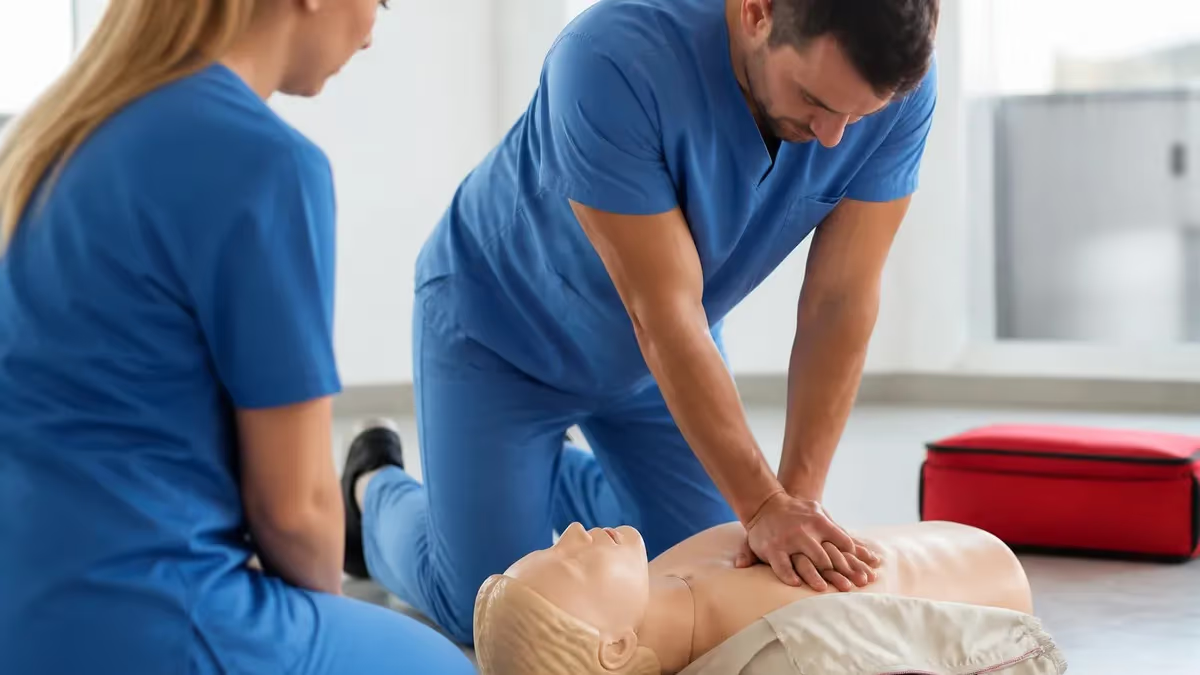
If you have ever asked what is a BLS certification, the short answer is that it is a credential that proves you can recognize and respond to life-threatening emergencies—cardiac arrest, respiratory failure, and airway obstruction—using evidence-based interventions. The American Heart Association (AHA) is the dominant issuing body in the United States, and its aha bls cpr course sets the national standard that hospitals, clinics, EMS agencies, and dental offices use when verifying staff competency. Millions of healthcare workers hold or are working toward this credential every year.
Understanding the full scope of BLS goes well beyond knowing how to push on someone's chest. The BLS certification exam from the American Heart Association covers high-quality CPR technique for adults, children, and infants; automated external defibrillator (AED) use; relief of foreign-body airway obstruction; bag-mask ventilation; and team dynamics in a resuscitation scenario. Each of these domains is tested both on a written or computer-based knowledge assessment and during hands-on skills stations with an AHA-certified instructor evaluating your performance in real time.
One of the most common points of confusion among candidates is the relationship between BLS and CPR. Many people wonder: is BLS the same as CPR? The honest answer is that CPR is a subset of BLS. Basic Life Support encompasses CPR but also includes the full chain of survival, AED integration, two-rescuer coordination, and oxygen delivery—skills that go beyond what a layperson learns in a community CPR class. If your employer requires BLS, a standard Heartsaver CPR card will not satisfy that requirement.
Another question that surfaces constantly is what does BLS stand for? It stands for Basic Life Support, a term the AHA introduced to distinguish provider-level emergency response skills from the simplified CPR training aimed at the general public. The "basic" in the name refers to the fact that these interventions require no advanced equipment like endotracheal tubes or IV medications—not that the course content is elementary. For healthcare professionals, BLS is the foundation on which ACLS, PALS, and other advanced certifications are built.
The AHA is not the only organization that offers BLS training. The American Red Cross Basic Life Support program is widely accepted and follows similar 2020 Guidelines for CPR and ECC. However, some employers—particularly large hospital systems—specify AHA cards by name. Before enrolling in any course, confirm which issuing body your employer or licensing board accepts, because submitting the wrong card can delay your start date or put your clinical rotation at risk.
This guide is designed to walk you through everything you need to know about the AHA BLS certification: what the exam covers, how the course is structured, how long your card stays valid, how renewal works, and how to use free practice tests to maximize your pass rate. Whether you are sitting for your first BLS card as a nursing student or renewing as a seasoned paramedic, the information here will help you walk into your skills check confident and prepared.
Throughout this article you will find free practice quizzes mapped directly to the AHA BLS exam domains, a study schedule you can adapt to your timeline, a checklist of everything to bring on test day, and answers to the ten questions candidates ask most often. Bookmark this page and return to it as you progress through your preparation—it is built to serve as your single reference hub for the entire BLS certification journey.
AHA BLS Certification by the Numbers
BLS Certification Study Schedule
- ▸Read the AHA BLS Provider Manual chapters 1–3
- ▸Watch the AHA CPR compression depth and rate videos
- ▸Practice adult CPR compression technique on a pillow or mannequin
- ▸Complete the High-Quality CPR practice quiz on PracticeTestGeeks
- ▸Study AED pad placement for adults, children, and infants
- ▸Learn bag-mask ventilation ratios (30:2 adult, 15:2 two-rescuer pediatric)
- ▸Review airway obstruction relief for conscious and unconscious victims
- ▸Complete the Special Situations & Scenarios practice quiz
- ▸Review infant and child compression depth and rate differences
- ▸Study team roles: team leader, compressor, ventilator, AED operator
- ▸Practice closed-loop communication scripts out loud
- ▸Run through two timed scenario simulations with a study partner
- ▸Complete all six practice quizzes and review every incorrect answer
- ▸Do a full-speed mannequin drill focusing on minimal interruptions
- ▸Review algorithm cards for adult, child, and infant cardiac arrest
- ▸Confirm course location, required ID, and card delivery process with your training center
Many candidates arrive at their BLS course unclear on exactly what the test covers, so let's break it down. The basic life support exam American Heart Association format consists of a written or computer-based knowledge test followed by a hands-on skills evaluation. The written portion typically contains 25 multiple-choice questions drawn from the BLS Provider Manual, and you must score at least 84 percent—answering 21 of 25 correctly—to pass. Questions test recall of compression rates, depths, ratios, AED steps, and the order of the adult and pediatric algorithms.
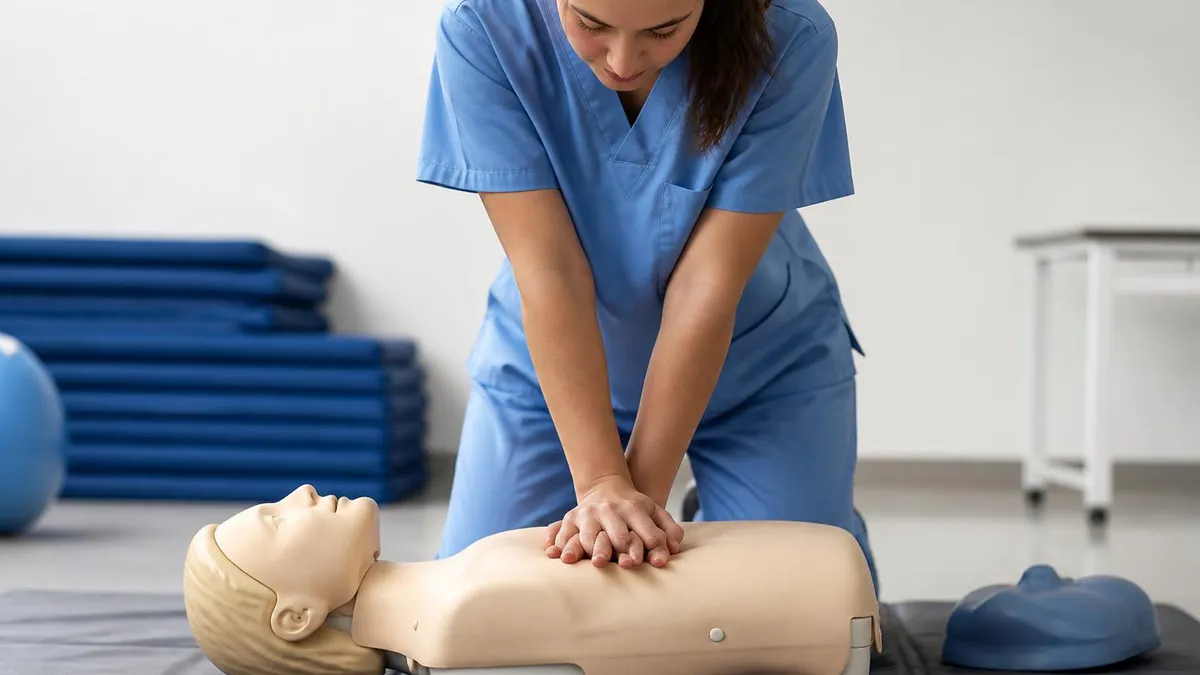
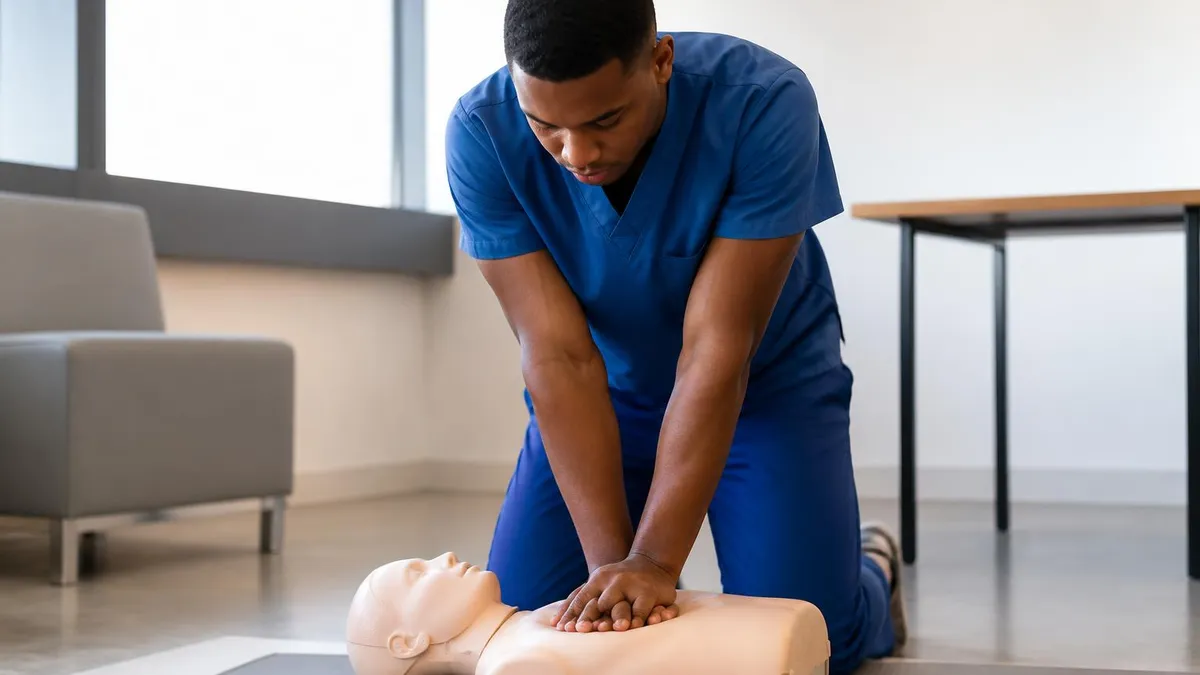
The skills portion is where most candidates feel the most pressure, but it is also the most straightforward if you have drilled your technique. An AHA-certified instructor will evaluate you on at least two skills stations: a one-rescuer adult CPR and AED scenario, and a two-rescuer scenario that includes bag-mask ventilation. You will be assessed on compression rate (100–120 per minute), compression depth (at least 2 inches for adults), full chest recoil between compressions, minimal hands-off time, and correct AED operation including pad placement and shock delivery.
The aha basic life support exam also tests infant and child CPR, which trips up many adult-focused clinicians. Key distinctions include compression depth of at least 1.5 inches for infants and about 2 inches for children, two-finger or two-thumb-encircling technique for infant compressions, and a 15:2 ratio when two trained rescuers are present for pediatric victims. These numbers differ enough from adult protocols that spending dedicated study time on them is essential—they account for a meaningful share of written test questions.
One of the most heavily tested concepts on the AHA BLS exam is minimizing interruptions to chest compressions. The AHA guidelines specify that chest compression fraction—the proportion of resuscitation time during which compressions are actually delivered—should be at least 60 percent and ideally greater than 80 percent. Every pause for ventilation, AED analysis, or rhythm check costs valuable perfusion time. Understanding this concept deeply, not just memorizing the number, will help you answer scenario-based questions that ask what a rescuer should do differently to improve outcomes.
Team dynamics and communication make up a surprisingly large portion of the exam content for the AHA BLS Provider course. The AHA stresses five elements of effective resuscitation teams: clear roles and responsibilities, knowing your limitations, constructive intervention, knowledge sharing, and closed-loop communication. Closed-loop communication means that when a team leader gives an instruction—"give 1 milligram of epinephrine"—the recipient confirms receipt, executes the task, and reports back: "epinephrine given." Written questions will present scenarios where communication breaks down and ask you to identify the error or correct response.
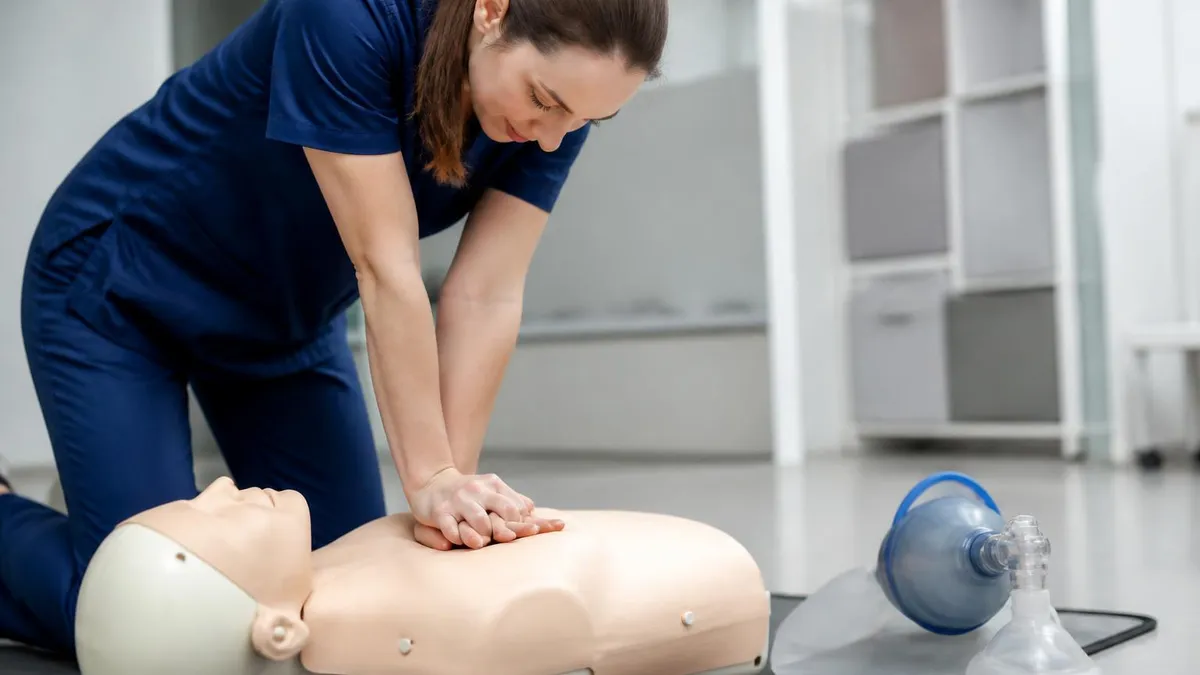
Bag-mask ventilation is another area that requires deliberate practice before the skills station. The AHA recommends an EC-clamp grip: the thumb and forefinger form a "C" over the mask to maintain a seal while the remaining three fingers form an "E" along the mandible to lift the jaw.
Ventilations should be delivered over one second, producing visible chest rise, at a rate of one breath every five to six seconds in a pulse-present adult and one breath every two to three seconds during CPR. Over-ventilation is explicitly flagged as harmful in the guidelines because it increases intrathoracic pressure and reduces venous return.
Finally, the AHA BLS exam covers the full Chain of Survival for both in-hospital and out-of-hospital cardiac arrest. The out-of-hospital chain includes: recognition and activation of emergency response, early CPR, rapid defibrillation, advanced resuscitation by EMS, post-cardiac-arrest care, and recovery. The in-hospital chain begins with surveillance and prevention rather than recognition. Knowing which chain applies to a given scenario and being able to identify where a breakdown occurred are classic exam question formats that reward careful reading of the clinical vignette provided.
BLS Practice Test Questions
Prepare for the BLS - Basic Life Support exam with our free practice test modules. Each quiz covers key topics to help you pass on your first try.
BLS High-Quality CPR & Provider Skills
BLS Exam Questions covering BLS High-Quality CPR & Provider Skills. Master BLS Test concepts for certification prep.
BLS Special Situations & Scenarios
Free BLS Practice Test featuring BLS Special Situations & Scenarios. Improve your BLS Exam score with mock test prep.
BLS Adult, Child & Infant Resuscitation
BLS Mock Exam on Adult, Child & Infant Resuscitation. BLS Study Guide questions to pass on your first try.
BLS Airway Management & Ventilation
BLS Test Prep for Airway Management & Ventilation. Practice BLS Quiz questions and boost your score.
BLS Automated External Defibrillator (AED)...
BLS Questions and Answers on Automated External Defibrillator (AED) Use. Free BLS practice for exam readiness.
BLS Certification: Cardiac Arrest
BLS Mock Test covering Certification: Cardiac Arrest. Online BLS Test practice with instant feedback.
BLS Certification: Choking
Free BLS Quiz on Certification: Choking. BLS Exam prep questions with detailed explanations.
BLS Certification: Respiratory Arrest
BLS Practice Questions for Certification: Respiratory Arrest. Build confidence for your BLS certification exam.
BLS Chain of Survival
BLS Test Online for Chain of Survival. Free practice with instant results and feedback.
BLS CPR Techniques & Procedures
BLS Study Material on CPR Techniques & Procedures. Prepare effectively with real exam-style questions.
BLS Legal & Ethical Considerations
Free BLS Test covering Legal & Ethical Considerations. Practice and track your BLS exam readiness.
BLS Post-Resuscitation Care
BLS Exam Questions covering Post-Resuscitation Care. Master BLS Test concepts for certification prep.
Is BLS the Same as CPR? AHA vs Red Cross vs Other Providers
The question is BLS and CPR the same comes up constantly, and the distinction matters for your career. CPR—cardiopulmonary resuscitation—is a specific technique involving chest compressions and rescue breathing. BLS is a full curriculum that includes CPR as its core skill but adds AED use, airway management, two-rescuer coordination, bag-mask ventilation, and pediatric considerations. A layperson Heartsaver CPR card demonstrates basic CPR ability; a BLS Provider card proves you can manage a cardiac emergency as part of a clinical team, which is why most healthcare employers accept only BLS.
The practical difference shows up most clearly during code situations. A CPR-certified person knows to push hard and fast and call 911. A BLS-certified healthcare provider knows the exact rate (100–120 compressions per minute), the correct depth (at least 2 inches for adults), how to minimize interruptions below 10 seconds, when to switch compressors every two minutes to prevent fatigue, how to operate an AED through all prompts, and how to communicate with teammates using closed-loop technique. These additions are what make the BLS Provider credential a clinical prerequisite rather than just a safety awareness course.
AHA BLS Certification: Pros and Cons to Consider
- +Universally accepted by US hospitals, EMS agencies, and licensing boards
- +Follows the latest AHA 2020 Guidelines for CPR and ECC, grounded in the strongest evidence base
- +Blended HeartCode format lets busy clinicians complete the cognitive portion online at their own pace
- +Two-year validity period reduces the burden of annual recertification compared to some competing credentials
- +Builds the foundation for advanced certifications like ACLS, PALS, and NRP
- +Skills-based evaluation ensures card holders have demonstrated real competency, not just multiple-choice knowledge
- −In-person skills station is mandatory—no fully online option is accepted by accredited employers
- −Course fees ($50–$75) add up over a career, especially when renewal is required every two years
- −Some training centers have long waitlists, which can delay employment start dates if you wait until the last minute
- −Card replacement or verification requests can take days to process through the AHA Training Network
- −The written exam's 84% passing threshold leaves little margin for error on a 25-question test
- −Renewal courses require physical attendance and skills re-evaluation even for highly experienced clinicians
Pros and Cons at a Glance
| Pros | Cons |
|---|---|
| Universally accepted by US hospitals, EMS agencies, and licensing boards | In-person skills station is mandatory—no fully online option is accepted by accredited employers |
| Blended HeartCode format lets busy clinicians complete the cognitive portion online at their own pace | Some training centers have long waitlists, which can delay employment start dates if you wait until the last minute |
| Two-year validity period reduces the burden of annual recertification compared to some competing credentials | Card replacement or verification requests can take days to process through the AHA Training Network |
| Builds the foundation for advanced certifications like ACLS, PALS, and NRP | Renewal courses require physical attendance and skills re-evaluation even for highly experienced clinicians |
BLS Exam Day Checklist: What to Bring and Prepare
- ✓Bring a valid government-issued photo ID that matches the name on your course registration.
- ✓Carry your AHA BLS Provider Manual or access the digital version on the AHA website for last-minute reference.
- ✓Wear comfortable, non-restrictive clothing so you can kneel and perform compressions without restriction.
- ✓Arrive 10–15 minutes early to complete check-in paperwork and locate the skills station room.
- ✓Review the adult cardiac arrest algorithm one final time, paying attention to compression-to-ventilation ratios.
- ✓Mentally rehearse the EC-clamp bag-mask technique and practice the jaw-thrust maneuver motion with your hands.
- ✓Know your infant two-thumb-encircling technique—instructors flag this frequently as a skills station failure point.
- ✓Practice closed-loop communication phrases out loud so they feel natural during the team scenario.
- ✓Confirm whether your employer requires the physical laminated card or accepts the digital eCard from the AHA website.
- ✓Plan your post-course card storage: photograph it with your phone and save a PDF backup in cloud storage immediately.
The 10-Second Rule Is Non-Negotiable
AHA guidelines specify that any interruption to chest compressions—for ventilations, AED analysis, rhythm checks, or provider switches—must last no longer than 10 seconds. Exceeding this window is one of the most common reasons candidates receive corrective feedback during the skills station. Practice pausing for exactly 10 seconds during your drills so you develop an instinctive sense of the limit before you are evaluated.
Understanding how long does BLS certification last is critical for planning your renewal timeline. An AHA BLS Provider card is valid for exactly two years from the date of issue. The expiration date is printed on the physical card and embedded in the digital eCard record.
Many employers require active certification at all times, meaning you cannot let your card lapse even by a single day. The best practice is to schedule your renewal course no later than 60 days before your expiration date, which gives you a buffer if your preferred course fills up or if an unexpected schedule conflict arises.
A basic life support renewal class is structurally different from an initial certification course. Renewal courses—sometimes called BLS Renewal or BLS Recertification—are shorter because they assume you already know the foundational content and have practiced the skills recently. A typical renewal course runs two to three hours and skips the extended didactic instruction in favor of a skills validation session and an abbreviated written or computer-based exam. The passing threshold remains 84 percent, and the skills evaluation standards are identical to those in the initial course.
One nuance that surprises many candidates is that the AHA does not formally recognize "expired BLS renewals." If your card has been expired for more than 30 days, most AHA training centers will require you to take the full initial BLS Provider course rather than the shorter renewal format. This policy exists because lapsed providers are assumed to need a full refresher, not just a quick verification check. The practical lesson: never let your card expire. Set a recurring calendar reminder 90 days before the expiration date so you have ample time to register and complete a renewal.
HeartCode BLS is the AHA's official blended-learning renewal pathway. You complete the online cognitive modules at your own pace—typically 60–90 minutes—and then attend a shorter in-person skills session at a partnered training center to demonstrate technique. This format is popular with night-shift nurses and rotating residents because it eliminates the need to sit through a full classroom session. After successfully completing both components, your new two-year eCard is issued within 24 hours directly to your email address registered with the AHA Training Network.
Some candidates ask whether they can renew their BLS certification entirely online. As of 2026, no fully online BLS renewal is accepted by accredited US healthcare employers. The AHA, Red Cross, and American Safety and Health Institute all require in-person skills validation because studies have consistently shown that online-only CPR training produces significant skill decay within months. Any website advertising a fully online BLS card that satisfies hospital credentialing requirements is almost certainly issuing a certificate of completion from a non-accredited program—not a credential your employer's HR department will accept.
For nurses and allied health professionals whose state license requires active BLS certification, the renewal stakes are especially high. A lapsed card can technically put you out of compliance with your practice act, expose your employer to liability, and in a worst-case scenario delay a license renewal. Many state boards of nursing require evidence of current BLS certification as part of the biennial license renewal package. Keeping a scanned copy of your card in both your personal files and your employee health record protects you if the original is lost or if questions arise during a regulatory audit.
If you completed your initial BLS through the Red Cross and want to switch to the AHA for your renewal—or vice versa—you can do so without any penalty. The two organizations' cards are interchangeable at the vast majority of US employers, and neither organization requires that renewals be completed through the same provider as the original certification. The only consideration is employer preference: if your hospital has an AHA-only policy, a Red Cross renewal card will not satisfy that requirement regardless of what it cost or how recently you obtained it.
If your BLS card lapses by more than 30 days, most AHA training centers will require you to retake the full initial BLS Provider course instead of the shorter renewal class—adding two to three hours and potentially a higher fee. Schedule your renewal course at least 60 days before your expiration date to guarantee you have options if your first-choice session is full or you need to reschedule due to a shift conflict.
Building a structured study plan is the single most effective thing you can do to improve your performance on the basic life support exam American Heart Association. The written portion rewards candidates who have internalized the numbers—compression rate, depth, ratio, ventilation timing—so precisely that they can recall them under time pressure without second-guessing. The best way to internalize numbers is through spaced repetition: instead of cramming all 25 BLS facts the night before the exam, spread your review across four weeks using the study schedule outlined earlier in this guide, returning to each concept at increasing intervals.
Practice tests are one of the highest-return study tools available because they simulate the format of the actual exam and expose you to the precise phrasing the AHA uses in its questions. When you answer a question incorrectly on a practice test, do not simply note the right answer and move on. Instead, open the BLS Provider Manual to the corresponding section and read the surrounding two or three paragraphs. Understanding why the correct answer is correct—not just what it is—prevents you from making the same mistake on a differently worded version of the same question on the real exam.
Scenario-based practice is as important as fact memorization for the skills station. The most common failure points in skills evaluations are: compression rate that drifts below 100 or above 120 per minute, insufficient depth (especially in candidates who are cautious about injuring the patient), failure to allow full chest recoil, mask leaks during bag-mask ventilation, and hesitation at the AED that extends the no-flow interval beyond 10 seconds.
Record yourself performing CPR on a mannequin or firm pillow and watch the playback—most candidates are shocked to discover that what they thought was a two-inch depth is actually closer to one inch when they see it on video.
Team dynamics preparation is frequently neglected by solo studiers who focus exclusively on the technical skills. The AHA evaluates your ability to communicate as clearly under stress as you perform compressions. Practice saying team leader prompts out loud: "I need someone on compressions," "Switch compressors in two minutes," "Stop CPR, analyzing rhythm—everybody clear." Practice the compressor's verbal acknowledgment: "I have compressions—switching in two." When these phrases feel natural in practice, they flow automatically during the evaluation, letting you concentrate your cognitive resources on the clinical decision points rather than on what to say next.
The AHA BLS Provider Manual is the authoritative source for all exam content, and reading it cover to cover at least once is non-negotiable if you want to pass on your first attempt. The manual is organized around algorithms, and understanding the logic of each algorithm—rather than just memorizing the boxes and arrows—allows you to navigate scenario variations that deviate slightly from the textbook presentation.
Exam questions often describe a scenario where one step in the algorithm has been performed and ask what should happen next. If you understand why each step follows the previous one, these questions become straightforward regardless of where in the algorithm the scenario begins.
Connecting your studying to real clinical experiences accelerates retention dramatically. If you work in a clinical environment, watch how your colleagues respond to codes and overhead emergency calls. Notice which steps happen first, how the team leader assigns roles, and where communication breaks down or succeeds.
If you are a student who has not yet had code exposure, ask a senior nurse or resident to walk you through the last code they participated in. This contextual anchoring makes the abstract algorithm feel like a description of events you have witnessed, which is far more memorable than a list of steps on a laminated card.
Finally, use the free practice quizzes on this page as your primary diagnostic tool throughout your preparation. After each quiz session, sort your incorrect answers by domain—High-Quality CPR mechanics, AED operation, pediatric protocols, team dynamics, special situations—and allocate your next study session to whichever domain shows the most gaps. This targeted approach is far more efficient than re-reading chapters you already understand well. Most candidates who fail the AHA BLS exam do so not because they lack knowledge overall, but because one specific domain—often infant CPR or bag-mask technique—was under-prepared.
For a deeper look at this topic, see our guide to aha bls cpr.
Many readers pair this guide with the aha bls practice questions to check their readiness before exam day.
For a deeper look at this topic, see our guide to aha bls cpr.
Special situations and non-standard scenarios make up a dedicated section of the AHA BLS Provider course and account for a meaningful share of exam questions. These scenarios test your ability to apply BLS principles when the standard algorithm does not map cleanly onto the situation. Common special situations include drowning, opioid-associated cardiac arrest, pregnancy-related cardiac arrest, and cardiac arrest in a patient with an implanted defibrillator. Each has protocol-specific modifications you need to know cold.
For drowning victims, the AHA recommends beginning with five rescue breaths before starting the standard 30:2 compression-ventilation cycle, because respiratory failure precedes cardiac arrest in most drowning cases and oxygenation is the immediate priority. This is the opposite of the compression-first approach used in witnessed adult cardiac arrest, and it is a frequent source of exam errors for candidates who have memorized only the standard adult algorithm. Any question that begins with a drowning or submersion scenario should immediately cue you to apply the modified sequence.
Opioid-associated cardiac arrest has received updated guidance in recent AHA guidelines. If an opioid overdose is suspected and naloxone is available, it should be administered intramuscularly or intranasally while CPR is in progress—it does not replace CPR and should not delay it. For a pulse-present victim who is not breathing adequately, rescue breathing alone may reverse the respiratory depression before cardiac arrest occurs, so checking for a pulse and providing rescue breaths before starting compressions is appropriate in this specific context. These nuances are tested because they deviate from the "compression first" default.
Pregnancy modifies BLS primarily through the need for manual left uterine displacement during CPR. From approximately 20 weeks gestation, the pregnant uterus can compress the inferior vena cava when the patient is supine, reducing venous return and cardiac output. A rescuer should use one hand to continuously displace the uterus to the patient's left while a separate rescuer performs compressions.
If this is impossible due to rescuer shortage, tilting the patient 15 to 30 degrees to the left with a wedge under the right hip is an alternative. The written exam may present a scenario with a visibly pregnant patient and ask which modification is required.
AED use near implanted devices is another special situation candidates often miss. When a patient has a pacemaker or implanted cardioverter-defibrillator (ICD), the AED pads should be placed at least one inch away from the implanted device to prevent interference with the shock delivery.
If the device is in the typical right subclavicular position, the anterior-anterior AED pad placement can be shifted to the left axilla or an anterior-posterior pad configuration can be used instead. The AHA also notes that an ICD that is actively firing during cardiac arrest—visible as a subtle muscular twitch—should not prevent the rescuer from performing CPR or using an external AED.
Electrical injuries and lightning strikes require attention to scene safety before initiating BLS—a principle that applies broadly but is especially critical when the hazard is ongoing. Once the scene is safe, BLS proceeds with the standard algorithm. Notably, lightning strike victims do not carry an electrical charge after the event, so rescuers do not need to wait before touching them. This is a common misconception that causes dangerous delays in care, and the AHA has specifically addressed it in recent guidelines updates. Expect at least one question on exam safety assessment in a special situations context.
Hypothermic cardiac arrest rounds out the major special situations domain. For a severely hypothermic patient in cardiac arrest, the AHA recommends continuing resuscitation efforts and rewarming the patient because cold temperatures dramatically extend the window of neurological viability—there are documented cases of full neurological recovery after more than an hour of cardiac arrest in profoundly hypothermic patients. The oft-quoted principle is: "No one is dead until they are warm and dead." The BLS exam typically tests awareness of this principle rather than the specifics of active rewarming, which falls under ACLS scope.
Sample BLS - Basic Life Support Practice Questions
Try these questions from our free BLS - Basic Life Support practice tests. The correct answer and an explanation follow each question.
Which scenario represents 'battery' in a BLS context?
- A. Performing CPR on a patient who has a valid DNR and competently refused resuscitation
- B. Failing to call 911 after witnessing a cardiac arrest
- C. Providing CPR incorrectly and breaking a rib
- D. Stopping CPR before the patient is stabilized
Answer: A. Performing CPR on a patient who has a valid DNR and competently refused resuscitation
Battery is intentional, unconsented touching; performing CPR on a patient with a valid DNR constitutes battery.
Which term describes the legal concept that a competent adult patient must receive enough information to make an informed decision about their care?
- A. Expressed consent
- B. Informed consent
- C. Implied consent
- D. Substituted judgment
Answer: B. Informed consent
Informed consent requires providers to explain risks, benefits, and alternatives so the patient can decide voluntarily.
A rescuer performing CPR hears a 'crack' during chest compressions. What should the rescuer do?
- A. Stop CPR immediately and wait for EMS
- B. Reposition the hands and continue CPR
- C. Reduce compression depth to 1 inch
- D. Switch to compression-only CPR
Answer: B. Reposition the hands and continue CPR
Rib fractures can occur during CPR but do not outweigh the benefit; the rescuer should recheck hand position and continue effective compressions.
A nurse performing CPR on a patient discovers a valid DNR bracelet mid-resuscitation. The correct action is to:
- A. Continue CPR until the full cycle is complete
- B. Stop resuscitation efforts immediately
- C. Contact the attending physician before stopping
- D. Document the DNR but continue until a supervisor confirms
Answer: B. Stop resuscitation efforts immediately
A valid DNR order is a legally binding physician's order; resuscitation must stop once it is identified.
BLS Questions and Answers

Basic Life Support 2026
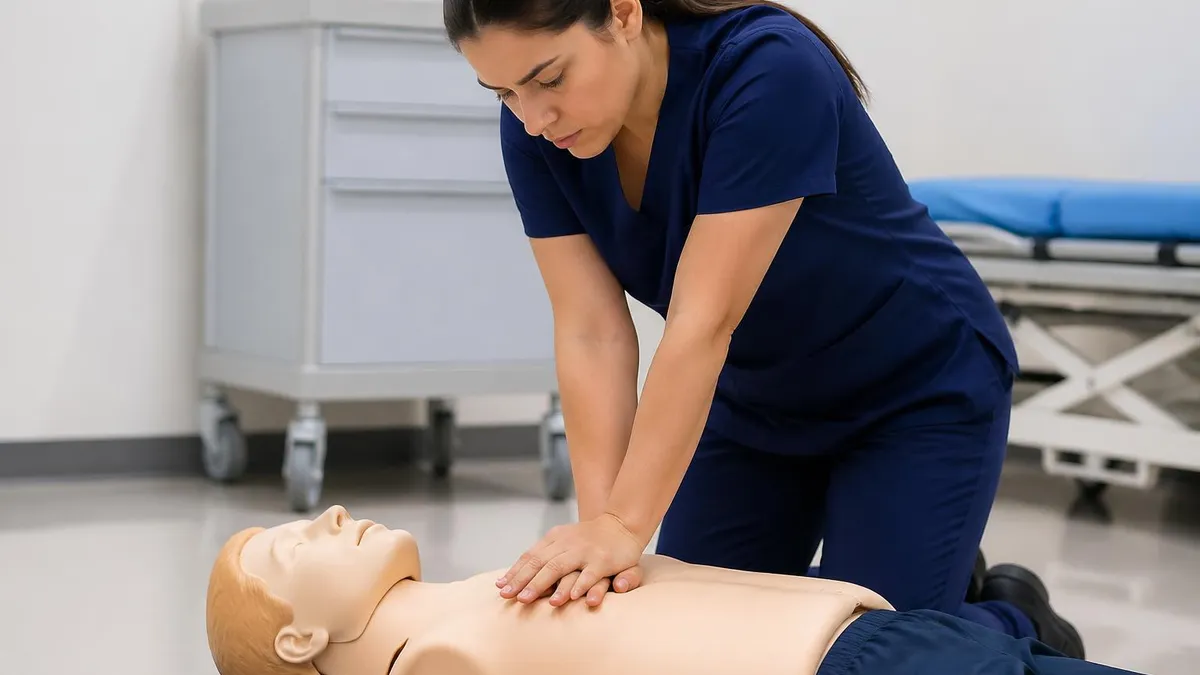
American Heart Association BLS: Certification, Renewal, Cost & What to Expect
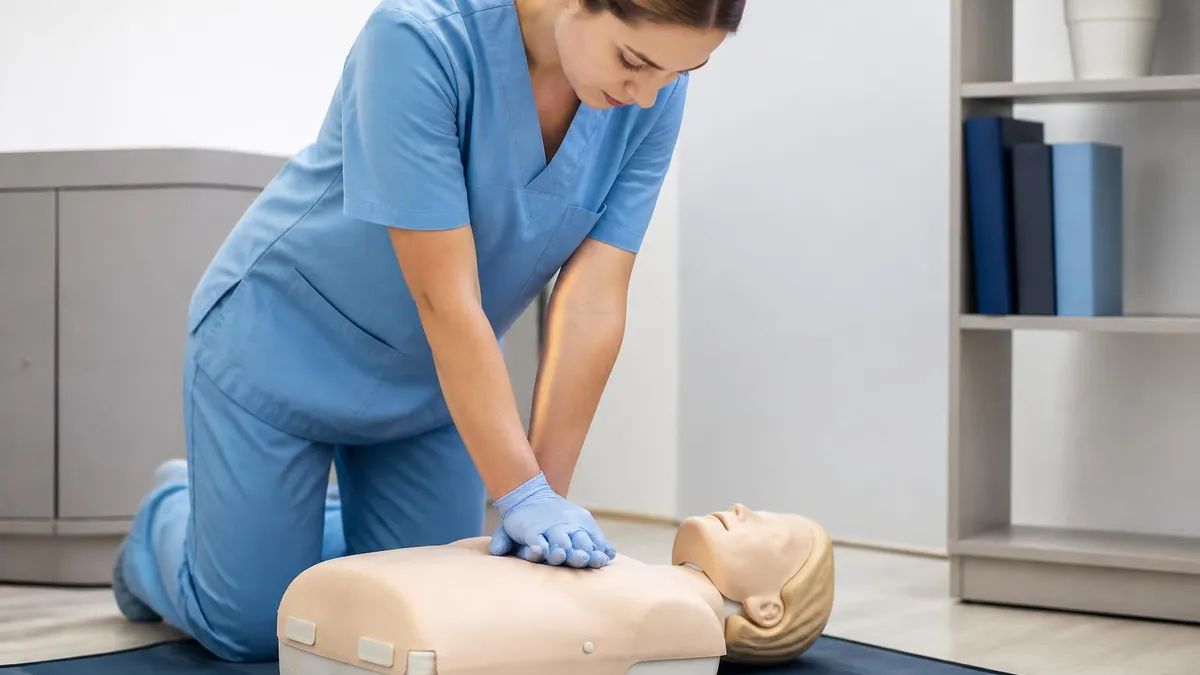
Red Cross BLS Certification: Course, Cost, and Renewal Guide
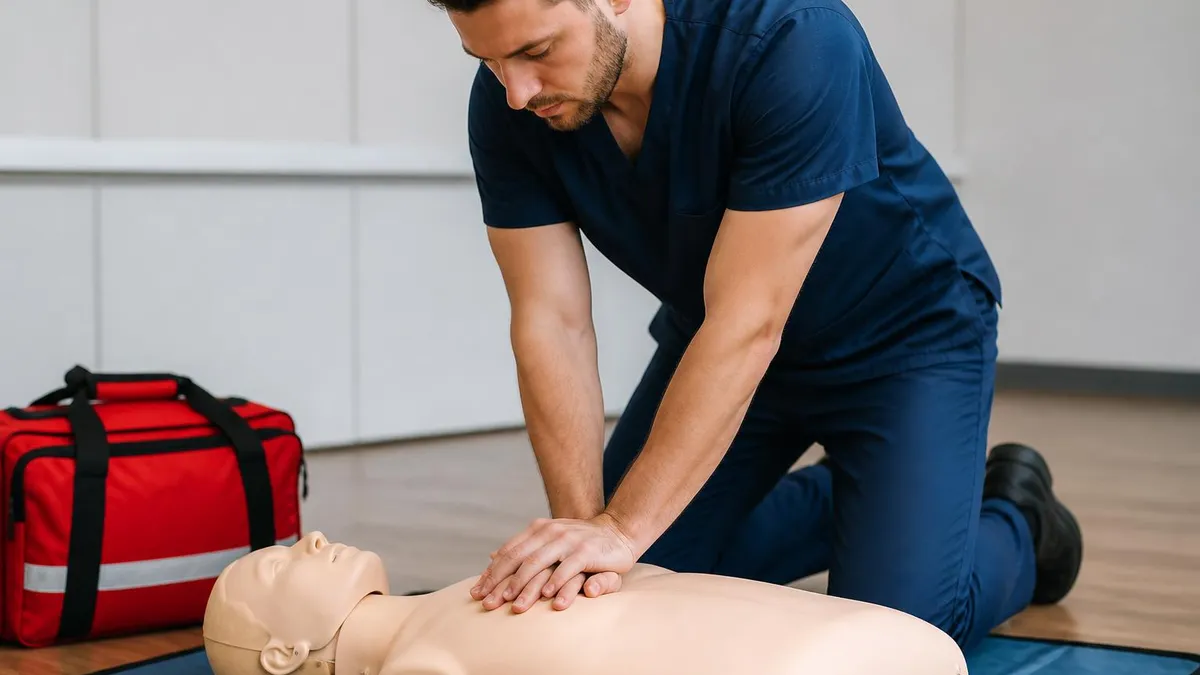
BLS Recertification Guide: Course Options, Online Renewal, Cost, Validity, and How to Maintain Your Certification
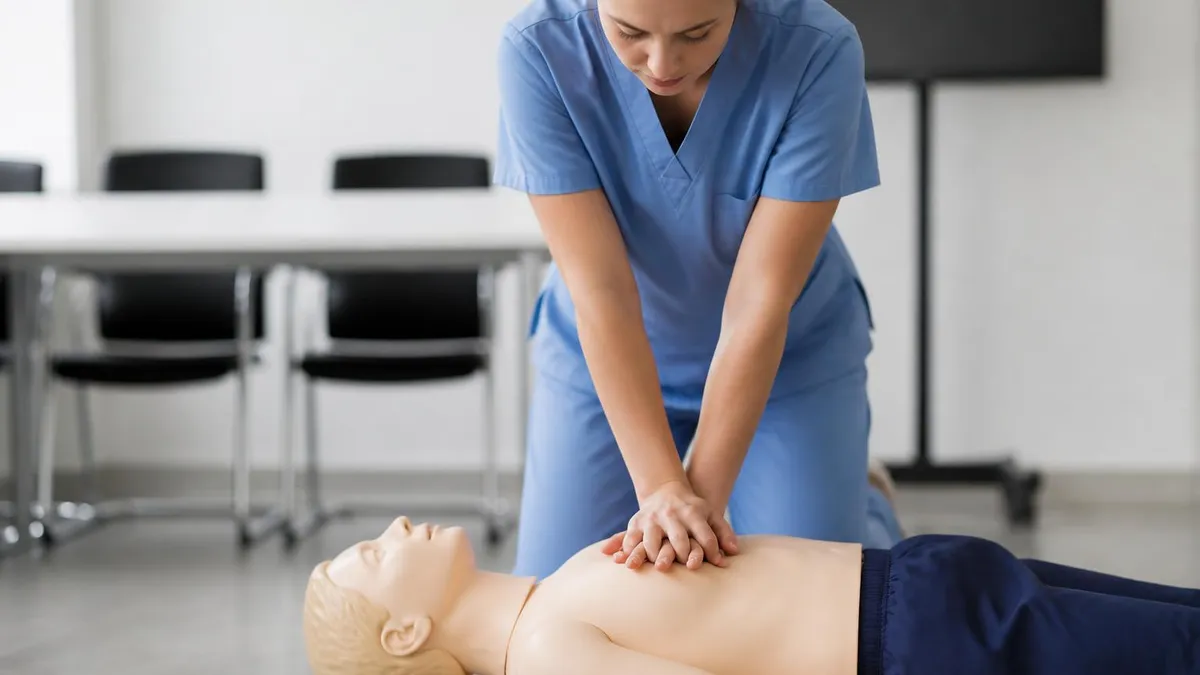
Free BLS Certification: Where to Get It, What's Legitimate, and What to Avoid
About the Author

Registered Nurse & Healthcare Educator
Johns Hopkins University School of NursingDr. Sarah Mitchell is a board-certified registered nurse with over 15 years of clinical and academic experience. She completed her PhD in Nursing Science at Johns Hopkins University and has taught NCLEX preparation and clinical skills courses for nursing students across the United States. Her research focuses on evidence-based exam preparation strategies for healthcare certification candidates.