
California Air Brake Endorsement: Complete Study Guide & CDL Test Prep
Master the California air brake endorsement with free CDL practice tests, study guides & tips. 🏆 Pass your air brake test on the first try.

The California air brake endorsement is a required credential for any commercial driver who operates vehicles equipped with air brakes, and understanding air brakes thoroughly is the foundation of passing your CDL knowledge exam. California's Department of Motor Vehicles administers a dedicated air brake written test that covers everything from system components and pressure regulation to emergency procedures and pre-trip inspection routines. Whether you are pursuing a Class A or Class B CDL, or simply need to remove the air brake restriction from your existing license, this guide walks you through every topic you need to master before test day.
Air brakes are far more complex than hydraulic systems found on passenger vehicles, relying on compressed air instead of fluid to transmit braking force to each wheel. The system includes compressors, air tanks, valves, brake chambers, and slack adjusters — all working in precise coordination. A failure in any one of these components can dramatically reduce stopping ability or cause a complete brake failure, which is why California's DMV takes the knowledge examination seriously and why thorough preparation is non-negotiable for aspiring commercial drivers.
One of the most frequently tested concepts on the CDL air brake test is the identification and function of individual components, such as the treadle valve (also called the foot valve or service brake valve), which controls air pressure delivered to the brakes when you press the pedal. The F-750 air brake treadle valve, for instance, is a common reference in study materials because the Ford F-750 platform is widely used in medium-duty commercial applications across California. Knowing how each valve operates helps you answer scenario-based questions that appear on the actual exam.
California drivers must also understand the role of antifreeze in air brake systems. Air brake antifreeze — typically alcohol-based — is injected into the air system during cold weather to prevent moisture trapped in the lines and tanks from freezing and blocking critical valves. While California's climate is generally mild, mountain routes and high-elevation passes in the Sierra Nevada can produce sub-freezing temperatures that make this knowledge operationally important, not just a test-day trivia item. Knowing when and how to add antifreeze correctly is a testable skill.
To start your practice right now, explore our new york air brake question bank, which includes hundreds of scenario-based questions aligned with both California and federal CDL standards. Drilling practice questions builds the pattern recognition you need to distinguish plausible-but-wrong answer choices from the correct federal FMCSA-based responses that California's exam expects.
This study guide is structured to move you from foundational knowledge to advanced test-taking strategy. You will learn the required air pressure ranges, how to conduct a proper pre-trip air brake inspection, the precise meaning of low-pressure warning devices, and how to handle brake fade on long downhill grades — all topics that carry significant weight on the California knowledge exam. Each section is paired with targeted practice quizzes so you can immediately test what you have just learned and identify any gaps before moving forward.
By the time you reach the end of this guide, you will have a comprehensive understanding of air brake theory, California-specific regulations, and proven study strategies that help drivers pass on the first attempt. Commit to working through every section, take every practice quiz, and review any question you miss until you understand not just the correct answer but the reasoning behind it. That deeper understanding is what separates drivers who pass from those who need to retake the exam.
California Air Brake Endorsement by the Numbers
Key Facts at a Glance
| Item | Value | Details |
|---|---|---|
| Minimum Questions on CA Air Brake Test | 25 | Must pass with 80% or higher |
| Passing Score Required | 80% | 20 correct out of 25 questions |
| Typical Test Duration | 60 min | No strict time limit in most offices |
| CA DMV Knowledge Test Fee | $38 | Fee applies per attempt |
| Attempts Allowed Per Fee Payment | 3 Tries | Retake required after 3 failures |

California Air Brake Endorsement Study Schedule
- ▸Read the California CDL Handbook air brake chapter in full
- ▸Learn all major components: compressor, governor, air tanks, valves, chambers
- ▸Memorize normal operating pressure range (100–125 psi)
- ▸Complete the Air Brakes Basic Q&A practice quiz
- ▸Study the treadle valve, relay valves, and quick-release valves in depth
- ▸Learn air brake antifreeze usage, alcohol evaporator function, and when to add antifreeze
- ▸Understand low air pressure warning activation (60 psi)
- ▸Complete Air Brake Pressure Regulation & Control practice quiz
- ▸Memorize the 7-step air brake check procedure
- ▸Practice the static pressure leak-down test (must not drop more than 4 psi per minute)
- ▸Study spring brake pop-out pressure (20–45 psi)
- ▸Complete Air Brake Pre-Trip Inspection practice quiz
- ▸Study emergency brake and parking brake requirements under FMCSR 393
- ▸Learn brake fade, heat buildup on downgrades, and escape ramp usage
- ▸Take all 6 practice quizzes and review every missed question
- ▸Schedule your California DMV knowledge test appointment
Understanding each component of the air brake system is the single most important step in preparing for the California CDL air brake test. The system begins with the air compressor, which is driven by the engine and feeds compressed air into storage tanks. The governor controls the compressor, cutting it out when tank pressure reaches approximately 125 psi and cutting it back in when pressure drops to around 100 psi. This automatic cycling keeps the system within its safe operating window at all times, and knowing those exact numbers is essential for the written exam.
The air tanks, also called reservoirs, store the compressed air that powers every braking action. Most vehicles have at least two tanks: a primary tank that supplies the rear brakes and a secondary tank that supplies the front brakes. A wet tank (supply tank) receives air directly from the compressor and collects water and oil that condense out of the compressed air. Drain valves at the bottom of each tank must be opened daily to remove this moisture, preventing it from freezing in cold weather or corroding internal components over time.
The brake pedal assembly contains the treadle valve, sometimes called the dual-circuit foot valve, which is arguably the most important control component in the system. When you press the brake pedal, the treadle valve simultaneously releases air from both the primary and secondary circuits in proportion to how hard you press. This dual-circuit design is a critical safety feature: if one circuit fails, the other circuit continues to apply brakes, preventing total brake loss. The F-750 air brake treadle valve is a frequently cited example in training materials because of its prevalence in medium-duty fleet vehicles.
Brake chambers convert air pressure into mechanical force at each wheel. A standard service brake chamber uses a flexible diaphragm that pushes a push rod when air pressure is applied. Spring brake chambers, used on rear axles of most commercial vehicles, add a powerful coil spring that applies the brakes mechanically whenever air pressure is lost or the driver sets the parking brake. If air pressure drops below the spring brake release threshold — typically between 20 and 45 psi — the springs automatically apply the brakes, which is why running out of air while moving is catastrophically dangerous.
Slack adjusters connect the push rod of the brake chamber to the S-cam brake mechanism and act as a lever arm. Their primary job is to adjust for brake lining wear, ensuring the push rod travels the correct distance to apply the brakes effectively. Automatic slack adjusters (ASAs) have been required on new air-braked vehicles since 1994 and self-adjust with each brake application.
However, automatic adjusters do not substitute for regular inspection — a dragging or loose slack adjuster still requires immediate attention. For a deep dive into component-level maintenance, review our guide to the air brake system covering chamber parts and service intervals.
The S-cam brake mechanism itself consists of an S-shaped cam that rotates when the slack adjuster moves, pushing the brake shoes outward against the brake drum. This friction converts kinetic energy into heat, slowing the vehicle. On long downhill grades, repeated braking can raise drum temperatures high enough to cause brake fade — a temporary and dangerous loss of braking effectiveness. Understanding brake fade is not just a test topic; it is a life-safety concept that every California CDL driver must internalize before operating on mountain roads like Highway 138, I-15 through Cajon Pass, or US-395 through the Eastern Sierra.
Finally, the parking brake system on air-braked vehicles uses spring brakes, not a separate mechanism. When the yellow diamond-shaped parking brake control (a push-pull knob on the dash) is pushed in, air pressure holds the springs compressed, releasing the brakes. When the knob is pulled out, air bleeds off and the springs apply the brakes. This means the parking brake is essentially fail-safe: the vehicle stays braked whenever air is lost. Students who confuse spring brakes with service brakes often miss multiple questions on the exam, so this distinction deserves careful study and repeated review through practice quizzes.
CDL Air Brake Test: What You Need to Know by Topic
The California CDL air brake test places heavy emphasis on specific pressure values that drivers must memorize. Normal operating pressure runs between 100 and 125 psi. The low-pressure warning device — a buzzer, light, or both — must activate before pressure drops below 60 psi. Spring brakes automatically apply when pressure falls between 20 and 45 psi. The safety relief valve, which prevents tank over-pressurization, is set to open at 150 psi. These numbers appear repeatedly on the exam, so flash-card drilling until each threshold is instant recall is strongly recommended for all test-takers.
When performing the static leak test during your pre-trip inspection, you must build system pressure to governor cut-out, then turn off the engine and time how much pressure drops over one minute. For single vehicles, pressure must not fall more than 3 psi per minute; for combination vehicles, no more than 4 psi per minute. After that baseline, fully apply the service brakes and recheck: additional loss must not exceed 4 psi per minute for single vehicles or 6 psi per minute for combinations. Exceeding these limits means the vehicle is out of service until the leak is repaired.

Air Brake Endorsement: Is Removing the Restriction Worth It?
- +Opens eligibility to drive a much wider range of commercial vehicles including school buses, transit buses, and large trucks
- +Increases earning potential — drivers with full unrestricted CDLs command higher wages in most California markets
- +Required for Class A CDL holders who want to pull heavy combination vehicles without operating restrictions
- +Demonstrates technical competence to employers, making you a more competitive job candidate
- +Air brake systems are safer and more reliable than hydraulic systems on heavy vehicles, so learning them improves overall road safety
- +Once earned, the endorsement stays on your CDL for life with no additional renewal testing required
- −Requires dedicated study time — the air brake knowledge test covers complex mechanical concepts that many drivers find challenging
- −Failed attempts incur additional DMV fees and require waiting periods before retesting in some California offices
- −Understanding air brake systems demands memorization of specific pressure values, leak rates, and inspection sequences that hydraulic-brake drivers are not used to
- −Pre-trip inspection requirements become more involved, adding time to daily driver routines for compliance
- −Mechanical failures in air brake systems can be severe — drivers bear greater responsibility for recognizing and reporting brake defects
- −Some employers require additional behind-the-wheel training on air-braked vehicles before allowing independent operation, adding cost and time to licensing
California Air Brake Pre-Trip Inspection Checklist
- ✓Build air pressure to governor cut-out (approximately 125 psi) before beginning the inspection sequence.
- ✓Confirm the low-pressure warning light and buzzer activate when pressure drops below 60 psi.
- ✓Test that spring brakes automatically pop out (apply) when pressure falls between 20 and 45 psi.
- ✓Shut off the engine, release the parking brakes, and time the static pressure drop — must not exceed 3 psi per minute for single vehicles.
- ✓Apply full service brakes and hold for one minute — pressure loss must not exceed 4 psi per minute for single vehicles.
- ✓Check the air compressor belt (if belt-driven) for cracks, fraying, and proper tension.
- ✓Drain all air tanks using the drain valve or automatic drain feature and inspect drainage for excessive oil or water.
- ✓Inspect brake chambers for rust, cracks, and proper push-rod travel — push rod must not exceed the legal adjustment limit.
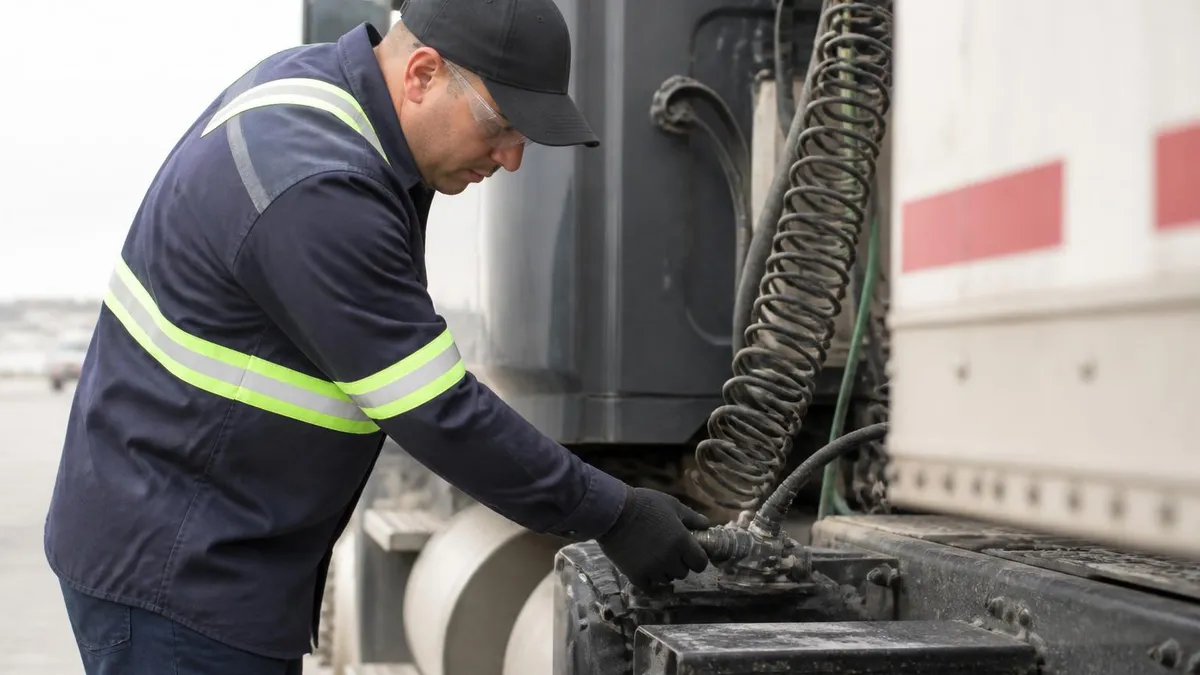
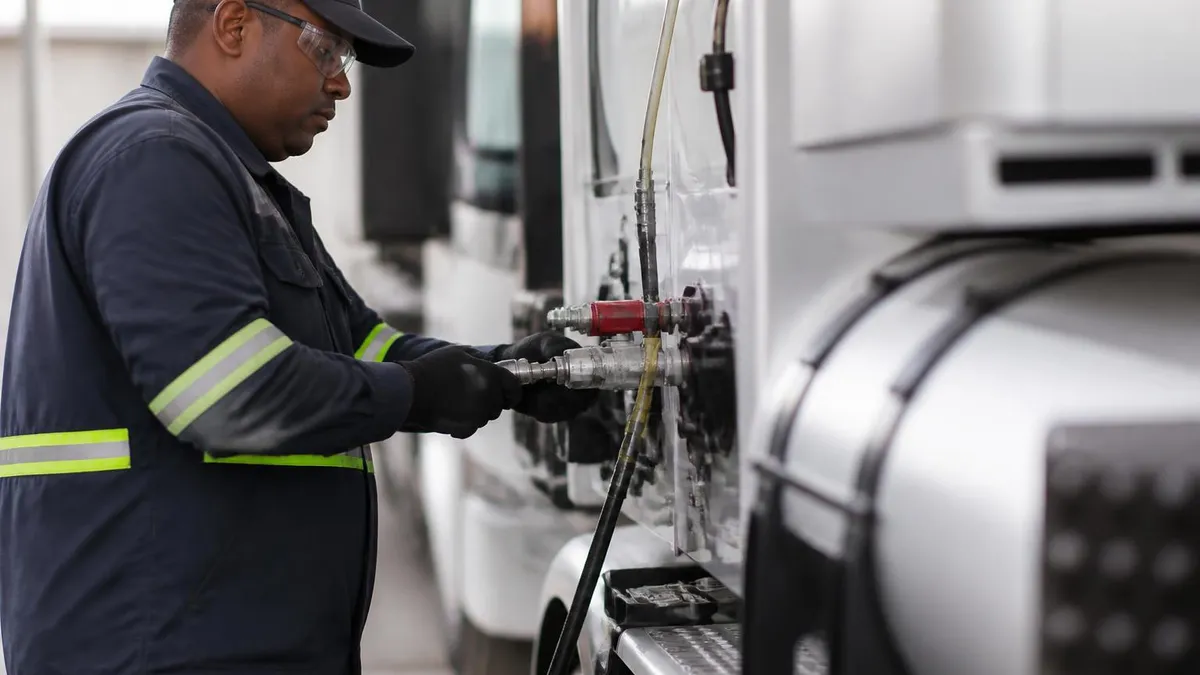
- ✓Check all air lines for cuts, chafing, crimping, or signs of wear that could cause air leaks under pressure.
- ✓Verify that slack adjusters are properly adjusted and that brake linings have sufficient thickness with no signs of contamination.

Know Your Three Key Pressure Numbers Cold
The single most reliable way to add 3–5 correct answers on your California CDL air brake test is to memorize three pressure thresholds: 60 psi (low-pressure warning activates), 20–45 psi (spring brakes apply), and 150 psi (safety relief valve opens). These numbers appear in multiple question formats — identification, scenario, and troubleshooting — so having them at instant recall turns potential misses into guaranteed points.
Passing the California CDL air brake test on your first attempt requires more than reading the handbook once — it demands active recall practice, targeted review of weak areas, and an understanding of how the DMV frames its questions. California's air brake knowledge test follows the same content structure as the federal CDL standard (FMCSA Part 383), but the DMV's question phrasing can be nuanced. Many candidates miss questions not because they lack the knowledge but because they misread the question stem or fail to distinguish between similar-sounding concepts like service brakes and emergency brakes.
One of the most effective strategies is to practice with questions that mirror the California DMV's question style. Our air brake test cdl practice resource includes full-length simulated exams calibrated to the 25-question California format, with answer rationales that explain why each wrong answer is wrong — not just why the correct answer is correct. This two-sided understanding is the key to avoiding traps set by plausible distractors that appear on the real exam.
A common mistake candidates make is focusing exclusively on system components while neglecting the inspection and testing procedures. The California air brake test typically devotes roughly one-third of its questions to pre-trip inspection, static brake tests, and adjustment procedures. If you can identify every component of the air brake system but cannot recite the steps for the air-loss-rate test or the stab-braking versus controlled-braking distinction, you are leaving a significant portion of the exam unprepared. Balance your study time between theory and procedures.
Another frequently missed topic area involves combination vehicle brake systems, particularly if you are pursuing a Class A CDL. Combination vehicles add trailer brake circuits, the trailer hand valve (trolley valve), trailer air supply valve (red octagonal knob), and the trailer emergency braking system into the equation.
The trailer supply valve must be pushed in (open) to supply air to the trailer; pulling it out cuts the trailer air supply, which sets the trailer spring brakes as an emergency measure. Test questions often present scenarios where the driver must choose the correct action when trailer air is lost, and only candidates who have practiced these scenarios answer correctly under time pressure.
Test anxiety is real, and it affects even well-prepared candidates. One proven technique is the process of elimination: California's air brake questions are multiple choice with four options. In most cases, you can immediately eliminate one or two answers as implausible, which improves your odds even when you are uncertain. Never leave a question blank — there is no penalty for wrong answers, so an educated guess on every remaining question is always the right strategy when time runs low.
Scheduling matters more than many candidates realize. California DMV offices in urban areas like Los Angeles, San Francisco, and Sacramento have longer wait times for walk-in knowledge tests, and appointment slots for CDL knowledge exams can book out two to three weeks in advance. Plan your study schedule to end at least one week before your intended test date, giving yourself buffer time to review weak areas after completing your final full-length practice exams. Arriving rested, having eaten, and mentally prepared makes a measurable difference in performance on test day.
Finally, understand that the California air brake endorsement is a permanent addition to your CDL — once earned, you do not need to retest when you renew your license. This makes the investment in thorough preparation worthwhile not just for test day but for your entire career. Drivers who truly understand their air brake systems are safer, catch problems earlier during pre-trip inspections, and make better decisions in emergency situations. The test is not a bureaucratic hurdle — it is a meaningful assessment of knowledge that protects you, your passengers, and every other vehicle on California's roads.
In California, driving a vehicle equipped with air brakes without the appropriate endorsement or with the air brake restriction in place is a violation of CVC Section 12814.6 and can result in fines, license suspension, and liability in the event of an accident. Even if your employer assigns you to an air-braked vehicle, it is your legal responsibility to hold the correct credential before operating that vehicle on public roads. Schedule your California DMV knowledge test before getting behind the wheel of any air-braked commercial vehicle.
Emergency situations involving air brakes demand an immediate, correct response — hesitation or the wrong action can turn a manageable problem into a fatal accident. The most common emergency scenario on the California CDL air brake test involves sudden air pressure loss while driving. If your low-pressure warning activates while in motion, you must bring the vehicle to a controlled stop as quickly and safely as possible before pressure drops to the spring brake engagement threshold. Attempting to continue driving with failing air pressure risks a sudden, uncontrolled stop when the spring brakes snap on automatically at highway speed.
Brake fade on long downhill grades is another critical emergency topic. Brake fade occurs when brake drums and linings overheat from repeated brake application, reducing friction and dramatically lengthening stopping distances. The correct technique for mountain descents is to select a low gear before starting downhill — not halfway down — and use engine braking as the primary speed control.
Apply the service brakes only in short, firm applications of about 3 seconds to bring speed down by approximately 5 mph below your target speed, then release and allow the brakes to cool before reapplying. Never ride the brakes continuously on a downgrade.
If you experience a brake failure on a downgrade and are unable to reduce speed through engine braking alone, California's mountain highways are equipped with truck escape ramps — sand-filled or uphill ramps designed to safely stop runaway vehicles. Using an escape ramp is always the correct choice when brake fade or failure makes it impossible to maintain safe speed.
The California CDL exam tests awareness of escape ramp protocols, including the fact that using an escape ramp is never a violation and that the vehicle can typically be towed out and inspected after use with minimal damage compared to a collision.
Jackknifing is an emergency specific to combination vehicles that occurs when the trailer pushes the tractor at a greater angle than the trailer, causing the rig to fold. Jackknifing most often results from aggressive braking on slippery surfaces when the trailer wheels lock while the drive wheels maintain traction — or when the drive wheels lock while the trailer continues pushing.
Modern vehicles with ABS (anti-lock braking systems) significantly reduce jackknife risk by preventing wheel lockup, but drivers must still understand the conditions that lead to jackknifing and the correct response: ease off the brakes to restore steering control, then reapply gently.
Air in brake lines — specifically, air contamination in hydraulic systems, or moisture contamination in air brake plumbing — is a critical topic for diagnosis questions. In a pure air brake system, the presence of too much water or oil contamination can cause valve sticking, corrosion, and freeze-up in cold conditions.
Drivers who notice a spongy feel in their air brake application or unusual delays in brake response should suspect contamination or a developing leak and pull over for inspection. For a systematic approach to diagnosing system faults, our resource on air in brake line issues and pressure drop diagnosis provides step-by-step troubleshooting guidance aligned with CDL exam expectations.
The proper use of the trailer hand valve (also called the trolley valve) in emergencies is another testable concept. The trailer hand valve should never be used for parking — it is not designed to hold the vehicle stationary for extended periods and can lose holding power as air bleeds off.
In emergency maneuvering, the trailer hand valve can help prevent trailer swing by applying trailer brakes independently of the tractor brakes, but this technique requires skill and practice. On the written exam, questions about the trailer hand valve typically focus on its correct use, its location (typically on the steering column or dashboard), and what happens when it is improperly used as a parking device.
Understanding California's chain of command for brake inspections is the final layer of emergency preparedness. Under FMCSA regulations — which California adopts — drivers are required to perform a pre-trip brake inspection before every trip and a post-trip inspection at the end of each day. Any brake defect that affects safe operation must be reported on a Driver Vehicle Inspection Report (DVIR) and must be repaired before the vehicle returns to service.
Drivers who falsify DVIR reports or knowingly operate vehicles with defective air brakes face significant civil and criminal penalties under California and federal law. The written test frequently includes questions about DVIR requirements as part of the legal compliance section.
With your foundational knowledge and emergency protocol understanding in place, the final phase of preparation is building test-taking speed and confidence through deliberate practice. Research on CDL exam outcomes consistently shows that candidates who complete at least five full-length practice tests before their actual exam pass at significantly higher rates than those who only read the handbook. The reason is simple: recognizing question patterns, managing time, and building automatic recall of key facts all improve dramatically with repetition under simulated test conditions.
Start your final week of preparation by taking a timed full-length practice test each morning. Review every question you miss immediately after completing the test — not at the end of the day, but right after the exam session while the question context is still fresh. Write down the correct answer and the reasoning in your own words.
This active processing encodes the information far more durably than passively re-reading the correct answer on a screen. By the end of five days, you should be consistently scoring 90% or higher on practice tests before you feel confident scheduling your California DMV appointment.
Pay special attention to questions involving numbers and sequences, because these are the items most likely to trip up candidates who have studied but not practiced enough. You need to know not just that the low-pressure warning activates below 60 psi, but also what happens next: you must pull safely off the road, because if pressure continues dropping to the spring brake engagement range, the vehicle will stop suddenly. The sequence matters as much as the numbers. Practice constructing the complete causal chain for each major system event rather than memorizing isolated facts.
Group your weak areas into three categories: concepts you do not understand at all, concepts you understand but confuse with similar concepts, and concepts you know but apply incorrectly under pressure. Each category requires a different remediation strategy. Concepts you do not understand need fresh instruction — try watching video explanations of air brake systems on YouTube to complement text-based learning. Concepts you confuse with similar ones benefit from comparison tables that lay the differences side by side. Concepts you know but misapply under pressure improve through repeated scenario-based practice with a timer running.
The night before your test, avoid intensive studying. Instead, do a light 20-minute review of your comparison tables and the key pressure values, then get a full night of sleep. Sleep is not optional for knowledge consolidation — the brain processes and stores memories during deep sleep cycles, meaning the information you studied during the week is literally being organized and locked in while you rest. Arriving at the DMV well-rested, having eaten a normal meal, and with your required documentation ready will put you in the best possible mental state to perform.
On the day of the test, read every question twice before selecting your answer. California DMV questions are sometimes written with double negatives or conditional phrasing that changes the correct answer entirely if misread. Pay particular attention to words like "except," "never," "always," and "only" — these qualifiers are often the hinge that separates the correct answer from a plausible distractor. If a question references a specific pressure value or procedure step, trust the numbers you memorized — they are designed to test exact knowledge, not approximations.
After passing your knowledge test, do not consider your air brake education complete. The written exam tests what you know in theory; actual road safety requires applying that knowledge in real driving conditions. Seek out supervised behind-the-wheel time in an air-braked vehicle as soon as possible after passing.
Notice how the brake pedal feels different from a hydraulic vehicle, how pressure builds and releases, and how the parking brake knob engages. This hands-on experience transforms test-day knowledge into genuine operational competence — the ultimate goal of the California CDL air brake endorsement process and the foundation of a long, safe commercial driving career in California.
Sample Air Brake Practice Questions
Try these questions from our free Air Brake practice tests. The correct answer and an explanation follow each question.
What should a crane operator do if the air pressure is too low during a brake test?
- A. Continue with the operation as usual.
- B. Stop the operation and fix any air pressure issues.
- C. Increase the air pressure manually.
- D. Continue lifting but at a lower speed.
Answer: B. Stop the operation and fix any air pressure issues.
If air pressure is too low during a brake test, it indicates a critical safety issue where the air brake system may not function properly. Continuing operation with insufficient air pressure can lead to brake failure and severe accidents. Therefore, stopping the operation and addressing the underlying air pressure problem is essential to ensure the safety of the operator, equipment, and surrounding environment.
What is the function of the brake pedal in an air brake system?
- A. To activate the hydraulic system.
- B. To control the brake application and release air pressure.
- C. To increase air pressure.
- D. To control the speed of the engine.
Answer: B. To control the brake application and release air pressure.
The brake pedal in an air brake system serves as the driver's primary interface for controlling the brakes. When pressed, it modulates the air pressure sent to the brake chambers, initiating the braking action. Releasing the pedal allows air pressure to be released, disengaging the brakes.
At 55 mph on dry pavement, approximately how many feet of additional stopping distance does air brake lag add compared to the moment you press the brake pedal?
- A. About 32 feet
- B. About 10 feet
- C. About 60 feet
- D. About 100 feet
Answer: A. About 32 feet
At 55 mph, a vehicle travels roughly 80 feet per second, so 0.4 seconds of brake lag adds approximately 32 feet before braking even begins.
What does the air brake manual say causes brake drums to overheat?
- A. Light, intermittent braking
- B. Excessive use of the service brakes on long grades
- C. Using engine braking
- D. Driving uphill
Answer: B. Excessive use of the service brakes on long grades
Excessive use of the service brakes, such as riding them down a grade, causes overheating and fade.
Air Brake Questions and Answers


About the Author

Educational Psychologist & Academic Test Preparation Expert
Columbia University Teachers CollegeDr. Lisa Patel holds a Doctorate in Education from Columbia University Teachers College and has spent 17 years researching standardized test design and academic assessment. She has developed preparation programs for SAT, ACT, GRE, LSAT, UCAT, and numerous professional licensing exams, helping students of all backgrounds achieve their target scores.