
Air Brake Fittings: Complete Guide to 3/8 Fittings, Types, and CDL Test Prep
Master air brakes fittings for your CDL test. 3/8 air brake fittings explained, types, installation tips & free practice questions. ✅

Understanding 3/8 air brake fittings is one of those foundational topics that separates a prepared CDL candidate from one who struggles on test day. Air brakes are the backbone of heavy commercial vehicle safety, and the fittings that connect every hose, valve, and reservoir are just as critical as the brake chambers themselves. A loose or incorrect fitting can result in dangerous air pressure loss, extended stopping distances, and catastrophic brake failure on a loaded semi-truck traveling at highway speeds.
The term "3/8" refers to the nominal pipe thread diameter measured in inches — specifically 3/8-inch NPT (National Pipe Tapered) thread, which is one of the most common sizes found in commercial truck air brake plumbing. These fittings appear throughout the air supply system, connecting components like the air dryer, wet tank, service reservoirs, and the delivery ports on relay valves and treadle valves. On vehicles such as the Ford F-750, the new york air brake treadle valve commonly uses 3/8-inch ports, making this size especially relevant for drivers operating medium-duty trucks.
For CDL candidates preparing for the air brake endorsement exam, understanding fitting types goes well beyond memorizing part numbers. The written test specifically evaluates whether you understand how air moves through the system, where pressure can be lost, and how different fittings contribute to overall brake performance. Questions about supply and delivery circuits, one-way check valves, and coupling components all relate directly to how fittings are installed and maintained across the braking system.
There are several broad categories of air brake fittings you will encounter on real equipment and on the air brake test cdl written examination. Push-to-connect (also called push-lock or DOT push-in) fittings allow nylon air lines to be inserted without tools, creating a secure seal under system pressure. Compression fittings use ferrules and nuts to grip the outside of a tube, while NPT threaded fittings provide a tapered metal-to-metal seal that is reinforced with thread sealant. Each type has specific applications, pressure ratings, and failure modes that a commercial driver must recognize during pre-trip inspections.
Air brake antifreeze is another topic that intersects with fittings and plumbing knowledge. In cold climates, moisture that accumulates in air lines can freeze at fitting junctions, blocking airflow and preventing brake actuation. Alcohol evaporators and air dryers with desiccant cartridges are installed in the system specifically to address this risk. Knowing where these components connect — and what size fittings are used — helps drivers understand why daily drainage of reservoirs and proper system maintenance are non-negotiable safety habits rather than optional procedures.
The Federal Motor Carrier Safety Administration (FMCSA) requires that all air brake plumbing on commercial motor vehicles meet specific material and pressure standards. Fittings must be rated for at least 150 psi working pressure, and many systems operate at governor cut-out pressures between 120 and 135 psi. Fittings that are corroded, cross-threaded, or installed with incompatible materials can fail under normal operating pressure, creating an immediate out-of-service condition under DOT inspection criteria. This regulatory dimension is heavily tested on state CDL air brake examinations.
This article covers everything you need to know about air brake fittings for both real-world maintenance awareness and CDL test success. We will walk through fitting types, system locations, inspection procedures, common failure points, and specific study strategies for the written exam. Whether you are a first-time CDL applicant or an experienced driver refreshing your knowledge before an endorsement upgrade, understanding fittings as part of the larger air brake system will make you a safer and more confident commercial vehicle operator.
Air Brake Fittings by the Numbers

Main Types of Air Brake Fittings
National Pipe Tapered fittings create a metal-to-metal seal using tapered threads. The 3/8-inch NPT size is the most common port size on air valves, reservoirs, and dryers. They require thread sealant (PTFE tape or liquid compound) to prevent leaks under brake system pressures.
These tool-free fittings accept DOT-approved nylon air line tubing (typically 1/4" to 1/2" OD) with a simple push-and-lock mechanism. A collet ring grips the tube and an O-ring seals it. They are rated for full air brake system pressure and are widely used in modern trailer brake circuits.
Compression fittings use a ferrule that deforms around the tube OD when the nut is tightened, creating a mechanical seal. They are common on copper and nylon tubing in older air brake systems. They require precise torque to avoid under-compression (leaks) or over-compression (tube damage).
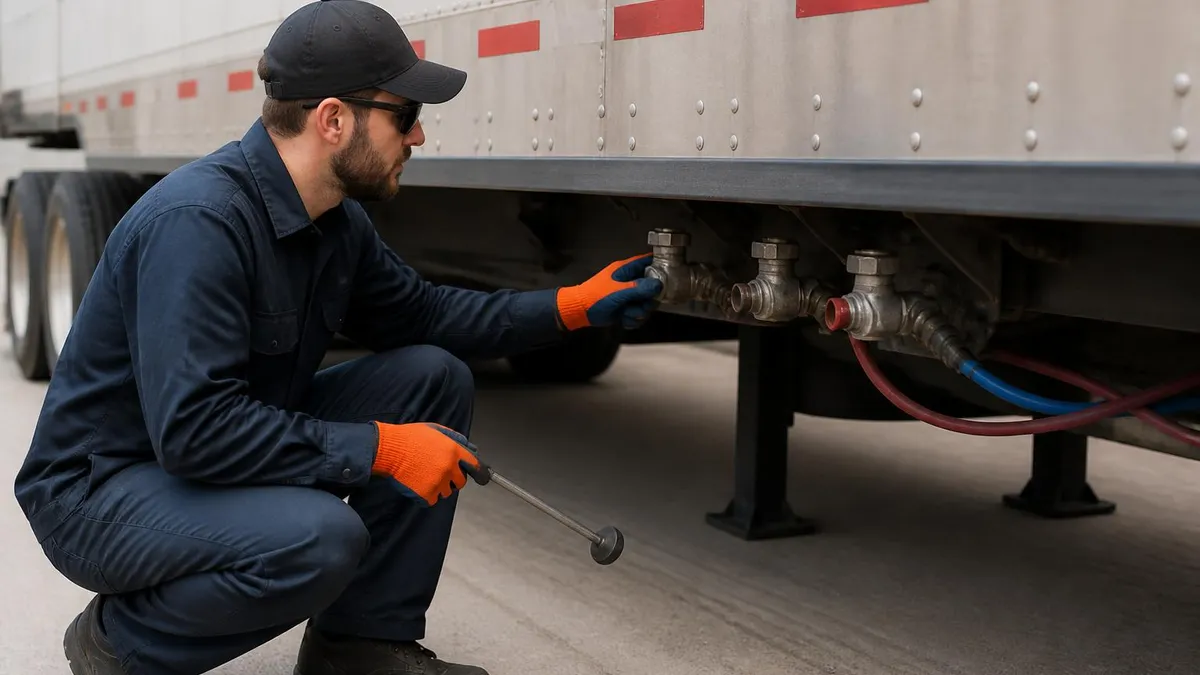
Gladhands are the standardized quick-disconnect couplings that connect tractor and trailer air lines. They come in two types — service (blue) and emergency (red) — and use a rubber seal and a quarter-turn lock. Damaged gladhand seals are among the most common sources of air in brake lines during DOT roadside inspections.
Understanding exactly where different air brake fittings appear throughout the system helps drivers recognize problems during pre-trip inspections and helps CDL students answer scenario-based exam questions more confidently. The air supply circuit begins at the compressor, which is typically driven off the engine's gear train or by a belt. From there, compressed air travels through a discharge line — usually 3/8-inch or 1/2-inch NPT plumbing — into the air dryer, which is the first major component where fittings play a critical role in moisture removal and filtration.
After the air dryer, the supply circuit feeds the wet tank (also called the supply reservoir) through a one-way check valve. This check valve prevents backflow if the compressor loses pressure, and it uses NPT threaded fittings on both inlet and outlet ports. From the wet tank, separate lines feed the primary and secondary service reservoirs, each protected by additional check valves. These dual-circuit designs mean that a fitting failure in one circuit does not necessarily disable the entire air brake system — but it will trigger the low-pressure warning and may cause uneven braking.
The delivery circuit — which moves air from reservoirs to the brake chambers whenever the driver presses the treadle pedal — relies heavily on relay valves. The Ford F-750 and similar medium-duty trucks equipped with air brakes typically use a front-axle relay valve and a rear-axle relay valve, both of which feature 3/8-inch NPT delivery ports.
When you push the treadle valve (foot valve), it sends a control signal pressure to the relay valves, which then deliver reservoir air directly to the brake chambers through large-bore 1/2-inch or 3/4-inch lines. Understanding this two-stage delivery process explains why relay valves reduce brake timing lag on longer vehicles.
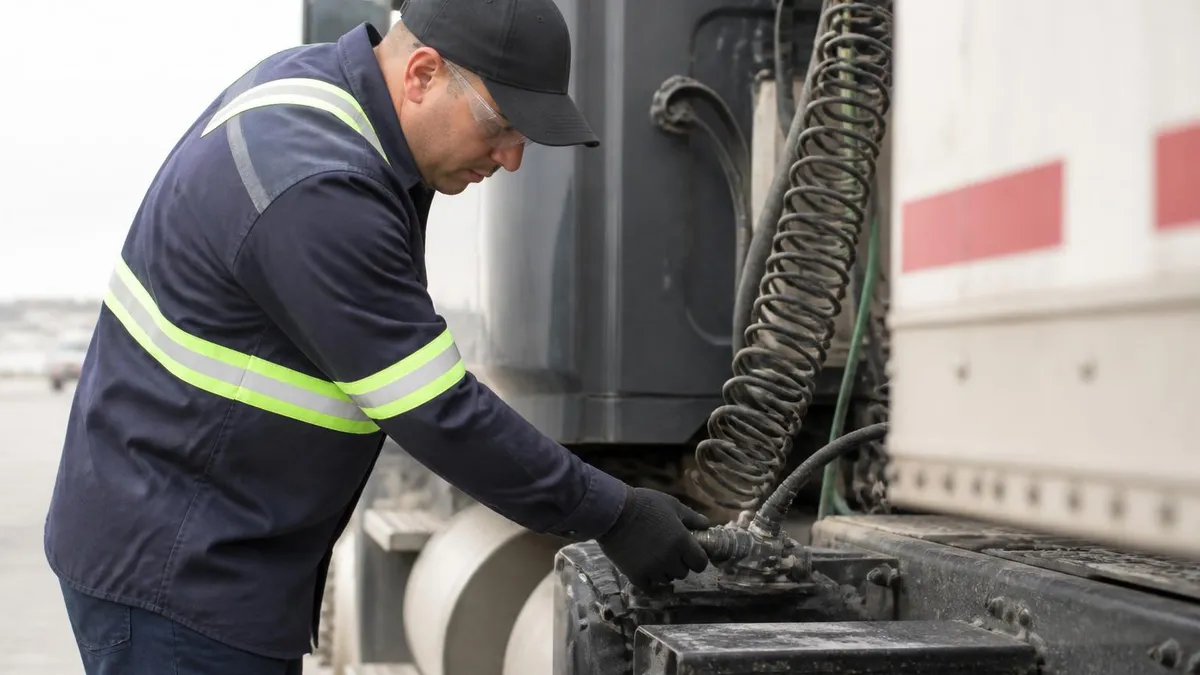
Trailer brake circuits introduce additional fitting complexity because of the gladhand connections. Each time a driver couples a trailer, the gladhand seals must be clean, pliable, and seated correctly. A cracked or missing gladhand seal allows air to escape, which registers as air in brake line pressure loss during the applied-brake leakage test — one of the specific test procedures covered on the CDL air brake written examination. Many state CDL tests include questions about acceptable leakage rates, making this a high-value study topic.
The parking brake and emergency brake circuits also rely on fittings, though their function is the reverse of service brakes. Spring brake chambers use air pressure to hold the spring compressed (releasing the brake); when air pressure drops below approximately 20–45 psi (depending on the spring brake specifications), the spring extends and applies the brakes mechanically.
The modulating valve that controls this process connects to the system via 3/8-inch NPT ports, and any fitting failure in this circuit can cause unexpected brake application or — more dangerously — failure to apply the parking brake when the driver assumes it is engaged.
Air brake antifreeze systems connect to the wet tank or the air dryer using small-bore fittings, typically 1/4-inch NPT or push-to-connect. Methanol-based alcohol evaporators inject small amounts of antifreeze into the air stream to prevent moisture from freezing at valves, fittings, and actuator ports in cold weather. Drivers operating in states with harsh winters — including those preparing for a northern-state CDL air brake endorsement — should understand how these systems interact with the rest of the brake plumbing, as exam questions may ask about their location, function, and maintenance intervals.
Pressure protection valves and the stop light switch are smaller components that also rely on correctly sized fittings. The stop light switch is typically a pressure-actuated electrical switch threaded into a delivery port with a 1/8-inch or 1/4-inch NPT fitting. When service air pressure rises above approximately 6 psi at the switch port, the circuit closes and illuminates the brake lights.
A leaking fitting at this location can cause intermittent brake light failure — a safety violation and an exam topic. Understanding the full map of where fittings appear in the air brake system prepares CDL candidates to answer questions about system function, failure modes, and inspection procedures with confidence.
CDL Air Brake Test: What You Need to Know About Fittings
The CDL air brake written test — offered in every US state as part of the Class A or Class B endorsement process — regularly features questions about air system components including fittings, valves, and plumbing configurations. Candidates can expect questions about the difference between supply and delivery circuits, the function of one-way check valves, the purpose of the air dryer, and why dual-circuit systems exist. Knowing that 3/8-inch NPT is the dominant fitting size at relay and treadle valve ports helps contextualize many circuit questions.
Study materials from the FMCSA Commercial Driver License Manual (Section 5) describe air brake system components in detail but do not always specify fitting sizes — that knowledge comes from hands-on experience or supplemental study. Practice tests that mirror the CDL air brake test format will expose you to phrasing similar to what state DMVs use, helping you recognize correct answers even when questions are worded in unfamiliar ways. Aim for at least 85% accuracy on practice tests before scheduling your actual exam.

Push-to-Connect vs. NPT Threaded Fittings: Which Is Better for Air Brakes?
- +Push-to-connect fittings install in seconds without tools, reducing maintenance time in fleet environments
- +No thread sealant required — eliminates risk of contaminating the air system with PTFE tape fragments
- +NPT fittings handle higher vibration loads better due to rigid metal-to-metal thread engagement
- +NPT 3/8-inch fittings are universally available at truck stops and parts suppliers across the US
- +Push-to-connect fittings can be released and reinstalled multiple times without losing sealing integrity
- +Threaded NPT fittings provide a permanent, torque-confirmed connection that is easy to inspect visually
- −Push-to-connect fittings can be accidentally released if the collet ring is depressed while the line is pressurized
- −NPT fittings require precise torque — overtightening can crack cast-iron valve bodies on older equipment
- −Push-to-connect fittings are sensitive to tube OD tolerance — undersized tubes create leak paths
- −NPT threads are prone to cross-threading when installed in tight spaces with limited tool access
- −PTFE tape on NPT threads can shred into the air system, clogging small orifices in relay valves
- −Compression fittings — a third option — require re-torqueing after initial pressurization to prevent slow leaks
Pros and Cons at a Glance
| Pros | Cons |
|---|---|
| Push-to-connect fittings install in seconds without tools, reducing maintenance time in fleet environments | Push-to-connect fittings can be accidentally released if the collet ring is depressed while the line is pressurized |
| No thread sealant required — eliminates risk of contaminating the air system with PTFE tape fragments | NPT fittings require precise torque — overtightening can crack cast-iron valve bodies on older equipment |
| NPT fittings handle higher vibration loads better due to rigid metal-to-metal thread engagement | Push-to-connect fittings are sensitive to tube OD tolerance — undersized tubes create leak paths |
| Push-to-connect fittings can be released and reinstalled multiple times without losing sealing integrity | NPT threads are prone to cross-threading when installed in tight spaces with limited tool access |
| Threaded NPT fittings provide a permanent, torque-confirmed connection that is easy to inspect visually | PTFE tape on NPT threads can shred into the air system, clogging small orifices in relay valves |
Air Brake Fittings Pre-Trip Inspection Checklist
- ✓Visually inspect all visible NPT fittings at the air dryer, wet tank, and reservoir ports for rust streaking or moisture weeping.
- ✓Check gladhand couplers for cracked, missing, or hardened rubber seals before coupling any trailer.
- ✓Tug gently on each push-to-connect air line to confirm the collet ring has fully engaged the tube.
- ✓Look for oil film around compressor discharge fittings — oil in the air system indicates worn compressor piston rings.
- ✓Perform the static leakage test: with brakes released, confirm pressure drop does not exceed 2 psi per minute.
- ✓Perform the applied leakage test: with brakes applied, confirm pressure drop does not exceed 4 psi per minute.
- ✓Check air line hoses connecting to fittings for chafing, kinking, or contact with hot exhaust components.
- ✓Inspect the spring brake control valve fittings for corrosion, especially on vehicles operating in salted road environments.
- ✓Confirm the air dryer purge valve fires correctly during compressor cut-out — a clogged purge fitting can prevent moisture discharge.
- ✓Verify the low-pressure warning light and buzzer activate before reservoir pressure drops below 60 psi during the engine-off pressure build test.
One Leaking 3/8" Fitting Can Trigger an Out-of-Service Order
Under FMCSA 49 CFR 393.45, any air brake system leak that causes pressure to drop faster than the allowable leakage rate is grounds for placing a commercial vehicle out of service immediately. A single loose 3/8-inch NPT fitting at a reservoir outlet can produce a slow leak that passes unnoticed until a DOT roadside inspection — resulting in lost revenue, a compliance violation on the carrier's safety record, and potential driver disqualification. Always verify fitting integrity as part of every pre-trip inspection, not just when brakes feel unusual.
Common air brake fitting failures follow predictable patterns, and knowing these patterns allows drivers and technicians to diagnose problems quickly rather than performing costly trial-and-error part replacements. The most frequent failure mode for NPT threaded fittings is vibration-induced loosening, which occurs when fittings are not torqued to specification during installation or when thread sealant is absent.
On heavy trucks operating over rough terrain or on construction sites, the continuous vibration transmitted through the frame can work a fitting loose over thousands of miles, producing a leak so slow that the compressor keeps up with it — masking the problem until the compressor itself fails from overwork.
Push-to-connect fitting failures most commonly result from using non-DOT-approved nylon tubing with incorrect outside diameter tolerances. Air brake nylon tubing is specified in nominal OD sizes (1/4", 3/8", 1/2") with tight manufacturing tolerances. Generic pneumatic tubing sourced from industrial suppliers may be slightly undersized, preventing the collet from gripping the tube firmly enough to hold under maximum system pressure. During a panic stop or a full emergency brake application, delivery pressure can spike above normal operating levels, and an improperly seated push-to-connect fitting can blow off the tube entirely — an immediate and dangerous brake failure event.
Corrosion is the dominant long-term failure mechanism for NPT fittings, particularly in regions where roads are treated with salt or magnesium chloride during winter months. Cast-iron valve bodies with steel NPT fittings form a galvanic couple in the presence of salt-laden moisture, causing accelerating corrosion at the fitting-to-body interface. Over time, the fitting seizes in place and the surrounding cast iron can crack when a technician attempts removal. Drivers who notice brown rust streaking below any air component should report it immediately, as the corrosion visible externally may indicate far worse conditions inside the threaded joint.
Gladhand coupler failures are among the most visible and most tested fitting failures on CDL exams. The rubber seal inside a gladhand coupler degrades with UV exposure, ozone, and fuel contamination. A hardened or torn gladhand seal allows supply air to leak between the tractor and trailer circuits, which reduces trailer brake application pressure and extends stopping distance — exactly the condition the air brake system is designed to prevent.
Drivers should carry spare gladhand seals and know how to replace them roadside, as a bad seal can strand a combination vehicle if trailer brakes cannot be applied sufficiently to pass a safety inspection.
The air dryer is a particularly fitting-intensive component, with ports for compressed air inlet, purge valve discharge, delivery outlet, and often a heater or bypass valve. Dryer inlet fittings see the highest temperature and pressure in the entire air system because air exits the compressor at elevated temperature before the aftercooler reduces it.
These high-temperature NPT fittings require high-temperature thread sealant compounds rather than standard PTFE tape, which can degrade and fragment under compressor discharge conditions. CDL test questions sometimes ask about the air dryer's location in the system, and knowing the fitting types at each port reinforces the correct answer.
Relay valve fitting failures deserve special attention because relay valves are the direct link between brake signal pressure and brake chamber delivery. A leaking 3/8-inch fitting at a relay valve delivery port causes one brake circuit to receive less air than the opposing circuit, producing brake imbalance.
Brake imbalance on a tandem-axle truck creates yaw forces during hard braking — the vehicle tends to rotate around the axle that is braking harder — which can cause loss of directional control. This is why FMCSA inspection criteria flag any relay valve fitting leak as a critical safety defect requiring immediate repair before the vehicle is returned to service.
Preventing fitting failures is largely a matter of following correct installation procedures and using appropriate materials. Always use the correct fitting type for the application — push-to-connect for flexible nylon lines, NPT with proper sealant for rigid metal-to-metal connections, and DOT-rated gladhand seals for tractor-trailer couplings. Torque NPT fittings to manufacturer specifications rather than relying on feel.
Replace rubber components (gladhand seals, O-rings in push-to-connect fittings) on a preventive maintenance schedule rather than waiting for visible failure. These practices not only prevent costly breakdowns but demonstrate the system knowledge that CDL examiners are testing when they ask about brake system maintenance and inspection procedures.

A common and dangerous mistake among technicians unfamiliar with air brake systems is substituting hydraulic fittings for air brake fittings. While some fitting types look identical externally, hydraulic fittings may lack the corrosion resistance, pressure cycling ratings, or thread specifications required for air brake service. Using unapproved fittings violates FMCSA regulations and voids manufacturer warranties. Always source replacement fittings from suppliers that explicitly certify their components for DOT air brake service, and verify the pressure rating stamped or labeled on the fitting matches or exceeds your system's maximum allowable pressure.
Effective study strategies for the CDL air brake endorsement exam go beyond reading the FMCSA Commercial Driver License Manual once and hoping for the best. The air brake section is notoriously detailed, covering system components, pressure specifications, inspection procedures, driving techniques, and regulatory requirements across approximately 30 pages of federal manual content. Candidates who treat the CDL air brake test like a simple multiple-choice quiz — studying only long enough to get lucky — typically discover that state exams use enough question variation and scenario-based phrasing to expose shallow preparation.
The most effective study approach combines reading the CDL manual with active recall through practice tests. Start with a careful read-through of Section 5 of the FMCSA CDL Manual, paying special attention to the diagrams showing air flow through the supply and delivery circuits. As you encounter each component — compressor, air dryer, reservoirs, relay valves, brake chambers — note the fitting types and sizes associated with each. This active annotation strategy creates a mental map of the system that makes scenario questions much easier to decode because you already understand how the pieces connect physically.
Practice tests that target specific subtopics — such as pressure regulation, emergency procedures, and pre-trip inspection — are more efficient than generic random-question tests when you have identified specific weak areas. After each practice session, review every question you missed and trace the error back to a specific gap in your understanding. Did you miss a pressure specification? A component location? A regulatory threshold? Each error is diagnostic information that guides your next study session toward the exact material you need to reinforce before test day.
Hands-on inspection experience dramatically accelerates CDL air brake comprehension. If you have access to a commercial vehicle — whether through a driving school, an employer, or a fleet facility — spend time physically tracing the air lines from the compressor through each component to the brake chambers. Locate the 3/8-inch NPT fittings at the relay valves and treadle valve.
Find the gladhand couplers and practice seating and releasing them. Drain the reservoirs and observe the moisture that exits. This tactile experience creates durable memory traces that written descriptions alone cannot provide, and it gives you concrete examples to draw on when answering exam questions that describe system behavior.
Timing your study sessions also matters. CDL written tests are typically scheduled at state DMV offices or third-party testing centers, and most states allow candidates to retake the air brake knowledge test after a waiting period (commonly one to seven days) if they fail. However, multiple failures can reset your application process in some states, so treating the first attempt as definitive is the safest approach. Schedule your exam only after you have achieved consistent scores above 85% on multiple full-length CDL practice tests covering all air brake topics, not just fittings.
The air brake endorsement opens significant career opportunities beyond basic Class B or Class A licensing. Drivers with the air brake endorsement can operate a much wider range of commercial vehicles including school buses, transit buses, heavy construction equipment, and long-haul semi-trucks. In states that offer the endorsement separately from the base CDL class, earning it early in your licensing process positions you for higher-paying freight and passenger transportation positions. The salary premium for drivers qualified on air brake vehicles versus hydraulic-only vehicles can exceed $8,000 per year in competitive freight markets.
Finally, remember that the CDL air brake exam is not just a regulatory hurdle — it is a test of knowledge that will keep you and everyone sharing the road with you safer throughout your driving career. Drivers who truly understand how air brake fittings, valves, and circuits work are better equipped to recognize developing problems during pre-trip inspections, respond correctly when low-pressure warnings activate, and make sound decisions during emergency braking situations. The exam is the starting point, but the knowledge should stay with you for every mile you drive a vehicle equipped with air brakes.
Practical preparation for both the CDL air brake test and real-world vehicle operation requires you to internalize specific numbers rather than relying on vague recall. On the written exam, pressure thresholds are heavily tested: the low-pressure warning must activate before reservoir pressure drops below 60 psi; the governor cuts out between 120 and 135 psi; the spring brakes begin to apply as pressure falls below approximately 40–45 psi; and normal operating pressure should be restored to within 90–100 psi within a specified time after the engine starts.
Candidates who have memorized these benchmarks answer pressure-related questions quickly and confidently, leaving more time for scenario-based questions that require more careful reasoning.
Understanding the difference between the service brake circuit, the parking brake circuit, and the emergency brake circuit is another high-yield study topic. The service circuit operates whenever the driver applies foot pressure to the treadle valve. The parking circuit uses spring energy stored in the brake chambers to hold the vehicle stationary when air pressure is released by pulling the yellow diamond-shaped knob.
The emergency circuit activates automatically if trailer supply air pressure drops below a threshold, applying the trailer's spring brakes to prevent a runaway. All three circuits share components and fittings but operate on different principles, and the CDL exam tests whether candidates understand the distinction.
When studying air brake fittings specifically, focus on what the FMCSA inspection criteria define as defects versus acceptable wear. A small amount of rust on the exterior of an NPT fitting body is typically acceptable if threads are intact and there is no active leak. A fitting that is actively seeping air — detectable by applying soapy water and watching for bubbles — is a defect that must be repaired before the vehicle is operated.
Push-to-connect fittings with cracked or deformed collet rings must be replaced even if no leak is currently present, because the failure mode is sudden and complete rather than gradual. Knowing the difference between cosmetic deterioration and functional defects is exactly what CDL examiners assess during pre-trip skills tests.
Route planning and operational practices also intersect with air brake fitting knowledge in ways that experienced drivers appreciate. High-altitude driving reduces the density of air the compressor can ingest, which slightly increases compressor cycle frequency and fitting stress. Extended downhill grades that require repeated service brake application generate heat in the brake chambers and lines, which can temporarily increase system pressure and stress fittings near the chambers. Drivers who understand these operational effects are better prepared to explain them during CDL road tests when examiners ask about adjusting driving technique for specific conditions.
Joining a CDL study group or working with a mentor driver who operates air brake vehicles is one of the most effective supplemental strategies available to candidates. A mentor can show you exactly what a 3/8-inch NPT fitting looks like on the treadle valve of an F-750, explain how to read a Bendix or WABCO air dryer service manual, and describe how brake performance changes when a fitting starts to leak during a long haul.
This experiential knowledge is difficult to acquire from written materials alone and creates the kind of confident, detailed recall that distinguishes high-scoring CDL candidates from those who barely pass.
Finally, use full-length CDL air brake practice tests under timed, exam-realistic conditions as your primary performance assessment tool in the weeks before your scheduled exam. Set a timer for the same duration as your state's actual test. Do not look up answers during the session. Score your results honestly and review every incorrect answer against the CDL manual and your study notes.
This feedback loop — practice, score, review, study the gap, practice again — is the most reliable method for achieving the passing score needed to earn your air brake endorsement and move forward in your commercial driving career with the knowledge and certification that high-demand employers require.
Air brake fittings may seem like a small technical detail within a vast system, but they are the physical connections that hold the entire braking infrastructure together. From the 3/8-inch NPT ports on your relay valves to the gladhand couplers that link your tractor to the trailer, every fitting represents a potential failure point that a skilled commercial driver is trained to inspect, understand, and report. Treating this knowledge as foundational — not as obscure trivia — is the mindset that leads to both exam success and a long, safe career behind the wheel of an air brake vehicle.
Sample Air Brake Practice Questions
Try these questions from our free Air Brake practice tests. The correct answer and an explanation follow each question.
What should a crane operator do if the air pressure is too low during a brake test?
- A. Continue with the operation as usual.
- B. Stop the operation and fix any air pressure issues.
- C. Increase the air pressure manually.
- D. Continue lifting but at a lower speed.
Answer: B. Stop the operation and fix any air pressure issues.
If air pressure is too low during a brake test, it indicates a critical safety issue where the air brake system may not function properly. Continuing operation with insufficient air pressure can lead to brake failure and severe accidents. Therefore, stopping the operation and addressing the underlying air pressure problem is essential to ensure the safety of the operator, equipment, and surrounding environment.
Why is brake adjustment important in an air brake system?
- A. To reduce air pressure.
- B. To ensure the brake system is correctly aligned and responsive.
- C. To increase braking power.
- D. To improve engine efficiency.
Answer: B. To ensure the brake system is correctly aligned and responsive.
Brake adjustment is crucial in an air brake system to ensure that the brake shoes or pads are correctly positioned relative to the drum or rotor. Proper adjustment guarantees that the brakes engage evenly and respond effectively when applied, providing consistent and reliable stopping power. This alignment is essential for optimal braking performance and preventing issues like pulling or reduced stopping distance.
At 55 mph on dry pavement, approximately how many feet of additional stopping distance does air brake lag add compared to the moment you press the brake pedal?
- A. About 32 feet
- B. About 10 feet
- C. About 60 feet
- D. About 100 feet
Answer: A. About 32 feet
At 55 mph, a vehicle travels roughly 80 feet per second, so 0.4 seconds of brake lag adds approximately 32 feet before braking even begins.
How much force is applied to the push rod in a type 30 brake chamber when a 40 PSI brake application is made?
- A. 70 PSI
- B. 400 PSI
- C. 1200 PSI
- D. There is no such thing as a type 30 brake chamber
Answer: C. 1200 PSI
The force applied to a brake chamber's push rod is calculated by multiplying the chamber's effective diaphragm area by the air pressure. A Type 30 brake chamber has an effective area of 30 square inches. Therefore, a 40 PSI brake application generates 30 sq. in. * 40 PSI = 1200 pounds of force.
Air Brake Questions and Answers


About the Author

Educational Psychologist & Academic Test Preparation Expert
Columbia University Teachers CollegeDr. Lisa Patel holds a Doctorate in Education from Columbia University Teachers College and has spent 17 years researching standardized test design and academic assessment. She has developed preparation programs for SAT, ACT, GRE, LSAT, UCAT, and numerous professional licensing exams, helping students of all backgrounds achieve their target scores.