
ACLS EKG Practice Test: Free ACLS EKG Answers, Rhythm Explanations & Exam Prep
🎯 Get ACLS EKG answers with a free practice test covering rhythms, drug doses, shock energies, and renewal tips to pass your ACLS exam with confidence.
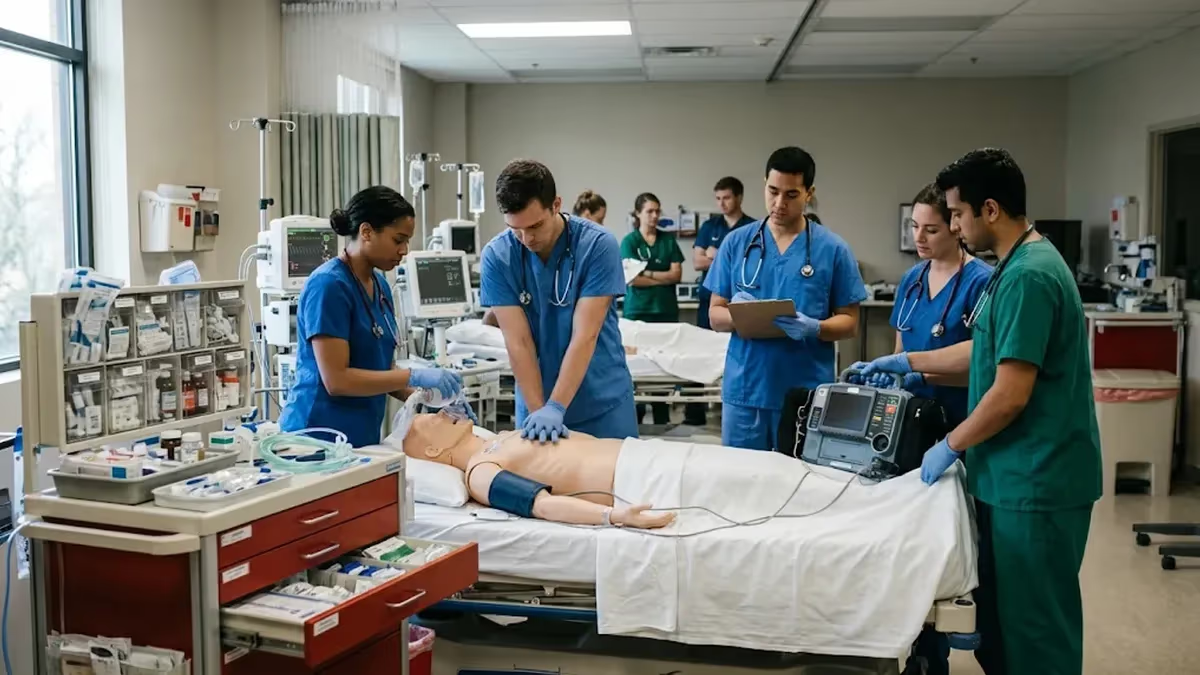
Searching for ACLS EKG answers usually means one of two things: you have an exam coming up and need to prove you can read a rhythm strip fast, or you missed a question on a practice test and want to know exactly why. This page does both. It pairs a free ACLS EKG practice test with plain-English explanations for every core rhythm, the treatment that goes with it, and the reasoning examiners expect you to show. Practice with the free ACLS Advanced Cardiovascular Life Support Practice practice test on PracticeTestGeeks (7 questions with answer explanations).
The Advanced Cardiovascular Life Support exam is built around recognition. The American Heart Association written test has 50 multiple-choice questions, requires an 84 percent to pass, and a large share of those items show a rhythm strip and ask what you do next. Memorizing a drug list alone will not carry you. You must see a wide, irregular, chaotic tracing, call it ventricular fibrillation within seconds, and know that the next action is defibrillation, not a medication.
Think of this guide the way you would think of a California DMV cheat sheet: a compact, trustworthy summary that removes guesswork before a high-stakes test. The ultimate California DMV cheat sheet works because it focuses on the rules examiners actually test. The same logic applies here. We focus on the rhythms, doses, and decision points that appear again and again, so your limited study hours go toward the material that earns points on exam day.
If you are recertifying, you probably wonder whether the whole process can happen from your couch. Many clinicians ask can you renew acls online, and the honest answer is that the knowledge portion can be, but the American Heart Association still requires a hands-on skills check with a qualified instructor. Our ACLS cheat sheet lists the algorithms and drug doses you should have memorized before test day. Review it alongside this page so the rhythm and the treatment stay linked in your memory.
Here is how to use the page. Start with the quick statistics and the rhythm cards, then take the free practice test and compare your answers against the explanations. Do not just check whether you were right. For every missed item, write down the rhythm, the key feature on the strip, and the first action. Reviewing why a wrong option was tempting is what builds the pattern recognition that holds up under exam pressure and real-code stress.
Accuracy matters here because the stakes extend beyond a card. The current AHA guidelines emphasize high-quality CPR at 100 to 120 compressions per minute, a depth of at least 2 inches, minimal interruptions, and rhythm checks every 2 minutes. Every EKG answer below is tied to that framework, so what you learn translates directly to the bedside and the code cart. Always confirm final details against your provider manual.
- To pass the AHA ACLS Provider Course Exam, students need a score of at least 84%. (American Heart Association)
- The AHA ACLS Provider Course Completion Card is valid for two years. (American Heart Association)
- Providers renewing their AHA ACLS card can take the shorter ACLS Update Course, which runs about 8.25–9.25 hours with video prework or 8.50–9.50 hours without it, breaks included. (American Heart Association)
- The AHA ACLS course is offered as instructor-led classroom training or as HeartCode blended learning, and both lead to the same AHA ACLS course completion card. (American Heart Association)
- Before attending the AHA ACLS Course, every student has to complete the online Precourse Self-Assessment with a score of at least 70%. (American Heart Association)
Facts verified Nov 9, 2026 against American Heart Association. Dates that have passed are removed automatically.
ACLS Exam at a Glance
| Item | Detail | Official source |
|---|---|---|
| Passing score | 84% minimum on the ACLS Provider Course Exam | American Heart Association |
| Validity | Valid for 2 years | American Heart Association |
| Renewal | ACLS Update Course: about 8.25–9.50 hours with breaks | American Heart Association |
| Delivery | Instructor-led classroom, or HeartCode blended learning (online + hands-on skills session) | American Heart Association |
| Eligibility | Score of at least 70% on the mandatory Precourse Self-Assessment, plus proficiency in BLS, ECGs, ACLS pharmacology and bag-mask ventilation | American Heart Association |
Facts verified Nov 9, 2026 against American Heart Association. Dates that have passed are removed automatically.
Free ACLS Advanced Cardiovascular Life Support Practice Study Tools
Interactive ACLS Advanced Cardiovascular Life Support Practice resources on PracticeTestGeeks, free to start:
- ACLS Advanced Cardiovascular Life Support Practice flashcards — review key terms and concepts card by card
- ACLS Advanced Cardiovascular Life Support Practice study guide — topic-by-topic overview of what the exam covers
- ACLS Advanced Cardiovascular Life Support Practice cheat sheet — one-page printable summary for last-minute review
ACLS EKG Exam by the Numbers
Core ACLS EKG Rhythms and the Answers to Know
Ventricular fibrillation shows a chaotic baseline with no QRS, while pulseless VT is a fast, wide, regular rhythm without a pulse. Both get immediate defibrillation at 120 to 200 joules biphasic, then 2 minutes of CPR, with epinephrine after the second shock and amiodarone after the third.
Asystole is a flat line confirmed in more than one lead, while PEA is an organized rhythm without a pulse. Neither is shocked. Deliver high-quality CPR, give epinephrine 1 mg early, secure the airway, and search for reversible causes using the H's and T's.
Sinus bradycardia, Mobitz II, and third-degree block matter when they cause hypotension, chest pain, or altered mentation. Give atropine 1 mg first, then use transcutaneous pacing, dopamine, or epinephrine infusion. Mobitz II and complete block often fail atropine, so prepare pacing early.
Decide stable versus unstable first. Unstable patients get synchronized cardioversion. Stable narrow regular rhythms get vagal maneuvers and adenosine, while stable wide regular rhythms get amiodarone or procainamide. Atrial fibrillation and flutter usually call for rate control, not adenosine.
Torsades is polymorphic VT with a twisting QRS axis and a prolonged QT interval. With a pulse, give magnesium sulfate 1 to 2 grams IV and correct electrolytes. Without a pulse, defibrillate. Avoid QT-prolonging drugs such as amiodarone and review the medication list for the trigger.
How to Read an ACLS EKG Strip and Find the Right Answer
Every correct ACLS EKG answer begins with the same five-question sweep, and the discipline of using it every time is worth more than any single fact. First, is there electrical activity at all? Second, is the rate fast, slow, or normal? Third, is the QRS narrow, under 0.12 seconds, or wide? Fourth, is the rhythm regular or irregular? Fifth, are P waves present, and does each one connect to a QRS complex? Answer them in order.
Once you have those answers, the clinical picture decides the treatment. The patient's pulse and perfusion matter more than the tracing. A rapid wide-complex rhythm in a patient with a pulse, a blood pressure of 70 over 40, and altered mentation is unstable and needs synchronized cardioversion. The identical strip in a stable, talking patient allows time for a 12-lead and medication. Exam writers love this contrast, so always read the stem for symptoms before choosing an intervention.
Consider a typical practice question. A patient is unresponsive and pulseless, and the monitor shows a chaotic baseline with no identifiable QRS complexes. The correct answer is ventricular fibrillation, and the first action is high-quality CPR until the defibrillator is charged, then a single shock at 120 to 200 joules on a biphasic device. After the shock, resume compressions immediately for 2 minutes before checking the rhythm again. Epinephrine 1 mg comes after the second shock, then every 3 to 5 minutes.
A 70-year-old is dizzy with a heart rate of 38 and blood pressure of 78 over 40, and the strip shows regular P waves with no relationship to the wide QRS complexes. That is third-degree, or complete, AV block with hemodynamic compromise. Atropine 1 mg IV, repeated every 3 to 5 minutes up to 3 mg, is reasonable but often fails when the block sits below the node. Prepare transcutaneous pacing or start dopamine at 5 to 20 mcg per kilogram per minute.
Narrow-complex tachycardia follows its own logic. A regular rhythm at 180 beats per minute with no visible P waves and a narrow QRS suggests supraventricular tachycardia. If the patient is stable, try vagal maneuvers first, then adenosine 6 mg by rapid IV push followed by a saline flush, and 12 mg if the first dose fails. If the patient is unstable, skip the drug and deliver synchronized cardioversion starting at 50 to 100 joules. Irregular atrial fibrillation starts higher, at 120 to 200 joules.
Strip reading improves only with volume. Scroll through any acls renewal online reddit thread and you will see the same advice repeated: rehearse full scenarios until the sequence becomes automatic. We agree, and our free megacode scenarios let you practice rhythm recognition, shock decisions, and drug timing together, so the strip, the algorithm, and the team roles click as one workflow. Pair that scenario work with the practice test below, and review every explanation, not only the answer key.
American Heart ACLS Renewal Online: Rhythm, Drug, and Shock Answers
The shockable rhythms are ventricular fibrillation and pulseless ventricular tachycardia, and both lead to immediate defibrillation at 120 to 200 joules on a biphasic device. The non-shockable pulseless rhythms are asystole and PEA, which call for continuous CPR, epinephrine, and a search for reversible causes. If the exam asks which rhythm should never be shocked, the answer is asystole, and the follow-up is always to confirm it in more than one lead. This single distinction accounts for many missed questions.
Perfusing rhythms are sorted by rate and QRS width. Sinus bradycardia, Mobitz II, and third-degree block fall under the bradycardia algorithm, with atropine, pacing, or dopamine and epinephrine infusions. Atrial fibrillation, flutter, SVT, and monomorphic VT fall under the tachycardia algorithm, where stability decides between drugs and synchronized cardioversion. Atrial fibrillation is irregularly irregular with no distinct P waves, while atrial flutter shows a sawtooth pattern, often with a ventricular rate near 150 from 2-to-1 conduction.
Is an ACLS EKG Practice Test Worth Your Study Time?
- +Builds fast rhythm recognition through repeated exposure
- +Shows exactly which rhythms and doses you confuse
- +Mimics the scenario style of the real written exam
- +Reinforces the link between each strip and its first action
- +Reduces test anxiety by making the format familiar
- +Gives instant feedback while the reasoning is fresh
- −Static strips cannot replicate a live, noisy monitor
- −Does not replace the hands-on skills session
- −Memorizing answers can create false confidence
- −Question styles vary between providers and instructors
- −Guideline details may differ from your course version
- −Needs spaced repetition to be effective, not a single sitting
Pros and Cons at a Glance
| Pros | Cons |
|---|---|
| Builds fast rhythm recognition through repeated exposure | Static strips cannot replicate a live, noisy monitor |
| Shows exactly which rhythms and doses you confuse | Does not replace the hands-on skills session |
| Mimics the scenario style of the real written exam | Memorizing answers can create false confidence |
| Reinforces the link between each strip and its first action | Question styles vary between providers and instructors |
| Reduces test anxiety by making the format familiar | Guideline details may differ from your course version |
| Gives instant feedback while the reasoning is fresh | Needs spaced repetition to be effective, not a single sitting |
Renew ACLS BLS Online Checklist: Get Ready for the EKG Section
- ✓Confirm your ACLS and BLS expiration dates and set a reminder 60 days ahead.
- ✓Ask your employer which renewal formats and providers it accepts.
- ✓Book the in-person skills session before starting the online modules.
- ✓Memorize the five-question sweep: activity, rate, QRS width, regularity, P waves.
- ✓Separate shockable from non-shockable arrest rhythms until it is automatic.
- ✓Write a one-page sheet of drug doses and shock energies by hand.
- ✓Complete at least two ECG interpretation practice tests and review every rationale.
- ✓Run one full megacode scenario out loud with a partner.
- ✓Match each of the H's and T's to a clinical clue.
- ✓Pack your ID, provider manual, and prerequisite certificates for class day.
Pulse first, then rhythm
Before you read a single wave, ask whether the patient has a pulse and adequate perfusion. Pulseless means CPR and the arrest algorithm. A pulse with instability means pacing or synchronized cardioversion. A pulse with stability means you have time to think. That one question eliminates half the answer choices on most ACLS EKG items.
Common ACLS EKG Mistakes and Tricky Look-Alike Rhythms
The most expensive mistakes on the ACLS exam come from look-alike rhythms. Asystole and fine ventricular fibrillation can look similar on a monitor, and both are pulseless emergencies, but only one is shockable. Before you call a flat line, confirm leads are attached, increase the gain, and check a second lead. If the tracing shows any chaotic, low-amplitude waves, treat it as fibrillation and defibrillate. If it is truly flat, continue CPR and give epinephrine. Never shock a true flat line.
Pulseless electrical activity, or PEA, is the second trap. PEA is not a specific waveform. It means an organized rhythm on the monitor without a palpable pulse, so the strip may look like a perfectly normal sinus rhythm. The answer is never a shock. Start compressions, give epinephrine 1 mg as soon as possible, and hunt for reversible causes using the H's and T's, such as hypovolemia, hypoxia, tension pneumothorax, tamponade, thrombosis, and toxins. Candidates who focus only on the waveform miss this question.
Second-degree AV blocks cause the next wave of errors. In Mobitz type I, also called Wenckebach, the PR interval lengthens with each beat until one QRS is dropped, producing a grouped, irregular pattern. In Mobitz type II, the PR interval stays constant and QRS complexes drop suddenly. Type I is usually benign and observed if the patient is stable. Type II can progress abruptly to complete block, so prepare for pacing even when the patient looks well.
Torsades de pointes deserves its own warning. It is a polymorphic ventricular tachycardia whose QRS amplitude twists around the baseline, typically triggered by a prolonged QT interval from medications, low magnesium, or low potassium. If the patient has a pulse and is stable, give magnesium sulfate 1 to 2 grams IV. If the patient is pulseless, treat it like ventricular fibrillation with immediate defibrillation. Using amiodarone for torsades is a classic wrong answer, because it prolongs the QT further.
Sinus tachycardia versus supraventricular tachycardia is another frequent confusion. Sinus tachycardia rarely exceeds about 150 beats per minute in adults, shows clear P waves, and varies slightly from beat to beat. SVT is often fixed and regular near 150 to 250 beats per minute, with P waves hidden or absent. A resting rate of 220 is almost never sinus. The treatment for sinus tachycardia is to find and fix the cause, such as fever, pain, or dehydration, not to give adenosine or cardiovert.
Finally, remember sequence errors. During cardiac arrest, the order is compressions, rhythm check, shock if shockable, immediately resume compressions, and drugs timed around the 2-minute cycles. For refractory VF or pulseless VT, amiodarone 300 mg is given first, and a second dose of 150 mg follows; lidocaine at 1 to 1.5 mg per kilogram is an accepted alternative. Questions that ask for the best next step reward the answer that keeps compressions running with minimal pauses.
Cards from courses with no hands-on skills check are frequently rejected by hospitals and licensing boards. Ask your education department or credentialing office for the accepted provider list in writing before you register, and book your skills session early, because slots near expiration dates fill quickly.
ACLS Renewal Online: What Changes and What Stays the Same
Recertification is where many clinicians first meet the EKG material again after two years away. An ACLS card is valid for 2 years, and the renewal course is usually shorter than the initial class because it assumes familiarity with the algorithms. You still need to demonstrate rhythm recognition, effective team roles, and correct drug and shock decisions. Expect a written exam, a megacode style skills test, and BLS competence, which is why many employers require both cards together.
American Heart ACLS renewal online options exist, but they are blended rather than fully remote. The AHA's HeartCode ACLS lets you complete the cognitive portion, including simulated rhythm cases, on a computer at your own pace. You then attend an in-person skills session with an authorized instructor to demonstrate airway management, compressions, defibrillation, and a team scenario. Only after both parts are complete do you receive the eCard, so budget time for scheduling the hands-on session.
Location rarely changes the rules, but it changes convenience. A nurse searching for acls renewal online chicago options will find the same AHA blended format as a paramedic comparing providers for acls and bls renewal online sacramento. Each region has training centers that run weekly skills sessions, and hospital education departments often host them for staff. Check availability early, because popular evening and weekend skills slots near expiration dates fill quickly, and a lapsed card can force you into the longer initial course.
Online forums can tell you what a class feels like, but treat them as anecdotes. Any acls renewal reddit thread will mix good tips with outdated rules, and the most repeated lesson is that rhythm questions catch people off guard. Prepare by drilling real tracings with our rhythm strip guide until naming each one takes under five seconds. Aim for accuracy first, then speed. Speed matters because the exam clock and the real-code clock both punish hesitation.
Know what employers and boards accept before you pay. Some hospitals insist on AHA cards specifically, while others accept equivalent courses from other organizations. Providers that advertise a fully online card with no skills check are generally not accepted by hospitals, and many state boards reject them for licensure or credentialing. Email your education department or credentialing office, ask for the accepted provider list in writing, and keep a copy. That one message can save you money and a failed audit.
Use the renewal as a reason to refresh the EKG foundation rather than cramming. Plan a two-week runway: three short sessions per week on rhythm identification, one session on drug doses and shock energies, and one full practice test. Because renewal classes move quickly, the instructor will assume you remember that bradycardia means a rate under 50, that VF and pulseless VT are shocked, and that PEA and asystole are not. Arriving with those anchors secured makes the whole class feel easier.
You can continue preparing with the new acls guidelines, which includes answer explanations for every question.
You can continue preparing with the acls test questions and answers, which includes answer explanations for every question.
Practical Tips for Final ACLS EKG Prep
Build your final week around active recall instead of rereading. Cover the answer, look at a strip, and say out loud the rhythm name, the rate, the key feature, and the first action. Speaking forces retrieval, and retrieval is what the exam measures. Ten minutes of this, three times a day, beats a single two-hour reading session. Track your misses in a simple notebook so patterns appear, such as repeatedly confusing Mobitz I with Mobitz II. Patterns show where to study next.
Create a one-page drug and energy sheet in your own handwriting. Include epinephrine 1 mg every 3 to 5 minutes, amiodarone 300 mg then 150 mg, adenosine 6 mg then 12 mg, atropine 1 mg up to 3 mg, and the biphasic defibrillation range of 120 to 200 joules. Writing the numbers yourself encodes them better than reading a printed table. Like any trusted cheat sheet, whether it is for the DMV or a resuscitation course, it works only if you review it daily.
Simulate exam conditions at least twice. Sit somewhere quiet, set a timer, and complete a full set of questions without notes. Some AHA written exams are open-resource, but you will not have time to look up every rhythm, so the goal is automatic recognition. After each simulation, sort mistakes into three bins: recognition errors, dose errors, and sequence errors. Fix the largest bin first, because that is where your next points are hiding. Repeat the drill until your score holds steady across two attempts.
Sort out logistics early so they do not steal study time. Many candidates ask can acls be renewed online and then discover too late that their employer wants an in-person skills check. Our renewal guide walks through blended formats, costs, and timelines so you can book the right course. If you also need BLS, ask whether your provider bundles both. Confirm the format, schedule the skills session, and download any pre-course materials at least two weeks before your expiration date.
On exam day, protect your working memory. Sleep at least seven hours, eat a real breakfast, and arrive early with your provider manual, ID, and any prerequisite certificates. During the test, read each stem fully before looking at the options, note the pulse status and blood pressure, and name the rhythm before choosing an answer. Skip and return to any question that stalls you for more than a minute, since easy points elsewhere are worth just as much.
Finally, if you do miss the 84 percent mark, treat it as information rather than failure. Most AHA courses allow a remediation and a retake of the written exam, and instructors will usually point to the exact content areas you missed. Come back to the practice tests below, focus on the weakest category, and retest within a few days while the feedback is fresh. Clinicians who analyze their errors tend to improve quickly, and the card you earn means the same as any other.
ACLS Questions and Answers
ACLS Cheat Sheet: Complete 2026 Quick Reference Guide for Algorithms, Drugs, Doses & H's and T's

Free ACLS Megacode Practice: Master Every Scenario Before Your Certification
ACLS Rhythm Strips: How to Read and Identify the Core Rhythms in 2026

Online ACLS Renewal: Complete 2026 Guide to Recertifying Your Advanced Cardiovascular Life Support Credential Fast

ACLS BLS Renewal: Complete 2026 Guide to Recertification Requirements, Timelines & Formats
Written and edited by Nathan Beja, founder of Practice Test Geeks, with AI assistance. Exam facts are checked against the official sources linked below. Editorial policy
Sources & references
Exam facts on this page (fees, format, dates, passing scores) are checked against these official sources; the date is our last check. Editorial policy
- cpr.heart.org — Score validity, test delivery, renewal, eligibility · verified Nov 2026
- heart.org — Passing score · verified Oct 2026