
Wound Care Nurse Jobs: Career Paths, Salary, Certification, and How to Get Hired
Wound care nurse jobs guide: career paths, salary ranges, certification options, work settings, daily responsibilities, and how to break into wound care... 💡
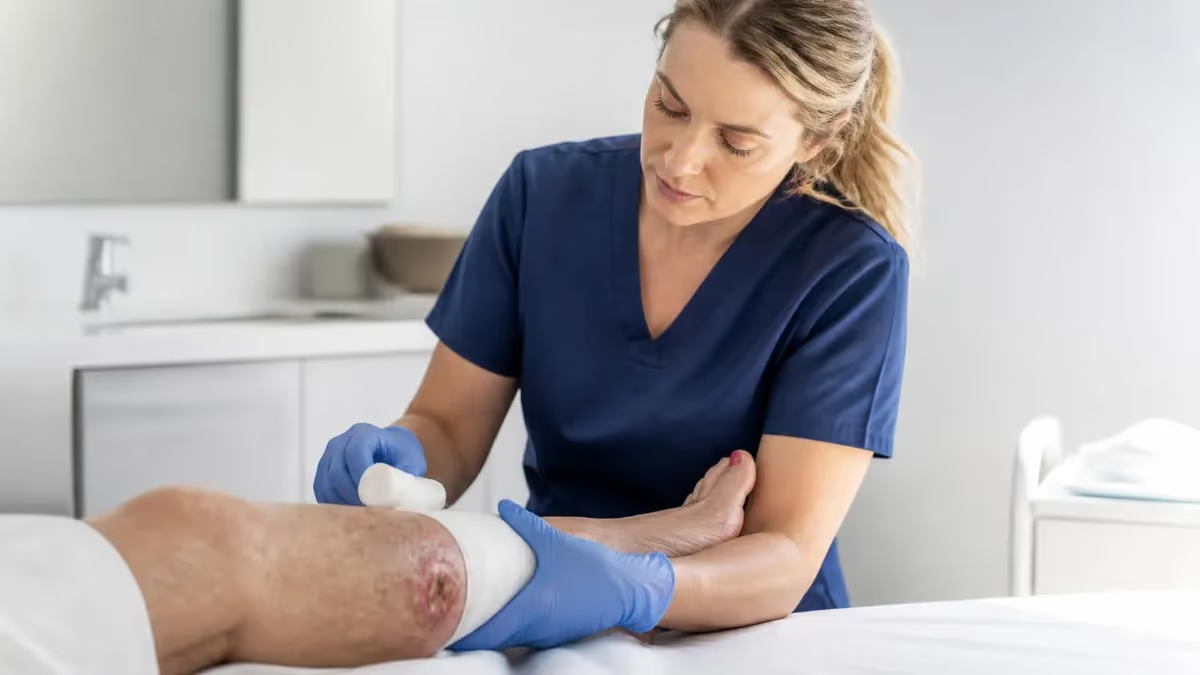
Wound care nursing is one of the fastest-growing specialties in healthcare, and demand for qualified wound care nurses has outpaced supply for the past decade. An aging population, rising rates of diabetes, more complex surgical patients, and improvements in wound treatment technology have all combined to create thousands of open positions across hospitals, outpatient clinics, long-term care facilities, and home health agencies. If you're a nurse considering wound care as a specialty, the job market right now is exceptionally favorable.
This guide covers everything you need to know about wound care nurse jobs: the different career paths available, salary ranges by setting and credential, certification pathways including WOC and WCC, what daily work actually looks like, and practical steps for transitioning into the specialty. Whether you're a new graduate exploring options or an experienced nurse considering a career pivot, wound care offers stable demand, meaningful patient impact, and pathways to advanced practice.

Why the Specialty Is Booming
Demand for wound care nurses has grown roughly 20% over the past five years. Driving forces include an aging population with more chronic wounds, the diabetes epidemic creating millions of patients with diabetic foot ulcers, advances in wound healing technology requiring specialized knowledge, and increasing recognition that proper wound management dramatically reduces healthcare costs and improves outcomes.
Three Main Career Paths in Wound Care
Inpatient wound consultations, post-surgical wound management, complex wound rounds, and specialty wound clinics within hospital systems.
Dedicated wound healing centers that treat chronic wounds — diabetic ulcers, venous ulcers, pressure injuries, and surgical complications.
Working with patients in nursing homes, assisted living, or in their own homes — often managing the highest-risk pressure injury populations.
The day-to-day work of a wound care nurse varies significantly by setting. In an acute care hospital, wound care nurses are typically part of a specialized team — sometimes called a WOC (Wound, Ostomy, and Continence) team — that consults across the hospital. A typical day might include rounding on post-surgical wounds with the surgical team, evaluating pressure injuries on critical care patients, training floor nurses on dressing changes, and consulting on complex cases. The pace is fast and the variety enormous. You might see a vascular ulcer in the morning and a complex surgical dehiscence in the afternoon.
Outpatient wound centers tend to have more predictable schedules and longer-term patient relationships. Patients come in weekly or biweekly for ongoing treatment that often spans months for chronic wounds. The nurse-patient relationship deepens over time as you guide patients through the slow journey of wound healing. The medical complexity is significant — most patients have underlying conditions like diabetes, peripheral vascular disease, or venous insufficiency that affect healing. Procedures like sharp debridement, hyperbaric oxygen therapy, and advanced dressings are routine.
Long-term care and home health bring different challenges. Patients are often the most vulnerable — elderly, debilitated, or with significant comorbidities. Pressure injury prevention and management dominate the workload. You're often the only wound care expert in the building or for the agency, which means more independent decision-making and more education of staff who don't share your specialty knowledge. The pace can be intense, but the impact on patient quality of life is enormous.
Wound Care Nursing By the Numbers
Wound Care Certification Options
Certified Wound Care Nurse — offered through the Wound, Ostomy and Continence Nurses Society. Requires a baccalaureate in nursing, accredited WOC education program, and passing the certification exam. The most rigorous credential.
Salary varies significantly by setting, credential, geographic location, and experience. Entry-level RNs working in wound care without specialty certification typically earn similar wages to other floor nurses — roughly $65,000-$85,000 depending on location. Adding wound care certification (WCC or CWCN) often produces immediate salary bumps of $5,000-$15,000 plus differentials at facilities that recognize the credential. Highly experienced certified wound care nurses in leadership roles can earn $120,000-$140,000+ at major medical centers.
Geographic location matters enormously. California, New York, Massachusetts, and Washington pay significantly more than national averages. The Pacific Northwest, Northeast, and major metro areas in general command premium wages. Rural areas pay less but often have lower cost of living and easier paths to leadership roles. Travel wound care nursing is another option — many agencies pay $2,500-$4,000 per week for short-term assignments at facilities with critical staffing needs.
Beyond base salary, wound care nurses often earn additional income through consulting, expert witness work, education and speaking, or development of wound care programs for facilities. Experienced certified wound care nurses are in high demand as program developers — facilities pay well for consultants who can establish or upgrade their wound care programs. The advanced wound care knowledge base translates into multiple income streams beyond traditional employment.

Many wound care product manufacturers offer free continuing education to RNs working in wound care. 3M, Medline, Smith & Nephew, Hollister, and others provide online courses, webinars, and on-site training. While these don't replace formal certification, they're excellent for staying current and building foundational knowledge before pursuing full certification.
Daily Skills Wound Care Nurses Use
Accurate measurement, staging, tissue type identification, exudate characterization, and tracking healing progression. The foundational skill for every wound care role.
Choosing among hundreds of dressing options based on wound characteristics. Foam, hydrocolloid, alginate, antimicrobial — each has specific use cases.
Removing dead tissue using sharp, mechanical, autolytic, or enzymatic methods. CWCNs and CWS may perform conservative sharp debridement.
Setting up and managing negative pressure wound therapy (also known as wound vacs). A common modality for complex wounds requiring specialized knowledge.
How to break into wound care nursing depends on where you are in your career. New graduates typically start as floor nurses and develop wound care interest organically — usually after seeing complex wounds that pique their curiosity. Most facilities prefer 1-2 years of acute care experience before transitioning to a dedicated wound care role. During that time, take every wound care training opportunity available, ask to round with the WOC team if your facility has one, and volunteer for complex dressing changes.
For experienced nurses considering a transition, the path is shorter. Apply for wound care nurse positions even before getting certified — many facilities will hire interested experienced nurses and support certification post-hire. Look at job postings carefully — some require certification, others require willingness to certify within a specified timeframe (usually 1-2 years). Build a strong cover letter explaining why you want to specialize and what you bring from your current role.
Networking matters in wound care. The WOCN and NAWCO professional organizations have active local chapters in most regions. Attending a chapter meeting is one of the best ways to meet practicing wound care nurses, hear about job openings, and learn about certification pathways. Conferences like the WOCN national conference, Symposium on Advanced Wound Care, and various regional events provide deeper networking and continuing education simultaneously.
Work Settings for Wound Care Nurses
Hospital-employed WOC nurses, wound team members, and floor nurses with wound care responsibilities. Highest acuity, fastest pace, most variety. Often the best learning environment for newer specialty nurses.
What certification provides beyond salary is professional credibility and broader career options. Certified nurses are typically the ones who get promoted to wound care program leadership, asked to develop policies and procedures, invited to speak at conferences, and considered for consulting opportunities. The certification signals serious commitment to the specialty and demonstrates mastery of a substantial knowledge base. Within facilities, certified wound care nurses are often the ones uncertified colleagues come to with questions — formal recognition of expertise that translates into informal influence and visibility.
Preparing for certification requires structured study. The WCC exam covers wound assessment, healing physiology, dressing categories, debridement methods, and various wound types (diabetic, venous, arterial, pressure, surgical). The CWCN covers the same material in more depth plus ostomy and continence care if pursuing that broader credential. Most successful candidates use a combination of review courses, textbooks like Wound Care Essentials, practice questions, and group study with colleagues preparing for the same exam.
The exams test both knowledge and clinical reasoning. You'll see case scenarios asking what dressing you'd choose, how you'd debride a specific wound, what factors might be impairing healing, and how you'd educate a patient or family about pressure injury prevention. Real-world clinical experience helps enormously — pure book knowledge without practical application leaves significant gaps. If you're preparing for certification, make sure you're actively working with wounds during your study period.
Steps to Wound Care Certification
- ✓Get 1-2 years of acute care or related nursing experience
- ✓Seek out wound care exposure through floor work, WOC rounds, or wound center observation
- ✓Take free CE courses from wound care product manufacturers to build foundational knowledge
- ✓Join WOCN or NAWCO professional organizations for resources and networking
- ✓Choose certification pathway (WCC for quicker, CWCN for more rigorous)
- ✓Enroll in the required preparatory course (64+ hours for WCC, longer for CWCN)
- ✓Complete clinical practicum requirements if applicable
- ✓Schedule certification exam through the certifying body
- ✓Allow 3-6 months of focused study before exam
- ✓Take practice tests to identify weak areas before sitting for the actual exam
- ✓Maintain certification through continuing education and recertification cycles

The advancement opportunities for wound care nurses extend well beyond bedside care. Many certified wound care nurses move into program management roles, overseeing wound care services across departments or facilities. Some become wound care educators, training the next generation of specialists. Others transition into industry — wound care product manufacturers hire experienced certified nurses as clinical specialists, regional sales managers, or product development consultants. The salaries in industry positions often exceed clinical roles, though work-life balance varies.
Advanced practice nursing in wound care is another emerging path. Nurse practitioners specializing in wound care can practice with significant autonomy in many states, performing more advanced procedures and managing entire wound care clinics. The combination of NP licensure plus wound care certification is increasingly in demand. Pay scales for wound care NPs run $115,000-$150,000+ in most markets, with leadership roles paying considerably more. The pathway requires graduate education on top of wound care certification, but the career impact is substantial.
For nurses interested in research, wound care has many active investigation areas. Bioengineered skin substitutes, growth factor therapies, regenerative medicine approaches, and new wound assessment technologies are all areas of ongoing study. Major medical centers and research universities have wound care research programs that hire research nurses. The combination of clinical experience and certification opens these positions to nurses interested in advancing the field's knowledge rather than just applying it.
Teaching is yet another path. Schools of nursing increasingly need clinical faculty with wound care expertise to teach students. Certifying organizations need exam writers and reviewers. Continuing education providers need course developers and instructors. If you enjoy teaching, the combination of certification plus clinical experience makes you valuable in educational roles. Many certified wound care nurses combine clinical practice with part-time teaching for variety and additional income.
Career Stages and Trajectories
Build solid medical-surgical or critical care experience. Develop interest in wound care through floor work. Take free CE courses. Identify mentors among certified wound care nurses.
The challenges of wound care nursing deserve honest discussion. The work is physically demanding — wound care nurses do significant standing, bending, and lifting. Long shifts on your feet take a toll, especially in busy outpatient centers or home health roles. Emotionally, working with patients whose wounds heal slowly or not at all can be draining. Building strong relationships with patients over months and watching some deteriorate despite your best efforts is part of the specialty.
Documentation requirements in wound care are substantial. Each wound encounter requires detailed assessment documentation, measurements, photographs in some settings, and treatment plans. The administrative burden is significant compared to some other specialties. Electronic health record systems have improved but the documentation expectations have risen along with EHR capabilities. Efficient documentation skills are essential for surviving the workload.
Education of patients and other healthcare providers is constant. You'll teach floor nurses how to do wound care correctly, train family caregivers on dressing changes, explain to physicians why a particular dressing choice matters, and answer questions about wound care from every direction. Strong communication skills and patience for repeating the same information are essential. The teaching aspect is rewarding for many but exhausting for others — knowing your tolerance for the educator role helps in choosing the right setting.
Despite the challenges, job satisfaction in wound care nursing is consistently high. The combination of intellectual challenge, meaningful patient impact, specialized knowledge, and career options keeps nurses in the specialty long-term. The work matters — chronic wounds devastate quality of life, and good wound care nurses transform patient experiences. The specialty rewards those who develop deep expertise and stay current with evolving evidence and technologies. For nurses willing to invest in certification and continuous learning, wound care offers a sustainable, rewarding, and well-compensated career.
Wound Care Nursing Career
- +Strong, sustained job demand across multiple settings
- +Salaries above general nursing averages, especially with certification
- +Diverse work settings to choose from (hospital, outpatient, home health, industry)
- +Specialized knowledge that grows in value over time
- +Multiple advancement paths (clinical, leadership, education, industry)
- +Meaningful patient impact on quality of life
- −Physically demanding with significant standing and lifting
- −Emotionally challenging when wounds don't heal or patients deteriorate
- −Heavy documentation requirements compared to some specialties
- −Constant patient and staff education responsibilities
- −Certification preparation requires significant time and study investment
Wound care evidence evolves constantly. New dressings, new therapies, and new evidence about old approaches emerge every year. Subscribe to journals like Wounds, Advances in Skin & Wound Care, and Wound Repair and Regeneration. Attend at least one major conference annually. Continuing education isn't just for recertification — it's how you provide care that's actually best for patients rather than care that was best ten years ago.
Beyond traditional employment, the wound care field offers unique flexibility for nurses interested in non-traditional careers. Telehealth wound care is a growing area — remote nurses review wound photos and care plans for facilities or home health agencies, providing specialist consultation without being on-site. The pandemic accelerated adoption of telehealth wound care, and many programs have continued post-pandemic. The role suits nurses who want flexibility, geographic independence, or who can no longer do the physical demands of bedside wound care but want to stay in the specialty.
Wound care nursing also lends itself well to legal consulting and expert witness work. Wound care malpractice cases frequently center on pressure injury prevention, appropriate dressing selection, debridement decisions, and documentation adequacy. Experienced certified wound care nurses with strong clinical and analytical skills can build secondary income streams as legal consultants, chart reviewers, or testifying experts. The work requires specific training in legal nursing but the underlying expertise is exactly what certification provides.
Entrepreneurial wound care nurses sometimes launch their own practices or consulting businesses. Independent wound care consultants work with facilities to develop programs, train staff, audit care, and address regulatory issues. Some certified nurses launch wound care clinics in collaboration with physician partners. Others develop educational businesses creating courses or coaching programs for nurses preparing for certification. The specialty's depth and the demand for expertise create opportunities for entrepreneurial nurses willing to take on business risk in exchange for greater control and potentially higher income.
Volunteer opportunities also exist for those interested in giving back. Organizations like the Sentinel Initiative provide wound care to underserved populations both domestically and internationally. Medical missions to developing countries often need wound care expertise, particularly for managing chronic wounds in patients without access to advanced products. The combination of paid clinical work and periodic volunteer contributions creates meaningful career patterns for nurses motivated by service alongside professional development.
Finally, the broader context of wound care as a specialty is worth considering. Healthcare in general is moving toward more outpatient care, more home-based care, and more team-based approaches. Wound care fits all these trends naturally. The specialty has built-in continuing demand because chronic wounds aren't going away — diabetes, obesity, and aging populations guarantee that. The career stability is exceptional compared to specialties whose roles are being automated or restructured. Investing in wound care expertise is investing in a career with reliable long-term demand and continuous growth opportunities.
One last practical consideration: the wound care community itself is unusually supportive compared to many specialties. Certified wound care nurses tend to mentor newcomers actively, share resources openly, and welcome new colleagues into the field. The professional organizations provide structured mentorship programs, online communities, and conferences with networking opportunities.
The smaller size of the specialty compared to general nursing creates a community where you'll come to know many of the leaders personally. That sense of belonging is part of what makes the specialty satisfying long-term — you're joining a community of people who care deeply about their patients and about each other's growth as wound care practitioners over the long term of their nursing careers and beyond clinical work into mentorship, education, research, and leadership roles that benefit the entire wound care nursing community as well as all of the patients that wound care professionals continue to serve.
Wound Care Nursing Questions and Answers
About the Author

Registered Nurse & Healthcare Educator
Johns Hopkins University School of NursingDr. Sarah Mitchell is a board-certified registered nurse with over 15 years of clinical and academic experience. She completed her PhD in Nursing Science at Johns Hopkins University and has taught NCLEX preparation and clinical skills courses for nursing students across the United States. Her research focuses on evidence-based exam preparation strategies for healthcare certification candidates.