
Advanced Wound Care: Modalities, Certifications, and Clinical Guide 2026 October
Advanced wound care guide: 🗨️ NPWT, hyperbaric oxygen, skin substitutes, certifications (WCC, CWS, CWCN), staging, salary boost, and clinical protocols.
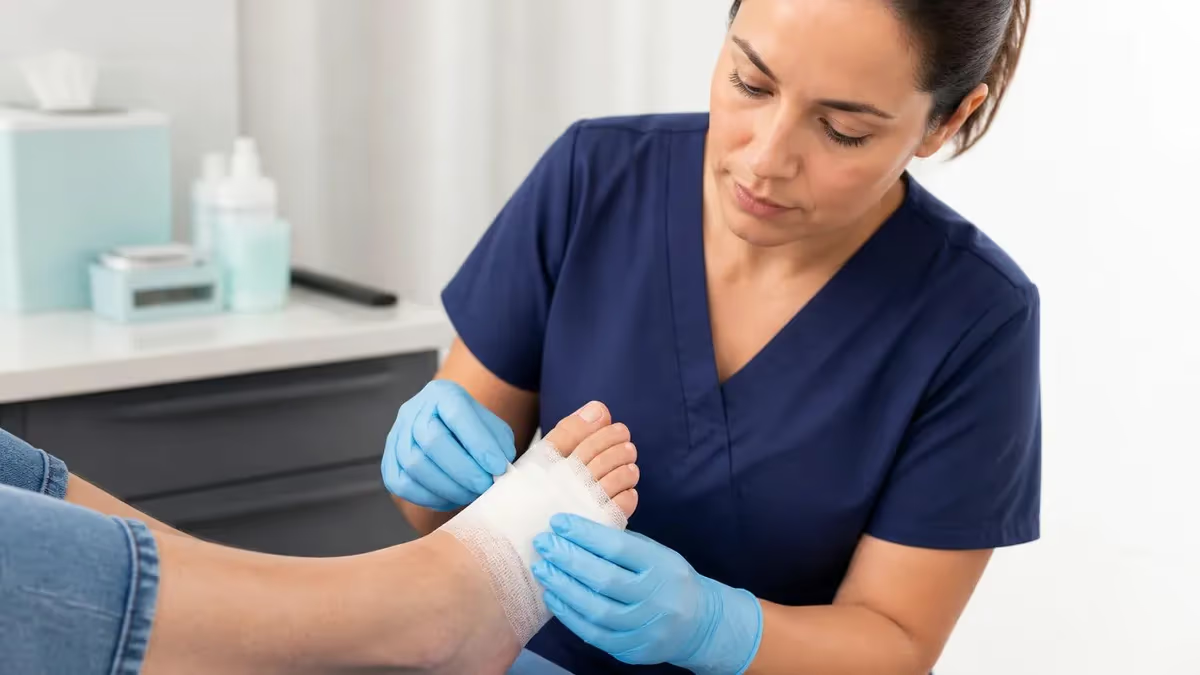
Advanced wound care is the specialty practice of treating wounds that fail to follow a normal healing trajectory. The textbook definition draws a clear line: any wound without meaningful epithelial advancement in 30 days is chronic, and at that point it stops being a dressing-change problem and becomes a multidisciplinary clinical puzzle.
Diabetic foot ulcers, stage 3 and 4 pressure injuries, venous stasis ulcers, arterial wounds, surgical dehiscence, and malignant cutaneous wounds all live in this territory. They cost the U.S. healthcare system an estimated $28 billion a year, and they demand a clinician who knows the difference between a hydrocolloid and a calcium alginate at 3 a.m.
This guide walks through what "advanced" actually means in wound care, the modalities that define the specialty, the certifications nurses pursue, and the assessment frameworks that hold the whole process together. Whether you are sitting for the wound care certification exam or trying to make sense of your first hyperbaric oxygen referral, you will find the clinical scaffolding here.
Definition
A wound becomes advanced when standard moist wound healing has failed. Triggers include 30+ days without progress, depth to muscle or bone, exposed tendon or hardware, surrounding cellulitis, ABI below 0.8, uncontrolled diabetes, or recurrent ulceration. At that point you need a wound specialist, a vascular workup, and frequently a hyperbaric or NPWT consult.
What separates advanced wound care from basic wound care
Basic wound care is the bread and butter of any nursing program. Clean the wound, apply a dressing, watch for infection, document. Most acute surgical and traumatic wounds heal predictably within two to three weeks when you give them moist wound healing, edge approximation, and decent nutrition. Advanced wound care begins when the textbook stops working. The wound stalls. Granulation tissue becomes hypergranular or disappears. The edges roll under (epibole). Slough builds up faster than you can debride it. Periwound skin macerates despite your best dressing choice.
At the advanced level, you stop thinking about the wound as a problem to dress and start thinking about it as a symptom of a failed system. Why isn't it healing? Is it perfusion? Pressure? Protein? Glucose control? Bioburden? Each one has a different answer and intervention. The dressing is the smallest part of the equation. Documentation gets serious too — wound photography, size measurement, undermining notation, tunneling depth, drainage volume, and offloading status all become non-negotiable. Medicare reimbursement for advanced therapies depends on this documentation being airtight.

5 key factors in every advanced wound assessment
Granulation (red), slough (yellow), eschar (black), epithelial (pink). Percentage breakdown drives therapy choice.
Use NERDS and STONEES mnemonic. Treat bioburden topically; treat true infection systemically.
Too dry stalls healing; too wet macerates the periwound. Match dressing absorption to drainage volume.
Measure weekly. <40% reduction at 4 weeks predicts non-healing — escalate the plan.
Glucose control, nutrition (albumin, prealbumin), perfusion (ABI, TBI), smoking, adherence, offloading capacity.
The core advanced wound care modalities
When a wound fails standard dressings, advanced wound care brings out the heavy artillery. These are not first-line therapies, and most require physician orders, prior authorization, or both. Negative Pressure Wound Therapy (NPWT) — better known by brand names like KCI's V.A.C. or Smith & Nephew's PICO — delivers continuous or intermittent subatmospheric pressure (typically -125 mmHg) through a sealed foam dressing. It increases granulation, reduces edema, improves perfusion at the wound edge, and pulls bacterial bioburden out of the wound bed. The workhorse for surgical dehiscence, deep diabetic foot ulcers, pressure injuries with depth, and traumatic wounds.
Hyperbaric Oxygen Therapy (HBO) places the patient inside a pressurized chamber (typically 2.0 to 2.4 atmospheres absolute) breathing 100% oxygen for 60 to 120 minutes per session, five days a week, for 20 to 40 treatments. The physiology is elegant: dissolved plasma oxygen jumps tenfold, driving angiogenesis, killing anaerobic bacteria, and rebooting fibroblast activity in tissues that have been hypoxic for months. CMS covers HBO for a narrow list: Wagner grade 3 diabetic foot ulcers with osteomyelitis, chronic refractory osteomyelitis, radiation tissue injury, and compromised flaps or grafts.
Skin substitutes and cellular tissue products are where wound care meets biotechnology. Apligraf is a bilayered living skin equivalent grown from neonatal foreskin fibroblasts and keratinocytes. Dermagraft is a cryopreserved dermal substitute. Integra is an acellular collagen-glycosaminoglycan matrix. The amniotic membrane family — EpiFix, Grafix, AmnioFix — uses dehydrated human amnion/chorion to deliver growth factors and cytokines straight to the wound bed.
These products are billed by square centimeter and run $1,500 to $5,000 per application. Maggot debridement therapy (MDT), FDA-cleared since 2004, delivers sterile Lucilia sericata larvae directly into necrotic wounds for 48 to 72 hours. They liquefy slough enzymatically while leaving healthy tissue alone.
Advanced wound care modalities at a glance
Negative Pressure Wound Therapy. Continuous -125 mmHg through sealed foam dressing. Used for surgical dehiscence, stage 3-4 pressure injuries, diabetic ulcers with depth, traumatic wounds. Dressing change every 48-72 hours. Brands: V.A.C., PICO, Avelle, Genadyne. Contraindicated over exposed vessels, untreated osteomyelitis, malignancy in the wound bed.
Wound staging and assessment frameworks
You cannot practice advanced wound care without mastering the assessment frameworks. They are the common language that lets a wound nurse in Phoenix communicate clearly with a vascular surgeon in Cleveland. Three frameworks dominate. NPUAP/NPIAP pressure injury staging remains the gold standard. Stage 1 is intact skin with non-blanchable erythema. Stage 2 is partial-thickness loss with exposed dermis, often a serum-filled blister.
Stage 3 is full-thickness loss with visible subcutaneous fat. Stage 4 is full-thickness loss with exposed bone, tendon, ligament, cartilage, or muscle. Unstageable means full-thickness loss obscured by slough or eschar. Deep Tissue Pressure Injury (DTPI) is persistent non-blanchable deep red, maroon, or purple discoloration of intact skin.
The Wagner classification for diabetic foot ulcers runs from grade 0 (intact at-risk foot) to grade 5 (gangrene of the entire foot). Grade 3 means deep ulcer with abscess or osteomyelitis — the threshold where HBO becomes Medicare-reimbursable. Grade 4 is localized gangrene of the toes or forefoot. The Braden Scale scores six factors — sensory perception, moisture, activity, mobility, nutrition, and friction/shear — for a total of 6 to 23 points. Scores at or below 18 indicate at-risk patients.
The TIMERS framework — Tissue, Infection/Inflammation, Moisture, Edge, Repair, Social — is the international standard for wound bed preparation. It replaced the older TIME mnemonic and added two critical dimensions modern wound specialists insist on. Repair covers cellular and tissue-based products and other advanced therapies. Social covers the human reality: can your patient actually get to the wound center twice a week? Can they afford the dressings between visits?

Sudden increase in pain disproportionate to wound appearance (think necrotizing fasciitis). Crepitus on palpation of periwound tissue (subcutaneous gas — surgical emergency). New fever with elevated WBC and CRP. Spreading erythema beyond 2 cm of wound margin. Exposed hardware, bone, or tendon. Black eschar with surrounding cellulitis on a foot — these patients need vascular and surgical consults the same day, not next week.
Wound care certifications — WCC, CWS, CWCN, CWON, CFCN
The alphabet soup of wound care credentials confuses students, partly because the field has multiple credentialing bodies competing for the same clinicians. WCC (Wound Care Certified) is offered through the National Alliance of Wound Care and Ostomy. Open to RNs, LPNs, PTs, OTs, and physicians. Candidates need a wound-related role plus completion of a Skin and Wound Management course or 120 hours of wound-specific CE. The exam is 110 questions. Recertification every five years. The most accessible entry-level option.
CWS (Certified Wound Specialist) through the American Board of Wound Management is the multidisciplinary gold standard. Open to RNs, NPs, PAs, MDs, DOs, DPMs, PTs, and OTs with 3+ years of wound care experience or a master's degree plus 2 years. The exam runs 150 questions across pathophysiology, assessment, treatment, and outcomes. CWS holders frequently lead wound care teams at major medical centers.
CWCN (Certified Wound Care Nurse) through the Wound, Ostomy and Continence Nurses Certification Board is the RN-specific credential. Two pathways: graduate from a WOCN-accredited program or take the experiential pathway with 1,500+ hours of wound nursing in five years plus 50 CE hours. CWON and CWOCN add ostomy and continence to the wound credential. The full CWOCN is generally considered the most rigorous and most marketable nursing certification in the entire field. CFCN (Certified Foot Care Nurse) through WOCNCB focuses on diabetic foot assessment, nail care, and prevention. See our wound care certification guide for the full pathway comparison.
Cost per session for advanced wound therapies
The wound care nurse's daily role
What does a wound care nurse actually do day-to-day? It varies enormously by setting. In acute care, the inpatient wound team nurse spends mornings consulting on new admissions flagged for skin breakdown, doing comprehensive assessments with photography, and writing care plans the bedside RNs execute. Afternoons run to follow-ups, dressing change demonstrations, and family education on offloading and nutrition. Outpatient wound center nurses run a faster cadence — eight to twelve patients per provider per day, each one needing measurement, photography, debridement assistance, dressing change, and documentation.
Home health wound nurses operate solo. You are in the patient's living room, on your knees, trying to convince a 78-year-old that yes, she really does need to keep her foot elevated. Documentation gets dictated in the driveway between visits. Long-term care wound nurses focus heavily on pressure injury prevention. The Braden Scale dictates turn schedules, and the wound nurse is often the only person in the facility who can stage a pressure injury correctly for the MDS submission. Hospice wound nurses live in a different paradigm — healing is no longer the goal, comfort is.
Comprehensive wound assessment checklist
- ✓Wound location, etiology, and duration documented
- ✓Length × width × depth measured in centimeters
- ✓Undermining and tunneling noted with clock-face direction
- ✓Tissue percentages: granulation / slough / eschar / epithelial
- ✓Drainage volume (none/minimal/moderate/heavy) and character (serous/sanguineous/purulent)
- ✓Periwound condition (intact, macerated, erythematous, indurated)
- ✓Pain score with movement and at rest
- ✓Wound photography with measuring guide visible
- ✓Vascular assessment (pulses, ABI/TBI if indicated)
- ✓Offloading and pressure redistribution plan
- ✓Nutrition screening (albumin, prealbumin, BMI)
- ✓Glucose control documented for diabetic patients
- ✓Patient and family education delivered and acknowledged

Salary, career outlook, and the certification ROI
The financial case for wound care certification is genuinely strong, which is unusual in nursing where many specialty credentials offer prestige but little salary bump. According to Payscale and Indeed data, the median base salary for a non-certified staff RN runs roughly $78,000 nationally. Add the WCC and you typically see a $4,000 to $8,000 increase. CWCN bumps that further — many wound centers post $90,000 to $108,000 for certified outpatient wound RNs. CWOCN at a major academic medical center can clear $120,000 base before differentials and on-call.
The hidden financial upside is consulting and per-diem opportunities. A CWCN with five years of experience can pick up wound consulting at long-term care facilities at $80 to $150 per hour, often as a side gig stacked on a full-time hospital role. Independent contractor wound nurses in home health markets like Phoenix, Houston, and Tampa report six-figure 1099 incomes by their third year. Beyond the dollars, the career outlook is genuinely future-proof — the over-65 population is growing 3x faster than the general population, and that cohort consumes the lion's share of wound care services.
For nursing students or new grads considering the path, the practical sequence is: get two years of med-surg or critical care experience first, take a Skin and Wound Management course (WCEI is the most widely respected), sit for the WCC at the 18-month mark, accumulate 1,500 wound-specific hours, then sit for CWCN. By year four, you are credentialed, employable anywhere, and earning at the top of your local market.
Advanced wound care by the numbers
Specialty wound care RN vs general med-surg RN
- +$5K-$15K higher base salary with certification
- +Predictable outpatient hours at wound centers
- +Strong consulting and per-diem income potential
- +Specialty mobility — wound skills transfer to home health, LTC, hospice
- +CMS quality metrics keep demand growing
- −Slow progress wears on clinicians emotionally
- −Frequent exposure to chronic infection odors
- −High documentation burden for Medicare reimbursement
- −Patients often elderly with poor adherence to offloading
- −Certification renewal and CE requirements every 5 years
Pros and Cons at a Glance
| Pros | Cons |
|---|---|
| Predictable outpatient hours at wound centers | Slow progress wears on clinicians emotionally |
| Strong consulting and per-diem income potential | Frequent exposure to chronic infection odors |
| Specialty mobility — wound skills transfer to home health, LTC, hospice | High documentation burden for Medicare reimbursement |
| CMS quality metrics keep demand growing | Patients often elderly with poor adherence to offloading |
Where wound care nurses work and how to break in
The five most common practice settings each have distinct cultures and pay scales. Hospital-based inpatient wound teams offer the highest acuity — you see post-op dehiscence on day three, the stage 4 sacral injury that developed during a long ICU stay, the necrotizing fasciitis on the third floor. The work is intellectually rich, but it lives inside hospital bureaucracy and shift work.
Outpatient wound and hyperbaric centers — many run by chains like Healogics and RestorixHealth — offer Monday-to-Friday hours with no weekends or holidays. The patient mix is heavily diabetic foot ulcers and venous stasis. Some centers run their own HBO chambers, adding chamber-side duties.
Long-term care facilities are perpetually understaffed for wound expertise. A wound nurse who can run a once-weekly skin-check round through a 120-bed facility, stage every wound correctly for the MDS, and train the CNAs on positioning can write her own ticket — often as a salaried consultant. Home health is where independent practice gets real: you manage your own caseload, set your own schedule, and operate with significant autonomy. Visit a wound care center for multidisciplinary evaluation, or learn about the role of the wound care specialist at the head of the team.
Breaking into wound care from a generalist nursing background usually follows three paths. First, internal transfer — your current hospital has a wound team, and after two years you apply when a position opens. Second, formal program — you take a WOCN-accredited wound management program which gives you the credential pathway and the network. Third, outpatient cold-apply — many Healogics and RestorixHealth centers will hire enthusiastic RNs without prior wound experience and pay for their certification within the first year.
Emerging technologies and the future of advanced wound care
Wound care is in a quiet golden age. Three categories of emerging therapy are likely to reshape practice over the next decade. Autologous platelet-rich plasma (PRP) draws the patient's own blood, spins out the platelets, and delivers the concentrated growth factors back to the wound bed. Early data on diabetic foot ulcers and venous stasis is promising. Stem cell therapies — both adipose-derived and bone marrow mesenchymal — are in clinical trials for refractory wounds. The mechanism appears to involve modulation of the chronic inflammatory state that locks chronic wounds in a non-healing phenotype.
Three-dimensional bioprinted skin grafts are moving from concept to clinical trial. Companies like Aspect Biosystems and CELLINK are printing layered constructs with patient-derived cells. The promise is custom-fit grafts for large burns and traumatic wounds without donor-site morbidity. Closer to current practice, smart dressings with embedded sensors are tracking wound pH, temperature, and moisture in real time. Bluetooth-enabled NPWT pumps push data to wound center dashboards. Telewound care — high-resolution photography and video calls — got a pandemic boost and is now standard in most wound center networks.
The advice for working clinicians is to stay credentialed, keep up with the literature, and maintain healthy skepticism of products with strong marketing but thin evidence. The wound care industry is full of expensive dressings with limited differentiation from cheaper alternatives. The clinicians who do this work for decades become very good at separating genuine innovation from rebranded foam. The supplies inventory keeps growing — see our guide to wound care dressings for current selection criteria.
If you take one thing from this guide, let it be this: advanced wound care is a system, not a dressing. Master the assessment frameworks first. Memorize NPUAP staging, get comfortable with Wagner, document with TIMERS, and use Braden to drive prevention. Then layer on the modalities — understand which wound responds to NPWT, which one needs HBO, when a skin substitute makes economic sense, and when maggots are the right answer. Stack credentials in the right order. Start with a Skin and Wound Management course. Sit for WCC at 18 months. Build your hours.
Take CWCN. Add CFCN if you work with diabetics. Pursue CWOCN if you want the gold standard. Each credential opens doors and pays for itself within the first year. And practice the soft skills — wound care is among the most relationship-driven specialties in nursing. Patients come back every week for months. You learn their grandchildren's names. You celebrate the closure. You sit with them when the wound becomes a hospice wound and the conversation shifts from healing to comfort. That continuity is the gift of the specialty.
Sample Wound Care Certification Exam Practice Questions
Try these questions from our free Wound Care Certification Exam practice tests. The correct answer and an explanation follow each question.
A clinician is caring for a patient who is chair-bound for most of the day. According to the 2019 International Clinical Practice Guideline, which intervention is a priority for this patient?
- A. Repositioning the patient in the chair every 4 hours.
- B. Using a donut-shaped cushion for pressure relief.
- C. Ensuring the patient's heels are elevated off the footrests.
- D. Using a pressure-redistributing chair cushion and regular repositioning.
Answer: D. Using a pressure-redistributing chair cushion and regular repositioning.
For individuals who are chair-bound, it is critical to use a pressure-redistributing cushion to manage pressure on the ischial tuberosities. Additionally, these individuals should be repositioned regularly. The guideline does not recommend donut-type devices as they can cause circumferential pressure and impede circulation.
Which clinical sign best differentiates wound infection from critical colonization?
- A. Increased exudate volume alone
- B. Presence of systemic fever and erythema extending beyond the wound margin
- C. Wound odor
- D. Change in exudate color
Answer: B. Presence of systemic fever and erythema extending beyond the wound margin
Systemic signs (fever, spreading cellulitis) distinguish wound infection from colonization, which lacks host inflammatory response.
Which of the following clinical findings is most suggestive of a malignant transformation within a chronic, non-healing wound, such as a Marjolin's ulcer?
- A. Periwound hemosiderin staining
- B. Serosanguinous drainage
- C. Presence of yellow, stringy slough
- D. Hypergranulation with firm, everted (rolled) wound edges
Answer: D. Hypergranulation with firm, everted (rolled) wound edges
Malignant wounds, particularly Marjolin's ulcers (a squamous cell carcinoma arising in a chronic wound or scar), often present with specific signs of abnormal tissue growth. These include firm, raised, and everted (rolled) margins, and excessive or abnormal granulation tissue. The other options are common findings in various non-malignant chronic wounds.
A clinician is assessing a wound for the presence of biofilm. Which clinical finding is MOST suggestive of biofilm presence?
- A. Wound with acute erythema and purulent exudate
- B. Wound that stalls despite optimal standard of care
- C. Wound with excessive granulation tissue
- D. Wound with serosanguineous drainage
Answer: B. Wound that stalls despite optimal standard of care
A wound that fails to progress despite appropriate treatment is a hallmark sign of biofilm, which resists standard care.
Wound Care Questions and Answers
About the Author

Registered Nurse & Healthcare Educator
Johns Hopkins University School of NursingDr. Sarah Mitchell is a board-certified registered nurse with over 15 years of clinical and academic experience. She completed her PhD in Nursing Science at Johns Hopkins University and has taught NCLEX preparation and clinical skills courses for nursing students across the United States. Her research focuses on evidence-based exam preparation strategies for healthcare certification candidates.