
Wound Care Dressings: Types, Alginate & Silver Guide 2026 October
Wound care dressings explained - alginate, foam, hydrocolloid, silver, wet-to-dry. Match dressing to wound type for certification exam and clinical 🧠
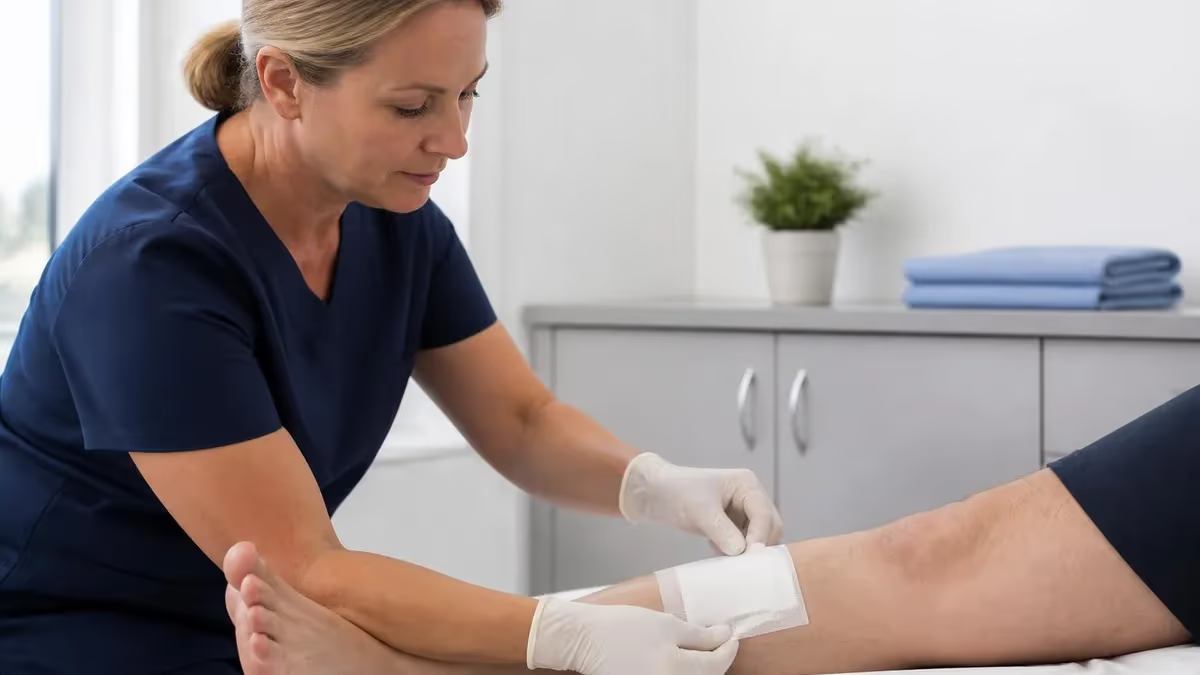
Picking the right wound care dressings sounds simple - until you're standing in front of a supply cart with twelve different options and a patient who needs help now. Hydrocolloids, alginates, foams, gauze, silver-impregnated everything. Each one claims to solve a different problem. Some genuinely do. Others get pulled out of habit because that's what the last nurse used.
This guide walks you through wound care dressing categories the way they actually get chosen in clinical practice - not by alphabet, not by manufacturer brochure, but by what the wound is doing. Whether you're prepping for the WCC, CWS, or CWCN exam, or just trying to make better decisions on the floor, the framework here matches how certified specialists think.
You'll get the breakdown on wound care dressing types, when each one shines, and where they fall apart. There's a heavy section on alginate dressings wound care professionals reach for with heavy exudate, plus a real look at wet-to-dry - a method many textbooks still teach but specialists rarely recommend anymore.
How Wound Care and Dressing Choices Actually Get Made
The clinical decision isn't "what's in stock." It's a quick read of four things: wound depth, drainage volume, infection risk, and tissue type at the base. Get those right and the dressing almost picks itself.
Drainage is the loudest signal. A dry wound bed needs moisture - hydrogels, hydrocolloids. A soaking wound needs absorption - alginates, foams, superabsorbents. Match the wrong category and you'll either macerate the surrounding skin or let the bed dry out and stall healing. Both outcomes show up on certification exam scenarios constantly.
Depth matters next. Partial-thickness wounds tolerate occlusive dressings well. Full-thickness wounds with tunneling or undermining need something that can fill the space - that's where calcium alginate ropes and gauze packing earn their place. Surface-only products on a deep wound just trap exudate at the entrance and call it a day.
Infection risk shifts the playbook. Antimicrobial dressings - silver, iodine, PHMB - get added when bioburden is high or signs of biofilm appear. They're not first-line for clean wounds. Overusing them is a flagged exam mistake and a real-world stewardship issue.
Wound Care Dressing Types - The Working List
Here's the breakdown of wound care dressing categories you'll actually see on shelves and on the test. Each has a sweet spot. None is universal.
Gauze (Woven and Non-Woven)
The oldest tool in the kit. Cheap, available, versatile. Used for packing, mechanical debridement, secondary coverage, and absorption. Its weakness - it dries out, sticks to the bed, and pulls off granulation tissue when removed. Modern practice uses gauze as a secondary dressing or for short-term packing, rarely as a primary contact layer.
Transparent Films
Thin polyurethane sheets, adhesive backing, semi-permeable. Brilliant for superficial wounds with minimal drainage, IV site protection, and as a secondary cover. They let oxygen and moisture vapor through but block bacteria. Pull one off a fragile periwound and you'll learn fast why these aren't for everyone - skin tears love film dressings.
Hydrocolloids and Their Quiet Wins
Occlusive, self-adhesive, contain gel-forming agents that interact with exudate to create a moist healing environment. Pressure injuries stage 2, minor burns, and donor sites do well under hydrocolloids. They can stay on 3-7 days. The catch - they're not for infected wounds or heavy drainage, and the gel they produce can look like pus on removal (which trips up new staff every time).
Hydrogels for the Dry Bed
Water or glycerin-based, donate moisture to dry wound beds. Use them on dry eschar, dry slough, painful wounds (they have a cooling effect), and radiation skin damage. They need a secondary dressing and won't help if drainage is moderate or higher - they'll just add to the swamp.
Foam Dressings - The Reliable Workhorse
Polyurethane or silicone-faced, absorbent, comfortable, available with or without adhesive borders. Foams handle moderate to heavy exudate, cushion bony prominences, and stay in place longer than most alternatives. The silicone-faced versions reduce trauma on removal - a huge deal for fragile skin.
Alginates
Calcium or calcium-sodium alginate fibers derived from seaweed. We'll cover these in depth below - they're worth their own section.
Hydrofibers and the Gel Conversion
Carboxymethylcellulose fibers that gel on contact with exudate. Similar use case to alginates but with even higher absorption and a softer gel. Often the choice for cavity wounds with heavy drainage where you also want atraumatic removal.
Antimicrobial Options
Silver, iodine (cadexomer or povidone), PHMB, honey-impregnated. Each has its own kinetics and limits. Silver alginate dressing wound care use is one of the most common combinations - broad-spectrum coverage plus exudate management in one package.
Composite Dressings
Multi-layer products that combine absorbent cores, contact layers, and adhesive borders. Convenient, slightly more expensive, and useful when you want one product instead of three.
Alginate Dressings Wound Care Specialists Trust
Alginates earn their reputation. Derived from brown seaweed, they're processed into calcium alginate (or calcium-sodium alginate) fibers, sheets, and ropes. On contact with sodium-rich exudate, the calcium ions swap out for sodium, and the fiber transforms into a soft gel that conforms to the wound bed.
That ion exchange does three things at once - it absorbs (up to 20 times its weight in fluid), it maintains a moist environment, and the calcium release supports hemostasis. That last property is why alginates show up in surgical packing for minor bleeding and in trauma kits.
When to Reach for an Alginate
Heavy exudate. That's the headline. Pressure injuries stage 3 or 4 with drainage, venous leg ulcers in the inflammatory phase, dehisced surgical wounds, partial-thickness burns with significant fluid, and any cavity wound that needs packing without trauma on removal.
Alginates are not for dry wounds. They'll desiccate the bed and adhere - removal becomes painful and damaging. They're also not ideal as a primary dressing on tunneling wounds unless the rope form is used, because flat sheets can't fill 3D space.
Silver Alginate Dressing Wound Care Decisions
Silver alginate combines the absorption and hemostatic properties of standard alginate with broad-spectrum antimicrobial action. Ionic silver disrupts bacterial cell membranes and interferes with DNA replication - and it works against MRSA, VRE, and Pseudomonas.
The clinical scenarios that justify silver alginate - locally infected wounds with moderate to heavy drainage, wounds at high risk of infection (immunocompromised patients, diabetic foot ulcers), and wounds where biofilm is suspected. It's not for clean, healing wounds. Silver carries cost and antimicrobial stewardship concerns, and chronic over-use is associated with delayed re-epithelialization.
Application Tips That Stick
Cut or fold the alginate to fit the wound - don't overlap healthy skin or it can macerate. Pack lightly into cavities, never tightly. Use a secondary dressing to hold it in place; foams are common partners. Change frequency depends on saturation - typically every 1-3 days, sooner if strikethrough appears. On removal, irrigate gently if any fibers cling. You shouldn't have to pull.
Wound Care Wet to Dry Dressing - Why It's Falling Out of Favor
Wet-to-dry dressings are still taught, still ordered, and still mostly wrong for modern wound care. The technique - saline-moistened gauze packed into the wound, allowed to dry, then pulled off, taking necrotic tissue and granulation tissue with it.
It's a form of nonselective mechanical debridement. The problems pile up fast. It removes healthy tissue along with the bad. It's painful - significantly so, often requiring premedication. It violates moist wound healing principles, which have been the standard of care for decades. It increases infection risk by exposing the wound bed during every change. And it's labor-intensive, requiring changes 2-3 times daily.
The Wound, Ostomy and Continence Nurses Society (WOCN) and most certification curricula now position wet-to-dry as a method of last resort, not a default. Better options for debridement include autolytic (hydrogels, hydrocolloids), enzymatic (collagenase), sharp (clinician-performed), and biological (maggot therapy in select cases).
If you see wet-to-dry ordered on a wound that has any granulation tissue, that's a conversation worth having with the prescribing provider - and a question that shows up on certification exams under "identify the inappropriate intervention."

Dressing Tape Wound Care Realities
Tape choice gets overlooked until a patient develops a medical adhesive-related skin injury (MARSI). Then it becomes urgent. Standard options include paper tape (most gentle), cloth tape (stronger hold), silicone tape (atraumatic removal, more expensive), and transparent film tape.
For fragile skin - elderly patients, long-term steroid users, pediatric patients - silicone tape or non-adhesive securement (tubular bandages, wraps) prevents skin tears. The cost difference disappears the moment you avoid a single MARSI incident.
For tape application, never stretch the tape across the skin. Apply with zero tension. The skin underneath should not be pulled when you remove the tape - that's what causes tears. Anchor the tape at both ends and lay the middle down flat.
Wound Care Dressing Change Best Practices
A dressing change is more than swapping materials. It's a wound assessment moment - measurements, tissue type, drainage volume and character, periwound condition, pain score, and progress toward goals all get documented.
Set up before you open anything. Hand hygiene, gloves, supplies within reach, a clean field. Patient comfort matters - premedicate if the change is painful, position for access without strain, explain what's happening.
Remove the old dressing slowly, observing what comes off - color, odor, character of exudate, whether the dressing adhered. Irrigate the wound bed with normal saline or wound cleanser, not povidone iodine or hydrogen peroxide on a healing bed (both are cytotoxic to fibroblasts).
Reassess the wound. Has the size changed? Is the tissue improving? Any tunneling, undermining, or new areas of concern? Document with measurements (length, width, depth in cm) and a tissue percentage estimate.
Apply the new dressing with the same principles - primary contact layer matched to wound conditions, secondary as needed for absorption or securement, and tape or wrap that won't damage skin on removal.
Building Toward Certification
If you're working toward certification, dressing selection is one of the highest-yield study areas. Roughly a quarter of questions on most wound care certification exams involve choosing or evaluating a dressing for a given scenario. Memorizing categories isn't enough - the exam tests clinical reasoning. You need to read a wound description and pick the dressing without seeing it on a shelf.
For broader prep, the wound care certification pathway covers eligibility, exam structures, and study resources for the WCC, CWS, and CWCN. The general wound care overview connects dressing knowledge to the rest of the discipline - assessment, debridement, nutrition, and outcomes. And if you want to compare specific products and brands, wound care products has the deeper breakdown of what's on the market and how systems like NPWT and VAC fit alongside the dressings covered here.
Putting It All Together
Wound care dressings work when they match the wound. Drainage, depth, infection status, and tissue type drive selection - not habit, not what's stocked at the front of the cart. The categories overlap in marketing language but separate cleanly in clinical use once you know what each one does.
Alginates earn their place with heavy drainage and cavities. Hydrocolloids and hydrogels handle dry, low-drainage wounds. Foams give comfort and absorption with long wear times. Antimicrobials get reserved for infection or high-risk situations, not routine wear. And wet-to-dry - outside of very specific use cases - has been replaced by methods that don't punish granulation tissue.
Get the framework right and the supply cart stops looking overwhelming. Each product has a job. Your job is to read the wound and pick the right one.
About the Author

Registered Nurse & Healthcare Educator
Johns Hopkins University School of NursingDr. Sarah Mitchell is a board-certified registered nurse with over 15 years of clinical and academic experience. She completed her PhD in Nursing Science at Johns Hopkins University and has taught NCLEX preparation and clinical skills courses for nursing students across the United States. Her research focuses on evidence-based exam preparation strategies for healthcare certification candidates.