
Traffic Management Plan Forklift: Complete Guide to Forklift Safety and Operations for TLILIC0003 Operators in Australia
Traffic management plan forklift guide for TLILIC0003 operators. Master safety zones, pedestrian separation, signage, and operations across 📝
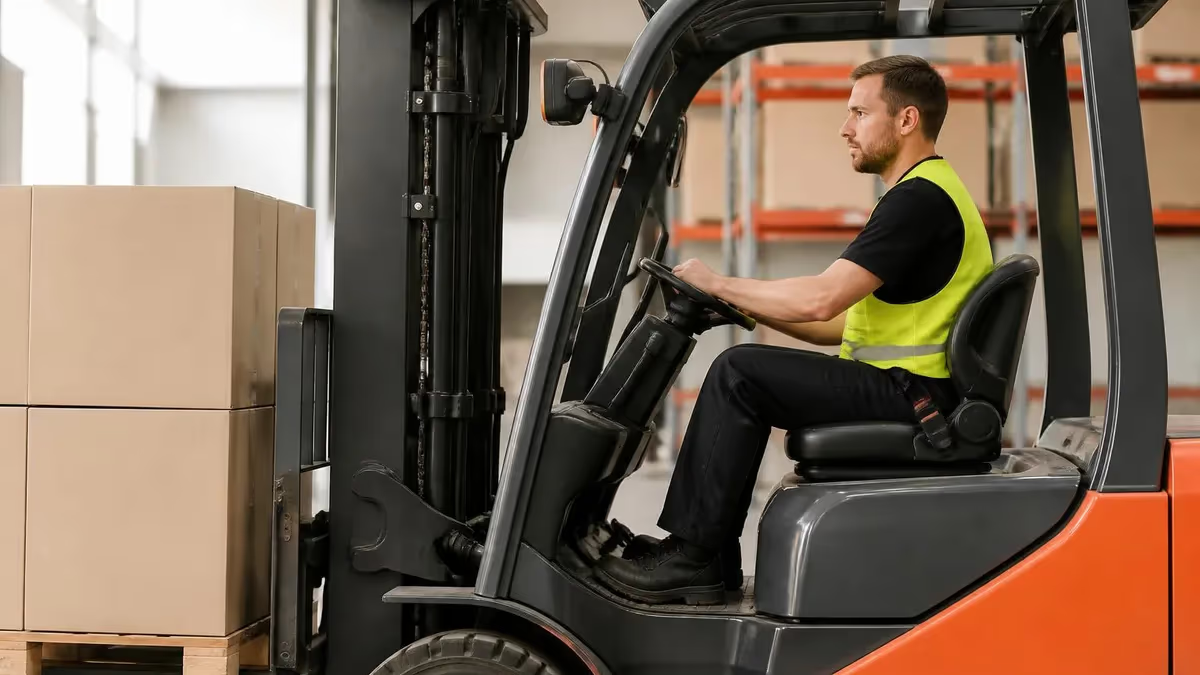
A well-designed traffic management plan forklift program sits at the very heart of TLILIC0003 competency in Australia, and it is the single most important document protecting workers in any warehouse, distribution centre, manufacturing plant, or construction yard where powered industrial trucks operate alongside people. Safe Work Australia attributes roughly one quarter of all serious workplace incidents involving mobile plant to forklifts, and the overwhelming majority involve a pedestrian, a blind corner, a missing barrier, or a procedure that existed on paper but was never followed on the floor. Understanding the plan is therefore not optional knowledge.
For TLILIC0003 candidates, the assessment scenarios examined by your Registered Training Organisation will almost always include a written or simulated component where you must read a site plan, identify pedestrian exclusion zones, and operate accordingly. Assessors look for evidence that you can interpret line markings, recognise designated crossing points, respond to give-way signage, and adapt speed to the conditions described in the safe work method statement. Memorising legislation alone will not get you through; you must demonstrate practical application in a live workplace environment.
Australian forklift safety operates under a layered regulatory framework. The Work Health and Safety Act 2011 and corresponding state regulations set the duty of care, while the Australian Standard AS 2359.2 governs operational safety for powered industrial trucks. Beyond these, each persons conducting a business or undertaking must produce site-specific traffic management documentation that addresses their unique layout, product flow, and pedestrian exposure. The TLILIC0003 unit of competency directly references all of these in its performance criteria, meaning your verbal questioning will probe each layer.
This guide walks through every element a TLILIC0003 operator needs to understand before sitting their high-risk work licence assessment. We cover plan structure, separation principles, signage interpretation, communication protocols, emergency procedures, and the practical operating habits that distinguish a competent licensed operator from one who simply scraped a pass. We have written each section to mirror the structure of the national assessment instrument so you can revise topic by topic.
Statistics from SafeWork NSW indicate that 70 percent of forklift fatalities involve pedestrians rather than the operator, and almost all of these occur during low-speed manoeuvring in supposedly controlled environments. That counter-intuitive truth shapes everything in modern traffic management thinking. Speed alone is not the enemy; the failure to separate people from plant, combined with poor visibility and assumed familiarity, kills far more workers each year than excessive velocity ever does.
Whether you are renewing an existing licence, transitioning from an LO order-picker ticket, or completing your very first high-risk work qualification, treat every page of this guide as exam-relevant. The depth of detail here matches the depth of questioning you can expect from your TLILIC0003 assessor, and the practical examples reflect real Australian worksites from Perth wharves to Brisbane cold-storage facilities.
By the end of this article you will be able to read a traffic management plan with confidence, explain its components in plain English, and apply its rules during practical operation. That combination of knowledge and behaviour is exactly what a verifier of competency looks for when signing off your statement of attainment, and it is exactly what keeps you and your coworkers alive each shift.
Forklift Safety in Australia by the Numbers
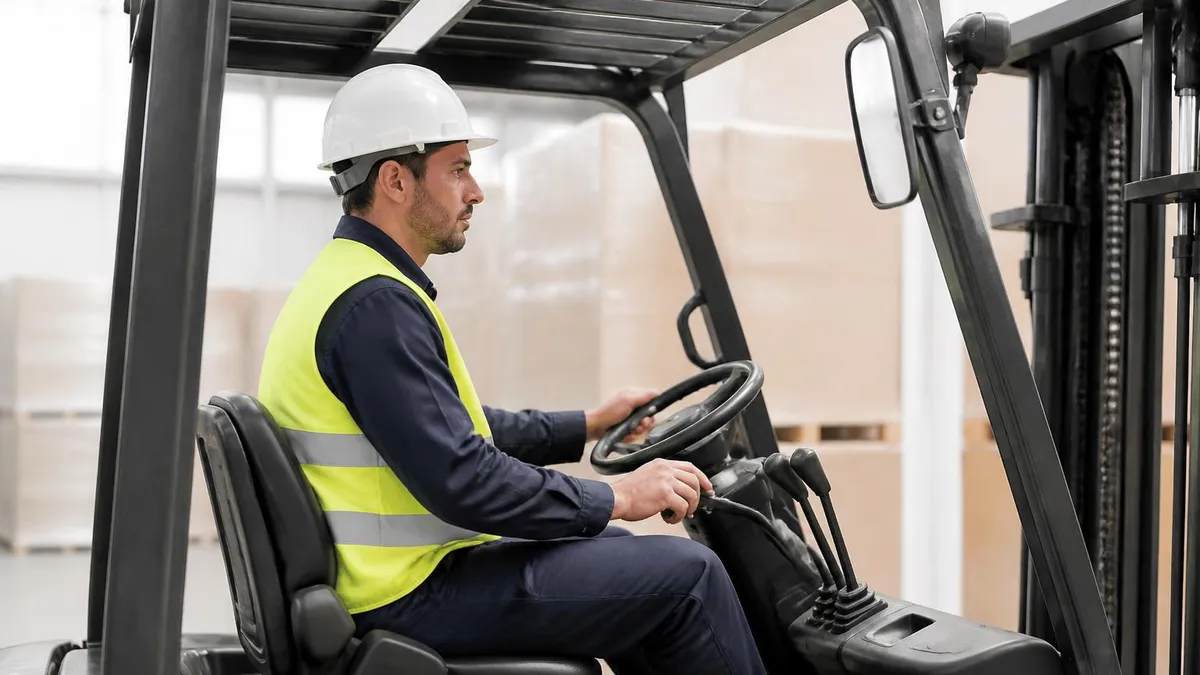
Core Elements of a Traffic Management Plan
A scaled drawing of the workplace showing forklift routes, pedestrian walkways, loading bays, charging areas, racking aisles, and emergency egress. Colour coding distinguishes vehicle-only zones from shared and pedestrian-only areas.
Documented identification of every interaction point between forklifts, pedestrians, other mobile plant, and stored goods. Each hazard is rated for likelihood and consequence using the standard 5x5 matrix prescribed in AS/NZS ISO 31000.
Application of the hierarchy of controls: elimination first, then engineering separation, administrative measures, and personal protective equipment last. The plan must justify each chosen control against higher-order alternatives.
A register of every sign, line marking, mirror, bollard, gate, and audible alarm installed across the site. Each entry includes location, AS 1319 classification, inspection frequency, and the person responsible for maintenance.
Step-by-step response protocols for collisions, tip-overs, load falls, spills, fires, and medical events. Procedures specify who calls 000, who isolates power, who controls bystanders, and who completes the post-incident report.
Pedestrian separation is the single most powerful control available to a Persons Conducting a Business or Undertaking, and TLILIC0003 verbal assessment will almost certainly probe your understanding of the hierarchy of controls applied to people-plant interaction. The gold standard is full physical separation through dedicated forklift-only roadways with kerbed walkways for foot traffic, but in most Australian workplaces this ideal is impossible because of legacy building footprints, narrow aisles, or shared loading docks. The plan must therefore explain how lower-order controls compensate.
Engineering controls sit immediately below full separation in the hierarchy. They include guardrails, bollards, mesh fencing along walkways, swing gates with magnetic interlocks at pedestrian crossings, transparent strip curtains at doorways, and convex mirrors at every blind corner. Modern sites are also installing proximity detection systems that vibrate or sound alarms when a pedestrian breaches a virtual exclusion zone around the truck. Your assessor will expect you to identify these controls during a site walk-through and explain each one's function.
Administrative controls form the next layer and include written safe work procedures, designated forklift operating hours, scheduled pedestrian-free windows for high-volume movements, mandatory radio check-ins before reversing into shared zones, and induction training for every visitor entering the operational footprint. These controls fail more often than engineering measures because they depend on consistent human behaviour, which is precisely why they sit lower in the hierarchy. TLILIC0003 candidates must understand why administrative measures alone are never sufficient.
High-visibility clothing represents the last line of defence and the lowest-order control. Class D/N hi-vis garments compliant with AS/NZS 4602.1 must be worn by every person on foot in any shared zone, but the plan should never rely on hi-vis as a primary control. forklift safety mentally treat every pedestrian as invisible, regardless of what they are wearing, and proceed on the assumption that the person may step into the path of the truck without warning.
Three-metre exclusion zones around an operating forklift are now considered the Australian industry baseline. When a pedestrian enters that zone the operator must stop, lower the forks to ground level, apply the park brake, and place the transmission in neutral until the person has cleared the area. Some sites extend this to five metres for counterbalance trucks carrying elevated loads. The TLILIC0003 assessor will watch closely for evidence of this discipline during your practical demonstration.
Communication between operators and pedestrians is the glue that holds separation controls together. Eye contact, hand signals, voice acknowledgement, and reversing alarms all play a role. Many sites mandate that operators sound the horn before every blind corner and before reversing more than three truck lengths. The plan should specify which signals are used and how new workers learn them during induction, and you should be able to recite these site-specific rules during questioning.
Finally, the plan must address contractor and visitor management. External delivery drivers, tradespeople, auditors, and customers entering the operational area present elevated risk because they have not completed full site induction. Sign-in protocols, escort requirements, designated waiting zones, and visible visitor identification (typically a coloured lanyard or vest) all feature in mature plans. Expect questions about how you would handle an unescorted visitor wandering into your aisle during peak picking activity.
TLILIC0003 Practice Test Questions
Prepare for the Forklift Licence Australia - TLILIC0003 exam with our free practice test modules. Each quiz covers key topics to help you pass on your first try.
TLILIC0003 Forklift Licence Australia Atta...
TLILIC0003 Exam Questions covering Forklift Licence Australia Attachments and Modifications. Master TLILIC0003 Test concepts for certification prep.
TLILIC0003 Forklift Licence Australia Batt...
Free TLILIC0003 Practice Test featuring Forklift Licence Australia Battery and Fuel Safety. Improve your TLILIC0003 Exam score with mock test prep.
TLILIC0003 Forklift Licence Australia Emer...
TLILIC0003 Mock Exam on Forklift Licence Australia Emergency Procedures. TLILIC0003 Study Guide questions to pass on your first try.
TLILIC0003 Forklift Licence Australia Fork...
TLILIC0003 Test Prep for Forklift Licence Australia Forklift Pre-Operational Checks. Practice TLILIC0003 Quiz questions and boost your score.
TLILIC0003 Forklift Licence Australia Haza...
TLILIC0003 Questions and Answers on Forklift Licence Australia Hazard Identification. Free TLILIC0003 practice for exam readiness.
TLILIC0003 Forklift Licence Australia Load...
TLILIC0003 Mock Test covering Forklift Licence Australia Load Centre Calculations. Online TLILIC0003 Test practice with instant feedback.
TLILIC0003 Forklift Licence Australia Load...
Free TLILIC0003 Quiz on Forklift Licence Australia Load Handling and Capacity. TLILIC0003 Exam prep questions with detailed explanations.
TLILIC0003 Forklift Licence Australia Oper...
TLILIC0003 Practice Questions for Forklift Licence Australia Operating in Different Environments. Build confidence for your TLILIC0003 certification exam.
TLILIC0003 Forklift Licence Australia Oper...
TLILIC0003 Test Online for Forklift Licence Australia Operating Techniques. Free practice with instant results and feedback.
TLILIC0003 Forklift Licence Australia Pede...
TLILIC0003 Study Material on Forklift Licence Australia Pedestrian Safety. Prepare effectively with real exam-style questions.
Signage, Line Markings and Zone Types
Mandatory signs under AS 1319 use a blue circle with a white pictogram and instruct the viewer to perform a specific action. On forklift-affected sites you will encounter signs requiring high-visibility clothing, safety footwear, hearing protection in compressor rooms, eye protection in battery charging areas, and pedestrian use of designated walkways only. Every mandatory sign in your traffic plan must be backed by a written procedure explaining when and why the requirement applies.
TLILIC0003 candidates should be able to point to the relevant sign before entering any zone and explain what it requires. Assessors test this by deliberately walking you past several signs during the practical and asking you to interpret each one. Memorise the colour-shape combinations because they appear on knowledge-test multiple-choice items and the answer is rarely obvious if you have not studied AS 1319 alongside the unit of competency learner guide.
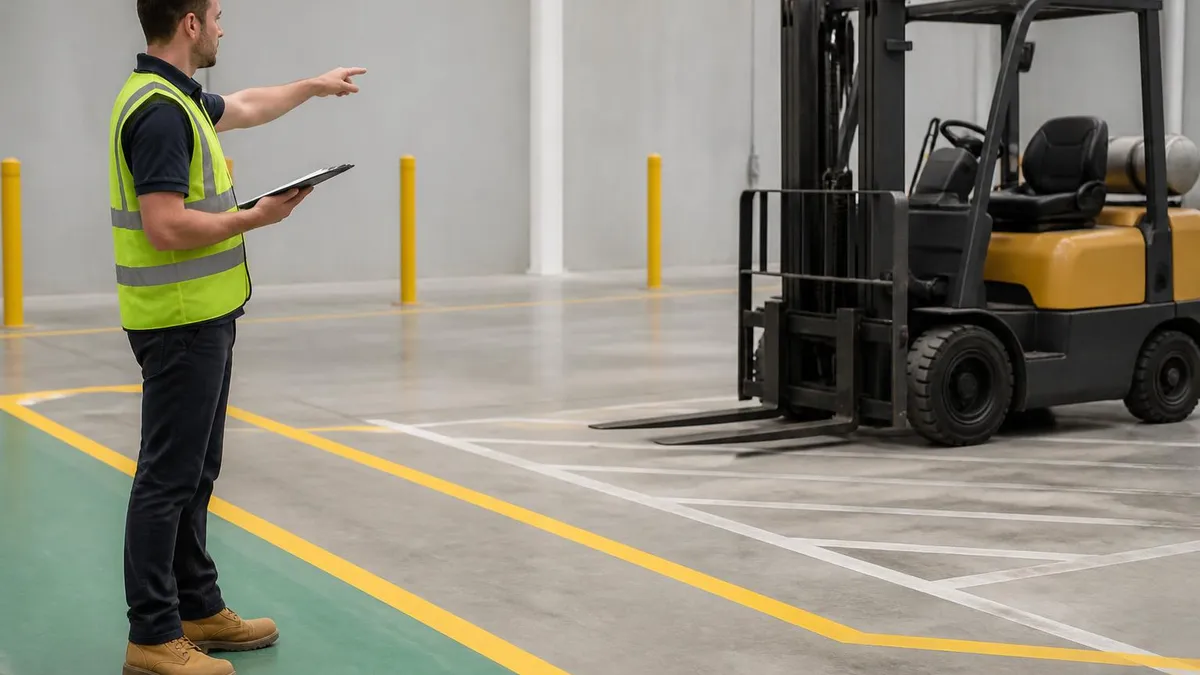
Physical Separation vs Administrative Controls: Trade-offs
- +Physical barriers remove human error from the safety equation entirely
- +Engineering controls work the same in every shift and every weather condition
- +Bollards and guardrails require no compliance effort from individual workers
- +Capital investment in separation is amortised over decades of accident prevention
- +Insurance premiums often fall after physical separation upgrades are documented
- +Mirrors and proximity sensors compensate for blind spots no procedure can fix
- −Physical works are expensive and disruptive to install in operating warehouses
- −Fixed barriers reduce floor flexibility for seasonal layout changes
- −Bollards can themselves become collision hazards if poorly placed
- −Some sites lack the structural floor strength to anchor heavy guardrails
- −Maintenance of mechanical gates and interlocks adds ongoing cost
- −Heritage buildings often cannot accept modern engineering retrofits
Daily Pre-Operational Traffic Management Checklist
- ✓Confirm the site traffic plan has been reviewed and signed off within the last 12 months
- ✓Inspect all pedestrian walkway markings for fading, scuffing, or obstruction by stored goods
- ✓Test convex mirrors at every blind corner for cleanliness, alignment, and structural integrity
- ✓Verify all swing gates, interlocks, and pedestrian barriers operate without resistance or play
- ✓Check that reversing alarm and amber strobe activate within two seconds of selecting reverse
- ✓Sound the horn before entering any aisle, intersection, or doorway in the operating footprint
- ✓Maintain a minimum three-metre exclusion zone around the truck at all times during operation
- ✓Reduce speed to walking pace when within 10 metres of any pedestrian crossing or door
- ✓Lower forks to within 150 mm of the floor whenever travelling without a load
- ✓Report any damaged signage, missing bollards, or obstructed sight lines to the supervisor immediately
Assume Every Pedestrian Will Step Into Your Path
The single most reliable predictor of long-term safe operation is mentally treating every person on foot as a potential collision target, regardless of high-visibility clothing or training status. Make eye contact, get a wave, and only then proceed. This habit, drilled into you during TLILIC0003 practical training, prevents the vast majority of low-speed crush injuries that fill Australian compensation claim ledgers each year.
Hazard identification on the floor begins with the formal documents but lives or dies on the moment-to-moment awareness of the operator. A traffic management plan can describe every fixed feature of a workplace, but it cannot predict the broken pallet that fell into the aisle ten minutes ago, the wet patch from a forklift that just drove through a beverage spill, or the cleaner who has temporarily blocked a walkway with a wet-floor sign. TLILIC0003 trains you to identify dynamic hazards through a continuous scan-and-decide routine.
Blind corners deserve specific mention because they are statistically responsible for a disproportionate share of forklift-pedestrian collisions. Australian sites address them through a combination of convex mirrors, audible warning systems triggered by motion sensors, mandatory horn sounding by the operator, and reduced speed limits posted at the corner approach. The most progressive sites use synchronised traffic lights at intersections, with pedestrian phases that lock out forklift movement entirely. Your assessor will probe your understanding of all these controls.
Doorways and roller shutters present a particular risk because they are the natural transition between visually distinct zones. An operator emerging from a brightly lit warehouse into a dim loading bay loses adaptive vision for several seconds, while a pedestrian crossing from the smoko room into the operational area expects the same quiet environment they just left. Traffic plans address this with stop-and-look protocols, strip curtains that slow truck speed by physical resistance, and dedicated pedestrian access doors offset from the main vehicle opening.
Loading dock operations combine multiple hazards: trucks reversing into the dock, deliveries being unloaded, pallets staged on the dock plate, and forklifts transferring goods between trailer and warehouse. The traffic management plan must explicitly address dock face safety with wheel chocks, trailer creep prevention, dock lights communicating safe-to-enter status, and clear demarcation between truck driver waiting zones and forklift operating zones. Driver-only safe zones marked by yellow boxes near the cabin are now standard.
Battery charging and refuelling areas introduce chemical, fire, and explosion hazards on top of the standard traffic risks. The plan should designate the charging zone as forklift-access-only during charging, prohibit smoking and ignition sources, mandate eye-wash station provision within ten metres, and specify ventilation requirements that prevent hydrogen accumulation. For LPG-powered trucks, cylinder change-out areas have their own no-smoking and ventilation rules that operators must internalise.
External yards introduce weather, surface gradient, and shared traffic with road-registered vehicles. Rain reduces tyre grip and lengthens stopping distance, slopes change load stability dramatically, and articulated delivery trucks present blind spots far larger than those of any forklift. The plan must require operators to reduce speed in rain, refuse to operate when sustained winds exceed manufacturer limits, and follow a specific sequence when working alongside semi-trailers in marshalling yards.
Finally, fatigue and distraction deserve formal recognition in any modern traffic management plan. Long shifts, double shifts, and end-of-day fatigue all measurably increase reaction time and reduce hazard perception. Plans should mandate rest break frequency, prohibit mobile phone use during operation, and require operators to self-report when they feel impaired by illness, medication, or insufficient sleep. TLILIC0003 candidates are tested on their understanding that fitness for work is an individual legal duty under the WHS Act.
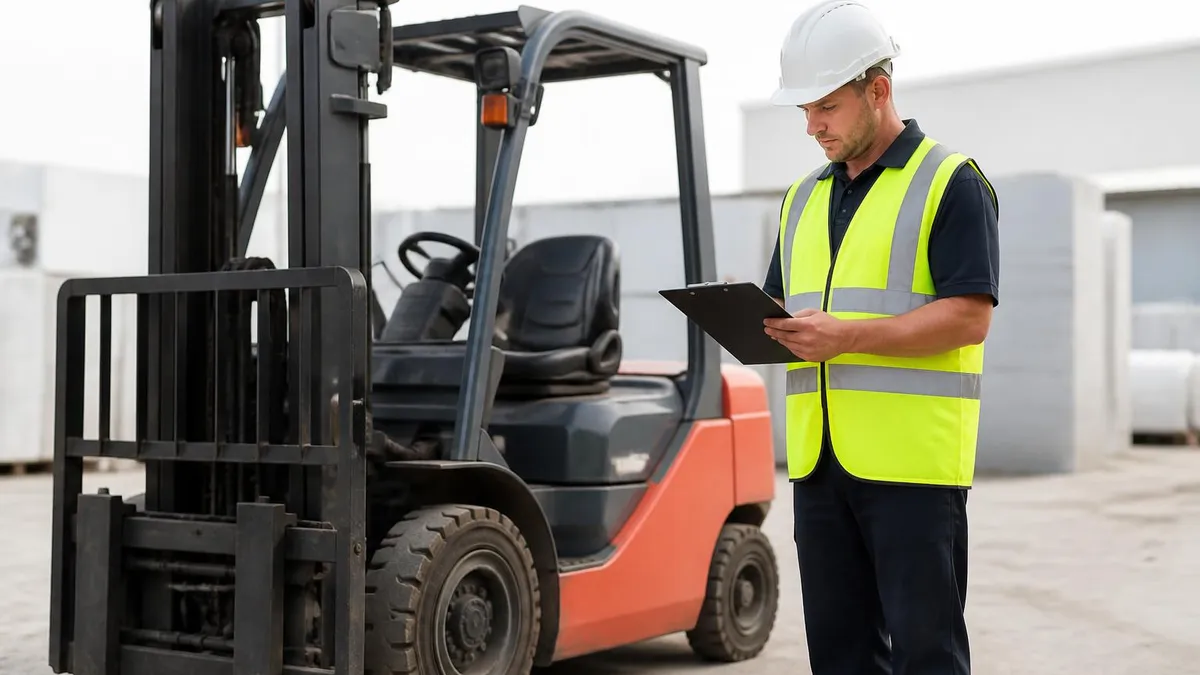
Bypassing an interlock, propping open a safety gate, or disabling a reversing alarm is treated under WHS legislation as reckless conduct and can attract personal criminal liability for the operator as well as the PCBU. Even one shift of operation with a defeated control can result in licence cancellation, prosecution, and permanent exclusion from high-risk work. If a control is impractical, escalate through the supervisor and risk assessment process — never improvise.
Preparing for the TLILIC0003 assessment requires you to integrate everything covered so far into a confident verbal and practical performance. Assessors use a national assessment instrument that includes a written knowledge test, a practical operating demonstration, and structured verbal questioning. Each of these components probes traffic management understanding through different lenses, so your preparation needs to cover all three formats rather than just rote-memorising answers from a single study guide.
For the written component, focus on legislative names, control hierarchy order, exclusion zone distances, and signage colour-shape pairings. These are the high-frequency items that appear across every state's variant of the assessment. Use the related guides in this series to revise the relevant forklift parts and the multi directional forklift trucks variants that change traffic-management requirements, because trucks with omnidirectional travel raise additional questions about pedestrian visibility.
The practical component is where most candidates lose marks. Assessors deliberately introduce hazards during the demonstration: a stray pedestrian, an obstacle in the aisle, a load placed at uncomfortable height. They are watching for your scan pattern, your speed adjustments, your horn use, your eye contact with pedestrians, and your willingness to stop the truck and reassess when conditions change. Practice these behaviours under supervision until they become automatic rather than deliberate.
Verbal questioning sits between the written test and practical demonstration in difficulty. Assessors will ask you to explain what you would do in scenarios that are not easily simulated, such as a fellow operator behaving unsafely, a contractor refusing to wear hi-vis, or a load that exceeds the rated capacity printed on the data plate. Prepare scripted responses that demonstrate knowledge of the chain of escalation: stop, isolate, report to supervisor, document.
Mock assessments offered by reputable Registered Training Organisations are worth their cost. They expose your weaknesses in a low-stakes environment, give you a realistic preview of pacing and pressure, and allow you to refine answers before the formal sitting. Most RTOs include at least one mock as part of the standard course fee; if yours does not, pay extra for one. Candidates who complete a mock pass the formal assessment at noticeably higher rates than those who do not.
State-specific licensing variations are worth checking before you sit. While the TLILIC0003 unit is nationally recognised, application processes differ between SafeWork NSW, WorkSafe Victoria, WorkSafe WA, and others. Each regulator requires a slightly different evidence package, identity verification process, and fee. Confirm your state's exact requirements with the regulator's website, not with hearsay from coworkers, because outdated information about photo specifications or proof of identity documents is a common cause of application rejection.
Finally, treat your statement of attainment and high-risk work licence card as legal documents that must be carried during every shift. WorkSafe inspectors routinely conduct random checks at high-traffic sites and operating without your card on your person is technically a breach. Some employers require the card to be displayed on a lanyard during operation. Renewal falls due every five years, and missing the renewal window means re-sitting the entire assessment, so set a calendar reminder twelve months ahead of expiry.
Practical operating habits separate licensed operators who stay accident-free across decades from those whose careers stall after their first reportable incident. The first habit to internalise is the three-second scan: every three seconds your eyes leave the load or the immediate path and sweep the wider operating zone, looking for pedestrians, plant, or changing conditions. This sounds simple but requires deliberate practice because the natural tendency is to fixate on the immediate task, especially under time pressure.
Speed management is the second habit and the one most often raised in incident investigations. Australian industry consensus is that 10 km/h is the absolute maximum indoor speed and that walking pace (around 5 km/h) is appropriate within ten metres of any pedestrian, crossing, doorway, or blind corner. Many telematics systems now log speed continuously and flag overspeed events to supervisors, so the days of clandestine speeding are largely over. Build the habit of disciplined speed from the first hour of training.
Load awareness is the third critical habit. Before every lift, mentally confirm that the load is within capacity at the operating distance from the mast, that the centre of gravity will not shift during travel, and that the path to destination is clear of obstacles. The TLILIC0003 assessment includes specific verbal probes about load charts and de-rating for non-standard attachments, so this knowledge must be active rather than passive. Reference the data plate before every challenging lift.
Communication discipline ties everything together. Sound the horn at a consistent volume and duration so coworkers learn to recognise your truck specifically. Use radio call-outs for any movement involving more than one operator. Wave back to pedestrians who have signalled their intent to cross, and never assume someone has seen you simply because they appear to be looking in your direction. Glance does not equal acknowledgement, and assumed communication causes more collisions than missed signals.
Mechanical condition checks before every shift are non-negotiable and form part of the pre-operational inspection required by AS 2359.2. Cover horn, alarms, lights, mirrors, hydraulics, mast operation, tilt function, tyres, forks, overhead guard, seat belt, and data plate legibility. Document every check in the logbook, because in the event of an incident the logbook is the first evidence WorkSafe inspectors request. A logbook with consistent thorough entries is also one of the strongest defences against personal liability.
Continuous professional development extends well beyond initial licence acquisition. Refresher training every two to three years (even though the licence itself is valid for five) catches drift in operating habits before it becomes dangerous. Toolbox talks, near-miss reporting culture, and active participation in workplace safety committees all signal to employers that you take your high-risk work licence seriously. These behaviours protect your licence renewal and improve your standing for promotion to trainer or assessor roles.
Above all, remember that the traffic management plan is a living document. Sites change layout, introduce new products, hire new workers, and respond to incidents by modifying procedures. Stay current with every revision, ask questions when something seems unclear, and participate constructively in plan reviews when invited. Operators who treat the plan as a partnership rather than a constraint typically have the longest, safest, and most rewarding careers in the materials handling industry across Australia.
TLILIC0003 Questions and Answers
Mast of Forklift: Complete Guide to Forklift Parts for TLILIC0003 Operators in Australia

Multi Directional Forklift Trucks: Complete Guide to Forklift Types and Parts for TLILIC0003 Operators in Australia

Free Forklift Practice Test 2026 - Forklift Exam Questions
Electric 3 Wheel Forklift: Complete Guide to Electric Forklift Types for TLILIC0003 Operators in Australia
Forklift Clearance Height: Complete Guide to Forklift Specifications for TLILIC0003 Operators in Australia
About the Author

Certified Crane Operator & Skilled Trades Exam Specialist
Ferris State UniversityRobert Martinez is a Journeyman Ironworker, NCCCO-certified crane operator, and forklift trainer with a Bachelor of Science in Construction Technology from Ferris State University. He has 21 years of ironworking, rigging, and heavy equipment operation experience across high-rise and industrial construction sites. Robert prepares candidates for crane operator, rigger, forklift, and skilled trades certification examinations.