
Mast of Forklift: Complete Guide to Forklift Parts for TLILIC0003 Operators in Australia
Mast of forklift explained: 🟢 learn forklift parts, mast stages, hydraulics, chains, and safety checks for your TLILIC0003 licence in Australia.
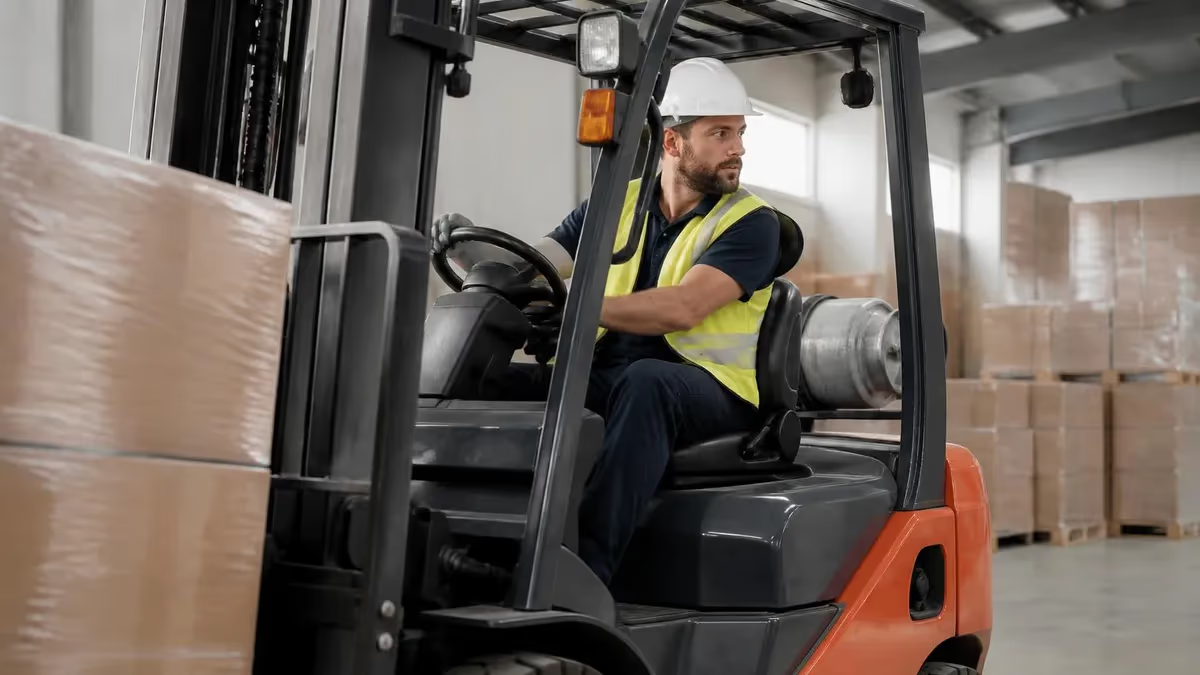
The mast of forklift is the vertical assembly at the front of the machine that raises, lowers, and tilts loads, and understanding how it works is non-negotiable for anyone preparing for the TLILIC0003 licence in Australia. Whether you operate in a Melbourne warehouse, a Brisbane port, or a regional Queensland coolroom, recognising mast components and their interaction with the rest of the forklift is the foundation of safe lifting. This guide breaks down every major part you will encounter on a counterbalance or reach truck.
Forklifts look simple from the outside, but they contain over 200 individual components grouped into the mast, carriage, chassis, power unit, hydraulic system, and operator controls. Each part has a defined role, and each has a wear pattern that you must be able to identify during a pre-start inspection. Skipping a single check, such as failing to spot a frayed lift chain or a leaking hydraulic hose, has caused serious incidents on Australian worksites year after year, according to Safe Work Australia incident data.
The TLILIC0003 unit of competency, which replaced the older TLILIC2001, places strong emphasis on machine knowledge. Assessors expect candidates to point to parts on a real forklift, name them correctly, and explain their function in plain English. You cannot pass the practical assessment by memorising answers alone; you must develop a hands-on familiarity with the mast channels, fork heel, tilt cylinders, drive axle, and load backrest extension.
This article walks through forklift anatomy from the mast downwards. We cover the three main mast types (simplex, duplex, triplex), the difference between free lift and full lift, the role of the hydraulic system in raising loads, and the function of the counterweight that prevents tipping. We also explain how attachments like rotators, side-shifters, and slip sheets bolt onto the carriage and what they mean for your rated capacity.
Beyond mechanical theory, knowing your parts helps you communicate clearly with mechanics, supervisors, and WHS officers. When you can describe a fault precisely — "the inner mast channel is binding at full extension" rather than "the lift feels weird" — repairs happen faster and incidents drop. Operators who pass TLILIC0003 with strong parts knowledge typically earn higher wages and move into supervisory or trainer roles within two to three years.
By the end of this guide, you will be able to identify every component a TLILIC0003 assessor might quiz you on, perform a structured pre-start inspection in under ten minutes, and understand the engineering principles behind safe load handling. Use the practice tests linked throughout to test your recall, and revisit this page during your study block. Forklift parts knowledge is the difference between a confident operator and one who gets sent home on assessment day.
Forklift Parts by the Numbers
Forklift Mast Types and Stages Explained
A simplex mast has one channel set and offers limited lift height, typically used in outdoor yards where overhead clearance is generous. It provides no free lift and is the simplest, most affordable mast configuration available.
Duplex masts feature two telescoping channels and provide free lift, allowing the forks to rise before the mast extends. This makes them ideal for working inside trucks, shipping containers, or buildings with low ceilings.
Triplex masts have three nested channels reaching 4.5 to 6 metres or higher, with full free lift. They are the standard in Australian warehouses where high-bay racking demands maximum extension without sacrificing low-clearance entry.
Quad masts push lift heights above 7 metres and are used in distribution centres with very tall racking. They require careful load handling because residual capacity drops significantly as you near the upper limits.
Free lift means the carriage rises while the outer mast stays stationary, critical in low-overhead spaces. Full lift describes the maximum extension once all mast stages telescope upward fully to reach top racking levels.
Once you understand mast types, the next step is to map every other major component on a counterbalance forklift. Start at the operator's seat: you have the steering wheel, accelerator, brake, inching pedal (on automatic transmissions), tilt control, lift control, side-shift control, and the seatbelt with its interlock sensor. The seat itself often contains a presence switch that disables hydraulics if the operator leaves the cabin without setting the park brake.
Move forward and you encounter the carriage, which is the steel plate the forks bolt onto. The carriage rides up and down inside the inner mast channel on rollers, and it is rated by ITA class (Class II covers loads to 2,500 kg, Class III to 4,500 kg). On top of the carriage sits the load backrest extension, a vertical guard that stops loads tipping back onto the operator. Below it, the forks hook into the carriage bar via heel locks.
The forks themselves are precision-forged steel components with a heel, blade, and tip. They have a stamped capacity rating on the shank and must be inspected for cracks, bending, and heel wear. A fork worn more than 10 per cent at the heel must be removed from service immediately under AS 2359.2. Many Australian sites paint a wear-indicator stripe across the heel so operators can visually check thickness during pre-start.
Behind the mast sits the chassis, housing the engine or battery, transmission, drive axle, and counterweight. The counterweight is a massive cast-iron block at the rear that balances the load. On electric forklifts, the heavy battery often doubles as the counterweight. The drive axle sits under the cab, carrying most of the truck's weight and providing traction. The steering axle is at the rear and is what makes forklifts so manoeuvrable in tight aisles.
The overhead guard (FOPS — Falling Object Protective Structure) is the cage above your head, certified to AS 2359.1 to protect against falling stock. It must never be modified, drilled, or welded without engineering sign-off. Mirrors, beacons, blue spotlights, and reverse alarms are typically mounted on the guard or the rear of the counterweight. Many TLILIC0003 candidates lose marks for not naming these safety devices during the verbal assessment, so practise them out loud.
Underneath, you will find tyres (cushion, pneumatic, or solid pneumatic), wheel hubs, brake assemblies (drum or wet-disc), and the steer linkage. Cushion tyres suit smooth indoor floors, pneumatic tyres handle outdoor yards, and solid pneumatics offer puncture-proof outdoor performance. The tyre type stamped on the data plate must match the operating environment — using cushion tyres outdoors on rough ground voids manufacturer warranties and reduces stability significantly.
Finally, the data plate (also called the capacity plate or compliance plate) is the single most important sticker on the machine. It lists serial number, model, tyre type, attachment configuration, mast type, lift height, and rated capacity at standard load centre. Australian regulators expect operators to read the data plate before every shift, especially when attachments change. If the plate is missing or illegible, the forklift must be taken out of service until an engineer reissues one.
TLILIC0003 Practice Test Questions
Prepare for the Forklift Licence Australia - TLILIC0003 exam with our free practice test modules. Each quiz covers key topics to help you pass on your first try.
TLILIC0003 Forklift Licence Australia Atta...
TLILIC0003 Exam Questions covering Forklift Licence Australia Attachments and Modifications. Master TLILIC0003 Test concepts for certification prep.
TLILIC0003 Forklift Licence Australia Batt...
Free TLILIC0003 Practice Test featuring Forklift Licence Australia Battery and Fuel Safety. Improve your TLILIC0003 Exam score with mock test prep.
TLILIC0003 Forklift Licence Australia Emer...
TLILIC0003 Mock Exam on Forklift Licence Australia Emergency Procedures. TLILIC0003 Study Guide questions to pass on your first try.
TLILIC0003 Forklift Licence Australia Fork...
TLILIC0003 Test Prep for Forklift Licence Australia Forklift Pre-Operational Checks. Practice TLILIC0003 Quiz questions and boost your score.
TLILIC0003 Forklift Licence Australia Haza...
TLILIC0003 Questions and Answers on Forklift Licence Australia Hazard Identification. Free TLILIC0003 practice for exam readiness.
TLILIC0003 Forklift Licence Australia Load...
TLILIC0003 Mock Test covering Forklift Licence Australia Load Centre Calculations. Online TLILIC0003 Test practice with instant feedback.
TLILIC0003 Forklift Licence Australia Load...
Free TLILIC0003 Quiz on Forklift Licence Australia Load Handling and Capacity. TLILIC0003 Exam prep questions with detailed explanations.
TLILIC0003 Forklift Licence Australia Oper...
TLILIC0003 Practice Questions for Forklift Licence Australia Operating in Different Environments. Build confidence for your TLILIC0003 certification exam.
TLILIC0003 Forklift Licence Australia Oper...
TLILIC0003 Test Online for Forklift Licence Australia Operating Techniques. Free practice with instant results and feedback.
TLILIC0003 Forklift Licence Australia Pede...
TLILIC0003 Study Material on Forklift Licence Australia Pedestrian Safety. Prepare effectively with real exam-style questions.
Hydraulic System, Lift Chains, and Mast of Forklift Mechanics
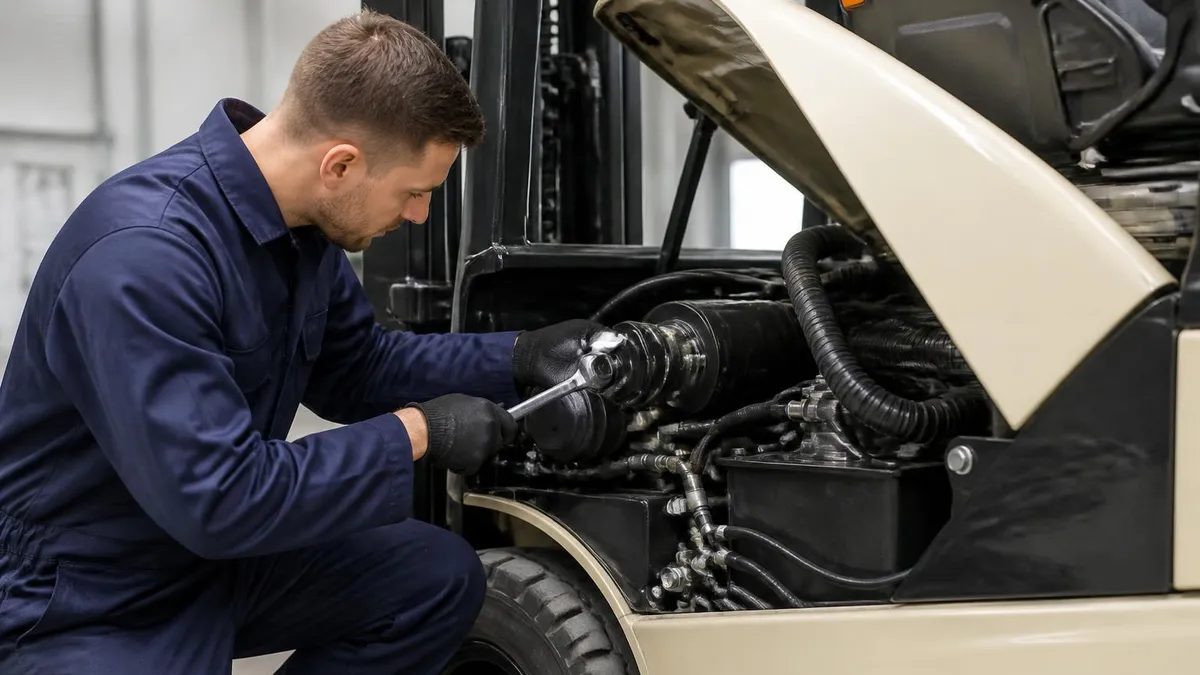
The hydraulic pump is the heart of every lift. It draws fluid from the reservoir tank and pressurises it through high-pressure hoses to the lift and tilt cylinders. Most Australian counterbalance forklifts run gear pumps at around 2,000 to 2,500 psi, driven by either the combustion engine or an electric motor on battery trucks.
A failing pump typically shows symptoms of slow lift speed, jerky operation, or audible whining under load. During pre-start checks, listen for unusual noise when you lift with no load and watch the fluid sight glass on the reservoir. Cloudy or milky fluid means water contamination, while a burnt smell indicates overheating — both reasons to tag the forklift out and call maintenance.
Knowing Forklift Parts Inside-Out: Why It Matters
- +Faster pre-start inspections that catch genuine faults
- +Clearer communication with mechanics, supervisors, and WHS officers
- +Higher pass rates on the TLILIC0003 verbal and practical assessment
- +Reduced incident rates and fewer near-miss reports filed
- +Better troubleshooting when minor issues arise mid-shift
- +Stronger pathway into supervisor, trainer, or yard-leader roles
- −Initial learning curve takes time and concentrated study
- −Different manufacturers use slightly different terminology
- −Requires hands-on practice on a real machine, not just theory
- −Older forklifts may have legacy components not covered in modern textbooks
- −Detailed knowledge does not replace formal mechanical qualifications
- −Some attachments require additional manufacturer-specific familiarisation
Pros and Cons at a Glance
| Pros | Cons |
|---|---|
| Faster pre-start inspections that catch genuine faults | Initial learning curve takes time and concentrated study |
| Clearer communication with mechanics, supervisors, and WHS officers | Different manufacturers use slightly different terminology |
| Reduced incident rates and fewer near-miss reports filed | Requires hands-on practice on a real machine, not just theory |
| Better troubleshooting when minor issues arise mid-shift | Older forklifts may have legacy components not covered in modern textbooks |
| Stronger pathway into supervisor, trainer, or yard-leader roles | Detailed knowledge does not replace formal mechanical qualifications |
Pre-Start Inspection Checklist for the Mast of Forklift
- ✓Check data plate is legible and matches the configuration in use
- ✓Walk around the machine looking for hydraulic fluid leaks under the mast
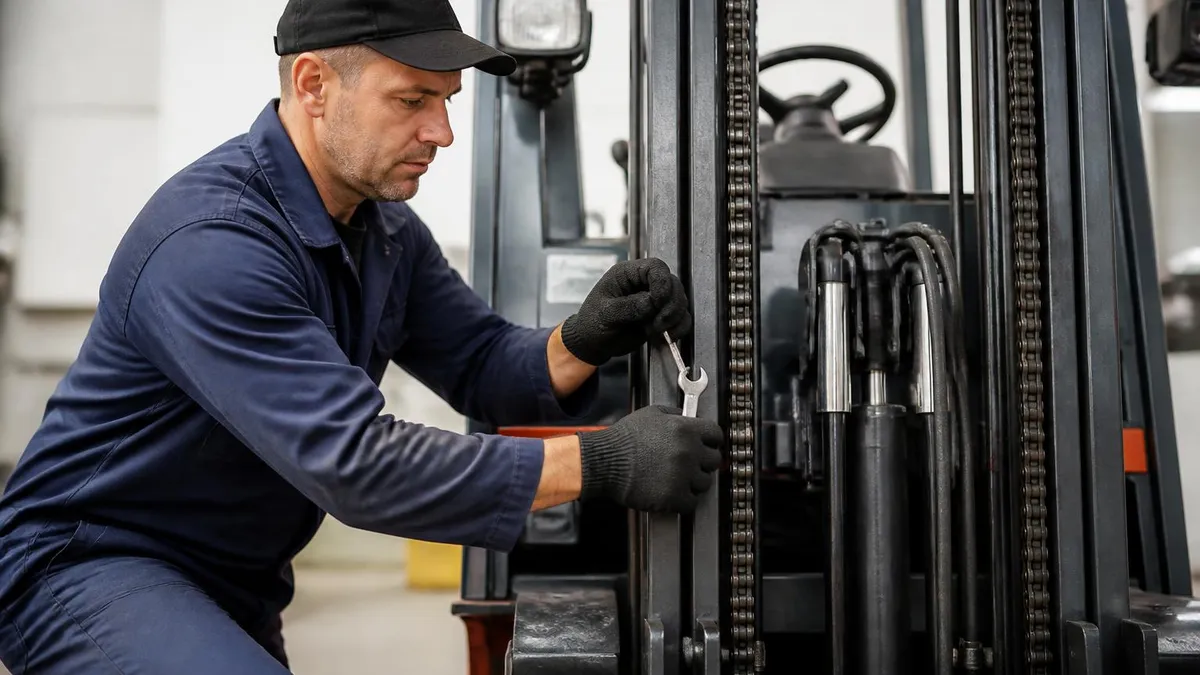
- ✓Inspect lift chains for stretch, rust, cracked plates, and adequate lubrication
- ✓Examine forks for cracks at the heel and check the wear-indicator stripe
- ✓Test load backrest extension is secure with no loose or missing bolts
- ✓Operate tilt forward and back through full range, listening for binding
- ✓Raise mast fully unloaded and watch for smooth, even cylinder extension
- ✓Check tyres for cuts, separation, embedded debris, and correct pressure
- ✓Test horn, reverse alarm, example, headlights, and seatbelt interlock
- ✓Confirm fire extinguisher charge gauge is in the green zone
- ✓Test service brake, park brake, and steering response in a clear area
- ✓Record findings in the pre-start logbook and tag out any defects found
Never operate a forklift with a defect tagged out
If your pre-start inspection identifies a fault — even a small hydraulic weep or a single cracked chain link — the forklift must be tagged out of service immediately. Australian work health and safety law makes the operator personally liable if they knowingly use defective plant. Always escalate to your supervisor and document the issue in the logbook before walking away.
Understanding the counterweight and how it interacts with the mast of forklift is what separates safe operators from those who tip loads. A forklift is essentially a lever: the load on the forks acts as resistance on one end, and the counterweight at the rear acts as the balancing force. The pivot point is the front drive axle, and as long as the moment of the counterweight exceeds the moment of the load, the rear wheels stay on the ground.
The data plate gives you a rated capacity at a standard load centre, almost always 600 mm in Australia. That means the forklift can safely lift its rated weight as long as the load's centre of gravity sits no further than 600 mm forward of the fork heel. As soon as the load centre moves forward — for example, lifting a long pallet or an oversized item — the effective capacity drops sharply. A 3,000 kg rated forklift might only safely handle 2,000 kg at an 800 mm load centre.
The mast position also affects stability. When you tilt forward, the load centre moves further from the front axle, reducing capacity. When you tilt back, the load shifts towards the truck, improving stability. Raising the mast high also shifts the centre of gravity upward, making the truck much easier to tip sideways during a turn. This is why operators are trained to travel with the forks low (about 150 mm off the ground) and the mast tilted back.
The stability triangle is a foundational concept tested heavily in TLILIC0003. Imagine three points: the two front drive wheels and the centre of the rear steer axle. These form a triangle, and as long as the combined centre of gravity of the forklift and its load stays inside that triangle, the truck remains stable. Cornering at speed, lifting on uneven ground, or carrying off-centred loads all push the centre of gravity outside the triangle.
Tyre condition feeds directly into stability. Worn, soft, or mismatched tyres lower the truck unevenly, shifting the centre of gravity. Cushion tyres used on rough outdoor ground compress unpredictably, creating sway. Pneumatic tyres at incorrect pressures behave like worn tyres. Any operator who skips tyre pressure checks during pre-start is gambling with stability every time they corner. Document tyre pressures weekly in the logbook.
The mast itself carries enormous stress. Inner and outer channels must roll smoothly together via mast rollers and side thrust rollers. Damaged rollers cause binding, which makes the mast judder during lift and amplifies any sideways force on the load. Mast cracks, particularly at weld points near the tilt cylinder mounting brackets, are catastrophic failure points and require immediate engineering inspection. Never operate a forklift with visible mast cracks.
Finally, learn to read your fork position relative to the load. Forks should always be spread to roughly two-thirds of the pallet width, fully inserted under the load until the heel touches the pallet face. A load resting only on the fork tips is profoundly unstable because the load centre is at maximum forward extension. This is one of the simplest concepts to master and yet one of the most common causes of dropped loads on Australian worksites.
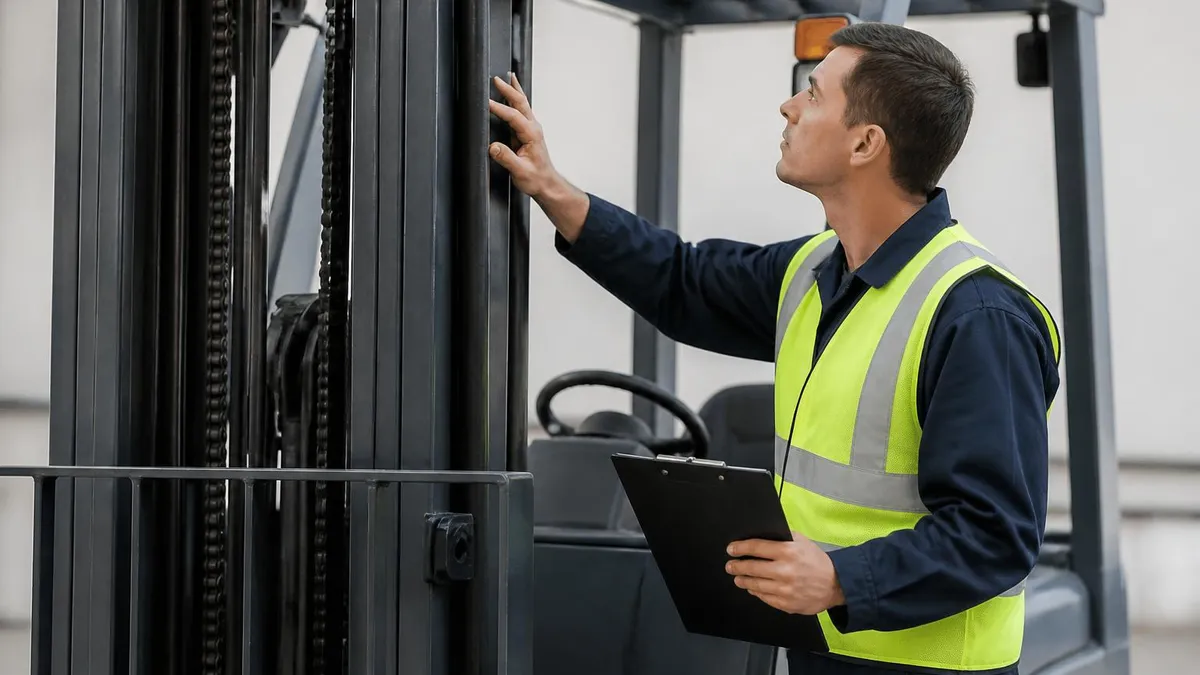
Under Australian WHS regulations and AS 2359 plant standards, any visible mast crack, structural deformation, or significant hydraulic leak requires immediate removal of the forklift from service. Do not patch, weld, or attempt repair without certified engineering sign-off. Tag out, log the defect, and contact your maintenance contractor or supervisor before anyone else attempts to use the machine.
Attachments dramatically change how the mast of forklift handles loads, and TLILIC0003 candidates are expected to know the implications. The most common attachment is a side-shifter, which lets the carriage move 100 to 200 mm left or right hydraulically, perfect for fine-tuning pallet placement in racking. Side-shifters add weight forward of the front axle, reducing rated capacity by roughly 5 to 10 per cent depending on the unit.
Fork positioners allow hydraulic adjustment of fork spread from the operator's seat, eliminating the need to dismount and slide forks manually. They are common in mixed-load operations such as breweries, building supplies, and food distribution centres. The data plate must show the rated capacity with the positioner fitted, since it cannot legally be operated using the base machine's plated capacity. The same applies to every other attachment.
Rotators spin loads 360 degrees and are used in food processing, paper milling, and waste handling. Because they extend the load centre significantly forward, rotators can cut rated capacity by 30 to 50 per cent. Drum clamps, bale clamps, push-pull units for slip sheets, and carton clamps all behave similarly. A separate compliance plate or sticker is required for every attachment configuration. See the dedicated guide on forklift rotators and attachments for full coverage of capacity recalculation.
Telescopic boom attachments, also called jibs or crane jibs, turn a forklift into a quasi-crane. They are useful for placing awkward loads through doorways or onto rooftops, but they extend the load centre by metres rather than millimetres, slashing capacity. Many Australian sites require operators using jibs to hold an additional load-shifting ticket beyond TLILIC0003, and the jib must be engineer-certified for each forklift model it attaches to.
Slip sheet attachments use a push-pull mechanism with thin metal forks and a clamp head that grips a paper or plastic slip sheet under the load. They eliminate pallets and are common in container loading, beverage, and FMCG industries. The operating technique is very different from standard fork work and requires specific induction. Despite the unique movement, the standard mast components — chains, cylinders, channels — work identically.
Whenever you fit or remove an attachment, the data plate must be updated to reflect the new configuration. This is a legal requirement, not a recommendation. Operators caught using a forklift without a current data plate face individual fines, and the PCBU (the business) faces much larger penalties under WHS legislation. A simple sticker overlay is acceptable as long as it is issued by a competent person and remains legible throughout the equipment's service life.
Capacity calculations after attachments are something every TLILIC0003 operator should be able to perform mentally. Take the base capacity, subtract the attachment's weight contribution at its load centre, then derate further if the load centre extends forward. When in doubt, ask the supplier for a calculated capacity chart specific to your machine and attachment combination — manufacturers provide these free on request and they take the guesswork out of safe lifting.
To pull this all together for your TLILIC0003 assessment, focus your study on three rhythms: visual recognition, verbal recall, and practical operation. Visual recognition means walking around a forklift and pointing to every part you have read about — the inner mast channel, the tilt cylinder mounting, the lift chain anchor, the carriage rollers. If you can borrow a few minutes around a forklift at your workplace, take photos of each part and label them on your phone for offline revision.
Verbal recall is what assessors test through their questioning. They will point at a part and ask you to name it, or describe a fault and ask what could cause it. Practise out loud, ideally with a workmate or family member quizzing you. Saying "hydraulic lift cylinder rod seal" is much harder than recognising it on a diagram, and the speed at which you respond signals genuine knowledge rather than rote memorisation.
Practical operation ties everything together. Once you know the parts, you can feel when something is wrong — a sluggish lift indicates pump or cylinder issues, a juddery mast points to roller wear, drift down with the controls released means failing cylinder seals. This intuitive sense develops only with seat time, which is why TLILIC0003 training mandates a minimum number of hours under instructor supervision before the assessment day.
Use the practice quizzes spread throughout this article in short bursts of 15 to 20 minutes rather than marathon sessions. Spaced repetition has been shown to improve retention by up to 50 per cent compared with cramming, according to learning science research applied in vocational education across Australia. Aim for two short sessions a day in the week before assessment and review every question you get wrong, not just the score.
If you are juggling shift work with study, prioritise weak areas. Most TLILIC0003 candidates find hydraulic theory and capacity calculations the hardest topics, while pre-start inspection comes naturally because it is the most physical and visual. Spend extra time on stability theory, the stability triangle, and how attachments derate capacity — these are heavily weighted in the written knowledge assessment and frequently asked verbally.
On the day of assessment, dress in correct PPE: safety boots, hi-vis vest, long sleeves, and any site-specific gear. Arrive 30 minutes early, complete your pre-start inspection slowly and verbally explain each step to the assessor. Examiners want to see safe habits and clear thinking, not speed. If you are unsure about a question, say so — they would rather hear "I would check the data plate before lifting" than watch you guess at a capacity.
Forklift operation is a long-term career skill in Australia, with operators in high demand across logistics, manufacturing, retail distribution, construction supply, ports, and agriculture. Mastering parts knowledge during your TLILIC0003 study sets you up not just for the test, but for promotion conversations, mechanical literacy, and a safer working life. Bookmark this guide, work through the quizzes systematically, and treat every shift as a chance to deepen your familiarity with the machine.
Sample Forklift Licence Practice Questions
Try these questions from our free Forklift Licence practice tests. The correct answer and an explanation follow each question.
What penalties apply for non-compliance with Operating Techniques regulations in Australia?
- A. No penalties
- B. Significant fines (up to millions of AUD for corporations) and potential imprisonment for serious offences
- C. A verbal warning only
- D. A small administrative fee
Answer: B. Significant fines (up to millions of AUD for corporations) and potential imprisonment for serious offences
Australian WHS penalties are severe, with Category 1 offences carrying fines up to AUD 3 million and potential imprisonment.
A forklift has a rated capacity of 2,000 kg at a 500 mm load centre. If the load centre increases to 750 mm, what happens to the safe carrying capacity?
- A. It increases proportionally
- B. It remains the same
- C. It decreases
- D. It doubles
Answer: C. It decreases
As the load centre increases beyond the rated distance, the safe carrying capacity decreases due to the increased moment (torque) acting on the forklift.
What does 'stacking height' mean in relation to forklift operations?
- A. The maximum height the forklift mast can extend
- B. The safe maximum height to which loads may be stacked in racking or freestanding
- C. The height at which the forklift's load backrest must be positioned
- D. The height restriction in the building where the forklift operates
Answer: B. The safe maximum height to which loads may be stacked in racking or freestanding
Stacking height refers to the safe maximum height to which loads may be stacked, determined by load weight, stability, racking ratings, and site-specific rules.
What is the role of PPE in managing Forklift Pre-Operational Checks risks?
- A. PPE is the primary control
- B. PPE is the last line of defence, used only when higher-level controls are not reasonably practicable
- C. PPE eliminates all risks
- D. PPE is not relevant
Answer: B. PPE is the last line of defence, used only when higher-level controls are not reasonably practicable
PPE is the least effective control in the hierarchy and should only be relied upon when other controls cannot adequately reduce the risk.
TLILIC0003 Questions and Answers
Free Forklift Practice Test 2026 - Forklift Exam Questions
Forklift Licence Australia: How to Get Certified (TLILIC0003)
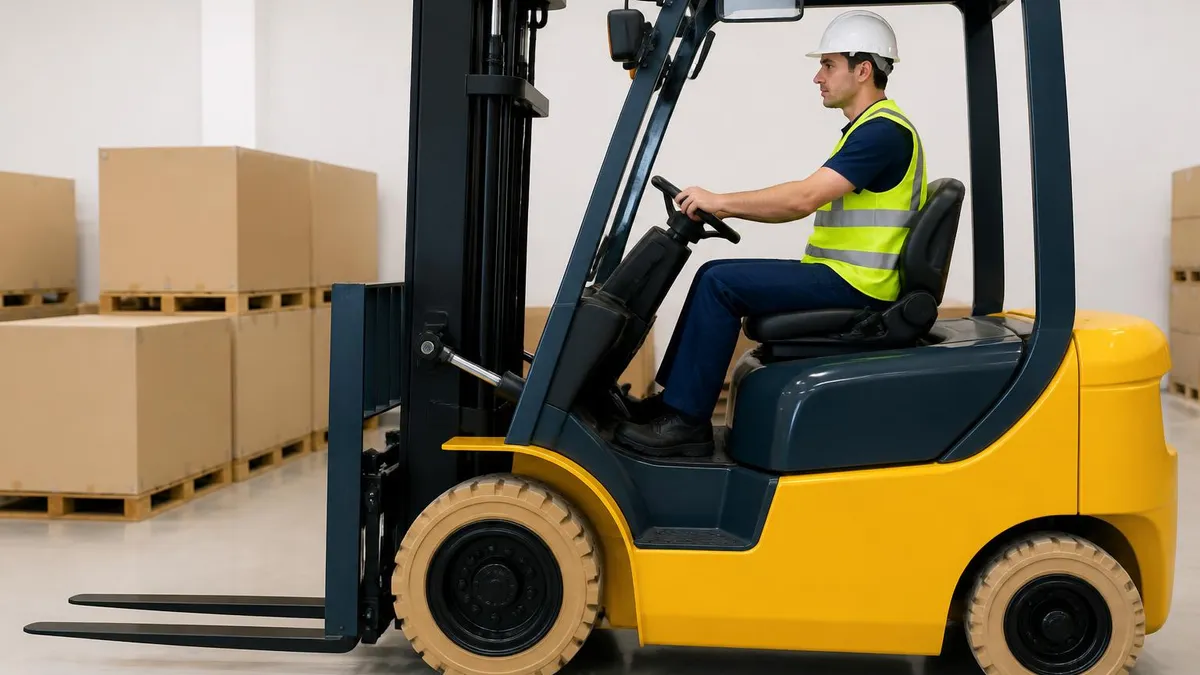
Forklift Rotators and Attachments: Complete TLILIC0003 Guide for Australian Operators

Forklift Licence Australia Practice Test PDF (Free Printable 2026)
Forklift Jobs in Australia 2026: Salary, Career Paths & How to Get Hired
About the Author

Certified Crane Operator & Skilled Trades Exam Specialist
Ferris State UniversityRobert Martinez is a Journeyman Ironworker, NCCCO-certified crane operator, and forklift trainer with a Bachelor of Science in Construction Technology from Ferris State University. He has 21 years of ironworking, rigging, and heavy equipment operation experience across high-rise and industrial construction sites. Robert prepares candidates for crane operator, rigger, forklift, and skilled trades certification examinations.