
Electric 3 Wheel Forklift: Complete Guide to Electric Forklift Types for TLILIC0003 Operators in Australia
Electric 3 wheel forklift guide for TLILIC0003 operators. ✍🏼 Compare counterbalance, reach trucks, pallet movers, battery types and Australian safety rules.
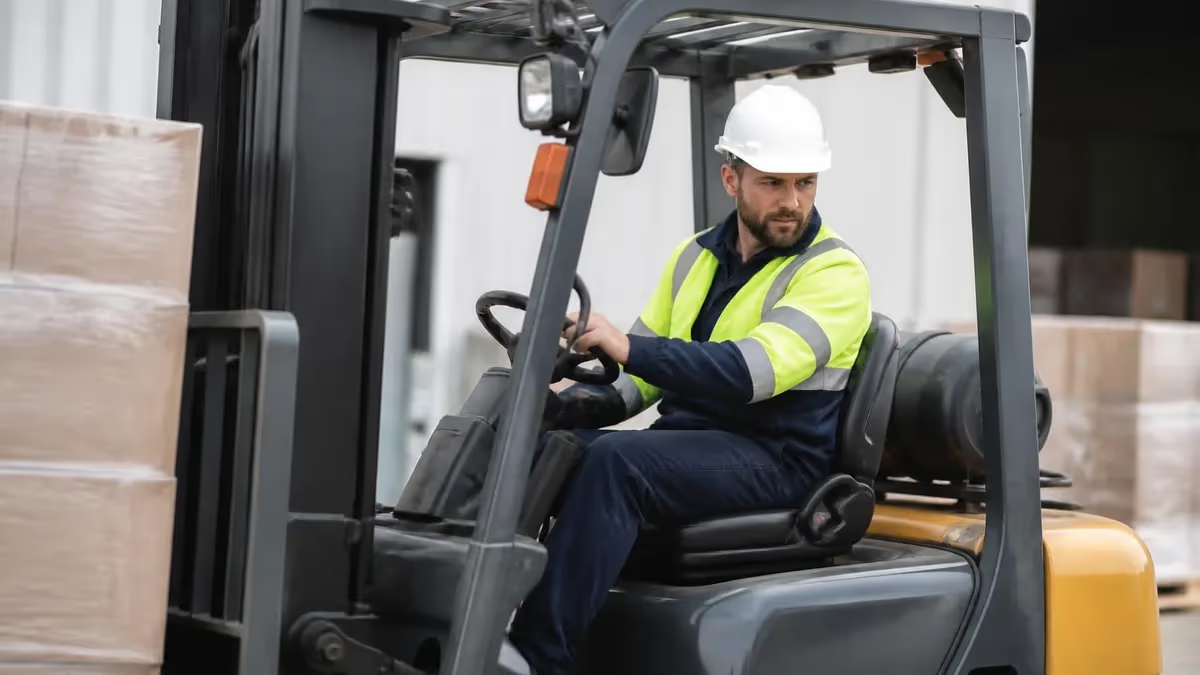
The electric 3 wheel forklift has become one of the most popular materials handling machines on Australian warehouse floors, and for TLILIC0003 candidates it represents a critical knowledge area. These compact, battery-powered trucks offer tight turning circles, zero exhaust emissions, and quieter operation than internal combustion alternatives. Operators preparing for assessment must understand how three-wheel electric units differ from four-wheel counterbalanced machines, reach trucks, order pickers, and pallet movers because every electric forklift type carries unique stability characteristics, load capacities, and operational hazards.
In 2026, the Australian Bureau of Statistics estimates that electric forklifts now account for more than 62% of all new powered industrial truck sales nationwide, driven by net-zero targets, indoor air-quality regulations, and falling lithium-ion battery prices. For TLILIC0003 trainees, this market shift means that the practical assessment will almost certainly involve an electric truck rather than an LPG or diesel unit. Understanding the entire family of electric forklift types is therefore no longer optional — it is essential exam content and a workplace expectation.
This guide walks through every common electric forklift category found in Australian distribution centres, cold stores, manufacturing plants, and retail backrooms. We cover three-wheel and four-wheel counterbalanced trucks, stand-up riders, reach trucks, walkie-stackers, very narrow aisle (VNA) trucks, order pickers, and tow tractors. For each type we explain the design logic, the typical load capacity, the stability triangle implications, and the specific TLILIC0003 performance criteria that examiners watch for during practical assessment.
We also unpack the engineering behind electric power systems, including lead-acid versus lithium-iron-phosphate (LFP) battery chemistry, opportunity charging, battery rooms, equalisation cycles, and the WHS hazards associated with hydrogen off-gassing. Operators who can articulate these differences during a verbal questioning component of the TLILIC0003 assessment routinely score higher than candidates who only memorise machine names. Understanding the why behind each design is what separates competent operators from licence holders who simply pass.
Australian work health and safety regulators — including SafeWork NSW, WorkSafe Victoria, and Workplace Health and Safety Queensland — have published model codes of practice covering powered mobile plant. These documents directly inform the TLILIC0003 unit of competency and reference the AS 2359 standard for powered industrial trucks. Throughout this article we cite specific clauses that examiners frequently quote during questioning, so you can connect machine knowledge to the regulatory framework that underpins your high-risk work licence.
For a deeper companion read on the structural components found across these machines, the mast of forklift guide breaks down the lift, tilt, and free-lift mechanisms that operate identically across most electric truck types. Combining that mechanical knowledge with the type-by-type comparisons in this guide gives you a complete picture of what to expect in your assessment.
Whether you are sitting your TLILIC0003 in Sydney, Melbourne, Brisbane, Perth, Adelaide, or a regional centre, the electric forklift types you encounter will follow the same nationally recognised competency standard. Use this article as your single-source reference, then drill the practice quizzes linked throughout to lock in the terminology, the safety rules, and the operational checklists that examiners use as their assessment rubric.
Free Forklift Licence Study Tools
Interactive Forklift Licence resources on PracticeTestGeeks, free to start:
- Forklift Licence practice test — 300+ questions with instant scoring and answer explanations
- Forklift Licence flashcards — review key terms and concepts card by card
- Forklift Licence study guide — topic-by-topic overview of what the exam covers
- Forklift Licence cheat sheet — one-page printable summary for last-minute review
Electric Forklift Types by the Numbers
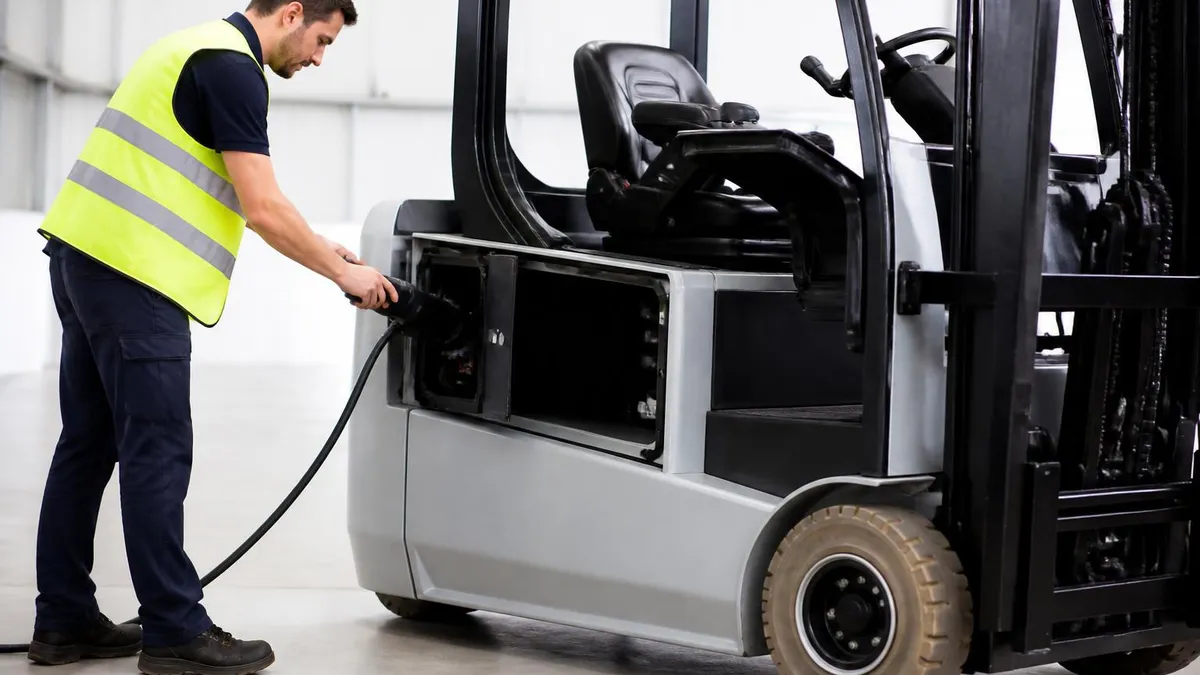
Main Electric Forklift Categories You Must Know
Compact electric truck with two front drive wheels and a single rear steering wheel. Excellent for narrow aisles, retail backrooms, and tight loading docks where manoeuvrability matters more than top capacity.
Standard configuration with four wheels providing greater lateral stability. Used for higher load capacities (2.5-5 tonnes), outdoor work on sealed surfaces, and operations requiring sustained travel speeds with heavier pallets.
Stand-up electric truck with a pantograph or moving mast that reaches into racking. Designed for narrow-aisle warehouses with lift heights commonly between 8 and 12 metres in Australian distribution centres.
Pedestrian-operated electric truck with a tiller arm. Used for short horizontal moves and low-level stacking. Some models still require a TLILIC0003 licence when lift height exceeds 900 mm under AS 2359.
Operator-up truck where the platform rises with the forks. Common in apparel, e-commerce and pharmaceutical pick faces. Requires a fall-arrest use and specific TLILIC0003 endorsement awareness.
Choosing between a three-wheel and four-wheel electric counterbalanced forklift is one of the most common operational decisions made in Australian warehouses, and TLILIC0003 examiners routinely ask candidates to explain the trade-offs. The three-wheel electric forklift uses two powered front wheels and a single rear wheel — sometimes a dual-tyre rear — that pivots through nearly 180 degrees. This geometry creates an exceptionally tight turning radius, typically between 1.7 and 2.0 metres, allowing the truck to spin almost within its own length and making it ideal for narrow-aisle retail and light manufacturing environments.
The four-wheel electric counterbalanced truck, by contrast, sacrifices manoeuvrability for stability and capacity. With four wheels forming a rectangular footprint, the stability triangle is wider at the rear, allowing the truck to handle heavier loads — often up to 5 tonnes — and to operate more confidently on slightly uneven outdoor surfaces. The trade-off is a turning radius of 2.2 to 2.8 metres, which can be prohibitive in narrow aisles. TLILIC0003 candidates should understand that the choice is fundamentally about matching the truck to the aisle width and load profile of the work site.
Stability characteristics differ in subtle but examinable ways. Three-wheel trucks pivot around a longitudinal axis that passes from the centre of the rear wheel through the midpoint between the front wheels. This narrower rear support means lateral tipping risk increases when turning at speed with a raised load. Four-wheel trucks have a wider rear support, but operators sometimes develop overconfidence and corner faster than the load chart permits. Both designs share the same fundamental stability triangle taught in TLILIC0003 — the difference is how quickly the resultant force vector moves toward the edge during dynamic operations.
Capacity ratings are another area where examiners probe candidate knowledge. A three-wheel electric forklift in the 1.5-2.5 tonne range will display a load capacity chart on the dash or near the operator station, and that chart de-rates capacity as load centre distance increases. A 2.0 tonne truck rated at 500 mm load centre may only safely handle 1.4 tonnes at 700 mm load centre. The same principle applies to four-wheel trucks but with different absolute numbers. Operators must always read the chart specific to the truck they are operating.
Indoor air quality is a major reason Australian businesses transition to electric. Diesel and LPG forklifts emit carbon monoxide, nitrogen oxides, and particulate matter that accumulate inside enclosed warehouses. SafeWork Australia exposure standards limit airborne contaminants, and electric trucks eliminate the engineering controls — extraction fans, scrubbers, monitoring — that combustion-powered fleets require. For cold storage, food processing, and pharmaceutical sites, electric is effectively mandatory under hygiene and HACCP frameworks.
Operator comfort and ergonomics have improved dramatically in the 2024-2026 model years. Modern three-wheel electric trucks now feature full suspension seats, climate-controlled cabins on premium models, integrated tablets with telemetry, and AC traction motors that deliver smooth acceleration without the jerky response of older DC systems. For deeper coverage of the chassis and structural components shared across these designs, see the multi directional forklift trucks reference, which explains how chassis layout affects load handling across the entire electric truck family.
Maintenance differences are also significant. Three-wheel electric trucks have fewer hydraulic and powertrain components than diesel equivalents, no engine oil changes, no fuel filters, no exhaust systems, and longer service intervals. Lithium-iron-phosphate (LFP) battery packs increasingly replace lead-acid units, eliminating the watering, equalising, and ventilated battery room requirements. TLILIC0003 candidates should be able to articulate at least three operational differences between three-wheel electric, four-wheel electric, and LPG counterbalanced trucks during verbal questioning.
TLILIC0003 Practice Test Questions
Prepare for the Forklift Licence Australia - TLILIC0003 exam with our free practice test modules. Each quiz covers key topics to help you pass on your first try.
TLILIC0003 Forklift Licence Australia Atta...
TLILIC0003 Exam Questions covering Forklift Licence Australia Attachments and Modifications. Master TLILIC0003 Test concepts for certification prep.
TLILIC0003 Forklift Licence Australia Batt...
Free TLILIC0003 Practice Test featuring Forklift Licence Australia Battery and Fuel Safety. Improve your TLILIC0003 Exam score with mock test prep.
TLILIC0003 Forklift Licence Australia Emer...
TLILIC0003 Mock Exam on Forklift Licence Australia Emergency Procedures. TLILIC0003 Study Guide questions to pass on your first try.
TLILIC0003 Forklift Licence Australia Fork...
TLILIC0003 Test Prep for Forklift Licence Australia Forklift Pre-Operational Checks. Practice TLILIC0003 Quiz questions and boost your score.
TLILIC0003 Forklift Licence Australia Haza...
TLILIC0003 Questions and Answers on Forklift Licence Australia Hazard Identification. Free TLILIC0003 practice for exam readiness.
TLILIC0003 Forklift Licence Australia Load...
TLILIC0003 Mock Test covering Forklift Licence Australia Load Centre Calculations. Online TLILIC0003 Test practice with instant feedback.
TLILIC0003 Forklift Licence Australia Load...
Free TLILIC0003 Quiz on Forklift Licence Australia Load Handling and Capacity. TLILIC0003 Exam prep questions with detailed explanations.
TLILIC0003 Forklift Licence Australia Oper...
TLILIC0003 Practice Questions for Forklift Licence Australia Operating in Different Environments. Build confidence for your TLILIC0003 certification exam.
TLILIC0003 Forklift Licence Australia Oper...
TLILIC0003 Test Online for Forklift Licence Australia Operating Techniques. Free practice with instant results and feedback.
TLILIC0003 Forklift Licence Australia Pede...
TLILIC0003 Study Material on Forklift Licence Australia Pedestrian Safety. Prepare effectively with real exam-style questions.
Electric Forklift Battery Types and Power Systems
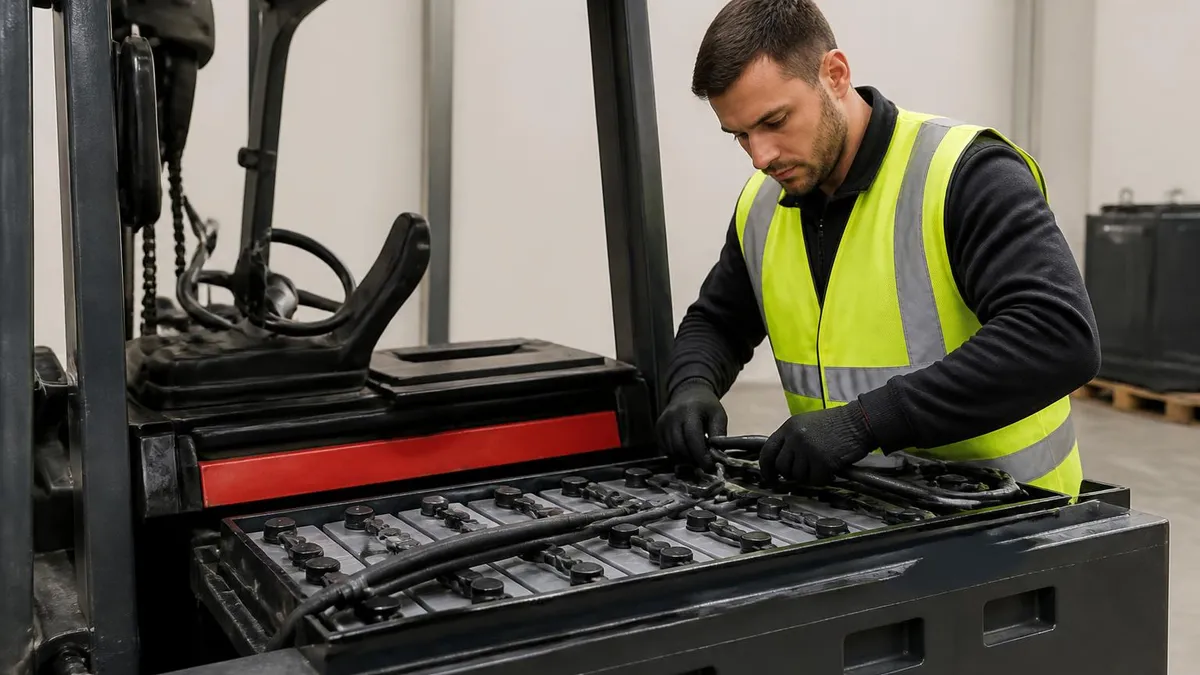
Flooded lead-acid batteries have powered Australian electric forklifts for over five decades and still dominate the rental fleet. A typical 48-volt lead-acid pack weighs between 900 and 1,400 kilograms and provides one full shift of work before requiring an 8-hour charge plus an 8-hour cool-down cycle. The battery doubles as ballast, contributing to the truck's stability triangle.
Operators must understand watering schedules, specific gravity testing with a hydrometer, equalisation charging, and the hydrogen off-gassing hazard that requires a ventilated battery room compliant with AS 2676. TLILIC0003 candidates often face questions about acid spill response — neutralise with sodium bicarbonate, never water alone — and personal protective equipment requirements during battery changes.
Electric 3 Wheel Forklift vs Four Wheel — Which Should You Choose?
- +Tighter turning radius — ideal for narrow aisles under 3.2 metres
- +Lower kerb weight makes them easier on mezzanine and suspended floors
- +Excellent manoeuvrability in retail backrooms and tight loading docks
- +Lower purchase price than equivalent four-wheel models
- +Reduced tyre wear due to centred steering geometry
- +Generally quieter operation in mixed-use indoor environments
- +Smaller battery compartments mean shorter charge times on some models
- −Lower maximum capacity — typically capped around 2.5 tonnes
- −Reduced lateral stability during fast cornering with raised loads
- −Not ideal for sustained outdoor work on uneven surfaces
- −Single rear wheel wears faster than dual-wheel rear configurations
- −Less suited to high-throughput cross-dock operations
- −Side shift attachments can shift centre of gravity outside the stability triangle more easily
- −Limited towing capacity compared to four-wheel counterbalanced trucks
Pros and Cons at a Glance
| Pros | Cons |
|---|---|
| Lower kerb weight makes them easier on mezzanine and suspended floors | Reduced lateral stability during fast cornering with raised loads |
| Excellent manoeuvrability in retail backrooms and tight loading docks | Not ideal for sustained outdoor work on uneven surfaces |
| Lower purchase price than equivalent four-wheel models | Single rear wheel wears faster than dual-wheel rear configurations |
| Reduced tyre wear due to centred steering geometry | Less suited to high-throughput cross-dock operations |
| Generally quieter operation in mixed-use indoor environments | Side shift attachments can shift centre of gravity outside the stability triangle more easily |
| Smaller battery compartments mean shorter charge times on some models | Limited towing capacity compared to four-wheel counterbalanced trucks |
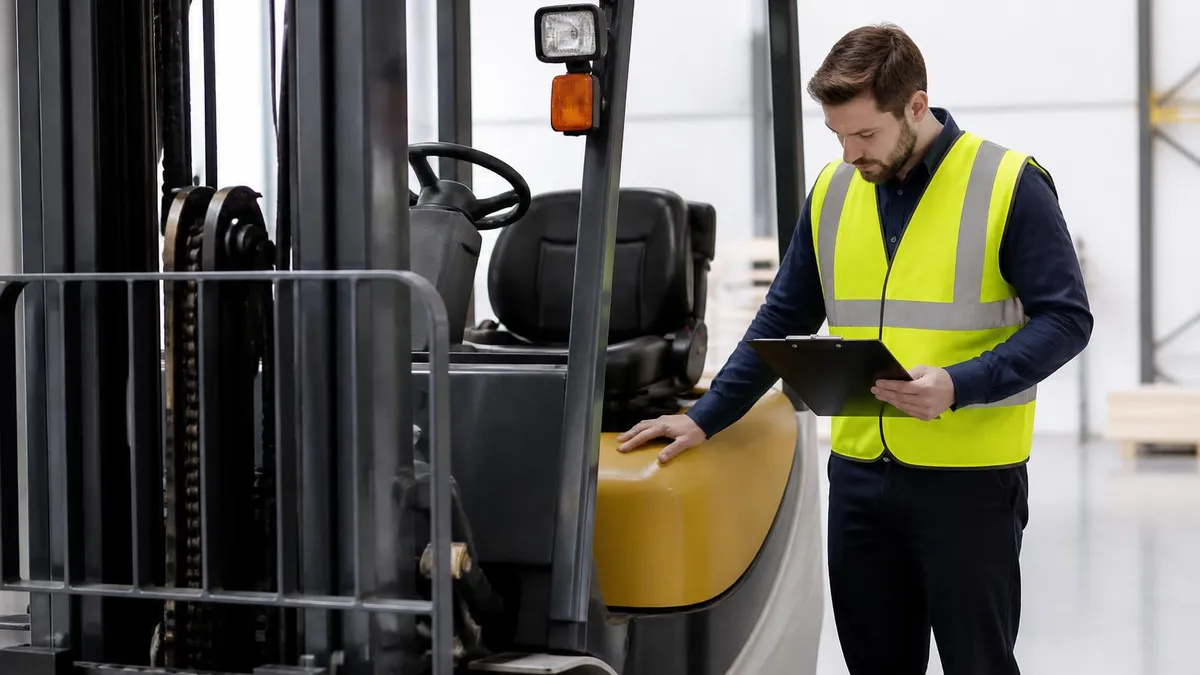
Electric Forklift Pre-Start Inspection Checklist
- ✓Confirm battery state of charge is above 20% and BMS shows no fault codes
- ✓Inspect battery connector, cable insulation and terminal posts for damage or corrosion
- ✓Check lead-acid electrolyte levels and top up with distilled water if required
- ✓Verify horn, reverse alarm, example and headlights are operational
- ✓Test service brake, park brake and seat-presence switch from a stationary position
- ✓Inspect forks for cracks, heel wear exceeding 10% and positive locking pins
- ✓Operate mast through full lift, lower and tilt range — listen for hydraulic noises
- ✓Check tyres for cuts, chunking, exposed cords and adequate tread on cushion or pneumatic types
- ✓Confirm load chart and compliance plate are legible and match the attachment fitted
- ✓Verify steering responds smoothly with no slack and the data plate is current
- ✓Ensure overhead guard, load backrest and seatbelt are intact and undamaged
- ✓Record findings on the pre-start log book and report defects before operating
Electric does not mean exempt — TLILIC0003 still applies
Many candidates assume that smaller electric trucks fall outside the high-risk work licence framework. Under AS 2359 and the model WHS regulations, any powered industrial truck with a lifting capacity over 0.9 metres requires a TLILIC0003 licence — including three-wheel electric units and ride-on walkie-stackers. The propulsion source does not change the licensing requirement; only lift height and operator position do.
Reach trucks, very narrow aisle (VNA) machines, and order pickers represent the specialised end of the electric forklift family, and Australian distribution centres rely on them heavily. A reach truck is a stand-up electric truck with a pantograph mechanism or a moving mast that extends the forks forward into pallet racking without the entire chassis having to enter the aisle. This design allows operations in aisles as narrow as 2.7 metres while still lifting pallets to heights of 8, 10, or even 12 metres in newer Australian DCs.
VNA trucks take aisle narrowness to the extreme. Wire-guided or rail-guided through aisles as tight as 1.6 metres, these trucks lift the operator cab and the load together to picking heights above 13 metres. VNA operation requires additional endorsement awareness under TLILIC0003 because the dynamic stability profile is fundamentally different from a counterbalanced truck — the load and operator share the same lifting platform, meaning fall-arrest uses and rigorous pre-start inspections become critical.
Order pickers occupy a middle ground. Common in e-commerce fulfilment, apparel distribution, and pharmaceutical picking, these trucks lift the operator on a platform alongside the forks. Heights commonly range from 3 to 10 metres. Operators must wear a fall-arrest use clipped to the designated anchor point at all times when the platform is raised — a frequently examined TLILIC0003 safety control. The truck typically uses a tiller-style steering arm and runs at lower speeds than counterbalanced trucks.
Walkie-stackers and pedestrian pallet movers are the entry-level members of the electric family. A pure pallet mover only translates loads horizontally and may not require a high-risk licence under AS 2359 if its lift height is below 900 mm. A walkie-stacker, however, can lift pallets to 4 or 5 metres and absolutely requires TLILIC0003. The tiller-arm safety reversing button is a key examined feature — it cuts power if the operator is pinned between the truck and a wall during reverse operation.
Tow tractors and tug trains, sometimes called burden carriers, are also electric powered industrial trucks but generally fall outside TLILIC0003 scope because they do not lift loads. They tow trolleys carrying parts in just-in-time manufacturing or kitting trolleys in airline catering. Knowing where TLILIC0003 scope ends — at the absence of a load-lifting function — is useful exam knowledge that examiners occasionally probe.
Side-loaders and multi-directional forklifts are specialised electric trucks designed for long loads such as timber, steel beams, and extruded aluminium. They can travel sideways through narrow aisles, eliminating the need to turn into a pick face. While less common than counterbalanced trucks, they appear in timber yards, steel merchants, and joinery workshops across Australia. The forklift clearance height reference covers the dimensional specifications that determine whether a multi-directional truck fits a given facility.
Articulated narrow-aisle trucks — sometimes branded Bendi or Flexi — combine four-wheel counterbalanced stability with a hinged mast that articulates up to 220 degrees. They can place pallets in racking from within a 1.8-metre aisle, doubling the storage density of a conventional warehouse. Australian property economics increasingly favour this footprint, so TLILIC0003 graduates entering 2026 distribution work should at least recognise the design even if they do not operate one immediately.
Lithium-iron-phosphate batteries must never be charged in the same room as flooded lead-acid units without proper segregation. Hydrogen off-gassing from lead-acid charging creates an explosion hazard if it accumulates near a thermal event in an LFP pack. SafeWork Australia and AS 2676 require ventilated, signposted, and chemically appropriate battery rooms — confirm your site's controls before any charging activity.
The stability triangle is the single most examined concept across every electric forklift type, and TLILIC0003 candidates must be able to draw it, describe it, and apply it to dynamic operation. On a four-wheel counterbalanced electric truck, the triangle is formed by the two front wheels and the centre point between the two rear steering wheels. On a three-wheel electric truck, the triangle is formed by the two front wheels and the single rear wheel directly. The combined centre of gravity of truck plus load must remain inside this triangle at all times.
When the truck is empty, the centre of gravity sits roughly under the operator station — well inside the triangle. When a load is picked up, the combined centre of gravity moves forward toward the front axle. As the load is raised, the centre of gravity also rises, making lateral tipping more sensitive to cornering speed. As the mast is tilted forward with a raised load, the centre of gravity can move outside the triangle entirely, causing a forward tip — one of the most common electric forklift fatality scenarios in Australia.
Load capacity de-rating is the practical application of stability theory. Every electric forklift has a data plate showing rated capacity at a nominated load centre — usually 500 or 600 mm for Australian trucks. When the load centre extends — for example because the pallet is unusually long or because an attachment moves the load forward — the rated capacity decreases. TLILIC0003 examiners often present a load chart and ask candidates to calculate the safe maximum mass for a specific load centre. Practice reading these charts before assessment.
Attachments fundamentally change the stability profile. A fork positioner, slip-sheet attachment, drum clamp, paper roll clamp, or rotator each adds weight to the carriage and moves the load centre forward. The truck's compliance plate must be re-rated by the manufacturer or a competent engineer when a non-standard attachment is fitted, and the new capacity plate must be visible to the operator. Operating an electric forklift with an unrated attachment is an immediate fail in any TLILIC0003 practical assessment.
Surface conditions matter even for indoor electric trucks. A wet warehouse floor, a transition strip between epoxy and concrete, a small loading dock plate, or a grain of stray product on the floor can each cause sudden traction loss. Electric trucks accelerate more aggressively than LPG units because of instant torque delivery, so wheel-spin and lateral skidding happen faster. Australian model codes of practice for powered mobile plant emphasise that operators must adjust speed to surface conditions — failing to do so is a common contributor to recorded forklift incidents.
Pedestrian segregation is the other dominant safety control. Painted walkways, physical bollards, swing gates, audible warning beacons, blue spotlights projected onto the floor in front of the truck, and proximity detection radar are all engineering controls that Australian sites layer together. TLILIC0003 candidates should be able to identify at least four hierarchical pedestrian controls during verbal questioning. The hierarchy of controls — elimination, substitution, engineering, administrative, PPE — must be quoted in correct order.
Speed limits inside Australian warehouses are typically 6 km/h in operating areas and 10 km/h in main aisles, although the figure varies by site. The general legal duty is to operate at a speed safe for the conditions, regardless of any signed limit. Many modern electric trucks ship with software-limited speed in defined zones using floor-mounted RFID beacons. Knowing how these zone controls work, and how to escalate a fault that disables them, is increasingly examined as Australian fleets digitise.
Preparing for the TLILIC0003 practical assessment on an electric forklift demands more than memorising machine names — it requires deliberate practice on the exact truck type the registered training organisation (RTO) will use. Before booking your assessment, confirm with the RTO whether the practical will be conducted on a three-wheel or four-wheel electric, and ask about the lift height, load weight, and attachment configuration. Familiarity with the specific machine reduces nerves on the day and is the single biggest predictor of first-attempt pass rates across Australian RTOs.
Spend at least two practice sessions on the actual truck type before assessment. Use the time to drill mast operations — lift, lower, tilt forward, tilt back, side shift — until you can perform each smoothly without looking at the levers. Practise approaching pallets from straight-on, picking up at maximum tilt back, raising clear of stack, reversing in a controlled arc, and traversing while maintaining the prescribed travel mast height of approximately 100 to 150 mm above the floor for indoor work.
Verbal questioning makes up roughly 30% of TLILIC0003 assessment outcomes. Examiners will ask you to identify the stability triangle, explain the data plate, describe pre-start checks, identify the hazards specific to electric trucks (battery acid, hydrogen off-gassing, BMS faults), and walk through the steps you would take if you encountered an emergency. Rehearse your answers aloud — many candidates know the content but stumble under pressure. Practise with a study partner using flash cards or the practice quizzes linked throughout this guide.
On assessment day, dress for the work: high-visibility vest, steel-capped boots, long trousers, and any site-specific PPE the RTO requires. Bring photo ID, your USI (Unique Student Identifier), and any training records the RTO has requested. Arrive 30 minutes early so you can complete a walk-around of the assessment truck without time pressure. Examiners notice candidates who treat the pre-start inspection as a tick-box exercise versus those who genuinely interrogate the machine — and they grade accordingly.
Common reasons for assessment failure on electric forklifts include: failing to apply the park brake when stationary, travelling with raised forks, exceeding the safe travel speed in pedestrian zones, failing to sound the horn at blind corners, failing to lower forks fully before exiting the truck, not securing the operator seatbelt, and incorrect load chart interpretation. None of these are difficult to fix — they fail through complacency rather than ignorance. Build a deliberate habit pattern before assessment.
After passing your TLILIC0003 you will receive a Notice of Assessment from the RTO, then your licence card from the relevant state regulator within 60 days. The licence is nationally recognised and valid for five years before renewal. Many operators choose to add other high-risk work licences on top — TLILIC0008 for slewing mobile cranes, TLILIC0014 for non-slewing cranes, or TLILIC0024 for working at heights. Each additional ticket increases your employability and salary potential in Australian materials handling careers.
If you are still researching providers, the free forklift practice test 2026 resource consolidates current exam questions across all categories. Combine that with the structured quizzes throughout this guide and you have a complete preparation pathway from awareness through to assessment-day readiness. Consistent practice over two to four weeks delivers far better outcomes than cramming the night before, and electric forklift operation rewards the operator who treats every shift as a chance to refine technique.
Sample Forklift Licence Practice Questions
Try these questions from our free Forklift Licence practice tests. The correct answer and an explanation follow each question.
Under WHS legislation, who is responsible for ensuring forklift operators hold a valid High Risk Work (HRW) licence?
- A. The forklift operator only
- B. The person conducting the business or undertaking (PCBU)
- C. The state transport authority
- D. The equipment hire company only
Answer: B. The person conducting the business or undertaking (PCBU)
The PCBU has the primary duty to ensure that only workers holding a valid HRW licence for the class of forklift operate the equipment at their workplace.
What supervisory requirements exist for Forklift Pre-Operational Checks activities?
- A. No supervision needed
- B. Adequate supervision by competent persons, proportionate to the level of risk
- C. Supervision is optional
- D. Only new workers need supervision
Answer: B. Adequate supervision by competent persons, proportionate to the level of risk
The level of supervision must be proportionate to the risk level, with competent supervisors overseeing the work.
What is the significance of Australian Standards for Forklift Pre-Operational Checks?
- A. They are advisory only
- B. Many are referenced in legislation making compliance legally required, and they set minimum technical requirements
- C. They are outdated
- D. They only apply to imported products
Answer: B. Many are referenced in legislation making compliance legally required, and they set minimum technical requirements
Australian Standards referenced in WHS Regulations become legal requirements and set the minimum technical benchmarks for compliance.
What penalties apply for non-compliance with Pedestrian Safety regulations in Australia?
- A. No penalties
- B. Significant fines (up to millions of AUD for corporations) and potential imprisonment for serious offences
- C. A verbal warning only
- D. A small administrative fee
Answer: B. Significant fines (up to millions of AUD for corporations) and potential imprisonment for serious offences
Australian WHS penalties are severe, with Category 1 offences carrying fines up to AUD 3 million and potential imprisonment.
TLILIC0003 Questions and Answers
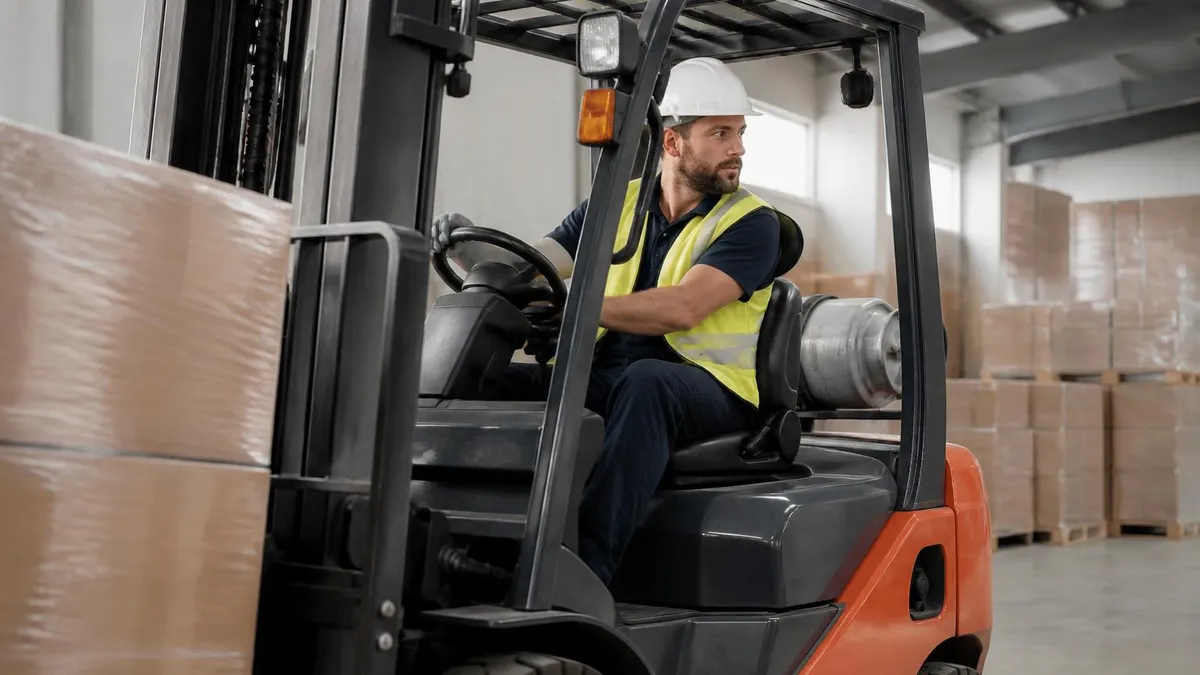
Mast of Forklift: Complete Guide to Forklift Parts for TLILIC0003 Operators in Australia
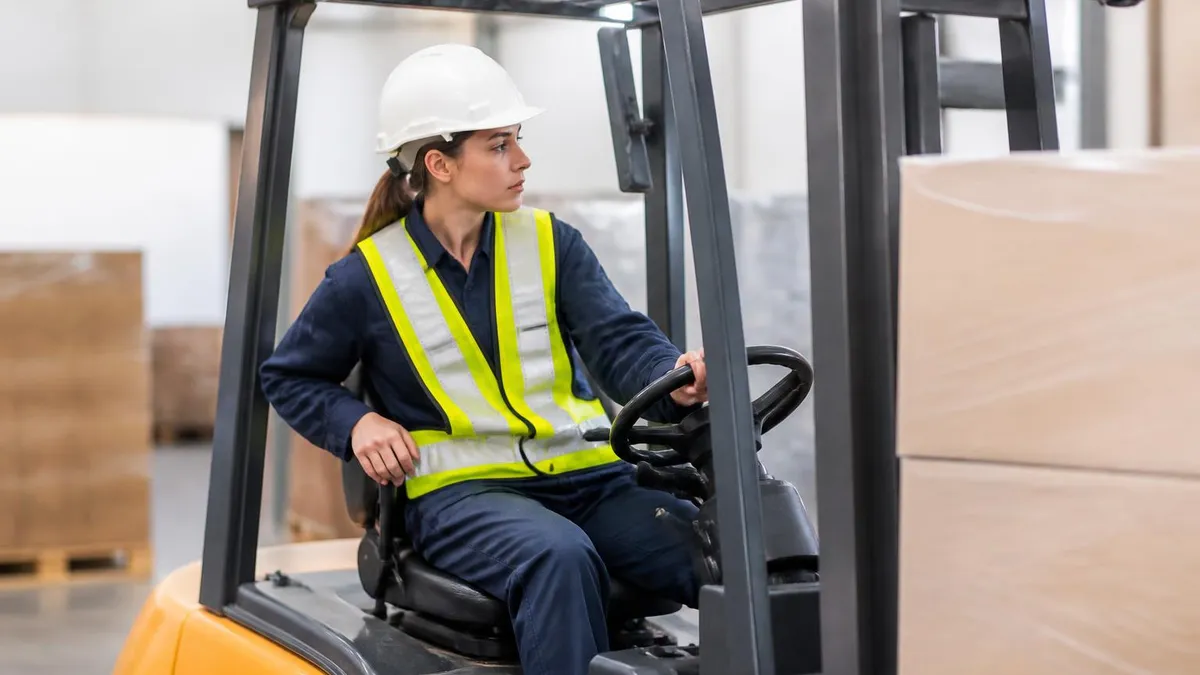
Multi Directional Forklift Trucks: Complete Guide to Forklift Types and Parts for TLILIC0003 Operators in Australia
Free Forklift Practice Test 2026 - Forklift Exam Questions
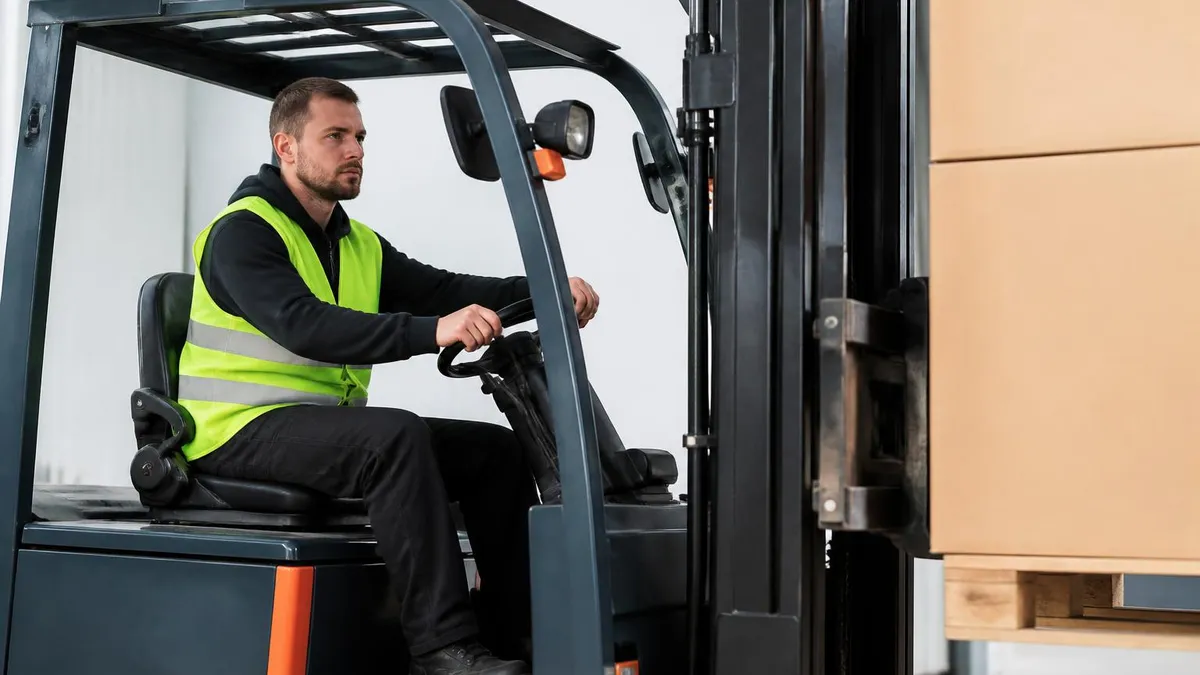
Forklift Clearance Height: Complete Guide to Forklift Specifications for TLILIC0003 Operators in Australia
Forklift Licence Near Me: How to Find Local TLILIC0003 Training Providers in Australia
About the Author

Certified Crane Operator & Skilled Trades Exam Specialist
Ferris State UniversityRobert Martinez is a Journeyman Ironworker, NCCCO-certified crane operator, and forklift trainer with a Bachelor of Science in Construction Technology from Ferris State University. He has 21 years of ironworking, rigging, and heavy equipment operation experience across high-rise and industrial construction sites. Robert prepares candidates for crane operator, rigger, forklift, and skilled trades certification examinations.