
TLILIC0003 Forklift Maintenance: Pre-Shift Checks & Service Guide (2026 October)
Forklift maintenance for TLILIC0003 operators: AS 2359 pre-shift inspection, log book duties, defect reporting and service schedules in Australia. ✏️
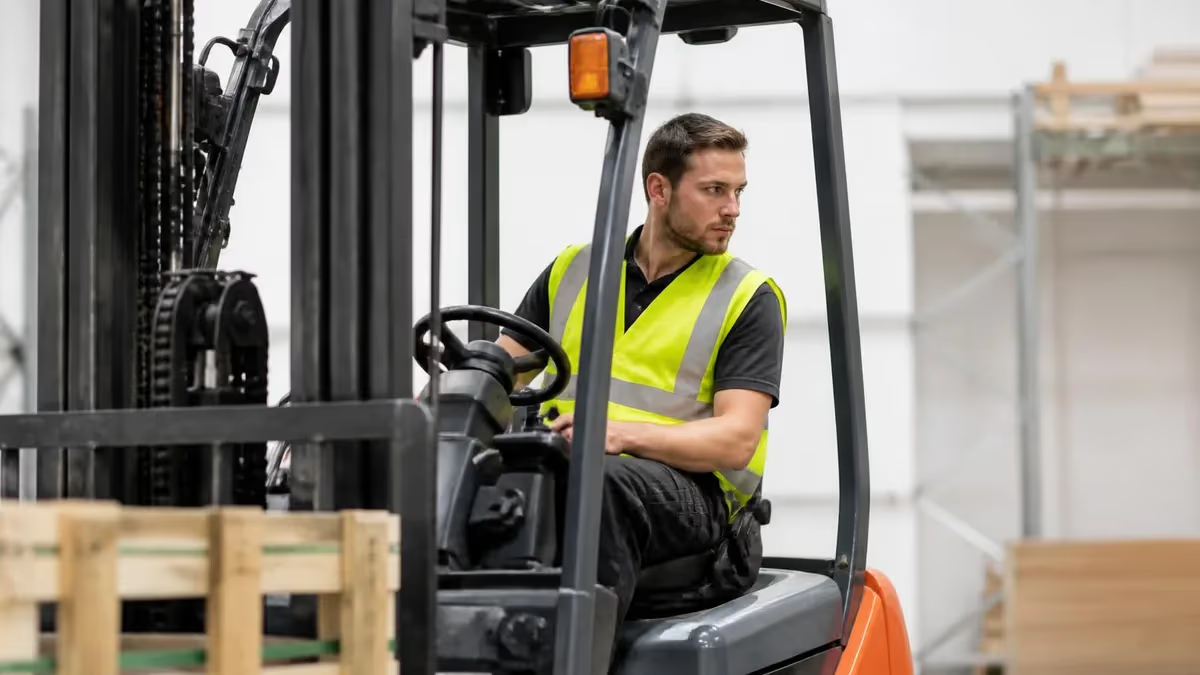
Forklift maintenance isn't paperwork for the sake of paperwork. For anyone holding a TLILIC0003 licence, the daily pre-shift check is the single biggest reason Aussie warehouses don't end up with crushed pallets, leaking hydraulic lines, or a worker pinned under a tipping load. Get the routine right and the truck looks after you. Skip it, and you're rolling the dice every shift.
This guide walks you through what TLILIC0003 operators actually have to do — and just as importantly, what you don't have to do. You're not a diesel mechanic. Major repairs, oil changes at 1,000 hours, mast cylinder reseals — that's the licensed technician's job under AS 2359. Your patch is the daily pre-shift inspection, fault reporting, and the log book. Know that boundary and your shift gets simpler.
We'll cover AS 2359-1 to AS 2359-5 (the Australian Standard suite for industrial trucks), the AS 2359.2 pre-shift checklist, weekly and monthly tasks the supervisor may delegate, the 250 / 500 / 1,000 hour service schedule, your WHS Act 2011 duties, what defects mean a red tag goes on right now, and where to find decent forklift service techs in Sydney, Melbourne, Brisbane, Perth and Adelaide. If you want a refresher on the basics first, the forklift maintenance overview covers operator-level fundamentals.
Quick context: in Australia, forklifts are classed as plant under the Work Health and Safety Act 2011, which means both the PCBU (your employer) and the operator carry duty of care. That's not a technicality — Safe Work Australia's plant injury data shows forklifts are involved in roughly 600 serious injuries a year, and a fair chunk trace back to skipped inspections or unreported faults. Maintenance done right is the cheapest insurance going.
Your licence covers operation, pre-shift inspection and defect reporting. It does not authorise you to perform mechanical repairs, hydraulic work, LPG cylinder changes (you can swap the bottle, not service the regulator), battery cell repairs, or anything inside the mast assembly. Doing any of that without the right ticket voids your insurance and breaches AS 2359.2 clause 6.
AS 2359 — The Australian Standard for Forklift Safety
AS 2359 is the suite of Australian Standards governing powered industrial trucks. It's not law on its own, but state WHS regulators reference it as the benchmark for "reasonably practicable" maintenance, which means in court it might as well be law. There are seven parts. The two you'll bump into as an operator are AS 2359.1 (general requirements and design) and AS 2359.2 (operation, including inspection and maintenance). The rest cover specifics like forks, tyres, rough-terrain machines and battery-electric trucks.
What does this mean on the ground? Your employer has to keep the truck in a condition that meets the standard. You have to inspect it, log faults, and refuse to operate it if something's wrong. That mutual duty is baked into the standard and into the WHS Act 2011 itself. Section 28 of the Act spells out the worker's duty — take reasonable care, follow instructions, don't put yourself or anyone else at risk. Operating a forklift you know is faulty fails all three tests.
Most workplace incidents involving forklifts trace back to a maintenance gap that should've been caught on the pre-shift. Worn tyres causing slow steering response. A hydraulic leak nobody reported. Horn that hasn't worked for three weeks. Brake pedal travel that's grown by an inch since last month. These are textbook AS 2359.2 inspection items, and they're the kind of things you spot in under five minutes if you actually do the walk-around. For the bigger picture of how forklifts work, the forklift parts reference breaks down every assembly you'll be checking.
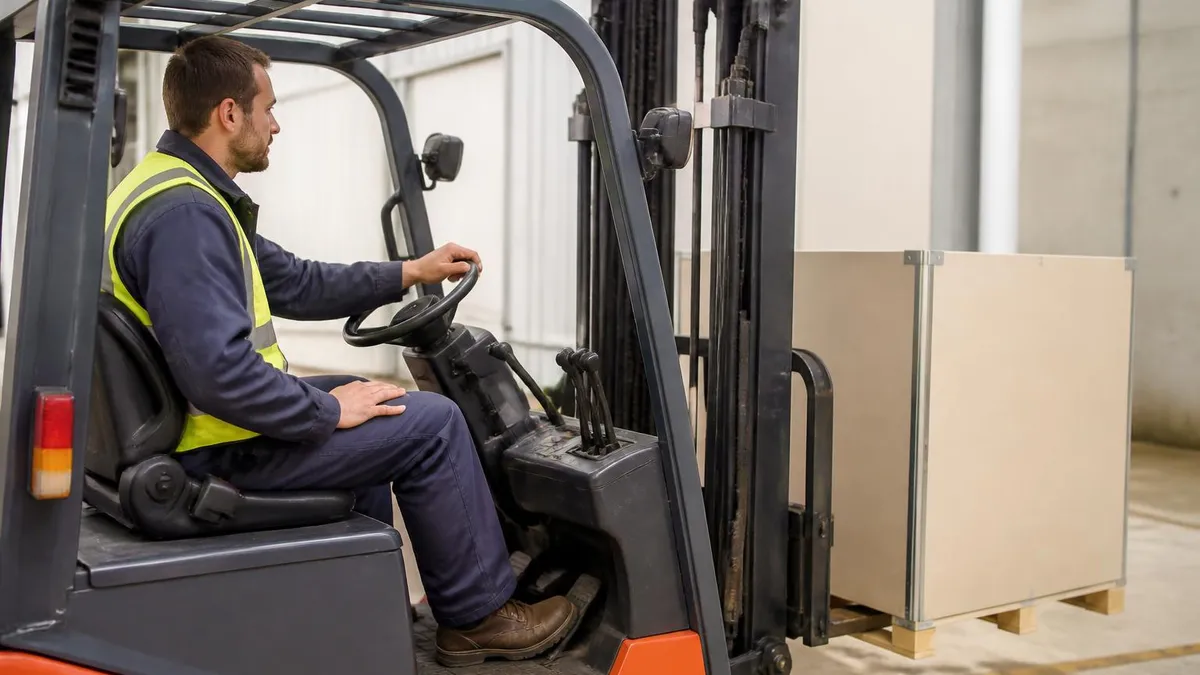
By the Numbers
The Daily Pre-Shift Inspection
Before key-on, you walk around the truck. That's the heart of it. Most workplaces hand you a printed checklist clipped to the dash, and the smart ones use a digital form that won't let you sign on until every line is ticked. Either way, the inspection covers two halves: a visual walk-around with the truck off, then an operational check with the engine running.
The cold check looks at tyres (cuts, chunks missing, pressure if pneumatic, wear below the markers on solid tyres), forks (cracks at the heel, bent tips, twist, the locking pin actually engaging), mast (chain tension and lubrication, rollers, hoses), load backrest (cracks, secure mounting), hydraulics (oil level via the dipstick or sight glass, hose condition, any leaks pooling underneath), fluids (engine oil, coolant, radiator condition, LPG hose if applicable), and fuel. On battery-electric trucks you also check the cells, electrolyte level on flooded batteries, and the connector for burn marks.
Key on. Now the operational checks. Horn — yes, it has to actually work, not just click. Lights — head, tail, reverse beep, example if fitted. Brakes — service brake feels firm, doesn't drift; park brake holds on the slope outside the workshop. Steering — no lag, no slop. Mast functions — lift up and down through full travel, tilt forward and back, side-shift if fitted, attachments through their range. Anything rattling, screaming, juddering or hesitating gets logged. End of story.
How long should this take? About five to eight minutes once you've got the rhythm. Operators who try to do it in 90 seconds either know the truck like the back of their hand or are skipping items. Don't skip items.
AS 2359.2 Pre-Shift Inspection Areas
AS 2359.2 doesn't dictate every line item, but workplace checklists built to the standard cover the same nine areas: tyres and wheels, forks and load backrest, mast and lift chains, hydraulics and hoses, fluid levels, brakes (service and park), steering, controls and gauges, and safety devices (horn, lights, mirrors, seatbelt, FOPS, overhead guard). Anything you'd never want to discover halfway through a lift sits in one of those nine buckets.
The AS 2359.2 Inspection Checklist in Detail
Take it bay by bay. Tyres: pneumatic tyres need pressure (manufacturer plate has the psi); solid press-on tyres need to be above the wear-line moulded into the rubber. Chunks gone? Tag it. Sidewall split on a pneumatic? Tag it. Aussie warehouse floors are brutal on solid tyres — sealed concrete with the odd metal swarf chews them quickly.
Forks: dye-penetrant inspections happen annually, but daily you're looking at the heel for visible cracks, tip for chips, the locking pin to confirm it actually drops into the carriage slot. AS 2359.2 says forks with more than 10% thickness loss at the heel come out of service. You won't be measuring with a vernier on the pre-shift, but visible wear is a flag.
Mast and lift chains: chains should look oiled and tensioned, not dry and slack. Listen for a screech on the way up — dry chain. Rollers should run smooth, no flat spots. Hoses should have no chafing or rubbing marks where they cross the mast structure. A hose that's been rubbing for two months will fail spectacularly on a heavy lift.
Hydraulics: check the reservoir level with the mast fully lowered (that's important — lifting raises the oil level reading). Look underneath for fresh drips. Old stains are normal; wet, fresh oil is not. Inspect hose clamps at the fittings. Cracked or bulging hoses get reported even if they haven't started leaking.
Brakes: service brake should bite within the first third of pedal travel and stop the truck without drift on a flat surface. Park brake should hold on a 15% slope (rule of thumb — your workplace might have a designated test slope). Squealing, grinding, pulsation, or extended travel are all defects.
Steering: test full lock both ways at low speed. Any free play in the wheel beyond a few centimetres before the truck responds is a problem. Hydraulic steering is the standard; if it feels heavy, the steering hydraulics may be losing pressure. The forklift inspection practice questions test you on exactly these items, so it's worth running through them before assessment day.
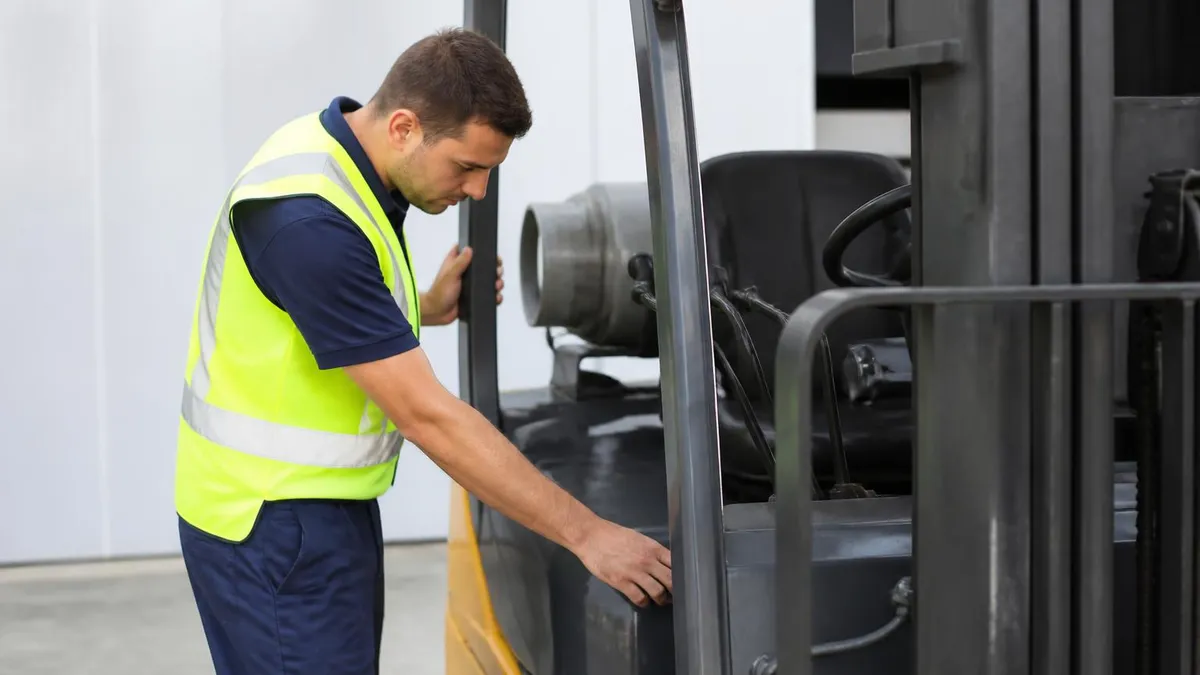
Pre-Shift Walk Through
Pressure on pneumatics, wear line on solids, chunks, splits, rim damage. Wheel nuts visible and tight.
Heel cracks, tip wear, locking pin function, load backrest secure with no cracked welds.
Chain tension and lubrication, roller condition, hose routing, no chafing across the mast.
Reservoir level mast-down, fresh leaks, hose condition, fittings secure, no bulges or cracks.
Engine oil, coolant, radiator, LPG hose if fitted. Battery electrolyte and connector on electric trucks.
Service brake firm with no drift; park brake holds on the test slope. No grinding or pulsation.
Full lock both ways, no excessive free play, no heavy spots. Hydraulic assist working through full travel.
Lift, tilt, side-shift, attachments through full range. Gauges read sensibly. Warning lights off at idle.
Horn, lights, reverse beeper, example, mirrors, seatbelt latch, overhead guard, FOPS, data plate legible.
Weekly and Monthly Tasks
Some workplaces delegate weekly tasks to operators; some keep them with the maintenance team. The typical weekly list is: chain lubrication, mast roller grease, full battery top-up on flooded electric batteries, tyre pressure check, fork tip alignment, and a sweep of the radiator fins for built-up dust. Monthly tasks usually include a heavier hydraulic inspection, brake pedal travel measurement against the spec, a full operational test of all attachments under load, and verifying the data plate is still legible and matches the truck's actual capacity ratings.
The line between operator and technician work isn't always crystal clear, so the rule of thumb is: if you're touching a spanner to anything other than greasing nipples, check whether your competency covers it. Some workplaces train operators in additional tasks like fork removal for inspection; others restrict everything beyond the pre-shift to ticketed mechanics. Your SWMS (Safe Work Method Statement) will spell it out.
Scheduled Major Services — 250, 500, 1,000 Hours
Now the big stuff. Manufacturers like Toyota, Linde, Crown, Hyster and Yale all publish a service schedule keyed to engine or motor hours. The pattern is broadly the same across brands: a 250-hour first-service inspection (often free with new trucks), 500-hour intermediate service (filters, fluids, tension checks), and 1,000-hour major service (transmission oil, hydraulic filter, full diagnostic, brake internals, mast bearings, often a wheel-off inspection).
These services are not operator work. They're booked through your forklift dealer or a licensed independent mechanic. As operator, your part is knowing the hour meter, flagging when service intervals approach, and not pushing the truck past a service window because the warehouse is busy. A skipped 1,000-hour service is how you end up replacing a transmission at 1,400 hours instead of swapping filters at 1,000. Cost difference: about 30 to 1.
LPG forklifts have an extra wrinkle — annual gas-system inspections by a licensed gasfitter are mandatory in most states. Electric trucks need battery capacity tests yearly. Diesel trucks need DPF (diesel particulate filter) cleaning per the schedule, particularly if they live in a low-emission indoor environment.
What Happens When
The first proper service. Engine oil and filter change on diesel/LPG trucks. Hydraulic level and condition check. Drive belts tensioned. Battery fluid top-up on electric. Steering and brake check, fork inspection, mast chain adjustment. Usually included free or at low cost with new trucks under the dealer warranty. Takes 2–3 hours.
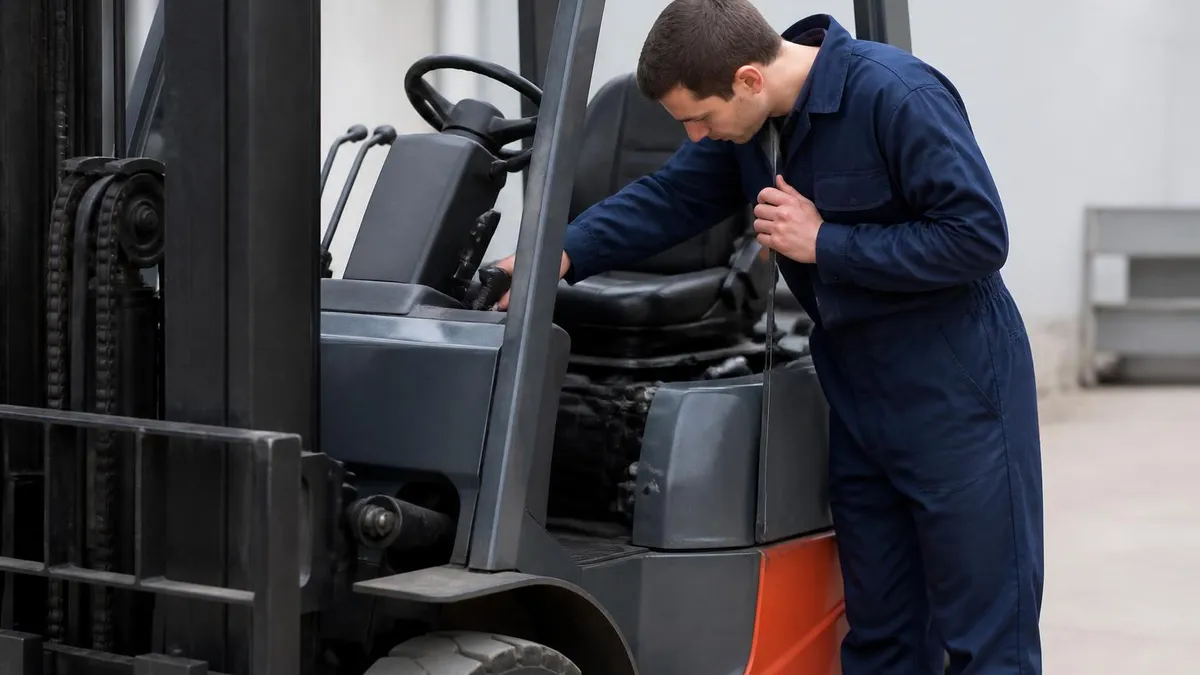
Operator Duties vs Technician Duties
Worth being absolutely clear on this. As a TLILIC0003 ticket holder, you are responsible for the pre-shift inspection, reporting any fault you find, refusing to operate an unsafe truck, completing the log book entry each shift, monitoring the hour meter against scheduled service intervals, and informing your supervisor when a service is due. You're also responsible for operating within rated capacity, respecting the load chart, and not modifying the truck in any way.
What you're not responsible for: mechanical repairs, hydraulic component replacement, structural welding (forks, mast, overhead guard), electrical work beyond replacing a blown fuse if your workplace permits it, anything that requires lifting the cab or pulling drive components, gas system internals on LPG trucks, and battery cell maintenance beyond electrolyte top-up. Doing any of those without the right ticket isn't just dodgy — it's a clear breach of the WHS Act and most likely your employer's SWMS too. The forklift licence framework draws this line deliberately so the operator focuses on operation and inspection, not repair.
The grey zone is consumables. Adding hydraulic fluid (top-up only, not flush). Topping up coolant. Swapping an LPG bottle. Charging the battery. Replacing a wiper blade. Most workplaces allow these as operator tasks, but they should be listed in your SWMS, and you should have been shown the right procedure. If it isn't in your SWMS, get a supervisor.
Where the Line Sits
- +Operator inspections catch 70%+ of brewing faults early
- +Daily log book creates a defensible maintenance record
- +Fast — five to eight minutes adds minimal time to the shift
- +No specialist tools or qualifications required
- +Builds operator familiarity with the specific truck
- −Operator scope is limited to inspection and reporting — no repair authority
- −Major faults still need licensed technicians, with the wait time that brings
- −Inconsistent inspection quality between operators is a real risk
- −Some workplaces over-delegate weekly tasks to under-trained operators
- −Without supervisor follow-up, logged defects can sit unresolved for days
Pros and Cons at a Glance
| Pros | Cons |
|---|---|
| Daily log book creates a defensible maintenance record | Operator scope is limited to inspection and reporting — no repair authority |
| Fast — five to eight minutes adds minimal time to the shift | Major faults still need licensed technicians, with the wait time that brings |
| No specialist tools or qualifications required | Inconsistent inspection quality between operators is a real risk |
| Builds operator familiarity with the specific truck | Some workplaces over-delegate weekly tasks to under-trained operators |
Log Book Requirements
Every forklift in Australia operating in a workplace covered by the WHS Act needs a maintenance record. Most workplaces use a physical log book in the truck cab or a digital equivalent on a tablet. What goes in: operator name, date, time of inspection, hour meter reading, every checklist item with a tick or a fault note, signature. If you find a defect, you record it with enough detail that a mechanic can find it — "hydraulic leak" is too vague; "slow drip at lift cylinder base, left side" is useful.
The log book also captures incidents (near-misses, contact with racking, dropped loads), refuelling or battery charges, fluid top-ups, and any maintenance work done. Auditors love log books because they tell the story of the truck. A truck with consistent daily entries and prompt fault follow-up is a well-maintained truck on paper and almost always in reality. A truck with sporadic entries and unresolved defects is a SafeWork prosecution waiting to happen.
Digital log books are catching on fast. Apps like Pinpoint, Forkify, and several proprietary dealer platforms force you to complete every checklist item before the truck starts (interlock through the ignition system). They timestamp everything and email defect reports straight to maintenance. Worth asking your workplace about if you're still on paper.
Fault Reporting and the Red Tag Rule
Some defects mean the truck is parked. Right now. Keys out of the ignition, red "do not operate" tag on the steering wheel, supervisor notified, log book entry made. There's no negotiating these. The AS 2359.2 list of immediate out-of-service defects includes: any brake failure or significant degradation, steering failure, mast hoist or tilt failure, fork crack or distortion, hydraulic leak (more than a slow seep), broken or damaged load backrest, missing or damaged overhead guard or FOPS, horn failure on a truck operating in a shared pedestrian zone, and any seatbelt damage on a sit-down counterbalance.
If a supervisor pressures you to operate a red-tagged truck, document it and refuse. WHS Act section 84 gives workers the right to cease unsafe work and protection from reprisal. That right exists because history shows operators do get pressured, and the law tries to counter it. Use it.
Run This Every Time
- ✓Park the truck on level ground, mast fully lowered, engine off
- ✓Walk around: visible damage, leaks underneath, anything obviously wrong
- ✓Tyres — pressure on pneumatic, wear-line on solid, no chunks or splits
- ✓Forks — heel cracks, tip wear, locking pin engages in carriage slot
- ✓Mast — chain tension and lubrication, rollers, hose routing
- ✓Hydraulic reservoir level with mast down, fresh leaks underneath, hose condition
- ✓Engine oil, coolant, radiator condition; LPG hose if fitted
- ✓Battery electrolyte and connector on electric trucks; cable burn marks
- ✓Key on — horn, lights, reverse beep, example if fitted
- ✓Service brake firm with no drift; park brake holds on the slope
- ✓Steering through full lock both ways, no slop, no heavy spot
- ✓Lift, tilt, side-shift and attachments through full travel
- ✓Gauges and warning lights — anything illuminated at idle is a flag
- ✓Seatbelt latch works; overhead guard secure; data plate legible
- ✓Log book entry signed off with hour meter and any defects noted
Common Defects and Where to Get the Truck Fixed
Some defects you'll see again and again across Australian warehouses. Hydraulic leaks at the lift cylinder base — usually a perished seal, fixed in an hour by a mobile mechanic. Tyre chunking on solid press-on tyres — comes from kerb impact and rough concrete, needs a press at a tyre yard. Brake judder — usually contaminated brake fluid or warped discs. Mast chain stretch — chains elongate by about 3% before they need replacement; AS 2359.2 says replace at 3%. LPG vapour lock in winter — regulator icing, usually a quick fix.
For scheduled services and warranty work, most workplaces book through the dealer who sold the truck. Toyota Material Handling has branches in every major Aussie city. Linde Australia, Crown, Yale and Hyster all operate dealer networks. Independent forklift mechanics often beat dealer rates on out-of-warranty work and are usually more flexible on after-hours callouts.
In Sydney, look at Wetherill Park, Bankstown and Smithfield for the highest concentration of forklift workshops — that's where most of the warehousing sits. Melbourne has hubs in Dandenong South, Laverton North and Truganina, all within reach of mobile callout. Brisbane operators usually deal with workshops out at Hemmant, Wacol and Yatala. Perth has clusters in Welshpool, Canning Vale and Kewdale.
Adelaide is more compact — Wingfield, Regency Park and Lonsdale cover most needs. Mobile mechanics are common in all five cities and usually cheaper for breakdown work than getting the truck floated to a workshop. If you're job-hunting in any of these cities, the forklift job description guide has current market info, and the forklift training page covers RTOs by location.
One last thing on cost: the cheapest forklift service is the one you don't need because the truck was maintained. A pre-shift inspection costs you eight minutes. A scheduled service costs the workplace a few hundred bucks. A blown hydraulic system in the middle of a shift costs production downtime, an emergency callout, and potentially an injury investigation. The economics massively favour preventive maintenance. Operators who treat the pre-shift as paperwork to dodge are saving the workplace nothing and exposing themselves to risk. Operators who do it properly are doing the smartest five-minute job of their shift.
Sample Forklift Licence Practice Questions
Try these questions from our free Forklift Licence practice tests. The correct answer and an explanation follow each question.
What is continuous improvement in Forklift Pre-Operational Checks management?
- A. Doing the same thing year after year
- B. Systematically reviewing performance, learning from incidents, and implementing improvements to prevent future harm
- C. Cutting safety budgets annually
- D. Increasing work speed each quarter
Answer: B. Systematically reviewing performance, learning from incidents, and implementing improvements to prevent future harm
Continuous improvement involves ongoing evaluation and enhancement of safety practices based on monitoring, audits, incidents, and feedback.
How should Forklift Pre-Operational Checks equipment be inspected and maintained?
- A. Only when it breaks
- B. Per manufacturer specifications and relevant Australian Standards, with documented inspection and maintenance records
- C. When someone remembers
- D. Only for new equipment
Answer: B. Per manufacturer specifications and relevant Australian Standards, with documented inspection and maintenance records
Equipment must be inspected and maintained according to specifications and standards, with all records documented.
Under Australian law, what rights do workers have regarding Forklift Pre-Operational Checks safety?
- A. No specific rights
- B. Rights to information, training, consultation, representation through HSRs, and to cease unsafe work
- C. Only the right to complain
- D. Rights depend on seniority
Answer: B. Rights to information, training, consultation, representation through HSRs, and to cease unsafe work
Workers have specific legal rights under WHS legislation including information, training, consultation, representation, and refusal of unsafe work.
What is a Code of Practice relevant to Forklift Pre-Operational Checks?
- A. A marketing document
- B. A practical guide approved under WHS legislation that can be used as evidence of what is reasonably practicable
- C. A voluntary suggestion only
- D. A company internal policy
Answer: B. A practical guide approved under WHS legislation that can be used as evidence of what is reasonably practicable
Codes of Practice provide practical guidance with legal significance — they can be cited as evidence of what is known and reasonably practicable.
TLILIC0003 Questions and Answers
About the Author

Certified Crane Operator & Skilled Trades Exam Specialist
Ferris State UniversityRobert Martinez is a Journeyman Ironworker, NCCCO-certified crane operator, and forklift trainer with a Bachelor of Science in Construction Technology from Ferris State University. He has 21 years of ironworking, rigging, and heavy equipment operation experience across high-rise and industrial construction sites. Robert prepares candidates for crane operator, rigger, forklift, and skilled trades certification examinations.