
ServSafe Training San Bernardino: Complete Guide to Food Handler Certification in San Bernardino County
Get your ServSafe or food handlers card in San Bernardino County. Requirements, costs, exam tips, and practice tests. 🎯 Start preparing today.
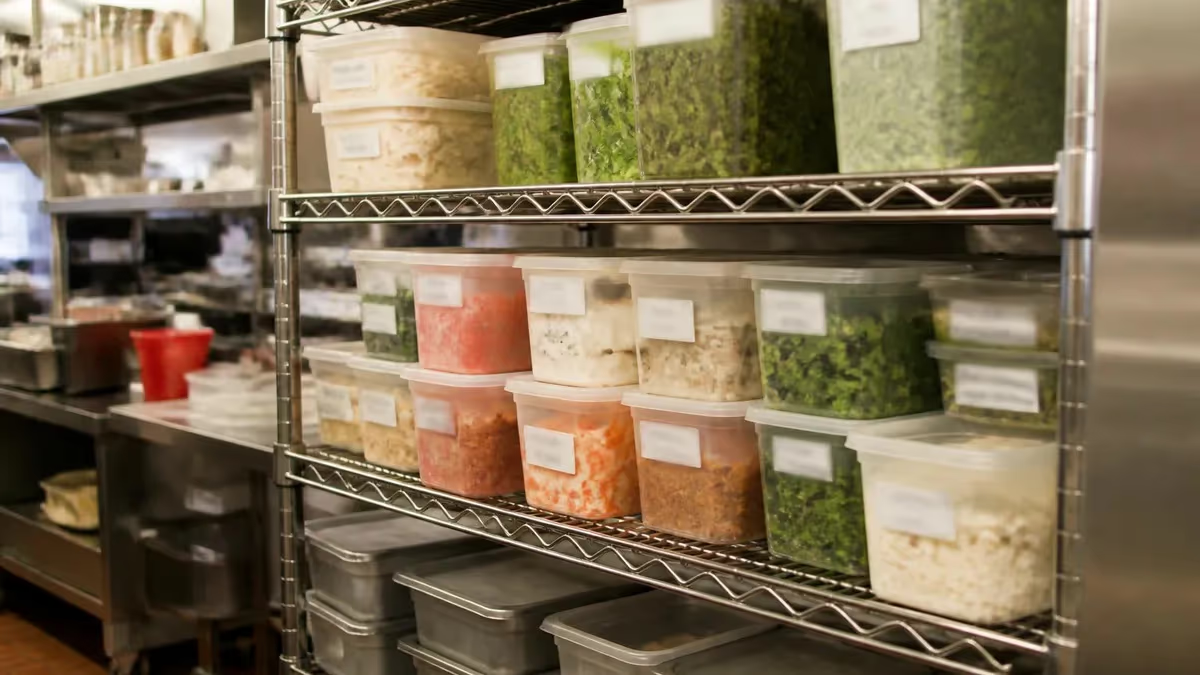
ServSafe certification is the gold standard for food safety training across the United States, and if you work in the food service industry in San Bernardino County, understanding the san bernardino county servsafe requirements is essential before you step behind a counter or into a commercial kitchen. Whether you are applying for your first food handlers card, renewing an existing food handlers certificate, or pursuing a full ServSafe Manager credential, the path starts with knowing exactly what the county, the state of California, and your employer each require from you. Practice with the free ServSafe Certification Practice practice test on PracticeTestGeeks (7 questions with answer explanations).
California's retail food code mandates that all food employees who handle non-prepackaged food complete an accredited food handler training course within 30 days of hire. This statewide rule applies to every restaurant, grocery store, catering operation, and food truck in San Bernardino County. The training must be delivered by an ANAB-accredited provider, and ServSafe — administered by the National Restaurant Association Educational Foundation — is one of the most widely accepted programs in the state. Many employers in the Inland Empire region specifically request ServSafe documentation during onboarding.
Beyond the basic food handlers permit level, California also requires that every food facility have at least one Certified Food Protection Manager on staff. This is where the ServSafe Manager certification becomes critical for supervisors, lead cooks, kitchen managers, and restaurant owners throughout the San Bernardino area. Passing the proctored ServSafe Manager exam demonstrates mastery of advanced topics including HACCP principles, temperature control, cross-contamination prevention, and regulatory compliance — knowledge that directly protects the public and shields your business from costly health department violations.
San Bernardino County spans over 20,000 square miles and includes major cities like San Bernardino, Fontana, Ontario, Rancho Cucamonga, Victorville, and Redlands. Across this vast region, the county's Department of Public Health Environmental Health Services division enforces food safety standards through routine inspections and complaint investigations. Establishments that employ properly trained and certified staff consistently score better on health inspections, face fewer closures, and build stronger reputations with the dining public. Investing in quality servsafe training san bernardino is therefore both a legal obligation and a smart business decision.
If you are wondering whether you need a food handlers card, a food handlers certificate, or the full ServSafe Manager certification, the answer depends on your job role and your employer's policies. Line cooks, servers, bussers, and prep staff typically need the basic food handler level. Managers, shift leads, and anyone responsible for overseeing a food operation generally need the manager-level credential. Some large employers in San Bernardino County go further and require every employee to hold a manager-level certification regardless of role, particularly in healthcare foodservice and institutional settings.
The good news is that earning your ServSafe credential has never been more accessible. In-person classes are offered through community colleges, restaurant associations, and private training companies throughout the Inland Empire. Online self-study options allow you to complete coursework at your own pace before scheduling a proctored exam. Practice resources — including full-length mock exams and topic-specific question sets — are freely available online, making it possible to prepare thoroughly regardless of your schedule or budget. The key is understanding the format, the content domains, and the minimum passing requirements before exam day.
This guide covers everything you need to know about ServSafe training in San Bernardino: county-specific requirements, exam formats, study strategies, costs, frequently asked questions, and the best free practice tools available. Whether you are starting from scratch or looking to refresh before a recertification exam, the information below will give you a clear, actionable roadmap to success.
Free ServSafe Certification Practice Study Tools
Interactive ServSafe Certification Practice resources on PracticeTestGeeks, free to start:
- ServSafe Certification Practice flashcards — review key terms and concepts card by card
- ServSafe Certification Practice study guide — topic-by-topic overview of what the exam covers
- ServSafe Certification Practice cheat sheet — one-page printable summary for last-minute review
ServSafe in San Bernardino County by the Numbers
- The ServSafe Food Protection Manager Certification Examination has 90 multiple-choice questions, 10 of which are unscored pilot questions. (National Restaurant Association)
- Candidates have 2 hours to complete the ServSafe Manager Exam, and with online proctoring the launch process does not count against that time. (National Restaurant Association)
- To pass the ServSafe Food Protection Manager Examination, you need a score of 70% or higher, which means answering at least 56 of the 80 scored questions correctly. (National Restaurant Association)
- A ServSafe Manager Exam access code costs $38.99, and the exam must then be given by a Registered ServSafe Instructor or Proctor, who may charge their own fee. (National Restaurant Association)
- The ServSafe Manager Exam with online proctoring costs $99.00, and ProctorU proctoring is included in that price. (National Restaurant Association)
- Each retake of the ServSafe Manager exam requires buying a new exam at the full price. (National Restaurant Association)
- ServSafe Manager candidates may take the exam twice within 30 days. A third or later attempt requires a 60-day wait after the last attempt, and no more than four attempts are allowed in 12 months. (National Restaurant Association)
- The ServSafe Food Protection Manager Certification is valid for 5 years, though state or local rules may require earlier renewal. (National Restaurant Association)
- To renew a ServSafe Manager certification, you buy a new exam and pass it again when your current certification is expiring. (National Restaurant Association)
Facts verified Oct 15, 2026 against National Restaurant Association. Dates that have passed are removed automatically.
ServSafe Exam at a Glance
| Item | Detail | Official source |
|---|---|---|
| Number of questions | 90 multiple-choice questions (80 scored + 10 pilot) | National Restaurant Association |
| Time limit | 2 hours | National Restaurant Association |
| Passing score | 70% (56 of 80 scored questions) | National Restaurant Association |
| Exam fee (Exam Access Code (registered proctor)) | $38.99 access code; proctor fees extra | National Restaurant Association |
| Exam fee (Online Proctor (ProctorU)) | $99.00 (online proctoring included) | National Restaurant Association |
| Exam fee (Testing Center (Pearson VUE)) | $108.99 (Pearson VUE testing center access included) | National Restaurant Association |
| Retake fee | Full new exam purchase for each retake | National Restaurant Association |
| Retake policy | 2 attempts in 30 days, then a 60-day wait; maximum 4 attempts in 12 months | National Restaurant Association |
| Validity | 5 years | National Restaurant Association |
| Renewal | Pass the exam again (new exam purchase) before the certification expires | National Restaurant Association |
| Delivery | Online proctoring (ProctorU), Pearson VUE test centers, or in person with a Registered ServSafe Proctor (online or print exam) | National Restaurant Association |
| Score release | Online: almost immediately; print: 3–4 business days | National Restaurant Association |
Facts verified Oct 15, 2026 against National Restaurant Association. Dates that have passed are removed automatically.

ServSafe Manager Study Schedule: 4-Week Plan
- ▸Read ServSafe Manager textbook Chapters 1–3 (microbiology, contamination, allergens)
- ▸Take a diagnostic practice test to identify weak areas
- ▸Create flashcards for the Big 6 pathogens and their symptoms
- ▸Review TCS (Time/Temperature Control for Safety) food definitions
- ▸Study receiving, storage, thawing, cooking, and holding temperature requirements
- ▸Memorize minimum internal cooking temperatures for all protein types
- ▸Practice danger zone temperature questions (41°F–135°F)
- ▸Complete 50-question practice set on food preparation standards
- ▸Study chemical sanitizer concentrations (chlorine, iodine, quats)
- ▸Review pest control, physical facilities, and equipment standards
- ▸Take a full 90-question timed practice exam under test conditions
- ▸Review all incorrect answers and re-read related textbook sections
- ▸Master HACCP 7 principles and active managerial control concepts
- ▸Complete two more full practice exams and aim for 80%+ scores
- ▸Review regulatory authority roles, employee health policies, and crisis management
- ▸Rest the day before the exam and review key flashcards only
Earning your ServSafe certification in San Bernardino County involves several concrete steps, and understanding each one before you begin will save you time and money. The first step is determining which certification level you need. The ServSafe Food Handler certificate is designed for non-managerial food service employees and requires completing a training course — either online or in-person — followed by a short assessment. This certificate satisfies California's food handler training mandate and is valid for three years from the date of completion.
The ServSafe Manager certification is a separate, more rigorous credential that involves proctored examination under controlled conditions. To prepare, most candidates either attend an in-person instructor-led course (typically 8–16 hours spread over one or two days), complete a self-study program using the official ServSafe Manager textbook and online materials, or use a combination of both approaches. In San Bernardino County, instructor-led courses are available through the Inland Empire Restaurant Association, local community colleges such as San Bernardino Valley College, and several private food safety training companies based in Ontario and Fontana.
The exam itself consists of 90 multiple-choice questions drawn from nine content domains. You need to answer at least 67 correctly — a 70% score — to earn a passing result. The exam is available in English and Spanish, which is particularly helpful given the large Spanish-speaking workforce in the Inland Empire region. Exams are proctored by registered ServSafe proctors; you cannot take the Manager exam entirely online without a proctor present, though some remote proctoring options have been introduced for qualifying locations.
Cost is a common concern for food service workers. A self-study exam bundle — including the textbook, online coursework access, and one exam attempt — typically runs between $170 and $200 through the official ServSafe website. Instructor-led courses that bundle training and exam tend to cost $150–$250 depending on the provider and location.
Some San Bernardino County employers reimburse certification costs upon successful completion, particularly larger restaurant chains and institutional food service operations. If cost is a barrier, check with your local workforce development board or the San Bernardino County Workforce Development Department, which sometimes subsidizes food service training for eligible workers.
In addition to ServSafe Manager, California food and beverage servers should be aware of rbs training requirements under the state's Responsible Beverage Service program. AB 1221, which took effect in 2022, requires all servers of alcoholic beverages in licensed establishments to complete an accredited RBS training course and pass a state exam administered through the California Department of Alcoholic Beverage Control's online portal. While RBS certification is distinct from ServSafe, many food service professionals in San Bernardino County need both credentials depending on their role.
Once you pass the ServSafe Manager exam, your certificate is issued by the National Restaurant Association Educational Foundation and is valid for five years nationwide. This means your San Bernardino certification is recognized if you move to Los Angeles, Orange County, or any other California jurisdiction — or even if you relocate to another state. Many reciprocal states accept ServSafe Manager as meeting their own CFPM requirements without additional testing, making it one of the most portable food safety credentials available.
The San Bernardino County Department of Public Health recommends that food facility operators maintain copies of all employee certification records on-site and make them available during health inspections. A best practice is to keep digital copies in a shared drive or HR system, with reminder alerts set 90 days before each certificate's expiration date. Health inspectors in San Bernardino County do verify certification status, and facilities that cannot produce documentation during an inspection may receive a compliance order requiring immediate corrective action.
Food Handlers Card vs. Certificate vs. Manager Certification
A food handlers card (also called a food handlers certificate or food handlers permit) is the entry-level credential required for most non-managerial food service employees in California. In San Bernardino County, you must obtain this card within 30 days of starting work in a food facility. The course covers basic food safety principles including personal hygiene, cross-contamination prevention, proper handwashing techniques, and safe temperature practices. Training typically takes 2–4 hours and can be completed entirely online through ANAB-accredited providers, making it one of the most accessible credentials in the food service industry.
The cost for a food handler card in California generally ranges from $15 to $45, depending on the provider. Once issued, the card is valid for three years. Some counties maintain their own approved provider lists, so always verify that your chosen course is accepted by San Bernardino County's Department of Public Health before enrolling. ServSafe's Food Handler program is widely accepted, but providers like eFoodHandlers, StateFoodSafety, and Learn2Serve are also popular options among Inland Empire workers.
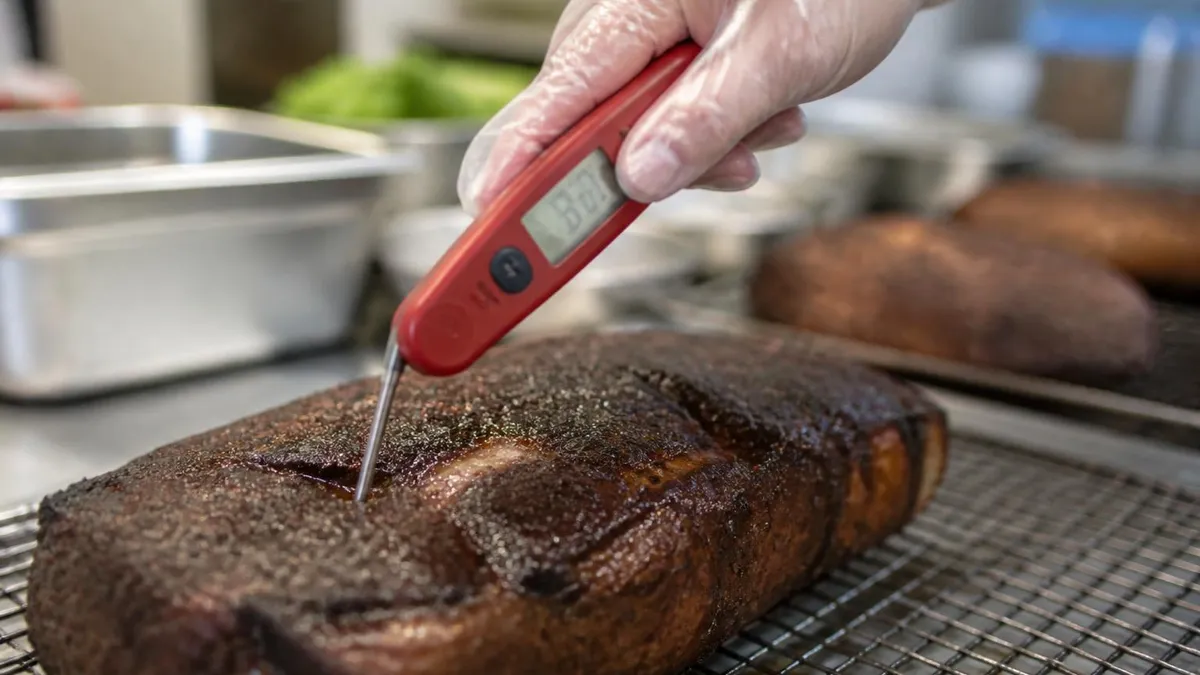
ServSafe Online vs. In-Person Training: Which Is Right for You?
- +Online training lets you study at your own pace and fits around shift work schedules
- +Self-paced online courses typically cost less than instructor-led classroom programs
- +Online materials can be reviewed multiple times before the exam at no extra cost
- +Instructor-led classes provide direct Q&A with experienced food safety professionals
- +Classroom training offers structured accountability that helps many learners stay on track
- +In-person courses often include exam bundled in the fee, streamlining the process
- −Online-only preparation misses the interactive learning that clarifies complex HACCP concepts
- −Self-study requires strong personal discipline; many candidates underestimate study time needed
- −Instructor-led courses require scheduling flexibility that shift workers may not always have
- −Classroom programs cost more and may require travel across San Bernardino County's large geography
- −Remote proctoring for the Manager exam requires compatible technology and a quiet testing environment
- −Online courses vary widely in quality; not all providers receive equal acceptance from employers
ServSafe Exam Day Preparation Checklist for San Bernardino County
- ✓Confirm your exam appointment date, time, and location at least 48 hours in advance
- ✓Bring a government-issued photo ID (driver's license, passport, or state ID) to the testing site
- ✓Review the nine ServSafe exam content domains one final time the evening before
- ✓Get a full night of sleep — fatigue significantly impairs multiple-choice test performance
- ✓Eat a balanced meal before the exam to maintain focus throughout the 2-hour session
- ✓Arrive at the testing location at least 15 minutes early to complete any check-in paperwork
- ✓Bring your exam registration confirmation number or printed voucher as required by the proctor
- ✓Turn off or silence your mobile phone before entering the examination room
- ✓Read every question carefully before selecting an answer — eliminate obviously wrong options first
- ✓Flag difficult questions and return to them after completing the questions you know confidently
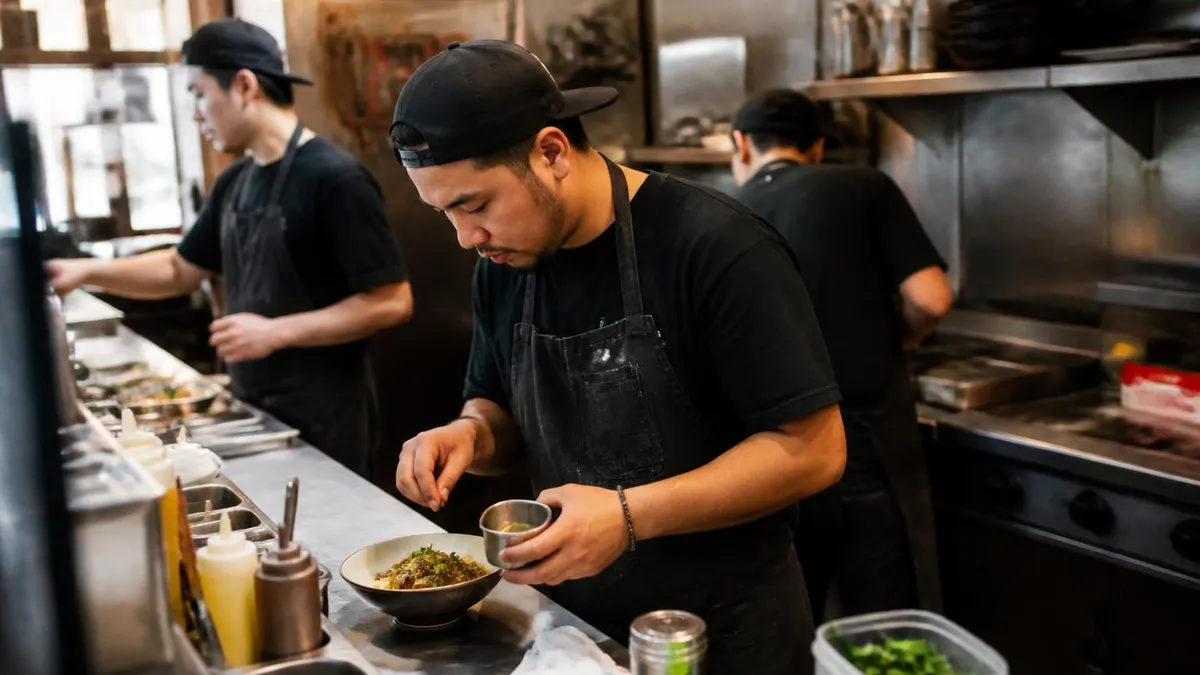
You Need a 75% Score — But Aim for 85%
The ServSafe Manager exam passing threshold is 70% (56 out of the 80 scored questions). However, experienced instructors in San Bernardino County recommend targeting 85% or higher on practice tests before scheduling your real exam. This buffer accounts for exam-day nerves, time pressure, and the possibility of encountering questions in domains where your knowledge is thinner. Candidates who consistently score 85%+ on practice exams pass the real test at a much higher rate than those who are just at the 75% threshold.
Effective study strategies make the difference between a first-attempt pass and a costly retake. The ServSafe Manager exam tests nine distinct content domains with varying question weights, so knowing which areas carry the most points allows you to allocate study time intelligently. The highest-weighted domains are typically the Flow of Food (receiving through service), Cleaning and Sanitation, and Food Safety Management Systems including HACCP. Together these three areas account for roughly 50% of all exam questions, making them the highest-return investment of your study hours.
Flashcards are consistently rated as one of the most effective memorization tools for ServSafe preparation. The exam requires you to recall specific numbers — minimum internal cooking temperatures (165°F for poultry, 155°F for ground beef, 145°F for whole muscle meats and fish), holding temperatures (135°F hot, 41°F cold), cooling requirements (135°F to 70°F within 2 hours, then to 41°F within an additional 4 hours), and chemical sanitizer concentrations (50–100 ppm chlorine, 12.5–25 ppm iodine). Building flashcard decks for these values and drilling them daily in the weeks before your exam will cement the recall needed under timed test conditions.
Practice exams are arguably the single most valuable study resource available to ServSafe candidates. A quality servsafe manager practice test mirrors the real exam's question structure, difficulty level, and domain distribution. When you review your results, pay attention not just to which questions you got wrong, but to why you got them wrong — was it a knowledge gap, a misread of the question, or confusion between two similar-sounding concepts? Targeted review of missed topics yields far more improvement per study hour than re-reading chapters you already understand well.
The ServSafe textbook is the authoritative source for all exam content and is worth owning even if you plan to use supplemental study materials. The most recent edition reflects the current Food and Drug Administration Food Code, which is the regulatory framework underlying most exam questions. Pay special attention to the summary points at the end of each chapter, the glossary definitions, and any diagrams showing food flow through a facility or HACCP decision trees. These visual elements often map directly to exam scenario questions.
Group study sessions can significantly accelerate preparation, particularly for candidates who learn well through discussion. Many San Bernardino County library branches offer meeting rooms that can be reserved at no charge, making them ideal venues for small study groups. Working through practice questions together, explaining reasoning out loud, and debating answer choices helps surface gaps in understanding that solo study might miss. The Ontario City Library, San Bernardino Public Library, and Fontana Lewis Library all have community meeting spaces suitable for this purpose.
YouTube and free online video content have matured significantly as ServSafe study tools. Several food safety educators have posted full chapter review videos aligned to the current ServSafe Manager textbook, covering topics like the science of foodborne illness, personal hygiene standards, the FIFO inventory method, and active managerial control. These videos work especially well as supplements for visual and auditory learners who absorb information better through watching and listening than through reading dense textbook prose. Use them to reinforce — not replace — textbook study.
Finally, time management during the actual exam deserves deliberate practice. With 90 questions and 120 minutes allowed, you have an average of 80 seconds per question. Practicing full timed exams — not just untimed question sets — trains the pacing instincts you need to avoid running short of time on the final pages of the exam. If you find yourself consistently running over time in practice, work on faster initial reads and more decisive answer selection rather than reconsidering every question multiple times.
California law (Health and Safety Code Section 113948) requires all food employees who handle non-prepackaged food to obtain an accredited food handler card within 30 days of starting work. Employers in San Bernardino County who allow uncertified employees to work with food beyond this window face health code violations and potential fines during routine inspections. Do not wait until your second or third week on the job — enroll in an accredited course during your first week to stay compliant and protect your employer from liability.
Once you have earned your ServSafe certification, maintaining it over the five-year validity period requires attention to a few key obligations. The most important is tracking your expiration date and beginning the recertification process well in advance — ideally 90 to 120 days before your current certificate expires.
Unlike some professional licenses, ServSafe Manager certification cannot be renewed through a simple renewal fee; you must retake and pass the proctored exam to receive a new five-year certificate. This means the full study process applies each time, though experienced managers typically require less preparation time on their second or third recertification cycle.
The food safety landscape does evolve between certification cycles, and the ServSafe textbook is updated periodically to reflect changes in the FDA Food Code and emerging food safety research. When preparing for recertification, it is worth checking whether a new edition of the textbook has been released since your last exam. Changes between editions sometimes shift the emphasis on specific topics — for example, earlier editions placed less focus on allergen management than current materials do, reflecting the growing regulatory and liability environment around food allergies in commercial kitchens.
Employers in San Bernardino County have an important role in supporting ongoing food safety education. Best-practice operators schedule regular in-service training sessions covering topics like proper handwashing technique refreshers, updated allergen protocols, seasonal food safety reminders (such as heightened temperature vigilance during Inland Empire summers when ambient temperatures routinely exceed 100°F), and reviews of any food safety incidents that occurred in the facility. These sessions keep food safety top of mind between formal certification cycles and help build a genuine food safety culture rather than a compliance-checkbox mentality.
The San Bernardino County Department of Public Health Environmental Health Services division publishes inspection reports for all permitted food facilities on its website. Reviewing your facility's recent inspection history is a productive exercise both before and after certification. Violations noted in past inspections highlight the specific food safety risks that your facility has struggled with, making them natural focal points for targeted staff training. If your facility has received citations for improper cooling procedures or inadequate handwashing facilities, for example, those are the exact topics to reinforce in your next training session.
For food service professionals who manage multiple locations across San Bernardino County or the broader Inland Empire, coordinating certification records across sites adds an administrative layer that is worth systematizing early. Cloud-based HR platforms that support document storage and automated expiration alerts are increasingly affordable even for small operators, and the time saved versus manual tracking more than justifies the investment. Some operators also maintain a bench of recently certified employees who can step into manager roles at any location if a primary CFPM leaves unexpectedly, reducing operational vulnerability during staff transitions.
Community colleges and adult education programs in San Bernardino County offer ServSafe as part of broader culinary arts and hospitality management curricula, and these programs can be an excellent pathway for food service workers who want to advance into management roles. Programs at San Bernardino Valley College and Chaffey College in Rancho Cucamonga include ServSafe preparation as a component of their food service management certificates. Completing a formal hospitality program alongside your ServSafe credential gives you both the certification and the broader management skills that employers in the Inland Empire's growing food service sector increasingly value.
For anyone who needs to review specific regulatory questions about San Bernardino County food safety requirements, the county's Environmental Health Services division maintains a dedicated phone line and email contact for permit holders and food service workers. Their staff can clarify questions about acceptable training providers, documentation requirements during inspections, and the process for bringing a facility into compliance after a violation. Proactive communication with the health department before problems arise is always preferable to reactive conversations after an inspection has already identified deficiencies.
Practical test-taking strategies can push your ServSafe Manager exam score from borderline to comfortably passing. One of the most effective techniques is the process of elimination applied systematically to every question. ServSafe multiple-choice questions typically include one clearly wrong answer, one partially correct answer, and one or two strong candidates. Eliminating the obviously incorrect option first narrows your decision to two choices, significantly improving your odds even when you are uncertain. This technique is especially useful for scenario-based questions where you need to identify the best course of action among several reasonable-sounding options.
Pay particular attention to questions that use absolute language like always, never, must, and only. These qualifiers often signal that the question is testing a hard regulatory rule rather than a general best practice. The FDA Food Code, which underlies the ServSafe curriculum, contains many absolute requirements — minimum cooking temperatures, maximum cooling timelines, mandatory handwashing triggers — and questions about these requirements tend to use absolute language that matches the regulatory text. When you see these words in a question stem, look for an answer that reflects an equally absolute rule.
Scenario questions — which make up a significant portion of the ServSafe Manager exam — require you to apply knowledge to realistic food service situations rather than simply recall a fact.
Common scenario formats include: a food item arrives at a delivery showing a specific temperature reading (should you accept or reject it?); an employee reports symptoms consistent with a foodborne illness (what action should the manager take?); a sanitizer test kit shows a certain ppm reading (is the solution safe, too weak, or too strong?). The best preparation for scenario questions is working through large volumes of practice questions that match this format, so the decision logic becomes automatic on exam day.
The cooling requirements deserve special emphasis because they are both heavily tested and frequently misunderstood in practice. Food must be cooled from 135°F to 70°F within two hours, and from 70°F to 41°F within an additional four hours — a total cooling window of six hours. Many candidates confuse these numbers or forget that the two-hour threshold applies to the upper cooling range specifically.
Acceptable cooling methods include ice-water baths, blast chillers, ice paddles, and dividing large food masses into shallow containers. Leaving a large pot of soup to cool at room temperature on a counter overnight is one of the most cited food safety violations in San Bernardino County restaurant inspections.
Personal hygiene questions are among the most straightforward on the exam but also among the most important in daily kitchen practice. The exam tests knowledge of when handwashing is required (after using the restroom, after handling raw meat, after touching the face or hair, after taking out trash, among other triggers), what constitutes proper handwashing technique (20 seconds minimum with soap, including wrist and between fingers), and what conditions require excluding or restricting food employees from working with food.
An employee with a diagnosed foodborne illness like Salmonella Typhi must be excluded from the workplace entirely; an employee with a sore throat but no fever may be restricted from working with exposed ready-to-eat food but not necessarily excluded.
Many candidates underestimate the HACCP content on the ServSafe Manager exam. HACCP — Hazard Analysis and Critical Control Points — is a systematic, science-based approach to identifying and controlling food safety hazards throughout the flow of food.
The exam tests knowledge of all seven HACCP principles: conduct a hazard analysis, identify critical control points, establish critical limits, establish monitoring procedures, identify corrective actions, verify the system works, and keep records. Understanding how these principles apply to a real food service operation — not just memorizing the list — is the level of knowledge the exam assesses in its more challenging scenario questions.
After you pass, take a moment to recognize the achievement. The ServSafe Manager certification represents a meaningful investment of time, money, and mental effort. It signals to employers, regulators, and the public that you take food safety seriously — a professional attribute that opens doors to advancement in the San Bernardino County food service industry. Use it as a foundation to build deeper expertise, mentor less-experienced colleagues, and contribute to a safer dining experience for every guest your operation serves.
Many readers pair this guide with the free printable servsafe study guide to check their readiness before exam day.
Sample ServSafe Certification Practice Practice Questions
Try these questions from our free ServSafe Certification Practice practice tests. The correct answer and an explanation follow each question.
What common challenge do professionals face when applying Staff Training & Food Safety Culture principles?
- A. Balancing theoretical best practices with practical constraints
- B. Finding the relevant textbook chapter
- C. Obtaining permission to use the principles
- D. The principles are too simple to present any challenge
Answer: A. Balancing theoretical best practices with practical constraints
Professionals commonly face the challenge of adapting theoretical best practices to practical constraints and real-world conditions.
What is the most important competency assessed in Staff Training & Food Safety Culture?
- A. Applied knowledge and practical problem-solving ability
- B. Memorization of textbook definitions only
- C. Years of experience without demonstrated skill
- D. Academic credentials without practical application
Answer: A. Applied knowledge and practical problem-solving ability
Staff Training & Food Safety Culture assessment focuses on applied knowledge and practical problem-solving, ensuring professionals can perform effectively in real-world situations.
What is the recommended approach to staying current in Staff Training & Food Safety Culture?
- A. Regular professional development, industry publications, and peer collaboration
- B. Reviewing initial training materials once per year
- C. Relying solely on past experience
- D. Waiting for regulatory changes to force updates
Answer: A. Regular professional development, industry publications, and peer collaboration
Staying current requires ongoing professional development, reading industry publications, and collaborating with peers.
What is the correct way to take a food temperature reading?
- A. Insert the thermometer into the thickest part of the food
- B. Touch the thermometer to the surface only
- C. Hold the thermometer near the food
- D. Estimate based on cooking time
Answer: A. Insert the thermometer into the thickest part of the food
Temperature should be taken by inserting a calibrated thermometer into the thickest part of the food, where it takes longest to reach the correct temperature.
ServSafe Questions and Answers

Temperature Danger Zone ServSafe: Preventing Time-Temperature Abuse When Transporting Food

ServSafe Certification Practice Test: Complete Prep Guide for Food Handlers and Managers

Respuestas de ServSafe: Guía Completa de Práctica y Certificación para Manipuladores de Alimentos

ServSafe Manager Certificate: Complete Study Guide and Certification Prep Hub for 2026
ServSafe Manager Certification: Complete 2026 Requirements, Exam, and Career Guide
About the Author

Registered Sanitarian & Food Safety Certification Expert
Cornell University College of Agriculture and Life SciencesThomas Wright is a Registered Sanitarian and HACCP-certified food safety professional with a Bachelor of Science in Food Science from Cornell University. He has 17 years of experience in food safety auditing, regulatory compliance, and foodservice management training. Thomas prepares food industry professionals for ServSafe Manager, HACCP certification, and state food handler examinations.