
Marine ROTC: Duties, Career Path, and Life as a Marine Corps Officer
Marine ROTC explained: how the NROTC Marine option works, officer duties, MOS career paths, pay, and the training that turns students into Marine officers. 🟢
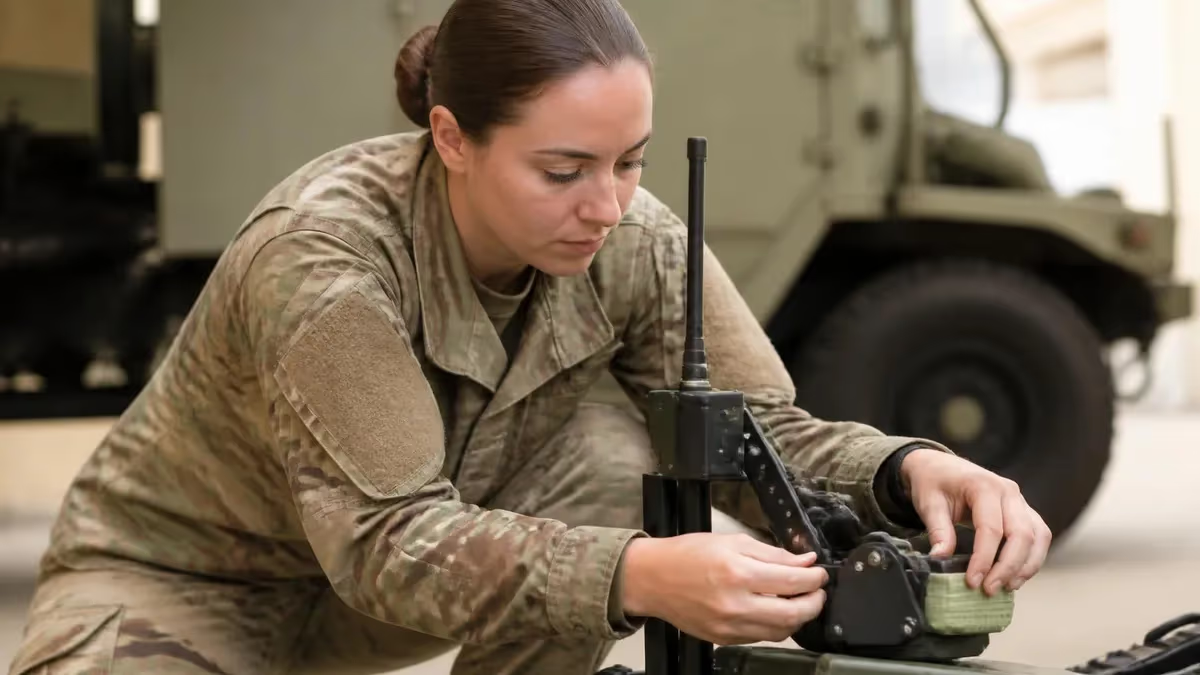
Marine ROTC is the college pathway that commissions civilians as second lieutenants in the United States Marine Corps, and it sits inside the Naval Reserve Officers Training Corps under what is officially called the Marine Corps option. Students enroll at one of more than 160 host or affiliated universities, take naval science and Marine-specific courses, complete physical training, and graduate ready to lead Marines. If you want a demanding leadership track with a clear officer career at the end, the Marine option deserves a hard look.
The program blends a normal college degree with military instruction so you finish with both a diploma and a commission. Unlike enlisting first, you spend four years preparing to be an officer from day one, learning small-unit tactics, military history, navigation, and the moral foundations the Corps expects. Many midshipmen pursuing the Marine option compete for marine rotc funding that covers tuition, fees, a book stipend, and a monthly subsistence allowance throughout the academic year.
What separates the Marine option from the Navy option within NROTC is the culture and the standards. Marine-option midshipmen drill with a Marine Officer Instructor, run the more rigorous Marine physical fitness test, and orient everything toward the warfighting ethos of the Corps. The summer between junior and senior year, candidates attend Officer Candidates School in Quantico, Virginia, a screening crucible that decides who is fit to lead. It is intense by design and weeds out those who cannot perform.
The payoff is real responsibility very early. A newly commissioned Marine second lieutenant can find themselves leading a platoon of roughly 40 Marines within their first year, accountable for their training, welfare, equipment, and lives. Few careers hand a 22-year-old that level of trust. The Corps invests heavily in turning college students into officers because it expects an immediate return: competent, ethical leadership at the tip of the spear, on day one of the fleet.
This guide walks through how Marine ROTC actually works, what officers do after they commission, the range of military occupational specialties available, what the pay looks like, and how the training is structured from freshman year through The Basic School. We will cover eligibility, the obligation you take on, and honest pros and cons so you can decide whether this path fits your goals. Expect specifics, not slogans, because the decision carries a multi-year service commitment.
Whether you are a high school senior weighing scholarship applications or a current college student thinking about lateral entry, understanding the duties and lifestyle of a Marine officer matters more than any recruiting brochure. The Marine option is not the easiest commissioning source, but for the right person it builds character, opens a respected career, and funds an education. Read on for a grounded, detailed picture of what you are signing up for and what you will become.
Marine ROTC by the Numbers

How Marine ROTC Works Year by Year
Midshipmen take naval science courses, attend physical training, and learn drill, leadership fundamentals, and Marine Corps history. You build the academic and fitness base while carrying a full college course load toward your degree.
The summer before senior year, Marine-option midshipmen attend the six-week OCS at Quantico. This screening evaluates leadership, physical stamina, and decision-making under stress. Passing is required to earn a commission as an officer.
Final-year midshipmen refine tactics and leadership, complete remaining naval science, and finish their degree. At graduation they commission as Marine second lieutenants and receive orders to The Basic School in Quantico.
Every new Marine officer attends roughly six months of TBS, learning to lead a rifle platoon regardless of future job. Performance here helps determine your military occupational specialty and first duty assignment.
Eligibility for the Marine option begins with the basics shared across NROTC: you must be a U.S. citizen, generally between 17 and 23 at the start of the program, medically qualified, and admitted to a participating university. Marine-option candidates also need to demonstrate the physical capacity for the Corps' standards and pass a fitness assessment early in the process. Academic strength matters; competitive applicants show solid GPAs, college-prep coursework, and standardized test scores that signal they can handle a rigorous degree.
The scholarship is the centerpiece for many applicants. The four-year national NROTC scholarship covers full tuition and required fees, provides a stipend for books, and pays a monthly subsistence allowance that increases each academic year. In exchange, scholarship midshipmen incur a minimum active-duty service obligation, typically four years, beginning after commissioning. Reviewing the full marine rotc scholarship structure before you apply helps you understand exactly what is funded and what you owe in return.
Applications open in the summer before senior year of high school, and the Marine Corps strongly rewards early submission. The package includes transcripts, test scores, a fitness assessment, recommendations, and interviews with a Marine officer. Selection boards meet on a rolling basis, so candidates who submit complete files early have a meaningful advantage. Waiting until winter to apply often means competing for the last remaining slots after the strongest boards have already filled.
If you do not win a national scholarship out of high school, you are not shut out. Many students join as college programmers, participate in the unit, perform well academically and physically, and earn a side-load scholarship during their first or second year. This route demands patience and proven performance, but it is a legitimate and common path to the Marine option. Talk to the Marine Officer Instructor at your target school about side-load timelines and how slots are allocated.
Physical readiness deserves special attention for Marine-option candidates. You will take the Marine Corps Physical Fitness Test, which includes pull-ups (or push-ups), an abdominal crunch or plank event, and a timed three-mile run. Hitting strong scores is not optional fluff; it signals to instructors and selection boards that you can endure OCS. Begin a structured training plan months before applying, focusing on upper-body strength and running endurance, the two areas where candidates most often fall short.
Finally, understand that the Marine option is a commitment that compounds. Each year you accept benefits, your obligation solidifies. There are decision points, particularly before the start of your sophomore year, where you can step away without an active-duty obligation. After that point, leaving the program can trigger repayment or enlisted service requirements. Read your contract carefully, ask questions, and make sure the Corps' lifestyle and values genuinely align with your long-term plans before you sign.
Marine ROTC Officer Duties Explained
The primary duty of a new Marine officer is leadership of Marines. As a platoon commander you are responsible for roughly 40 Marines, overseeing their training, discipline, professional development, and welfare. You plan and execute missions, enforce standards, and make decisions that affect mission success and lives. This responsibility arrives fast, often within months of joining your first unit in the fleet.
Effective leadership here is hands-on and constant. You conduct daily accountability, lead physical training, counsel Marines on careers and personal challenges, and represent your platoon to senior officers. The Corps expects you to know your Marines individually and to set the example in fitness, knowledge, and character. Failure to lead well is felt immediately by the people who depend on you.

Is the Marine ROTC Option Right for You?
- +Full tuition, fees, book stipend, and monthly allowance on national scholarship
- +Guaranteed officer commission and career upon successful completion
- +Immediate leadership responsibility over 40 Marines as a new lieutenant
- +Respected credential that translates to strong civilian career options later
- +Structured fitness, discipline, and leadership development from freshman year
- +Lifelong network of fellow officers and access to veteran benefits
- −Minimum four-year active-duty service obligation after commissioning
- −Demanding physical standards and the OCS screening crucible at Quantico
- −Limited control over your duty station, MOS, and deployment schedule
- −Heavy time commitment layered on top of a full college course load
- −Early exit after sophomore year can trigger repayment or enlisted service
- −Frequent moves and family separation are common throughout a career
Marine ROTC Application Checklist
- ✓Confirm U.S. citizenship and age eligibility before you start.
- ✓Research host and affiliated NROTC universities offering the Marine option.
- ✓Build a competitive GPA and complete college-prep coursework.
- ✓Take the SAT or ACT and aim for above-average scores.
- ✓Start a structured fitness plan focused on pull-ups and running.
- ✓Open your NROTC scholarship application the summer before senior year.
- ✓Gather transcripts, test scores, and strong recommendation letters.
- ✓Complete the Marine Corps physical fitness assessment.
- ✓Schedule and prepare for your interview with a Marine officer.
- ✓Submit the complete package early to catch the strongest selection boards.
Apply early and arrive physically prepared
Marine option selection boards review files on a rolling basis, so early, complete applications consistently outperform last-minute ones. Pair that with genuine physical readiness, especially upper-body strength and running endurance, and you give yourself the best shot at both a scholarship and surviving OCS.
After commissioning and completing The Basic School, every Marine officer receives a military occupational specialty, or MOS, that defines their career field. The Corps assigns MOSs based on a combination of your performance at TBS, the needs of the Marine Corps, and your stated preferences. Unlike civilian job hunting, you do not simply pick; the institution balances individual desire against fleet requirements. Understanding the major occupational fields helps you set realistic expectations and target the path that fits your strengths.
Ground combat arms include infantry, artillery, and combat engineers, the officers who lead Marines in direct ground operations. Infantry officers command rifle platoons and are central to the Corps' identity. Artillery officers direct indirect fire support, while combat engineers handle mobility, counter-mobility, and demolitions. These fields demand exceptional physical stamina, tactical sharpness, and the temperament to lead in austere, high-stress environments where decisions carry immediate, serious consequences.
Aviation is a major draw for many candidates. Marine pilots and naval flight officers fly fixed-wing jets, helicopters, and tiltrotor aircraft, supporting Marines on the ground and projecting power from sea and air. The aviation pipeline is long and competitive, requiring flight school after TBS, but it offers a distinctive career and highly transferable skills. Selection depends on aptitude testing, medical qualification, and performance, and the training investment the Corps makes is substantial.
Combat service support and logistics keep the entire force running. Logistics officers, supply officers, and ground maintenance officers ensure Marines have fuel, ammunition, food, parts, and functioning equipment wherever they operate. This field rewards organizational excellence and planning under constraint. While less visible than infantry or aviation, logistics is decisive; campaigns are won and lost on sustainment, and these officers manage complex systems across vast distances and unpredictable conditions.
Other specialized fields include communications, intelligence, cyber, financial management, and legal. Communications officers build and protect the networks that connect the force. Intelligence officers analyze threats and inform decisions at every level. The Corps also commissions judge advocates and financial managers who bring professional expertise into uniform. These technical and professional MOSs offer career skills with strong civilian crossover and appeal to officers whose talents lean analytical or specialized rather than purely tactical.
Whatever MOS you receive, your first tour shapes your trajectory. Officers typically serve in their primary field for several years, gaining expertise and leadership reps, then may broaden through schools, staff tours, and joint assignments. Promotion to captain and beyond depends on sustained strong performance, professional military education, and demonstrated leadership. The Marine Corps grows officers deliberately, expecting each to master their craft first and then expand into wider command and staff responsibilities over a full career.

The Marine Corps assigns your occupational specialty based on the needs of the Corps, your TBS performance, and your preferences, in that order of weight. You can request a field, but there is no guarantee you receive it. Enter the program prepared to serve and excel wherever you are placed.
Compensation for Marine officers is set by federal pay tables and is identical across all military branches for a given rank and years of service, so a Marine second lieutenant earns the same base pay as an Army or Air Force counterpart. As of recent pay scales, a brand-new O-1 second lieutenant earns roughly $45,000 in annual base pay, and that figure climbs with promotions and longevity. Base pay is only the starting point of total compensation, which is why the headline salary understates what officers actually receive.
On top of base pay, officers receive significant allowances that are typically tax-free. The Basic Allowance for Housing varies by duty location and dependency status and can add many thousands of dollars per year, often more in high-cost areas. The Basic Allowance for Subsistence covers food costs. Because these allowances are untaxed, an officer's effective take-home value is meaningfully higher than the base salary suggests, a distinction many comparisons to civilian salaries miss entirely.
Benefits extend well beyond cash. Officers receive comprehensive medical and dental coverage through TRICARE for themselves and their families at little to no cost, a benefit worth thousands annually in the civilian market. The retirement system, now the Blended Retirement System, combines a defined contribution with matching plus a pension for those who serve 20 years. Thirty days of paid leave each year, education benefits, and access to base facilities round out a substantial package. To compare this path with funding routes, review the full marine rotc scholarship breakdown.
Education benefits deserve special mention. Beyond the ROTC scholarship that funded your degree, serving officers can access the Post-9/11 GI Bill, tuition assistance for graduate study, and a range of professional military education opportunities the Corps pays for. Some of these benefits are transferable to a spouse or children under certain service conditions. For families, the cumulative educational value across a career can rival or exceed the cost of the undergraduate scholarship that started everything.
Pay grows predictably as you advance. Promotion from second lieutenant to first lieutenant typically comes around 18 to 24 months in, with captain following a couple of years later, each step bringing a noticeable raise. Officers who stay for a full career reaching major, lieutenant colonel, or higher see base pay rise substantially, complemented by larger housing allowances and the eventual pension. The financial trajectory rewards commitment, with steady, transparent increases tied to rank and time in service.
It is worth being clear-eyed: military pay is competitive and stable but not extravagant, and it comes with demands few civilian jobs impose, including deployments, relocations, and long hours. The value proposition is the total package, secure pay, strong benefits, healthcare, retirement, and education, combined with leadership experience that civilian employers prize. For someone drawn to service and leadership, the compensation supports a comfortable life; for someone chasing maximum income alone, other paths may pay more.
If you are preparing for the Marine option, start with honest self-assessment and a long runway. The single most controllable variable is physical fitness, and it is the area where candidates most often stumble at OCS. Begin training a full year before you expect to attend, building pull-up strength, running endurance over three miles, and core stability. Consistency beats intensity; steady progress over months produces durable performance, while crash programs leave you injured or exhausted when it counts most.
Academics carry equal weight, because you must finish a real degree while meeting military requirements. Choose a manageable but respected major, build relationships with professors early, and learn to schedule ruthlessly. Marine-option midshipmen balance naval science classes, physical training, drill, and a full course load, so time management is a survival skill, not a nicety. Students who treat the program like a varsity commitment, planning their weeks deliberately, consistently outperform those who improvise and react.
Develop your leadership reputation deliberately from freshman year. Instructors and peers form lasting impressions, and selection for scholarships, OCS slots, and early responsibility often tracks with how you carry yourself daily. Volunteer for hard tasks, show up early, master the fundamentals others skip, and own your mistakes without excuses. The Corps prizes character and reliability over flash. Building a track record of dependable performance early pays dividends at every later decision point in the pipeline.
Study the intellectual side of the profession, not just the physical. Read Marine Corps history, learn the rank structure and customs, memorize core knowledge, and understand the values of honor, courage, and commitment until they feel like your own. Officers are expected to think, communicate clearly, and make ethical decisions under pressure. Practicing tactical reasoning, order writing, and decision-making before you need them, including with structured question banks, builds confidence that shows when instructors test you.
Use your Marine Officer Instructor as your single most valuable resource. This experienced officer knows the timelines, the standards, the side-load process, and exactly what selection boards look for. Ask direct questions, request honest feedback on your performance, and act on the guidance. Candidates who engage their MOI proactively gain a roadmap others lack. Do not wait to be told what to do; show initiative, which is itself the trait the Corps is evaluating in every interaction.
Finally, prepare your mind for the obligation and the lifestyle, because clarity now prevents regret later. Talk to current officers and recent commissionees about deployments, moves, and the rhythm of fleet life. Make sure your family understands the commitment. The Marine option is not merely a way to pay for college; it is the front door to a career and an identity. Enter it with eyes open, fully prepared, and genuinely motivated, and the training will build something in you that lasts a lifetime.
ROTC Questions and Answers





About the Author

Educational Psychologist & Academic Test Preparation Expert
Columbia University Teachers CollegeDr. Lisa Patel holds a Doctorate in Education from Columbia University Teachers College and has spent 17 years researching standardized test design and academic assessment. She has developed preparation programs for SAT, ACT, GRE, LSAT, UCAT, and numerous professional licensing exams, helping students of all backgrounds achieve their target scores.
Join the Discussion
Connect with other students preparing for this exam. Share tips, ask questions, and get advice from people who have been there.
View discussion (9 replies)