
California RDA Practice Test: Complete Study Guide for Registered Dental Assistants
Ace your California RDA exam 🎯 Free practice tests, study tips, and exam format breakdowns for registered dental assistants in 2026 October.

If you are preparing for your California RDA exam, using a high-quality california rda practice test is one of the most effective strategies you can adopt. The Registered Dental Assistant credential issued by the Dental Board of California is a rigorous, multi-part examination that tests your knowledge across clinical procedures, infection control, radiography, and patient management. Getting familiar with the format and question styles before exam day significantly reduces anxiety and improves your score on the actual test.
The RDA meaning in dentistry refers to a licensed professional who works chairside with dentists, performing expanded duties that go beyond what an unlicensed dental assistant can legally do in California. As a registered dental assistant, you are permitted to take radiographs, place and carve amalgam, take impressions, and assist with anesthesia administration — all under the supervision of a licensed dentist. Understanding the definition RDA carries in the California regulatory context is critical because the exam reflects exactly those expanded-duty standards.
California is one of the most demanding states for dental assistant licensure. The Dental Board of California administers a written examination that covers eight content domains, from dental charting and tooth morphology to infection control and medical emergencies. The exam is computer-delivered and includes 120 to 130 scored questions drawn from a large validated item bank. Passing requires a score of at least 75 percent on the written component, plus successful completion of the Registered Dental Assistant Practical Examination (RDAPE).
Many candidates also need to understand how RDA dental standards differ from the national Dental Assisting National Board (DANB) credential. California does not recognize the DANB CDA as a substitute for the state RDA license. You must apply directly to the Dental Board of California, meet specific education or experience requirements, and pass both the written and practical exams. This distinction surprises many out-of-state applicants who assumed their existing credentials would transfer seamlessly.
Structured practice test sessions help you identify your weakest content areas before you sit for the real exam. Most successful candidates report spending 8 to 12 weeks in focused study, completing between 800 and 1,200 practice questions total. The data is clear: candidates who complete at least three full-length practice tests before exam day pass at significantly higher rates than those who study only from textbooks. Practice tests simulate time pressure, build question-reading stamina, and reinforce retention through active recall rather than passive review.
This guide walks you through everything you need to dominate your California RDA exam: the exact exam format, the eight content domains tested, evidence-based study strategies, a realistic study schedule, and access to free practice questions organized by topic. Whether you are a recent dental assisting program graduate or a working assistant seeking licensure after years of on-the-job experience, this resource is designed to close the gap between where you are and where you need to be on test day.
One important note before diving in: the RDA definition under California law is tied to your ability to perform specific intraoral and extraoral procedures that require demonstrated competence. The exam exists to verify that competence. Every question on the written test connects directly to a clinical or regulatory scenario you will encounter in real dental practice. Approaching your practice sessions with that clinical frame of mind — rather than treating the exam as an abstract memorization exercise — is the single biggest shift that moves struggling candidates into the passing column.
California RDA Exam by the Numbers

California RDA Written Exam Format
| Section | Questions | Time | Weight | Notes |
|---|---|---|---|---|
| Infection Control & OSHA | 22 | Flexible | 17% | Sterilization, PPE, exposure protocols |
| Dental Radiography | 20 | Flexible | 15% | Technique, errors, safety, positioning |
| Chairside Assisting & Tray Setups | 20 | Flexible | 15% | Instrument ID, procedure sequencing |
| Dental Charting & Tooth Morphology | 18 | Flexible | 14% | Universal numbering, Palmer, FDI systems |
| Anesthesia & Sedation Assistance | 16 | Flexible | 12% | Local and nitrous oxide protocols |
| Medical Emergencies | 14 | Flexible | 11% | Recognition, response, prevention |
| Expanded Duties (California-Specific) | 12 | Flexible | 9% | Coronal polish, sealants, impressions |
| Dental Materials & Lab Procedures | 8 | Flexible | 6% | Cements, composites, alginate |
| Total | 130 | 3.5 hours | 100% |
Understanding each content domain of the California RDA written exam gives you the strategic foundation to allocate your study time where it will have the greatest impact. Infection control and OSHA compliance carries the highest question weight at approximately 17 percent of the exam, which means roughly 22 questions will test your knowledge of sterilization cycles, PPE requirements, exposure incident protocols, and the legal standards set by both state and federal regulators. Mastering this domain is non-negotiable for passing candidates.
Dental radiography is the second-heaviest domain, accounting for about 15 percent of questions. California's RDA written exam tests both technique and theory — you will need to know the bisecting angle technique versus the paralleling technique, identify common radiographic errors and their causes, explain radiation safety principles including the ALARA concept, and demonstrate knowledge of proper patient positioning for periapical, bitewing, and panoramic films. Many candidates underestimate how technical these questions can get, particularly around cone angle errors and elongation versus foreshortening.
Chairside assisting and instrument knowledge is another 15 percent area. You should be able to identify dental instruments by name and function, understand the sequencing of multi-step procedures like amalgam restorations and crown preparations, and know the correct way to set up tray setups for common procedures. RDA dental practice in California requires that you work efficiently and anticipate the dentist's needs — the exam reflects that expectation by asking scenario-based questions about procedure flow rather than simple recall questions.
Dental charting, tooth morphology, and occlusion together make up 14 percent of the exam. This domain covers the Universal Numbering System, Palmer notation, and FDI international notation, as well as the anatomical landmarks of each tooth class, Angle's classifications of malocclusion, and how to accurately record existing restorations, missing teeth, and pathological findings on a dental chart. Charting questions are often presented as visual scenarios or case vignettes that require you to interpret a patient's existing dental record.
Anesthesia and sedation assistance is weighted at approximately 12 percent, reflecting the expanded duties that distinguish California's RDA from dental assistants in other states. Questions in this domain cover the pharmacology of common local anesthetics, the maximum recommended doses for adults and pediatric patients, the stages of nitrous oxide sedation, patient monitoring responsibilities, and the signs of adverse reactions including toxicity and allergic response. This is a high-stakes domain because errors in anesthesia assistance carry serious patient safety implications.
Medical emergency recognition and management accounts for 11 percent of exam questions. You must know how to recognize and respond to syncope, anaphylaxis, angina, myocardial infarction, hypoglycemia, seizures, and stroke in the dental office setting. The exam tests both the recognition phase — identifying signs and symptoms — and the response phase, including who calls 911, who administers oxygen, and the sequence of basic life support steps. Candidates who complete an accredited dental assisting program will have covered emergency protocols in their clinical training, but self-study candidates should invest extra time here.
If you want a comprehensive look at how these domains connect to your day-to-day responsibilities as a licensed professional, review our rda practice test resources and career overview to understand the scope of practice that the exam is designed to certify. The expanded duties unique to California — coronal polishing, pit and fissure sealant application, taking impressions for study models, and placing and carving amalgam — account for another 9 percent of questions, so do not neglect them in your study plan even though they represent a smaller slice of the total score.
RDA Dental Study Strategies by Learning Style
Visual learners should build their California RDA study plan around annotated diagrams, radiographic error charts, and color-coded dental charting exercises. Print or digitally annotate the Universal Numbering System chart until you can identify all 32 teeth and their landmarks without reference. Create a radiographic error visual guide that pairs each mistake — cone cut, elongation, overlap — with its cause and correction. Flashcard apps like Anki that support image-based cards work especially well for instrument identification and tooth morphology review.
For infection control, create a visual flowchart of the sterilization cycle from contaminated instruments through cleaning, packaging, sterilization, and sterile storage. Mapping the workflow spatially helps you answer exam questions that ask about the sequence of steps or the consequence of skipping a step. Similarly, draw out the anesthesia administration procedure step by step, annotating which actions are legal for the RDA versus those reserved for the dentist. Visual mapping of scope-of-practice boundaries is one of the highest-yield study activities for the expanded duties domain.

Online Practice Tests vs. Textbook-Only Study: Which Works Better?
- +Immediate feedback on incorrect answers accelerates error correction and prevents reinforcement of wrong information
- +Simulates the computer-delivered exam environment so the format feels familiar on test day
- +Tracks performance by domain so you can identify and prioritize your weakest content areas
- +Timed question sets build stamina and the ability to manage pacing across 130 questions
- +Rationale explanations teach underlying clinical principles rather than isolated factual recall
- +Available 24/7 so you can study in short bursts during breaks at work or at home
- −Low-quality practice banks may contain outdated or inaccurate questions that teach incorrect information
- −Over-reliance on recognition memory from repeated exposure to the same questions without true comprehension
- −Does not replace hands-on clinical experience required for the practical component of the RDA exam
- −Screen fatigue can accumulate during extended practice sessions and reduce retention effectiveness
- −Some candidates memorize answer patterns rather than learning the underlying clinical rationale
- −Internet-dependent tools may not be accessible in all study environments, limiting flexibility
California RDA Exam Day Preparation Checklist
- ✓Confirm your test center location, parking, and arrival time at least 48 hours before exam day
- ✓Bring two valid forms of government-issued photo identification as required by the testing vendor
- ✓Review your Dental Board of California authorization-to-test letter and bring a printed copy
- ✓Complete a full-length timed practice test within 72 hours of the exam to activate recall pathways
- ✓Avoid cramming new material the night before — focus on a light review of high-weight domains only
- ✓Eat a balanced meal before the exam and pack a water bottle and approved snack for the break period
- ✓Arrive at the testing center at least 30 minutes early to complete check-in and biometric procedures
- ✓Read every question stem completely before evaluating answer choices to avoid misreading trap distractors
- ✓Flag difficult questions for review and continue forward rather than spending excessive time on any single item
- ✓Use the remaining time after completing all questions to review flagged items before submitting the exam
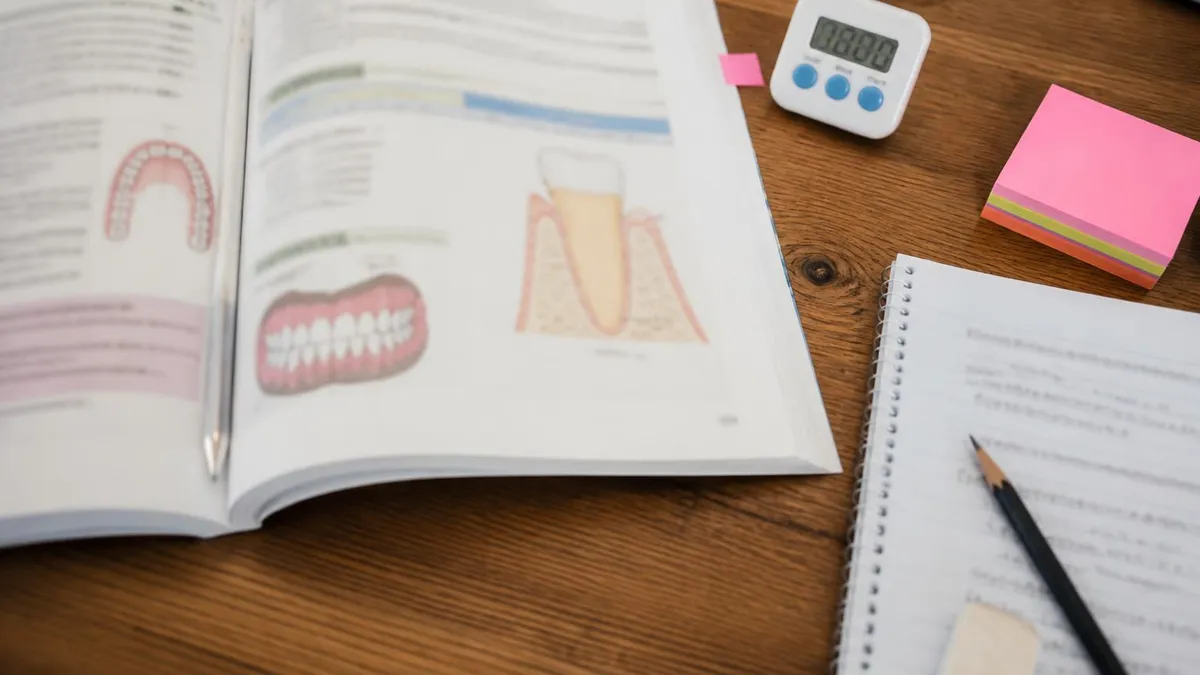
California's First-Time Pass Rate Averages Around 54% — Preparation Is the Differentiator
Candidates who complete at least 800 practice questions before exam day pass at rates significantly higher than those who study from textbooks alone. The written exam is designed to test clinical reasoning, not rote memorization — practice tests are the only study method that replicates that cognitive demand. Prioritize quality over quantity: review every incorrect answer thoroughly before moving to the next question set.
Knowing how to use practice tests strategically — rather than just completing them passively — is what separates candidates who score in the high eighties from those who barely pass. The most effective approach begins with a diagnostic test taken without any prior review. This cold baseline tells you exactly where your knowledge gaps are before you invest study time, so you can front-load your effort on the domains that need the most work rather than reviewing material you already know well.
After your diagnostic, organize your study calendar around the eight content domains weighted by their exam percentage. Infection control and radiography together account for 32 percent of the test — if you are weak in either area, those domains deserve daily attention during the first three weeks of your preparation. Do not make the common mistake of spending most of your time on the material you find most interesting or most familiar. The exam does not reward comfort; it rewards comprehensive competence across all tested areas.
Mid-way through your preparation, take your second full-length practice test under timed, exam-like conditions. Compare your domain-by-domain performance to your baseline diagnostic. The domains where you have improved most significantly can receive lighter maintenance review going forward. The domains where improvement has stalled — or where you have actually regressed, which sometimes happens when candidates move through topics too quickly — should receive intensified attention during the back half of your study schedule.
A critical but often overlooked practice-test strategy is the error log. After every practice session, record every question you answered incorrectly: the topic, the specific concept tested, why you chose the wrong answer, and why the correct answer is right. Reviewing your error log weekly reveals patterns — perhaps you consistently miss questions about maximum anesthesia doses, or you confuse the steps in the sterilization cycle. Targeted review of your personal error patterns is far more efficient than re-reading entire textbook chapters.
For the California-specific expanded duties domain, seek out practice questions that address the legal scope of what an RDA can do independently versus what requires direct dentist supervision. Many RDA candidates have been working as dental assistants for years before seeking licensure and may hold informal assumptions about their scope of practice that differ from what California law actually specifies. The written exam will test those legal boundaries precisely — questions often present scenarios where the RDA must decide whether an action is within or outside their authorized scope.
As you approach the final two weeks before your exam, shift from learning new material to consolidating and retrieving what you have already studied. Your final week should consist of one more full-length timed practice test, two or three domain-specific targeted sessions addressing any remaining weak areas, and a light review of your error log. Resist the temptation to introduce new study resources in the final week — the cognitive overhead of processing unfamiliar material at this stage creates confusion rather than clarity and can destabilize information that is already well-consolidated.
Understanding the rda promart and other specialized instrument and equipment terminology that appears on the California RDA exam requires practical exposure. If your dental assisting program or workplace does not give you hands-on time with the specific instruments tested, supplement with high-quality video resources that show instrument use in clinical context. The ability to connect a visual image of an instrument to its name, function, and the procedure it supports is a skill that pure text-based study cannot fully develop — your practice test performance will reflect that gap if you do not address it proactively.
The Dental Board of California typically issues authorization-to-test letters that are valid for a limited window, often 90 to 120 days. If you miss your testing window without an approved deferral, you may need to reapply and pay additional fees. Confirm your exam eligibility period immediately upon receiving your authorization letter and schedule your test date within the first two weeks to preserve maximum flexibility in case you need to reschedule.
The California RDA Practical Examination (RDAPE) is a separate component that tests your hands-on clinical skills in front of live evaluators. While the written exam tests what you know, the practical exam tests what you can do — and many candidates who pass the written exam on the first attempt struggle with the practical component because they have not invested equivalent preparation time in clinical simulation. Understanding both components together gives you a complete picture of what California's licensure process requires.
The practical examination typically includes stations for coronal polishing, fluoride application, instrument identification, radiographic technique, taking alginate impressions, placing and carving amalgam restorations on a typodont, and demonstrating proper infection control procedures. Each station is scored by a licensed examiner according to standardized rubrics. Candidates who have completed an accredited dental assisting program have a significant advantage because they have performed these skills under faculty supervision before attempting the licensure examination.
For candidates qualifying through work experience rather than a formal dental assisting program, practical exam preparation requires deliberate, supervised practice. Simply having performed these tasks informally at a dental office is not sufficient — you need to perform them according to the specific technique criteria the Dental Board evaluators use. Seek out continuing education workshops, community college dental assisting labs that offer open practice sessions, or mentorship from a currently licensed RDA or dentist who can evaluate your technique against exam standards.
Infection control station performance is particularly important in the practical exam because a single critical error — such as touching a contaminated surface with an ungloved hand or failing to change gloves between tasks — can result in immediate failure of that station. Review the Dental Board of California's published practical exam candidate handbook thoroughly and note every critical versus non-critical error category. Critical errors are instant station failures; non-critical errors accumulate into point deductions. Knowing which mistakes carry which consequences helps you prioritize your technique refinement.
Radiographic technique is another high-risk practical station. You must demonstrate proper film or sensor placement, correct cone angulation, and appropriate lead apron placement on a typodont mannequin. The examiners assess both the technical accuracy of your radiographic technique and your radiation safety practices. Candidates who have not recently practiced periapical and bitewing technique on a mannequin often experience difficulty with the spatial visualization required to achieve correct vertical and horizontal angulation under exam pressure.
Preparing for both the written and practical components simultaneously is logistically demanding, which is why most successful candidates follow a phased approach. During the first 8 weeks, prioritize written exam content — knowledge acquisition, practice testing, and error log review. During the final 4 weeks, shift emphasis toward practical skill refinement while maintaining written exam fluency through weekly practice test sessions. This phased structure prevents the cognitive split-attention that occurs when candidates try to study theory and practice clinical skills with equal intensity at the same time.
For comprehensive certification guidance beyond what this page covers, including application requirements, fee schedules, and continuing education requirements for license renewal, the california rda practice test resource page provides a detailed walkthrough of the complete California RDA licensure pathway from application through active license status. Combining that regulatory knowledge with the clinical preparation strategies outlined here gives you the full strategic picture needed to approach both exam components with confidence and purpose.
The final phase of your California RDA exam preparation should focus on consolidating your clinical reasoning skills and building the test-taking endurance needed to sustain performance across a 3.5-hour computer-delivered examination. By this point in your preparation, you should have completed multiple full-length practice tests, reviewed your error log consistently, and addressed your primary knowledge gaps through targeted domain review. The final two weeks are about refinement, confidence, and logistics — not new learning.
One of the most practical final-phase strategies is to practice reading exam questions with deliberate attention to qualifiers and conditional language. California RDA exam questions frequently include words like always, never, first, most appropriate, and best — terms that narrow the range of correct responses and that careless readers often overlook. Train yourself to underline or mentally note these qualifiers every time you encounter them in practice, because the difference between a correct and incorrect answer often hinges on a single word in the question stem.
Time management during the actual exam requires a pre-planned pacing strategy. With 130 questions in 210 minutes, you have approximately 97 seconds per question — just over a minute and a half. Most questions should take you 45 to 75 seconds, which means you should have time remaining at the end to revisit flagged questions.
If you find yourself spending more than 2 minutes on a single question during practice tests, this is a signal to practice your decision-making speed. Eliminating two obviously wrong answer choices and committing to the better of the remaining two is almost always more productive than extended deliberation.
Nutrition, sleep, and physical preparation matter more than most candidates acknowledge. Cognitive performance on standardized tests is measurably affected by sleep deprivation — candidates who sleep fewer than 6 hours the night before the exam score lower on average than well-rested peers, regardless of their preparation level. Prioritize 7 to 8 hours of sleep in the final week, reduce caffeine after noon to protect sleep quality, and treat the 48 hours before your exam as a recovery period rather than a final cramming opportunity.
On exam morning, arrive at the testing center early enough to clear check-in procedures without rushing. The biometric check-in process at Pearson VUE or other approved testing centers involves photo identification, palm vein scanning, and a security screening that can take 15 to 20 minutes. Candidates who arrive stressed and late lose the mental composure that the first section of the exam demands. Build a generous time buffer into your morning logistics, regardless of how close the testing center is to your home.
During the exam itself, do not interpret difficulty as failure. The California RDA written exam includes field test items — unscored experimental questions that the Dental Board uses to validate new items for future test forms. You will not know which questions are scored and which are field test items, but encountering a question that seems unusually difficult or outside your knowledge base does not mean you are doing poorly. Stay calm, apply your best clinical reasoning, and move forward. Anxiety about individual questions is far more damaging to your overall score than any single wrong answer could be.
After you submit the exam, most candidates receive their preliminary score report before leaving the testing center. If you pass, your next step is confirming the Dental Board has received all components of your application — including your practical exam results if taken separately — and processing your license issuance.
If you need to retake the written exam, review your score report by domain to understand exactly where the deficit occurred, build a revised study plan targeting those specific areas, and allow yourself at least four to six additional weeks of focused preparation before scheduling a retake. Many successful California RDAs passed on their second attempt after strategic, targeted remediation.
RDA Questions and Answers

What Is an RDA in Dentistry? Complete Career Overview for Registered Dental Assistants
RDA Certification: Complete Guide to Becoming a Registered Dental Assistant in 2026

Registered Dental Assistant Salary: 2026 Pay, Growth & Career Guide

RDA License Lookup: How to Verify a Registered Dental Assistant's Credentials

RDA Classes: Complete Study Guide for Registered Dental Assistant Certification
About the Author

Educational Psychologist & Academic Test Preparation Expert
Columbia University Teachers CollegeDr. Lisa Patel holds a Doctorate in Education from Columbia University Teachers College and has spent 17 years researching standardized test design and academic assessment. She has developed preparation programs for SAT, ACT, GRE, LSAT, UCAT, and numerous professional licensing exams, helping students of all backgrounds achieve their target scores.
Join the Discussion
Connect with other students preparing for this exam. Share tips, ask questions, and get advice from people who have been there.
View discussion (8 replies)