
RDA Practice Test: Free Registered Dental Assistant Questions & Answers (2026)
🗨️ Free registered dental assistant practice test with realistic RDA exam questions, answers, and study tips to pass your RDA certification fast.
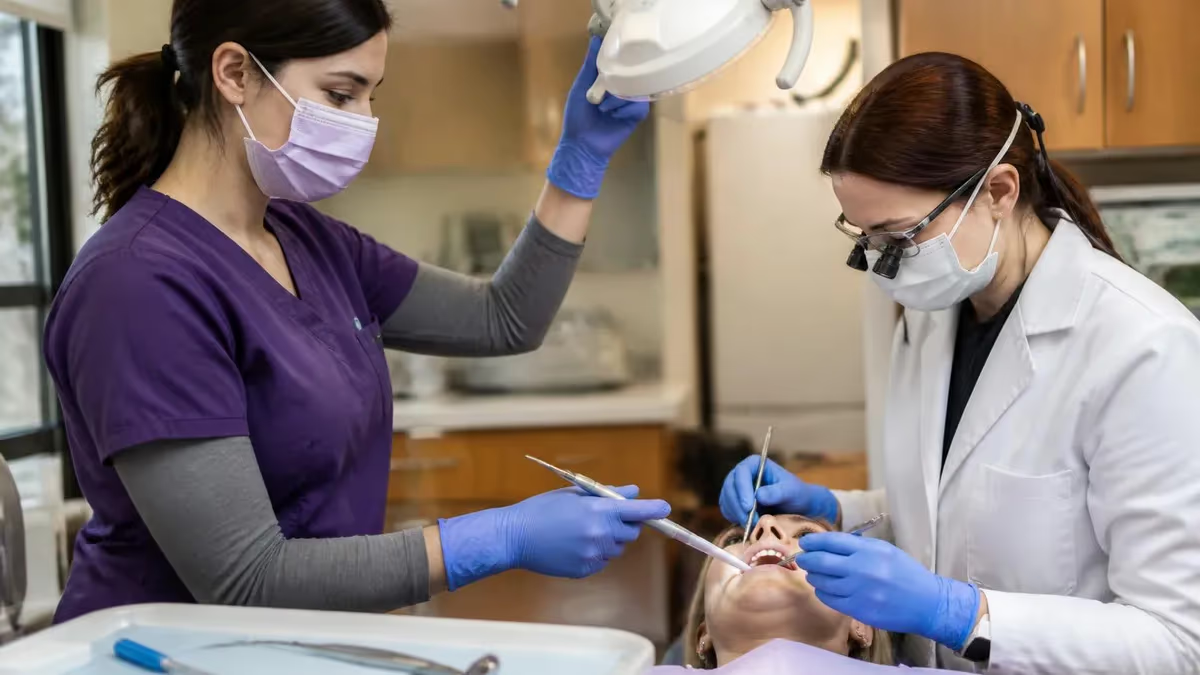
A focused rda practice test is the single most effective way to find out whether you are truly ready for your registered dental assistant exam, and it is far more useful than passively re-reading a textbook. When you sit down with realistic questions, you discover the gaps in your knowledge while there is still time to fix them. Our free rda practice test mirrors the structure, tone, and difficulty of the real registered dental assistant certification exam so nothing on test day catches you off guard. Practice with the free Registered Dental Assistant practice test on PracticeTestGeeks (7 questions with answer explanations).
If you are new to this path, you may be searching for the rda meaning or a clear definition rda before diving into questions. In a dental career context, RDA stands for Registered Dental Assistant: a credentialed professional who has passed a state or national exam and is licensed to perform expanded clinical duties beyond those of a basic chairside assistant. Understanding that rda definition helps you appreciate why the exam tests both clinical skill and patient-safety judgment so heavily throughout.
The registered dental assistant credential opens doors. With certification you can take radiographs, place sealants, perform coronal polishing, apply fluoride, and assist with more advanced procedures depending on your state. Each of those duties shows up on the exam, which is exactly why a practice test built around real categories matters. Random trivia will not prepare you; questions organized by anesthesia, charting, instruments, sterilization, radiography, and medical emergencies will move you toward a confident pass.
Many candidates underestimate how much the exam emphasizes safety, infection control, and emergency response rather than rote memorization. You might know the name of every instrument on a tray, but the exam also wants to know whether you understand why a particular sterilization monitor failed or how you would react if a patient collapsed in the chair. A good practice test forces you to think like a clinician, not just a student who memorized flashcards the night before the exam.
This guide pairs detailed study advice with direct links to free quizzes covering every major exam domain. You can read a section, take the matching quiz, review your wrong answers, and immediately reinforce the concept. That loop of study, test, and review is backed by decades of learning research and consistently produces higher scores than cramming. Treat each quiz as a diagnostic tool rather than a pass-fail judgment of your worth or your future as a dental professional.
Throughout this article we reference the highest-value keywords candidates actually search, including rda certification requirements, rda meaning, and what the registered dental assistant role involves day to day. Whether you are weeks away from your test or just starting to explore the field, the resources below will give you a clear, structured, and confidence-building path toward passing on your first attempt and launching a genuinely rewarding healthcare career.
RDA: upcoming dates and official changes
- Updated Oct 19, 2026: Registration deadline (AMT RDA certification) is now Application valid 1 year (previously Application valid for one year).
- Updated Oct 19, 2026: Delivery (AMT RDA certification) is now Pearson VUE test center (previously Pearson VUE testing centers).
Facts verified Oct 19, 2026 against Dental Board of California. Dates that have passed are removed automatically.
- AMT allows an RDA exam retake 45 days after a failed attempt, limited to four lifetime attempts per certification. (americanmedtech.org)
- AMT exams can be taken at a Pearson VUE testing center once the candidate is authorized to test. (americanmedtech.org)
- AMT RDA applicants must meet one of five routes: Education, Competency & Work-Based Learning, Military, Work Experience or Instructor. (americanmedtech.org)
- AMT candidates see their score moments after completing the exam. (americanmedtech.org)
Facts verified Oct 19, 2026 against Dental Board of California. Dates that have passed are removed automatically.
RDA Exam at a Glance
| Item | Detail | Official source |
|---|---|---|
| Retake policy (AMT RDA certification) | 45-day wait; 4 lifetime attempts | americanmedtech.org |
| Delivery (AMT RDA certification) | Pearson VUE test center | americanmedtech.org |
| Eligibility (AMT RDA certification) | Education, competency/work-based learning, military, work experience or instructor route | americanmedtech.org |
| Score release (AMT RDA certification) | Moments after the test | americanmedtech.org |
| Registration deadline (AMT RDA certification) | Application valid 1 year | americanmedtech.org |
Facts verified Oct 19, 2026 against Dental Board of California. Dates that have passed are removed automatically.
Free Registered Dental Assistant Study Tools
Interactive Registered Dental Assistant resources on PracticeTestGeeks, free to start:
- Registered Dental Assistant flashcards — review key terms and concepts card by card
- Registered Dental Assistant study guide — topic-by-topic overview of what the exam covers
- Registered Dental Assistant cheat sheet — one-page printable summary for last-minute review
RDA Practice Test by the Numbers

RDA Exam Format & Structure
| Section | Questions | Time | Weight | Notes |
|---|---|---|---|---|
| Anesthesia & Sedation | 15 | 14 min | 15% | Monitoring & assisting |
| Dental Charting & Morphology | 18 | 16 min | 18% | Tooth ID & occlusion |
| Instruments & Tray Setups | 17 | 15 min | 17% | Procedure-specific trays |
| Sterilization & Monitoring | 20 | 18 min | 20% | Infection control |
| Radiographic Techniques | 15 | 14 min | 15% | Errors & safety |
| Medical Emergencies | 15 | 13 min | 15% | Recognition & response |
| Total | 100 | 90 minutes | 100% |
The registered dental assistant role is one of the most hands-on positions in modern dentistry, blending technical skill with constant patient interaction. On any given day an RDA might take and process radiographs, set up procedure trays, perform coronal polishing, apply fluoride varnish, place dental sealants, and assist the dentist during restorations or extractions. Because these duties directly affect patient safety, every one of them is fair game on the exam, and our free quizzes are organized to reflect that real clinical scope of practice.
Beyond chairside tasks, registered dental assistants are often the calm voice that guides anxious patients through a procedure. They explain post-operative instructions, document treatment in the patient chart, and ensure that consent and medical histories are complete and accurate. The exam tests this communication-and-documentation dimension because a small charting error can lead to a major treatment mistake. A strong rda practice test will include scenario questions that ask you to spot incomplete or contradictory chart entries before they cause harm.
Infection control sits at the very heart of the registered dental assistant job. From the moment a patient sits down to the final wipe-down of the operatory, the RDA follows strict protocols for surface disinfection, instrument processing, and personal protective equipment. Sterilization and monitoring carry the heaviest weight on most exams, around twenty percent, precisely because lapses here endanger lives. Practicing these questions until they feel automatic is one of the highest-return investments you can make in your entire study plan.
Radiography is another core competency. A registered dental assistant must position the sensor or film correctly, select appropriate exposure settings, follow ALARA radiation-safety principles, and recognize common errors such as cone cuts, elongation, foreshortening, and overlapping. Exam writers love radiographic-error identification because it proves you can self-correct in real practice. When you take our free radiography quiz, study not just the right answer but the cause of each error so you can prevent it on the job every time.
Assisting with anesthesia and sedation is a higher-stakes responsibility that requires vigilance. The RDA prepares syringes, monitors the patient's vital signs and level of consciousness, and watches for adverse reactions during local or nitrous-oxide sedation. Exam questions in this domain often blend pharmacology basics with monitoring judgment, asking what you would do if a patient's breathing changed. Treat these as emergency-prevention questions rather than simple drug-fact recall, and your scores in this category will climb noticeably.
Finally, the registered dental assistant must be ready for true medical emergencies: syncope, allergic reactions, hypoglycemia, airway obstruction, and cardiac events can all occur in the dental chair. Knowing the recognition signs and the correct first response is non-negotiable, which is why this domain appears on every credible exam. The role is demanding but deeply rewarding, and mastering these categories through targeted practice is what separates candidates who pass on the first try from those forced to retake the exam.
RDA Meaning & Definition Explained
The rda meaning in dentistry is straightforward but important: RDA stands for Registered Dental Assistant. This is a credentialed professional who has met state education and examination requirements to perform expanded clinical duties under a dentist's supervision. The registered dental assistant title signals that the holder has passed a recognized competency exam and maintains active licensure with their state dental board, which legally separates them from an uncredentialed assistant.
Understanding the rda meaning matters because employers, patients, and regulators all rely on the title to confirm scope of practice. A plain dental assistant and a registered dental assistant are not interchangeable; the registered credential legally expands what tasks you may perform in the operatory. That distinction is exactly why so many candidates search the rda meaning before committing to the certification pathway and the focused exam preparation it requires to succeed. Knowing the precise rda meaning also helps you read job listings accurately, since many postings list registered dental assistant as a hard requirement rather than a preference.

Should You Use Free RDA Practice Tests? Pros & Cons
- +Identifies your weak domains before the real exam, when there is still time to fix them
- +Builds familiarity with question wording and the pressure of timed conditions
- +Completely free, so you can retest as many times as you want
- +Organized by real exam categories like sterilization, radiography, and emergencies
- +Reinforces learning through the proven test-review-retest loop
- +Boosts confidence so test-day anxiety does not sabotage your performance
- −Free tests may not perfectly match your specific state board's question pool
- −Without reviewing wrong answers, repeated guessing teaches very little
- −Cannot replace hands-on clinical training and supervised externship hours
- −Question volume on any single free site is finite, so combine several sources
- −Easy to over-rely on recognition instead of true understanding of concepts
- −No substitute for reading your state's official candidate handbook and scope rules
Pros and Cons at a Glance
| Pros | Cons |
|---|---|
| Identifies your weak domains before the real exam, when there is still time to fix them | Free tests may not perfectly match your specific state board's question pool |
| Builds familiarity with question wording and the pressure of timed conditions | Without reviewing wrong answers, repeated guessing teaches very little |
| Completely free, so you can retest as many times as you want | Cannot replace hands-on clinical training and supervised externship hours |
| Organized by real exam categories like sterilization, radiography, and emergencies | Question volume on any single free site is finite, so combine several sources |
| Reinforces learning through the proven test-review-retest loop | Easy to over-rely on recognition instead of true understanding of concepts |
| Boosts confidence so test-day anxiety does not sabotage your performance | No substitute for reading your state's official candidate handbook and scope rules |
RDA Practice Test Preparation Checklist
- ✓Read your state dental board's official RDA candidate handbook end to end
- ✓Confirm your eligibility, education hours, and any required externship
- ✓Take a full-length rda practice test to establish your baseline score
- ✓Identify your two weakest domains from the diagnostic results
- ✓Drill sterilization and monitoring questions until they feel automatic
- ✓Review every wrong answer and write down why the correct option is right
- ✓Practice radiographic error identification with real image examples
- ✓Memorize emergency recognition signs and the correct first response for each
- ✓Retake practice quizzes under timed conditions to build exam stamina
- ✓Schedule your exam only after you consistently score above the pass threshold

Always review your wrong answers within 24 hours
Taking a quiz is only half the work. The candidates who improve fastest revisit every missed question while it is still fresh, writing down the underlying concept rather than just the letter of the correct choice. This active review converts a single mistake into permanent knowledge and is the highest-return study habit you can build before exam day.
Studying effectively for the registered dental assistant exam is less about how many hours you log and more about how you structure those hours. The most reliable approach is the diagnostic-first method: take a full rda practice test before you study anything, score it honestly, and let the results dictate where your attention goes. If sterilization is your weakest area, that is where the first study block belongs, not the topic you already enjoy and feel most comfortable with already.
Spaced repetition beats cramming every single time. Rather than a marathon session the night before, schedule short, frequent study blocks across several weeks. Revisit each domain multiple times with a few days in between so the material moves into long-term memory. Research on learning consistently shows that the same total study time, spread out instead of crammed, can improve retention dramatically. Build a simple calendar and protect those study blocks like real, unmovable appointments on your day.
Active recall is the engine that makes practice tests so powerful. When you force your brain to retrieve an answer, you strengthen the memory far more than re-reading ever could. That is why a quiz-heavy plan outperforms a reading-heavy one. After each quiz, close the page and try to explain the concept aloud as if teaching a classmate. If you cannot explain why a wrong answer is wrong, you have just found your next study target to attack.
Simulate real conditions as your exam approaches. Sit in a quiet room, set a timer that matches the real exam pace, and complete a full-length practice test without pausing. This trains both your knowledge and your stamina, and it desensitizes you to the time pressure that derails so many otherwise-prepared candidates. Note how you feel at the forty-minute mark; if your focus dips there, that is exactly what you need to train before test day finally arrives.
Prioritize by exam weight, not by personal interest. Because sterilization and monitoring typically carry the heaviest weight, mastering that domain delivers the biggest score gain per hour of study. Charting, instruments, radiography, anesthesia, and emergencies follow close behind. Map your weakest domains against their exam weight and you will quickly see where focused effort pays off most. A balanced plan still touches every category, but it leans hardest where the points are most plentiful.
Finally, manage your energy as carefully as your information. Sleep, hydration, and short breaks measurably improve recall and reaction speed, both of which the exam rewards. Avoid the temptation to pull an all-nighter, which reliably lowers scores. In the final week, taper to light review and confidence-building quizzes rather than absorbing brand-new material. Walking into the testing center rested and calm is worth several points, and it is entirely within your own control with a little planning.
RDA certification rules, exam content, and passing scores vary by state. Always confirm your education hours, eligibility, and the specific exam your state board accepts before you register. Testing under the wrong assumptions can cost you both your fee and weeks of delay, so read the official candidate handbook first.
The path to becoming a registered dental assistant follows a clear sequence, though the exact steps depend on your state. Most candidates begin with a state-approved dental assisting program or accumulate documented on-the-job training hours. From there you complete any required courses in radiation safety, coronal polishing, or infection control, then apply to sit for the rda certification exam through your state board. Knowing this sequence early helps you avoid scrambling for a missing prerequisite at the very last minute.
Rda certification is what legally transforms a general dental assistant into a registered one with expanded duties. The credential typically requires passing a written exam, and in some states a practical or clinical component as well. Once certified, you can perform tasks that an uncredentialed assistant cannot, which directly increases both your value to an employer and your earning potential. That is why so many assistants treat the exam as a smart career investment rather than just a hurdle to clear.
Eligibility is the step candidates most often get wrong. Some states require graduation from an accredited program, while others accept a defined number of supervised work hours instead. There may be separate certificates required for radiography or specific expanded functions. Before you pay any fee, read your state board's eligibility section line by line and gather every document it lists. A rejected application over a missing transcript is a frustrating and entirely avoidable delay you can prevent.
The exam itself is designed to confirm that you can practice safely and competently from day one. Expect a heavy emphasis on infection control, radiography safety, and emergency response, because those are the areas where mistakes harm patients most directly. The content blueprint published by your board tells you exactly how many questions come from each domain, and you should use that blueprint to weight your study time. Treat it as a map showing exactly where the points are hiding.
After you pass, certification is not permanent without upkeep. Most states require continuing education credits and periodic renewal to keep your registered dental assistant status active. Some also mandate current CPR or basic-life-support certification on file. Building a habit of tracking your renewal date and CE hours from the start keeps your credential in good standing and prevents the stressful, last-minute scramble that catches many assistants off guard every single renewal cycle around the country.
If you want a deeper walkthrough of the credential, eligibility, and what to expect on test day, our companion guide to the rda practice test breaks the entire process down step by step. Pairing that overview with the free quizzes on this page gives you both the big-picture roadmap and the hands-on practice you need. The combination is what turns an anxious first-time candidate into someone who walks in fully prepared and walks back out newly certified.
With your study plan in place, the final stretch before your exam is about sharpening execution rather than absorbing new material. In the last two weeks, shift the bulk of your time to full-length, timed practice tests and disciplined review of every miss. The goal is to walk into the testing center having already experienced the exam's rhythm dozens of times, so the real thing feels routine rather than threatening. Familiarity, more than raw knowledge alone, is what truly calms test-day nerves for most candidates.
Develop a simple, repeatable strategy for working through questions. Read each question stem completely before looking at the answer choices, and watch for qualifier words like always, never, first, and except, which often determine the correct response. When two answers seem close, ask which one a board examiner focused on patient safety would prefer. That safety lens resolves a surprising number of tricky questions, because the exam consistently rewards the most cautious, protocol-driven choice over the merely convenient or faster one.
Pace yourself deliberately and never let a single hard question drain your clock. If you are stuck after thirty seconds, flag it, make your best guess, and move on without hesitation. Returning later with fresh eyes often makes the answer obvious, and you avoid the trap of sacrificing five easy points to chase one difficult one. Most exams do not penalize guessing beyond a wrong answer, so always answer every question rather than leaving any blanks behind you.
Use the elimination method aggressively. Even when you do not know the answer outright, you can usually rule out one or two clearly wrong options, which dramatically improves your odds on the remaining choices. Practicing this skill on free quizzes trains your instinct so it kicks in automatically under pressure. Pay special attention to answers that are technically true but do not actually address what the question is asking, a classic distractor on credentialing exams that traps unprepared candidates.
Prepare your logistics the day before so nothing rattles you. Confirm the testing center address, your identification requirements, and your arrival time, then lay everything out the night before. Eat a real meal, hydrate, and get a full night of sleep instead of squeezing in one more study session. Arriving early and unhurried lets your preparation do its job. The most common test-day mistakes are logistical, not academic, and they are entirely preventable with a little forethought.
After the exam, regardless of how it felt, give yourself credit for the work you put in. If you passed, begin tracking your continuing-education and renewal requirements immediately so your credential stays active. If you fell short, request your score breakdown, identify the domains that pulled you down, and return to the matching quizzes with a sharper focus. Every attempt teaches you something useful, and the candidates who treat a setback as data rather than defeat almost always pass on the next try.
Above all, trust the process you have built. Consistent practice, honest review, and steady pacing beat last-minute panic every single time. The free quizzes throughout this page exist to give you that consistent practice across all six exam domains, so use them generously and often. With a clear plan and the discipline to follow it, the registered dental assistant exam becomes not an obstacle but the final, very achievable step into a stable and meaningful dental career.
Sample Registered Dental Assistant Practice Questions
Try these questions from our free Registered Dental Assistant practice tests. The correct answer and an explanation follow each question.
A dental assistant notices the autoclave's biological indicator test shows growth after a cycle. What is the correct immediate action?
- A. Run one more cycle and retest before taking action
- B. Stop using the autoclave and remove all non-implantable items sterilized since the last negative test
- C. Notify the dentist but continue using the autoclave for non-surgical procedures
- D. Recall only patients who received implant procedures
Answer: B. Stop using the autoclave and remove all non-implantable items sterilized since the last negative test
A positive biological indicator means the sterilizer failed; the autoclave must be removed from service immediately and all items sterilized since the last successful test must be recalled and resterilized.
Which duty is within the scope of practice for a Registered Dental Assistant in most US states?
- A. Diagnosing dental caries
- B. Performing coronal polishing after training and certification
- C. Prescribing fluoride treatments
- D. Interpreting radiographs independently
Answer: B. Performing coronal polishing after training and certification
Coronal polishing is a delegable expanded function that RDAs can legally perform in most states after completing required training.
The State Dental Board has the authority to take which action against a dental assistant who violates the Dental Practice Act?
- A. File a criminal indictment
- B. Suspend or revoke the assistant's license or certificate
- C. Impose prison sentences
- D. Order the employer to terminate the assistant
Answer: B. Suspend or revoke the assistant's license or certificate
The State Dental Board can suspend, revoke, or place conditions on a dental assistant's license or certificate for violations of the Dental Practice Act.
When instructing a patient on the Bass toothbrushing technique, the dental assistant should direct the patient to angle the brush bristles at approximately:
- A. 0 degrees (parallel to the occlusal plane)
- B. 30 degrees toward the gingival margin
- C. 45 degrees toward the gingival margin
- D. 90 degrees perpendicular to the tooth surface
Answer: C. 45 degrees toward the gingival margin
The Bass technique places the bristles at a 45-degree angle to the gingival margin so they penetrate slightly into the gingival sulcus and disrupt subgingival plaque. This makes it effective for patients with gingivitis or periodontal disease. The bristles are then vibrated with short back-and-forth strokes.
Take the full Registered Dental Assistant practice test
RDA Questions and Answers

How this page was made: written with AI tools and published by Nathan Beja, founder of Practice Test Geeks, who is responsible for its content. Exam facts are checked against the official sources listed below. Not reviewed by a subject-matter expert. Editorial policy
Sources & references
Exam facts on this page (fees, format, dates, passing scores) are checked against these official sources; the date is our last check. Editorial policy
- dbc.ca.gov — Eligibility, fees, registration deadline · verified Oct 2026
- americanmedtech.org — Eligibility, test delivery, registration deadline, retake policy, score release · verified Oct 2026
- test-takers.psiexams.com — Fees, retake policy, score release, time limit · verified Oct 2026