
RDA Certification: Complete Guide to Becoming a Registered Dental Assistant in 2026 October
❓ RDA certification guide covering exam requirements, costs, study schedule, and pass rates. Everything you need to become a Registered Dental Assistant.
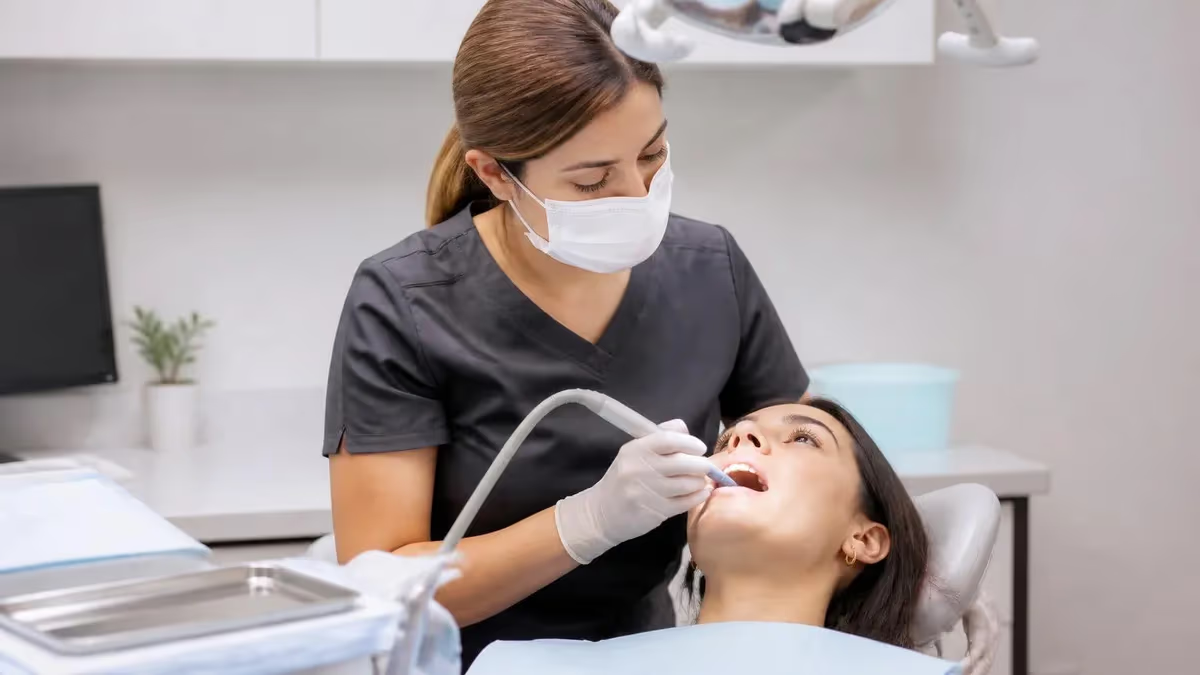
RDA certification is the credential that transforms an entry-level chairside worker into a state-licensed clinical professional with the legal authority to perform expanded duties under a dentist's supervision. If you are exploring this career path, the rda meaning is simple: a Registered Dental Assistant has completed the educational, clinical, and examination requirements set by a state dental board and now holds an active license to practice. That license unlocks higher pay, broader responsibilities, and a stable career.
Across the United States, roughly 350,000 dental assistants work in private practices, public clinics, and specialty offices. Of those, a growing percentage are pursuing or already hold RDA certification because employers increasingly require it. States like California, Texas, Arizona, and Minnesota maintain formal registration systems with examinations, while others rely on national credentials like the CDA or DANB pathways to validate competence.
The path to becoming a Registered Dental Assistant involves four core stages: completing an accredited or board-approved training program, accumulating supervised clinical hours, passing a written examination, and in many states passing a practical clinical exam. The total time investment ranges from nine months to two years depending on whether you enroll in a certificate program, an associate degree track, or an on-the-job training pathway that leads to eligibility.
One of the most common questions new students ask is whether the credential is worth the investment. The short answer is yes. Registered Dental Assistants typically earn between $4 and $8 more per hour than unregistered assistants performing similar work. Over a 30-year career, that wage premium adds up to more than $200,000 in additional lifetime earnings, easily justifying the upfront cost of training and exam fees.
This guide walks you through every component of RDA certification: eligibility requirements, exam format, study resources, costs, timelines, and the practical strategies test-takers use to pass on their first attempt. We pull data from state dental boards, the Dental Assisting National Board, and surveys of working RDAs to give you accurate, current information you can act on.
You will also find direct links to free practice quizzes covering every major exam domain, from instrument identification to radiographic technique. These quizzes mirror the question style and difficulty of the real exam and are used by thousands of candidates each month as part of their preparation. Bookmark this page, work through each section systematically, and treat the practice questions as diagnostic checkpoints rather than memorization drills.
By the end of this article you will understand exactly what RDA certification requires in your state, how much it costs, how long it takes, and the most efficient study plan to follow. Whether you are a high school graduate exploring dental careers or a current dental assistant looking to formalize your skills, this guide gives you a clear, step-by-step roadmap.
RDA Certification by the Numbers

Core RDA Certification Requirements
Complete a board-approved dental assisting program of at least 9 months, or document equivalent on-the-job training of 12-24 months under a licensed dentist. Programs must include 240+ clinical hours.
Accumulate supervised clinical hours performing basic chairside duties, radiography, instrument processing, and patient management. Most states require 1,000-2,500 verified hours before exam eligibility.
Submit fingerprints and pass a state and federal criminal background check. Felony convictions involving fraud, violence, or controlled substances may disqualify or require board review.
Hold current Basic Life Support (BLS) or CPR for Healthcare Providers certification. Some states also require Infection Control, Coronal Polishing, and Radiation Safety certificates before sitting for the exam.
Pass the state's written general knowledge exam and, in states like California, a separate clinical practical exam demonstrating chairside competency, isolation techniques, and material manipulation.
The written portion of RDA certification typically contains 100 to 170 multiple-choice questions covering nine major content domains. These domains were developed by job-task analyses conducted by state dental boards and reflect the real responsibilities of a working registered dental assistant. Understanding the weighting of each domain helps you allocate study time efficiently rather than trying to memorize every textbook chapter equally.
The largest content area is usually chairside assisting and four-handed dentistry, accounting for roughly 25 percent of questions. Within this domain you will encounter scenarios involving tray setups, instrument transfer, moisture control, suction technique, and assisting during specific procedures like amalgam restorations, crown preparations, endodontic therapy, and surgical extractions. Expect questions that test both rote memory and applied clinical judgment.
Infection control and sterilization typically represent 15 to 18 percent of the exam. Topics include personal protective equipment selection, instrument processing workflows from contaminated to sterile, autoclave monitoring with biological indicators, surface disinfection protocols, and waterline maintenance. Recent updates to the exam emphasize the latest CDC guidelines and OSHA bloodborne pathogen standards, so use current study materials rather than older editions.
Radiography and imaging accounts for 12 to 15 percent of questions. You will need to identify common technique errors like elongation, foreshortening, cone cuts, and overlap, recognize anatomical landmarks on bitewing and periapical films, and understand patient and operator radiation safety. Digital radiography concepts, sensor placement, and exposure factor adjustments now appear regularly on updated exams.
Dental materials make up about 12 percent of the test. Expect to manipulate the test items mentally: which cement for which crown, which liner under which restoration, mixing ratios for impression materials, and proper handling of dental alloys and composites. Memorize working times, setting times, and the indications for each material category rather than trying to learn brand names.
The remaining domains cover oral pathology and basic dental sciences, medical and dental emergencies, dental office management, jurisprudence and ethics, and pharmacology. Each contributes 5 to 10 percent of questions. Pharmacology often surprises candidates because it requires understanding drug classes, common interactions, and contraindications relevant to dental treatment rather than detailed prescribing knowledge.
Most state exams use a scaled score with a passing threshold around 75 percent. You generally have three to four hours to complete the written portion, which works out to roughly 70 to 100 seconds per question. That pace is comfortable if you have studied systematically but punishing if you are still learning content during the exam. The students who pass on their first attempt almost universally report completing 1,500 to 2,500 practice questions across the months leading up to test day.
RDA Practice Test Questions
Prepare for the RDA - Registered Dental Assistant exam with our free practice test modules. Each quiz covers key topics to help you pass on your first try.
RDA Assisting with Administration of Anest...
RDA Exam Questions covering Assisting with Administration of Anesthesia and Sedation. Master RDA Test concepts for certification prep.
RDA Dental Charting, Tooth Morphology, and...
Free RDA Practice Test featuring Dental Charting, Tooth Morphology, and Occlusion. Improve your RDA Exam score with mock test prep.
RDA Dental Instruments and Tray Setups
RDA Mock Exam on Dental Instruments and Tray Setups. RDA Study Guide questions to pass on your first try.
RDA Instrument Processing, Sterilization, ...
RDA Test Prep for Instrument Processing, Sterilization, and Monitoring. Practice RDA Quiz questions and boost your score.
RDA Radiographic Techniques and Errors
RDA Questions and Answers on Radiographic Techniques and Errors. Free RDA practice for exam readiness.
RDA Recognition and Management of Medical ...
RDA Mock Test covering Recognition and Management of Medical Emergencies. Online RDA Test practice with instant feedback.
RDA Restorative and Impression Materials
Free RDA Quiz on Restorative and Impression Materials. RDA Exam prep questions with detailed explanations.
RDA State Dental Practice Act and Legal/Et...
RDA Practice Questions for State Dental Practice Act and Legal/Ethical Responsibilities. Build confidence for your RDA certification exam.
RDA Job Responsibilities and Duties
RDA Test Online for Job Responsibilities and Duties. Free practice with instant results and feedback.
RDA Skills and Personal Attributes
RDA Study Material on Skills and Personal Attributes. Prepare effectively with real exam-style questions.
RDA Definition and Scope Across States
California is widely considered the most rigorous state for RDA certification. The Dental Board of California requires graduation from a board-approved program or 15 months of equivalent work experience plus completion of specific courses in coronal polishing, ultrasonic scaling, radiation safety, and infection control. Candidates must pass three separate examinations: a Written General Knowledge exam, a Written Law and Ethics exam, and a Combined Clinical and Practical exam.
The practical portion is conducted at approved exam sites and includes hands-on tasks like applying topical fluoride, taking impressions, placing rubber dams, and demonstrating coronal polishing technique on a manikin. Failing any single section requires a retake of only that section, but each retake carries its own fee. California's pass rate hovers around 65 percent on first attempts, lower than the national average.

Is RDA Certification Worth Pursuing?
- +Higher hourly wages averaging $4-8 more per hour than unregistered assistants
- +Legal authority to perform expanded duties like coronal polishing and sealant placement
- +Greater job mobility and easier transitions between practices and specialties
- +Stronger negotiating position for raises, benefits, and schedule flexibility
- +Foundation for advancement into office management, hygiene school, or dental therapy
- +Recognition and professional respect from dentists, hygienists, and patients
- +Pathway to specialty certifications in orthodontics, oral surgery, and pediatrics
- −Upfront training costs ranging from $3,000 to $20,000 depending on program type
- −Exam fees and renewal costs totaling $300-$600 every two years
- −Time commitment of 9-24 months before becoming eligible to test
- −Ongoing continuing education requirements of 12-25 hours annually
- −State-specific rules that may not transfer cleanly if you relocate
- −Practical exam anxiety especially in states with hands-on clinical testing
- −Background check requirements that may exclude candidates with certain convictions
Pros and Cons at a Glance
| Pros | Cons |
|---|---|
| Legal authority to perform expanded duties like coronal polishing and sealant placement | State-specific rules that may not transfer cleanly if you relocate |
| Greater job mobility and easier transitions between practices and specialties | Practical exam anxiety especially in states with hands-on clinical testing |
| Stronger negotiating position for raises, benefits, and schedule flexibility | Background check requirements that may exclude candidates with certain convictions |
RDA Certification Application Checklist
- ✓Verify your state dental board's current eligibility requirements and exam vendor
- ✓Complete a board-approved dental assisting program or document equivalent work hours
- ✓Obtain official transcripts and program completion certificates from your school
- ✓Secure current Basic Life Support or CPR for Healthcare Providers certification
- ✓Complete required courses in coronal polishing, radiation safety, and infection control
- ✓Gather verified clinical hour documentation signed by your supervising dentist
- ✓Submit fingerprints for state and FBI criminal background checks
- ✓Pay the application fee and exam fees through the official board portal
- ✓Schedule your written and practical exams at an approved testing center
- ✓Bring valid government photo identification on exam day along with all confirmation materials
Candidates who complete 1,500+ practice questions pass at nearly double the rate
Internal data from major RDA prep platforms shows that test-takers who work through 1,500 or more practice questions across all content domains achieve a first-attempt pass rate near 88 percent, compared to 47 percent for candidates who complete fewer than 500 questions. The pattern holds regardless of training program or years of clinical experience.
The total cost of RDA certification varies dramatically based on the educational pathway you choose and the state where you plan to practice. Understanding the full cost structure prevents budget surprises and helps you plan financing through scholarships, employer reimbursement, or federal student aid. The price difference between the cheapest and most expensive paths can exceed $20,000, so this decision deserves careful research before enrollment.
Certificate programs at community colleges and proprietary career schools typically range from $3,000 to $15,000 for tuition alone. Add textbooks, scrubs, instrument kits, immunizations, and background checks and most students spend an additional $800 to $1,500 on supporting costs. These programs usually run nine to twelve months and qualify graduates to sit for state and national exams immediately upon completion.
Associate degree programs at community colleges range from $6,000 to $20,000 over two years and include general education courses that transfer toward a bachelor's degree if you later pursue hygiene or healthcare administration. The longer timeline costs more upfront but pays dividends if your goal is upward mobility into dental hygiene, where most programs now require an associate degree as the entry-level credential. Many rda promart students choose this path specifically for future flexibility.
On-the-job training is the lowest-cost pathway but takes the longest. You begin working as an unregistered chairside assistant under a licensed dentist, accumulating the supervised hours your state requires before allowing exam eligibility. Most states demand 12 to 24 months of full-time experience plus completion of specific short courses in radiation safety, infection control, and coronal polishing. Total out-of-pocket cost can be under $2,000 if your employer covers the supplementary courses.
Exam fees themselves are relatively modest compared to training. The written general knowledge exam typically costs $100 to $250, the law and ethics exam adds $50 to $100, and the clinical practical exam ranges from $300 to $500. National DANB component exams cost about $250 each and may be required or accepted depending on your state. Budget $500 to $900 in exam fees alone, and add another $100 to $200 for the initial license issuance fee.
Ongoing costs include biennial license renewals of $80 to $200, continuing education credits of 12 to 25 hours per renewal cycle, and CPR recertification every two years. Many RDAs also invest in professional liability insurance for $150 to $300 annually, which provides peace of mind even when an employer's policy covers workplace incidents. Total annual maintenance averages $250 to $500 once you are certified and working.
The timeline from enrollment to active certification depends on pathway and state. The fastest route, used by candidates who already hold a dental assisting certificate, can compress to four months including study time and exam scheduling. The slowest route, on-the-job training in a state requiring 2,500 supervised hours, may take two and a half years. Average across all pathways is approximately fourteen months from first day of school to license in hand.

Many state dental boards process applications in 60 to 90 days, and incomplete submissions reset the clock. Missing a single fingerprint card, transcript, or signature can delay your exam date by an entire testing cycle. Submit your application at least 120 days before your target exam date and follow up weekly until you receive your authorization to test letter.
Career outcomes for Registered Dental Assistants are strong and projected to remain so through 2034 according to Bureau of Labor Statistics projections. Employment growth for dental assistants overall is expected at 7 percent through the decade, faster than the average for all occupations, driven by an aging population requiring more dental care and the expansion of group dental practices that hire larger clinical teams than traditional solo offices.
Median pay for RDAs nationwide sits around $48,250 per year, but the top 10 percent earn more than $63,000 in states like California, Massachusetts, Minnesota, and Washington. Specialty practices in oral surgery, orthodontics, and pediatric dentistry often pay 10 to 20 percent above general practice rates because the clinical demands and skill requirements are higher. Endodontic and periodontic offices fall in a similar premium range.
Beyond base salary, many practices offer benefits packages worth $8,000 to $15,000 annually including health insurance, retirement matching, paid time off, uniform allowances, and continuing education stipends. Larger group practices and dental service organizations tend to provide more comprehensive benefits than small private offices, though small offices often offer more schedule flexibility and closer mentorship relationships with the dentist owner.
Advancement opportunities open up significantly once you hold the credential. Experienced RDAs frequently move into lead assistant or clinical coordinator roles, where they supervise other assistants and manage clinical operations. Office manager positions in dental practices often draw from the assistant ranks and can pay $55,000 to $80,000 annually. Many rda vape graduates also use the credential as a stepping stone to dental hygiene school, dental sales, or dental school admissions.
Geographic mobility for RDAs is moderately good but not seamless. Each state maintains its own licensing rules, and credentials do not automatically transfer. However, most states offer reciprocity or expedited licensure for RDAs in good standing from other regulated states, typically requiring only a jurisprudence exam and verification of clinical hours. Plan for a 60 to 120 day transition period when relocating to a new state and budget for new state-specific fees.
Job satisfaction surveys consistently rank dental assisting in the top quartile of healthcare occupations, with workers reporting strong relationships with coworkers, manageable physical demands, and reliable schedules that support work-life balance. The work is meaningful, the schedule is predictable, and the credential provides genuine job security in an industry that rarely contracts even during economic downturns.
Burnout exists but is typically lower than for nurses or other allied health workers, partly because most dental practices operate predictable Monday through Thursday schedules with limited evening, weekend, or on-call demands. RDAs who work in pediatric or surgical specialties report somewhat higher stress but also higher compensation, so the trade-off is generally rated as favorable by surveyed practitioners.
The final stretch of RDA exam preparation is where many candidates either lock in their pass or sabotage themselves with poor strategy. The most consistent advice from RDAs who passed on the first attempt is to stop learning new content in the last two weeks and instead transition entirely to active recall through practice questions, flashcards, and timed mock exams. Cramming new material in the final days raises anxiety without improving recall.
Build your final two weeks around three full-length timed practice exams, scheduled to mimic real exam conditions. Start the practice exam at the same time of day as your actual exam, use the same length of break, and avoid your phone during the entire session. After each practice exam, spend two to three hours reviewing every missed question and noting the underlying concept rather than just memorizing the correct answer. The pattern of your errors reveals your remaining content gaps.
Sleep, nutrition, and physical preparation matter more than most candidates realize. Sleep deprivation in the 48 hours before testing measurably reduces working memory and reading comprehension, both critical for multiple-choice exams with longer clinical scenarios. Plan for eight hours of sleep two nights before the exam, because the night-before sleep is often disrupted by anxiety. Eat a moderate protein-rich breakfast on test day and avoid caffeine spikes that cause mid-exam crashes.
On exam day arrive at the testing center at least 30 minutes early with two forms of identification, your authorization to test letter, and any board-approved items you are permitted to bring. Most testing centers prohibit personal items beyond ID and may provide a locker for storage. Wear layered clothing because testing room temperatures vary, and pack a snack and water bottle for breaks if your exam includes one.
During the exam itself, work through questions in two passes. On the first pass, answer every question you know quickly and confidently, and flag any item where you hesitate for more than 30 seconds. After completing the full set, return to flagged items with the time you saved. This approach prevents a single difficult question from consuming time you need for easier later items and reduces the panic spiral that catches many candidates.
When you encounter a question with two seemingly correct answers, look for the qualifying word that distinguishes them: best, first, most appropriate, primary, immediately. The exam writers often build two plausible answers where one is technically correct but the other is the better choice in the specific scenario described. Slow down on those words and reread the question stem before committing.
After the exam, give yourself permission to disconnect for at least a day before checking results or replaying questions in your mind. Most state boards release results within two to six weeks. If you pass, your registration becomes active once you complete the final paperwork and pay any remaining fees. If you do not pass, you typically can retake the exam after 30 to 90 days, and most retakers pass on their second attempt with a focused study plan targeting their previous weak areas.
Sample Registered Dental Assistant Practice Questions
Try these questions from our free Registered Dental Assistant practice tests. The correct answer and an explanation follow each question.
The State Dental Board has the authority to take which action against a dental assistant who violates the Dental Practice Act?
- A. File a criminal indictment
- B. Suspend or revoke the assistant's license or certificate
- C. Impose prison sentences
- D. Order the employer to terminate the assistant
Answer: B. Suspend or revoke the assistant's license or certificate
The State Dental Board can suspend, revoke, or place conditions on a dental assistant's license or certificate for violations of the Dental Practice Act.
Which of the following is a primary responsibility of a Registered Dental Assistant during a dental procedure?
- A. Performing root canals
- B. Handing instruments to the dentist
- C. Diagnosing dental conditions
- D. Administering anesthesia
Answer: B. Handing instruments to the dentist
During a dental procedure, a primary responsibility of a Registered Dental Assistant is to assist the dentist chairside, which includes efficiently handing instruments. This role requires excellent manual dexterity and anticipation of the dentist's needs to ensure smooth and timely treatment. RDAs also prepare materials, suction fluids, and ensure patient comfort throughout the procedure.
A parent calls to inquire about their 17-year-old child's dental treatment. Under HIPAA, when can the dental office share this information without the minor's consent?
- A. Never — minors always have full privacy rights
- B. When the parent is the legal guardian and the minor has not requested confidentiality
- C. Only if the minor is being treated for a communicable disease
- D. Only after the treating dentist approves each request
Answer: B. When the parent is the legal guardian and the minor has not requested confidentiality
Parents who are legal guardians generally have access to a minor's health records unless an exception applies, such as emancipation or treatment for sensitive services.
A dental assistant notices that the protective eyewear worn by a patient has visible blood on it after a procedure. The correct action is to:
- A. Wipe the eyewear with a dry paper towel and return it to the dispenser
- B. Discard the eyewear immediately
- C. Clean and disinfect with an intermediate-level disinfectant before reuse on the next patient
- D. Rinse under tap water only
Answer: C. Clean and disinfect with an intermediate-level disinfectant before reuse on the next patient
Reusable patient eyewear must be cleaned to remove organic debris and then disinfected with an intermediate-level disinfectant before being used on the next patient.
RDA Questions and Answers


About the Author

Educational Psychologist & Academic Test Preparation Expert
Columbia University Teachers CollegeDr. Lisa Patel holds a Doctorate in Education from Columbia University Teachers College and has spent 17 years researching standardized test design and academic assessment. She has developed preparation programs for SAT, ACT, GRE, LSAT, UCAT, and numerous professional licensing exams, helping students of all backgrounds achieve their target scores.
Join the Discussion
Connect with other students preparing for this exam. Share tips, ask questions, and get advice from people who have been there.
View discussion (8 replies)