
RDA Classes: Complete Study Guide for Registered Dental Assistant Certification
Everything about RDA classes, rda meaning, and registered dental assistant certification prep. Free practice tests, study schedules, and exam tips. 🆕
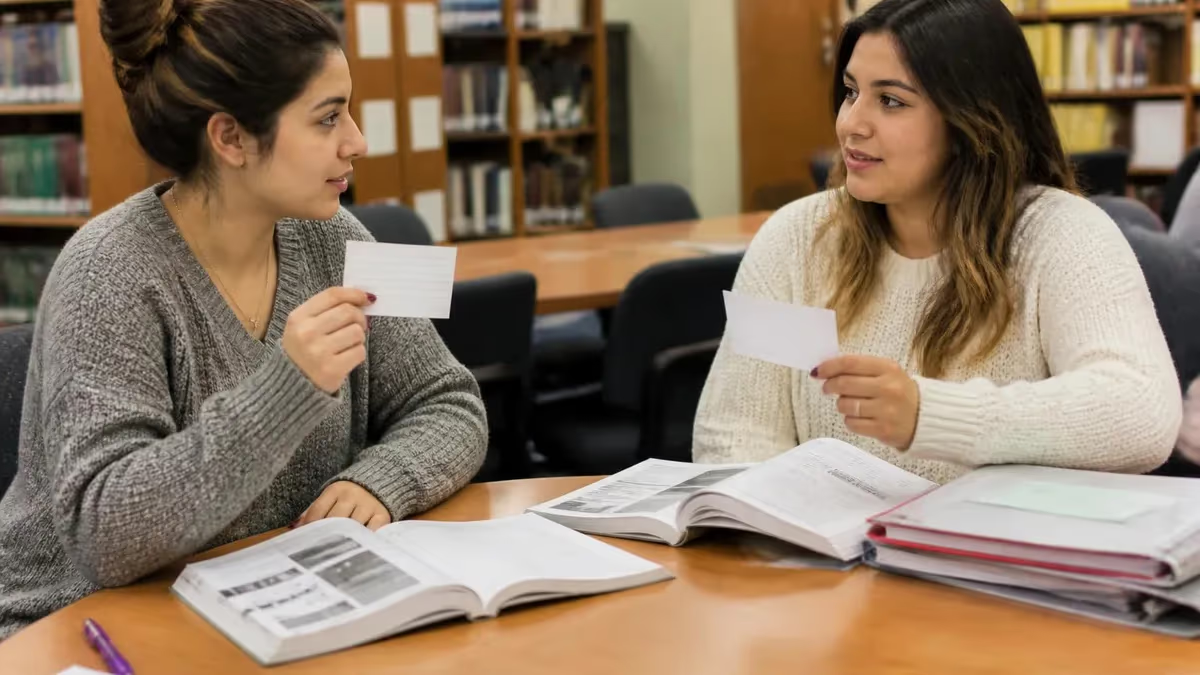
If you are exploring rda classes for the first time, understanding the rda meaning is the essential first step. RDA stands for Registered Dental Assistant, a credential that verifies a dental professional has met the clinical, radiographic, and infection-control standards required by their state dental board. Unlike a general dental assistant who may work without a formal license in some states, an RDA has passed a written and practical examination, completed accredited coursework, and demonstrated hands-on competency. This distinction matters enormously to employers, patients, and state regulators alike.
The path to becoming a registered dental assistant typically begins with enrolling in an accredited dental assisting program at a community college, vocational school, or dedicated dental institute. These programs range from nine months to two years in length, depending on whether you pursue a certificate or an associate degree. During that time, students gain exposure to everything from patient charting and radiographic techniques to sterilization protocols and medical emergency response — all topics that appear directly on the RDA licensing examination.
Many candidates feel overwhelmed when they first look at the scope of the RDA curriculum, and that reaction is completely understandable. The examination covers a wide breadth of dental science, and the sheer volume of material can make structured preparation seem daunting. That is precisely why a well-organized study guide paired with targeted rda classes can be the difference between passing on your first attempt and having to retake the exam months later at additional cost and stress.
One of the most common questions prospective students ask is how rda dental knowledge differs from the kind of general biology or healthcare coursework they may have taken in high school or early college. The answer is that RDA coursework is highly procedure-specific. You are not studying anatomy in the abstract — you are learning the exact teeth, quadrants, surfaces, and clinical actions that a dentist will direct you to perform chairside. This applied, hands-on orientation makes the material simultaneously more challenging and more immediately rewarding than general science courses.
Another concept worth clarifying early is the difference between the RDA and the CDA (Certified Dental Assistant). The CDA is awarded by the Dental Assisting National Board and is recognized nationwide, while the RDA is a state-level credential used most prominently in California and a handful of other states. Some states use the title interchangeably or accept both, so verifying your specific state's requirements before investing in a program is critical. A program that prepares you specifically for the California RDA exam, for instance, will have a distinct curriculum emphasis compared to a program aimed at DANB's national exam.
Salary data consistently shows that earning an RDA credential pays off financially. According to Bureau of Labor Statistics occupational data, dental assistants with recognized credentials earn a median wage roughly 12–18 percent higher than their uncredentialed counterparts, with top earners in high-cost metropolitan areas exceeding $65,000 annually. Beyond salary, the credential opens doors to expanded duties — in California, for example, RDAs can perform coronal polishing, take preliminary impressions, and place rubber dams, tasks that a non-credentialed assistant cannot legally perform.
This comprehensive study guide walks you through every dimension of RDA exam preparation: the structure of the exam, the highest-yield content areas, proven study strategies, cost considerations, and the most effective free and paid resources available in 2026. Whether you are a working dental assistant who needs to credential up or a brand-new student mapping out your career path, the sections below will give you the concrete, actionable roadmap you need to succeed.
RDA Classes & Certification by the Numbers
Key Facts at a Glance
| Item | Value | Details |
|---|---|---|
| Program Length | 9–24 mo | Certificate to associate degree |
| Questions on CA RDA Exam | 170 | Written + law & ethics combined |
| Exam Duration | 3 hrs | Computer-based testing at approved sites |

RDA Exam Study Schedule
- ▸Review all 32 permanent teeth: names, numbers, surfaces
- ▸Practice tooth morphology sketches from memory
- ▸Complete 30 dental charting practice questions
- ▸Learn Universal Numbering System vs. Palmer Notation
- ▸Memorize OSHA Bloodborne Pathogen standard requirements
- ▸Study sterilization methods: autoclave, dry heat, chemical vapor
- ▸Review spore testing intervals and documentation rules
- ▸Complete instrument processing practice quiz set
- ▸Study paralleling vs. bisecting-angle techniques
- ▸Identify common radiographic errors and corrections
- ▸Review radiation safety: ALARA, lead apron, thyroid collar
- ▸Practice reading periapical, bitewing, and panoramic films
- ▸Review tray setups for major procedure types
- ▸Study properties of dental materials: composites, amalgam, cements
- ▸Memorize cavity classification (Class I–VI)
- ▸Complete dental instruments identification drill
- ▸Memorize signs and management of common dental emergencies
- ▸Study vasovagal syncope, anaphylaxis, and angina protocols
- ▸Review drug categories and their dental implications
- ▸Complete medical emergencies practice quiz
- ▸Complete two full-length timed practice exams
- ▸Score and identify lowest-performing content areas
- ▸Review California Dental Practice Act and RDA scope of practice
- ▸Re-read notes on any topic scoring below 70%
The content covered in rda classes can be organized into several major domains, and understanding what each domain tests is the most efficient way to allocate your study time. The California Dental Board's RDA written examination draws from general chairside assisting, dental radiography, infection and hazard control, and the Dental Practice Act. Each domain carries a different percentage weight on the actual exam, which means that studying all topics with equal intensity is a less effective strategy than concentrating on the highest-weighted areas first.
General chairside assisting is the largest single domain on the examination, encompassing patient management, dental procedures, instrument identification, tray setups, dental materials, and expanded duties such as coronal polishing and placing periodontal dressings. Candidates who come from working clinical environments often feel confident in this area, but the exam tests precise terminology and procedural sequencing rather than general comfort with the clinical environment. Knowing that a matrix band is used before amalgam condensation is not enough — you need to know the exact brand names, component parts, and step-by-step setup sequence.
Dental radiography is the second major content area, and it trips up many candidates who feel they understand the practical skill but struggle to articulate the underlying physics and geometry. Questions in this domain cover the paralleling technique, bisecting-angle technique, exposure settings, film processing (both manual and digital), common errors and their causes, and radiation safety regulations including the ALARA principle. A candidate who can take a perfectly exposed bitewing film in the clinic may still fail these questions if they cannot explain why elongation occurs or what operator error causes cone-cutting artifacts.
Infection and hazard control is another domain where memorization of regulatory specifics is essential. The exam tests knowledge of OSHA Bloodborne Pathogen Standards, CDC infection control guidelines for dental settings, sterilization method categories (heat sterilization, chemical sterilization, high-level disinfection), spore testing requirements, and proper handling and disposal of sharps and regulated waste. Many candidates underestimate this section, but it consistently accounts for a meaningful percentage of exam questions and is an area where disciplined memorization pays direct dividends.
The California Dental Practice Act section covers the legal framework governing what an RDA is permitted to do, under what supervision level, and what penalties apply for violations. This section is California-specific and has no direct parallel on national exams like the DANB CDA. Candidates must know the difference between general supervision, direct supervision, and general supervision requiring written authorization. They must also understand which procedures are RDA-only, which require additional permits, and what the RDA's legal obligations are regarding patient records, confidentiality, and mandatory reporting.
Pharmacology and medical emergencies round out the high-yield content areas. The exam does not expect candidates to prescribe medications, but it does require knowledge of common drug classes used in dentistry — local anesthetics, vasoconstrictors, antibiotics, analgesics, and anxiolytics — including their mechanisms, contraindications, and common adverse effects. The medical emergencies section tests recognition and initial management of conditions such as syncope, anaphylaxis, angina pectoris, hypoglycemia, asthma attacks, and seizures. Knowing that a patient who feels faint should be placed in the Trendelenburg position (supine with feet elevated) is a classic testable fact.
Nutrition and patient education represent a smaller but still present portion of the examination. RDAs are often the first point of patient contact for questions about diet and oral health, and the exam reflects this reality by testing knowledge of cariogenic foods, fluoride mechanisms, oral hygiene instruction techniques, and motivational communication strategies. Candidates who overlook this section sometimes lose easy points that could tip a borderline score toward a passing grade.
Study tools that align with the actual exam content domains are significantly more effective than generic dental assisting textbooks. The best resources include state board-released practice examinations, domain-specific question banks, and structured review courses that organize content by weighted exam category. Online platforms have made it increasingly practical for working candidates to study in short, focused sessions rather than trying to block out large chunks of time in an otherwise demanding schedule.
RDA Dental Exam Study Strategies by Topic
Radiography questions reward candidates who understand the geometry behind each technique before they try to memorize individual rules. Start by drawing the paralleling and bisecting-angle setups on paper — literally sketch the tooth, film, and central ray — until you can predict whether a given variation will produce elongation or foreshortening. Once the geometry makes intuitive sense, error identification questions become straightforward rather than requiring rote memorization of a long list.
Digital radiography has become increasingly common in modern dental offices, and the RDA exam reflects this shift. Study the differences between photostimulable phosphor (PSP) plate systems and direct digital sensors, including handling protocols, infection control requirements, and common image quality issues unique to each format. Radiation safety concepts like the inverse square law, maximum permissible dose limits, and proper positioning during exposure are consistently tested and reward candidates who can apply the numbers, not just recite the terms.

Online RDA Classes vs. In-Person Programs: What's Right for You?
- +Online classes allow self-paced study that fits around work and family schedules
- +Tuition at online or hybrid programs is often 20–35% lower than traditional in-person costs
- +Students can review recorded lectures repeatedly until difficult material clicks
- +Geographic flexibility means access to top-rated programs regardless of local options
- +Digital materials are updated more frequently to reflect current exam content
- +Asynchronous discussion boards let students ask questions outside of class hours
- −Clinical externship hours cannot be completed online and must be arranged separately
- −Hands-on instrument and materials practice is harder to replicate without a lab setting
- −Self-discipline demands are higher without a fixed class schedule to create accountability
- −Some state boards and employers still prefer or require an in-person accredited diploma
- −Limited real-time interaction with instructors can slow down complex concept questions
- −Technology issues, internet reliability, and equipment costs fall entirely on the student
RDA Exam Preparation Checklist
- ✓Confirm your state's RDA licensure requirements and exam format before enrolling in any program
- ✓Verify that your dental assisting program is accredited by CODA (Commission on Dental Accreditation)
- ✓Obtain the official candidate handbook from your state dental board and read every page
- ✓Complete all required clinical hours and obtain signed documentation from your supervising dentist
- ✓Purchase or download the most current edition of a California RDA exam review book published within the last two years
- ✓Take at least two full-length timed practice exams under realistic conditions before your test date
- ✓Score each practice exam by domain and spend extra review time on any domain below 70%
- ✓Memorize the California Dental Practice Act's supervision levels: general, direct, and general with written authorization
- ✓Review the OSHA Hazard Communication Standard and all required office safety training topics
- ✓Register for your exam at least four weeks in advance to secure your preferred test date and location
- ✓Prepare required identification documents (government-issued photo ID) and test center address a week before exam day
- ✓Get a full night of sleep before exam day and arrive at the testing center 30 minutes early

Practice Tests Increase Pass Rates by Up to 23%
Research on licensure exam preparation consistently shows that candidates who complete five or more full-length practice tests before their exam date pass at significantly higher rates than those who rely on reading and note-taking alone. The testing effect — the cognitive phenomenon where retrieval practice strengthens long-term memory — is especially powerful for the type of procedural and regulatory content that dominates the RDA written examination. Treat every practice question as a learning event, not just a score-checking exercise.
Understanding the cost structure of rda classes is essential for making an informed enrollment decision, especially for candidates who are managing existing financial obligations while transitioning into a dental career. Program costs vary widely depending on institution type, program length, and geographic location, but a realistic understanding of all cost categories — tuition, fees, equipment, and examination costs — prevents unpleasant surprises midway through your credential journey.
Community college dental assisting programs are typically the most affordable pathway to RDA eligibility. In California, for example, community college tuition is set at a state-determined per-unit rate that rarely exceeds $50 per unit for California residents, making a complete dental assisting certificate program achievable for $2,000 to $5,000 in tuition alone. By contrast, private vocational schools offering the same credential in accelerated nine-to-twelve-month formats often charge $12,000 to $22,000. The accelerated timeline is a genuine advantage for candidates who want to enter the workforce quickly, but the cost premium is significant.
Beyond tuition, prospective students should budget for program-specific equipment and supply fees. Most dental assisting programs require students to purchase a clinic kit containing instruments, a loupe, protective eyewear, clinical scrubs, and a lab manual. This kit typically costs between $500 and $1,200 depending on the program. Textbooks add another $300 to $600 unless the student purchases used editions or rents from the campus bookstore. Some programs include these costs in a comprehensive program fee; others itemize them separately, making comparison shopping between programs more complex than it first appears.
The RDA examination itself carries application and testing fees that vary by state and examination type. In California, the Dental Board charges a combined application and examination fee for the RDA written exam and the Dental Practice Act exam. As of 2025, the combined fee for a new applicant is approximately $375 to $450, depending on the examination cycle. Candidates who fail and need to retake the examination pay a reduced retake fee, but the added cost underscores why thorough preparation before the first attempt is the financially prudent strategy.
Financial aid is available for many accredited dental assisting programs, though the availability and type of aid varies significantly. Programs offered at Title IV-eligible institutions — which includes most community colleges and many accredited private schools — allow students to apply for federal Pell Grants, subsidized Stafford Loans, and work-study opportunities through the FAFSA. Students attending non-Title-IV programs must rely on private loans, employer tuition assistance, or state workforce development grants. California's Employment Training Panel (ETP) and similar state programs in other states sometimes fund dental assisting training for eligible employers and workers.
Scholarship opportunities specifically for dental assisting students do exist, though they require active searching and application effort. The American Dental Assistants Association (ADAA) administers the Juliette A. Southard/Oral-B Scholarship, which awards $500 to $1,000 to ADAA student members annually. State and local dental societies often offer their own small scholarships, and some dental offices will sponsor a promising employee's education in exchange for a commitment to remain with the practice after credentialing. Exploring all of these options before taking on debt is a worthwhile investment of two to three hours of research time.
Return on investment for the RDA credential is strong by most measures. Bureau of Labor Statistics projections show dental assistant employment growing eight to eleven percent through 2032, faster than the average for all occupations.
In California specifically, the combination of an aging population, expanded Medi-Cal dental coverage for adults, and a shortage of credentialed dental assistants in rural and underserved communities means that job market conditions favor credentialed candidates more than they have in previous decades. The lifetime income premium associated with the RDA credential over an uncredentialed position typically recoups program costs within eighteen to thirty-six months of full-time employment.
The California Dental Board and most state dental boards set specific application windows and eligibility expiration dates that cannot be extended. If you complete your educational requirements but do not submit your application within the allowed timeframe — typically two years in California — your coursework documentation may need to be resubmitted and verified at additional cost. Always submit your application as soon as you are eligible rather than waiting until your preferred exam date is closer.
The weeks immediately before the RDA examination require a deliberate shift in study strategy. During the earlier phases of preparation, the goal is content acquisition — absorbing information across all exam domains through reading, watching, and listening. In the final two to three weeks, the goal shifts to retrieval practice and weak-area remediation. This is the phase where full-length timed practice tests become the primary tool, and where honest self-assessment about knowledge gaps must translate into targeted review rather than passive re-reading of material you already know well.
Scheduling your exam date strategically can have a measurable impact on your outcome. Most testing experts recommend scheduling the exam approximately six to eight weeks after completing your preparation program, giving you enough distance from coursework to study independently but not so much time that you start to forget recently acquired material. Candidates who schedule their exam more than four months after finishing their program often report that regulatory details — particularly California Dental Practice Act specifics — have faded from memory and require significant re-review before the test date.
Simulating exam conditions during practice tests is one of the most underutilized preparation strategies among RDA candidates. The actual exam is computer-based, timed, and takes place in a quiet but unfamiliar testing environment with no reference materials available. Candidates who have only studied from books or watched video lectures without completing timed practice sessions under realistic conditions often experience significant time pressure anxiety on exam day, even when they know the material. Practicing with a timer in a distraction-free environment for at least two of your full-length practice exams is a direct investment in your exam-day performance.
For candidates who have access to a study group — whether in person or through an online forum — collaborative review of difficult concepts can be highly effective. Teaching a concept to another person is one of the most powerful methods of solidifying your own understanding of it. If your study group partner is struggling to understand why chemical vapor sterilization requires a specialized ventilation system, explaining it clearly in your own words will reinforce your own retention of that regulatory fact far more effectively than re-reading the same textbook passage.
Nutrition and sleep in the week before the exam deserve more attention than most candidates give them. Cognitive performance on demanding standardized exams is meaningfully degraded by sleep deprivation, dehydration, and blood sugar fluctuations. Candidates who stay up late studying the night before the exam consistently perform below their practice test averages.
The night before the exam, review only your personal note sheet of the most difficult-to-remember facts, then stop studying by 9:00 PM, hydrate, and prioritize a full seven to eight hours of sleep. The exam tests what you have learned over months, not what you can cram into the final twelve hours.
On exam day, read every question stem carefully before looking at the answer choices. RDA examination writers are skilled at constructing plausible distractors that exploit common misconceptions. If you jump to the answer choices before fully processing the question, you are more likely to be drawn to a familiar-sounding distractor rather than the correct answer.
For questions you find genuinely difficult, use the process of elimination to narrow to two options, make your best informed selection, flag the question for review if time permits, and move on without dwelling. Time spent agonizing over a single uncertain question is time taken away from questions you can answer correctly.
After passing the RDA examination, your first priority should be applying for your state license promptly and keeping your continuing education (CE) requirements calendar up to date. In California, RDAs must complete 25 hours of CE every two years, including mandatory hours in infection control and medical emergencies.
Planning your CE well in advance — rather than scrambling to meet requirements in the final weeks before renewal — ensures that you maintain good standing and stay current with evolving clinical best practices. The investment you made in your RDA credential through months of dedicated study deserves to be protected through consistent professional development throughout your career.
Practical exam-day preparation extends well beyond the content you have memorized. Experienced RDA candidates and examination coaches consistently emphasize that logistical preparedness — knowing exactly where the testing center is, what identification you need, and what the check-in process involves — eliminates a category of anxiety that can impair cognitive performance even before the first question appears on screen.
The Pearson VUE or PSI testing centers used for most state board examinations have clear candidate rules that are published in the candidate handbook. Reading these rules completely, rather than skimming them, prevents disqualification for avoidable violations like arriving with prohibited items.
Time management during the actual examination is a skill that must be practiced deliberately, not assumed. The California RDA written exam gives candidates three hours to complete approximately 170 questions, which works out to roughly 63 seconds per question. Most questions on a well-prepared candidate's exam take 20 to 40 seconds, leaving buffer time for more complex scenario-based questions that require reading a clinical vignette before answering. The goal is not to rush but to maintain a steady pace that uses all available time without allowing any single difficult question to consume a disproportionate share of your testing session.
Anxiety management is a legitimate preparation topic for many candidates, particularly those who have been out of a formal testing environment for several years. Standardized test anxiety is a documented psychological phenomenon that can cause candidates with strong knowledge to underperform significantly. Evidence-based interventions include controlled breathing exercises during the exam itself, expressive writing about exam-related concerns the night before, and reframing techniques that shift internal self-talk from threat-focused to challenge-focused. None of these interventions require special training — they are simple habits that meaningfully reduce performance anxiety when practiced consistently in the weeks before the exam.
Post-exam, if you receive a failing score, the most productive response is an immediate gap analysis rather than a period of discouragement. Most state dental boards provide domain-level score reports that show your performance percentage in each content area. These reports are your roadmap to a more targeted retake preparation.
If your radiography score was 62% but your infection control score was 88%, your retake preparation should allocate four times as many study hours to radiography as to infection control. Retake candidates who follow this data-driven approach rather than restudying everything equally consistently improve their scores by 10 to 20 percentage points on their next attempt.
Professional networking is an often-overlooked component of the RDA journey that pays dividends long after the examination is passed. The ADAA (American Dental Assistants Association) and its state chapters offer networking events, continuing education discounts, liability insurance options, and advocacy on behalf of dental assistants with state legislators and regulatory bodies. Joining the ADAA as a student member before graduation is one of the most cost-effective professional investments a new RDA can make, providing access to a community of experienced professionals who can offer mentorship, job referrals, and career guidance.
The evolving landscape of dental technology is also worth monitoring as you build your career. Digital radiography, intraoral scanning, CAD/CAM milling systems, and AI-assisted diagnostic tools are transforming the clinical environment in ways that create new opportunities for RDAs who embrace continuing education. State boards are beginning to introduce CE requirements that address these technologies, and employers are increasingly willing to pay premium wages to credentialed dental assistants who can operate and maintain digital systems alongside their traditional chairside and radiographic duties.
Ultimately, the RDA credential is not a destination — it is a foundation. The discipline, scientific knowledge, and clinical awareness you develop while preparing for and passing the RDA examination are the same qualities that will serve you throughout a career in dental assisting, whether you remain in a clinical role, transition into dental office management, pursue advanced credentials such as Expanded Function Dental Assistant (EFDA) permits, or use your credential as a stepping stone toward a career in dental hygiene or dentistry.
Every hour you invest in thorough, focused preparation is an investment in the professional identity and career trajectory you are building for yourself.
Sample Registered Dental Assistant Practice Questions
Try these questions from our free Registered Dental Assistant practice tests. The correct answer and an explanation follow each question.
How often are RDAs typically required to complete continuing education to maintain certification?
- A. Every year
- B. Every two years
- C. Every five years
- D. Continuing education is not required after certification
Answer: B. Every two years
Registered Dental Assistants are typically required to complete continuing education (CE) every two years to maintain their certification or licensure. This ensures that RDAs stay current with the latest advancements, techniques, and safety protocols in dental care. The specific number of CE hours required can vary by state or certifying body.
A state requires RDAs to hold current CPR certification. Which organization's CPR course is most commonly accepted?
- A. OSHA
- B. American Red Cross or American Heart Association
- C. DANB
- D. Centers for Disease Control (CDC)
Answer: B. American Red Cross or American Heart Association
Most state dental boards accept CPR certification from the American Red Cross or the American Heart Association for licensure purposes.
Which of the following accredits dental assisting programs that qualify you for RDA certification?
- A. National Dental Association (NDA)
- B. American Dental Assistants Association (ADAA)
- C. Commission on Dental Accreditation (CODA)
- D. American Dental Hygienists' Association (ADHA)
Answer: C. Commission on Dental Accreditation (CODA)
The Commission on Dental Accreditation (CODA) is the sole agency recognized by the U.S. Department of Education to accredit dental and dental-related education programs, including dental assisting. Accreditation by CODA ensures that a program meets rigorous quality standards, making its graduates eligible for certification and licensure. Choosing a CODA-accredited program is crucial for career advancement in dental assisting.
Which type of impression material is used for final impressions of crown and bridge preparations due to its high dimensional accuracy?
- A. Alginate (irreversible hydrocolloid)
- B. Zinc oxide eugenol (ZOE)
- C. Polyvinyl siloxane (PVS/addition silicone)
- D. Compound (thermoplastic)
Answer: C. Polyvinyl siloxane (PVS/addition silicone)
Polyvinyl siloxane (PVS, addition-cured silicone) provides excellent dimensional stability, high detail reproduction, and can be poured multiple times, making it the material of choice for crown and bridge final impressions.
RDA Questions and Answers
RDA Certification: Complete Guide to Becoming a Registered Dental Assistant in 2026

RDA (Registered Dental Assistant) Test: Your Guide
RDA Jobs: Complete 2026 Career Guide for Registered Dental Assistants

RDA License Lookup: How to Verify a Registered Dental Assistant's Credentials
RDA Practice Test: Free Registered Dental Assistant Questions & Answers (2026)
About the Author

Educational Psychologist & Academic Test Preparation Expert
Columbia University Teachers CollegeDr. Lisa Patel holds a Doctorate in Education from Columbia University Teachers College and has spent 17 years researching standardized test design and academic assessment. She has developed preparation programs for SAT, ACT, GRE, LSAT, UCAT, and numerous professional licensing exams, helping students of all backgrounds achieve their target scores.
Join the Discussion
Connect with other students preparing for this exam. Share tips, ask questions, and get advice from people who have been there.
View discussion (8 replies)