
PCA Certification: Personal Care Assistant Training and Programs 2026 October
PCA certification — 🎓 Personal Care Assistant training programs, state requirements, what's covered, CPR and background checks, and how PCA differs from CNA.
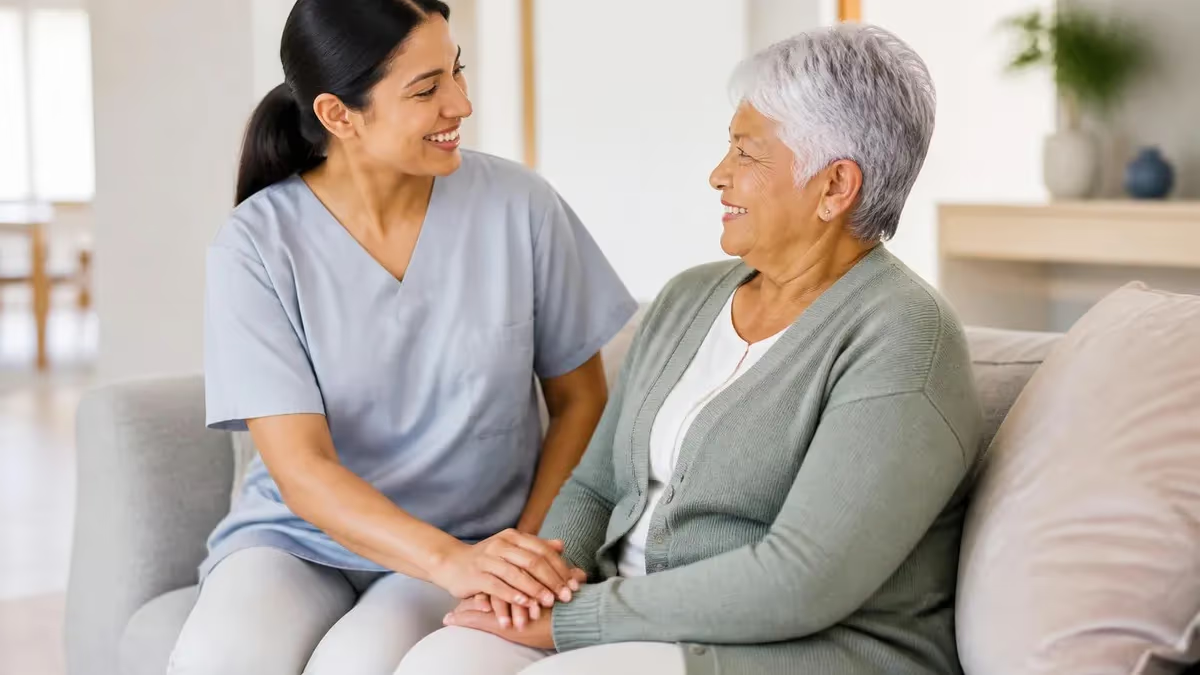
PCA certification — meaning Personal Care Assistant certification — prepares workers to provide non-medical, hands-on support to clients in their homes, residential settings, and community-based programs. The certification covers state-specific training requirements that allow PCAs to work for home health agencies, residential care providers, and Medicaid-funded community-based services. The role overlaps with related credentials like CNA (Certified Nursing Assistant), HHA (Home Health Aide), and DCW (Direct Care Worker), but with state-specific differences in scope, training hours, and authorized employment settings.
This guide walks through what PCA certification involves, the typical training requirements (40-75 hours of classroom and clinical instruction in most states), the curriculum that PCA programs cover, the differences between PCA and other care-worker credentials like CNA, the major paths to certification (community colleges, employer-sponsored training, online and hybrid programs), the additional requirements like CPR/first aid and background checks, the state-by-state variation that affects nearly every aspect of certification, and the practical workflow for becoming a certified PCA in your state.
One important upfront clarification: "PCA" refers to Personal Care Assistant in this article, not Certified Dental Assistant (CDA) or principal component analysis. Those abbreviations are easy to confuse but represent completely different things. Personal Care Assistants help clients with activities of daily living (bathing, dressing, eating, mobility, light housekeeping) in homes and residential settings. The role serves elderly individuals, people with disabilities, and people recovering from medical events who need support with daily activities but don't require skilled nursing or therapeutic services.
The Personal Care Assistant role is one of the largest healthcare-adjacent workforce categories in the United States. The Bureau of Labor Statistics groups personal care aides, home health aides, and similar workers together, with about 4 million combined positions across the categories. The workforce is projected to grow significantly faster than average through the late 2020s, driven by population aging, expansion of home and community-based services as alternatives to institutional care, and chronic shortages that affect service delivery in most US markets.
For workers entering the field, PCA certification is one of the most accessible credentials in healthcare. Training typically runs 40-75 hours total, costs $0-$1,500 depending on whether the program is employer-sponsored or self-paid, and produces a credential that opens entry-level positions in home health, residential care, and adult day programs. The work is physically and emotionally demanding but accessible to workers without prior healthcare experience and provides a foundation for further career development into CNA, LPN, or other clinical credentials over time.
PCA certification at a glance
Role: Personal Care Assistants help clients with non-medical activities of daily living — bathing, dressing, eating, mobility, light housekeeping — in homes, residential settings, and community-based programs. Training: typically 40-75 hours including classroom and supervised clinical practice. Cost: $0-$1,500 depending on whether employer-sponsored or self-paid. Common requirements: CPR/first aid certification, criminal background check, TB screening, basic immunizations. Career path: entry-level role; many PCAs continue to CNA, HHA, LPN, or RN over time.
What Personal Care Assistants do
Personal Care Assistants provide hands-on support to clients with activities of daily living (ADLs). The core ADL list includes bathing (showers, tub baths, bed baths), dressing (selecting clothes, helping put them on, fastening buttons or zippers), toileting (assisting with the bathroom, managing incontinence supplies, cleaning afterward), eating (meal preparation, feeding assistance for clients who can't feed themselves), mobility (transfers between bed and chair, walking assistance, wheelchair management), and grooming (hair care, oral hygiene, shaving, nail care). PCAs typically also perform light housekeeping (laundry, vacuuming, dishwashing) and meal preparation as part of the broader support relationship.
The role is intentionally non-medical. PCAs don't administer medications (in most states), don't perform clinical assessments, don't manage IV lines, and don't provide therapeutic services like physical therapy or wound care. The line between PCA work and skilled nursing care is regulated by state law and varies somewhat by jurisdiction. In states allowing nurse delegation, PCAs may be authorized to perform certain delegated tasks under nurse supervision (medication reminders, simple wound dressings, vital signs) when properly trained. Most states limit PCA scope to truly non-medical assistance.
PCAs work in multiple settings. Home care agencies dispatch PCAs to clients' homes for hourly visits or live-in care. Residential settings (group homes, assisted living facilities, adult family homes) employ PCAs as direct-care staff supporting multiple residents on shifts. Adult day programs serve clients during daytime hours with PCAs facilitating activities, supporting personal care during the day, and coordinating with families at pickup and dropoff. Some PCAs also work for individual families directly through Medicaid waiver programs that allow family members to be paid for caregiving roles for relatives.
The day-to-day rhythm varies by setting. Home care PCAs often visit 3-6 clients per day for 1-3 hours each, traveling between client homes. Residential PCAs work 6-12 hour shifts at a single facility, supporting multiple residents simultaneously through structured care routines. Family PCAs often provide 4-8 hours of care per day to a single relative, with consistent schedules. Each setting has different physical demands, emotional rewards, and pay structures, and most PCAs find their preferred setting by trying different ones early in their careers.

What PCA training covers
The core technical skills of personal care work. Training covers proper techniques for bathing, dressing, toileting, eating support, mobility assistance, and grooming. Includes hands-on practice in classroom labs with mannequins and supervised clinical practice with real clients under instructor oversight. ADL competency is the foundation that everything else builds on, and most certification programs spend significant time on each ADL category to develop muscle memory and confidence in trainees.
Safe lifting and transfer techniques to prevent injury to both worker and client. Covers proper body positioning, gait belts, transfer boards, mechanical lifts, and the assessment of when each technique is appropriate. Back injuries are common among personal care workers when transfer techniques are poor; the training emphasis on body mechanics is one of the most important parts of the curriculum from a worker-safety perspective. Practice happens with classroom partners simulating client transfers.
Hand hygiene, glove use, isolation precautions, handling of contaminated materials, sanitation of client environments. Training covers OSHA bloodborne pathogen requirements and basic infection prevention principles. Particularly important in residential settings where infections can spread quickly among medically fragile residents. Updates since the COVID-19 pandemic have expanded the curriculum on respiratory illness prevention and PPE use across most state PCA training programs.
Effective communication with clients including those with dementia, hearing loss, language differences, or cognitive impairments. Specific techniques for dementia-related behaviors (validation therapy, redirection, environmental modification). Many states have expanded dementia-specific content in PCA training over recent years as the population of clients with cognitive impairment has grown. The communication competency is among the most challenging for new PCAs to develop, often improving substantially through real client experience over time.
Basic measurement of vital signs (temperature, pulse, respiration, blood pressure) and observation of client condition for changes that should be reported to nurses or family. Some states limit PCAs from taking vital signs without nurse supervision; others include vital signs as standard PCA scope. Even when not authorized to measure, PCAs are trained to observe and report changes in client condition (decreased appetite, mood changes, skin issues, behavior changes) as part of the care team's monitoring of the client's overall health status.
Recording the services provided, time worked, and any incidents or observations during shifts. Ethical considerations specific to in-home and residential care work — boundary issues, gift acceptance, client autonomy, mandatory reporting of suspected abuse or neglect. Most agencies require shift documentation that supports Medicaid billing and care-plan compliance. The documentation skill is often underestimated by new PCAs but represents 10-20 percent of paid hours in many positions across the industry.
State-by-state variation in PCA certification
PCA certification requirements vary dramatically across US states. Some states have formal state-mandated PCA certification with specific curriculum hours, examination requirements, and state registry tracking. Other states use employer-based certification where each employer trains its own staff to internal standards without a unified state credential. A third group has Medicaid-program-specific requirements tied to particular waiver programs — workers in those programs need specific training but workers in other settings don't.
Common state patterns include: Massachusetts has a formal PCA Workforce Council with standardized training and a state registry. Minnesota uses Personal Care Assistance services through Medicaid with state-mandated training requirements. New York uses Consumer Directed Personal Assistance Program (CDPAP) with specific training rules. California uses In-Home Supportive Services (IHSS) with county-level training requirements that vary across counties. Texas uses Personal Attendants under Community Care for Aged and Disabled with state requirements. Each state's specific requirements differ in important ways, and aspiring PCAs should research their specific state's rules before assuming general patterns apply.
Training hours range from 10 hours at the low end (some employer-only training models) to 120+ hours at the high end (states with extensive formal certification). The most common range is 40-75 hours total, including classroom instruction plus supervised clinical or shadow hours. The wide range reflects different state philosophies about how much training is needed for safe practice. States with the highest training requirements often align PCA training closer to CNA training; states with minimal requirements treat PCA work as primarily learn-on-the-job under agency supervision.
For workers researching their state's specific requirements, the best starting point is usually the state's Department of Health, Department of Human Services, or Medicaid agency website. These agencies typically publish PCA training and certification standards specific to the state's programs. The exact agency name varies by state — Department of Aging, Office of Long-Term Care, Department of Disability Services, etc. — but searching "[your state] personal care assistant certification" usually finds the right state agency portal with the relevant training requirements published.
Paths to PCA certification
The most common path. Home health agencies, residential care providers, and adult day programs train new hires through their internal programs that meet state requirements. The training is typically free to the worker (sometimes paid as orientation hours), runs 40-75 hours over 1-3 weeks, and produces certification valid at that employer and often other employers in the same state. This is the easiest entry point for workers without existing healthcare backgrounds because the employer handles all the logistics.
How PCA differs from CNA, HHA, and other credentials
Several care-worker credentials exist with overlapping but distinct scopes. Certified Nursing Assistant (CNA) is a federally regulated credential with national minimum training requirements (75 hours under federal Medicaid rules; many states require more — typically 75-180 hours). CNAs work in nursing homes, hospitals, and assisted living, performing clinical-adjacent tasks like vital signs, basic clinical care under nurse supervision, and medical-setting ADL support. CNA training is more clinically focused than PCA training, and CNAs can perform some tasks that PCAs cannot in many states.
Home Health Aide (HHA) is similar to CNA but specifically for Medicare-certified home health agencies. Federal rules require HHA training (75 hours under federal Medicare rules) and competency testing. HHAs perform clinical-adjacent home care tasks similar to CNAs in nursing homes but in the home setting. Some states use HHA and PCA interchangeably; others maintain distinct certifications with different scopes. The Medicare connection is the defining feature — HHAs work for Medicare-certified agencies; PCAs typically work for Medicaid-funded or private-pay services.
Direct Support Professional (DSP) is the credential for workers supporting people with intellectual and developmental disabilities. DSP training overlaps significantly with PCA training but emphasizes person-centered support, community participation, and developmental disability-specific content. Many states regulate DSP separately from PCA, with the workforce supporting different populations through different funding streams. A worker may be certified as both PCA and DSP if they work across multiple populations during their career.
Medication Aide is a specialty certification (where allowed) that adds medication administration to either CNA or PCA scope. Some states allow trained medication aides to administer prescribed medications under nurse delegation; other states reserve all medication administration to nurses regardless of additional training. The medication aide credential typically requires 16-40 hours of additional training beyond the underlying CNA or PCA certification, plus skills demonstration on medication safety and the five rights of medication administration.

PCA certification rules vary dramatically across states. The general patterns described here capture broad themes but specific requirements in any given state may differ in important ways. Always verify with your state's Department of Health, Department of Human Services, or Medicaid agency before paying for training or accepting a job that depends on specific certification status. The official state agency website is the authoritative source for current requirements; third-party guides (including this one) provide context but can become outdated as states change their rules over time.
Additional requirements beyond classroom training
Beyond the classroom and clinical training hours, PCA certification typically requires several additional components. CPR and First Aid certification is required by nearly every PCA program and employer. American Heart Association BLS or Heartsaver, or Red Cross equivalent, is the standard. The certification is renewable every two years and runs 4-8 hours for the initial course at modest cost ($50-$150). Some PCA programs include CPR training as part of the curriculum; others require students to obtain it separately before or during the program.
A criminal background check is required at hire and sometimes during the certification process. Federal and state databases are checked for criminal history, sex offender registry status, and abuse-registry status. Most states have specific disqualifying offenses (typically felonies involving violence, abuse, or theft, particularly against vulnerable adults or children). Convictions don't automatically disqualify in all cases — the state and employer evaluate the specific offense, time elapsed, and rehabilitation evidence — but they do create barriers that need to be addressed before certification proceeds.
Tuberculosis (TB) screening through skin testing or blood testing is required in nearly all states because of the close contact PCAs have with vulnerable populations. The TB test is typically done annually thereafter. Basic immunizations (Hepatitis B series, MMR, Tdap, varicella) are required by most employers per OSHA and state public health rules. Influenza vaccination is required by some employers, especially those serving residential populations where flu transmission risks are high.
Beyond these health and background components, ongoing requirements include annual continuing education (typically 12-24 hours per year covering specific topics like infection control, dementia care, and abuse prevention), annual recertification of CPR and TB screening, and any state-specific renewal requirements. Most agencies build the continuing-education hours into employees' regular work as paid in-service training. Workers should track their training hours and certification expirations to maintain continuous eligibility for PCA work over their career.
Becoming a certified PCA — checklist
- ✓Research your state's PCA certification requirements through the state's Department of Health or Medicaid agency.
- ✓Identify training options — employer-sponsored, community college, state-run, or online/hybrid programs.
- ✓Verify the program is approved by your state to satisfy certification requirements.
- ✓Complete required training hours (typically 40-75 hours of classroom and clinical instruction).
- ✓Earn CPR/AED and First Aid certification through American Heart Association or Red Cross.
- ✓Complete TB screening and required immunizations (Hepatitis B, Tdap, MMR, varicella).
- ✓Pass criminal background check and submit fingerprints if required.
- ✓Apply to the state PCA registry if your state maintains one.
- ✓Apply for PCA positions with home health agencies, residential providers, or family-caregiver programs.
- ✓Maintain certification through annual continuing education and CPR/TB renewal.
For workers entering the PCA field, the cleanest path is usually to apply directly to a home health agency or residential care provider that handles the certification training as part of onboarding. The agency-sponsored route eliminates upfront training costs and produces immediate employment after certification. Self-funded community college programs provide more transferable credentials but require investing time and money before earning income. Both paths work; the choice depends on individual circumstances and risk tolerance for the upfront investment.
Pay and career progression for certified PCAs
Pay for certified PCAs has historically been low and has been improving slowly in recent years as workforce shortages have increased pressure on agencies and Medicaid programs. The Bureau of Labor Statistics groups personal care aides with home health aides, with median pay around $33,000-$36,000 annually as of 2026. Pay varies significantly by state — New York, Oregon, Washington, Massachusetts, and several other states have raised PCA wages substantially since 2020 in response to chronic staffing shortages affecting service quality.
Per-hour wages for certified PCAs typically run $13-$22 per hour in 2026, with most workers in the $14-$18 range. Higher rates appear in major metros with high cost of living, in residential settings with overnight or weekend differentials, and for workers with specialty certifications (medication aide, behavior support, complex medical) that command higher pay. Workers in family-caregiver programs through Medicaid waivers earn similar rates and often have schedule flexibility advantages over agency-employed PCAs.
Beyond hourly wages, certified PCAs may receive shift differentials for evenings and weekends, mileage reimbursement for home-care travel between clients, paid sick leave (in states with sick-leave laws), and health insurance from larger employers. The benefits picture is improving slowly but remains weaker than higher-tier healthcare workers. Some employers offer modest pay differentials for completing additional certifications (medication aide, dementia care specialist, etc.) that recognize additional training without requiring promotion to a different role.
Career progression for committed PCAs follows a predictable pattern. Many PCAs use the entry-level role as a stepping stone to higher-paying healthcare credentials. Common pathways include PCA → CNA (75-180 hours of additional training, opens nursing home and hospital roles at $16-$22/hr), PCA → HHA → LPN (1-2 years of nursing school for LPN, opens skilled nursing positions at $50,000-$60,000), or PCA → BSN/RN (longer educational investment but $70,000+ income with the BSN credential). The PCA role provides healthcare experience and demonstrates work ethic, both of which support applications to more advanced training programs.

PCA certification — quick numbers
Specialty certifications that increase PCA earning power
Where state law allows, completing 16-40 hours of medication administration training authorizes the PCA to administer prescribed medications under nurse delegation. The certification expands the role and typically earns $0.50-$2.00/hour pay differential. Common in residential settings where nurse staffing is limited and properly trained PCAs can administer scheduled medications. Renewable annually or biannually depending on state requirements.
Specialized training in dementia care techniques (validation therapy, redirection, sundowning management, person-centered approaches for cognitive impairment) prepares PCAs for residential and home roles serving clients with dementia. Training typically runs 24-40 hours beyond standard PCA curriculum. Pay differentials of $0.50-$1.00/hour are common. The specialty is increasingly valued as the population of clients with dementia grows.
Becoming a certified CPR instructor lets a PCA teach CPR/First Aid courses to other workers, in addition to their direct care work. Instructor training takes about 20 hours and produces a portable credential with separate income potential. Many agencies appreciate having internal CPR instructors who can train new hires without external scheduling. The role provides variety and modest additional income alongside direct care work.
Bilingual fluency, particularly Spanish, opens dramatically more PCA positions in many US markets and often produces $1.00-$3.00/hour pay differentials. Bilingual PCAs are in high demand because client populations include many limited-English speakers. Some agencies pay for language-skill assessment and ongoing language training as part of professional development. The specialty doesn't require formal certification but agencies often verify proficiency through interview-based assessment.
Common questions about PCA certification
Prospective PCAs often ask whether the work is too physically demanding. The honest answer is that PCA work involves real physical demands — lifting and transferring clients, hours on feet, repetitive motions during ADL support. Workers with back, knee, or shoulder issues should consider day program or non-residential settings where physical demands are lower than home or facility-based residential work. Most agencies emphasize body mechanics in training to reduce injury risk, but the cumulative physical wear over a long career is real and worth considering before committing to PCA work as a primary occupation long-term.
Another common question is whether emotional demands are sustainable. The honest answer is that PCA work involves real emotional weight. You build relationships with clients over months and years, see them through illness and decline, navigate complex family dynamics, and sometimes lose clients to illness, family decisions, or moves to higher levels of care. Burnout and turnover are common in the field. Strong PCAs build self-care practices, maintain peer support relationships, and use available employer EAP services to sustain themselves through demanding cases over the long term.
A practical concern is whether PCA pay can support a household. The honest answer depends on geography and household structure. Single workers in lower-cost markets can live on PCA wages with frugal budgeting. Workers supporting families typically need multiple income streams or eventual progression to higher-paying healthcare credentials. The pay improvement trajectory for committed PCAs is real but slow; expecting fast salary growth is unrealistic, while expecting steady incremental wage growth combined with credential-based pay differentials over a few years is realistic for most workers staying in the field.
The final concern many prospective PCAs share is whether the work is meaningful enough to justify the demands. This one is universally yes from current PCAs interviewed in industry research. The relational nature of the work, the visible impact on clients, and the broader social mission of supporting aging adults and people with disabilities in their preferred settings consistently produce high job satisfaction reports despite the pay challenges. Many PCAs describe their work as more meaningful than higher-paying jobs they could take elsewhere — though they would also like the higher pay alongside the meaning.
PCA: Pros and Cons
- +pca — pCA certification validates expertise recognized by employers nationwide
- +Certified professionals typically earn 15-20% higher salaries
- +Opens doors to advanced positions and leadership roles
- +Demonstrates commitment to professional standards and ethics
- +Builds a strong professional network through certification communities
- −Exam preparation typically requires 2-4 months of dedicated study
- −Certification and exam fees can range from $150-$500+
- −Must complete continuing education to maintain active certification
- −Pass rates vary — thorough preparation is essential for success
- −Some certifications require prerequisite experience or education
Pros and Cons at a Glance
| Pros | Cons |
|---|---|
| pca — pCA certification validates expertise recognized by employers nationwide | Must complete continuing education to maintain active certification |
| Opens doors to advanced positions and leadership roles | Pass rates vary — thorough preparation is essential for success |
| Demonstrates commitment to professional standards and ethics | Some certifications require prerequisite experience or education |
Sample Personal Care Assistant Practice Questions
Try these questions from our free Personal Care Assistant practice tests. The correct answer and an explanation follow each question.
What should a PCA do if a patient refuses care?
- A. Force the patient to accept care.
- B. Ignore the refusal and continue with the care.
- C. Respect the patient’s decision and offer alternatives or discuss their concerns.
- D. Report the patient to the healthcare provider immediately.
Answer: C. Respect the patient’s decision and offer alternatives or discuss their concerns.
Patients have the right to refuse care, and a PCA must respect this decision. The correct action is to acknowledge their refusal, offer alternatives if appropriate, and discuss their concerns to understand the underlying reasons. This upholds patient autonomy and allows the care team to address issues or find alternative solutions.
What is the importance of Nutrition & Hydration in patient care?
- A. It is irrelevant to patient care.
- B. It is essential for maintaining patient health and comfort.
- C. It is only necessary for elderly patients.
- D. It only relates to personal preference.
Answer: B. It is essential for maintaining patient health and comfort.
Proper Nutrition and Hydration are fundamental for all bodily functions, especially for patients who may be recovering or managing chronic conditions. Adequate intake provides essential energy, supports immune function, aids in tissue repair, and ensures medications work effectively. This directly contributes to maintaining the patient's physical health, preventing complications, and enhancing their overall comfort and well-being.
Which action best protects a patient's dignity during perineal care?
- A. Work quickly without covering the patient
- B. Keep the patient fully covered and expose only the area being cleaned
- C. Ask a coworker to observe to ensure proper technique
- D. Perform care with the room door open for better lighting
Answer: B. Keep the patient fully covered and expose only the area being cleaned
Exposing only the necessary area maintains privacy and preserves the patient's dignity throughout care.
When documenting care in a client's record, the PCA makes an error. The correct way to correct it is to:
- A. Use white-out to cover the mistake and write the correction over it
- B. Draw a single line through the error, write 'error,' initial it, and add the correct information
- C. Tear out the page and rewrite the entry
- D. Leave the error and add a note on a separate sheet
Answer: B. Draw a single line through the error, write 'error,' initial it, and add the correct information
A single line through the error with initials and 'error' notation preserves the original entry and meets legal documentation standards.
PCA Questions and Answers
About the Author

Registered Nurse & Healthcare Educator
Johns Hopkins University School of NursingDr. Sarah Mitchell is a board-certified registered nurse with over 15 years of clinical and academic experience. She completed her PhD in Nursing Science at Johns Hopkins University and has taught NCLEX preparation and clinical skills courses for nursing students across the United States. Her research focuses on evidence-based exam preparation strategies for healthcare certification candidates.