
Free PCA Training: Complete Guide to No-Cost Personal Care Assistant Certification Programs in 2026 October
Free PCA training programs explained: 📝 state-funded options, agency-sponsored courses, online certification paths, and how to start your PCA career at
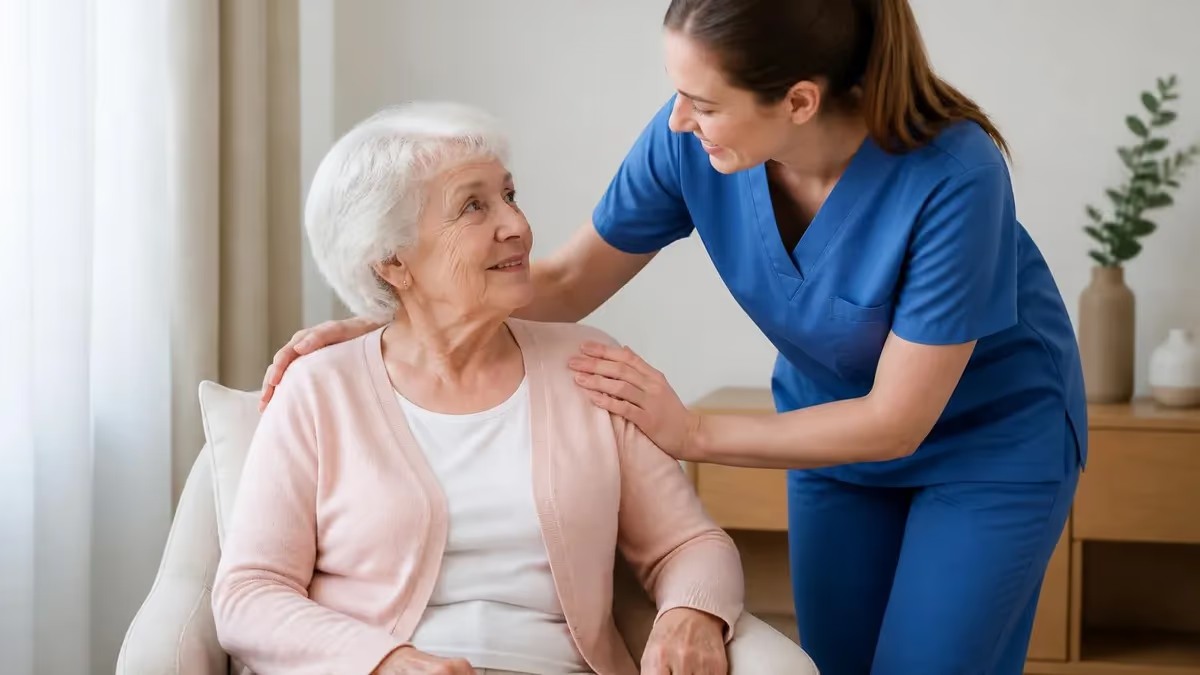
Finding quality free pca training has become one of the most practical entry points into the healthcare workforce, especially for adults seeking a stable career without taking on student debt. Personal Care Assistants serve as the backbone of home health and long-term care, and demand has surged across every U.S. state. With Medicaid waiver programs, state workforce grants, and agency-sponsored training pipelines, candidates can now complete certification in four to eight weeks at zero out-of-pocket cost. This guide walks through every legitimate no-cost pathway available in 2026.
The healthcare industry is projected to add over 924,000 home health and personal care aide jobs between now and 2032, according to the Bureau of Labor Statistics. That is the largest projected job growth of any occupation in the country. Free training programs exist precisely because employers cannot fill these roles fast enough. Hospitals, nursing homes, home care agencies, and state Medicaid programs all subsidize training because they desperately need certified workers ready to start within weeks rather than months.
Understanding the pca medical requirements before enrolling helps you choose the right program. Every state defines PCA scope of practice differently, and some states require additional competency testing on top of federal minimums. The 75-hour federal minimum applies to home health aides under Medicare, but PCA-only roles may require as few as 40 hours or as many as 120 hours depending on jurisdiction. Knowing this in advance prevents enrolling in a program that does not match your career goals.
Free training typically falls into four categories: employer-paid programs where you sign a work commitment, state workforce development grants administered through American Job Centers, community college tuition waivers funded by Workforce Innovation and Opportunity Act dollars, and nonprofit programs serving displaced workers, veterans, and individuals transitioning from public assistance. Each pathway has different eligibility rules, time commitments, and post-training obligations, which we will break down in detail below.
One important distinction: free training is not the same as easy training. PCA coursework covers infection control, body mechanics, vital signs, communication with cognitively impaired clients, dementia care, end-of-life support, emergency response, and documentation standards. Programs include both classroom hours and supervised clinical practice, often requiring background checks, TB tests, drug screens, and CPR certification before clinicals begin. Completing the program demands genuine commitment and a willingness to learn skills that directly affect vulnerable people.
Throughout this guide you will find verified program types, eligibility checklists, application timelines, regional differences, common pitfalls, and practical advice from current PCAs who completed free training within the last two years. We will also cover what to expect after certification, including starting wages, advancement pathways into CNA or LPN roles, and how to evaluate employer offers that include continuing education benefits.
Whether you are reentering the workforce, switching careers from retail or food service, supplementing income, or building toward a nursing degree, free PCA training offers a legitimate on-ramp to meaningful, in-demand work. The pages ahead will help you identify the right program, avoid scams, and enter your first PCA position with confidence.
Free PCA Training by the Numbers

Four Main Types of Free PCA Training Programs
Home care agencies pay for your training in exchange for a work commitment, typically 6-12 months. You earn wages during training in many cases, and certification stays with you after the commitment ends.
States fund PCA training through Medicaid HCBS waiver budgets to expand the workforce serving disabled and elderly clients. Enrollment is usually through county social services or designated training providers.
Workforce Innovation and Opportunity Act dollars cover tuition at approved community colleges and vocational schools. Apply through your local American Job Center after eligibility screening.
Organizations like Goodwill, Catholic Charities, and veteran service nonprofits offer free PCA training to displaced workers, returning citizens, refugees, and veterans transitioning to civilian careers.
SEIU and similar healthcare unions operate registered apprenticeships that combine paid on-the-job training with classroom instruction, leading to portable PCA credentials in many states.
Eligibility for free PCA training varies dramatically by state, and understanding your local rules is the single most important step before applying. Some states like Minnesota, Massachusetts, and Washington run strong publicly funded training pipelines that anyone over 18 can access. Others rely heavily on employer-sponsored programs because state Medicaid budgets do not include a direct training line item. The fastest way to identify what is available is to call your state Department of Health workforce division or visit a CareerOneStop center.
In most states, candidates must be at least 18 years old, possess a high school diploma or GED (or be willing to complete one concurrently), pass a criminal background check, pass a TB screening, and provide documentation of lawful work authorization. Some programs add language requirements, basic literacy assessments, or in-person interviews to ensure candidates can handle client communication. None of these requirements should cost the applicant money in a legitimate free program.
The role of a Personal Care Assistant differs from related positions, and confusing them costs people time and money. The pca church communities and faith-based home care networks sometimes use the title interchangeably with home health aide, but the legal scope of practice is set by state regulation, not by employer preference. Always confirm whether the program leads to PCA, HHA, or CNA certification, because the three are not equivalent and the wage scales differ accordingly.
State-specific funding cycles also affect availability. WIOA grants reset on a federal fiscal year basis (October 1), and many state Medicaid training programs operate on calendar year budgets. If you apply in late summer or early fall, you may be told funding is exhausted until the next cycle. Applying in October, November, January, or February typically yields the fastest enrollment. Persistence matters, and many candidates secure a seat by checking back weekly during slow periods.
Public assistance recipients receive priority placement in many free programs. If you are currently receiving SNAP, TANF, Medicaid, or unemployment benefits, mention this on your initial application because it often unlocks additional support services like childcare vouchers, transportation reimbursement, uniform allowances, and stipends during training. These wraparound services can make the difference between completing the program and dropping out due to financial pressure during the unpaid coursework weeks.
Veterans qualify for additional pathways. The VA Veteran Readiness and Employment (VR&E) program, GI Bill On-the-Job Training benefits, and several state veteran employment offices fund PCA training as a short-term reskilling option. Veterans who completed corpsman, combat medic, or medical specialist training during service may also qualify for credential challenge pathways, allowing them to test directly for civilian certification rather than completing the full course.
Reciprocity between states is uneven. A PCA certificate from Texas may not transfer directly to New York, and a Minnesota PCA Individual Provider designation does not automatically convert to a Massachusetts PCA credential. If you anticipate moving within the first year of certification, factor portability into your program choice. Some national certifications, such as those from the National Association of Health Care Assistants, carry more weight across state lines than state-issued credentials.

PCA Practice Test Questions
Prepare for the PCA - Personal Care Assistant exam with our free practice test modules. Each quiz covers key topics to help you pass on your first try.
PCA Duties and Responsibilities
Free PCA Practice Test featuring Duties and Responsibilities. Improve your PCA Exam score with mock test prep.
PCA Qualifications
PCA Mock Exam on Qualifications. PCA Study Guide questions to pass on your first try.
PCA Working Conditions
PCA Test Prep for Working Conditions. Practice PCA Quiz questions and boost your score.
PCA Assisting with Daily Living Activities
PCA Questions and Answers on Assisting with Daily Living Activities. Free PCA practice for exam readiness.
PCA Basic Nursing Skills
PCA Mock Test covering Basic Nursing Skills. Online PCA Test practice with instant feedback.
PCA Basic Patient Care Skills
Free PCA Quiz on Basic Patient Care Skills. PCA Exam prep questions with detailed explanations.
PCA Communication and Interpersonal Skills
PCA Practice Questions for Communication and Interpersonal Skills. Build confidence for your PCA certification exam.
PCA Ethical and Legal Responsibilities
PCA Test Online for Ethical and Legal Responsibilities. Free practice with instant results and feedback.
PCA Health and Safety Procedures
PCA Study Material on Health and Safety Procedures. Prepare effectively with real exam-style questions.
PCA Health & Safety Protocols
Free PCA Test covering Health & Safety Protocols. Practice and track your PCA exam readiness.
PCA Infection Control
PCA Exam Questions covering Infection Control. Master PCA Test concepts for certification prep.
PCA Mental Health & Emotional Support
Free PCA Practice Test featuring Mental Health & Emotional Support. Improve your PCA Exam score with mock test prep.
PCA Nutrition & Hydration
PCA Mock Exam on Nutrition & Hydration. PCA Study Guide questions to pass on your first try.
PCA Patient Mobility & Transfers
PCA Test Prep for Patient Mobility & Transfers. Practice PCA Quiz questions and boost your score.
What You Will Learn: PCA Skin, Hygiene, and Core Curriculum
The pca skin care module is one of the most clinically important parts of training. You will learn to identify pressure injuries at every stage, perform proper bathing and perineal care, apply barrier creams correctly, and document skin changes that require nursing follow-up. Skin breakdown is the leading preventable complication in home care, and PCAs are the eyes and hands closest to the problem.
You also practice oral care for clients with dentures or swallowing difficulties, nail and foot care within PCA scope, hair washing for bedbound clients, and transfers that protect both client skin and PCA body mechanics. Each skill is demonstrated in a lab setting before you practice on a peer or supervised clinical client. Most programs require checkoffs on 15-20 specific competencies before clinical placement begins.
Free PCA Training: Honest Pros and Cons
- +Zero out-of-pocket tuition cost in legitimate programs
- +Rapid completion in 4-8 weeks for full-time enrollment
- +High job placement rates immediately after certification
- +Wraparound services like transportation and childcare for eligible students
- +Credential opens path to CNA, LPN, and RN advancement
- +Stipends and paid training available in many employer-sponsored programs
- +Strong job security with consistent industry demand
- −Work commitments of 6-12 months in employer programs
- −Limited program seats with long waiting lists in some states
- −Background check requirements disqualify some applicants
- −Unpaid coursework weeks can create short-term financial strain
- −Starting wages remain modest compared to other healthcare roles
- −Physical demands and emotional labor are significant
- −State credentials do not always transfer across state lines
Pros and Cons at a Glance
| Pros | Cons |
|---|---|
| Zero out-of-pocket tuition cost in legitimate programs | Limited program seats with long waiting lists in some states |
| High job placement rates immediately after certification | Background check requirements disqualify some applicants |
| Wraparound services like transportation and childcare for eligible students | Unpaid coursework weeks can create short-term financial strain |
| Credential opens path to CNA, LPN, and RN advancement | Starting wages remain modest compared to other healthcare roles |
| Stipends and paid training available in many employer-sponsored programs | Physical demands and emotional labor are significant |
| Strong job security with consistent industry demand | State credentials do not always transfer across state lines |

Enrollment Checklist for Free PCA Training
- ✓Verify you are at least 18 years old and have valid government-issued ID
- ✓Gather your high school diploma or GED documentation (or enroll in concurrent GED)
- ✓Request a recent TB skin test or chest X-ray from a free clinic or county health department
- ✓Schedule a fingerprint-based criminal background check through your state portal
- ✓Apply for a Social Security verification letter if your card is missing or damaged
- ✓Contact your local American Job Center to screen for WIOA eligibility
- ✓Call three home care agencies in your area to ask about employer-sponsored training
- ✓Visit your state Department of Health workforce page for approved program lists
- ✓Apply for SNAP, transportation assistance, or childcare vouchers if eligible
- ✓Complete CPR certification through American Heart Association or Red Cross
- ✓Prepare two professional references with current contact information
- ✓Confirm the program is on your state's approved training provider list before enrolling
Apply to Three Programs Simultaneously
Wait times for free programs vary from one week to four months depending on funding cycles and seat availability. The fastest path to enrollment is applying to at least three programs at once: one employer-sponsored, one community college WIOA-funded, and one nonprofit-administered. You can withdraw from the others once you confirm a start date with the first. This approach typically cuts wait time from months to weeks.
After certification, job placement happens quickly because employers are actively recruiting and most free training programs include placement assistance. Within 30 to 60 days of completing your final clinical hours, you should have at least one written offer in hand. Starting wages in 2026 range from $14 to $22 per hour depending on geography, with metro areas in California, Massachusetts, Washington, and New York paying at the higher end of that range. Overnight and weekend shift differentials add another $1-$3 per hour.
Most new PCAs begin with a home care agency rather than a facility. Agency placement offers more schedule flexibility, smaller caseloads, and the ability to develop long-term client relationships. Facility roles in assisted living or nursing homes offer more consistent hours, better benefits, and clearer paths to CNA certification through tuition reimbursement. There is no universally better option, and many PCAs work both settings during their first year to determine which environment suits them.
Understanding what is a pca in a nursing team context helps new graduates negotiate role boundaries effectively. PCAs work under nursing delegation in most states, meaning a registered nurse remains responsible for the care plan even when the PCA is alone with the client. Knowing your scope and refusing tasks outside it protects your license, your client, and your career. Good employers respect these boundaries; poor employers pressure you to exceed them.
Continuing education is where careers either accelerate or stall. Most states require 12-24 hours of in-service training annually to maintain certification. Top employers offer these hours free during paid work time, while marginal employers expect you to complete them on your own time without reimbursement. When evaluating job offers, ask specifically about continuing education policies and tuition reimbursement for CNA or LPN advancement. The difference can be worth thousands of dollars over five years.
Within 12-18 months of starting, most PCAs are eligible to bridge into CNA certification, which typically requires an additional 75-150 hours of training plus passing a state competency exam. CNAs earn an average of $4-$7 more per hour than PCAs and have broader scope of practice including some delegated nursing tasks. CNA certification also opens hospital employment, which generally pays higher than home care or assisted living settings.
The longer-term pathway leads to LPN (Licensed Practical Nurse) within 12-18 months of additional schooling, or RN through associate or bachelor's nursing programs. Many hospitals and large home health agencies offer tuition reimbursement up to $5,000-$10,000 per year for employees pursuing nursing degrees while continuing to work as PCAs or CNAs. This earn-while-you-learn pathway has produced many successful nurses who started with free PCA training.
Wages aside, job satisfaction in PCA work tends to be high for caregivers who genuinely connect with clients. The work is hard, emotionally demanding, and physically taxing, but the relationships you build with clients and families create meaning that office jobs rarely provide. Surveys from the Paraprofessional Healthcare Institute show that 78% of home care workers report high satisfaction with the caregiving aspect of their work, even when reporting lower satisfaction with wages and scheduling.
If a program asks for upfront tuition while advertising itself as free, requires you to purchase materials only available through them, or guarantees specific employers without naming them, it is likely not legitimate. Real free programs are listed on state Department of Health websites and CareerOneStop. Always verify approval status before enrolling and never pay any fee for a program advertised as free.
Scam training programs have proliferated alongside legitimate ones, and protecting yourself requires understanding the warning signs. The most common scam involves a program advertising free training while charging $200-$800 for required textbooks, uniforms, background checks, or testing fees that should be covered or kept under $100 total. Another variant promises job guarantees without naming employers, then disappears after collecting fees. A third targets immigrant communities with Spanish-language ads for certifications that are not recognized by any state.
Verifying program legitimacy takes ten minutes. Visit your state Department of Health website and search for "approved nurse aide training program list" or "approved PCA training providers." Cross-reference the program name and address. Check the Better Business Bureau and your state Attorney General's consumer protection division for complaints. Search Reddit and Glassdoor for student reviews. A legitimate program will be easy to verify; a scam will not appear on official lists no matter how professional the website looks.
Finding pca skincare employers and reputable agencies works similarly. Reputable agencies are licensed by your state, listed in Medicare's Home Health Compare database (for Medicare-certified agencies), and reviewed honestly by current and former employees. They will not pressure you to sign contracts before clinicals are complete, will not require you to pay for required training, and will pay overtime and offer workers compensation as required by law.
Watch for red flags during interviews. Reputable agencies discuss scope of practice clearly, provide written job descriptions, and explain how clinical supervision works. Sketchy agencies are vague about supervision, expect you to perform tasks outside PCA scope, or offer cash-only payment arrangements that bypass payroll taxes. Cash payment arrangements may seem appealing short-term but leave you without unemployment insurance, workers compensation, or proof of income for housing applications and tax filings.
Document everything during your training and job search. Save copies of every application, every certificate, every employment offer, and every pay stub. Keep a log of clinical hours and the supervising instructor's contact information. If a training program closes or loses accreditation after you complete it, your personal records become the only proof of your training. This documentation also helps when applying for certification reciprocity in another state.
Background check disqualifications surprise many applicants who assumed older or minor offenses would not matter. State PCA registries typically disqualify candidates with felony convictions involving violence, abuse, neglect, financial exploitation, or drug-related charges within specific lookback windows, usually 5-10 years. Some states allow variance applications for older offenses, particularly with evidence of rehabilitation. If you have any criminal history, request your state-specific disqualifying offenses list before paying for a background check.
Finally, trust your instincts during clinical placement. If a clinical site feels unsafe, unsanitary, or unprofessional, report concerns to your program director immediately. Legitimate programs take such reports seriously and rotate students out of problematic sites. If your program dismisses concerns or pressures you to ignore them, that itself is a warning sign about the program's quality. Your safety, your clients' safety, and your future career all depend on completing clinicals in an environment that meets professional standards.
Practical preparation for your first weeks of training and your first weeks of work makes the difference between thriving and dropping out. Start by establishing a sustainable routine before classes begin. Free programs are intense, often running six to eight hours daily for four to eight weeks, plus homework, clinical rotations, and competency checkoffs. Treat this period like a full-time job. Arrange childcare, transportation, and meals in advance so daily logistics do not derail your studies.
Invest in two pairs of supportive shoes before clinicals start. Brands like Hoka, Brooks, and Dansko cost $120-$160 but prevent the foot, knee, and back injuries that end careers prematurely. Many candidates underestimate how much standing and walking PCA work involves. Eight to twelve thousand steps per shift is typical, and concrete facility floors compound the impact. Quality footwear is the single most important physical investment you can make in your career.
Practice the foundational skills at home before clinicals. You can practice hand hygiene technique, blood pressure measurement (if you have a cuff), proper body mechanics, and bed-making on yourself or family members. You can rehearse documentation by writing daily logs in the format your program uses. Repetition before clinicals reduces anxiety and frees mental bandwidth to focus on the client relationships rather than the technical mechanics.
Build relationships with classmates intentionally. Your cohort will become your professional network, study group, job lead source, and emotional support system. Form a small study group of three to five committed students who meet twice weekly. Share notes, quiz each other, and practice skills together. Cohort study groups consistently outperform solo studiers on both written exams and clinical checkoffs, and the friendships often last for years into the profession.
Develop a basic understanding of medical terminology before training begins. Free resources like Memrise, Quizlet, and YouTube channels offer entire medical terminology courses you can complete in 10-15 hours. Knowing prefixes, suffixes, and root words in advance makes the entire curriculum easier and gives you a confident edge in early classes. This same foundation also makes the transition to CNA or LPN coursework dramatically smoother later.
Take care of your mental health from day one. Caregiver burnout is real, and protecting yourself begins before you start working. Identify three coping practices that work for you (walking, journaling, prayer, exercise, friend check-ins) and commit to using them weekly. Many programs offer access to free counseling through employee assistance programs once you begin work, and using these resources is a sign of professionalism, not weakness. The PCAs who last in this field are the ones who treat their own wellbeing as part of the job.
Finally, approach your first job with humility and curiosity. Even excellent training programs cannot fully prepare you for the variety of clients, families, homes, and situations you will encounter. Ask questions, observe experienced coworkers, take notes after challenging shifts, and request feedback regularly from supervising nurses. The PCAs who advance fastest are not those who arrived knowing the most, but those who stayed coachable and continued learning every shift. Free training got you in the door; consistent learning will build your career.
Sample Personal Care Assistant Practice Questions
Try these questions from our free Personal Care Assistant practice tests. The correct answer and an explanation follow each question.
A state Medicaid program requires PCAs to complete 40 hours of training before seeing clients independently. This type of requirement is best described as:
- A. Voluntary continuing education
- B. Mandatory pre-service training
- C. On-the-job apprenticeship
- D. Supervisor shadowing only
Answer: B. Mandatory pre-service training
Pre-service training hours completed before independent client care are mandatory under many state Medicaid waiver programs.
Which federal program is the primary payer for Medicaid-funded Personal Care Assistant services in most US states?
- A. Medicare Part A
- B. Medicaid HCBS Waiver
- C. TRICARE
- D. Veterans Affairs Community Care
Answer: B. Medicaid HCBS Waiver
Medicaid Home and Community-Based Services (HCBS) waivers fund PCA services for eligible individuals who would otherwise require institutional care.
Why is it important for a Personal Care Assistant (PCA) to perform proper hand hygiene?
- A. To reduce the need for gloves.
- B. To prevent the spread of infections and promote safety.
- C. It is only needed when handling food.
- D. It is unnecessary if gloves are worn.
Answer: B. To prevent the spread of infections and promote safety.
Proper hand hygiene is the single most effective way to prevent the transmission of harmful microorganisms and reduce the risk of infection. PCAs interact closely with vulnerable patients, making meticulous handwashing essential to protect both the patient from healthcare-associated infections and the PCA from exposure. This practice is fundamental to maintaining a safe and healthy care environment for everyone.
What should a PCA do if a patient shares personal information that could indicate abuse or neglect?
- A. Keep the information confidential and take no further action.
- B. Document the information in the patient’s file but do not report it.
- C. Report the information immediately to the appropriate supervisor or authority.
- D. Confront the suspected abuser directly.
Answer: C. Report the information immediately to the appropriate supervisor or authority.
PCAs are mandated reporters and have a legal and ethical obligation to report any information that suggests abuse or neglect. If a patient shares such information, the PCA must report it immediately to their supervisor or the appropriate authority. This action is crucial for protecting vulnerable individuals and ensuring their safety.
PCA Questions and Answers

PCA - Personal Care Assistant: Complete Study Guide 2026
What Does a PCA Do? Complete Guide to Personal Care Assistant Duties and Daily Responsibilities
PCA Nurse: Complete Guide to the Personal Care Assistant Role in Modern Nursing Teams
PCA Agencies Near Me: How to Find, Evaluate, and Choose a Local Personal Care Assistant Agency in 2026
PCA - Personal Care Assistant: Career Paths, Salary, and Requirements 2026
About the Author

Registered Nurse & Healthcare Educator
Johns Hopkins University School of NursingDr. Sarah Mitchell is a board-certified registered nurse with over 15 years of clinical and academic experience. She completed her PhD in Nursing Science at Johns Hopkins University and has taught NCLEX preparation and clinical skills courses for nursing students across the United States. Her research focuses on evidence-based exam preparation strategies for healthcare certification candidates.