
PCA Training Near Me: How to Find Local Programs, Certification Requirements, and What to Expect in 2026 October
PCA training near me guide: find local programs, costs, certification requirements, class schedules, and what to expect before becoming a Personal Care... ⏳
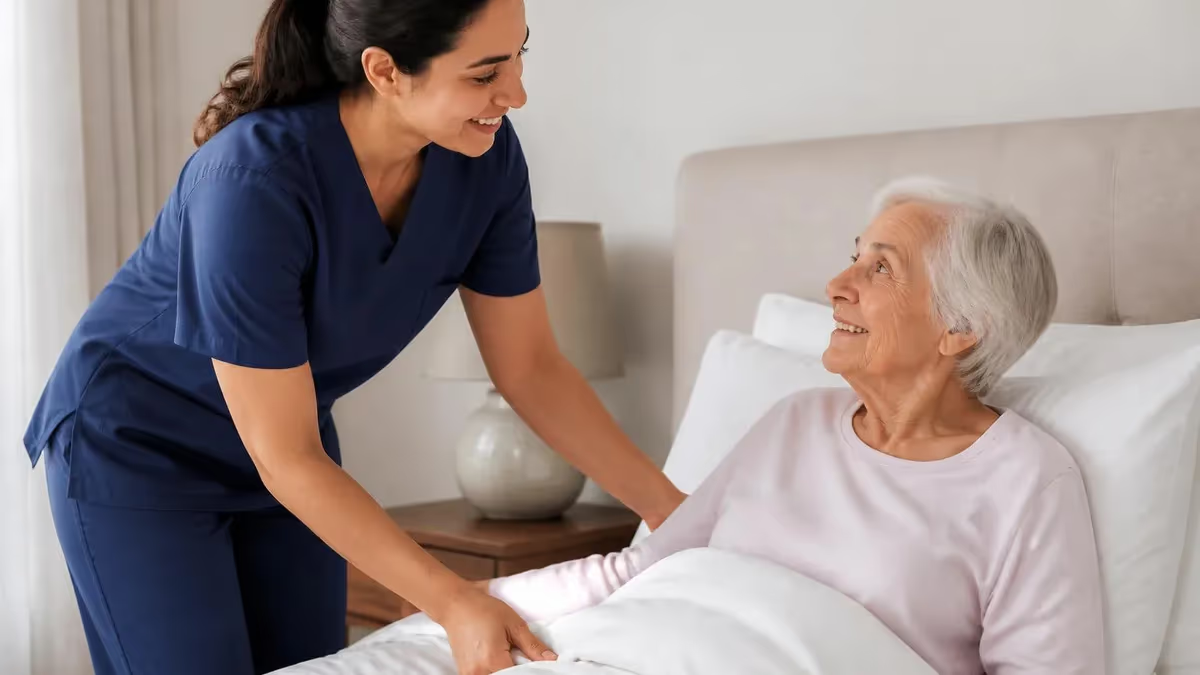
Searching for pca training near me is usually the first concrete step anyone takes toward becoming a Personal Care Assistant, and it is also the moment when the path suddenly feels real. You stop reading about caregiving in the abstract and start comparing classroom locations, weekly schedules, tuition figures, and start dates that line up with your life. The good news is that PCA training is one of the most accessible entry points in healthcare, with programs running in nearly every community college, vocational school, community-based agency, and home care company in the United States.
Before you commit to a program, it helps to understand what PCA actually means in your state. The pca skin of the role, so to speak, is a mix of hands-on personal care, basic health monitoring, household support, and emotional companionship. The training you take must match the legal scope of practice your state allows, which is why a program in Massachusetts may look quite different from one in Texas, Minnesota, or Florida. Always confirm that the curriculum aligns with your state's PCA, HCA, or home care worker regulations.
Most local PCA training programs run between 40 and 120 hours, split into classroom instruction, skills lab practice, and supervised clinical or in-home observation. Some agencies offer paid, on-the-job training in as little as one to two weeks, especially in states with caregiver shortages. Community colleges typically schedule longer programs across four to eight weeks. Workforce development boards, vocational rehabilitation offices, and Medicaid home and community-based services waivers often subsidize the entire cost for qualifying students.
When you type pca training near me into a search engine, you will see three main types of providers compete for your attention: home care agencies, accredited training schools, and community colleges or adult education centers. Each comes with different trade-offs in cost, depth of instruction, job placement support, and credential portability. A short agency program can put you to work in two weeks, while a college course gives you a transcript and credit you can apply toward CNA, HHA, or LPN pathways later.
Before you call any program, gather a few facts about yourself: your state of residence, whether you already have a high school diploma or GED, your transportation situation, any criminal background concerns, and how many hours per week you can realistically attend class. These details determine which programs you actually qualify for and which schedules are feasible. A surprising number of students enroll, then drop out because the class times conflicted with childcare or a second job, not because the material was too hard.
This guide walks you through how to evaluate local PCA training options, what a typical curriculum covers, how much you should expect to pay, what credentials you walk away with, and how to translate that certificate into a paying job within 30 days. We will also cover the differences between state-registered training, agency-sponsored training, and online hybrid programs, plus the red flags that signal a school is not worth your time or money.
By the end, you will have a practical checklist for narrowing your search, a sense of realistic timelines, and a clear understanding of what your first day on the job will look like once you finish training. The PCA workforce is projected to grow faster than almost any other healthcare role through 2032, which means that the time you invest in finding the right local program now will pay off in steady demand, flexible scheduling, and a clear ladder into nursing or allied health if you want it.
PCA Training by the Numbers
Key Facts at a Glance
| Item | Value | Details |
|---|---|---|
| Typical Training Length | 40-120 hrs | Varies by state |
| Federal HHA Minimum | 75 hrs | PCA often less |
| Time to Certificate | 2-6 weeks | Full-time pace |

Where to Find PCA Training Near You
Private and Medicaid-certified agencies often train caregivers for free in exchange for a short employment commitment. Training is fast, practical, and leads directly to client assignments within days of finishing.
Public colleges offer state-approved PCA, HHA, or nurse aide programs for $400 to $1,500. You receive a college transcript, which transfers easily into CNA, LPN, or nursing degree pathways later.
Public school district adult ed programs often run subsidized or free PCA classes through workforce development funding. Schedules are flexible, with evening and weekend cohorts for working students.
Private career colleges deliver intensive PCA or caregiver certificates in two to four weeks. Tuition is higher, but placement services and shorter timelines appeal to career changers in a hurry.
State-approved hybrid programs combine online theory with in-person skills labs at a local partner site. Useful for rural students, but verify your state accepts the credential before enrolling.
PCA training curriculum is more substantive than many people expect. Even short 40-hour programs cover personal care, infection control, safe transfers, vital signs, nutrition, dementia care basics, communication, patient rights, and emergency response. Longer programs add deeper content on chronic disease management, medication reminders, end-of-life care, documentation, and the legal scope of unlicensed assistive personnel. Every program ends with a competency check where you demonstrate skills like bathing, dressing, ambulation, and hand hygiene on a mannequin or live partner.
The classroom portion typically runs 16 to 40 hours and uses textbooks, slide decks, and short videos. Instructors are usually registered nurses or experienced caregivers who supplement the curriculum with stories from real client homes. Pay attention during this section, because the same content forms the foundation of any state competency exam you will take afterward. If you are weighing a future career move, this material also overlaps heavily with CNA and HHA exams, giving you a head start on credentials that pay more.
Skills lab is where most students discover whether caregiving fits them. You will practice transferring a partner from bed to wheelchair, using a gait belt safely, repositioning someone in bed, providing perineal care, applying support stockings, and assisting with feeding. Programs that skimp on lab time are a red flag. You want at least eight to sixteen hours of hands-on practice before you ever touch a client. Some students find lab uncomfortable at first, which is normal and improves with repetition.
Clinical or field experience varies more than any other component. Agency-based programs often place you with a working PCA who shadows you through a real shift. College programs may rotate you through a partner long-term care facility for eight to twenty hours. A few short programs skip clinicals entirely, which is legal in some states but leaves you less prepared on day one. If your program offers an optional clinical extension, take it. Real client exposure is the single best predictor of first-job confidence.
Documentation training is often underweighted, yet it is the skill that separates new hires who keep their jobs from those who get written up. You will learn how to record care plans, complete daily activity logs, note changes in condition, and report incidents according to agency policy. Medicaid-billing agencies require precise time tracking and task documentation because audits can claw back payment if records are incomplete. Treat the documentation module as if your paycheck depends on it, because in many states it literally does.
Soft skills are woven throughout the curriculum but rarely tested directly. Empathy, active listening, cultural competence, boundary setting, and de-escalation make the difference between a PCA who lasts and one who burns out in three months. Good programs build role-play scenarios where you practice handling a client who refuses care, a family member who is rude, or a coworker who cuts corners. If your program does not address these realities, supplement with the pca hydrating toner resources on career advancement and workplace dynamics.
Finally, expect a written final exam and a practical skills demonstration. Pass rates for state-approved PCA exams typically run between 80 and 95 percent on the first attempt, which is much higher than nursing exams because the scope of practice is narrower. Most programs offer a retest if you fail, sometimes at no extra cost. Walking out with a printed certificate, a state registry number, and a clear record of completed clinical hours gives you negotiating power on your first job offer.

PCA Practice Test Questions
Prepare for the PCA - Personal Care Assistant exam with our free practice test modules. Each quiz covers key topics to help you pass on your first try.
PCA Duties and Responsibilities
Free PCA Practice Test featuring Duties and Responsibilities. Improve your PCA Exam score with mock test prep.
PCA Qualifications
PCA Mock Exam on Qualifications. PCA Study Guide questions to pass on your first try.
PCA Working Conditions
PCA Test Prep for Working Conditions. Practice PCA Quiz questions and boost your score.
PCA Assisting with Daily Living Activities
PCA Questions and Answers on Assisting with Daily Living Activities. Free PCA practice for exam readiness.
PCA Basic Nursing Skills
PCA Mock Test covering Basic Nursing Skills. Online PCA Test practice with instant feedback.
PCA Basic Patient Care Skills
Free PCA Quiz on Basic Patient Care Skills. PCA Exam prep questions with detailed explanations.
PCA Communication and Interpersonal Skills
PCA Practice Questions for Communication and Interpersonal Skills. Build confidence for your PCA certification exam.
PCA Ethical and Legal Responsibilities
PCA Test Online for Ethical and Legal Responsibilities. Free practice with instant results and feedback.
PCA Health and Safety Procedures
PCA Study Material on Health and Safety Procedures. Prepare effectively with real exam-style questions.
PCA Health & Safety Protocols
Free PCA Test covering Health & Safety Protocols. Practice and track your PCA exam readiness.
PCA Infection Control
PCA Exam Questions covering Infection Control. Master PCA Test concepts for certification prep.
PCA Mental Health & Emotional Support
Free PCA Practice Test featuring Mental Health & Emotional Support. Improve your PCA Exam score with mock test prep.
PCA Nutrition & Hydration
PCA Mock Exam on Nutrition & Hydration. PCA Study Guide questions to pass on your first try.
PCA Patient Mobility & Transfers
PCA Test Prep for Patient Mobility & Transfers. Practice PCA Quiz questions and boost your score.
Understanding PCA Meaning, Medical Scope, and Credentials
The pca meaning depends on context. In healthcare, PCA stands for Personal Care Assistant, also called Personal Care Aide. The role focuses on non-medical, hands-on support that lets clients remain in their homes safely. PCAs help with bathing, dressing, grooming, toileting, meal preparation, light housekeeping, and companionship.
In some states, PCA also refers to Patient Care Assistant or Patient Care Associate, a hospital-based role with a slightly different scope. Always confirm which definition your prospective employer or training program uses, because the curriculum, pay, and clinical setting differ significantly between home-based PCAs and hospital-based ones.
Agency Training vs. College Training: Which Is Right for You?
- +Agency training is usually free or paid, with no out-of-pocket tuition
- +Agency programs guarantee a job offer immediately upon completion
- +Training is fast, often two weeks or less from start to first paycheck
- +Schedules are flexible and built around adult learners with families
- +College programs give you a transcript that transfers to CNA or LPN later
- +College instructors are typically RNs with broader clinical experience
- +Workforce development funding can cover college tuition entirely for qualifying students
- −Agency training locks you into a short employment commitment with that company
- −Agency curriculum may skip topics not directly relevant to that employer's clients
- −College programs cost $400 to $1,500 and take four to eight weeks
- −College schedules can conflict with second jobs or childcare responsibilities
- −Some online hybrid programs are not recognized by every state registry
- −Smaller agencies may not offer formal skills lab time, only on-the-job shadowing
- −Credential portability between states is uneven and may require retesting

PCA Training Enrollment Checklist
- ✓Confirm you meet the minimum age requirement (usually 16 or 18 depending on state)
- ✓Gather proof of high school diploma, GED, or equivalent if required
- ✓Schedule a TB test and any required immunizations before classes start
- ✓Complete a criminal background check through the state-approved vendor
- ✓Verify your driver's license and reliable transportation for clinical sites
- ✓Apply for workforce development or Medicaid waiver funding if eligible
- ✓Request a copy of the program's state approval letter or accreditation
- ✓Ask about job placement rates and the agencies that hire program graduates
- ✓Confirm class times, total hours, and clinical site locations before paying
- ✓Plan childcare, work coverage, and study time across the full program length
Workforce Innovation and Opportunity Act (WIOA) funds can pay 100% of your PCA training
Most local American Job Centers administer WIOA funding that covers tuition, books, transportation, and even childcare for healthcare training. Eligibility extends well beyond unemployed workers, including underemployed adults and recent high school graduates. Walk into your local center, ask for a career counselor, and bring proof of income, ID, and a list of approved PCA programs in your area.
The cost of PCA training near you varies dramatically based on provider type, state subsidies, and whether you qualify for workforce funding. At the low end, home care agencies often deliver training at zero cost and even pay you a stipend during the program. At the high end, private vocational schools may charge $1,200 to $1,800 for an intensive certificate. Community colleges fall in the middle at roughly $400 to $900, with additional fees for textbooks, uniforms, background checks, and the state competency exam.
If you are paying out of pocket, factor in the hidden costs that catch students off guard. A TB test runs $20 to $50. Background checks and fingerprinting cost $30 to $75. Uniform scrubs and non-slip shoes add another $50 to $100. The state competency exam itself often costs $75 to $150, and a retake adds the same. CPR and First Aid certification, sometimes required separately, runs $60 to $120. Budget at least $250 to $400 above tuition for these incidentals.
Free training options are surprisingly plentiful if you know where to look. Medicaid home and community-based services waivers fund free PCA training in many states because the workforce shortage threatens the entire program. Veterans can use VA education benefits. Vocational rehabilitation offices fund training for adults with disabilities. State workforce boards distribute federal WIOA dollars to approved programs. Some hospital systems and large home care chains offer paid apprenticeship-style training that turns into guaranteed jobs.
Pay close attention to refund policies before you write a check. Some programs offer full refunds within the first week but nothing after, while others use a sliding scale tied to hours completed. If life happens and you have to withdraw, you do not want to lose your entire investment. Ask for the refund policy in writing, and confirm whether your seat is guaranteed if you need to defer to the next cohort. Reputable programs are transparent about both refunds and deferrals.
Financing options beyond grants include payment plans through the school, healthcare-specific tuition lenders, and some employer reimbursement arrangements. A growing number of states offer income share agreements or pay-after-employment models where you owe nothing upfront and pay a small percentage of your first year's wages. These can be reasonable if the terms are clear, but read the fine print. The total cost can exceed traditional tuition if you finish quickly and earn well.
Tax season holds one more pleasant surprise. PCA training expenses, including tuition, books, exam fees, and required equipment, may qualify for the Lifetime Learning Credit or be deductible as job-related education if you are already working in healthcare. Keep every receipt, every tuition statement, and every mileage log for clinical travel. A tax professional familiar with healthcare workers can often recover several hundred dollars that students leave on the table.
Finally, consider the opportunity cost of not training. Every week you spend hesitating is a week you are earning a non-healthcare wage when you could be earning $14 to $22 per hour as a certified PCA. In high-cost-of-living states, certified PCAs working overnight or weekend differentials clear $50,000 a year before overtime. The training is the bottleneck, not the job market. Once you finish, demand is so strong that most graduates field multiple offers within their first week of applying.
Some unaccredited programs sell certificates that no agency or state Medicaid program will honor. Before enrolling, call your state's nurse aide or home care registry and confirm the program is on the approved list. If a school cannot give you the exact name of the regulatory body that approved them, walk away. A few hours of research now prevents months of wasted tuition and lost income later.
The leap from finishing PCA training to working your first paid shift should take no more than two to three weeks if you prepare during the program itself. Start applying to agencies in your final week of classes, not after you receive your certificate. Most agencies will extend a conditional offer pending your state registry listing, and many will schedule your orientation for the week after you finish. The candidates who hesitate often watch better shifts go to peers who applied early.
When you compare offers, look beyond the hourly wage. Mileage reimbursement, paid travel time between clients, weekend and overnight differentials, health benefits, paid time off, and continuing education stipends can shift the total compensation by several thousand dollars a year. A $15 hourly rate with paid travel and full benefits often beats a $17 rate with no benefits and unpaid driving time. Ask for a written breakdown of all compensation components before signing.
Your first 90 days set the trajectory of your entire PCA career. Show up early, document precisely, ask questions before you guess, and treat every client interaction as a chance to build a reference. Supervisors notice the new hires who learn names, remember preferences, and report changes promptly. These are the PCAs who get the steady, stable client assignments while others bounce between fill-in shifts and last-minute cancellations.
Specialize as soon as you can. PCAs with dementia care experience, hospice exposure, or pediatric and developmentally disabled client experience command higher wages and steadier hours. Many agencies pay extra for bilingual caregivers, particularly Spanish, Mandarin, Vietnamese, Russian, and Haitian Creole speakers. If your program offered electives or your agency offers in-service training in any specialty, take it. The bump in pay and shift selection is immediate.
Plan your next credential from day one. The PCA certificate is the on-ramp to a healthcare ladder that climbs to Home Health Aide, Certified Nursing Assistant, Patient Care Technician, Medication Aide, LPN, and RN. Many employers pay tuition for nursing-track education if you commit to staying on after graduation. The porsche experience of moving up that ladder is well documented, and the credential stack you start building today pays compounding returns over a 20- or 30-year career.
Avoid the burnout traps that sideline new PCAs. Do not pick up so many overtime shifts in the first month that you exhaust yourself. Do not skip meals or breaks because a client asks. Do not lift clients alone if a safe transfer requires two people. Do not work through a fever or stomach illness, even if the agency pressures you. Burnout and injury are the top reasons new PCAs leave the field, and both are largely preventable with disciplined boundaries from day one.
Build a peer network early. Other PCAs are your best source of intelligence on which agencies pay on time, which supervisors actually return calls, which clients are challenging, and which shifts have the best differentials. Join a state caregiver association, a union if one represents PCAs in your state, or even a private Facebook group for caregivers in your region. The knowledge shared in these networks is worth more than any formal continuing education unit, and the friendships sustain you through hard weeks.
Practical preparation for your first day of training is straightforward, but small details make a real difference. Pack a notebook, two pens, a water bottle, a small snack, and a watch with a second hand. Smartphones are often discouraged in skills lab and clinical, so a basic wristwatch makes vital signs practice easier. Wear scrubs or comfortable layers, closed-toe non-slip shoes, and tie back long hair. Arrive 15 minutes early on day one to handle paperwork and meet your instructor.
Mentally, treat training like a paid job even if you are paying tuition. Show up rested, do the assigned reading before each class, and review your notes the same evening. Adult learners often forget how quickly material compounds in a short program. Falling behind in week one of a four-week course is hard to recover from. Set up a small study spot at home with your textbook, a notebook, and reliable lighting, and protect 30 to 60 minutes of study time every weekday.
Form a study group within the first week. Two or three classmates committed to passing the exam together will quiz each other on terminology, practice transfers and vital signs in pairs, and share notes when someone misses a class. Skills lab partners often become long-term professional friends. If your program has a private messaging group, join it. The shared accountability dramatically increases pass rates and shrinks the lonely feeling that adult students sometimes describe in healthcare programs.
Take the state competency exam seriously even though pass rates are high. Most failures come from skipping a single critical step in a practical demonstration, such as forgetting to introduce yourself, failing to wash hands, leaving the bed rail down, or skipping the privacy screen. The written exam tests scope of practice, infection control, body mechanics, and patient rights. Use a free online practice bank like the pca pump question library to drill weak spots before exam day.
On exam day, sleep at least seven hours, eat a real breakfast, and arrive 30 minutes early. Bring two forms of ID, your admission letter, and any equipment your program requires. Read each written question fully before answering, because PCA exams love distractor answers that are partially correct. For the practical, narrate your steps out loud as you perform them. Evaluators score what they see and hear, not what you intended to do silently.
After you pass, request several official copies of your certificate and your state registry confirmation. You will need them for every job application, every agency credentialing file, and any future credential stacking like CNA or HHA. Save digital scans in cloud storage and keep one paper copy in a folder at home. Losing a certificate and waiting weeks for a replacement has cost more than one new PCA their first job offer.
Finally, give yourself credit. Completing PCA training is a real accomplishment that opens a stable career in one of the fastest-growing fields in the United States. Whether you stay a PCA for life because you love the work or you use it as a launchpad into nursing, the skills you gain are transferable, the demand is durable, and the impact on the clients you serve is genuine. The search for pca training near me ends here. The career it starts can last as long as you want it to.
Sample Personal Care Assistant Practice Questions
Try these questions from our free Personal Care Assistant practice tests. The correct answer and an explanation follow each question.
A PCA notices the client's bathroom floor is slippery after bathing. What is the safest immediate action?
- A. Leave it to air-dry after the session
- B. Dry the floor immediately and consider placing non-slip mats
- C. Warn the client verbally about the wet floor
- D. Place a towel on the floor temporarily
Answer: B. Dry the floor immediately and consider placing non-slip mats
Drying the floor immediately and using non-slip mats prevents falls, which are a leading cause of injury for elderly clients.
A client tells the PCA they are experiencing crushing chest pain radiating to their left arm. What should the PCA do?
- A. Call 911 immediately and keep the client calm and still
- B. Give the client water and have them rest
- C. Ask the client to walk to the car to drive to the hospital
- D. Administer the client's nitroglycerin without consulting anyone
Answer: A. Call 911 immediately and keep the client calm and still
These are classic signs of a heart attack requiring immediate emergency services; keeping the client calm minimizes cardiac stress.
What is the importance of Patient Mobility & Transfers in patient care?
- A. It is irrelevant to patient care.
- B. It is essential for maintaining patient health and comfort.
- C. It is only necessary for elderly patients.
- D. It only relates to personal preference.
Answer: B. It is essential for maintaining patient health and comfort.
Patient mobility and transfers are fundamental to preventing complications like pressure ulcers, muscle atrophy, and circulatory issues. By assisting patients with movement, PCAs promote physical well-being, improve circulation, and enhance overall comfort, which are crucial for recovery and quality of life.
In what way can PCAs benefit family caregivers?
- A. By increasing their workload
- B. By providing them with respite and support
- C. By demanding constant supervision
- D. By reducing the overall safety of the care recipient
Answer: B. By providing them with respite and support
Family caregivers often experience significant physical and emotional strain, leading to burnout. PCAs provide invaluable respite by taking over caregiving duties, allowing family members to rest, attend to personal needs, or pursue other responsibilities. This support system helps alleviate stress, prevents caregiver exhaustion, and strengthens the overall caregiving network, ensuring sustainable care for the recipient.
PCA Questions and Answers

PCA - Personal Care Assistant: Complete Study Guide 2026
PCA - Personal Care Assistant: Career Paths, Salary, and Requirements 2026

PCA (Personal Care Assistant) Test: What to Expect
PCA Practice Test Video Answers
Positive Coaching Alliance: Certification, Philosophy, and Why It's Reshaping Youth Sports
About the Author

Registered Nurse & Healthcare Educator
Johns Hopkins University School of NursingDr. Sarah Mitchell is a board-certified registered nurse with over 15 years of clinical and academic experience. She completed her PhD in Nursing Science at Johns Hopkins University and has taught NCLEX preparation and clinical skills courses for nursing students across the United States. Her research focuses on evidence-based exam preparation strategies for healthcare certification candidates.