
Pennsylvania Boating License: Complete PA Guide 2026 October
🏆 Get ready for your Pennsylvania Boating License: Complete certification. Practice questions with step-by-step answer explanations and instant scoring.
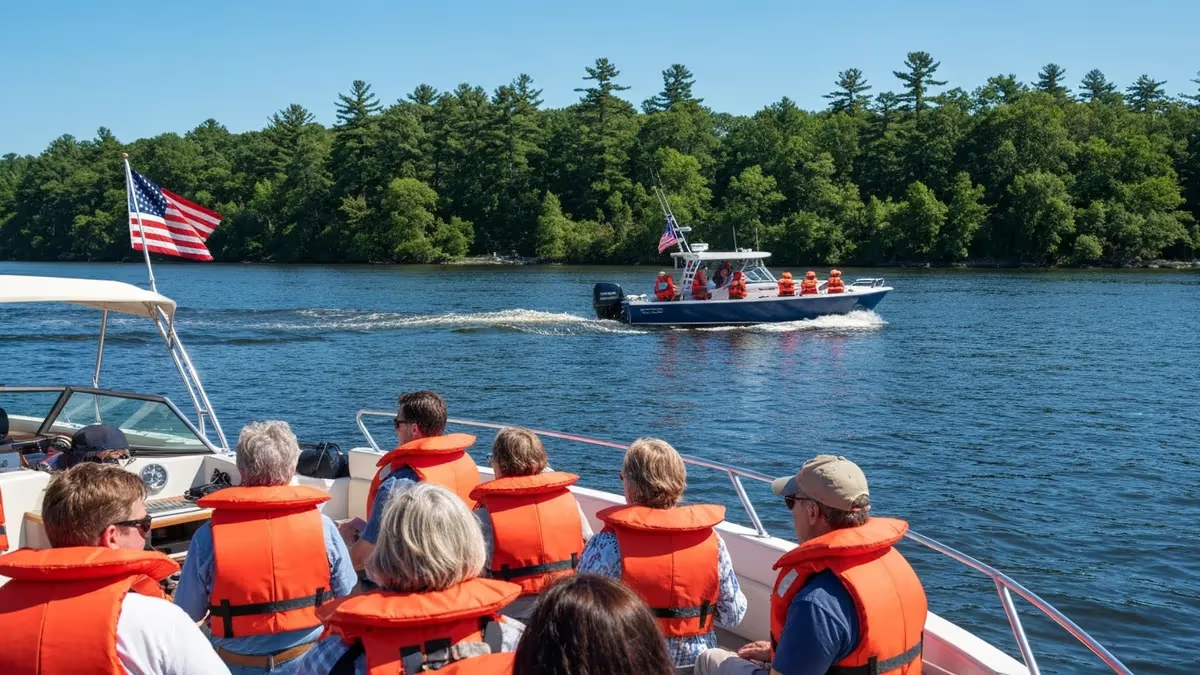
Who Needs a PA Boating License?
Pennsylvania does not issue a traditional "boating license" — instead, the state issues a Boating Safety Education Certificate under the authority of the Pennsylvania Fish & Boat Commission (PFBC). This certificate is required for anyone who:
Was born on or after January 1, 1982 and operates a motorboat with 10 horsepower or more on Pennsylvania waters. If you were born before January 1, 1982, you are exempt from this requirement — though taking a safety course is still recommended. Operators of non-motorized vessels (canoes, kayaks, paddleboards) do not need a certificate regardless of birth date.
Personal watercraft (PWC) such as Jet Skis follow slightly different rules: any operator age 12 or older must hold the certificate, and operators under 16 must also have an adult aboard. If you're preparing for the state knowledge exam, our boating license practice questions cover every PFBC topic area.
PA Boating Age Requirements
Pennsylvania sets clear age minimums for operating motorized boats on state waters. Understanding the rules before you head out prevents fines and, more importantly, keeps everyone safe on the water.
Under 12: Children younger than 12 may not operate a motorboat of 10 HP or more independently. They may operate under direct adult supervision as a passenger activity but cannot be the sole operator at any time.
Ages 12–15: Teenagers 12 through 15 may operate a motorboat of 10 HP or more only if an adult who is 18 years of age or older is physically present aboard the vessel and maintains overall control. A certificate is required for PWC operators in this age group as well. Many younger boaters in this group use our boating license practice test to prepare for their safety exam.
Age 16 and older: Those 16 and up who were born on or after January 1, 1982 may operate independently — provided they hold a valid PFBC Boating Safety Education Certificate. No adult chaperone is required once this certificate is in hand.
These age thresholds apply across the entire commonwealth, including all rivers, lakes, and connecting waterways. Other states have similar frameworks — for comparison, see our guide to the NJ boating license or the nc boating license, which share the mid-Atlantic NASBLA approval standard.
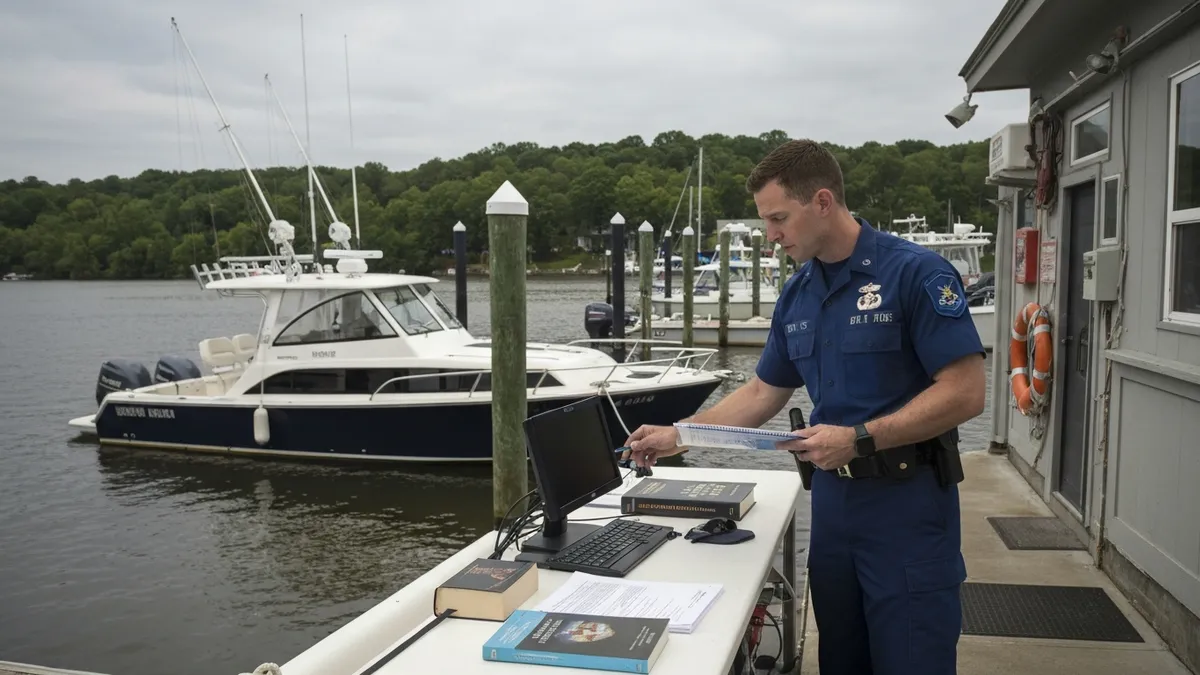
How to Get Your PA Boating Safety Certificate
The PFBC offers two pathways to earn your Boating Safety Education Certificate: a state-approved online course and in-person classroom instruction. Both result in the same NASBLA-approved, lifetime certificate.
Option 1 — Online Course (Boat-Ed.com): The official PFBC online provider is Boat-Ed.com, which charges approximately $29.95 for the complete course. You work through the material at your own pace, take a proctored final exam online, and receive an immediate temporary certificate. Your official wallet card arrives by mail within a few weeks. This is the fastest route for most adults and teens born after 1982.
Option 2 — PFBC Classroom Course: The commission holds in-person classroom sessions throughout Pennsylvania, many of which are free of charge. These are especially popular with younger boaters who benefit from hands-on instruction. Class schedules are listed on the PFBC website. After passing the final exam, students receive the same lifetime certificate as the online course.
Once issued, the certificate never expires and is recognized in all states that require boating education. If you move from Pennsylvania to another state, your PA certificate satisfies requirements nationwide. States like Minnesota boat license holders and those with a NYS boating license enjoy the same reciprocity under NASBLA standards.
What the PA Boating Safety Course Covers
Whether you take the online or classroom version, the PFBC-approved course covers the same core curriculum required by the National Association of State Boating Law Administrators (NASBLA). Expect to study the following topic areas in detail.
The course opens with Pennsylvania-specific regulations: registration rules, legal operating hours, wake zones, and restricted areas on major waterways including the Delaware, Susquehanna, and Allegheny rivers. Understanding these local rules is essential before the final exam. You can reinforce your knowledge with our do you need a license to drive a boat overview, which explains federal versus state jurisdiction on waterways.
The curriculum also covers navigation rules (the maritime equivalent of traffic laws), reading buoys and markers, right-of-way situations, and how to handle vessel traffic in locks and bridges. Environmental stewardship — preventing aquatic invasive species spread, no-wake zones near wetlands — is covered as well. Our neighbors in the midwest face similar curricula; the mn boat license guide shows how Minnesota structures the same NASBLA topics. Southern states like Tennessee boating license and Alabama boating license also align with this national framework.
PA Boating Safety Exam Prep Checklist
- ✓Study Pennsylvania Fish & Boat Commission regulations and local waterway rules
- ✓Memorize the mandatory safety equipment list: life jackets, fire extinguisher, sound device
- ✓Learn navigation light requirements for operating after sunset
- ✓Practice reading buoy colors and marker shapes (red right returning)
- ✓Understand right-of-way rules between powered vessels, sailboats, and human-powered craft
- ✓Review proper towing procedures and safe passenger capacity guidelines
- ✓Know blood alcohol content (BAC) limits for boating under the influence in PA (0.08%)
- ✓Study the Pennsylvania no-wake zone rules and restricted areas
- ✓Complete at least one full-length practice test before your final exam
- +Validates your knowledge and skills objectively
- +Increases job market competitiveness
- +Provides structured learning goals
- +Networking opportunities with other certified professionals
- −Study materials can be expensive
- −Exam anxiety can affect performance
- −Requires dedicated preparation time
- −Retake fees apply if you don't pass
Pros and Cons at a Glance
| Pros | Cons |
|---|---|
| Validates your knowledge and skills objectively | Study materials can be expensive |
| Increases job market competitiveness | Exam anxiety can affect performance |
| Provides structured learning goals | Requires dedicated preparation time |
| Networking opportunities with other certified professionals | Retake fees apply if you don't pass |
Sample Boating License Test Practice Questions
Try these questions from our free Boating License Test practice tests. The correct answer and an explanation follow each question.
What pre-departure checks should be performed before every boating trip?
- A. Inspect hull, check fuel and oil levels, test bilge pump, verify safety equipment, check weather, and file a float plan
- B. Only check if the engine starts
- C. No checks are needed for short trips
- D. Only check the weather forecast
Answer: A. Inspect hull, check fuel and oil levels, test bilge pump, verify safety equipment, check weather, and file a float plan
Pre-departure checks include hull inspection, engine and fuel system check, bilge pump test, safety equipment inventory (PFDs, flares, fire extinguisher), navigation light test, weather check, and filing a float plan.
What must you do if you are involved in a boating accident with injuries?
- A. Stop, provide assistance, and report the accident
- B. Leave the scene quickly
- C. Only report it if property was damaged
- D. Wait a week before reporting
Answer: A. Stop, provide assistance, and report the accident
Boaters are legally required to stop, render aid, and report accidents involving injury.
What does the abbreviation BUI stand for in boating law?
- A. Boating Under Inspection
- B. Boating Under the Influence
- C. Boat Use Infraction
- D. Basic Underway Information
Answer: B. Boating Under the Influence
BUI stands for Boating Under the Influence, the waterway equivalent of DUI for motor vehicles.
What weather conditions indicate an approaching thunderstorm while boating?
- A. Rapidly building dark cumulonimbus clouds, sudden wind shifts, dropping barometric pressure, and distant lightning
- B. Clear blue skies with light cirrus clouds
- C. Steady light rain
- D. Fog forming over the water
Answer: A. Rapidly building dark cumulonimbus clouds, sudden wind shifts, dropping barometric pressure, and distant lightning
Thunderstorm indicators include towering dark clouds, sudden wind direction changes, falling barometric pressure, visible lightning, and increased wave action. Head to shore immediately when signs appear.
PA Boating License Questions and Answers
More Boating License Guides
About the Author

Educational Psychologist & Academic Test Preparation Expert
Columbia University Teachers CollegeDr. Lisa Patel holds a Doctorate in Education from Columbia University Teachers College and has spent 17 years researching standardized test design and academic assessment. She has developed preparation programs for SAT, ACT, GRE, LSAT, UCAT, and numerous professional licensing exams, helping students of all backgrounds achieve their target scores.
Join the Discussion
Connect with other students preparing for this exam. Share tips, ask questions, and get advice from people who have been there.
View discussion (6 replies)