
OSHA Forklift Training: Certification Requirements, Cost & 2026 September Guide
💯 OSHA approved forklift training requirements, costs, and certification steps. Learn 1910.178 rules, employer duties, and how to get certified in 2026 September.

OSHA approved forklift training is the foundation of safe powered industrial truck operation in every U.S. warehouse, distribution center, construction site, and manufacturing facility. Under federal regulation 29 CFR 1910.178(l), no employee under the age of 18 may operate a forklift, and no employee of any age may operate one without first completing formal instruction, hands-on training, and a workplace evaluation conducted by a qualified trainer. Employers who skip these steps face fines exceeding $16,000 per serious violation and up to $165,514 for willful or repeat offenses in 2026.
Forklifts cause roughly 7,500 nonfatal injuries and about 70 to 100 deaths in the United States each year, according to Bureau of Labor Statistics data compiled by NIOSH. The majority of these incidents involve operators who were either untrained, undertrained, or operating a class of truck they were never certified to use. OSHA citations for inadequate forklift training consistently rank in the top ten most-cited workplace standards, year after year.
The good news is that compliance is straightforward when you understand the rule. Training must cover truck-related topics, workplace-related topics, and the requirements of the OSHA standard itself. It must be delivered by someone with the knowledge, training, and experience to teach operators and evaluate their competence. Certification is valid for three years, after which a refresher evaluation is required. Training is also required immediately if an operator is observed driving unsafely, has an accident, or is assigned to a different type of truck.
This guide walks through every element of a compliant program: who must be trained, what topics must be covered, how long training takes, what it costs, what documentation must be kept, and how to verify whether a course advertised online is actually OSHA-compliant. It also explains the seven OSHA truck classes, the difference between certification and a license, and why no card or wallet credential is technically required by the federal rule.
Whether you are a warehouse worker preparing for your first evaluation, a supervisor responsible for building a training program, a small business owner trying to avoid citations, or a safety professional updating procedures for 2026, you will find concrete steps below. We cover online courses, in-person classes, employer-led programs, and the documentation checklist that satisfies an OSHA inspector. The standard has not changed substantively since 1999, but enforcement priorities, training delivery methods, and acceptable evidence of competency have all evolved.
One common misconception worth correcting at the outset: there is no such thing as an OSHA-issued forklift license. OSHA does not certify trainers, does not approve specific courses, and does not maintain a registry of operators. Any vendor claiming to sell an "OSHA license" or "OSHA card" for forklift operation is using marketing language, not regulatory language. What OSHA requires is documented evidence that your employer trained and evaluated you on the specific equipment you operate, in the specific workplace where you operate it.
OSHA Forklift Training by the Numbers
Path to OSHA Forklift Certification
Formal Instruction
Practical Training
Workplace Evaluation
Written Certification
Three-Year Refresher
The OSHA standard breaks required content into three categories: truck-related topics, workplace-related topics, and the requirements of the powered industrial truck standard itself. Truck-related topics cover operating instructions, differences between forklifts and automobiles, controls and instrumentation, engine or motor operation, steering and maneuvering, visibility restrictions including load obstructions, fork attachments and limitations, vehicle capacity, vehicle stability, inspection and maintenance, refueling or recharging, and any operating limitations specific to the truck class being used.
Workplace-related topics are equally detailed. They include the surface conditions where the truck will operate, the composition of loads to be carried and load stability, load manipulation and stacking, pedestrian traffic, narrow aisles and restricted areas, hazardous classified locations such as flammable or dusty environments, ramps and sloped surfaces, closed environments with air contamination risks, and any other unique workplace conditions that could affect safe operation. This is why purely generic online courses cannot fully satisfy the rule on their own.
The third category, requirements of the OSHA standard, requires operators to understand the regulation itself, including the daily inspection mandate, the rules about leaving a truck unattended, capacity plates, modifications and attachments, and the prohibition against riders on forks. Many employers underweight this category because it feels academic, but inspectors frequently quiz operators directly on these points during site visits, and a blank stare from your operator can support a citation against your program.
A qualified trainer is defined by OSHA as someone with the knowledge, training, and experience to train operators and evaluate their competence. There is no required credential, no OSHA-issued trainer card, and no minimum number of years of experience written into the standard. However, a trainer must be able to defend their qualifications if challenged. Most employers use a combination of safety managers, experienced lead operators, equipment dealer reps, or third-party trainers who carry their own credentials from organizations like NSC, NCCCO, or the National Forklift Foundation.
Evaluation is its own step, distinct from training. Even if an operator passes a written test and a skills demonstration at a training facility, the workplace evaluation must occur in the actual environment where they will operate. An evaluator watches the operator perform real or simulated tasks, scoring competency on a documented checklist, and only then signs off on certification. Skipping or rushing this step is one of the most common compliance failures uncovered during OSHA investigations after an incident.
Note that the rule covers all powered industrial trucks, not just sit-down counterbalanced forklifts. Order pickers, reach trucks, pallet jacks with raised platforms, rough terrain forklifts, and side-loaders are all covered. Walk-behind electric pallet jacks are a debated edge case, but OSHA letters of interpretation generally treat them as covered equipment when they have any rider platform or controls that an operator must manipulate while moving. When in doubt, train and document.
Operators must be certified for each specific truck type they use. Someone trained on a Class IV sit-down counterbalanced LP gas forklift is not automatically qualified to operate a Class II narrow-aisle reach truck. If your facility uses multiple classes, your training program should reflect that, and your documentation should specify which classes each operator has been evaluated on. Reviewing the underlying osha standards for first aid kits is a useful starting point for any safety manager.
OSHA Practice Test Questions
Prepare for the OSHA - Safety Certificate exam with our free practice test modules. Each quiz covers key topics to help you pass on your first try.
OSHA Basic OSHA Practice
OSHA Exam Questions covering Basic OSHA Practice. Master OSHA Test concepts for certification prep.
OSHA Confined Space Entry
Free OSHA Practice Test featuring Confined Space Entry. Improve your OSHA Exam score with mock test prep.
OSHA Fall Protection
OSHA Mock Exam on Fall Protection. OSHA Study Guide questions to pass on your first try.
OSHA - Safety Certificate Electrical Safet...
Free OSHA Quiz on OSHA - Safety Certificate Electrical Safety Standards Questions and Answers. OSHA Exam prep questions with detailed explanations.
OSHA - Safety Certificate Emergency Action...
OSHA Practice Questions for OSHA - Safety Certificate Emergency Action and Fire Plans Questions and Answers. Build confidence for your OSHA certification exam.
OSHA - Safety Certificate Hazard Communica...
OSHA Test Online for OSHA - Safety Certificate Hazard Communication Standard Questions and Answers. Free practice with instant results and feedback.
OSHA - Safety Certificate Introduction to ...
OSHA Study Material on OSHA - Safety Certificate Introduction to OSHA Questions and Answers. Prepare effectively with real exam-style questions.
OSHA - Safety Certificate Lockout/Tagout P...
Free OSHA Test covering OSHA - Safety Certificate Lockout/Tagout Procedures Questions and Answers. Practice and track your OSHA exam readiness.
OSHA - Safety Certificate Machine Guarding...
OSHA Exam Questions covering OSHA - Safety Certificate Machine Guarding Requirements Questions and Answers. Master OSHA Test concepts for certification prep.
OSHA - Safety Certificate OSHA Recordkeepi...
Free OSHA Practice Test featuring OSHA - Safety Certificate OSHA Recordkeeping and Reporting Questions and Answers. Improve your OSHA Exam score with mock test prep.
OSHA - Safety Certificate Personal Protect...
OSHA Mock Exam on OSHA - Safety Certificate Personal Protective Equipment (PPE) Questions and Answers. OSHA Study Guide questions to pass on your first try.
OSHA - Safety Certificate Walking and Work...
OSHA Test Prep for OSHA - Safety Certificate Walking and Working Surfaces Questions and Answers. Practice OSHA Quiz questions and boost your score.
OSHA - Safety Certificate Electrical Safet...
OSHA Mock Test covering - Safety Certificate Electrical Safety Standards. Online OSHA Test practice with instant feedback.
OSHA - Safety Certificate Emergency Action...
Free OSHA Quiz on - Safety Certificate Emergency Action and Fire Plans. OSHA Exam prep questions with detailed explanations.
OSHA - Safety Certificate Hazard Communica...
OSHA Practice Questions for - Safety Certificate Hazard Communication Standard. Build confidence for your OSHA certification exam.
OSHA - Safety Certificate Introduction to ...
OSHA Test Online for - Safety Certificate Introduction to OSHA. Free practice with instant results and feedback.
OSHA - Safety Certificate Lockout/Tagout P...
OSHA Study Material on - Safety Certificate Lockout/Tagout Procedures. Prepare effectively with real exam-style questions.
OSHA - Safety Certificate Machine Guarding...
Free OSHA Test covering - Safety Certificate Machine Guarding Requirements. Practice and track your OSHA exam readiness.
OSHA - Safety Certificate OSHA Recordkeepi...
OSHA Exam Questions covering - Safety Certificate OSHA Recordkeeping and Reporting. Master OSHA Test concepts for certification prep.
Online vs In-Person OSHA Approved Forklift Training
Online-only courses can satisfy the formal instruction portion of OSHA forklift training, but they cannot satisfy the entire requirement. The rule explicitly requires hands-on practical training and a workplace evaluation, neither of which can be completed through a video or quiz. Reputable online providers acknowledge this and provide a certificate of completion for the classroom portion only, leaving the practical evaluation to the employer.
Online options typically cost between $50 and $100, take 1 to 3 hours, and cover stability triangles, load capacity, pre-shift inspection, and OSHA rule basics. They work well for refreshers, multi-site employers, or supplementing in-person sessions. Watch out for vendors advertising a complete "OSHA license" online for $40, because no online-only program is fully compliant on its own.

Employer-Led Programs vs Third-Party Trainers
- +Employer-led programs cost dramatically less per operator after initial trainer setup is complete
- +Internal trainers know your specific equipment, layout, and operational hazards intimately
- +Scheduling is flexible and can fit shift patterns, seasonal hiring spikes, or urgent backfills
- +Documentation stays inside your safety management system and is easier to retrieve during audits
- +Refresher evaluations can be conducted casually and frequently rather than batched annually
- +Trainer can coach on real workplace incidents and near-misses as they happen in real time
- −Initial train-the-trainer investment can run $1,500+ per qualified staff member
- −Internal trainers may lack credibility with employees compared to outside experts
- −Bias risk where managers under-document failed evaluations to keep production moving
- −Updating curriculum when standards or equipment change becomes the employer's burden
- −Single-trainer dependency creates a gap when that person leaves the company
- −Smaller employers may not have enough volume to justify training a dedicated internal trainer
OSHA Forklift Training Compliance Checklist
- ✓Confirm every operator is at least 18 years of age before any training begins
- ✓Verify the trainer's knowledge, experience, and credentials are documented in writing
- ✓Cover all truck-related topics required under 29 CFR 1910.178(l)(3)(i)
- ✓Cover all workplace-related topics specific to your facility layout and hazards
- ✓Provide hands-on practical training on the actual truck class to be operated
- ✓Conduct a workplace evaluation in the real operating environment, not just a training pad
- ✓Document operator name, training date, evaluation date, and trainer or evaluator name
- ✓Issue truck-class-specific certification, not a generic blanket forklift card
- ✓Schedule three-year refresher evaluations and track them in your safety calendar
- ✓Trigger immediate refresher training after any unsafe operation, accident, or new truck assignment
There is no such thing as an OSHA-issued forklift license
OSHA does not issue, approve, or maintain any license, card, or registry for forklift operators. The agency requires that your employer train and evaluate you, then document that training. Any vendor selling a standalone "OSHA forklift license" online for a low flat fee is using marketing language. Real compliance requires hands-on training and a workplace evaluation on your specific equipment.
The total cost of OSHA approved forklift training varies widely depending on the delivery model, the number of operators, and whether you are training from scratch or running a refresher cycle. For a single new operator, expect to spend $50 to $100 on online classroom content, plus roughly $150 to $300 for an on-site evaluation if you hire an outside trainer. Group rates drop the per-operator cost significantly, with some providers charging $80 to $120 per head when six or more operators are trained at once.
For employers running their own program, the upfront investment is heavier but pays back quickly. A train-the-trainer course typically runs $500 to $1,500 per attendee for a two-day session. After that, your internal trainer can run sessions for the cost of their time plus any printed materials and equipment downtime. Many warehouses with 20 or more operators report a payback period under one year compared to using consultants.
Time investment is similarly variable. A first-time operator usually completes formal classroom content in 2 to 4 hours, then spends another 2 to 4 hours on hands-on training and evaluation. Total seat-time is roughly 4 to 8 hours per operator. Experienced operators undergoing a three-year refresher can often complete the cycle in 1 to 2 hours, focused mostly on rule updates, accident review, and a brief skills check on the current equipment.
Indirect costs are easy to miss. While operators are in training, they are not producing output, and the forklift used for hands-on practice cannot move freight. Smart employers schedule training during slow shifts, around lunch breaks, or on dedicated training days when production targets are reduced. Some operations build training time directly into new-hire onboarding so that lost-productivity hours overlap with already-budgeted ramp-up time.
Compare these costs to a single OSHA citation. The 2026 maximum penalty for a serious violation is $16,550, willful or repeat violations can reach $165,514, and the average cited employer pays multiple violations per inspection. Workers' compensation costs after a forklift accident routinely exceed $50,000 for serious injuries and $1 million or more for fatalities, before any lawsuits or insurance premium hikes. Training is the cheapest line item in your safety budget, no matter how you slice it.
If budget is a barrier, several free or low-cost resources help. OSHA itself publishes a free Operator Training etool with curriculum outlines, daily inspection checklists, and stability principles. State on-site consultation programs, available in every state, can review your program at no charge for small employers. Equipment dealers often include training when you buy or lease new forklifts. Combining these resources with a paid evaluation visit can keep total program costs under $100 per operator without sacrificing compliance.
Finally, do not overlook secondary costs that come with multi-class fleets. Each truck class requires its own training and evaluation. If your facility uses sit-down counterbalanced trucks plus narrow-aisle reach trucks plus order pickers, each operator needs separate documentation for each class. Cross-training is common but cannot be assumed, and inspectors often spot-check class-specific competency during walkthroughs.
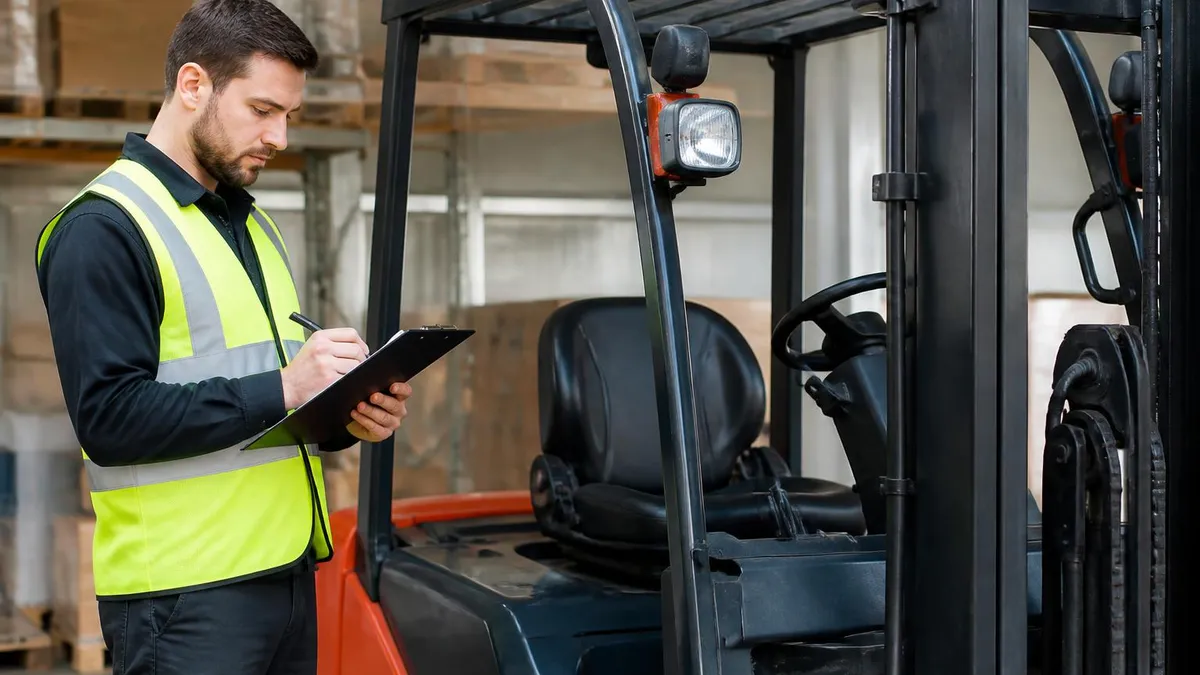
OSHA requires immediate refresher training whenever an operator is observed operating unsafely, is involved in an accident or near-miss, receives an evaluation that reveals operating unsafely, is assigned to a different type of truck, or when workplace conditions change in a way that affects safe operation. Do not wait for the three-year mark if any of these triggers occur — document the retraining immediately to avoid citation exposure.
Renewal and refresher rules are where many otherwise-compliant programs fall apart. The standard requires a formal evaluation of each operator's performance at least once every three years. This evaluation is not just paperwork — it must be a documented observation by a qualified evaluator who watches the operator perform real or simulated tasks and signs off on competency. Many employers misread this as "retraining every three years" and run an unnecessary full course, while others skip the evaluation entirely.
The trigger list for immediate refresher training, separate from the three-year cycle, is broader than most operators realize. An accident or near-miss involving the truck triggers retraining. Operating in an unsafe manner, even without an incident, triggers retraining. Assignment to a different truck type triggers retraining specific to the new class. A change in workplace conditions, such as a new aisle layout, new hazardous material storage, or new pedestrian patterns, can also trigger a documented refresher.
Documentation for a refresher does not have to be exhaustive, but it does have to include the operator's name, the date of training and evaluation, and the name of the person performing the evaluation. Many employers use a one-page checklist that captures the truck class, the workplace conditions observed, the operator's performance, and any corrective coaching delivered. Keep these records for the duration of the operator's employment, ideally with copies retained for several years after separation.
One area where employers consistently struggle is part-time and temporary workers. A worker who operates a forklift for only one shift per week still requires the full training, evaluation, and three-year refresher cycle. Temp agency workers fall under joint employer rules: the host employer is responsible for site-specific training and evaluation, while the staffing agency typically covers general orientation and basic safety. If your staffing contract is unclear on this, fix it before the next OSHA inspection rather than after.
Cross-training between truck classes is a frequent gray area. If an experienced sit-down counterbalanced operator is being moved to a stand-up reach truck, the rule does not require a full eight-hour course, but it does require enough additional training and evaluation to cover the differences between the two trucks. A typical compliant approach is a one-hour briefing on the new truck's controls, stability characteristics, and unique hazards, followed by hands-on practice and a fresh workplace evaluation. Document the transition just as carefully as the original certification.
What about operators changing jobs between employers? Certifications are technically employer-specific because they are tied to your workplace and your equipment. A new employer is not required to honor your previous certification, and most do not. They will accept your training history as evidence of competence, then conduct their own workplace evaluation on their equipment. This is fully compliant and often takes only an hour for experienced operators, but the new employer must still document it. For more background on agency authority, review what OSHA does.
Finally, do not let recordkeeping become an afterthought. Inspectors who arrive after an incident will ask for training records first. Records stored in shared drives, HRIS systems, or paper folders are all acceptable as long as they can be produced quickly and contain the required elements. Many employers integrate forklift training records directly into their learning management system alongside other compliance training, which both simplifies audits and helps trigger automatic refresher reminders before the three-year deadline passes.
For operators preparing for their initial evaluation, the most useful preparation is hands-on time with the actual equipment under supervision. Read the manufacturer's operator manual cover to cover, paying special attention to the load capacity chart and any modifications or attachments specific to your truck. Walk through the daily pre-shift inspection on the truck you will be tested on, naming each item out loud, so that the muscle memory carries into the evaluation when nerves can otherwise cause omissions.
Understand the stability triangle. Most evaluation questions and skill checks circle back to this concept: a forklift's stability is governed by a triangle drawn between the two front wheels and the center pivot of the rear axle. Loads, lift heights, tilt angle, and travel speed all shift the combined center of gravity, and tipping happens when the center of gravity moves outside that triangle. If you can explain the triangle in your own words and apply it to a real scenario, you will pass the theory portion comfortably.
Practice the daily inspection until it becomes routine. OSHA requires a documented inspection at the start of every shift. The list typically includes tires, forks, mast, hoses, controls, brakes, horn, lights, seatbelt, leaks, and any data plate damage. Many evaluators begin the workplace evaluation by handing you a checklist and watching you walk around the truck. Confidence in this routine signals competence and sets a positive tone for the rest of the evaluation.
For the skills portion, focus on smooth operation rather than speed. Evaluators are watching for safe pickups, careful tilt, controlled travel, proper horn use at blind corners, three-point contact when mounting and dismounting, full lowering of forks before leaving the truck, and proper parking with brakes set. Rushing through a course to demonstrate efficiency is exactly the wrong approach. Slow, deliberate movements with clear awareness of pedestrians and surroundings score highest on most evaluation rubrics.
Free practice questions from sites that mirror OSHA's general industry training are an effective study tool, especially for the rule-knowledge portion of the certification. Look for questions covering capacity plates, attachments, fueling and charging procedures, hazardous locations, and pedestrian interaction rules. Many evaluators include a short written component alongside the skills test, and operators who have run through 50 to 100 practice questions tend to handle these comfortably.
If you struggle with the written portion, try teaching the material to someone else. Walk a coworker through the stability triangle, explain why you never leave a forklift unattended with the forks raised, describe what you would do if you smelled propane from an LP cylinder. Teaching forces you to organize information in a way that sticks, and most operators who do this once or twice find that the written test feels easy by comparison. Your trainer should welcome this kind of preparation.
On the day of the evaluation, arrive early, eat something, and bring your reading glasses if you need them for the checklist. Wear closed-toe boots, high-visibility vest if your site requires one, and any other PPE specified in your site rules. Confidence comes from preparation. By the time the evaluator hands you the keys, you should already have practiced every skill they will test, in some cases dozens of times, on the same truck, in the same aisles, with the same loads you will see every shift afterward.
OSHA Questions and Answers

OSHA Training Near Me: How to Find Classes, Online Courses & DOL Cards in 2026

OSHA 10-Hour Training: Online Course, DOL Card & 2026 Guide

OSHA Standards: Where to Find & How to Apply

Bloodborne Pathogens Standard: OSHA's 1910.1030 Rule Explained

What Does OSHA Do? Mission, Functions, and Worker Protection
About the Author

Certified Safety Professional & OSHA Compliance Expert
Indiana University of Pennsylvania Safety SciencesDr. William Foster holds a PhD in Safety Science from Indiana University of Pennsylvania and is a Certified Safety Professional (CSP) and Certified Hazardous Materials Manager. With 20 years of occupational health and safety management experience across construction, manufacturing, and chemical industries, he coaches safety professionals through OSHA certification, CSP, CHST, and safety management licensing programs.
Join the Discussion
Connect with other students preparing for this exam. Share tips, ask questions, and get advice from people who have been there.
View discussion (8 replies)