
OSHA Fixed Ladder Requirements: The Complete 2026 September Guide to Cages, Cleats, Clearances, and Fall Protection Compliance
🧠 OSHA fixed ladder requirements explained: cage rules, clearances, rung spacing, fall protection deadlines, and the 2026 September phase-out timeline.

Understanding OSHA fixed ladder requirements is essential for any employer who maintains permanently installed ladders on tanks, towers, rooftops, silos, or industrial structures. A fixed ladder is one that is attached to a building or piece of equipment rather than something portable you lean against a wall. Because workers climb these ladders repeatedly and often at significant heights, OSHA dedicates specific rules to their design, spacing, fall protection, and maintenance under the general industry walking-working surfaces standard found in 29 CFR 1910.
The rules changed meaningfully in 2017 when OSHA overhauled Subpart D, and the most consequential change is a multi-year phase-out of safety cages and wells in favor of personal fall arrest systems and ladder safety systems. Many facility managers still believe a cage satisfies every requirement, but that assumption can lead to costly citations. Knowing exactly when a cage is acceptable and when it must be replaced is the single most important takeaway for compliance.
OSHA defines a fixed ladder as a ladder with rails or individual rungs permanently attached to a structure. This category includes through ladders, side-step ladders, and individual-rung ladders welded to tanks. The standard that governs them is 29 CFR 1910.23, while fall protection requirements appear in 1910.28 and training appears in 1910.30. Each section interlocks, so a compliant installation must satisfy design, protection, and training rules simultaneously rather than treating them in isolation.
Height is the trigger that determines which protections apply. A short fixed ladder serving a loading dock has far fewer obligations than a 50-foot ladder climbing a water tower. OSHA uses the 24-foot mark as the dividing line: above that height, additional fall protection becomes mandatory. Below it, employers still must meet design and clearance standards, but the elaborate fall-arrest infrastructure is not required, which keeps low-rise installations comparatively simple to manage.
This guide walks through every dimension that matters: rung diameter and spacing, side clearances, the distance from the ladder to the wall behind it, landing platforms, and the critical 2036 deadline by which all qualifying ladders must carry a personal fall arrest system or ladder safety system. We also cover inspection, maintenance, and the documentation OSHA inspectors expect to see when they arrive at a worksite for a programmed or complaint-driven inspection.
Whether you manage a single warehouse roof hatch or hundreds of fixed ladders across a refinery, the requirements are the same in principle but vary in execution. The goal of this article is to translate the regulatory language into practical, plain-English guidance you can apply immediately. By the end, you will understand not only what the rules say but why they exist and how to prioritize upgrades so your most dangerous ladders get attention first and your compliance budget is spent wisely.
Fixed Ladder Rules by the Numbers

Core Design Requirements for Fixed Ladders
Each rung, cleat, or step must support at least a 250-pound concentrated load and provide a firm, slip-resistant grip. Round rungs are typically a minimum of three-quarter inch in diameter for metal ladders to ensure adequate hand purchase.
Rungs must be spaced uniformly and not more than 12 inches apart, measured center to center. Inconsistent spacing creates trip and misstep hazards that OSHA cites frequently during walking-working surface inspections.
Fixed ladders must provide at least 16 inches of clear width between side rails for through and side-step ladders, giving the climber adequate room for hands and feet without contacting surrounding structure.
Where a single run exceeds the allowed length, ladders must be broken into multiple sections with landing platforms, or offset to limit continuous climbing distance and provide rest points during long ascents.
Ladders must extend at least 42 inches above a landing or be fitted with grab bars so the climber can safely transition on and off the ladder at the top without overreaching.
Clearances are where many otherwise solid installations fall short, because the dimensions are precise and easy to overlook during fabrication. OSHA requires a perpendicular distance of at least 7 inches from the centerline of the rungs to the nearest permanent object behind the ladder. This toe clearance gives the ball of the foot room to rest on the rung and prevents the climber's foot from being pushed off. In confined spaces such as utility vaults, OSHA allows a reduced clearance of 4.5 inches, but only when an unavoidable obstruction exists.
The space in front of the ladder matters just as much as the space behind it. OSHA generally requires at least 30 inches of clearance measured from the centerline of the rungs outward into the climbing space. When that full clearance cannot be provided because of equipment or structural limits, a deflector or other protection may be substituted, but the goal remains the same: the climber's body must have room to move without striking machinery, piping, or walls during ascent and descent.
Side clearance is the third dimension to verify. From the centerline of a fixed ladder, at least 15 inches of clear space must exist on each side unless a cage, well, or ladder safety device limits the need. Pinch points created by adjacent steel or conduit are a common citation, especially on retrofit ladders added to older structures where the surrounding layout was never designed with a climber in mind.
Rung spacing and step uniformity deserve a second look during any audit. The maximum 12-inch center-to-center spacing must be consistent from the bottom rung to the top, and the bottom rung should sit no more than 12 inches above the lower landing surface. A tall first step forces an awkward stretch that disproportionately injures shorter workers and anyone carrying tools, so inspectors examine the bottom transition carefully.
Material and finish requirements round out the dimensional rules. Rungs and side rails must be free of sharp edges, burrs, and projections that could cut hands or snag clothing. Metal ladders exposed to corrosive environments must be galvanized, painted, or otherwise protected, and the surface of each rung must be corrugated, knurled, dimpled, or coated to provide slip resistance. A smooth, painted rung that becomes slick when wet is a hazard OSHA treats seriously.
Finally, the structural connection to the building cannot be ignored. Brackets, bolts, and welds securing the ladder must be capable of supporting the maximum intended load, and they should be inspected for corrosion and fatigue cracking. A ladder that meets every dimensional rule but is pulling away from a corroded anchor is still a serious hazard. Documenting the as-built dimensions at installation gives you a baseline to measure deterioration against during future inspections.
OSHA Practice Test Questions
Prepare for the OSHA - Safety Certificate exam with our free practice test modules. Each quiz covers key topics to help you pass on your first try.
OSHA Basic OSHA Practice
OSHA Exam Questions covering Basic OSHA Practice. Master OSHA Test concepts for certification prep.
OSHA Confined Space Entry
Free OSHA Practice Test featuring Confined Space Entry. Improve your OSHA Exam score with mock test prep.
OSHA Fall Protection
OSHA Mock Exam on Fall Protection. OSHA Study Guide questions to pass on your first try.
OSHA - Safety Certificate Electrical Safet...
Free OSHA Quiz on OSHA - Safety Certificate Electrical Safety Standards Questions and Answers. OSHA Exam prep questions with detailed explanations.
OSHA - Safety Certificate Emergency Action...
OSHA Practice Questions for OSHA - Safety Certificate Emergency Action and Fire Plans Questions and Answers. Build confidence for your OSHA certification exam.
OSHA - Safety Certificate Hazard Communica...
OSHA Test Online for OSHA - Safety Certificate Hazard Communication Standard Questions and Answers. Free practice with instant results and feedback.
OSHA - Safety Certificate Introduction to ...
OSHA Study Material on OSHA - Safety Certificate Introduction to OSHA Questions and Answers. Prepare effectively with real exam-style questions.
OSHA - Safety Certificate Lockout/Tagout P...
Free OSHA Test covering OSHA - Safety Certificate Lockout/Tagout Procedures Questions and Answers. Practice and track your OSHA exam readiness.
OSHA - Safety Certificate Machine Guarding...
OSHA Exam Questions covering OSHA - Safety Certificate Machine Guarding Requirements Questions and Answers. Master OSHA Test concepts for certification prep.
OSHA - Safety Certificate OSHA Recordkeepi...
Free OSHA Practice Test featuring OSHA - Safety Certificate OSHA Recordkeeping and Reporting Questions and Answers. Improve your OSHA Exam score with mock test prep.
OSHA - Safety Certificate Personal Protect...
OSHA Mock Exam on OSHA - Safety Certificate Personal Protective Equipment (PPE) Questions and Answers. OSHA Study Guide questions to pass on your first try.
OSHA - Safety Certificate Walking and Work...
OSHA Test Prep for OSHA - Safety Certificate Walking and Working Surfaces Questions and Answers. Practice OSHA Quiz questions and boost your score.
OSHA - Safety Certificate Electrical Safet...
OSHA Mock Test covering - Safety Certificate Electrical Safety Standards. Online OSHA Test practice with instant feedback.
OSHA - Safety Certificate Emergency Action...
Free OSHA Quiz on - Safety Certificate Emergency Action and Fire Plans. OSHA Exam prep questions with detailed explanations.
OSHA - Safety Certificate Hazard Communica...
OSHA Practice Questions for - Safety Certificate Hazard Communication Standard. Build confidence for your OSHA certification exam.
OSHA - Safety Certificate Introduction to ...
OSHA Test Online for - Safety Certificate Introduction to OSHA. Free practice with instant results and feedback.
OSHA - Safety Certificate Lockout/Tagout P...
OSHA Study Material on - Safety Certificate Lockout/Tagout Procedures. Prepare effectively with real exam-style questions.
OSHA - Safety Certificate Machine Guarding...
Free OSHA Test covering - Safety Certificate Machine Guarding Requirements. Practice and track your OSHA exam readiness.
OSHA - Safety Certificate OSHA Recordkeepi...
OSHA Exam Questions covering - Safety Certificate OSHA Recordkeeping and Reporting. Master OSHA Test concepts for certification prep.
Fixed Ladder Fall Protection by Height
Fixed ladders that extend less than 24 feet above a lower level do not require cages, wells, personal fall arrest systems, or ladder safety systems under the current standard. Employers still must meet all design, clearance, and rung-spacing rules, and the ladder must be maintained in safe condition. The reduced obligation reflects OSHA's judgment that fall energy and exposure are lower over short climbs.
That said, employers should not treat short ladders as risk-free. Falls from even 10 to 15 feet routinely cause fractures and head injuries. Where feasible, voluntarily adding a ladder safety system or rest platform improves safety and future-proofs the installation against any expansion that would push it past the 24-foot threshold and into mandatory protection territory.

Ladder Safety Systems vs. Personal Fall Arrest Systems
- +Ladder safety systems allow hands-free continuous attachment during the entire climb
- +Carrier rail or cable systems are durable and need minimal maintenance once installed
- +A single carrier system protects every worker who climbs that ladder
- +Sliding sleeves engage automatically if the climber slips or releases
- +Systems integrate cleanly with full-body harnesses workers already own
- +Properly installed rail systems can be retrofitted onto most existing ladders
- −Personal fall arrest requires planned anchorage points and clear fall clearance below
- −Carrier systems carry meaningful upfront purchase and installation costs
- −Workers need training on the specific sleeve or connector used on each ladder
- −Free-fall and swing-fall distances must be calculated for arrest systems
- −Components require documented periodic inspection and timely replacement
- −Retrofit installation may interrupt normal access to the structure during work
OSHA Fixed Ladder Compliance Checklist
- ✓Confirm each rung supports at least a 250-pound concentrated load.
- ✓Verify rung spacing is uniform and no more than 12 inches center to center.
- ✓Measure at least 7 inches of toe clearance behind every rung.
- ✓Provide at least 16 inches of clear width between side rails.
- ✓Ensure the ladder extends 42 inches above the landing or has grab bars.
- ✓Identify every ladder taller than 24 feet for fall protection review.
- ✓Replace cages with PFAS or ladder safety systems on repaired sections.
- ✓Schedule all over-24-foot retrofits before the November 2036 deadline.
- ✓Inspect anchors, welds, and brackets for corrosion and fatigue cracking.
- ✓Confirm rung surfaces are slip-resistant and free of sharp edges.
- ✓Train every climbing employee under 29 CFR 1910.30 and document it.
- ✓Keep written inspection records available for OSHA review.
November 18, 2036 ends the cage exemption
Every fixed ladder extending more than 24 feet must have a personal fall arrest system or ladder safety system by November 18, 2036. Cages and wells will no longer satisfy OSHA on their own. Begin budgeting and scheduling retrofits now, because waiting until the deadline approaches creates an installer bottleneck and compliance risk.
The phase-out of cages is the defining feature of modern fixed ladder regulation, and it unfolds across three milestone dates that every safety manager should commit to memory. The first date is November 19, 2018, the deadline by which new fixed ladders over 24 feet had to be equipped with a personal fall arrest system or ladder safety system instead of a cage. Any ladder you install today on a structure climbing higher than 24 feet must follow this rule without exception, and a cage alone will not satisfy an inspector.
The second milestone governs repairs and replacements. Whenever a section of an existing over-24-foot ladder is repaired or replaced after the 2018 date, that section must be fitted with a personal fall arrest system or ladder safety system. In other words, you cannot patch an old caged ladder with new caged sections. This provision steadily pushes the entire inventory of tall ladders toward modern fall protection as normal wear forces ongoing maintenance over the years.
The third and final milestone is November 18, 2036. On that date, the cage exemption disappears entirely. Every fixed ladder over 24 feet, no matter how old, must carry a personal fall arrest system or ladder safety system. OSHA built in nearly two decades of lead time precisely because retrofitting thousands of ladders across American industry is a substantial undertaking, but that generous runway should not lull employers into procrastination.
Smart facilities treat the 18-year window as a planning horizon rather than a reprieve. The best approach is to inventory every fixed ladder, record its height, installation date, and current protection method, then rank the inventory by risk. The tallest, most frequently climbed, and most corroded ladders should be retrofitted first. Spreading the capital expense across several budget cycles is far easier than absorbing it all in the final year before the deadline.
It is worth emphasizing that the cage was never as protective as it looks. Research informing the rule change found that cages do little to arrest a genuine fall; a falling worker simply tumbles inside the cage, striking rungs and the cage hoops on the way down. A carrier-rail ladder safety system, by contrast, engages a sliding sleeve that locks within inches of a slip, holding the climber against the ladder. This safety logic, not mere paperwork, is why OSHA reversed decades of cage-centric guidance.
Documentation ties the whole timeline together. When an inspector asks how you are managing the transition, a written retrofit schedule with target dates, budget allocations, and completion records demonstrates good-faith compliance. Even though the absolute deadline is years away, an employer who can show a credible, funded plan is in a far stronger position than one who simply points to a cage and hopes the 2036 date feels distant enough to ignore.
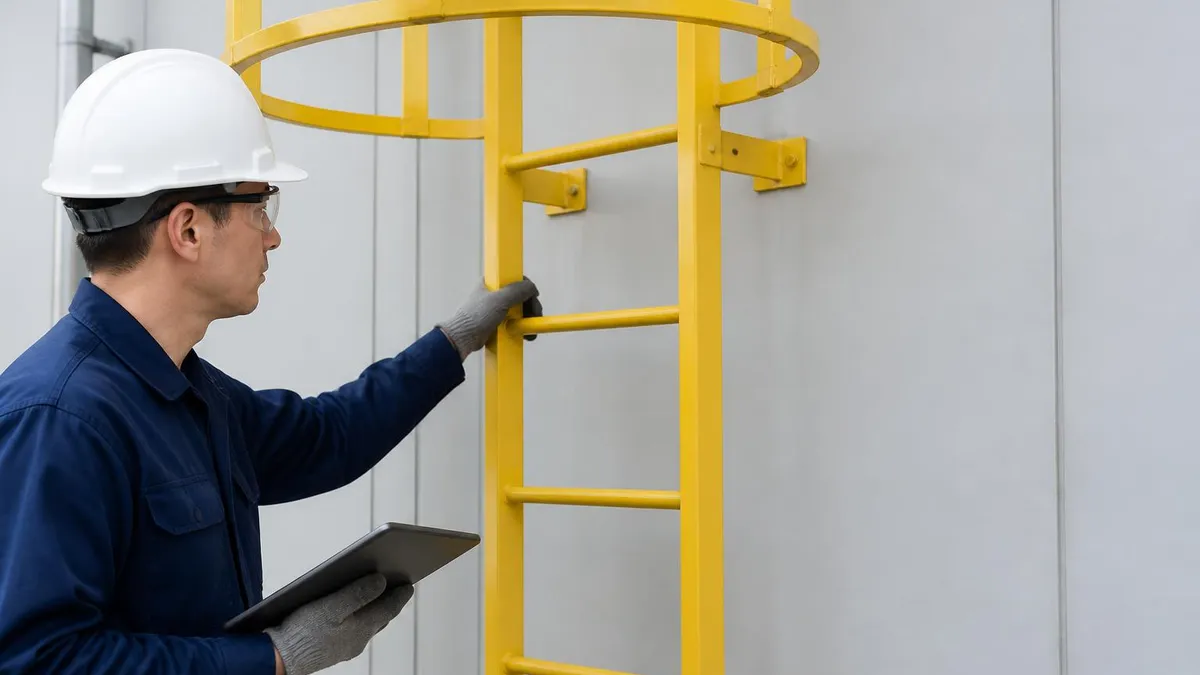
If you installed a fixed ladder taller than 24 feet after November 19, 2018 and protected it only with a cage, it is already out of compliance. New tall ladders require a personal fall arrest system or ladder safety system, and relying on a cage exposes you to citations and serious fall risk today, not just by 2036.
Inspection and maintenance turn a compliant design into a compliant ladder over its working life. OSHA requires that ladders be maintained in a safe condition and inspected for visible defects before initial use during a work shift and after any occurrence that could affect safe use. For fixed ladders, that translates into a routine of regular structured inspections supplemented by quick visual checks by the workers who climb them. A bent rung, a corroded weld, or a loose anchor bolt can transform an approved ladder into a fatal hazard.
A thorough fixed ladder inspection examines several systems in sequence. Start with the structural connections, checking brackets, bolts, and welds for corrosion, cracking, or movement. Move to the rungs and rails, looking for bends, dents, sharp edges, missing slip-resistant surfacing, and any rung that flexes under load. Then evaluate the fall protection components: cages for crushed hoops, carrier rails for debris or misalignment, and anchorages for the certified strength they need to arrest a fall safely.
The fall arrest and ladder safety system hardware demands particular attention because lives depend on it functioning instantly. Carrier sleeves and trolleys must slide freely yet lock when jerked, lanyards and lifelines must be free of cuts and chemical damage, and harnesses must show no frayed webbing or distorted buckles. Manufacturers publish inspection criteria and service-life limits for these components, and OSHA expects employers to follow them. Any component that fails inspection must be removed from service immediately rather than taped over or deferred.
Corrosion deserves special mention because so many fixed ladders live outdoors or inside chemically aggressive environments. Galvanized coatings eventually wear, and once bare steel is exposed, rust accelerates at welds and contact points where moisture lingers. Stainless steel or aluminum may be warranted in coastal or process settings. During inspection, tap suspect areas and probe heavily rusted sections; a ladder that sheds flakes or shows section loss has lost strength even if it still looks climbable from a distance.
Recordkeeping converts your inspection effort into defensible compliance. Maintain a log for each ladder that captures the inspection date, the inspector's name, findings, and corrective actions taken. Photographs of defects and repairs strengthen the record. When OSHA arrives, an organized inspection history signals a mature safety program and can influence how a citation is classified. Equally important, the trend data helps you predict which ladders are deteriorating fastest so you can prioritize repairs before failure rather than after an incident.
Training closes the loop on the human side of the system. Under 29 CFR 1910.30, every employee who uses fall protection on a fixed ladder must be trained by a qualified person on the hazards and the proper use of the equipment, and retrained whenever conditions change or a worker shows inadequate understanding. A flawlessly maintained ladder safety system provides zero protection if the climber clips in wrong or skips the connection entirely, so documented, refreshed training is as much a compliance requirement as the steel itself.
Putting these requirements into practice starts with a complete inventory. Walk your entire facility and catalog every fixed ladder, recording its location, total climbing height, installation date, and current protection method. This single document becomes the backbone of your compliance program because it tells you instantly which ladders fall under the over-24-foot rules and which already need a personal fall arrest system or ladder safety system rather than a cage. Without an inventory, you are guessing, and OSHA inspectors rarely reward guesses.
Next, prioritize by risk rather than by convenience. A 60-foot ladder on a frequently accessed water tower poses far more exposure than a 30-foot ladder climbed twice a year. Score each ladder on height, climbing frequency, condition, and consequence of a fall, then tackle the highest scores first. This risk-based sequencing ensures your limited retrofit budget protects the most workers in the shortest time and demonstrates a rational, defensible decision process if your program is ever questioned.
When you specify retrofits, involve a qualified engineer or the system manufacturer early. Carrier-rail systems must be matched to the ladder's geometry, and anchorage points for personal fall arrest must be engineered to withstand the forces a fall generates. Cutting corners on design invites both citations and tragedy. Reputable vendors will perform a site survey, recommend a system, and provide installation drawings and load calculations you can keep on file as part of your compliance documentation.
Do not neglect the smaller details that inspectors love to find. Confirm that bottom rungs sit at the correct height, that ladders extend the required distance above landings, that grab bars are present where needed, and that clearances behind and beside the ladder meet the minimums. These low-cost fixes often correct longstanding violations that have nothing to do with the headline cage rule, and addressing them shows a comprehensive rather than selective approach to safety.
Build training into your rollout from day one. Every time you install a new ladder safety system, schedule hands-on training for the workers who will use it before the ladder returns to service. Pair the training with a short competency check where each worker demonstrates correct connection and disconnection. Keep signed attendance and competency records, and set a recurring calendar reminder for refresher training so the requirement never quietly lapses between annual audits.
Finally, integrate fixed ladders into your broader walking-working surfaces and fall protection program rather than treating them as a one-off project. The same management system that handles guardrails, floor holes, and portable ladders should own fixed ladder inspections, retrofits, and training. When everything lives under one program with clear ownership, defined inspection intervals, and a funded retrofit schedule, compliance becomes routine maintenance instead of a recurring fire drill, and your workers climb on equipment you can genuinely trust.
OSHA Questions and Answers

OSHA Lightning Safety: Standards, Rules & Outdoor Worker Protection Guide for 2026

OSHA Approved Hard Hats: Complete 2026 Guide to ANSI Z89.1 Compliance, Types, and Workplace Requirements

OSHA.gov: Your Complete Guide to the Official OSHA Website

OSHA 510: Course Content, Path to Trainer, and Realistic Path

OSHA Process Safety Management: Complete Guide to PSM Standard 1910.119 for 2026
About the Author

Certified Safety Professional & OSHA Compliance Expert
Indiana University of Pennsylvania Safety SciencesDr. William Foster holds a PhD in Safety Science from Indiana University of Pennsylvania and is a Certified Safety Professional (CSP) and Certified Hazardous Materials Manager. With 20 years of occupational health and safety management experience across construction, manufacturing, and chemical industries, he coaches safety professionals through OSHA certification, CSP, CHST, and safety management licensing programs.
Join the Discussion
Connect with other students preparing for this exam. Share tips, ask questions, and get advice from people who have been there.
View discussion (8 replies)