
OSHA 30 Construction: Complete Guide to the 30-Hour Outreach Course, Cards, and Requirements
OSHA 30 construction guide: course content, who needs it, how to get your DOL card, cost, time to complete, and free practice questions to prepare. 🧠

The OSHA 30 construction course is a 30-hour outreach training program designed for supervisors, foremen, site managers, and workers who carry safety responsibility on construction job sites. Administered through the OSHA Outreach Training Program, it goes far beyond basic hazard awareness and dives into the leadership-level knowledge needed to recognize, prevent, and abate the most common construction dangers. Many general contractors, unions, and state agencies now treat the OSHA 30 card as a baseline credential before a worker sets foot on a regulated site. Practice with the free OSHA Safety Certificate practice test on PracticeTestGeeks (7 questions with answer explanations).
Unlike the shorter 10-hour version aimed at entry-level laborers, the 30-hour program assumes you will be making decisions that affect the safety of other people. That is why the curriculum spends extra time on the Focus Four hazards, employer responsibilities, hazard abatement strategies, and the worker rights guaranteed under the Occupational Safety and Health Act of 1970. Completing it signals to employers that you understand not just what a hazard looks like, but how to control it before anyone gets hurt on the project.
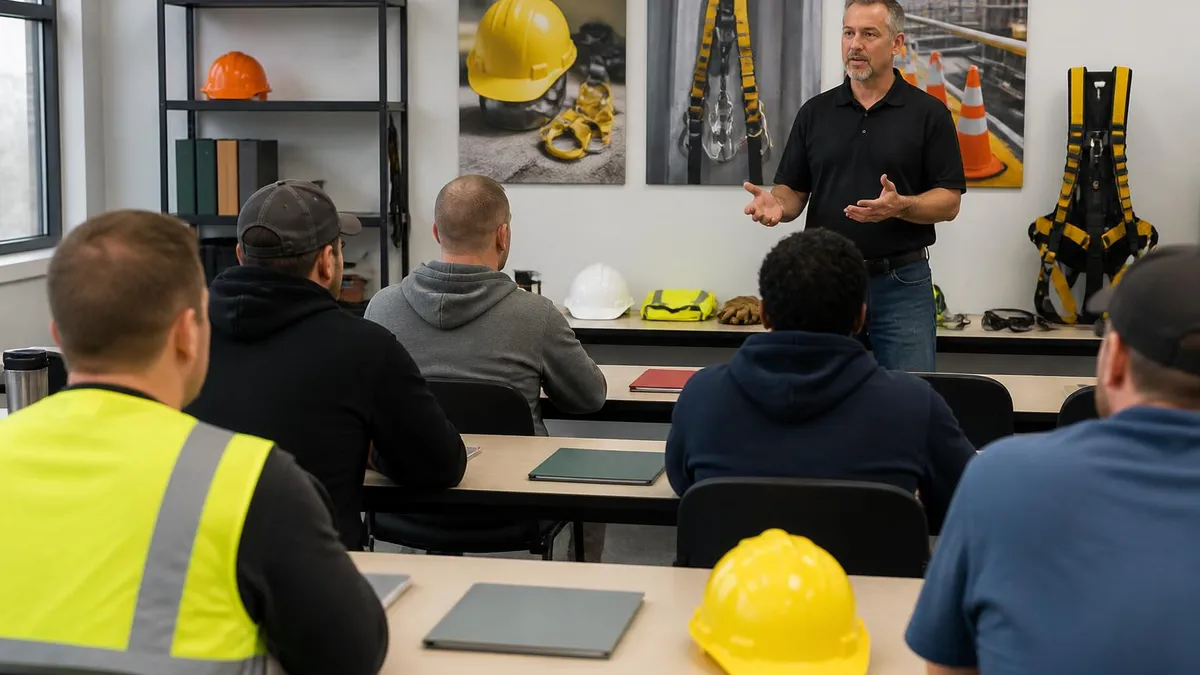
The course is delivered by authorized OSHA outreach trainers, either in a traditional classroom or through an OSHA-accepted online provider. Because the training is voluntary at the federal level but frequently mandated by contracts and state law, thousands of workers complete it every year. Properly fitted personal protective equipment matters throughout the material, and selecting osha 30 construction compliant head protection is one of the first practical lessons most trainees encounter early on.
One point that confuses newcomers is that there is no "OSHA 30 exam" in the way most people imagine a high-stakes certification test. Instead, the program uses module quizzes and a final assessment built into the course, and OSHA does not require a test or set a passing score to earn your completion card, though trainers may give quizzes. The real challenge is staying engaged across 30 hours of content and absorbing the standards well enough to apply them on the job, not memorizing answers for a single sit-down test.
This guide walks through everything you need to know before enrolling: who actually needs the card, what topics the curriculum covers, how long the training takes, what it costs, and how the Department of Labor card is issued and verified. We will also cover the differences between OSHA 30 and OSHA 10, common mistakes that delay card delivery, and how to study efficiently so the time you invest translates into genuine site-readiness rather than a forgotten certificate.
Throughout the article you will find free practice questions you can use to test your understanding of construction safety fundamentals. While these quizzes do not replace the official course, they are an excellent way to reinforce key concepts like fall protection thresholds, scaffold requirements, and hazard communication. By the end, you should have a clear, realistic picture of what the OSHA 30 construction credential is, why employers value it, and exactly how to earn yours without wasting time or money.
Free OSHA Safety Certificate Study Tools
Interactive OSHA Safety Certificate resources on PracticeTestGeeks, free to start:
- OSHA Safety Certificate flashcards — review key terms and concepts card by card
- OSHA Safety Certificate study guide — topic-by-topic overview of what the exam covers
- OSHA Safety Certificate cheat sheet — one-page printable summary for last-minute review
OSHA 30 Construction by the Numbers
- OSHA does not require a test or set a passing score to earn an OSHA 10-hour or 30-hour Outreach course completion card, but trainers may give a test to check learning. (U.S. Department of Labor, Occupational Safety and Health Administration (OSHA), Outreach Training Program)
- OSHA does not set one price for its 10-hour and 30-hour Outreach classes; the class fee is set by each independent OSHA-authorized trainer or online provider. (U.S. Department of Labor, Occupational Safety and Health Administration (OSHA), Outreach Training Program)
- An OSHA 10-hour or 30-hour card can be replaced only once per class and only within five years of the class; after that, the student has to retake the class to get a card. (U.S. Department of Labor, Occupational Safety and Health Administration (OSHA), Outreach Training Program)
- OSHA Outreach student course completion cards for Construction, General Industry, Maritime and Disaster Site do not have an expiration date, and Maritime cards stopped expiring as of April 1, 2019. (U.S. Department of Labor, Occupational Safety and Health Administration (OSHA), Outreach Training Program)
- Students do not renew OSHA Outreach cards, but OSHA-authorized Outreach trainers must complete an update course every four years to stay authorized. (U.S. Department of Labor, Occupational Safety and Health Administration (OSHA), Outreach Training Program)
- OSHA 10-hour and 30-hour Outreach classes are taught in person by OSHA-authorized trainers or online by OSHA-accepted independent providers; OSHA does not run online classes itself. (U.S. Department of Labor, Occupational Safety and Health Administration (OSHA), Outreach Training Program)
- The OSHA Outreach Training Program has no minimum age, but to get an OSHA card a student must complete the entire class, including all required topics and the minimum number of contact hours. (U.S. Department of Labor, Occupational Safety and Health Administration (OSHA), Outreach Training Program)
- After finishing an OSHA 10-hour or 30-hour Outreach class, students get their course completion card from the trainer or online provider, who has 90 days to issue it. (U.S. Department of Labor, Occupational Safety and Health Administration (OSHA), Outreach Training Program)
Facts verified Oct 16, 2026 against U.S. Department of Labor, Occupational Safety and Health Administration (OSHA), Outreach Training Program. Dates that have passed are removed automatically.
OSHA Exam at a Glance
Facts verified Oct 16, 2026 against U.S. Department of Labor, Occupational Safety and Health Administration (OSHA), Outreach Training Program. Dates that have passed are removed automatically.

How the OSHA 30 Construction Course Is Structured
Core required topics include an introduction to OSHA, the Focus Four hazards, personal protective equipment, and health hazards in construction. These modules form the non-negotiable backbone of the curriculum and account for the largest share of the 30 hours.
Trainers select additional topics such as cranes, excavations, scaffolds, electrical safety, or stairways and ladders. A minimum number of electives must be covered, letting programs tailor content to the trades most relevant to their trainees.
After mandatory and elective hours are met, trainers may add optional subjects like ergonomics, safety program management, or site-specific procedures to round out the full 30 hours of required instruction time.
The course concludes with a knowledge check covering all modules. Most providers require 70 percent or higher to pass, with the ability to review and retake missed sections before the completion card is issued.
Determining who actually needs the OSHA 30 construction card comes down to one question: what level of safety responsibility do you carry on the job site? The 30-hour program is specifically aimed at supervisors, superintendents, foremen, safety directors, and anyone who directs the work of others. If your role involves planning tasks, conducting toolbox talks, enforcing safety rules, or signing off on hazard abatement, employers and project owners will almost always expect the 30-hour credential rather than the 10-hour version.
Many of the requirements are contractual rather than strictly legal. Federal OSHA does not mandate that every construction worker hold an outreach card. However, a growing number of states, cities, and project owners do. New York City, for example, requires extensive site safety training on many construction sites, and OSHA 30 satisfies a large portion of those hours. Large general contractors routinely write the OSHA 30 requirement into their subcontractor agreements, meaning your ability to win work can hinge on holding a valid card.
Trade unions and apprenticeship programs are another major driver of demand. Carpenters, electricians, ironworkers, laborers, and operating engineers often complete OSHA 30 as part of their journeyman progression or as a prerequisite for dispatch to certain jobs. Because the credential never federally expires, completing it once can satisfy a requirement that follows you across multiple employers and projects throughout your career, which is part of why so many workers choose to pursue it early.
It is also worth understanding who does not strictly need the full 30 hours. A brand-new laborer with no supervisory duties is typically better served by the OSHA 10 course, which delivers the essential hazard-recognition basics in a shorter, less expensive format. Pushing every entry-level worker through 30 hours can waste training budget when the 10-hour version already satisfies the contractual requirement for that role. Matching the credential to the job duty is the smart, cost-effective approach for most employers.
Insurance and liability considerations frequently push employers toward requiring OSHA 30 for their leadership. Workers' compensation carriers and project insurers may offer better terms or require documented training when supervisors hold recognized safety credentials. From the employer's perspective, having a trained supervisor who can identify a missing guardrail or an improperly tagged piece of equipment dramatically reduces the risk of a costly recordable injury or an OSHA citation during an inspection.
If you are unsure whether your specific role requires it, the safest move is to ask the project's safety manager or review the prime contract's safety provisions. Requirements vary by state, owner, and trade, and they change over time. When in doubt, holding the OSHA 30 card rarely hurts your employability and often opens doors. For supervisors specifically, it is increasingly treated as a non-negotiable baseline rather than a nice-to-have professional development bonus on the modern construction site.
The Focus Four and Other Key OSHA 30 Construction Topics
The Focus Four are the construction hazards responsible for the majority of worker deaths: falls, struck-by, caught-in/between, and electrocution. OSHA 30 devotes significant time to each because falls alone account for roughly one in three construction fatalities every year. Trainees learn the specific thresholds, such as the six-foot trigger height for fall protection in general construction, and how those rules apply.
Beyond memorizing definitions, the course teaches how to control these hazards in practice. That means understanding guardrail systems, personal fall arrest equipment, proper trenching protection, and lockout/tagout to prevent electrocution. Supervisors are expected to spot a Focus Four exposure on a walk-through and abate it before the work proceeds, which is exactly the skill the 30-hour format is built to reinforce in trainees.
Is the OSHA 30 Construction Course Worth It?
- +Satisfies most supervisor-level contract and union safety requirements
- +DOL completion card never federally expires once issued
- +Covers hazard abatement, not just hazard recognition
- +Recognized nationwide by general contractors and project owners
- +Improves employability and can raise earning potential
- +Available fully online at your own pace from authorized providers
- +Reduces recordable injuries and OSHA citation risk on site
- −Requires a full 30 hours of instruction time to complete
- −Online cost of roughly $160-189 is out of pocket if unpaid by employer
- −Online providers cap daily hours, so it cannot finish in one day
- −Not legally required everywhere, leading to confusion about need
- −Some states require additional site-specific training on top of it
- −Card replacement can be slow and may incur a fee if lost
OSHA 30 Construction Enrollment Checklist
- ✓Confirm your role requires the 30-hour course, not the 10-hour version.
- ✓Verify the provider is authorized through the OSHA Outreach Training Program.
- ✓Check that the course is for the Construction industry, not General Industry.
- ✓Confirm the provider issues official DOL completion cards.
- ✓Set aside enough time given daily online hour limits.
- ✓Use a reliable device and internet connection for online modules.
- ✓Take notes on Focus Four thresholds and PPE requirements.
- ✓Complete all module quizzes before the final assessment.
- ✓Score at least 70 percent on the final to pass.
- ✓Save your completion certificate and confirm your card mailing address.
- ✓Keep a digital copy of your card for site check-ins.
- ✓Note that the physical card typically arrives within a few weeks.
Two different documents
When you finish an online OSHA 30 course you can usually print a completion certificate immediately, but that is not your official credential. The Department of Labor plastic card is mailed separately and can take up to two weeks or more to arrive. Many sites require the physical card or its number, so plan ahead and never assume the printable certificate alone will satisfy a job-site safety check.
Cost is one of the first questions prospective trainees ask, and the answer depends heavily on delivery method. Online OSHA 30 construction courses from authorized providers typically run between $160 and $189. In-person classroom training generally costs more because of instructor and facility expenses, but it may be required by certain employers or unions that prefer live instruction. Some employers cover the cost entirely, so always check whether your company has a preferred provider before paying out of pocket.
Time commitment is the other major factor. The course requires a full 30 hours of instruction, and online providers are bound by OSHA rules that cap daily hours, generally limiting you to around seven and a half hours per day. That means the fastest realistic completion is roughly four days, even if you have free time available. In practice, many working professionals spread the course across one to two weeks, fitting modules around their job schedule rather than cramming everything at once.
The online format includes built-in safeguards to ensure you actually engage with the material. Timers prevent you from skipping ahead, and the system tracks your progress so you cannot simply click through. Module quizzes appear throughout, and a final assessment at the end verifies your overall comprehension. If you fall below the passing threshold, reputable providers let you review the missed content and retake the assessment, so a single weak section does not derail your card or your hard-earned hours.
Once you pass, the provider reports your completion to OSHA, and the official Department of Labor completion card is processed. This is where many people get tripped up. The printable certificate you receive instantly is useful for showing immediate proof, but the durable plastic DOL card is mailed separately and can take a couple of weeks to arrive. If a job start date is looming, factor this delivery window into your planning so you are not caught without the credential a site demands.
The OSHA 30 card does not carry a federal expiration date, which surprises workers who assume safety credentials must be renewed annually. Federally, your card remains valid indefinitely. However, individual states, employers, or project owners may impose their own refresh requirements, sometimes asking workers to retrain every three to five years to keep knowledge current. Understanding the difference between the federal rule and local or contractual policy prevents unpleasant surprises when a site rejects an older card unexpectedly.
Replacement is another practical consideration. If you lose your card, you must contact the original training provider, since OSHA itself does not maintain a central replacement service for outreach cards. Providers will typically issue a duplicate within the standard timeframe after completion, but this can involve a fee and a wait. Keeping a clear photo of both sides of your card on your phone is a simple habit that saves enormous hassle when a foreman asks for proof during a morning site check-in.

Only courses delivered by trainers authorized through the OSHA Outreach Training Program issue valid Department of Labor completion cards. Some websites advertise cheap 'OSHA certificates' that are not recognized on real job sites. Always verify the provider is authorized before paying, or you risk completing hours that no employer will accept and having to start the entire course over.
Understanding the difference between OSHA 30 and OSHA 10 helps you choose the right course and avoid paying for hours you do not need. The most obvious distinction is duration: OSHA 10 delivers ten hours of training while OSHA 30 delivers thirty. But the deeper difference is the intended audience and depth of coverage. OSHA 10 targets entry-level workers and focuses on basic hazard awareness, whereas OSHA 30 targets those with safety responsibility and digs into prevention, abatement, and supervisory duties in far greater detail.
Content depth follows directly from that audience difference. Both courses cover the Focus Four hazards, but OSHA 30 spends considerably more time on each, plus additional modules on topics like managing safety and health programs, employer responsibilities, and a broader range of elective subjects. A laborer needs to recognize that an unguarded edge is dangerous; a supervisor completing OSHA 30 needs to know which guardrail system to specify, how to inspect it, and how to document the abatement for the records.
Cost and time naturally scale with the longer course. OSHA 10 is cheaper and can often be finished in two days online, making it attractive for high-volume onboarding of new crews. OSHA 30 costs more and takes longer, but it delivers a credential that satisfies supervisor-level requirements that the 10-hour card cannot. Choosing the 10-hour course to save money only to discover your role demands the 30-hour card wastes both the original fee and your valuable time.
From an employer's standpoint, the two courses serve complementary purposes within a single safety program. A typical jobsite might require every worker to hold at least an OSHA 10 card while mandating OSHA 30 for foremen, superintendents, and safety personnel. This tiered approach ensures everyone has baseline awareness while concentrating the deeper training where decision-making authority sits. Selecting proper osha 30 construction head protection and other PPE is covered in both, but enforcement responsibility falls on the 30-hour graduates.
Career-wise, the OSHA 30 card carries more weight on a resume. Because it signals readiness for leadership and a thorough grounding in construction safety, it can be the deciding factor between candidates competing for a foreman or site-safety role. Many workers who start with OSHA 10 later upgrade to OSHA 30 as they move into supervisory positions, and the broader knowledge pays off both in promotability and in their ability to keep entire crews safe.
If you genuinely cannot decide, consider where your career is heading over the next few years. If you expect to direct other workers, plan projects, or take on any safety oversight, the OSHA 30 construction course is the smarter long-term investment despite the higher upfront cost and time. If you are confident your role will remain strictly entry-level for the foreseeable future, OSHA 10 may be perfectly sufficient. Matching the credential to your trajectory, not just today's task, prevents costly do-overs later.
Passing the OSHA 30 construction assessment and, more importantly, retaining the knowledge comes down to a few practical study habits. First, treat the module quizzes as learning checkpoints rather than obstacles. When you miss a question, go back and understand why the correct answer is right instead of guessing again. The final assessment draws from across the entire course, so the concepts you genuinely understand early on compound into an easier finish. Active recall beats passive clicking every single time you study.
Second, build a personal cheat sheet of the hard numbers as you go. Construction safety is full of specific thresholds that show up repeatedly: the six-foot fall protection trigger in general construction, permissible exposure limits for silica, scaffold platform requirements, and ladder extension distances above a landing. Writing these down by hand as you encounter them creates a quick-reference document and reinforces memory far better than rereading the slides. Keep this sheet for the job site, not just the test.
Third, use free practice questions to simulate retrieval under mild pressure. Quizzes like the ones linked throughout this article let you test whether you can produce an answer without the course material in front of you. That gap between recognizing material and recalling it is exactly where most people overestimate their readiness. A few short practice sessions spread across your study period will surface weak spots while you still have time to revisit the relevant module thoroughly.
Fourth, pace the course deliberately rather than rushing to finish. Because online providers cap daily hours anyway, you cannot cram all 30 hours into a marathon session even if you wanted to. Use that built-in spacing to your advantage by reviewing the previous day's key points before starting new material. This spaced repetition is one of the most reliable ways to move information from short-term to long-term memory, which matters because the goal is a safer job site, not just a passing score.
Fifth, connect the abstract standards to real situations you have seen or can imagine. When the course covers caught-in/between hazards, picture an actual trench or a piece of rotating equipment and walk through how the control measures would apply. This mental rehearsal makes the material stick and prepares you to act when you encounter the hazard for real. Supervisors who can translate a regulation into a concrete site decision are exactly what the 30-hour credential is meant to produce in the field.
Finally, do not neglect the worker-rights and employer-responsibility modules just because they feel less technical than fall protection or electrical safety. These sections appear on the assessment and, more importantly, define the legal framework you will operate within as a supervisor. Knowing how to handle a hazard report, an inspection, or a retaliation concern is part of running a safe site. Treat every module as equally test-relevant and job-relevant, and your card will reflect genuine competence rather than a narrow focus.
With steady pacing, active recall, and a few rounds of practice questions, the OSHA 30 construction course becomes far more manageable. The investment of 30 hours and a modest fee returns a nationally recognized credential, real hazard-control skills, and a stronger position in the construction labor market. Approach it as professional development rather than a box to check, and the knowledge will serve you across every project for the rest of your career on site.
Sample OSHA Safety Certificate Practice Questions
Try these questions from our free OSHA Safety Certificate practice tests. The correct answer and an explanation follow each question.
Which of the following machine parts, functions, or processes must be safeguarded according to the general requirements of OSHA 1910.212?
- A. Only the primary on/off switch.
- B. Only areas where routine maintenance is performed.
- C. Point of operation, ingoing nip points, and rotating parts.
- D. Only machines less than 10 years old.
Answer: C. Point of operation, ingoing nip points, and rotating parts.
OSHA 29 CFR 1910.212(a)(1) requires that one or more methods of machine guarding be provided to protect employees from hazards such as those created by the point of operation, ingoing nip points, rotating parts, flying chips, and sparks.
Which of the following is a fundamental requirement for all machine guards according to OSHA's general requirements at 29 CFR 1910.212?
- A. The guard must be painted yellow to indicate a hazard.
- B. The guard must be removable without the use of tools for easy access.
- C. The guard must be affixed to the machine and not create a new hazard.
- D. The guard must be equipped with an audible alarm that sounds during operation.
Answer: C. The guard must be affixed to the machine and not create a new hazard.
OSHA 29 CFR 1910.212(a)(2) states that guards shall be affixed to the machine where possible and secured elsewhere if attachment is not possible. It also specifies that the guard shall be such that it does not offer an accident hazard in itself. The other options are not universal requirements for all machine guards.
How often must fire extinguishers be visually inspected according to OSHA requirements?
- A. Annually
- B. Monthly
- C. Weekly
- D. Every six months
Answer: B. Monthly
OSHA requires that portable fire extinguishers be visually inspected at least monthly to ensure they are accessible and functional.
What is the primary hazard addressed by OSHA's housekeeping requirements for walking-working surfaces?
- A. Fire
- B. Slips, trips, and falls
- C. Electrical shock
- D. Chemical exposure
Answer: B. Slips, trips, and falls
Good housekeeping keeps surfaces clean, dry, and orderly to prevent slips, trips, and falls.
OSHA Questions and Answers

OSHA Approved Hard Hats: Complete 2026 Guide to ANSI Z89.1 Compliance, Types, and Workplace Requirements

OSHA 300 Form: Complete Guide to the Log of Work-Related Injuries and Illnesses

OSHA 510: Course Content, Path to Trainer, and Realistic Path

OSHA Eyewash Requirements: Complete 2026 Guide to Eye Wash Stations, ANSI Z358.1 Compliance, and Workplace Standards

OSHA Violation Search: How to Find, Interpret, and Use Enforcement Records
How this page was made: written with AI tools. Exam facts are checked against the official sources listed below. Not reviewed by a subject-matter expert. Editorial policy
Sources & references
Exam facts on this page (fees, format, dates, passing scores) are checked against these official sources; the date is our last check. Editorial policy
- osha.gov — Test delivery, eligibility, fees, passing score, renewal, retake policy, score validity, score release · verified Oct 2026