
NREMT Practice Test PDF 2026 September
🎓 Prepare for the NREMT certification. Practice questions with answer explanations covering all exam domains.
NREMT Practice Test PDF — Free Study Guide for EMT and Paramedic Certification
Preparing for the National Registry of Emergency Medical Technicians (NREMT) exam requires more than memorizing protocols — you need to think like a clinician in high-pressure scenarios. A NREMT practice test PDF lets you drill the content areas, practice clinical reasoning, and identify knowledge gaps before your exam date. Download our free printable NREMT study guide below and use it alongside your course textbook and the National EMS Education Standards.
NREMT Computer Adaptive Test (CAT) Format
The NREMT cognitive exam is a Computer Adaptive Test (CAT), which means the difficulty of questions adapts based on your performance in real time. Unlike fixed-format exams, the CAT selects each question from a bank based on your previous responses — correct answers unlock harder questions, while incorrect answers bring easier ones. The exam continues until the algorithm has sufficient confidence to make a pass/fail decision.
For EMT-Basic candidates, the CAT uses between 70 and 120 questions. For AEMT candidates, 70–120 questions as well. Paramedic candidates face 80–150 questions. There is no fixed number of questions you'll receive — the exam ends when the algorithm determines your ability with statistical confidence. This means you might pass in 70 questions or take all 120. A short exam does not necessarily mean you failed; it often means the algorithm reached a clear conclusion quickly.
The CAT format has a significant practical implication for preparation: since you cannot bank points from "easy" questions early on, every response matters equally. There is no strategic advantage to pacing yourself differently for early versus late questions. Consistent clinical reasoning throughout the entire exam — even when fatigued — is what drives NREMT pass rates.
Questions are multiple-choice with four answer options. Most are scenario-based rather than purely factual — you're presented with a patient presentation and asked what to do first, what to assess next, or which intervention is most appropriate. Purely memorization-based study is insufficient for CAT-format clinical questions. You must understand why the correct intervention is appropriate, not just which one it is.
EMT-Basic: Content Areas and Exam Structure
The NREMT EMT-Basic cognitive exam tests knowledge and clinical reasoning across five major content areas, weighted proportionally to reflect real-world EMS practice demands.
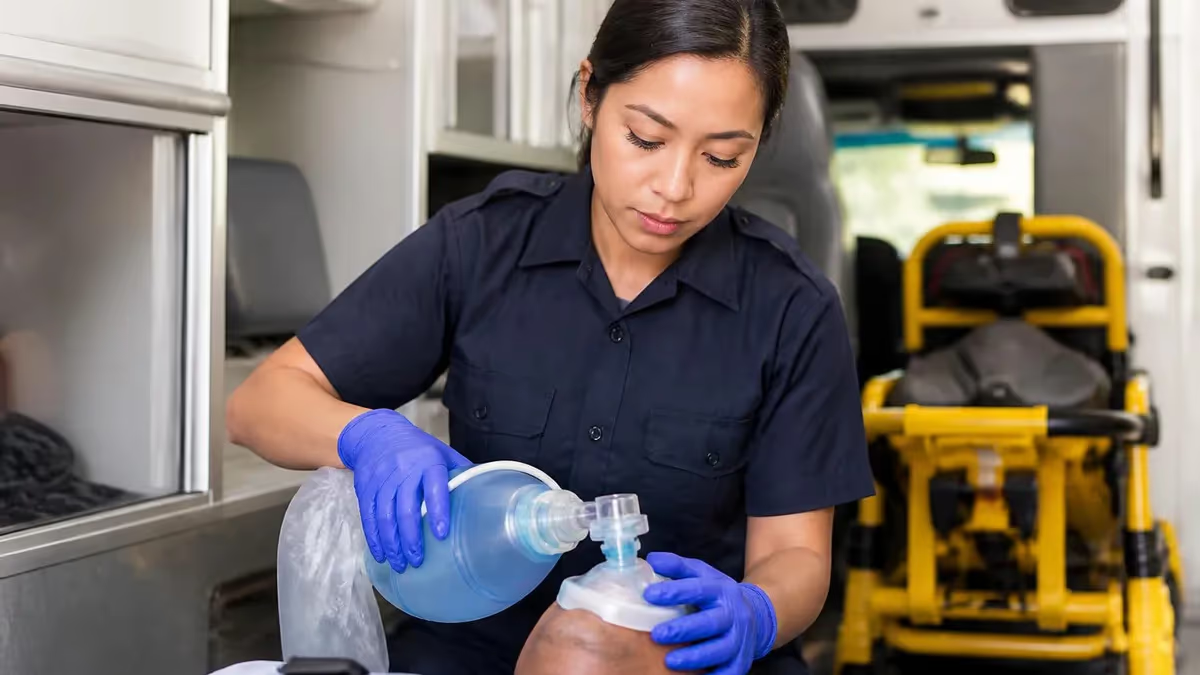
Airway, Respiration, and Ventilation (18–22%): This section covers airway anatomy and physiology, airway management techniques (head-tilt chin-lift, jaw thrust, oral and nasal airways, suction), bag-valve-mask ventilation, supplemental oxygen delivery systems (nasal cannula, non-rebreather mask, partial rebreather), and recognition and management of respiratory distress. The airway is the first priority in every patient encounter — any deficiency here is a critical failure item.
Cardiology and Resuscitation (20–24%): This section tests knowledge of the cardiac system, recognition of cardiac emergencies, CPR (including compression-only and full CPR with ventilations), AED operation and patient criteria, and pharmacology for cardiac emergencies within EMT scope (aspirin administration for suspected MI). Understanding chain of survival, return of spontaneous circulation (ROSC) indicators, and post-resuscitation care are all tested.
Trauma (14–18%): Trauma content covers mechanism of injury, bleeding control (direct pressure, tourniquets, wound packing), shock recognition and management, spinal motion restriction principles, fracture management (splinting), burn assessment (rule of nines, depth classification), and head injury recognition including signs of increased intracranial pressure.
Medical and Obstetrics/Gynecology (27–31%): This is the largest weighted section and covers altered mental status, diabetic emergencies (hypoglycemia vs. hyperglycemia), seizures, stroke (Cincinnati Prehospital Stroke Scale), anaphylaxis and allergic reactions, abdominal emergencies, behavioral emergencies, toxicological emergencies, and obstetric emergencies including normal delivery and complications like cord prolapse and breech presentation.
EMS Operations (10–14%): Operations content includes ambulance operations, scene safety and standard precautions, mass casualty incident triage (START triage system), lifting and moving patients, documentation and patient care reporting, and professional ethics and legal responsibilities (consent, refusal, duty to act, scope of practice).
AEMT: Advanced Level Competencies
The NREMT Advanced Emergency Medical Technician (AEMT) exam builds directly on EMT-Basic competencies while adding advanced assessment skills and interventions. AEMT scope of practice expands beyond basic life support to include limited advanced life support procedures.
Key AEMT-specific competencies tested include: intravenous and intraosseous access and fluid therapy, limited medication administration (IV dextrose, nitroglycerin, epinephrine via auto-injector, albuterol, diphenhydramine, and others depending on state scope), advanced airway management including supraglottic airway devices and nasotracheal intubation in some states, cardiac monitoring (interpretation of basic rhythms), and expanded patient assessment techniques.
The AEMT exam uses the same CAT format as the EMT-Basic exam with the same question count range (70–120). The clinical decision-making emphasis is higher — AEMT candidates are expected to integrate assessment findings with expanded treatment options and justify those choices through clinical reasoning, not just protocol recitation.
Paramedic: Advanced Scope and Clinical Reasoning
The NREMT Paramedic exam is the most demanding of the three certification levels, both in content breadth and the depth of clinical reasoning required. Paramedic scope of practice includes virtually all prehospital interventions: endotracheal intubation, 12-lead ECG acquisition and interpretation, advanced cardiac pharmacology, sedation and rapid sequence intubation, and complex patient assessment for medical, trauma, cardiac, and critical care scenarios.
The Paramedic cognitive exam uses 80–150 CAT questions. Content is organized around the same five domains as the EMT exam but expanded significantly in depth and complexity. Paramedic candidates must demonstrate ability to integrate multiple systems findings — a patient with altered mental status, respiratory distress, and a focal neurological finding requires a differential diagnosis process, not a single-track protocol response.
Paramedic pharmacology is a major exam emphasis. Candidates must know mechanism of action, indications, contraindications, dosing calculations, and expected effects for a large formulary including antiarrhythmics, vasopressors, analgesics, sedatives, bronchodilators, thrombolytics, and many others. Calculation errors are a common failure point — drug math practice is non-negotiable.
Critical Failure Items
The NREMT psychomotor exam (practical skills stations) includes critical criteria — specific actions whose omission or commission automatically fails the station regardless of everything else the candidate does correctly. The cognitive exam does not use identical "critical failure" rules, but certain errors in clinical reasoning consistently correlate with failure.
The most common NREMT exam failures involve: prioritizing interventions out of order (attempting to treat secondary problems before addressing airway, breathing, or major bleeding), failing to recognize critical presentations (sepsis, stroke, STEMI, tension pneumothorax), selecting treatments outside EMT scope, and ignoring or misinterpreting chief complaint and mechanism of injury information embedded in scenario stems.
NREMT has publicly stated that the cognitive exam places highest priority on airway management and life-threatening emergencies. Candidates who are solid on routine assessment but weak on critical emergency recognition and management will fail even if their overall knowledge base is adequate. Drilling high-acuity scenarios specifically is the most valuable use of prep time close to exam day.
Pass/Fail Determination and Remediation
The NREMT uses a "mastery standard" for pass/fail determination — you must demonstrate competence above a predetermined cut score to pass. The CAT algorithm is designed to minimize measurement error, so the pass/fail decision is highly reliable. Borderline candidates may receive more questions (up to the maximum) as the algorithm works to achieve confidence in its assessment.
Candidates who fail receive a Diagnostic Performance Report identifying relative weaknesses in each content area. This report uses phrases like "below passing standard," "near passing standard," and "above passing standard" for each domain. Remediation should target domains rated below or near passing standard first, using additional study time, skills practice, and targeted practice questions.
NREMT allows three attempts before requiring additional education or a refresher course. Most states have their own retake policies layered on top of NREMT requirements, so candidates should check their state EMS office requirements in addition to NREMT rules. After failing three times, candidates must demonstrate completion of a remediation course before testing again.