
NREMT Medical Assessment: Patient Assessment Skills Practice Guide
NREMT medical assessment guide: skill sheet steps, SAMPLE, OPQRST, vitals, common chief complaints, critical-criteria failures, and scoring tips. 🎯
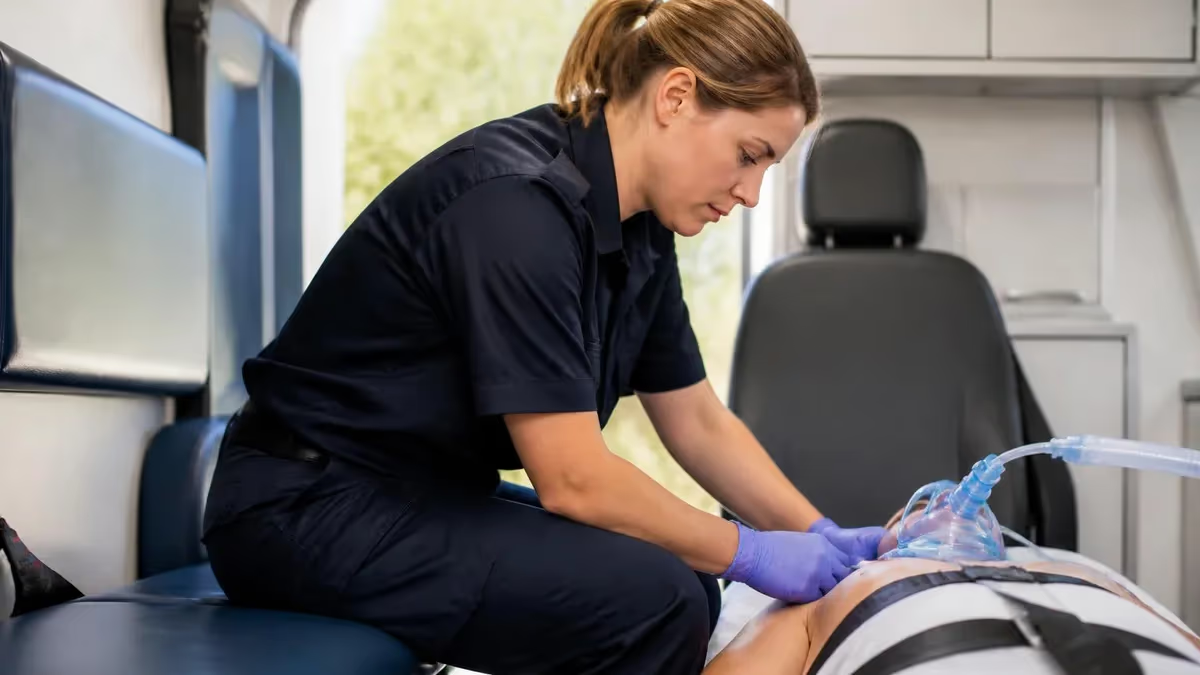
The medical assessment station is where a lot of NREMT candidates trip — not because the medicine is hard, but because the rhythm of the station is. You walk in, the evaluator hands you a scenario card with maybe four lines of dispatch information, and then a stopwatch starts ticking somewhere in the back of your mind. Six minutes for a focused medical assessment. Ten minutes if it is the longer trauma-adjacent version.
Either way, you are now expected to size up the scene, manage airway and breathing, take a SAMPLE history, run through OPQRST, get a full set of vitals, perform a focused secondary exam, restate the chief complaint, and verbalize a transport decision — all without losing points for skipping any of the so-called critical criteria that the nremt has marked with an asterisk on the scoring sheet.
This guide will not pretend the station is easy. It will, however, walk you through the parts that examiners actually mark you down for, the medical chief complaints that show up most often in the scenario card, and the small habits that separate candidates who pass the medical station on the first attempt from candidates who repeat it.
The good news is that the skill is highly trainable. Once you have run through it eight or ten times with a partner, the structure becomes second nature, and your conscious attention can shift from what comes next to what is this patient actually telling me. That shift is the entire ballgame.
There are two flavors of the station you should be aware of going in. The adult medical assessment is the one most candidates encounter at the NREMT EMT-Basic and Advanced EMT level, and it is run with a manikin or live patient simulating a generic medical emergency.
The pediatric medical assessment, when it appears, follows a slightly different scoring template that puts more weight on appropriate use of the pediatric assessment triangle, weight-based considerations, and parental communication. The two stations share the same skeleton, but they ask you to flex different muscles, and the candidates who pass both have practiced each one separately rather than assuming the pediatric version is just a smaller version of the adult.

Time is the silent grader at this station. Six minutes feels generous when you are reading about it on a study guide, and it feels brutally short when an evaluator is staring at you and your patient is mumbling about chest pain. The number-one mistake candidates make is treating the assessment as a sequence of small tasks rather than a connected narrative.
The skill sheet is written as a checklist because that is the only fair way to grade thirty-odd items, but if you perform it as a checklist your patient becomes invisible and your evaluator notices. The candidates who finish on time without rushing are the ones who treat the patient as a person, ask questions out loud, and verbalize their findings as they go. The checklist gets ticked off as a byproduct.
Two sets of vitals is the standard expectation. You take one baseline set early — after you have addressed the obvious airway and breathing concerns — and a second set later in the assessment to demonstrate that you can track trends. Skipping the second set is one of the easier ways to lose points on an otherwise strong run, and many candidates lose it not because they forgot but because they ran out of time. Pace yourself. If you have not retaken vitals by the four-minute mark, you should be moving toward them immediately.
Any one of these ends your station regardless of how well the rest went. Failing to take or verbalize body substance isolation precautions. Failing to determine scene safety. Failing to obtain a SAMPLE history. Failing to take vital signs. Failing to perform an organized medical assessment in the order the National Registry has defined. Memorize these five. Verbalize them. The single sentence BSI, scene safe at the very start of the station protects you from losing the entire skill on a thirty-second oversight.
The critical-criteria list is not a secret. The NREMT publishes it openly in the skill sheet packet, and any candidate who has not read the actual sheet — not a summary of it, the actual sheet — is studying with one hand tied behind their back.
Pull the PDF down from the NREMT site, print it, and run through it with a highlighter the way you would prep for any other certification exam. The asterisks next to certain line items are the only things that can end the station outright. Everything else costs you a point or two, and you can still pass even with several minor deductions.
Among the five, the BSI and scene-safe verbalization is the one most candidates skip on their first practice attempt. It feels artificial. You walk into a controlled testing environment with no realistic scene hazards, and saying out loud that the scene is safe feels theatrical. Do it anyway. The evaluator is not grading your acting; they are grading whether you remembered. Same with the SAMPLE history.
Even if the patient has already told you they take metoprolol, you must structure the history-taking explicitly so the evaluator can mark each letter of the acronym on their sheet. Signs and symptoms, Allergies, Medications, Past medical history, Last oral intake, Events leading to the call. Walk through them in order. The order matters less than the completeness, but the order makes the completeness easier to demonstrate.
BSI, scene safety, number of patients, mechanism or nature of illness, additional resources. The first 30 seconds of the station.
General impression, mental status (AVPU), airway, breathing, circulation, priority decision. Treat life threats as you find them.
Chief complaint, OPQRST on the symptom, SAMPLE history. Spoken aloud so the evaluator can score each element.
Focused physical exam based on chief complaint, full vitals, interventions, transport decision, second set of vitals before completion.

The four cards above are the spine of the station. Everything else hangs off them. If you can run through those four phases in roughly equal time — about ninety seconds each, with a little buffer at the end for the second vitals — you will hit every scored item. Practice with a watch visible to you. The watch is not for the evaluator; it is for you to internalize the pacing. After ten or fifteen practice runs, you will stop needing it, but during early practice it is genuinely useful.
One small habit that pays disproportionate dividends: verbalize what you are doing as you do it. I am checking radial pulse. Pulse is strong and regular at about 88. I am now auscultating lung sounds bilaterally. Clear to auscultation on both sides. This sounds robotic on paper. In the station it accomplishes two things.
First, it lets the evaluator score what you found without having to ask. Second, it forces you to actually do each step properly, because saying it out loud commits you to the action. Candidates who go silent in the middle of the assessment tend to skip steps without noticing.
Onset — when did it start, what were you doing? Provocation/Palliation — what makes it better or worse? Quality — describe the sensation in your own words. Region/Radiation — where is it, does it move anywhere? Severity — on a scale of zero to ten. Time — has it been constant, intermittent, getting worse, getting better? Walk through every letter. Even if the patient already told you the answer, restating it under the OPQRST framework lets the evaluator mark each line.
Of the four tabs above, OPQRST is the one candidates most often partially complete and assume they finished. The mistake usually involves skipping Provocation/Palliation or merging Region with Radiation without explicitly asking the second part.
The fix is simple — say each letter out loud, or ask each question in the same order every single time so the muscle memory does the work. Many candidates write OPQRST on the back of their glove during practice. By the time you walk into the actual station, you will not need the cheat sheet, but the act of writing it has cemented the order.
SAMPLE is similarly easy to skim through. The trap is Last oral intake, which patients with chest pain or altered mental status often dismiss as irrelevant. It is not irrelevant — last oral intake matters for medication absorption, for surgical planning, and for ruling out hypoglycemia in confused patients. Ask it. Document the answer. Move on.
Scenario writers at the NREMT favor four medical presentations because they exercise the assessment framework cleanly. Chest pain in a middle-aged patient with cardiac risk factors. Dyspnea in a patient with known COPD or asthma. Altered mental status in a diabetic patient or an elderly patient on multiple medications. Abdominal pain with associated nausea, vomiting, or syncope. If you have practiced these four scenarios in detail, you have practiced 80 percent of what the station will ask you to do.
Chest pain scenarios are the most common opener. The dispatch information will mention a 55-year-old with substernal chest pressure, often described as crushing or squeezing, sometimes radiating to the left arm or jaw. Your job in the first minute is to confirm the airway is open, the patient is breathing adequately, the pulse is present and roughly regular, and that there are no immediate life threats from arrhythmia or shock.
Then OPQRST around the pain — when did it start, what were you doing, does anything make it worse or better, can you describe the sensation, where exactly is it, on a scale of one to ten how severe is it, has it been constant or coming and going? SAMPLE next, with particular attention to cardiac medications and prior cardiac history. Aspirin per protocol if the local scope allows and there are no contraindications. Oxygen titrated to saturation. Position of comfort. Transport decision verbalized clearly.
Dyspnea scenarios test whether you can distinguish between respiratory and cardiac causes. The patient may have a history of COPD, asthma, or congestive heart failure. Your focused exam will include lung sounds at multiple fields, accessory muscle use, tripod positioning, peripheral edema, jugular venous distension, and skin color. Treatment depends on findings and scope of practice.
If wheezing is present and the patient has a prescribed inhaler, assist with administration if your protocol allows. If rales suggest fluid overload, position upright, oxygen by non-rebreather, and prepare for rapid transport. The cardinal sin in dyspnea scenarios is over-oxygenating a known COPD patient without titrating to saturation — keep the saturation in the 88 to 92 percent range for that population unless your local protocol specifies otherwise.
Altered mental status scenarios are designed to test whether you remember to check glucose. A confused diabetic patient with a blood sugar of 38 is almost certainly hypoglycemic, and oral glucose or IV dextrose, depending on scope, is the right intervention. Skipping glucose in an AMS scenario is one of the most common point deductions at the station. Add a stroke screen for unilateral findings, pupil check for opioid involvement, and a temperature where infection is suspected. The mnemonic AEIOU-TIPS — alcohol, epilepsy, insulin, overdose, uremia, trauma, infection, psychiatric, stroke — covers the differential.
Abdominal pain scenarios reward methodical palpation. Start in the quadrant furthest from the reported pain and work toward it. Note guarding, rebound tenderness, rigidity, and any pulsatile masses. Ask about associated nausea, vomiting, diarrhea, constipation, blood in stool or vomitus, last menstrual period in female patients of reproductive age. Vital signs matter especially here because shock from a ruptured abdominal aortic aneurysm or an ectopic pregnancy can present as abdominal pain with normal or mildly elevated heart rate before decompensation.

Pre-Station Checklist for the NREMT Medical Assessment
- ✓Verbalize BSI and scene safety within the first ten seconds of the station
- ✓State your general impression and AVPU level out loud before touching the patient
- ✓Address airway, breathing, and circulation in that order before history taking
- ✓Establish chief complaint, then run OPQRST in full on the presenting symptom
- ✓Complete SAMPLE history with all six elements spoken aloud
- ✓Obtain baseline vital signs and announce each value as you measure it
- ✓Perform a focused secondary exam driven by the chief complaint
- ✓Verbalize a transport decision and rationale before reassessment
- ✓Take a second set of vital signs to demonstrate reassessment and trending
- ✓End the station with a brief verbal handoff including chief complaint, key findings, and interventions
The checklist above is the bare floor of what the evaluator is scoring. Hit every item on it and you will pass the station. Skip any one of the critical items — BSI, scene safety, SAMPLE, vital signs, organized assessment — and you will fail regardless of how well you performed the rest. The candidates who fail and cannot articulate why almost always missed one of these structural items in the rush of the moment. Slowing down enough to verbalize each step is, paradoxically, the fastest way to get through the station cleanly.
Pediatric medical assessment scenarios introduce a few additional considerations. The pediatric assessment triangle — appearance, work of breathing, circulation to skin — replaces the adult general-impression step and is meant to be performed across the room before any hands-on contact.
Weight-based dosing for any medication assistance becomes relevant, and the Broselow tape or a similar length-based estimator should be referenced or verbalized when scope-relevant treatments come up. Communication shifts too. You speak with the child at their developmental level while keeping the caregiver informed, and you involve the caregiver in the history-taking because the patient may not be a reliable historian.
Should You Practice the Medical Assessment Station Alone or With a Partner?
- +Partner practice creates realistic conversational rhythm during history-taking
- +A second person can simulate distracting patients or family members the way real calls do
- +Verbal feedback in real time helps catch missed steps you would otherwise overlook
- +Switching roles teaches you what the evaluator is actually watching for
- +Practicing handoffs requires another person to receive the report
- −Solo practice with the skill sheet builds the structural memory faster in early sessions
- −Coordinating partner schedules slows down high-volume repetition
- −Bad habits from an untrained partner can become your habits if no instructor reviews
- −Solo verbalization in front of a mirror still hits most scored items
- −Recording yourself solo lets you review pacing without external pressure
Pros and Cons at a Glance
| Pros | Cons |
|---|---|
| Partner practice creates realistic conversational rhythm during history-taking | Solo practice with the skill sheet builds the structural memory faster in early sessions |
| A second person can simulate distracting patients or family members the way real calls do | Coordinating partner schedules slows down high-volume repetition |
| Verbal feedback in real time helps catch missed steps you would otherwise overlook | Bad habits from an untrained partner can become your habits if no instructor reviews |
| Switching roles teaches you what the evaluator is actually watching for | Solo verbalization in front of a mirror still hits most scored items |
| Practicing handoffs requires another person to receive the report | Recording yourself solo lets you review pacing without external pressure |
A reasonable practice plan blends both. Start solo for the first three or four runs to internalize the order. Then bring in a partner — ideally another candidate or a paramedic instructor — for live scenarios where the patient responds unpredictably and you have to adapt. Twenty practice runs total, spread over two or three weeks, is enough for most candidates. Compress that schedule too tightly and the early lessons fade; spread it too thin and you forget the pacing between sessions.
One often-overlooked aspect of preparation is reviewing your local protocols alongside the NREMT skill sheet. The skill sheet describes a generic national standard, but your scope of practice depends on your state and your medical director. Knowing which medications you can assist with, which interventions require online medical control, and which transport decisions are within your authority all sharpens your verbal handoff at the end of the station. Evaluators sometimes test this knowledge with follow-up questions after the timed portion ends. Being prepared with a confident, protocol-grounded answer is part of presenting yourself as a competent provider.
The mental side of the station deserves a paragraph of its own. Test anxiety is real, and the NREMT testing environment can feel more clinical than the field. Candidates sometimes freeze for the first ten seconds because the artificial setup throws them off. The cure is repetition.
By the time you have run the station fifteen times in practice, the opening lines come out automatically — BSI, scene safe, my general impression is a 55-year-old male sitting upright on the couch in mild distress, alert and oriented, complaining of chest pain — and the rest follows from there. Confidence in the opening sentence carries through the rest of the assessment.
If you have read this far, you already have a stronger handle on the medical assessment station than most candidates entering their first practice session. The remaining work is mechanical — book the time, run the scenarios, time yourself, get feedback, refine. The candidates who pass the station on their first attempt are not the ones with the strongest medical knowledge. They are the ones who have practiced the structure of the assessment until the structure is invisible to them. When the structure is invisible, the medicine shows through.
One final note on what happens after the timed portion. Some evaluators will ask a brief follow-up question or two — what would you do differently if the patient deteriorated en route, what additional information would you want if the patient were younger, what is your transport decision rationale — and these questions are sometimes scored separately as part of the overall station performance.
Treat them the same way you treat the timed portion. Answer briefly, answer in terms of patient presentation and protocol, and avoid the temptation to over-explain. A confident two-sentence answer beats a rambling one nearly every time.
Good luck with your station. The medical assessment is one of the most fairly graded skills on the NREMT psychomotor exam — the scoring is transparent, the criteria are published, and the structure is consistent across testing sites. Walk in knowing the sheet, knowing your pacing, and knowing your protocols, and you will walk out with a passing score.
NREMT Questions and Answers
About the Author

Paramedic & Emergency Services Certification Trainer
George Washington UniversityCaptain Ryan O'Brien is a licensed paramedic and NREMT-certified emergency medical professional with a Bachelor of Science in Emergency Medical Services from George Washington University. He has 15 years of field experience as a paramedic and firefighter, and has coached hundreds of EMT and paramedic candidates through their NREMT written and psychomotor licensing examinations.
Join the Discussion
Connect with other students preparing for this exam. Share tips, ask questions, and get advice from people who have been there.
View discussion (2 replies)