
NREMT: Complete National Registry of EMTs Guide 2026 September
Complete NREMT guide: certification levels, cognitive exam format, application fees, recertification cycles, state reciprocity, and scope of practice ⏳
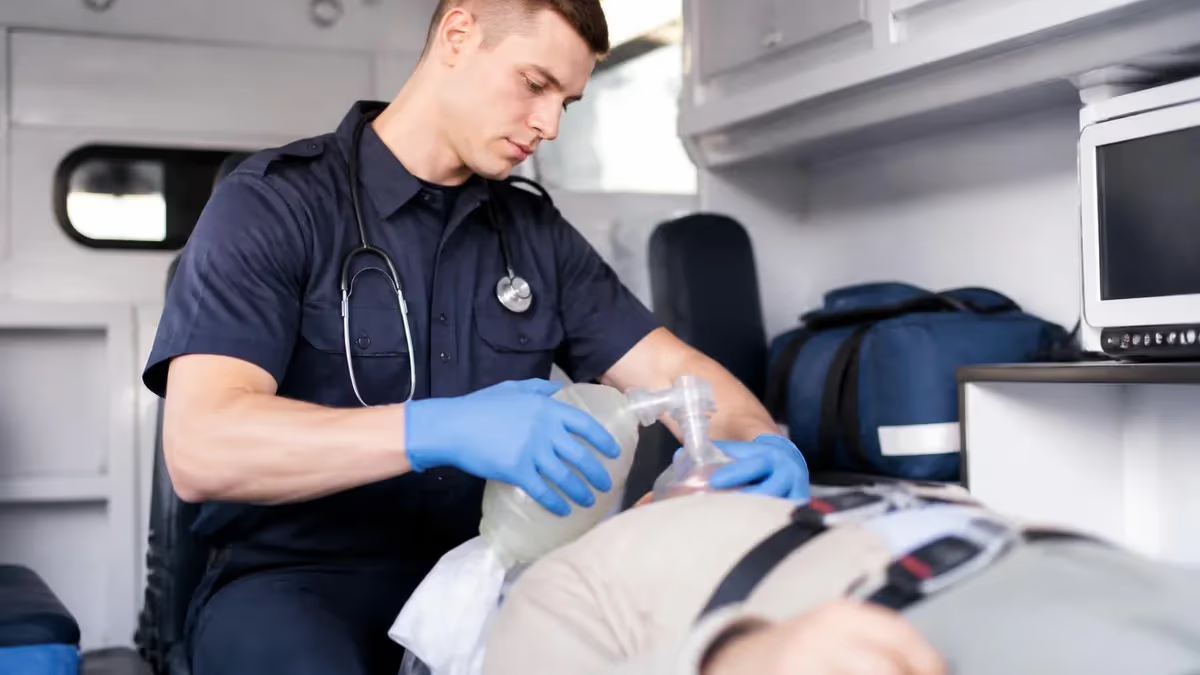
The National Registry of Emergency Medical Technicians (NREMT) sits at the center of every certified EMS provider's career in the United States. It builds, validates and scores the cognitive and psychomotor examinations used by nearly every state to license prehospital providers. The Registry was founded in 1970 after a federal recommendation called for one national standard of EMS competency, and its mission has not shifted much since: protect the public by certifying the people who arrive when the worst day of someone's life is unfolding.
Understanding how the Registry works is more than trivia. Your study plan, your scope of practice on day one, your ability to transfer between states, and even your insurance billing codes flow downstream of decisions the NREMT makes. New candidates often arrive at testing day having memorized protocols but never having read the candidate handbook, and that gap shows up on the score report in painful black and white.
This guide walks through the structure of the organization, the four levels of certification it issues, how the cognitive computer-adaptive test and psychomotor skill stations actually run in 2026, and what to expect during application, scheduling, recertification, and the move to state licensure that turns your card into a working badge.

NREMT By The Numbers
The NREMT is a nonprofit, not a government agency. It is overseen by a board of directors with seats reserved for physicians, state EMS officials, educators, and field providers. Because it is independent, states adopt or reference its exams voluntarily rather than under federal mandate, which keeps the testing apolitical and clinical.
In practice, 46 states plus DC, Guam, Puerto Rico and the Virgin Islands use the Registry exam as part of initial licensure. Texas, Wyoming, New York and a few others maintain their own state exams but still recognize the NREMT credential for reciprocity. This patchwork is why the Registry is sometimes called a de facto national license without ever using that label in its own materials.
The Registry also drives EMS workforce data. Every certified provider must complete an annual update that records employment status, agency affiliation, and basic demographics. This dataset feeds the National EMS Information System and shapes federal funding decisions, training grants, and pandemic response planning. Many providers click through the survey without thinking, but the data has influenced rural paramedic salary studies and post-COVID staffing models.
The NREMT is an independent nonprofit that develops and scores the cognitive and psychomotor exams used by 46 states to license EMS providers. Holding an NREMT card is required for licensure in most jurisdictions, but the state EMS office grants the actual permission to practice within state lines.
Certification levels form the spine of how the Registry organizes the field. The four nationally recognized levels are Emergency Medical Responder, EMT, Advanced EMT, and Paramedic. Each tier maps to a specific minimum education standard published by the National Highway Traffic Safety Administration in the National EMS Education Standards document.
Each level also has its own cognitive blueprint, psychomotor skills list, and recertification cycle. Climbing levels is not automatic — you do not "upgrade" credentials so much as test in from a new approved program. Bridging courses exist (EMT-to-paramedic bridges, for example), but the cognitive exam at the new tier is required.
Emergency Medical Responder, often shortened to EMR, is the entry tier. EMRs provide immediate lifesaving care while waiting for higher-level help to arrive. Think volunteer first responders in rural counties, ski patrollers, industrial first-aid teams, and many police officers. Their scope is narrow but vital: airway maneuvers, oxygen delivery, bleeding control, CPR with AED, splinting, and assisting with childbirth.
NREMT Certification Levels Side By Side
Entry tier providing immediate lifesaving care while higher-level help arrives. Cognitive exam 90 to 110 items, 1 hour 45 minutes time limit, application fee 80 dollars. Common roles include ski patrol, police officers, volunteer first responders, and industrial first-aid teams who arrive before the ambulance and stabilize until transport arrives.
Most populous level and the typical first credential most candidates earn. Provides basic life support on ambulances. Computer-adaptive exam 70 to 120 items, 2 hours, fee 104 dollars. Covers airway and ventilation, cardiology, trauma, medical/OB-GYN, and EMS operations across adult and pediatric populations with adult content weighted at about 85 percent.
Bridge tier between EMT and Paramedic created in 2009. Adds IV and IO access, supraglottic airways, and a defined medication list including epinephrine and dextrose. 135-item exam with 35 unscored research items, 2 hours 15 minutes, fee 129 dollars. Common in rural and tiered-response systems where full paramedic units are cost-prohibitive.
Apex level with advanced airway management, cardiac monitoring with 12-lead interpretation, and autonomous critical decisions on cardiac arrest, complex pediatric resuscitation, and field amputation. Linear fixed-length exam 80 to 150 items, up to 2.5 hours, fee 152 dollars. Thousands of hours of CoAEMSP-accredited education required leading to certificate, associate or bachelor degree.

The EMT tier is the most populous level and the one most candidates pursue first. EMTs staff the back of ambulances across the country and provide basic life support for medical and trauma calls. The cognitive exam runs 70 to 120 items in a computer-adaptive format covering airway, cardiology, trauma, medical and operations.
About 85 percent of items target adult patients and roughly 15 percent target pediatric patients. The Registry deliberately weights cardiology and respiratory care heavily because cardiac arrest and respiratory failure dominate field statistics — those are the calls where bystander and EMT decisions move the needle on survival, so the blueprint follows real-world frequency rather than textbook chapter order.
Above the EMT sits the Advanced EMT, created in 2009 to bridge basic and paramedic. AEMTs can start IVs, administer a defined list of medications, and use supraglottic airway devices. The cognitive exam contains 135 items with 35 unscored research questions and runs two hours fifteen minutes. AEMT programs add 150 to 250 instructional hours on top of EMT training, and many rural systems rely on AEMTs as a cost-effective alternative to staffing full paramedic units.
Cognitive Exam Format By Level
Computer-adaptive format. 90 to 110 items. Time limit 1 hour 45 minutes. Application fee 80 dollars. Single content blueprint covering basic patient assessment, airway maneuvers, bleeding control, CPR with AED, splinting and immobilization, and operations including scene safety and incident command basics. EMR is most often used by police, fire suppression personnel, ski patrol, and rural volunteer first responders who arrive ahead of the ambulance.
The Paramedic level represents the apex of prehospital training. Paramedic education is measured in thousands of hours rather than hundreds, and accredited programs lead to a certificate, associate, or bachelor's degree. The cognitive exam contains 80 to 150 linear items and lasts up to two and a half hours.
Paramedics carry the deepest pharmacology, advanced airway, cardiac monitoring and 12-lead interpretation, and they make autonomous decisions on field amputations, surgical airways, and complex pediatric resuscitations. The Registry transitioned the paramedic cognitive exam from CAT to a linear, fixed-length format in 2024 — that change gave candidates a more predictable testing experience while preserving psychometric rigor.
Computer-adaptive testing remains the engine for EMR, EMT and AEMT scoring. The CAT algorithm chooses each question based on how you answered the previous one. Get one right and the next item is slightly harder; miss one and the next is easier. The exam ends when the algorithm is 95 percent confident your ability sits above or below the passing standard, which is why two candidates at neighboring computers can finish at completely different question counts.
Your Authorization to Test (ATT) letter is valid for only 90 days from issue. If you do not schedule and sit within that window, you must reapply and pay the fee again. Schedule the test as soon as the ATT arrives, ideally within four weeks of program graduation when retention is highest. Internal program data shows first-attempt pass rates drop 8 to 12 percentage points for candidates who wait longer than 90 days.
Score reports do not show a numeric percentage — you either passed or did not. A failing report breaks performance down into the five content domains marking each as above passing, near passing, or below passing. Use this rubric to focus retake study rather than guessing at weak areas. Candidates who fail can retest after a 15-day waiting period up to three times before remedial education is required.
After six total attempts without passing, the candidate must enroll in a complete refresher program approved by their state EMS office. The 15-day cooling period exists to encourage real remediation rather than rapid-fire reattempts, and the Registry has held that policy firm even under candidate pressure to shorten it.
The psychomotor portion historically required candidates to perform 10 to 12 hands-on skill stations in front of state-appointed evaluators. As of 2024 the Registry transitioned most psychomotor testing to a state-controlled model where states verify skills through portfolio review of accredited program records rather than a separate testing day. AEMT and Paramedic candidates follow a similar program-based verification, though some states still run scenario-based capstone testing for paramedics.

Documents You Need On Test Day
- ✓Government-issued photo ID such as driver's license, passport, or military ID
- ✓Secondary ID showing your signature (credit card or second government ID)
- ✓Authorization to Test letter printed or accessible on phone
- ✓Confirmation number from Pearson VUE scheduling email
- ✓Arrive 30 minutes early — late arrivals are turned away without refund
- ✓Leave phone, smartwatch, food, and notes in the provided locker
Application and scheduling run through the Registry's online portal at nremt.org. Create an account, pay the application fee, and your program director must submit verification of course completion before the system releases an Authorization to Test letter. Pearson VUE delivers all cognitive exams; once the ATT is issued you have 90 days to schedule and sit at any Pearson testing center.
Bring two forms of identification, one a government-issued photo ID. Pearson centers operate under strict security — no phones, watches, food, or notes beyond what is provided at the station. If you fail, you must wait 15 days before reapplying and you pay the full exam fee again. The Registry does not refund failed attempts, which is why so much study advice emphasizes first-attempt readiness.
State licensure layers on top of the national certificate. Holding an NREMT card does not, by itself, let you work an ambulance — you must apply to your state EMS office, complete a background check and fingerprinting in most jurisdictions, prove medical fitness for duty, and pay state licensing fees. The two credentials operate in parallel: the NREMT proves you met the national standard, the state license is the actual permission to practice.
Reciprocity is where the credential earns its keep. A provider holding a current Registry card can move to almost any other state and apply for licensure without retesting, as long as they meet state requirements like background checks and state-specific protocol exams. This is especially valuable for military medics, traveling paramedics on contract assignments, and providers relocating for family reasons.
Computer-Adaptive vs Linear Testing
- +CAT ends faster for clearly competent candidates, sometimes under an hour
- +Question difficulty matches your ability so you are not bored or overwhelmed
- +Psychometrically efficient — requires fewer items for the same confidence level
- +Reduces total testing time across thousands of candidates
- −Cannot skip ahead or return to previous questions during the exam
- −Anxiety increases when the test ends at the minimum item count
- −Skip-the-hard-ones pacing strategies do not apply
- −Difficult to gauge how you are performing while sitting the exam
Recertification happens every two years through the National Continued Competency Program. The Registry divides required hours into a national component covering core EMS topics, a local component reflecting regional clinical needs, and an individual component the provider chooses freely. Total hours range from 20 for EMR to 60 for Paramedic, with EMT at 40 and AEMT at 50.
Half of those hours can be distributive (online modules), with the other half requiring in-person or interactive virtual delivery. CPR or AHA certification at the level appropriate to your tier must be current. If you fail to recertify on time your credential lapses — a lapse under two years allows reinstatement through catch-up; more than two years usually means retaking the cognitive exam plus a full refresher.
Scope of practice is not set by the Registry — it is set by your state EMS medical director and codified in state regulation. The Registry tests against a national education standard that represents the maximum scope; states then carve back what their providers can do. AEMTs in some states administer naloxone autonomously while others require online medical control; always read your state scope document before your first shift.
Historical context helps. Before 1970 every state ran its own ambulance attendant testing or, in many counties, no formal testing at all. The 1966 National Academy of Sciences report "Accidental Death and Disability: The Neglected Disease of Modern Society" documented how patchwork prehospital care was killing trauma patients who would have survived with consistent training. That report kicked off federal grants that built the modern EMS system, and the Registry was created as the credentialing arm.
The 2009 redesign still shapes the field. The previous structure had two intermediate levels (Intermediate-85 and Intermediate-99) that varied so much between states they were almost useless for reciprocity. The National EMS Education Standards collapsed those into a single AEMT level. The same redesign rewrote the paramedic standard around competency and required accreditation through the Committee on Accreditation of Educational Programs for the EMS Professions, which raised first-attempt pass rates by roughly 15 points.
On test day, arrive 30 minutes early — Pearson centers turn away late candidates without refund. Wear layers because test rooms run cold. Read each question stem twice; the Registry favors items where the wrong answer is also true but the correct answer is the priority action. Slow down, identify the priority verb, then choose. Treat the candidate handbook as required reading the way you would read any career-defining syllabus.
One final practical note before you sit down at the testing center. The Registry publishes its candidate handbook free on the website, and it runs about 30 pages covering testing rules, the appeals process, test security policies, and disciplinary procedures. The Registry permanently bars candidates caught sharing exam content online, and that policy is enforced — multiple high-profile cases since 2020 have resulted in lifetime decertification along with referral to state EMS offices for further action.
Use the candidate handbook the same way you would use a syllabus for a career-defining course. The handbook explains the irregularity review process if testing center technical issues affect your sitting, and how to file a formal appeal if you believe an item was scored incorrectly. Reading it before test day removes one variable from an already stressful experience and prepares you for the rare situation when something goes wrong outside your control.
For candidates preparing for the exam, the most reliable path is structured deliberate practice rather than passive reading. Use a question bank that mirrors the Registry blueprint and aim to complete at least 1,500 to 2,000 questions before sitting. Track which content areas trigger the most wrong answers, then return to the textbook for those topics rather than rereading material you already know.
Treat each missed question as a study item, not a failure. Many successful candidates keep a paper journal of every wrong answer with a one-sentence explanation of why the correct choice was correct, building a personal cheat sheet of weak areas that they review on testing morning. That habit pays off because the Registry blueprint changes very little year to year — your patterns of error today are likely the patterns of error on test day too.
Finally, do not underestimate the value of full-length timed practice. Sitting one or two adaptive practice tests at full length in a quiet room conditions you to the pacing of the real exam. Many candidates score well on individual chapter quizzes only to bomb the cognitive exam because they have never strung 100-plus questions together in one sitting. Treat exam endurance as a skill to train, the same way you would train for a long shift on the truck — and your performance will follow.
A last word on mindset. The Registry is not designed to fail you. Its mission is public protection through valid testing of competent providers, and the algorithm is built to find the candidates who are ready. If you have completed an accredited program, drilled questions consistently, and slept the night before, you are very likely to pass on the first attempt. National first-attempt pass rates run between 65 and 75 percent depending on the level, with well-prepared candidates from strong programs sitting comfortably above 85 percent.
NREMT Questions and Answers
About the Author
Paramedic & Emergency Services Certification Trainer
George Washington UniversityCaptain Ryan O'Brien is a licensed paramedic and NREMT-certified emergency medical professional with a Bachelor of Science in Emergency Medical Services from George Washington University. He has 15 years of field experience as a paramedic and firefighter, and has coached hundreds of EMT and paramedic candidates through their NREMT written and psychomotor licensing examinations.
Join the Discussion
Connect with other students preparing for this exam. Share tips, ask questions, and get advice from people who have been there.
View discussion (2 replies)