
NREMT Firefighter Salary 2026: EMT & Paramedic Pay by State
Pass the NREMT Firefighter Salary 2026: EMT & exam with confidence. Practice questions with detailed explanations and instant feedback on every answer. 🆕
NREMT Firefighter Salary in 2026: What You'll Actually Earn
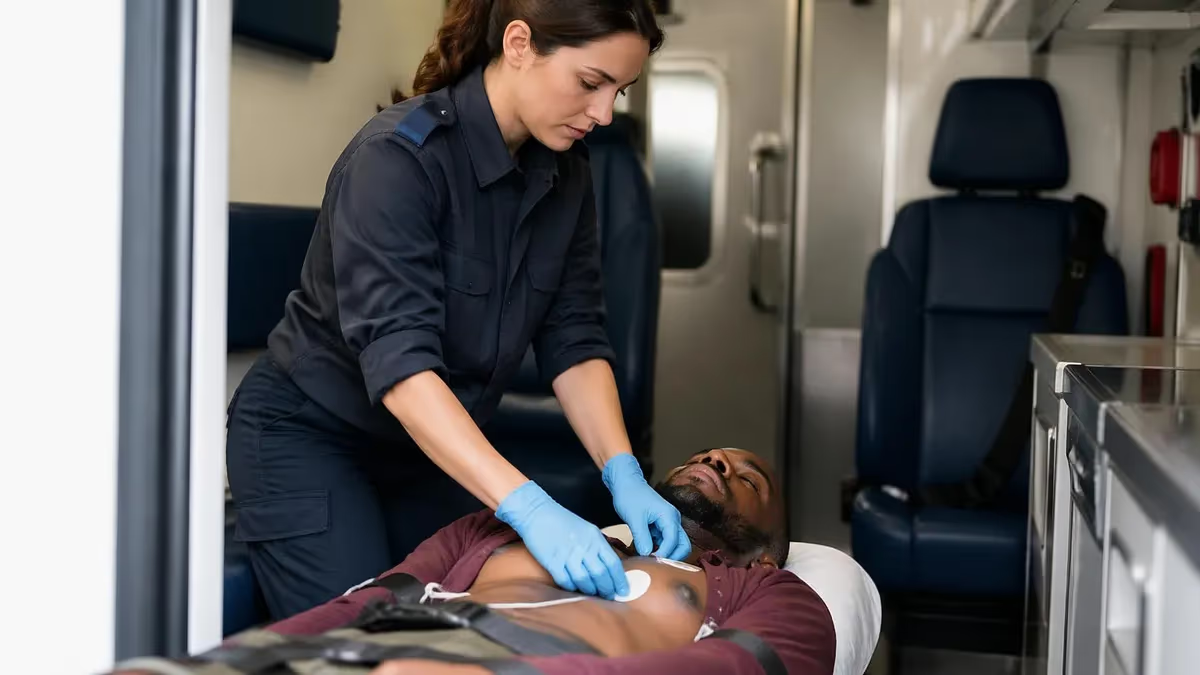
Understanding nremt firefighter salary expectations is essential whether you're entering the fire service, upgrading from EMT to paramedic, or mapping out a long-term EMS career. The Bureau of Labor Statistics reports a median firefighter salary of $58,290 per year in 2026 -- but that number hides enormous variation. Your actual pay depends on your state, your department, your rank, and your certifications. A probationary firefighter in Mississippi earns $33,000. A senior firefighter/paramedic in Los Angeles earns six figures before overtime hits. Same job title. Wildly different paychecks.
The nremt certification is where it all starts. Most career fire departments require at minimum an EMT-Basic credential from the National Registry of Emergency Medical Technicians just to apply. From there, every certification you add -- paramedic, hazmat technician, technical rescue -- pushes your compensation higher. The firefighter salary conversation isn't really about one number. It's about the ladder you climb and how fast you climb it.
This guide breaks down real salary data by certification level, state, department type, and rank. We'll cover EMT salary versus paramedic salary within fire departments, which states pay the most (and least), and specific strategies to maximize your earnings. Whether you're studying for the NREMT exam right now or already working a truck, you'll find actionable data here -- not vague ranges pulled from job boards.
Free NREMT Study Tools
Interactive NREMT resources on PracticeTestGeeks, free to start:
- EMT Airway and Breathing Practice Test 1 — 15 questions with instant scoring and answer explanations
- NREMT flashcards — review key terms and concepts card by card
- NREMT study guide — topic-by-topic overview of what the exam covers
- NREMT cheat sheet — one-page printable summary for last-minute review

EMT Salary vs Paramedic Salary in the Fire Service
The gap between EMT salary and paramedic salary is the single most important pay distinction in emergency services -- and it's bigger than most people expect. Nationally, EMTs average $38,830 per year. Paramedics average $49,700. But those numbers reflect all EMS settings. Inside fire departments, both figures jump significantly. Fire department EMTs typically earn $45,000 to $60,000 thanks to union contracts and public-sector pay scales. Firefighter salary data consistently shows that department-based EMTs out-earn their private ambulance counterparts by 20 to 40 percent.
Paramedics in fire departments earn even more. The typical firefighter/paramedic pulls $62,000 to $88,000 in base salary, with senior paramedics at major metro departments clearing $90,000 or more. Many departments offer a separate paramedic stipend -- usually $4,000 to $15,000 per year -- stacked on top of base firefighter pay. That stipend exists because departments desperately need paramedics and losing them to hospitals or private services hurts response capabilities.
The investment in paramedic school -- typically 1,200 to 1,800 hours of training beyond EMT -- pays for itself within two to three years of the salary bump. If you're weighing whether to pursue paramedic certification, the emt salary versus paramedic salary math makes it a clear financial win. Over a 25-year fire service career, the cumulative difference often exceeds $400,000 in base salary alone, not counting the pension impact of higher final-year earnings.
Firefighter & Paramedic Salary by State
Geography is the biggest wild card in the paramedic salary and firefighter pay equation. California firefighters average $96,060 -- nearly three times what Mississippi firefighters earn at $33,400. The gap comes down to unionization rates, population density, local tax bases, and cost of living. You can't just chase the highest number without factoring in what a dollar buys where you live. A $96,000 salary in San Francisco goes about as far as $55,000 in Jackson, Mississippi once you account for housing and taxes.
Here are the top-paying states for firefighters: California ($96,060), New Jersey ($88,450), Washington ($78,600), Illinois ($76,280), and New York ($75,940). The bottom: Mississippi ($33,400), West Virginia ($35,200), and Arkansas ($36,700). The emt salary pattern mirrors this closely -- high-paying states for firefighters are also high-paying states for EMTs and paramedics, because the same economic factors drive both. You might wonder about nremt login portals and how certification transfers between states -- and the good news is that NREMT certification is nationally recognized, so relocating doesn't mean re-testing.
One factor that surprises people: the FDNY salary. New York ranks fifth for average firefighter pay, but FDNY specifically pays well above the state average. A senior FDNY firefighter/paramedic with overtime can clear $130,000 to $150,000 annually. Similar dynamics exist in Chicago, Houston, and Los Angeles -- the flagship department in each state pays far above the state average.
Salary Breakdown by Role
Entry-Level EMT (Private EMS): $30,000 to $38,000 per year. Private ambulance companies pay the least, but they're the easiest to get hired at -- often serving as a stepping stone to fire department positions.
Fire Department EMT: $45,000 to $60,000 per year. Union contracts, shift differentials, and public-sector benefits push fire department EMT pay well above the national EMT average.
Senior Fire Department EMT: $55,000 to $68,000 per year. Step increases based on years of service add up. A 10-year EMT in a metro department earns significantly more than a new hire in the same role.
Overtime Impact: Fire department EMTs on 24-hour shifts commonly earn $8,000 to $20,000 in annual overtime. Total compensation for a mid-career fire department EMT often reaches $65,000 to $80,000.
The NREMT Exam: Your Gateway to a Firefighter Career
Every firefighter salary discussion starts at the same place -- passing the nremt practice test and earning your certification. The National Registry of Emergency Medical Technicians administers the cognitive exam that most states use for EMT and paramedic licensure. Without it, you can't get hired at the vast majority of career fire departments. It's not optional. It's the price of entry.
The NREMT exam uses Computer Adaptive Testing, similar to how the CAT-ASVAB works. You'll see between 70 and 120 questions, and the algorithm adjusts difficulty based on your performance. It stops once it's 95% confident you either meet or don't meet the competency standard. First-attempt pass rates hover around 65 to 70 percent for EMT-Basic -- meaning roughly a third of test-takers fail on their first try. The nremt study test resources available online can significantly improve your odds.
Content domains cover airway and breathing, cardiology, trauma, medical emergencies, and EMS operations. You don't need to memorize every protocol -- the exam tests your ability to assess patients and make decisions, not recite textbook definitions. Practice with scenario-based questions that force you to prioritize interventions. That's what the real exam does, and that's what your nremt practice questions should mirror.
Factors That Drive Firefighter Pay Up or Down
Beyond geography and certification, several structural factors shape your earnings. Union membership is huge. The International Association of Fire Fighters represents about 330,000 members, and IAFF-affiliated departments consistently pay 15 to 25 percent more than non-union departments in comparable regions. Union contracts also lock in scheduled raises, overtime protections, minimum staffing, and retirement benefits. If firefighter salary is a priority, targeting union departments is a smart move.
Department size matters almost as much. Large urban departments -- think LAFD, FDNY, Chicago FD, Houston FD -- pay substantially more than rural or small-town departments. They also offer faster promotion tracks and more specialty assignment opportunities. The tradeoff is higher call volume, more physical risk, and tougher hiring competition. Some metro departments receive 300 to 500 applications per opening. Your nremt login credentials and certification status need to be current, and many departments also require a firefighter written exam, CPAT physical ability test, and background investigation.
The nremt practice questions you drill now directly affect your earning potential later. Here's why: departments that require NREMT paramedic certification at hire -- not just EMT -- start new hires at a higher step. Some departments in Texas, Florida, and California hire exclusively at the paramedic level now, skipping the EMT-only firefighter track entirely. The nremt lookup tool on the NREMT website confirms your certification status for employers. Keep it current.
Firefighter Salary: Pros and Cons
- +Fire department pay exceeds private EMS by 20 to 40 percent for the same certification level
- +Defined-benefit pensions can be worth $500,000 to $1,000,000+ over a retirement lifetime
- +Overtime on 24-hour shifts adds $10,000 to $40,000+ in annual earnings for most firefighters
- +Paramedic certification delivers the highest single pay increase available -- $10,000 to $20,000 per year
- +Union contracts guarantee structured step increases, so your salary grows automatically with seniority
- +Specialty team assignments (HAZMAT, rescue, dive) carry additional pay differentials of $2,000 to $8,000
- −Entry-level firefighter pay ($38,000 to $52,000) can be tight in high-cost-of-living areas
- −Roughly 69 percent of US fire departments are volunteer -- paid positions are highly competitive
- −Rural and small-town departments pay significantly less with fewer promotion opportunities
- −Physical demands and injury risk are real -- career-ending injuries affect long-term earning potential
- −24-hour shift schedules strain family life and make side employment logistically challenging
- −Salary data varies widely by source, making it hard to get accurate numbers for specific departments
NREMT Exam Prep and Emergency Medical Technician Salary Growth
Passing the nremt exam is step one. But your emergency medical technician salary trajectory depends on what you do after certification. The smartest move for most new EMTs is getting hired by a fire department as quickly as possible -- even if it means relocating. Private ambulance companies are fine for gaining experience, but the pay difference is too large to ignore long-term. A three-year EMT at a private service earns $35,000 to $42,000. A three-year EMT at a fire department earns $52,000 to $65,000. Same certification, same skills, completely different paycheck.
Once you're in a department, start paramedic school within your first two to three years. Many departments offer tuition reimbursement or even paid study time for paramedic programs. The emergency medical technician salary jump from EMT to paramedic -- typically $10,000 to $20,000 annually -- is the fastest way to increase your base pay without waiting years for seniority-based step increases. Some departments won't promote you to engineer or lieutenant without a paramedic credential, so it unlocks career advancement too.
Firefighter pay also grows through less obvious channels. Education incentives -- usually $500 to $3,000 per year for associate's or bachelor's degrees -- add up over a career. Bilingual pay differentials (common in departments serving diverse populations) can add $2,000 to $5,000 annually. And if you're wondering about the FDNY specifically, their starting salary for a probationary firefighter is about $45,000, jumping to $85,000 or more after five years with overtime.
Firefighter Salary Maximization Checklist
- ✓Complete NREMT EMT-Basic certification before applying to any fire department
- ✓Target large urban or suburban departments with IAFF union contracts for higher base pay
- ✓Enroll in paramedic school within your first two to three years on the job
- ✓Join specialty teams (HAZMAT, technical rescue) for annual pay differentials
- ✓Work strategic overtime during high-demand shifts to boost annual earnings by $10,000+
- ✓Pursue an associate's or bachelor's degree for education incentive pay ($500 to $3,000/year)
- ✓Study for promotional exams early -- each rank jump means 15 to 30 percent more pay
- ✓Learn a second language for bilingual pay differentials in diverse-population departments
- ✓Maintain current NREMT certification -- lapsed credentials can block promotions and transfers
- ✓Factor pension value into department comparisons -- defined-benefit plans vary enormously
NREMT Test Prep: Building the Foundation for Higher Pay
Your nremt test prep investment pays dividends far beyond passing a single exam. The skills and knowledge you build studying for the NREMT directly translate to better clinical performance on the job -- and better performance leads to faster promotions, specialty team selections, and higher pay. Don't treat the nremt test as a hoop to jump through. Treat it as the foundation your entire career gets built on.
Structure your study plan around the NREMT content domains: airway management, cardiology, trauma, medical emergencies, and EMS operations. Use adaptive nremt practice test resources that mimic the CAT format. The exam adjusts difficulty based on your answers, so drilling with static multiple-choice questions alone won't fully prepare you. You need practice that gets harder when you're doing well -- just like the real test.
Timing matters too. Most successful candidates study for four to six weeks, spending 60 to 90 minutes daily on content review and practice questions. Don't skip the scenario-based questions. The NREMT doesn't just test knowledge recall -- it tests your ability to prioritize patient care decisions under pressure. If you can handle the exam's adaptive difficulty, you'll be ready for the clinical realities of the fire service. And that readiness is what turns an entry-level firefighter salary into a six-figure career over time.
NREMT Certification, Recertification, and Career Longevity
Your nremt certification isn't a one-and-done credential. The National Registry requires recertification every two years for EMTs and paramedics. You'll need to complete continuing education hours -- 40 hours for EMTs, 60 for paramedics -- within each two-year cycle. Letting your certification lapse can block promotions, prevent lateral transfers to other departments, and even jeopardize your current position in states that tie fire department employment to active NREMT status.
Building a solid nremt study guide habit early in your career pays off at every recertification cycle. Many firefighters treat continuing education as a box to check rather than a growth opportunity. Don't make that mistake. Use recertification requirements to learn new protocols, refresh clinical skills, and prepare for the next promotional exam. Departments notice which firefighters treat professional development seriously -- and that reputation affects your competitiveness for promotions, specialty assignments, and leadership roles.
Career longevity in the fire service is strongly tied to pension planning. Most career departments offer defined-benefit pensions calculated on your final average salary -- typically the average of your highest three to five earning years. This means every salary increase you earn through paramedic certification, promotions, and overtime directly impacts your retirement income. A captain retiring with a $120,000 final salary at 70% pension replacement earns $84,000 per year in retirement. That math makes strategic salary maximization a 30-year investment, not just a paycheck-to-paycheck concern.
NREMT certification must be renewed every two years. EMTs need 40 continuing education hours; paramedics need 60. Don't let your certification lapse -- it can block promotions, transfers, and even continued employment in some states. Set calendar reminders 6 months before your expiration date to start logging CE hours.
FDNY Salary and Top-Paying Department Comparisons
The fdny salary is one of the most-searched firefighter pay topics -- and for good reason. FDNY is the largest fire department in the United States with over 11,000 uniformed members. A probationary FDNY firefighter starts at roughly $45,000 per year. That jumps to about $85,000 after five years on the job, and senior firefighters with overtime regularly clear $100,000 to $130,000. FDNY captains earn $130,000 to $170,000 in total compensation. The pension is equally strong -- 50% of final average salary after 20 years of service.
But FDNY isn't the highest-paying department per capita. LAFD firefighter/paramedics start higher and climb faster, with senior paramedics earning $90,000 to $115,000 in base salary alone. Seattle Fire Department, San Jose FD, and several Northern California departments also outpace FDNY in base pay, though FDNY's pension structure and 20-year retirement eligibility are among the best nationwide. The nremt recertification requirements apply regardless of which department you work for -- keeping your credentials active is non-negotiable everywhere.
If you're comparing departments, look beyond base salary. Total compensation includes overtime potential, pension formula, health insurance quality, deferred compensation options, and specialty pay. A department offering $5,000 less in base salary but a 3% pension multiplier instead of 2% might be worth far more over a career. Run the numbers for your target retirement age and years of service before committing to a specific department based on starting pay alone.
NREMT Practice Test Questions
Prepare for the NREMT - National Registry of Emergency Medical Technicians exam with our free practice test modules. Each quiz covers key topics to help you pass on your first try.
NREMT EMT Airway and Breathing Practice Test
NREMT Exam Questions covering EMT Airway and Breathing Practice Test. Master NREMT Test concepts for certification prep.
NREMT EMT Cardiology Practice Test
NREMT Mock Exam on EMT Cardiology Practice Test. NREMT Study Guide questions to pass on your first try.
NREMT EMT/NREMT Practice Test (Cardiology)
Free NREMT Quiz on EMT/NREMT Practice Test (Cardiology). NREMT Exam prep questions with detailed explanations.
NREMT EMT/NREMT Practice Test (Medical)
NREMT Practice Questions for EMT/NREMT Practice Test (Medical). Build confidence for your NREMT certification exam.
NREMT EMT/NREMT Practice Test (Operations)
NREMT Test Online for EMT/NREMT Practice Test (Operations). Free practice with instant results and feedback.
NREMT EMT/NREMT Trauma Practice Test
NREMT Study Material on EMT/NREMT Trauma Practice Test. Prepare effectively with real exam-style questions.
NREMT EMT Trauma Practice Test
NREMT Exam Questions covering EMT Trauma Practice Test. Master NREMT Test concepts for certification prep.
NREMT EMT Practice Test
Free NREMT Practice Test featuring EMT Practice Test. Improve your NREMT Exam score with mock test prep.
NREMT Ethical Considerations & Legal Respo...
NREMT Mock Exam on Ethical Considerations & Legal Responsibilities. NREMT Study Guide questions to pass on your first try.
NREMT Neurological Emergencies & Stroke Cares
NREMT Questions and Answers on Neurological Emergencies & Stroke Cares. Free NREMT practice for exam readiness.
NREMT Obstetrics & Gynecology Emergencies
NREMT Mock Test covering Obstetrics & Gynecology Emergencies. Online NREMT Test practice with instant feedback.
NREMT Patient Assessment & Decision-Making
Free NREMT Quiz on Patient Assessment & Decision-Making. NREMT Exam prep questions with detailed explanations.
NREMT Pediatric Assessment & Neonatal Care
NREMT Practice Questions for Pediatric Assessment & Neonatal Care. Build confidence for your NREMT certification exam.
NREMT Pharmacology & Medication Administra...
NREMT Test Online for Pharmacology & Medication Administration. Free practice with instant results and feedback.
NREMT Practice Test
NREMT Study Material on Practice Test. Prepare effectively with real exam-style questions.
NREMT Respiratory Emergencies & Oxygen Del...
Free NREMT Test covering Respiratory Emergencies & Oxygen Delivery. Practice and track your NREMT exam readiness.
Firefighter EMT Career: Your Next Steps
Whether you're just starting out or already working in EMS, the path forward is clear. Get certified. Get hired by a fire department. Get your paramedic credential. That three-step sequence accounts for the largest salary jumps you'll ever see in this career. A firefighter emt who follows this path in a union metro department can realistically reach $80,000 to $100,000 within ten years -- a trajectory that very few careers offer with similar education requirements.
If you're still preparing for your initial certification, take a practice nremt 2025 emt test to gauge your readiness. Our free practice tests mirror the CAT format with adaptive difficulty and instant scoring. Understanding where you stand before exam day eliminates surprises and lets you target your remaining study time on weak content domains. Don't waste three weeks studying airway management if your diagnostic shows cardiology is your actual weak spot.
The firefighter emt career path rewards preparation at every stage. Prepare for the NREMT exam seriously. Prepare for fire department hiring processes (written exams, CPAT, interviews) just as seriously. Prepare for paramedic school before you even start it -- review A&P, pharmacology basics, and advanced assessment skills. And prepare for promotional exams years in advance by studying incident command, fire behavior, and leadership principles. Every hour of preparation translates to higher pay, better assignments, and a more secure retirement. The investment always pays back.
Sample NREMT Practice Questions
Try these questions from our free NREMT practice tests. The correct answer and an explanation follow each question.
In order to assist intubation, a paramedic may utilize Sellick's maneuver. In this procedure, which cartilage are you compressing?
- A. Cricoid cartilage
- B. Aryepiglottic cartilage
- C. Thyroid cartilage
- D. Hyoid cartilage
Answer: A. Cricoid cartilage
Sellick's maneuver, also known as cricoid pressure, involves applying firm pressure to the cricoid cartilage. This maneuver is performed during intubation to compress the esophagus against the cervical vertebrae, aiming to prevent gastric regurgitation and aspiration into the lungs. It helps improve visualization of the vocal cords by displacing the larynx posteriorly.
Following the immobilization of an extremity fracture to the lower right arm, the paramedic should perform what step last?
- A. Ensuring the splint is applied tightly.
- B. Placing the hand in the position of function.
- C. Assessing presence of distal motor, sensory, and perfusion.
- D. Placing the immobilized extremity below the level of the heart
Answer: C. Assessing presence of distal motor, sensory, and perfusion.
After immobilizing any extremity fracture, it is crucial to reassess the neurovascular status distal to the injury as the final step. This involves checking for motor function, sensation, and perfusion (pulses, capillary refill, skin color/temperature) to ensure the splint is not too tight and is not compromising circulation or nerve function. This assessment must be performed both before and after splinting to identify any changes and confirm proper application.
While assessing the carotid and radial pulse in your unresponsive patient, you determine that the carotid pulse is weak and rapid, and the peripheral pulses are absent. What other clinical assessment finding would you expect to be present?
- A. An irregular rhythm of the pulse
- B. A decrease in the respiratory rate
- C. Cool and pale skin
- D. An increase in arterial pressure
Answer: C. Cool and pale skin
A weak and rapid carotid pulse with absent peripheral pulses indicates significant hypoperfusion, often due to shock. In this state, the body shunts blood away from the periphery to vital organs through vasoconstriction in the skin. This physiological response manifests clinically as cool, pale, and often clammy skin, as blood flow to the skin is significantly reduced.
You find that your diabetic patient is hypoglycemic. You have oral glucose to give to the patient. You will give 15 grams of instant glucose to the patient except if they are ___________?
- A. Conscious with blood sugar
- B. Semi conscious with gag reflex and the ability to swallow
- C. Semi conscious without the ability to swallow
- D. Conscious with an altered mental status and blood sugar of 80mg/dl
Answer: C. Semi conscious without the ability to swallow
Oral glucose should only be administered to patients who are conscious and have an intact gag reflex, ensuring they can safely swallow without aspirating. A patient who is semi-conscious and lacks the ability to swallow is at high risk for aspiration if oral glucose is given. In such cases, alternative routes like intravenous dextrose or intramuscular glucagon are necessary.
Take the full NREMT practice test
If you want more targeted practice, the nremt practice test free page covers the same material with additional questions and explanations.
NREMT Questions and Answers



How this page was made: written with AI tools. Exam facts are checked against the official sources listed below. Not reviewed by a subject-matter expert. Editorial policy
Sources & references
Exam facts on this page (fees, format, dates, passing scores) are checked against these official sources; the date is our last check. Editorial policy