
What Does MSF Stand For? Complete Guide to the Motorcycle Safety Foundation, Course Costs & Practice Tests
What does MSF stand for? Learn about the Motorcycle Safety Foundation, msf course cost, msf practice test tips & written test prep. ✅

If you have been searching for what MSF stand for, the answer is the Motorcycle Safety Foundation — a national nonprofit organization dedicated to improving the skills, safety, and confidence of riders across the United States. Founded in 1973 and headquartered in Irvine, California, the MSF has trained millions of new and returning motorcyclists through its standardized curriculum, licensing programs, and rider education partnerships with all 50 state governments. Understanding the MSF's role is the first step toward earning your motorcycle endorsement.
The Motorcycle Safety Foundation does far more than simply offer a weekend riding course. It develops and publishes the curricula used by the vast majority of state-approved rider training providers, conducts ongoing research into crash causation and protective gear, and advocates for motorcycle-friendly public policy at the federal and state levels. When your state's Department of Motor Vehicles directs you to complete a rider education course, there is a high probability that the course content was designed or heavily influenced by the MSF's educational framework.
One of the most common questions new riders ask — right alongside how much does the msf course cost — is whether the training is actually worth the time investment. The short answer is yes, overwhelmingly so. Studies consistently show that riders who complete formal training are significantly less likely to be involved in a serious collision during their first year of riding than those who attempt to teach themselves or rely solely on an informal mentor. The MSF's curriculum is built on decades of evidence-based research.
The MSF offers several course levels tailored to different experience levels and goals. The Basic RiderCourse (BRC) is designed for absolute beginners and covers everything from how to mount the motorcycle to basic braking, turning, and low-speed maneuvering. The BRC typically spans two days and includes both a classroom knowledge component and hands-on range exercises. In most states, successful BRC completion waives the DMV riding skills test, which is a major practical benefit for new riders who want to avoid the stress of a separate licensing exam.
Beyond the foundational BRC, the MSF also provides the Advanced RiderCourse (ARC) for experienced riders who want to sharpen their skills, the Ultimate Bike Bonding RiderCourse (UBBRC) for riders who want to train on their own motorcycle, and specialized courses for riders interested in dirt riding or two-up riding with a passenger. There are also online eCourse options that allow students to complete the knowledge component of the BRC from home before arriving at the range, reducing in-person classroom time and making the weekend schedule more manageable.
The MSF written test — more accurately called the knowledge test or the end-of-course written assessment — evaluates whether students have absorbed the classroom material well enough to make sound decisions on the road. This test covers topics including protective gear selection, visual scanning strategies, safe following distances, braking techniques, low-traction surface handling, and the effects of alcohol and other substances on riding ability. Passing this test is required for course completion and, by extension, for obtaining the waiver that substitutes for the DMV riding skills examination in most states.
Preparing for the MSF knowledge test does not need to feel overwhelming. The MSF course materials are clearly written and well-organized, and the test questions are drawn directly from the topics covered in the classroom sessions and the MSF's Rider's Handbook. Taking a quality MSF practice test before the real assessment helps you identify gaps in your knowledge, build confidence, and walk into the test room ready to succeed. This guide walks you through everything you need to know — from what MSF stands for to exactly how to pass the written test on your first attempt.
Motorcycle Safety Foundation by the Numbers

MSF Course Structure: What Every Rider Should Know
Students cover the MSF Rider's Handbook, protective gear selection, traffic strategies, and hazard recognition. This content feeds directly into the written knowledge test. Many providers now allow students to complete this portion online via the MSF eCourse before arriving at the range.
Hands-on skills practice on a closed course using motorcycles provided by the training site. Exercises include slow-speed balance, braking drills, swerving maneuvers, and cornering. Successful completion of all range exercises earns your skills test waiver in most states.
A multiple-choice exam covering all classroom topics. Most providers administer it at the end of the first or second day. A passing score — typically 74% or higher — is required for course completion and for receiving your state licensing waiver documentation.
Upon passing both the written test and range skills evaluation, students receive an MSF completion card. This card is presented to your state DMV to add a motorcycle endorsement to your driver's license without a separate riding skills test in most participating states.
The MSF course cost is one of the first practical questions every aspiring rider needs to answer before enrolling, and the pricing landscape is more varied than many people expect. Unlike a single standardized national fee, the cost of an MSF Basic RiderCourse depends heavily on your state, your specific training provider, and whether your state government subsidizes rider education as part of a highway safety program. Understanding the cost breakdown upfront helps you budget accurately and avoid surprises on enrollment day.
At the lower end of the spectrum, several states — including California, Oregon, and Washington — operate state-funded rider education programs that dramatically reduce the out-of-pocket cost for residents.
In California, for example, the California Motorcyclist Safety Program (CMSP) offers the Basic RiderCourse at community colleges for as little as $25 to $50 for California residents, with the state picking up the bulk of the cost through a dedicated motorcycle registration fee fund. This makes the course accessible to riders across all income levels and is one reason California has one of the highest rider training participation rates in the country.
In states without heavy subsidies, students can expect to pay somewhere between $150 and $350 for a complete Basic RiderCourse that includes all range sessions, classroom instruction, the written knowledge test, and motorcycle/helmet rental. Providers at motorcycle dealerships, community colleges, and independent riding schools all charge different rates, so it is always worth calling two or three local providers before enrolling. Some providers also offer small discounts for military veterans, AAA members, or riders who complete the online eCourse module before arriving at the range.
The MSF eCourse — the online knowledge-only version — typically costs between $20 and $35 on its own. This option is useful for riders who want to refresh their knowledge without repeating the full two-day course, or for those who need flexible scheduling. To learn more about all available online learning pathways, you can explore what does msf stand for and how the eLearning portal integrates with in-person training options. Understanding the digital tools available makes the overall enrollment process far smoother.
Beyond the base course tuition, riders should factor in a few additional potential expenses. If you do not own a motorcycle and your training provider does not supply one, you may need to rent one at an additional daily fee. Most providers do include a loaner motorcycle and sometimes a helmet in the base course price, but it is worth confirming this when you register.
You should also budget for your own protective riding gear — at minimum, a properly fitted DOT- or ECE-certified helmet, a riding jacket with armor, gloves, ankle-covering boots, and long pants — which represents a one-time investment that will serve you well beyond the course itself.
Riders who fail the written knowledge test or the range skills evaluation on their first attempt may be allowed to retest, but policies vary by provider. Some schools offer one free retest; others charge a retake fee ranging from $25 to $75. This is yet another strong argument for thorough preparation before the course begins. Students who arrive having already reviewed the MSF Rider's Handbook, watched instructional videos, and taken multiple MSF practice tests consistently report higher first-attempt pass rates and a more relaxed, enjoyable course experience overall.
Finally, consider the long-term financial value of completing the MSF course beyond just the licensing convenience. Many major motorcycle insurance carriers — including Geico, Progressive, State Farm, and Nationwide — offer premium discounts of 5% to 15% for riders who can document successful completion of an approved MSF course. Over the life of your insurance policy, these savings can easily total several hundred dollars, meaning the course effectively pays for itself. The combination of improved riding skills, state licensing benefits, and insurance savings makes the MSF course one of the highest-return investments a new motorcyclist can make.
MSF Written Test: What to Expect and How to Prepare
The MSF written test is a multiple-choice knowledge assessment administered at the end of the Basic RiderCourse. Most versions contain between 25 and 50 questions drawn from the MSF Rider's Handbook, covering topics such as proper gear selection, visual scanning habits, safe following distance, braking techniques on slippery surfaces, effects of alcohol and fatigue on riding performance, and how to handle common road hazards like gravel, railroad tracks, and wet pavement. A passing score is typically 74% or better, which means you can miss only a handful of questions.
The questions are written in plain language and avoid trick wording, but they do require genuine understanding of the underlying concepts — not just surface-level memorization. For example, you may be asked to calculate a safe following distance at highway speeds, identify the safest path through a curve based on a diagram, or determine which piece of protective gear provides the most critical impact protection. Reviewing the Rider's Handbook at least twice and working through a full MSF practice test set the night before the exam is one of the most effective preparation strategies available.

MSF Course: Benefits and Limitations Every Rider Should Weigh
- +Waives the DMV riding skills test in most U.S. states, saving time and reducing stress
- +Motorcycles and helmets are typically provided, so no bike ownership is required to enroll
- +Insurance discounts of 5–15% are available from most major carriers upon course completion
- +Curriculum is evidence-based and developed from decades of motorcycle crash research
- +Online eCourse option allows flexible knowledge study on your own schedule before range day
- +Builds genuine riding skills that reduce crash risk during the critical first year of riding
- −Course cost of $150–$350 in unsubsidized states can be a barrier for budget-conscious riders
- −Range exercises use small training motorcycles that may feel very different from your own bike
- −Weekend course schedule is fixed; limited flexibility for riders with irregular work schedules
- −Provider quality and instructor experience vary significantly by location and training site
- −The written test covers some nuanced technical details that are not intuitive to new riders
- −Completion card does not expire, but some states require a refresher course after several years
Pros and Cons at a Glance
| Pros | Cons |
|---|---|
| Waives the DMV riding skills test in most U.S. states, saving time and reducing stress | Range exercises use small training motorcycles that may feel very different from your own bike |
| Motorcycles and helmets are typically provided, so no bike ownership is required to enroll | Weekend course schedule is fixed; limited flexibility for riders with irregular work schedules |
| Curriculum is evidence-based and developed from decades of motorcycle crash research | Provider quality and instructor experience vary significantly by location and training site |
| Online eCourse option allows flexible knowledge study on your own schedule before range day | The written test covers some nuanced technical details that are not intuitive to new riders |
| Builds genuine riding skills that reduce crash risk during the critical first year of riding | Completion card does not expire, but some states require a refresher course after several years |
MSF Practice Test & Course Preparation Checklist
- ✓Download or order the official MSF Rider's Handbook and read it cover to cover at least once.
- ✓Register for the MSF eCourse online module and complete all knowledge units before range day.
- ✓Take at least two full-length MSF practice tests under timed, exam-like conditions.
- ✓Review every incorrect practice test answer and understand the reasoning behind the correct choice.
- ✓Memorize key numbers: safe following distances, BAC legal limits, stopping distance guidelines.
- ✓Confirm your provider supplies motorcycles and helmets so you know what gear to bring yourself.
- ✓Assemble your personal protective gear: helmet, jacket with armor, gloves, ankle boots, long pants.
- ✓Get a full night of sleep the night before each course day — fatigue impairs both riding and test recall.
- ✓Arrive 15 minutes early on both course days to review your notes and mentally prepare.
- ✓Bring your registration confirmation, valid driver's license, and any required payment to the site.
- ✓Ask your instructor to clarify any Rider's Handbook concepts you found confusing during study.
Your MSF Completion Card is Valid Nationwide
Once you receive your MSF Basic RiderCourse completion card, it is recognized by DMVs across all 50 states and never expires. If you move to a new state before visiting your DMV, your original completion card is still accepted for the licensing endorsement process. Keep it stored safely with your other important documents.
Walking into your first MSF Basic RiderCourse day can feel both exciting and nerve-wracking, but understanding what the experience actually looks like from start to finish takes most of the uncertainty out of the equation. Most providers structure the BRC as a two-day event: the first day focuses primarily on classroom instruction and perhaps some very basic range orientation, while the second day is devoted almost entirely to supervised range riding exercises culminating in the skills evaluation. Some providers with eCourse integration compress the classroom portion significantly, devoting both days primarily to range time.
The classroom sessions are interactive rather than purely lecture-based. MSF-certified instructors use the official MSF curriculum materials, videos, and group discussions to walk students through the Rider's Handbook content. Topics covered include the hierarchy of traffic controls, visual search strategies (the SIPDE method: Search, Identify, Predict, Decide, Execute), protective gear standards, the effects of alcohol and medications on reaction time, and proper motorcycle controls operation. Students are encouraged to ask questions, and experienced instructors draw on real-world riding scenarios to illustrate abstract concepts in memorable ways.
The range exercises are where most students report their greatest anxiety — and their greatest satisfaction. Instructors set up a series of marked exercises on a smooth, paved closed course using cones, tape lines, and painted markers. Each exercise targets a specific skill: starting and stopping smoothly, riding in a straight line at low speed, making U-turns within a confined space, braking from higher speeds, and swerving around a simulated obstacle. The motorcycles provided are typically small-displacement models in the 250cc to 500cc range, which are forgiving and manageable for complete beginners.
During the skills evaluation that closes out the range sessions, each student is observed executing a series of exercises by the instructor. Common evaluation components include a controlled stop from approximately 20 mph within a marked stopping zone, a tight U-turn within a defined box, and a swerve-and-brake maneuver. Points are deducted for foot touches, stopping outside the marked zone, failure to complete a maneuver, or traffic violations such as rolling a stop. Students must finish below a specified point threshold to pass the skills evaluation and earn their completion card.
One important thing to understand about the range evaluation is that it is designed to be achievable by genuine beginners, not just experienced riders. The MSF intentionally calibrates the difficulty level so that students who have followed the course instruction and practiced the exercises throughout the day can successfully demonstrate the required skills. Riders who fail the initial evaluation are sometimes given an opportunity to retry a specific maneuver, and instructors are focused on your learning and development throughout the course rather than looking for reasons to fail you.
Students sometimes worry about dropping the motorcycle during range exercises. Drops happen occasionally, and they are not automatically disqualifying. Instructors understand that low-speed maneuvering on an unfamiliar machine is genuinely challenging, and a single slow-speed drop during a practice exercise rarely results in course failure as long as the student demonstrates learning and improvement over the course of the day. The training motorcycles are equipped with engine guards and crash bars specifically because drops during training are an expected and manageable part of the learning process.
After both the written knowledge test and the range skills evaluation are complete and passing scores confirmed, the instructor or course administrator will issue your official MSF completion card. Most providers can issue the card the same day, though some mail it within a week.
Your next step is to visit your state DMV with the card, your driver's license, and the applicable endorsement fee to add the motorcycle (M) endorsement to your license. In most states, the DMV will waive the riding skills test requirement upon presentation of your valid MSF completion card, making the final licensing step quick and straightforward.

The MSF written knowledge test has a passing threshold of approximately 74% in most states — which sounds generous until you realize that unprepared students frequently score in the 60–70% range on their first attempt. Failing the written test means you cannot receive your completion card that day, potentially requiring you to reschedule and pay a retake fee. Spending just two to three hours on an MSF practice test the evening before your course date dramatically reduces this risk and saves you both time and money.
Once you have passed the MSF Basic RiderCourse and added the motorcycle endorsement to your driver's license, you might assume the learning journey is complete. In reality, most experienced riders and safety researchers describe the BRC as the beginning of a lifelong skill development process rather than a graduation point. The MSF itself offers multiple advanced training options for riders who want to continue building their capabilities beyond the foundational level, and taking advantage of these resources dramatically reduces your long-term crash risk.
The MSF Advanced RiderCourse (ARC) is specifically designed for riders who have been on the road for at least six months and have accumulated meaningful riding experience. The ARC builds on BRC fundamentals by introducing more complex exercises — including emergency braking from higher speeds, precise cornering at the limits of available traction, collision avoidance maneuvers, and riding in adverse conditions. Many experienced riders who have been riding for years report that the ARC reveals significant gaps in their technique and fundamentally changes how they approach risk on public roads.
Riders who want to practice on their own motorcycle — rather than a provider-supplied training bike — can enroll in the Ultimate Bike Bonding RiderCourse (UBBRC). This course is conducted on the student's personal motorcycle, which means the exercises directly translate to the feel, weight, and handling characteristics of the bike you will actually be riding on public roads. This specificity makes skill transfer from training to real-world riding significantly more direct than training on an unfamiliar loaner motorcycle, though the UBBRC requires that participants already have basic motorcycle operating competency.
For riders interested in exploring off-pavement riding, the MSF also offers the DirtBike School curriculum, which covers the fundamentally different skill set required for dirt and trail riding. Off-road riding involves different balance techniques, throttle management strategies, and body positioning than street riding, and many experienced street riders are surprised to discover how much the DirtBike School improves their overall motorcycle control when they return to pavement. The two disciplines genuinely complement each other in meaningful ways.
State DMVs and employer programs sometimes provide financial incentives for riders to complete advanced MSF courses beyond the BRC. Some large employers with significant numbers of riding employees offer partial or full reimbursement for advanced rider training as part of their employee safety programs. Military branches also frequently mandate advanced MSF training for service members who ride motorcycles, recognizing that motorcycle fatalities represent a significant category of off-duty military accidents. If any of these programs apply to you, it is worth investigating whether your training costs can be offset.
Insurance carriers also reward ongoing rider education. While the initial BRC completion typically earns you a one-time discount, some carriers offer additional premium reductions for riders who complete an advanced course within a specified number of years. Contacting your insurance agent to ask about multi-course discount stacking is a straightforward way to potentially reduce your annual premium by an additional percentage point or two. Over a five-year policy period, these incremental savings can add up to a meaningful amount.
Finally, the MSF maintains an online presence where riders can access ongoing safety resources, research publications, and updates to its curriculum. The organization also partners with motorcycle manufacturer training programs, meaning that if you purchase a new motorcycle from a brand like Honda, Yamaha, Kawasaki, or Harley-Davidson, you may have access to manufacturer-sponsored rider training events at no additional cost. Staying connected to the MSF ecosystem beyond your initial course certification is one of the most practical ways to continue growing as a safer, more skilled motorcyclist throughout your riding career.
Building a focused, efficient study plan for the MSF written test does not require hours of daily preparation — but it does require deliberate, structured effort over several days leading up to your course. The single most impactful thing you can do is read the MSF Rider's Handbook in full before your course begins. The Handbook is the direct source document from which virtually all written test questions are drawn, and students who have read it at least once before the classroom session consistently report that the instructor's explanations click into place much more quickly and make more intuitive sense.
When reading the Handbook for the first time, pay particular attention to the chapters on protective gear, visual skills, and strategies for handling hazardous road conditions. These three topic areas tend to generate the largest proportion of written test questions at most providers, and they are also the areas where students without real-world riding experience have the least pre-existing intuition to draw on. Reading slowly and actively — pausing to summarize key points in your own words — is more effective than reading quickly and passively covering the text without deep processing.
After your initial Handbook read-through, shift your preparation to active recall practice using MSF practice tests. Active recall — the process of trying to retrieve information from memory rather than re-reading source material — is among the most scientifically validated learning techniques available. When you take a practice test, you force your brain to actively retrieve and apply the knowledge you studied, which encodes it far more durably than passive re-reading. Aim to complete at least two to three full practice test sessions before your course, reviewing missed questions after each session.
Pay close attention to questions involving specific numbers and thresholds, since these represent easy points to lose if you have not memorized them precisely. Key numbers to know include the 2-second minimum following distance rule (and how to calculate it at different speeds), the 0.08% blood alcohol content legal limit for motorcycle operation, the recommended eye protection standards, and the specific head position and visual search sequence used during lane changes. These precise details are tested regularly and reward careful study over casual familiarity.
On the morning of your written test, resist the temptation to do a frantic last-minute cram review of everything in the Handbook. At this point, you have done your preparation work and additional cramming is unlikely to help while it may actually increase anxiety by surfacing facts you feel uncertain about. Instead, spend 15 to 20 minutes reviewing your summary notes on the highest-priority topic areas, eat a good breakfast to support focus and energy, and arrive at the testing location with time to spare so you can settle in calmly before the test begins.
During the test itself, read each question carefully and completely before evaluating the answer choices. Many students make avoidable mistakes by reading only the first portion of a question and jumping to an answer that seems correct based on incomplete information.
If a question asks about the best action in a specific scenario, make sure you have understood the full scenario — the road type, the speed, the road conditions, the position of other vehicles — before choosing your answer. When two answer choices seem equally plausible, look for the one that most directly aligns with the specific language and principles emphasized in the MSF Rider's Handbook.
After completing the MSF course and earning your endorsement, do not allow your preparation investment to fade. The skills and knowledge you built during training require consistent practice to maintain, and the first three months of independent street riding are statistically the highest-risk period for new riders.
Start with shorter rides in low-traffic environments, gradually expand to more complex conditions as your confidence and skill build, and consider scheduling your Advanced RiderCourse approximately six months after your BRC so that your foundational skills are solidly in place before you take on the more demanding ARC exercises. This progression approach represents the safest, most effective path to long-term riding success.
Sample MSF - Motorcycle Safety Foundation Practice Questions
Try these questions from our free MSF - Motorcycle Safety Foundation practice tests. The correct answer and an explanation follow each question.
During the Stands check in T-CLOCS, you notice the side stand doesn't fold up fully on its own. The risk this creates is:
- A. It increases aerodynamic drag slightly
- B. The stand can contact the road during a left-hand lean and flip the motorcycle
- C. Riders may forget to deploy it when parking
- D. It causes the rear tire to wear faster
Answer: B. The stand can contact the road during a left-hand lean and flip the motorcycle
A side stand that doesn't retract fully can strike the ground during a left turn, instantly pivoting the bike down and causing a crash.
What does 'SEE' stand for in the MSF strategy for managing risk?
- A. Stop, Evaluate, Execute
- B. Search, Evaluate, Execute
- C. Scan, Escape, Engage
- D. Signal, Exit, Evade
Answer: B. Search, Evaluate, Execute
MSF's SEE strategy — Search, Evaluate, Execute — is a systematic approach to identifying and responding to hazards.
In the T-CLOCS acronym, what does the first 'C' stand for?
- A. Chassis
- B. Controls
- C. Cables
- D. Chain
Answer: B. Controls
The first 'C' in T-CLOCS stands for Controls, which includes throttle, brakes, levers, pedals, and cables.
What does the 'S' in T-CLOCS stand for?
- A. Speedometer
- B. Suspension
- C. Stands
- D. Signals
Answer: C. Stands
The 'S' in T-CLOCS stands for Stands, covering the side stand and center stand condition and function.
Take the full MSF - Motorcycle Safety Foundation practice test
MSF Questions and Answers

MSF eCourse: Complete Guide to Online Training, Written Test Prep & Course Costs

MSF eLearning Portal: How to Use elearning.msf-usa, MSF Course Cost & Written Test Prep
MSF Practice Test Video Answers

Motorcycle Safety Foundation Login: MSF Course Cost, Practice Test & Written Test Guide
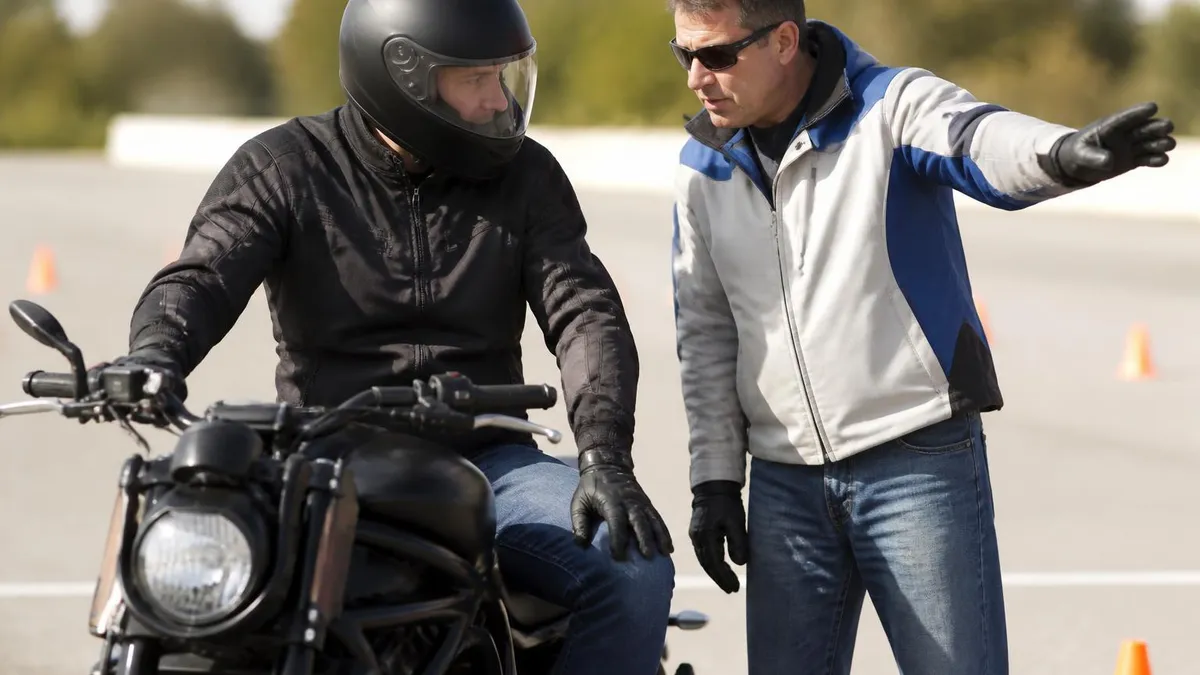
Motorcycle Safety Foundation Course: Complete 2026 Training Guide
About the Author

Business Consultant & Professional Certification Advisor
Wharton School, University of PennsylvaniaKatherine Lee earned her MBA from the Wharton School at the University of Pennsylvania and holds CPA, PHR, and PMP certifications. With a background spanning corporate finance, human resources, and project management, she has coached professionals preparing for CPA, CMA, PHR/SPHR, PMP, and financial services licensing exams.