
Cheap MSF Course Near Me: 2026 October Guide to Affordable Motorcycle Safety Training
✅ Find a cheap MSF course near me with our 2026 October guide. Compare prices, locations, msf practice test prep, and pass the written test on the first try.
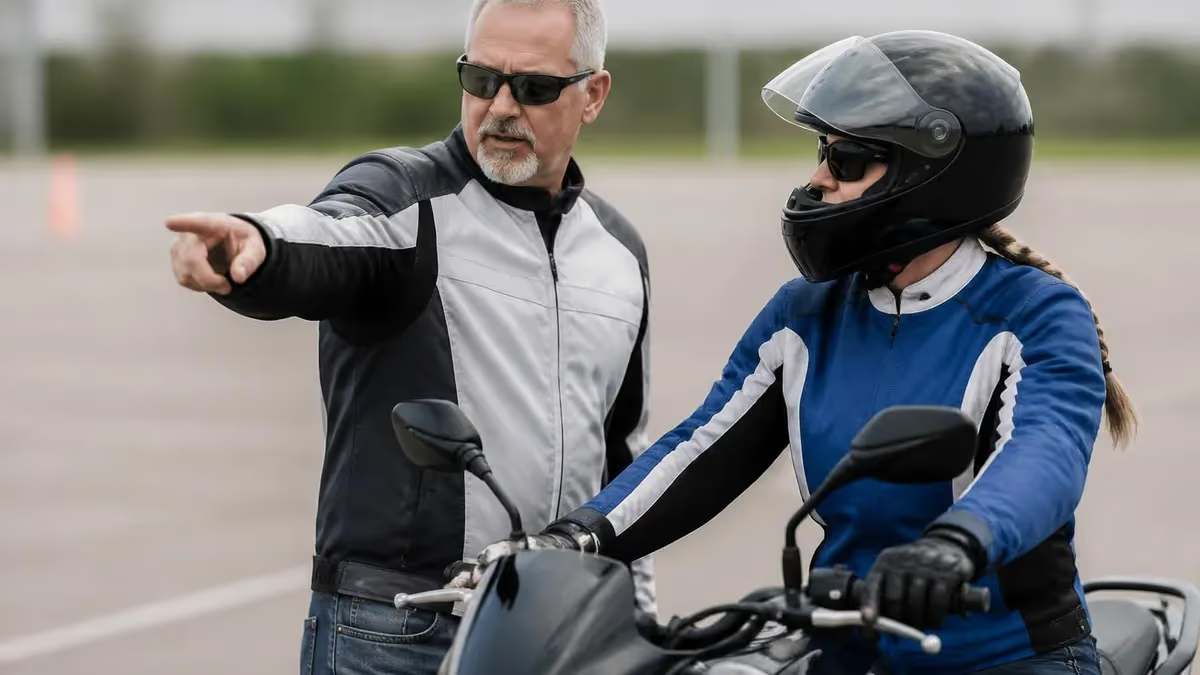
Searching for a cheap msf course near me is the single smartest first move any new rider can make in 2026, and it pays dividends long after the parking-lot cones come down. The Motorcycle Safety Foundation Basic RiderCourse remains the gold standard for licensing waivers across more than 45 states, and finding an affordable training site in your zip code can save you hundreds of dollars while still delivering nationally recognized instruction. Before you sign up, take a free msf practice test to gauge how much classroom prep you need.
Most beginners assume MSF training is one-size-fits-all, but pricing varies wildly between $0 community college subsidies and $400 private range fees. A Pennsylvania resident pays nothing thanks to PennDOT funding, while a Floridian shopping for the same Basic RiderCourse may pay $325 at a private school. Knowing how these subsidies, rebates, and military discounts work is the first step to keeping money in your pocket without sacrificing instructor quality, range size, or motorcycle availability.
This guide walks you through finding the cheapest legitimate MSF course in your area, decoding what each tier of price actually buys you, and preparing for the written test using free resources. We will compare community college programs, dealership-sponsored classes, military bases that open courses to civilians, and state-funded rider education programs. Each option meets the same MSF curriculum standards, but the experience and total cost can differ by an order of magnitude.
You will also learn what to bring on training day, how to pass the skills evaluation on your first attempt, and how the written exam ties into the hands-on portion. The msf test combines classroom theory and range performance, and the cheapest courses sometimes compress this into a single weekend rather than three weekday evenings plus a Saturday. Understanding the format matters because tired riders fail more skills checks than under-prepared ones.
If you are riding on a tight budget, do not skip the helmet, gloves, boots, or jacket required by every MSF site, because showing up under-equipped means being sent home with no refund. We will cover affordable gear bundles in the $200 range that pass any range gate inspection. We will also discuss how to use your MSF completion card to negotiate insurance discounts of 10 to 15 percent on most major carriers, which often recoups the entire cost of the class within twelve months.
Finally, this article addresses the rumors floating around forums that some states are phasing out the MSF Basic RiderCourse in favor of state-specific curricula. While a handful of states use MotoMark1 or Total Control alternatives, MSF still dominates the market in 2026 and remains the most universally recognized completion credential for licensing offices, insurers, and out-of-state transfers. Read on to find the best deal in your area and walk into class fully prepared.
Whether you are a teenager getting your first endorsement, a returning rider after a decade off two wheels, or a spouse joining a touring partner for the first time, the path to a license starts with the same step: locate the nearest MSF-certified RiderCoach, secure a seat, and study the manual cover to cover. The next 18 sections give you everything needed to do exactly that, on a budget, in 2026.
Cheap MSF Course Near Me by the Numbers

MSF Course Format & Cost Tiers Explained
Pennsylvania, New York, Idaho, and Maryland fund the Basic RiderCourse through motorcycle registration fees, making the class completely free to residents who hold a valid permit and meet age requirements.
Tuition typically ranges from $50 to $175. These programs run on weekend schedules and often include free motorcycle and helmet use, making them the best value for budget-conscious students.
Independent RiderCoach businesses charge $200 to $400 for the same curriculum. They offer more schedule flexibility, smaller class sizes, and often newer training motorcycles than public programs.
Harley-Davidson Riding Academy, Honda Rider Education, and BMW Performance Center run branded MSF courses for $250 to $450, with discounts if you purchase a motorcycle within 90 days.
Active-duty service members ride free at on-base courses, and many bases open seats to dependents and veterans at deeply discounted rates of $50 to $100 per student.
Finding a cheap msf course near me starts with checking your state motorcycle safety program website before any commercial search engine, because state-run portals list every approved training site with current pricing and seat availability. The official msf written test curriculum is identical across every site, but the rates are not, so a 20-mile drive to a neighboring county can sometimes cut your tuition by 70 percent without changing the certification you receive at the end.
Pennsylvania residents pay nothing because the state covers tuition through a portion of the motorcycle registration fee, and similar programs exist in Idaho, Maryland, New York, and Oregon. If you live near a state line, it is worth investigating whether you qualify for the cheaper neighboring program. Some states require proof of residency, while others simply require a valid permit and accept out-of-state students at the same subsidized rate as locals, especially when seats would otherwise go empty.
Community colleges are the next-best value, often charging $75 to $150 for the same 15-hour curriculum. Look for continuing education or workforce development catalogs rather than degree programs, because MSF courses are usually listed under non-credit lifelong learning. Schools like Lone Star College in Texas, Wake Tech in North Carolina, and Mt. San Antonio College in California consistently offer the lowest non-subsidized rates in their regions, with brand-new Honda Grom or Yamaha TW200 training bikes.
Dealership academies look expensive on paper but often refund your tuition with the purchase of a new motorcycle within 60 to 90 days of completion. Harley-Davidson Riding Academy, for example, lists at $350 but credits the full amount toward any Sportster or Softail purchase. If you were going to buy a bike anyway, this turns paid training into free training with a built-in discount on the bike itself, plus a complimentary first-year service plan in many cases.
Military service members and their families have the absolute cheapest options. The Department of Defense funds Basic RiderCourses on nearly every major base, and most installations open extra seats to retirees, civilian employees, and dependents at no charge or for a nominal $25 administrative fee. Check the base safety office calendar directly; these courses fill weeks in advance during spring and summer riding season, so book early or join the waitlist for cancellation seats that open up the week before.
For students in rural areas where the nearest MSF site is over an hour away, consider a weekend road trip combined with a hotel stay. Many private schools offer Friday-evening-through-Sunday compressed schedules designed for out-of-town students, and the total cost including a budget hotel still often beats local private rates. Group bookings with three or more students typically unlock another 10 to 20 percent discount, so coordinate with friends or your motorcycle club for shared savings on tuition and lodging.
Finally, do not forget to apply for rebates after you complete the course. Several insurance companies, including Progressive, GEICO, Allstate, and Foremost, offer immediate $100 to $250 rebates when you submit your MSF completion card. Combined with the standard policy discount, these rebates frequently cover 50 percent or more of what you paid for tuition, effectively cutting your real out-of-pocket cost in half.

MSF Practice Test Questions
Prepare for the MSF - Motorcycle Safety Foundation exam with our free practice test modules. Each quiz covers key topics to help you pass on your first try.
MSF Operator Manual
Free MSF Practice Test featuring Operator Manual. Improve your MSF Exam score with mock test prep.
MSF - Motorcycle Safety Foundation Basic R...
MSF Test Prep for - Motorcycle Safety Foundation Basic Riding Skills. Practice MSF Quiz questions and boost your score.
MSF - Motorcycle Safety Foundation Braking...
MSF Questions and Answers on - Motorcycle Safety Foundation Braking and Stopping. Free MSF practice for exam readiness.
MSF - Motorcycle Safety Foundation Corneri...
MSF Mock Test covering - Motorcycle Safety Foundation Cornering and Turning. Online MSF Test practice with instant feedback.
MSF - Motorcycle Safety Foundation Emergen...
Free MSF Quiz on - Motorcycle Safety Foundation Emergency Maneuvers. MSF Exam prep questions with detailed explanations.
MSF - Motorcycle Safety Foundation Impairm...
MSF Practice Questions for - Motorcycle Safety Foundation Impairments and Protective Gear. Build confidence for your MSF certification exam.
MSF - Motorcycle Safety Foundation Managin...
MSF Test Online for - Motorcycle Safety Foundation Managing Riding Risk. Free practice with instant results and feedback.
MSF - Motorcycle Safety Foundation Motorcy...
MSF Study Material on - Motorcycle Safety Foundation Motorcycle Controls and Operation. Prepare effectively with real exam-style questions.
MSF Course Test Preparation Strategies
The msf course test covers SEE strategy (Search, Evaluate, Execute), proper following distance, braking dynamics, and curve negotiation. Roughly 25 of the 50 questions on the written portion focus on these core safety concepts, so prioritize them in your study time. Use the official Basic RiderCourse handbook supplied at registration, and supplement with a free msf course practice test that mirrors the actual question style and difficulty level you will face.
Spend at least three evenings reading the handbook cover to cover before class day one. The instructor moves quickly through chapters because most students assume the written test is easy, but national first-attempt failure rates hover near 8 percent specifically because riders skip the reading. The msf motorcycle written test rewards careful study and punishes overconfidence, so treat it like any other standardized exam with concentrated preparation.
Cheap MSF Course vs. Premium Private Training
- +Identical MSF curriculum and completion card regardless of price tier
- +Most state DMVs waive the road test for any approved MSF graduate
- +Insurance discount applies equally to all MSF Basic RiderCourse graduates
- +Free or subsidized programs often have newer training motorcycles than expected
- +Larger class sizes mean more peer learning and shared problem-solving opportunities
- +Weekend-compressed schedules at budget sites work for students with weekday jobs
- +Community college programs typically include free helmet and gear loans
- −Free programs can have 6-to-12-week waitlists during peak riding season
- −Limited makeup options if you miss a session due to illness or weather
- −Larger class sizes mean less one-on-one instructor attention during range exercises
- −Older training motorcycles at some budget sites may have quirky clutches or controls
- −Compressed weekend schedules can be physically exhausting for older students
- −Free seats often go to in-state residents first with proof-of-residency requirements

Cheap MSF Course Near Me Registration Checklist
- ✓Verify your state motorcycle learner permit is current and not expired
- ✓Check your local DMV website for the official approved MSF training site list
- ✓Compare prices across community colleges, private schools, and military bases
- ✓Confirm the course awards a skills test waiver in your specific state of residence
- ✓Reserve a seat at least four to six weeks ahead during spring and summer riding season
- ✓Read the entire MSF Basic RiderCourse handbook before classroom day one arrives
- ✓Take at least three free practice tests online to gauge your readiness for the written exam
- ✓Gather DOT-approved helmet, full-finger gloves, ankle boots, long pants, and a jacket
- ✓Confirm whether the school provides a training motorcycle or you must supply one
- ✓Bring two forms of identification, your permit, and the registration confirmation email
Stack rebates for the lowest possible out-of-pocket cost
Combine state subsidies, insurance rebates, and dealership credits to get net-zero or even net-positive on your MSF training. A Pennsylvania rider who takes the free state course, claims a $200 Progressive rebate, and buys a Harley with the Riding Academy credit can actually profit from completing the program.
The range portion is where your investment truly pays off, because the skills you build on those plastic cones translate directly to safer street riding for decades to come. Most cheap MSF courses use the exact same Honda Grom 125, Yamaha TW200, or Suzuki TU250X training motorcycles found at premium schools, because the MSF curriculum requires bikes under 500cc to keep low-speed exercises safe for beginners. The bike you train on does not affect what you can ride after graduation.
Day one of the range introduces you to the friction zone, clutch control, and slow walking pace exercises. Many adults are shocked at how much core strength low-speed riding requires, because keeping a 300-pound motorcycle upright at three miles per hour is harder than cruising at 30 miles per hour. The msf basic rider course test answers always emphasize smoothness over speed, so practice riding as slowly as possible without putting a foot down to build the balance you need.
Day two introduces shifting, swerving, and emergency braking. Most students dread the quick stop because instructors yell BRAKE without warning, but the exercise is designed to build automatic responses you will use in real traffic. The technique is squeeze the front lever progressively while pressing the rear pedal steadily, and never grab the front brake suddenly because that locks the wheel and causes a wash-out crash even at low speeds in the controlled environment.
Day three is evaluation day for most weekend formats, and nerves are the biggest obstacle. By this point you have completed roughly 10 hours of riding, and your muscle memory is far more developed than you think. Trust your training, look up and forward through every turn, and remember that the four scored exercises are designed so any student who completed the practice runs can pass. Failing happens to riders who second-guess themselves or skip steps in the procedure briefing.
If you do struggle with a specific exercise, the RiderCoach will offer extra practice runs between scored attempts. Take every offer because there is no penalty for asking, only for failing the actual scored attempt. The coaching staff at cheap MSF courses are no less qualified than at premium schools; the certification process is national and identical, and many state-funded instructors have decades more experience than dealership employees on rotation through teaching duty.
Bring layered clothing for range day because weather changes during the four-hour session, and you cannot leave the range to grab a different jacket. A breathable mesh jacket over a thermal base layer works for most three-season conditions, and disposable rain ponchos in your bag handle surprise showers. Many cheap courses run rain-or-shine because rescheduling 20 students is logistically impossible, so come prepared for whatever the forecast suggests for your specific evaluation day.
Once you pass the range evaluation and the written test, you receive the MSF completion card on the spot. Photograph both sides immediately and store the image in cloud backup, because losing the physical card means a $25 to $50 replacement fee from MSF headquarters and a two-to-three-week wait. The card is valid for license waiver purposes for one full year in most states, so plan your DMV visit accordingly to maximize the value.
Some discount schools advertise motorcycle training that is NOT officially MSF-certified. These courses may not award a state license waiver, leaving you stuck taking the DMV road test anyway. Always verify the course is listed on your state's official approved provider page before paying any tuition, and confirm the completion card carries the MSF logo.
After passing your MSF course, the next 30 days are critical for converting your completion card into real-world riding privileges and insurance savings. Visit your DMV within two weeks while the material is fresh, because some test administrators ask conversational questions about what you learned even when waiving the formal road test. Bring your completion card, current permit, proof of insurance for the motorcycle you intend to register, and payment for the endorsement fee, which ranges from $5 to $50 depending on state. Reviewing a quick msf course written test refresher the night before never hurts.
Insurance companies treat the MSF completion card as proof of trained-rider status, and most carriers apply the discount immediately upon presentation. Progressive, Dairyland, and Foremost specialize in motorcycle insurance and offer the steepest discounts, often 12 to 15 percent off the base premium for the first three years. Standard auto insurance bundlers like GEICO and State Farm provide 5 to 10 percent off but require you to email or fax the card to their underwriting department before the discount applies to your policy.
If you are under 25, the MSF discount stacks on top of any good-student or driver-improvement discounts already on your policy, sometimes cutting premiums in half. For young riders shopping for their first sport bike, this stacking effect is significant because base premiums on a Yamaha YZF-R3 or Kawasaki Ninja 400 for a 19-year-old can exceed $1,800 annually before discounts. The MSF card alone can save $250 to $350 per year, paying back the course fee in under twelve months even at full retail rates.
Some states require an additional state-specific motorcycle safety course for riders under 18, even with the MSF card in hand. Texas, California, and New York have unique provisions for minors that may require parental sign-off, additional supervised riding hours, or a graduated licensing scheme that limits passenger and nighttime riding privileges for the first six months. Check with your state DMV before assuming the MSF card alone fully unlocks your endorsement, because rules vary significantly by state and change frequently.
For older riders returning to motorcycling after a long absence, consider following up the Basic RiderCourse with the MSF Intermediate or Advanced RiderCourse within six months. These follow-up programs are typically $100 to $200 and focus on real-world traffic skills, group riding, and emergency maneuvers at higher speeds. They are not required for licensing but dramatically improve survival skills for riders transitioning from a 250cc training bike to a 600cc or 1000cc personal motorcycle on busy public roads.
Document your training timeline carefully for insurance purposes and for any future motorcycle club memberships that may request proof of formal instruction. The Iron Butt Association, AMA Roadside Assistance, and some manufacturer-sponsored owners groups offer perks tied to formal training credentials. Keep your card, your range evaluation score sheet, and any classroom certificate in a fireproof safe alongside your title and registration paperwork for easy access throughout your riding career.
Finally, give back to the community by mentoring new riders once you have your first season under your belt. Many cheap MSF programs survive on volunteer support from past graduates who help with range setup, registration paperwork, and student parking on class days. Volunteering also unlocks heavily discounted Advanced RiderCourse seats in subsequent years, creating a long-term value loop that rewards engagement with the local motorcycle safety community for years to come.
Practical preparation in the final two weeks before your class day separates students who pass on the first attempt from those who repeat the program. Start by physically driving to the training site at the same time of day you will arrive on class morning, because finding the range entrance, parking lot, and check-in trailer at 7 AM in unfamiliar territory adds unnecessary stress to an already nerve-racking day. Most MSF sites are tucked behind community colleges or industrial parks with poor signage.
Review the MSF Rider Handbook in 30-minute focused sessions rather than marathon reading attempts, because retention drops sharply after the first hour. Use the chapter-end review questions as self-quizzes and flag any concept you miss for re-reading. The msf motorcycle test heavily emphasizes risk-offset strategy, lane positioning, and the SIPDE or SEE acronyms, so commit those frameworks to memory using flashcards or audio recordings you can play during your daily commute.
Build basic motorcycle-handling muscle memory before class using a bicycle. Practice slow-speed weaves in an empty parking lot, head-and-eyes turns where you look through curves before initiating them, and emergency braking with your front-heavy bicycle brake. These bicycle exercises translate surprisingly well to motorcycle range work because the underlying balance, scanning, and body-position principles are identical regardless of vehicle size, weight, or engine displacement.
Hydrate aggressively in the 48 hours leading up to range day, and avoid alcohol entirely the night before because impaired judgment carries over into the morning. Eat a protein-rich breakfast with complex carbohydrates two hours before arrival, and pack a midday snack like trail mix or a banana for the lunch break between exercises. Low blood sugar is a leading cause of poor performance on the afternoon scored evaluations, and most students do not realize how much energy concentration burns over a four-hour range session.
Bring sunscreen, sunglasses with retention straps, and a wide-brimmed hat for breaks between range exercises. Summer training sessions in Arizona, Texas, and Florida regularly hit 100 degrees on the asphalt, and the reflective heat off the parking lot surface is brutal even on otherwise mild days. Many cheap MSF programs run in unshaded lots because that is what is available, so prepare for direct sun exposure throughout the entire range portion of your training experience.
If you wear glasses, ensure they fit comfortably under your helmet without slipping down your nose during head checks. Prescription motorcycle goggles or insert lenses for full-face helmets are worth the investment if you ride regularly, but for the course itself, a simple anti-fog wipe on your existing lenses and a snug nose-bridge fit usually suffice. Contact lens wearers should bring backup glasses in case wind irritation forces an early lens removal during higher-speed second-day exercises.
Finally, treat the MSF course as the beginning of your education, not the end. Two days of training and 15 hours of total instruction can teach the fundamentals, but real expertise comes from thousands of miles of street riding, ongoing skill refreshers, and continued reading. Order a copy of David Hough's Proficient Motorcycling and Lee Parks' Total Control to read after passing the course, and budget for an Advanced RiderCourse within your first 5,000 miles of solo riding.
MSF Questions and Answers

About the Author

Business Consultant & Professional Certification Advisor
Wharton School, University of PennsylvaniaKatherine Lee earned her MBA from the Wharton School at the University of Pennsylvania and holds CPA, PHR, and PMP certifications. With a background spanning corporate finance, human resources, and project management, she has coached professionals preparing for CPA, CMA, PHR/SPHR, PMP, and financial services licensing exams.