
Motorcycle Safety Foundation Course: Complete 2026 October Training Guide
Motorcycle Safety Foundation course breakdown for 2026 October: cost, hours, pass rates, what you ride, and how the BRC waiver works in your state. ❓
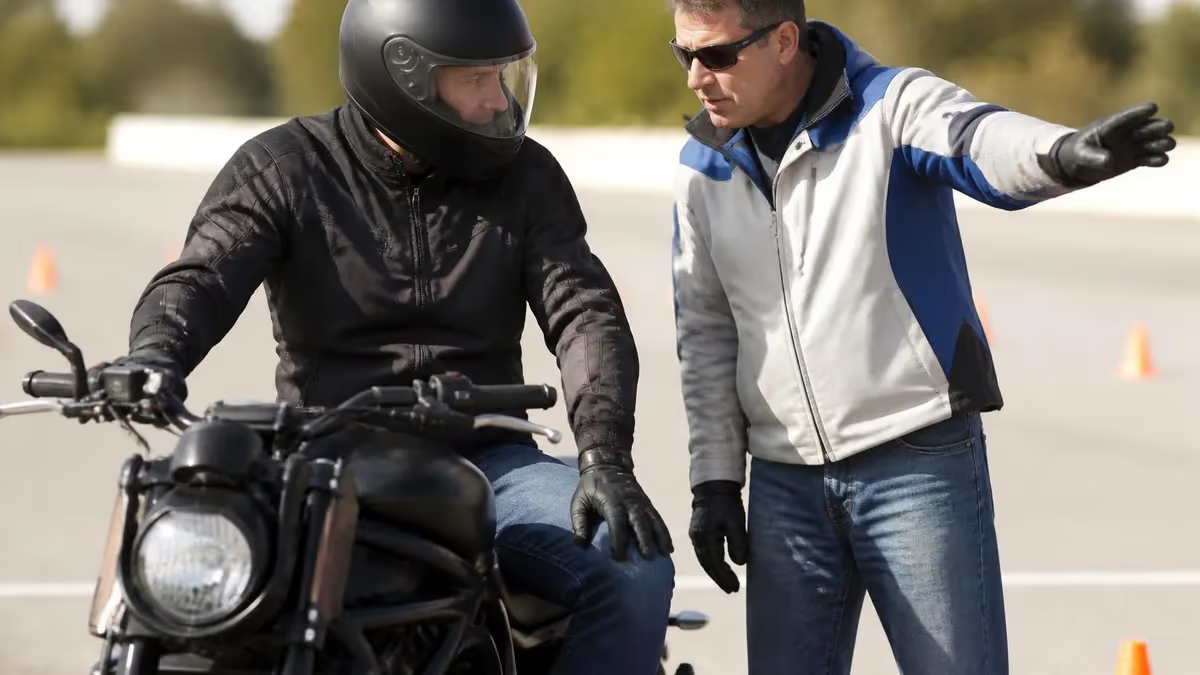
You signed up for a Motorcycle Safety Foundation course because somebody, somewhere, told you it was the smart way to start riding. They were right, but they probably didn't tell you what actually happens once you show up. A weekend of classroom slides? Not quite. You'll be on a bike by the end of day one, dragging your boots in a parking lot, trying to remember which lever is the clutch.
The MSF Basic RiderCourse, or BRC, is the most common entry point. It runs roughly 15 to 20 hours split across classroom theory and live range practice. You don't need a motorcycle. You don't even need a permit in most states. The school provides everything: bike, helmet (sometimes), insurance, and a coach who has watched thousands of nervous adults figure out how to make a 400-pound machine move in a straight line.
This guide walks through what the course covers, what it costs, how long it takes, and what happens with your driver's license at the end. We'll cover the eRiderCoach option, the 3-Wheel BRC for trike and Spyder folks, and the Advanced RiderCourse for people who already have a few thousand miles. If you're prepping for the written portion, the MSF practice test hub is the fastest way to drill the questions that show up on the knowledge check.
MSF Course at a Glance

Those numbers shift a little depending on where you live. California sites tend to run cheaper because the state subsidizes the program through CHP. Texas, Florida, and the Northeast usually charge full sticker price. Some employers, military bases, and even dealerships reimburse the cost when you buy a bike within a certain window, so ask before you swipe your card.
What the BRC Actually Covers
The BRC is built around a curriculum the Motorcycle Safety Foundation has refined since the 1970s. It's not a hobby class. It's a defensive riding system that draws from crash data, the Hurt Report, and decades of coach feedback. Every drill has a reason behind it, even the slow weaves that feel pointless on day one.
Classroom vs Range Split
The classroom portion runs roughly 5 hours and covers risk awareness, the SEE strategy (Search, Evaluate, Execute), protective gear, and group riding. The range portion runs 10-12 hours across two days and covers every motor skill from clutch control to emergency swerves. The knowledge test is multiple choice, 50 questions, 80% passing.
The Five Core Range Modules
Controls, friction zone, walking the bike, first launches in first gear with no shifting.
Power walks, fully seated rides, smooth throttle, basic braking using both front and rear.
Slow turns, gear shifting, swerves, and the bread-and-butter quick stop from 15-20 mph.
Slow-look-press-roll cornering technique, U-turns inside a 24-foot box, and obstacle scanning.
Four-part graded test: cone weave, U-turn, swerve, and quick stop. Pass all four to earn the card.
The skill evaluation is where most failures happen, but the failure rate is still under 15 percent at most ranges. Coaches grade on points lost rather than pass-fail per exercise, so you can flub the U-turn and still pass if everything else is clean. The most common point losses are dabbing a foot during the cone weave, running wide on the U-turn, and applying both brakes unevenly during the quick stop.
Pricing varies more than people expect. A bare-bones state-subsidized course in California can run $260 for new riders. The same curriculum at a private RiderCoach site in New Jersey might cost $375. Military members ride free at most installations through the DoD Motorcycle Safety Program, and active-duty personnel are required to take it before riding on base.
Scheduling is the bigger headache. Spring and early summer slots fill up months in advance, especially in the Midwest and Northeast where the riding season is short. If you're determined to ride by May, book in February. The fall sees better availability and often cooler weather, which is genuinely easier for new riders sweating inside a full helmet.
MSF Course Options Compared
The classic entry-level course. 15-20 hours, classroom plus range, bikes provided. Designed for riders with zero experience. Ends with a knowledge test and skill evaluation. Completion card waives the DMV road test in most states.

Most BRC sites supply 250cc to 500cc beginner-friendly bikes (Honda Rebel 300, Yamaha V-Star 250, Kawasaki Eliminator). If you already own a small standard or cruiser, ask about the BRC2 instead. You'll save a few hours and get fitted to the machine you'll actually ride home on.
One thing nobody warns you about: the bikes the school provides are tired. They've been dropped, fixed, dropped again, and ridden by hundreds of students. Clutches are vague, brakes are mushy, and turn signals sometimes don't work. Don't blame yourself if the bike feels weird. It is weird. Your own motorcycle will feel like a Cadillac after the BRC.
What to Wear and Bring
Gear requirements are non-negotiable. Show up missing one item and you'll be sent home, refund or no refund. The MSF gear policy aligns with the All The Gear, All The Time philosophy, even though most coaches will admit they don't wear armored pants to the grocery store.
Required MSF Course Gear
- ✓DOT-approved helmet (provided by some schools, but check first)
- ✓Eye protection: face shield, goggles, or shatter-resistant glasses
- ✓Long-sleeved shirt or jacket, no tank tops or short sleeves
- ✓Long, sturdy pants (denim minimum, no leggings or athletic shorts)
- ✓Over-the-ankle boots (no canvas sneakers, no sandals, no heels)
- ✓Full-fingered gloves (leather preferred, no fingerless or gardening gloves)
- ✓Water bottle and sunscreen for outdoor range days
- ✓Rain gear if there's any chance of weather; courses run rain or shine
The boot rule trips people up. Hiking boots work. Steel-toed work boots work. Cowboy boots technically work but the heel can catch on the foot peg. Skate shoes, Vans, Converse, and any low-top sneaker will get you turned away. Buy a cheap pair of motorcycle boots online for around $80 if you don't own real boots. You'll use them every day you ride.
The Knowledge Test
The written portion is short and the pass rate is high, but it still catches people who skipped the workbook. Questions cover the SEE strategy, lane positioning, the T-CLOCS pre-ride inspection, gear selection, and crash statistics. The wording is plain English, not legal code, and there's no trick math.
Topics that show up most often: when to use which brake, lane position numbers (1, 2, 3), what affects stopping distance, why countersteering works at speed, and the role of alcohol in fatal crashes. The SEE strategy practice questions and the T-CLOCS inspection drill cover the two highest-frequency topics on the test.
Spend 30 minutes on the practice test the night before and you'll likely score in the 90s. Spend zero minutes and you might still pass, but the 80 percent threshold leaves less margin than people assume. Two wrong on a short test is fine. Six wrong on a 25-question section is a fail.
The Riding Skill Evaluation
This is the part everyone fixates on. The four scored exercises are simple in description and tricky in execution. They're the same four exercises the DMV would test you on if you skipped the course, which is exactly why the completion card serves as a waiver.
The Four Graded Exercises
Weave through five offset cones, then come to a controlled stop in a marked box. Dabbing a foot or knocking a cone costs points.
Make a complete U-turn inside a painted rectangle without crossing lines or putting a foot down. The hardest single exercise for most students.
Accelerate to 15 mph, then perform a maximum-effort stop using both brakes when the coach signals. Locking a tire or skidding loses points.
Approach a cone at 18-20 mph, swerve left or right at the last moment based on the coach's pointed direction, then return to the original line.

You're allowed to lose up to 21 points across the four exercises and still pass. Drop a bike, leave the course, or stall more than twice and you fail outright. Coaches will often give you a retry on one exercise if your day was otherwise solid, but that's at their discretion and not a guarantee. The basic riding skills review walks through each maneuver in detail.
After You Pass: License Waiver and Endorsement
The completion card is your golden ticket. In 47 states, presenting it at the DMV within 12 months of completion lets you skip the road skills test entirely. You still pay license fees and may need to take a vision check or written test, depending on your state, but the on-bike portion is waived.
Is the MSF Course Worth It?
- +Bikes and (usually) helmets provided, so no investment before you know if you'll like riding
- +Coaches catch bad habits before they become muscle memory
- +Completion card waives DMV road test in 47 states
- +Insurance discounts of 10-15% with most major carriers
- +Structured environment is safer than parking-lot self-teaching
- +Networking with other new riders and finding local riding partners
- −Two-day weekend commitment, often booked months in advance
- −$200-$375 cost when self-teaching is technically free
- −School bikes are worn and feel nothing like a modern motorcycle
- −Pass rate is high but failure means losing the entire course fee
- −Some advanced riders find the BRC pace painfully slow
- −Gear requirements force gear purchases for people who haven't committed to riding yet
Pros and Cons at a Glance
| Pros | Cons |
|---|---|
| Bikes and (usually) helmets provided, so no investment before you know if you'll like riding | Two-day weekend commitment, often booked months in advance |
| Coaches catch bad habits before they become muscle memory | School bikes are worn and feel nothing like a modern motorcycle |
| Structured environment is safer than parking-lot self-teaching | Pass rate is high but failure means losing the entire course fee |
| Networking with other new riders and finding local riding partners | Some advanced riders find the BRC pace painfully slow |
The three states that don't accept the waiver outright (Vermont, North Dakota, and a handful of partial states) still treat completion as a strong endorsement when you do take the DMV test. Some insurance carriers also knock 10-15 percent off your premium for the first three years after completion. Geico, Progressive, and State Farm all offer the discount; you upload a copy of the card through their app.
For most new riders, the answer is yes. The waiver alone usually saves more time than the course takes, and the insurance discount can pay back the tuition within 18 months. The only people who reasonably skip it are returning riders with years of experience who just need to renew an endorsement, and even they often benefit from the BRC2 refresher.
Common Reasons People Fail
The failure rate is low, but it's not zero. The same handful of mistakes account for almost every failed evaluation. Knowing them ahead of time is half the battle.
1) Dropping the bike during the U-turn (instant fail at most ranges). 2) Failing to use both brakes during the quick stop. 3) Knocking down more than two cones in the weave. 4) Skidding the rear tire repeatedly under hard braking. 5) Scoring below 80 percent on the knowledge test after passing the range.
Two of those five are preventable with practice on a bicycle, of all things. A bicycle in a parking lot teaches the same balance and counter-steering principles a motorcycle does, just at lower stakes. If you haven't ridden a bike since middle school, get one out a week before the course and just ride it around. Your body will remember what your brain forgot.
Stalling is also a non-issue if you understand the friction zone. The friction zone is the half-inch of clutch lever travel where the engine begins to engage the rear wheel but isn't fully locked. New riders treat the clutch like a light switch and the bike either rockets forward or stalls. Coaches will drill the friction zone in module 1, and the slower you let the clutch out, the more obedient the bike behaves.
Online: The eRiderCoach Option
The MSF now offers an eCourse that replaces the classroom portion. You complete the theory online at your own pace, then show up at the range for just the on-bike days. Total seat time drops from two full weekends to one. Cost is roughly the same, sometimes $30 cheaper, and the knowledge test moves online too.
The eCourse works well for self-starters who absorb material faster from text than from a slideshow in a folding chair. It's less effective for people who learn from group discussion or who have questions about specific scenarios. Coaches still recommend the in-person classroom for riders under 21 or anyone who hasn't been in a structured learning environment in a while.
Failing isn't the end. Most schools let you retake the failed portion (range or knowledge) for a reduced fee, usually $50-$100, within 30 days. A few schools require a full re-enroll at full price. Read the cancellation and retake policy before you sign the waiver on day one.
If you fail the range twice, coaches typically recommend taking the BRC again from scratch rather than continuing to retest. The skill gaps that caused two failures usually need more saddle time, not another test attempt. Some students take the course three or four times before they get the card. There's no shame in it. The card is worth more than the ego hit.
State-Specific Notes
Each state administers the MSF program through a slightly different agency. California uses the CHP. Texas uses TxDPS. Florida runs it through the Department of Highway Safety. The curriculum is the same, but pricing, scheduling, and the exact list of approved waiver sites varies. Check your state's motorcycle safety program page before booking through a third party.
Some states (Oregon, Idaho) require the course for anyone under 21 seeking an endorsement, no waiver option. Others (Pennsylvania, Maryland) make it optional but heavily incentivized through fee reductions and insurance partnerships. Read your state's specific rules in the MSF state requirements hub before you assume.
Pennsylvania runs its program through PennDOT but contracts the actual training to community colleges and Harley-Davidson dealerships. The curriculum is identical, but range conditions differ wildly. A community college range might be a giant empty parking lot with fresh paint. A dealership range might be a back lot squeezed between a service bay and a fence. Look up reviews of the specific site, not just the program.
The same advice applies to anyone living in a major metro with multiple sites to choose from. A 20-minute longer drive to a better-rated range is worth it. Look for reviews that mention range surface condition, coach attitude, and whether the school takes student feedback seriously after a rough day. The good sites have a reputation in local riding clubs.
Building Confidence Between Drills
The breaks between drills are where confidence quietly gets built. You'll spend ten minutes riding around in a giant slow circle, working on the friction zone, while coaches watch from the edge. It feels boring. It is boring. But the muscle memory you build during those slow circles is what saves you when traffic does something unexpected on your second week of real-world riding.
Don't compare yourself to the other students. There's always one person who picks it up instantly and one person who never quite gets it. Coaches won't tell you which one you are; they just keep coaching. The skill evaluation on day two doesn't grade you relative to the class, it grades you against a fixed standard. Pass the standard and you pass the course.
Returning Riders and the BRC2
The BRC2 is the silent overachiever of the MSF lineup. It's designed for riders who already own a bike but either let their license lapse, never got an endorsement, or want a license waiver after years of off-road or unlicensed riding. The course runs one day, around six hours on the range, and you bring your own motorcycle.
Most BRC2 students are 30-50 years old, returning to riding after a decade away, or upgrading from a scooter to a real motorcycle. The coaches are the same RiderCoaches who run the BRC, and they're often happier teaching the BRC2 because students are more engaged and the pace is faster. If you've ridden before, even just dirt bikes as a kid, the BRC2 is the more efficient path. The cornering and turning question set covers a lot of what the BRC2 emphasizes.
What Happens on Day One
- ✓Show up 15-30 minutes early — late arrivals can be turned away
- ✓Bring driver's license, course registration confirmation, and payment receipt
- ✓Sign liability waivers and assumption-of-risk forms
- ✓Get assigned a bike based on height and inseam measurement
- ✓Walk-around safety briefing covering controls and shifter pattern
- ✓First range exercise: power walks and engine starts under coach supervision
The first exercise is the silliest looking one. You sit on the bike, engine off, and walk it forward using your feet, just to get used to the weight. Then the engine starts and you do power walks: clutch out enough to creep forward at walking speed while you steady the bike with your feet. It looks ridiculous and feels ridiculous. It also teaches you the friction zone faster than any other method.
By the end of hour one you're rolling along in first gear at maybe 10 mph, feet on the pegs, doing huge slow circles. You won't shift to second gear until the afternoon. You won't touch a brake at speed until day two morning. The progression is deliberately slow because rushing it produces bad habits that cost points on the evaluation.
Day two starts where day one ended, but with brake work added in. Quick stops, swerves, and cornering drills fill the morning. Lunch is on your own, usually a 30-minute break. The afternoon is the skill evaluation. Coaches run each student through the four scored exercises one at a time while the rest of the class watches. The wait between your turns gives you time to mentally rehearse, which actually helps more than people expect.
Sample MSF - Motorcycle Safety Foundation Practice Questions
Try these questions from our free MSF - Motorcycle Safety Foundation practice tests. The correct answer and an explanation follow each question.
In MSF training, what does the phrase 'slow, look, press, roll' refer to?
- A. The steps for an emergency stop on a straight road
- B. A four-step cornering process: reduce speed, look through turn, press handlebar, roll on throttle
- C. The procedure for a U-turn in a parking lot only
- D. A fuel-saving technique for highway riding
Answer: B. A four-step cornering process: reduce speed, look through turn, press handlebar, roll on throttle
MSF's 'slow, look, press, roll' is the foundational cornering sequence: manage speed before the turn, aim your eyes through it, countersteer to lean, and smoothly apply throttle.
The best course of action to stop your motorcycle if it begins to wobble is to
- A. put the front brake on.
- B. quicken to escape the sway.
- C. engage the back brake.
- D. gradually cut off the throttle.
Answer: D. gradually cut off the throttle.
The best approach to halt a wobbling motorcycle is to gently close the throttle. It may get worse if you try to speed out of the wobble or apply the brakes.
The term 'risk offset' in MSF training refers to:
- A. Adding speed to move through a hazard zone faster
- B. Compensating for one risk by reducing another, such as slowing down in poor visibility
- C. Offsetting your lane position to the left at all times
- D. Canceling a ride when any single hazard is present
Answer: B. Compensating for one risk by reducing another, such as slowing down in poor visibility
Risk offset means managing total risk by reducing controllable factors — like speed — when uncontrollable factors — like weather — increase danger.
If a rider feels drowsy during a long trip, what is the MSF's recommended course of action?
- A. Increase speed to stay stimulated and alert
- B. Drink an energy drink and continue riding
- C. Pull off the road safely and rest before continuing
- D. Open the visor for fresh air and maintain current speed
Answer: C. Pull off the road safely and rest before continuing
The only safe response to drowsiness while riding is to stop, rest, and recover — no stimulant or technique substitutes for genuine sleep.
Take the full MSF - Motorcycle Safety Foundation practice test
MSF Questions and Answers
About the Author

Business Consultant & Professional Certification Advisor
Wharton School, University of PennsylvaniaKatherine Lee earned her MBA from the Wharton School at the University of Pennsylvania and holds CPA, PHR, and PMP certifications. With a background spanning corporate finance, human resources, and project management, she has coached professionals preparing for CPA, CMA, PHR/SPHR, PMP, and financial services licensing exams.