
Motorcycle Safety Foundation Login: MSF Course Cost, Practice Test & Written Test Guide
Access the MSF login portal, learn MSF course cost, and prep with MSF practice test questions. ✅ Complete 2026 October guide for US riders.

The motorcycle safety foundation login portal is your gateway to one of the most respected rider training programs in the United States. Whether you are registering for the Basic RiderCourse, tracking your completion certificate, or accessing eCourse pre-study materials, understanding how the MSF online system works will save you time and frustration. Thousands of new riders each year search for the login page without realizing it connects directly to their course enrollment, their MSF card status, and their written test preparation resources.
One of the first questions riders ask before committing to a course is about msf course cost. Nationally, the Basic RiderCourse (BRC) typically ranges from $150 to $350, depending on your state, the sponsoring provider, and whether your state's DMV or motorcycle safety program subsidizes the fee. Some states like California, Florida, and Texas offer heavily discounted or even free courses through state-funded programs. Knowing the cost upfront helps you plan your schedule and budget before you even create your login account.
Once enrolled, the MSF portal gives you access to the eCourse, which is a prerequisite for many in-person BRC sessions. The eCourse covers fundamental concepts — traffic awareness, braking technique, cornering principles, and gear selection — that you will later practice on the range. Completing the eCourse before your range day means you arrive better prepared, which directly increases your odds of passing both the written knowledge test and the riding skills evaluation on your first attempt.
The MSF written test is a knowledge check administered either online through the eCourse module or in person at the start of your classroom session. It typically contains 25 to 50 multiple-choice questions drawn from the Motorcycle Operator Manual and MSF curriculum. Questions cover topics like right-of-way rules, proper following distance, protective gear requirements, and emergency braking procedures. Riders who complete a focused motorcycle safety foundation practice test before their exam consistently report higher confidence and better first-attempt results.
Your MSF login also connects you to your course history and certificate records. If you completed a Basic RiderCourse years ago and need proof for your insurance company or your state DMV, logging into your profile at msf-usa.org lets you retrieve or reprint your card. This is especially useful if you have moved to a new state or lost your original certificate and need to provide documentation for a license waiver or insurance discount.
Understanding the full scope of what the MSF system offers — from initial registration through written test prep and certificate retrieval — helps you get the most value from your enrollment fee. This guide walks you through every step: how to create and access your account, what the msf course cost covers at different pricing tiers, how to prepare effectively for the MSF written test, and how to use practice resources to sharpen your knowledge before test day.
Whether you are a first-time rider signing up for your very first BRC or an experienced motorcyclist looking to take the Advanced RiderCourse (ARC), the information in this guide applies to you. Read on for a comprehensive breakdown of the MSF login process, course costs, written test format, and the best practice tools available to US riders in 2026.
MSF Course & Test by the Numbers
Key Facts at a Glance
| Item | Value | Details |
|---|---|---|
| Typical MSF Course Cost | $150–$350 | Varies by state and provider |
| MSF Written Test Questions | 25–50 | Multiple choice format |
| Basic RiderCourse Length | 16+ hrs | Classroom + range time |
| Required Passing Score | 80%+ | On the MSF knowledge test |

MSF Written Test Format
| Section | Questions | Time | Weight | Notes |
|---|---|---|---|---|
| Motorcycle Operator Manual | 20 | 20 min | 40% | Rules of the road, traffic laws |
| Riding Techniques | 15 | 15 min | 30% | Braking, cornering, lane position |
| Safety Gear & Awareness | 10 | 10 min | 20% | Helmet, visibility, hazard scanning |
| Emergency Situations | 5 | 10 min | 10% | Swerving, evasive action, skids |
| Total | 50 | 45–60 minutes | 100% |
Understanding the msf course cost in detail helps riders budget properly and avoid surprises at registration. The Basic RiderCourse (BRC) is the most common entry-level program, and its price reflects the cost of range equipment, trained coaches, insurance, facility rental, and curriculum licensing. In most states, you can expect to pay between $150 and $350 for the full BRC experience, which includes both the eCourse online module and two days of in-person range instruction followed by a skills evaluation.
Several factors influence the cost of msf course you will pay. State motorcycle safety programs — funded by rider surcharges on registration fees and DMV transactions — frequently subsidize course costs significantly. In states like California (CMSP), Florida (FDOT), and Illinois (IDOT), the cost can drop below $50 or even be fully funded. In contrast, providers in states without dedicated safety funding programs, such as parts of the rural Midwest, may charge closer to the $300–$350 range because they carry the full operational cost without subsidy.
The msf class cost also varies by provider type. Community colleges and technical schools affiliated with the MSF often charge lower rates because they receive institutional support and can spread overhead costs across multiple programs. Private motorcycle dealerships that sponsor BRC courses may charge slightly more but sometimes bundle perks like gear discounts or trade-in incentives. Checking the MSF course finder at msf-usa.org — accessible once you create your login — lets you compare providers in your zip code side by side.
Beyond the Basic RiderCourse, the MSF offers several other programs at varying price points. The BRC2 (an update to the experienced rider course) typically costs $100–$200. The Advanced RiderCourse (ARC) ranges from $200 to $400. Military personnel, veterans, and first responders often qualify for discounts, and many major motorcycle manufacturers — including Harley-Davidson, Honda, Kawasaki, and BMW — offer partial or full reimbursement when you purchase a new bike and complete an MSF course within a set timeframe. Always ask your dealer and check manufacturer websites before registering.
When evaluating msf course cost versus self-study for your state motorcycle license, consider what the course fee actually buys. A BRC includes range bikes (so you do not need to own a motorcycle to take it), certified instructors with liability coverage, all learning materials, and — in most states — a license waiver that lets you skip the DMV riding skills test entirely. That waiver alone can save you appointment wait times, DMV fees of $25–$75, and the stress of testing on your own bike in traffic.
The msf motorcycle practice test resources available through the eLearning portal are included in your course enrollment fee, so once you register and log in, you have access to practice questions, video modules, and interactive scenarios at no additional charge. This makes the upfront cost even more valuable when you factor in the quality and depth of the preparation materials provided before your range days begin.
Finally, keep in mind that most providers have a cancellation and rescheduling policy. If you pay for a course and then need to reschedule due to weather, work, or illness, many providers charge a $25–$50 rebooking fee. Reading the fine print in your confirmation email — found in the account portal after your motorcycle safety foundation login — ensures you understand refund eligibility and deadlines before your scheduled course date.
MSF Practice Test Strategies by Experience Level
If you have never ridden a motorcycle before, the MSF written test may feel overwhelming at first glance. Start by completing the eCourse modules in order — they are specifically sequenced to build your knowledge progressively. After each module, take the built-in self-check quiz before moving on. Aim to complete at least two full MSF practice test runs using third-party question banks before your scheduled range day, focusing on operator manual rules, braking distances, and lane positioning concepts.
First-time riders benefit most from understanding the "why" behind each answer rather than simply memorizing correct choices. When you encounter an unfamiliar question about following distance or intersection hazards, look up the explanation in the Motorcycle Operator Manual PDF, which is freely available on the MSF website. Connecting the rule to a real riding scenario makes it far easier to recall under time pressure during the actual written knowledge check on course day.

MSF Course vs. DMV Self-Study: Which Is Right for You?
- +License waiver in most states — skip the DMV riding skills test entirely
- +Structured range instruction builds muscle memory that books alone cannot provide
- +Course bikes are provided — no need to own a motorcycle to get licensed
- +Insurance discounts of 5–15% from many major carriers after course completion
- +Access to the MSF eLearning portal with practice tests included in enrollment fee
- +MSF card is recognized nationwide and by military/commercial licensing authorities
- −MSF course cost of $150–$350 is higher than a standard DMV test fee
- −Requires a two-day time commitment that does not fit every work schedule
- −Range courses are weather-dependent — rain cancellations can push your date back
- −Some providers have waitlists of 2–6 weeks during peak summer registration season
- −eCourse prerequisite must be completed before range day, adding preparation time
- −Skills evaluation is still required at the end of the course — not a guaranteed pass
MSF Login & Enrollment Checklist: 10 Steps Before Your Course
- ✓Visit msf-usa.org and click "Find a Course" to search providers by zip code and course type.
- ✓Create your MSF account using a valid email address you check regularly — confirmation links expire after 24 hours.
- ✓Complete all eCourse modules in sequence before attending your scheduled range day.
- ✓Screenshot or print your eCourse completion certificate from your account portal dashboard.
- ✓Research your state's motorcycle safety program to confirm whether a cost subsidy applies to your enrollment.
- ✓Contact your auto or motorcycle insurance provider to ask about course completion discounts before you register.
- ✓Run at least two full MSF practice test sessions using free online question banks to benchmark your knowledge.
- ✓Pack proper riding gear for range day: DOT-approved helmet, jacket, gloves, long pants, and over-the-ankle boots.
- ✓Review the MSF Motorcycle Operator Manual PDF — available free at msf-usa.org — focusing on braking and cornering sections.
- ✓Arrive 15 minutes early on course day with your photo ID and eCourse completion printout ready to present.

80% Is the Passing Threshold — But Aim for 90%+
Most MSF providers require an 80% score on the written knowledge check to proceed to range instruction. However, riders who score 90% or higher on practice tests consistently report feeling more confident during the range skills evaluation, because they spent less mental energy recalling rules and more attention on physical technique. Build your margin and take the pressure off yourself on test day.
The MSF written test, also called the MSF course written test or knowledge check, draws its content directly from two primary sources: the Motorcycle Operator Manual (also known as the Motorcycle Operator Safety Training manual in some states) and the MSF Basic RiderCourse curriculum guide. Understanding which topics each source covers and how questions are weighted helps you focus your study time on the highest-yield material rather than spreading effort thinly across every possible subject area.
The largest portion of the MSF written test — approximately 40% — focuses on motorcycle operation and the rules of the road as they specifically apply to two-wheeled vehicles. Expect questions about proper lane positioning on curves, the two-second following distance rule, how to scan for hazards at intersections, and the correct procedure for executing a U-turn in a limited-space environment. These operational rules form the backbone of safe street riding and are the questions most frequently missed by test-takers who rely only on their car driving experience.
Riding technique questions make up roughly 30% of a typical MSF test. This section covers braking technique — including the proper ratio of front to rear brake application (approximately 70% front, 30% rear in most emergency stops), how to handle a front wheel skid versus a rear wheel skid, and the correct body position for cornering at speed. Many riders find these questions counterintuitive at first, because the correct answers sometimes conflict with instincts developed during casual riding without formal training.
Safety gear and rider awareness questions account for about 20% of the written test content. The MSF curriculum is specific about helmet requirements — only DOT-certified helmets are considered compliant — as well as the importance of wearing high-visibility gear, using reflective strips, and maintaining proper eye protection. Questions about night riding, riding in rain, and dealing with reduced-visibility conditions from fog or smoke also fall into this category and appear with notable frequency on actual course written tests nationwide.
Emergency situation questions round out the remaining 10% of the typical MSF written test. These questions cover topics like what to do when a car suddenly cuts into your lane, how to execute a maximum-braking swerve without losing control, what happens to your braking distance on wet pavement versus dry, and the correct response when your throttle sticks open. These scenarios require applying multiple principles simultaneously, so riders who have internalized the material through consistent practice testing tend to outperform those who only skimmed the manual once before test day.
A useful framework for studying is to group the material into these four categories and take a dedicated practice session focused on each one. Spend 20 minutes exclusively on operational rules questions, then shift to technique-focused questions, then gear and awareness, and finally emergencies. This categorical approach builds confidence in each domain individually rather than mixing topics together in a way that can create confusion about which principle applies to which situation during the timed written test.
The msf motorcycle written test resources available through video-based platforms can also be invaluable for visual learners. Watching an expert rider execute a proper emergency stop or a slow-speed U-turn on video, paired with a written explanation of the correct technique, creates a dual-channel memory encoding that makes the information far easier to retrieve when you encounter a related question on the written knowledge check. Combining video review with multiple written practice test sessions is the most effective preparation strategy available to riders before their MSF course day.
Most MSF Basic RiderCourse providers now require full eCourse completion at least 24 hours before your scheduled range session. If you log into your MSF account and see an incomplete eCourse status the night before your course, contact your provider immediately. Arriving at the range without a completed eCourse on file can result in being turned away, forfeiting your enrollment fee, and needing to reschedule — sometimes weeks out if the course is popular in your area.
After you pass both the MSF written knowledge check and the range skills evaluation, the process of receiving and using your completion documentation begins. Your provider will log your passing status directly in the MSF system linked to your motorcycle safety foundation login account, and within 24 to 72 hours your MSF completion card — sometimes called your MSF card or BRC certificate — will be available for download or mailing. This card is the physical proof that you completed an approved motorcycle safety course.
The MSF card serves several important purposes beyond just a sense of achievement. In most US states, presenting your MSF BRC completion card at the DMV waives the requirement to take the riding skills portion of your motorcycle license test. This means you pay the standard license upgrade fee, show your card, pass a vision test and written rules-of-the-road test if required, and walk out with your motorcycle endorsement the same day — without ever having to perform a skills evaluation in a DMV parking lot on your own bike under examiner observation.
Insurance benefits represent another significant return on your MSF course cost investment. Major carriers including Progressive, GEICO, Allstate, and State Farm offer premium discounts ranging from 5% to 15% for riders who can document completion of an approved motorcycle safety course. Some carriers require the course to have been completed within the last 36 months to qualify for the discount, while others honor it indefinitely as long as your policy remains active. Always submit your completion documentation to your insurer as soon as you receive it to start benefiting immediately.
If you plan to pursue additional training — such as the BRC2, the Street RiderCourse, or the ARC — your original BRC completion is logged in your MSF account and serves as the prerequisite record for enrolling in advanced programs. The MSF system tracks your training history chronologically, so when you log in years later to register for an advanced course, your previous completions are already on file and you do not need to locate old physical certificates. This makes the login account a permanent rider training record worth maintaining carefully.
Military service members have additional pathways through the MSF system. The MSF has a dedicated Military Sport Bike Rider Course (MSRC) specifically designed for high-performance sport bike riders on military installations. If you are active duty, reserve, or National Guard, your installation's safety office may offer this course for free or at heavily subsidized rates. The completion documentation flows through the same MSF portal and is linked to your login account, so your training record is unified regardless of which course type you completed.
For riders who completed an MSF course years ago and need to retrieve their documentation, the account recovery process through the MSF website is straightforward but requires patience. You will need the email address used during original registration, your date of birth, and ideally your course completion date. If your original account was created before MSF's system migration, you may need to contact MSF directly at 1-800-446-9227 to have customer service merge old records into a new account. Keeping your login credentials stored securely after initial registration prevents this complication entirely.
Take your preparation seriously by exploring the msf motorcycle test resources that cover the full course structure, because knowing what to expect on range day reduces anxiety and lets you focus on skill development. Riders who arrive at the range already familiar with the layout of a typical BRC skills course — the figure-eight, the quick stop, the swerve exercise — perform significantly better than those encountering these exercises for the first time with no mental model of what the evaluators are looking for and how performance is scored.
Practical preparation for the MSF course and written test goes beyond reading the manual once and hoping for the best. The riders who consistently pass on their first attempt — and who go on to develop genuinely safe riding habits — are those who treat the written test and range evaluation as two equally important pillars of a comprehensive preparation strategy. Neglecting either one creates gaps that show up at the worst possible moment, either during the knowledge check or when an instructor watches you attempt your first emergency braking exercise on the range.
Start your written test preparation at least one week before your course date. This gives you enough time to complete all eCourse modules without rushing, run multiple full-length practice tests, review any topics where your practice scores fall below 80%, and revisit those topics a second time to confirm retention. Cramming the night before a knowledge-heavy test rarely produces durable results, and the MSF written test is specifically designed to check conceptual understanding rather than rote memorization of lists.
When using MSF practice test resources online, prioritize platforms that provide detailed explanations for each answer rather than simply telling you whether you got a question right or wrong. Understanding why a particular answer is correct — and why each incorrect option is wrong — builds reasoning skills that transfer directly to novel questions you may not have seen in practice. This approach is far more effective than simply repeating the same question set until you have the answers memorized positionally.
Physical preparation for range day is often overlooked by riders who focus entirely on the written knowledge check. Wear your riding gear to every range session, including gear that fits properly and does not restrict movement. Practice mounting and dismounting a bicycle or a low-speed scooter if you have access to one, just to get comfortable with the basic body mechanics of swinging your leg over a two-wheeled vehicle and finding your balance point. Arrive hydrated, rested, and fed — range days are physically demanding, and fatigue degrades both fine motor control and decision-making quality under pressure.
During the range skills evaluation, the MSF instructor is scoring you on specific observable behaviors: clutch control during slow-speed maneuvers, smooth brake application in the quick-stop exercise, proper head and eye positioning through cones and turns, and the ability to stop within a marked distance from a defined speed. Knowing these scoring criteria in advance lets you practice the right behaviors rather than just hoping your natural instincts align with what the evaluators are looking for at the end of your two-day Basic RiderCourse experience.
After passing your course, do not let your skills atrophy. The MSF recommends that riders complete a refresher course every three to five years, especially after long winter layoffs or significant gaps in riding activity. Each time you log back into your motorcycle safety foundation login account to register for a new course, you are investing in the skills and knowledge that keep you and the people around you safer on the road. The MSF system is designed to support a lifetime of progressive rider development, not just a one-time licensing checkpoint.
Finally, encourage other riders in your circle to complete an MSF course. The data on rider fatalities consistently shows that untrained and unlicensed riders are dramatically overrepresented in crash statistics. Sharing what you learned — and pointing newer riders toward quality MSF practice test resources and enrollment pathways — is one of the most meaningful contributions you can make to overall road safety. Your motorcycle safety foundation login account is just the beginning of a long relationship with structured, evidence-based rider training that benefits you every time you swing a leg over a bike.
Sample MSF - Motorcycle Safety Foundation Practice Questions
Try these questions from our free MSF - Motorcycle Safety Foundation practice tests. The correct answer and an explanation follow each question.
What is the correct tire pressure source a rider should use when inflating motorcycle tires?
- A. The maximum pressure number molded on the tire sidewall
- B. The manufacturer's recommended pressure in the owner's manual or on the motorcycle placard
- C. A standard 32 PSI used for all motorcycles
- D. Whatever pressure the previous owner used
Answer: B. The manufacturer's recommended pressure in the owner's manual or on the motorcycle placard
Always use the pressure specified in the owner's manual or on the motorcycle — the tire sidewall shows maximum capacity, not the recommended riding pressure.
What effect does increasing speed have on a motorcycle's steering?
- A. It makes the bike easier to turn at any speed
- B. It requires more countersteering input to initiate a lean
- C. It reduces the need for handlebar input
- D. It has no effect on steering effort
Answer: B. It requires more countersteering input to initiate a lean
At higher speeds, gyroscopic forces make the motorcycle more stable but require deliberate countersteering pressure to initiate a lean and turn.
Which type of protective jacket material provides the best abrasion resistance in a motorcycle crash?
- A. Heavy denim or canvas cotton
- B. Synthetic nylon with mesh panels
- C. Leather or reinforced textile (CE-rated)
- D. Water-resistant polyester windbreakers
Answer: C. Leather or reinforced textile (CE-rated)
Leather and CE-rated reinforced textile jackets offer the highest abrasion resistance and impact protection.
During an emergency stop on a motorcycle with ABS, you should:
- A. Pump the brakes rapidly to help the ABS work properly
- B. Apply steady, maximum pressure to both brakes and let ABS manage wheel speed
- C. Release the front brake and let ABS control only the rear
- D. Apply brakes gently because ABS cannot handle aggressive input
Answer: B. Apply steady, maximum pressure to both brakes and let ABS manage wheel speed
With ABS, apply firm steady pressure to both brakes and hold it — the system automatically modulates pressure to prevent lockup without any pumping needed.
Take the full MSF - Motorcycle Safety Foundation practice test
MSF Questions and Answers

MSF eCourse: Complete Guide to Online Training, Written Test Prep & Course Costs

MSF eLearning Portal: How to Use elearning.msf-usa, MSF Course Cost & Written Test Prep
MSF Practice Test Video Answers
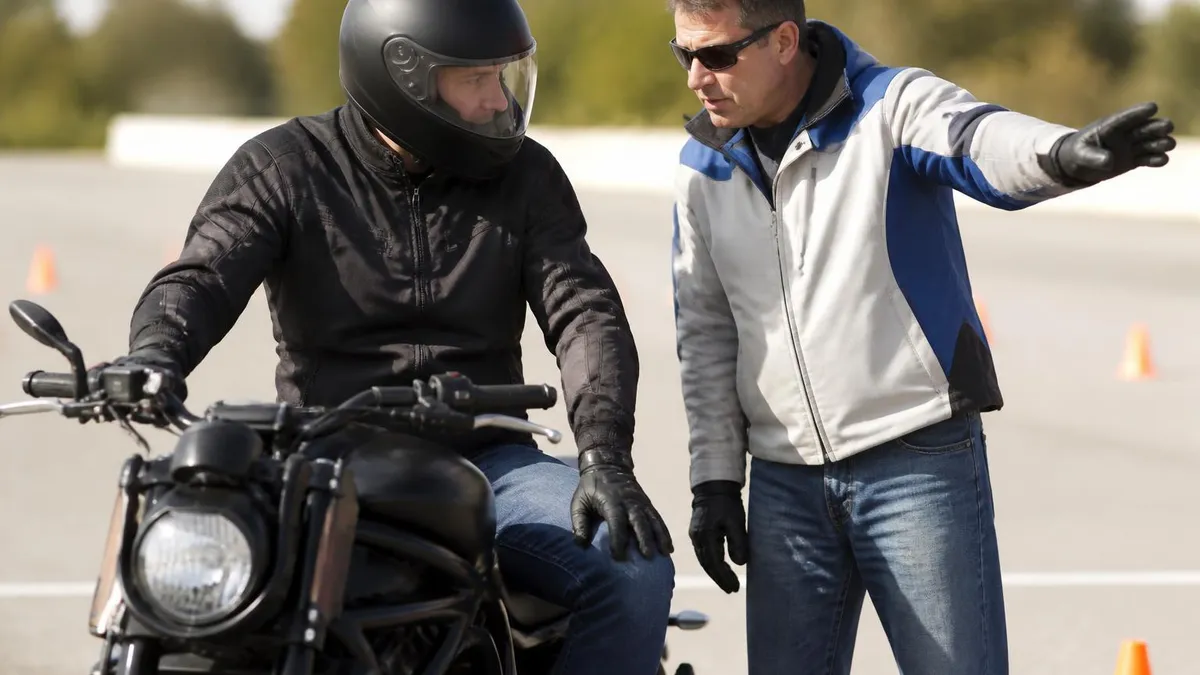
Motorcycle Safety Foundation Course: Complete 2026 Training Guide

MSF Card & Basic Rider Course: Complete 2026 Guide to Test Prep, Costs & Your Certificate
About the Author

Business Consultant & Professional Certification Advisor
Wharton School, University of PennsylvaniaKatherine Lee earned her MBA from the Wharton School at the University of Pennsylvania and holds CPA, PHR, and PMP certifications. With a background spanning corporate finance, human resources, and project management, she has coached professionals preparing for CPA, CMA, PHR/SPHR, PMP, and financial services licensing exams.