
MSF Practice Test Answers: Situational Awareness, Written Test Prep & Course Cost Guide
Master MSF situational awareness answers & written test prep. Learn msf course cost, test format, and top study tips. 🏆 Free practice quizzes inside.

If you are searching for MSF situational awareness answers and want to ace the MSF written test on your first attempt, you have landed on the right resource. The Motorcycle Safety Foundation's Basic RiderCourse is the gold standard for new and returning riders across the United States, combining classroom instruction, eLearning modules, and a practical riding range session into one cohesive program. Understanding how the written component is structured — and which concepts appear most frequently — gives you a significant edge before you ever sit down with the test booklet or tablet.
The MSF course cost typically ranges from $150 to $350 depending on your state's sponsorship agreements, the training site you choose, and any additional materials fees. Many states subsidize the program through their highway safety offices, so riders in places like California, Florida, or Texas may pay considerably less than the national average. Before registering, it is always worth calling your local RiderCourse site directly to confirm the exact MSF class cost, because online listings are not always up to date.
One of the biggest advantages of taking the msf test through an accredited site is that passing often waives the DMV knowledge and skills tests entirely. This means your performance in the MSF course directly determines whether you walk out with a motorcycle endorsement or have to schedule a separate DMV appointment. That dual purpose makes preparation especially important — you are not just studying to pass a classroom quiz, you are studying to earn your license.
Situational awareness is the thread that runs through every module of the BRC curriculum. The MSF defines situational awareness as your ability to continuously scan the riding environment, identify hazards before they become threats, and make smooth, controlled adjustments to speed and path of travel. Questions on the written test routinely ask you to evaluate scenarios involving following distance, intersection management, lane positioning, and emergency braking sequences. Knowing the correct answers to these scenario-based questions is what separates riders who breeze through the test from those who need a retake.
The MSF course written test covers a broad range of topics beyond situational awareness, including proper protective gear standards, alcohol and drug impairment thresholds, mechanical inspection checklists, and night-riding strategies. The test is generally 25 to 50 multiple-choice questions, and most sites require a score of 80 percent or higher to pass. Because the questions are drawn from the same core curriculum nationwide, practicing with representative questions before your course date is one of the most effective preparation strategies available.
This guide breaks down every major topic area on the MSF written test, gives you concrete answers to the most commonly tested situational awareness scenarios, and explains how the cost of the MSF course compares to what you would spend on a standalone DMV preparation class. By the end, you will know exactly what to study, how to study it, and where to find free practice resources that mirror the actual test format as closely as possible.
Whether you are a first-time rider with zero seat time or an experienced motorcyclist returning to refresh your skills, the strategies in this article apply equally. The MSF curriculum has been refined over decades of rider education research, and the written test reflects that depth. Let us walk through everything you need to know to walk into your course date confident, prepared, and ready to pass.
MSF Course & Written Test by the Numbers
Key Facts at a Glance
| Item | Value | Details |
|---|---|---|
| Typical MSF Course Cost | $150–$350 | Varies by state subsidy |
| Written Test Questions | 25–50 | Multiple choice format |
| Minimum Passing Score | 80% | Required at most sites |
| Total BRC Course Time | 15–20 hrs | Classroom + range combined |

MSF Written Test Format
| Section | Questions | Time | Weight | Notes |
|---|---|---|---|---|
| Situational Awareness & Hazard Recognition | 15 | ~12 min | 30% | Scenario-based; most commonly failed section |
| Protective Gear & Risk Management | 10 | ~8 min | 20% | ATGATT principles, helmet standards |
| Braking, Cornering & Speed Control | 10 | ~8 min | 20% | SEE strategy, traction limits |
| Laws, Impairment & Night Riding | 8 | ~7 min | 16% | State-specific items may vary |
| Motorcycle Inspection & Maintenance | 7 | ~5 min | 14% | T-CLOCS checklist items |
| Total | 50 | 30–45 minutes | 100% |
Situational awareness on the MSF written test is tested almost exclusively through scenario-based questions. A typical question presents a riding situation — approaching a blind curve, merging onto a highway, or following a large truck — and asks what the rider should do first, where the rider should position their lane, or how much following distance is appropriate. The correct answer almost always reflects the MSF's SEE strategy: Search, Evaluate, Execute. If you internalize that three-step decision cycle, you can reason your way through questions even when the exact scenario feels unfamiliar.
One of the most frequently tested MSF situational awareness answers involves following distance. The MSF recommends a minimum two-second following distance in normal conditions, expanding to three or four seconds when following large vehicles, riding in poor weather, or traveling at highway speeds. Test questions often present scenarios where the rider is tailgating a pickup truck on a wet road and ask which combination of actions is correct. The answer will always involve both increasing following distance AND reducing speed — never just one or the other.
Intersection management is another high-frequency topic. Approximately one-third of all motorcycle crashes occur at intersections, and the MSF curriculum devotes significant attention to this statistic. Written test questions about intersections typically focus on lane positioning (ride in the left third of the lane when approaching a controlled intersection to increase your visibility to cross-traffic), covering the brake lever before entering the intersection, and scanning left-right-left as you approach.
If a question asks which lane position gives you the best protection from a car running a red light from the left, the answer is the right portion of your lane — it creates the most lateral distance.
Questions about the motorcycle safety foundation practice test curriculum frequently cover the concept of visual lead distance. The MSF instructs riders to look as far ahead as 12 seconds of travel time in urban environments. At 30 mph that is roughly 528 feet. At 60 mph on a freeway that extends to over 1,000 feet.
The practical implication is that riders should be scanning the horizon and periphery continuously rather than fixating on the road immediately in front of the front wheel. Test questions that describe a rider staring at the pavement or watching only the car directly ahead are always describing an incorrect behavior.
Night riding situational awareness questions focus on the concept of overriding your headlight. This occurs when a rider travels fast enough that their stopping distance exceeds the distance illuminated by their headlight, leaving no reaction time for unexpected obstacles. The MSF teaches riders to reduce speed at night until they can stop completely within the range of their headlight beam. Test questions will present scenarios of riders traveling at the same daytime speed after dark and ask what the primary risk is — the correct answer is always overriding the headlight, not fatigue or reduced visibility per se.
Curve negotiation is one of the more nuanced situational awareness topics on the MSF written test. The curriculum teaches that the safest entry strategy for a curve of unknown radius is to enter wide, late, and slow, then accelerate smoothly through the apex.
If a question asks how a rider should adjust when they discover mid-curve that the turn is tighter than expected, the correct actions are: do not brake hard, press more firmly on the inner handlebar (countersteering), look through the curve to the exit, and lean the motorcycle more deeply. Grabbing the front brake mid-curve is always the wrong answer because it reduces traction precisely when you need it most.
Finally, group riding situational awareness questions test knowledge of staggered formation riding. The MSF recommends that riders in a group maintain a staggered formation — the lead rider rides in the left third of the lane, the second rider rides one second behind in the right third of the lane, and so on.
The minimum following distance in a staggered formation is still two seconds from the rider directly ahead in the same lane position. Questions will sometimes try to trick you by suggesting that riders in a group can reduce following distance because they are familiar with each other — that is always wrong.
MSF Written Test Study Strategies by Topic
To master situational awareness questions, practice applying the SEE strategy — Search, Evaluate, Execute — to every scenario you encounter. When you read a practice question, first identify what hazard the rider is facing, then evaluate which response options increase safety margins, and finally select the execution step that keeps the rider in control. Most wrong answers on this section involve reactive braking, fixating on a hazard instead of the escape path, or reducing only one of the two key variables (speed and space) when both need to change.
A reliable shortcut for scenario questions is to ask yourself: does this answer give the rider more time and more space? The MSF curriculum consistently rewards decisions that maximize both time-to-hazard and physical buffer distance. If one answer choice says "brake hard and swerve" and another says "reduce speed and increase following distance," the latter is almost always correct unless the question specifies an emergency requiring immediate avoidance. Practice identifying the difference between preventive responses and emergency responses — the test will ask you about both.

Taking the MSF Course: Is It Worth the Cost?
- +Passing the BRC waives the DMV motorcycle skills test in most states, saving time and DMV fees
- +MSF course cost is often subsidized by state highway safety programs, reducing out-of-pocket expense
- +Structured curriculum covers situational awareness, gear, braking, and cornering in one integrated program
- +Completion certificate can qualify you for insurance discounts of 10–15% with major carriers
- +Hands-on range training provides supervised practice unavailable in self-study formats
- +MSF BRC completion is accepted nationwide, so your certification transfers if you move states
- −The cost of MSF course ($150–$350) can be a barrier for budget-conscious new riders
- −Course schedules may be limited in rural areas, requiring travel to an approved training site
- −The written test is taken during the course, limiting independent study time before the exam
- −Failing the riding evaluation requires retaking the range portion, which adds time and sometimes cost
- −The curriculum does not cover advanced techniques like trail braking or track riding
- −Some experienced riders find the pace of the beginner BRC too slow for their existing skill level
MSF Written Test Prep Checklist
- ✓Complete all MSF eLearning pre-course modules at least 48 hours before your scheduled course date
- ✓Memorize the SEE strategy (Search, Evaluate, Execute) and practice applying it to real traffic situations
- ✓Study the T-CLOCS inspection checklist: Tires, Controls, Lights, Oil, Chassis, Stands
- ✓Review the two-second following distance rule and know when to extend it to three or four seconds
- ✓Learn the staggered formation riding guidelines including minimum spacing within the group
- ✓Practice identifying the correct lane position for five scenario types: curves, intersections, highways, construction zones, and night riding
- ✓Understand the front-brake-to-rear-brake contribution ratio (approximately 70/30) for emergency stops
- ✓Review DOT helmet certification standards and know which helmet types the MSF recommends
- ✓Study the legal BAC limit (0.08%) and the MSF's zero-alcohol recommendation for motorcyclists
- ✓Take at least two full-length MSF practice tests online and review every question you miss before test day

When in doubt, choose the option that gives you more time and more space.
More than 60 percent of MSF written test questions about situational awareness can be answered correctly by applying one rule: which option maximizes the rider's time to react and physical buffer distance from hazards? The SEE strategy — Search ahead, Evaluate hazards, Execute a smooth adjustment — is the framework behind every correct scenario-based answer. Internalize it before test day and you will be able to reason through unfamiliar questions without memorizing every possible scenario.
Understanding the MSF course cost structure is important before you register, because the total expense varies considerably depending on where and how you enroll. At the national level, the MSF licenses its curriculum to thousands of training sites operated by community colleges, independent riding schools, Harley-Davidson dealerships, and state safety programs. Each operator sets its own pricing within guidelines established by its state's motorcycle safety program office. This decentralized model explains why two sites in the same metropolitan area might charge $50 or more difference for the same Basic RiderCourse.
In states with strong public funding — California, Oregon, and New York are notable examples — the state motorcycle safety program covers a substantial portion of the training cost, and riders pay only a nominal registration fee ranging from $25 to $75.
In states where the program is less subsidized, such as parts of the Southeast and Mountain West, riders typically pay the full market rate of $200 to $350 for the combined eLearning, classroom, and range sessions. The MSF itself does not set a national price, so the only way to know your exact msf class cost is to contact your nearest BRC provider directly.
Beyond the base tuition, riders should budget for associated expenses that are easy to overlook. Motorcycle rental fees, charged at sites that provide training bikes rather than requiring students to bring their own, typically add $25 to $75 to the total. Gear rental — helmets, gloves, and jackets — adds another $15 to $40 if you do not already own the required protective equipment. Some sites bundle gear rental into the tuition price; others charge separately. Always ask for an itemized breakdown before you pay your registration deposit.
Insurance discounts represent a meaningful financial offset to the cost of the MSF course. Major carriers including Progressive, GEICO, and State Farm offer discounts ranging from 10 to 15 percent on motorcycle insurance premiums for riders who hold a current MSF completion certificate. For a rider paying $600 per year in motorcycle insurance, a 15 percent discount saves $90 annually — meaning the course pays for itself in less than three years on insurance savings alone, before accounting for the crash reduction and skill development benefits.
The MSF motorcycle written test, taken as part of the BRC, is included in your course tuition. There is no separate fee for the written exam or for the riding skills evaluation. If you fail the written test on your first attempt, most sites allow one free retake on the same day. If you fail the riding evaluation, retake policies vary by site — some allow a same-day retry, others require you to reschedule and may charge a reduced retake fee. Understanding your site's retake policy before you enroll removes a significant source of anxiety on test day.
For riders who are weighing the cost of MSF course against the alternative of self-study and a standalone DMV appointment, the math strongly favors the MSF route in most states. A typical DMV motorcycle knowledge test costs $5 to $35 depending on the state. However, if you fail the DMV skills test — which evaluates cone weaving, U-turns, quick stops, and swerving at low speed — you must reschedule and repay the fee, often waiting weeks for an open appointment. MSF graduates bypass the DMV skills test entirely, saving both time and the uncertainty of a DMV testing environment.
Some employers in logistics, law enforcement, and security also reimburse MSF course fees for employees who ride as part of their job duties. Check your employer's professional development or safety training budget before paying out of pocket. Additionally, several motorcycle manufacturers — Honda, Kawasaki, and BMW among them — offer MSF course subsidies or rebates to new-bike buyers as part of their customer loyalty programs. A quick call to the dealer where you purchased or are considering purchasing a motorcycle can reveal reimbursement options you might not find on the manufacturer's website.
In high-demand markets like Los Angeles, Chicago, and Houston, MSF Basic RiderCourse slots fill 4–8 weeks in advance during spring and summer riding season. If your state requires MSF completion before you can apply for a motorcycle endorsement, a full course calendar could delay your license by two months or more. Register as soon as your schedule is confirmed, and use the waiting time to complete all eLearning pre-course modules and take MSF practice tests online so you arrive fully prepared.
Once you understand the MSF course written test format and cost structure, the next step is developing a systematic study plan that covers every topic area without wasting time on material that rarely appears on the exam. The most efficient approach starts with the MSF's own pre-course eLearning modules, which are available through the MSF eCourse platform and cover the same content as the classroom session in an interactive digital format.
Completing these modules before your course date means you are reviewing material during the classroom portion rather than encountering it for the first time, which significantly reduces cognitive load during the written test.
After completing the eLearning modules, shift your focus to practice testing. The msf motorcycle written test prep resources available through PracticeTestGeeks include hundreds of scenario-based questions organized by topic, allowing you to identify weak areas and focus your review time accordingly. If you consistently miss questions about night riding, spend extra time on the overriding-the-headlight concept and the reduced-speed strategies the MSF recommends. If braking questions trip you up, review the front-to-rear brake ratio and the steps for threshold braking until they become automatic.
One often-overlooked study strategy is to read the explanations for questions you answer correctly, not just the ones you miss. The MSF curriculum contains a number of counterintuitive concepts — like the fact that increasing throttle slightly mid-curve can actually stabilize the motorcycle by loading the rear suspension and improving traction — that are easy to memorize as isolated facts but harder to apply under test pressure without deeper understanding. Reading the rationale behind correct answers builds the conceptual framework that lets you generalize to novel scenarios on test day.
Gear and protective equipment questions are among the easiest to prepare for because the MSF's recommendations are consistent and rarely change between curriculum editions. The mnemonic ATGATT — All The Gear, All The Time — summarizes the MSF's position on protective clothing.
Memorize the five gear categories: helmet (DOT certified, full-face preferred), jacket (leather or textile with CE-rated armor), gloves (full-fingered, palm protection), boots (over-the-ankle, ankle protection), and pants (leather or textile with hip and knee armor). Any question asking what gear is appropriate or what gear can be left off will have an answer that contradicts ATGATT, making it easy to eliminate incorrect choices.
The T-CLOCS pre-ride inspection checklist is another high-frequency topic that rewards simple memorization. T-CLOCS stands for Tires and wheels, Controls (levers, cables, throttle), Lights and electrical, Oil and fluids, Chassis (frame, suspension, chain), and Stands (kickstand and center stand). Written test questions about pre-ride inspection will either name a specific item and ask which T-CLOCS category it belongs to, or describe a problem found during inspection and ask whether it is safe to ride. If any item fails the T-CLOCS check, the correct answer is always to address the problem before riding — never to proceed with a known defect.
Lane positioning questions are another area where consistent preparation pays dividends. The MSF identifies three lane positions within a single lane — left third, center, and right third — each appropriate for different scenarios. The left third is best when approaching or being approached from behind at intersections, because it increases your visibility to crossing traffic.
The right third is appropriate when following a large vehicle like a bus or semi-truck, because it allows you to see around the vehicle's right side. The center position is appropriate in most highway situations but should be avoided in rain because the center of the lane accumulates oil drips from passing cars.
Students preparing for the msf basic rider course test answers section on alcohol and impairment should pay particular attention to the MSF's emphasis that impairment begins before the legal limit of 0.08 percent BAC. The curriculum notes that balance and coordination — both critical to motorcycle operation — degrade measurably at BAC levels as low as 0.04 percent.
Written test questions may present a scenario where a rider has had "just one drink" and ask whether it is safe to ride; the correct MSF answer is always no. The only safe blood alcohol level for motorcycle operation, per the MSF curriculum, is zero.
With your study plan established and your practice tests completed, the final phase of MSF written test preparation focuses on consolidating your knowledge and managing test-day performance. The night before your course, review your weakest topic area one final time using a focused set of 15 to 20 practice questions.
Do not attempt a full marathon study session the evening before — fatigue impairs recall and creates the kind of second-guessing that turns confident test-takers into anxious ones. A targeted 30-minute review followed by 7 to 8 hours of sleep is consistently more effective than pulling an all-nighter with a textbook.
On the morning of your course, eat a full breakfast and arrive at the training site at least 15 minutes early. This gives you time to complete any administrative paperwork, get comfortable in the classroom environment, and mentally transition from everyday mode into learning mode. Many test-takers perform below their preparation level simply because they arrived rushed and spent the first 20 minutes of the classroom session still mentally at the breakfast table or stuck in traffic. Arriving calm and early eliminates that performance gap at no additional study cost.
During the written test itself, use the process of elimination aggressively. MSF written test questions are multiple choice, typically with four options. In most cases, at least one answer is clearly a dangerous or illegal behavior and can be eliminated immediately.
Of the remaining three, look for the option that most directly reflects SEE (Search, Evaluate, Execute) and that maximizes time and space for the rider. If two options both seem safe, choose the one that is more proactive — the MSF curriculum consistently rewards riders who address hazards before they become emergencies rather than reacting to them after the fact.
Flag questions you are unsure about and return to them after completing the rest of the test. Anxiety about a difficult question mid-test can bleed into subsequent questions, causing you to rush and make careless errors on questions you actually know. Completing the questions you are confident about first builds momentum and leaves you with a calmer mindset when you return to the flagged items. Most MSF written tests allow ample time to review every flagged question at least once before submitting.
After the written test, you will move to the range for the riding evaluation. Many students feel more nervous about the range than the written test, but the skills evaluated — figure eights in a confined space, quick stops from 15 mph, and swerve maneuvers — are all skills you will practice multiple times during the range sessions before the evaluation.
The key mental adjustment is to treat the evaluation as another practice session rather than a high-stakes performance. Instructors are rooting for you to pass; they will provide coaching cues and encouragement throughout the evaluation. Focus on smoothness and technique rather than speed or perfection.
If you pass both the written test and the riding evaluation — which the majority of prepared students do — you will receive an MSF completion card or digital certificate, typically on the same day. This certificate is your ticket to the DMV to add a motorcycle endorsement to your driver's license without taking additional written or skills tests in most states.
Keep a digital copy of your certificate in your phone's photo library and a physical copy in your wallet, because DMV offices occasionally request both. The certificate is also what you submit to your insurance company to claim your safe-rider discount.
The skills you develop studying for the MSF motorcycle written test do not expire when you pass the exam. The situational awareness concepts, the SEE strategy, the lane positioning principles, and the risk management framework are all tools you will use every single time you ride.
Riders who treat the MSF curriculum as a minimum standard and continue building on it through advanced courses, regular practice, and ongoing self-evaluation are statistically the safest riders on the road. Your preparation for the written test is not just about earning a passing score — it is the foundation of a lifetime of safer riding.
Sample MSF - Motorcycle Safety Foundation Practice Questions
Try these questions from our free MSF - Motorcycle Safety Foundation practice tests. The correct answer and an explanation follow each question.
What is the best practice regarding the height of cargo strapped on top of a motorcycle?
- A. Height does not matter as long as both sides are equal
- B. Keep cargo as low as possible and avoid stacking it high above the seat
- C. Cargo may be stacked as high as the rider's helmet for aerodynamic benefit
- D. High cargo is acceptable if it is additionally tied to the handlebars
Answer: B. Keep cargo as low as possible and avoid stacking it high above the seat
Keeping cargo low prevents raising the center of gravity, which would make the motorcycle harder to handle and more prone to tipping.
What is the MSF's recommended practice for maintaining emergency braking skills?
- A. Only practice during actual emergencies on the road
- B. Practice quick stops regularly in a safe, controlled environment
- C. Rely on ABS to handle all emergency situations
- D. Practice emergency braking once before the license test only
Answer: B. Practice quick stops regularly in a safe, controlled environment
Regular practice of quick stops in a controlled environment builds the muscle memory and confidence needed to execute them correctly under stress.
When bringing the motorcycle to a smooth, straight-line stop, what is the recommended braking practice according to the MSF?
- A. Use only the front brake for maximum power.
- B. Use only the rear brake to avoid locking the front wheel.
- C. Apply both brakes at the same time, with controlled pressure.
- D. Apply the rear brake first, then progressively add the front brake.
Answer: C. Apply both brakes at the same time, with controlled pressure.
The MSF teaches that for maximum braking effectiveness and stability in a straight line, both the front and rear brakes should be applied simultaneously. The front brake provides the majority of the stopping power (around 70%), while the rear brake adds to the total braking force and helps keep the motorcycle balanced.
If your rear wheel skids during emergency braking, what is the safest response?
- A. Release the rear brake immediately and let it snap back
- B. Maintain the rear brake pressure and keep the skid controlled until stopped
- C. Apply more front brake to compensate
- D. Stand on the pegs to shift weight forward
Answer: B. Maintain the rear brake pressure and keep the skid controlled until stopped
Maintaining the rear brake through a straight skid keeps the wheel sliding predictably; releasing it abruptly can cause the bike to snap sideways.
Take the full MSF - Motorcycle Safety Foundation practice test
MSF Questions and Answers

MSF eCourse: Complete Guide to Online Training, Written Test Prep & Course Costs

MSF eLearning Portal: How to Use elearning.msf-usa, MSF Course Cost & Written Test Prep
MSF Practice Test Video Answers
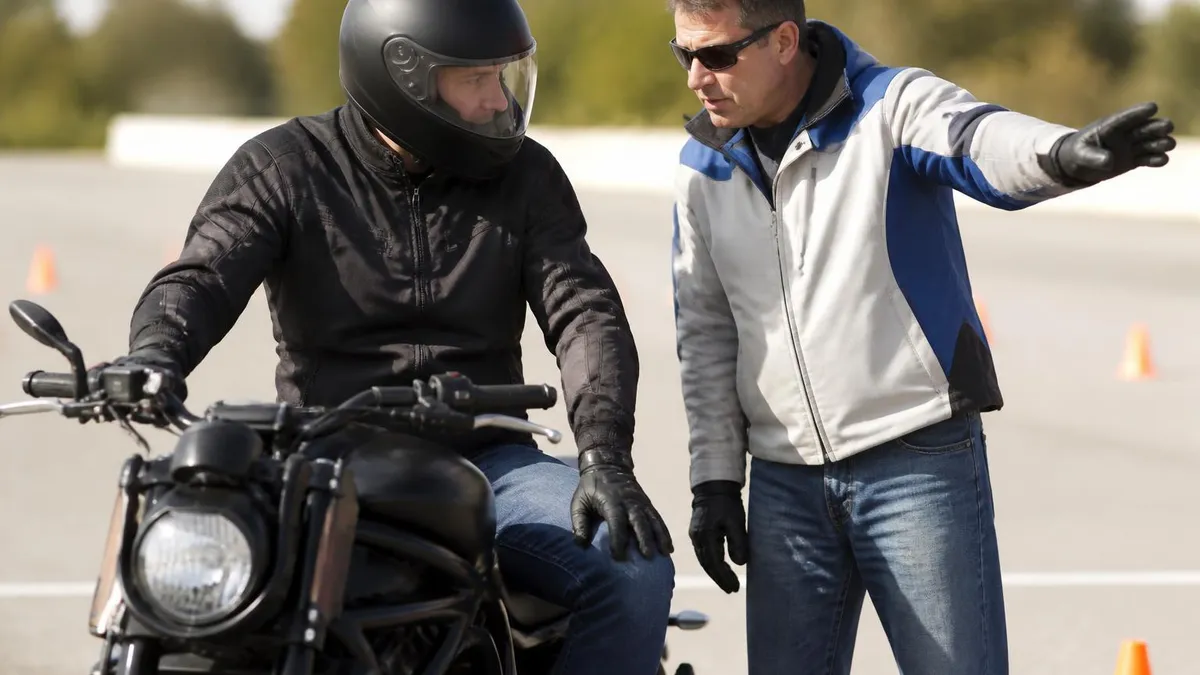
Motorcycle Safety Foundation Course: Complete 2026 Training Guide

MSF Card & Basic Rider Course: Complete 2026 Guide to Test Prep, Costs & Your Certificate
About the Author

Business Consultant & Professional Certification Advisor
Wharton School, University of PennsylvaniaKatherine Lee earned her MBA from the Wharton School at the University of Pennsylvania and holds CPA, PHR, and PMP certifications. With a background spanning corporate finance, human resources, and project management, she has coached professionals preparing for CPA, CMA, PHR/SPHR, PMP, and financial services licensing exams.