
MRI Centers Near You: How to Choose, What to Expect, and Costs 2026 September
🎓 Compare MRI centers by price, equipment, accreditation, and wait time. Learn how to pick the right imaging facility and what to expect on scan day.
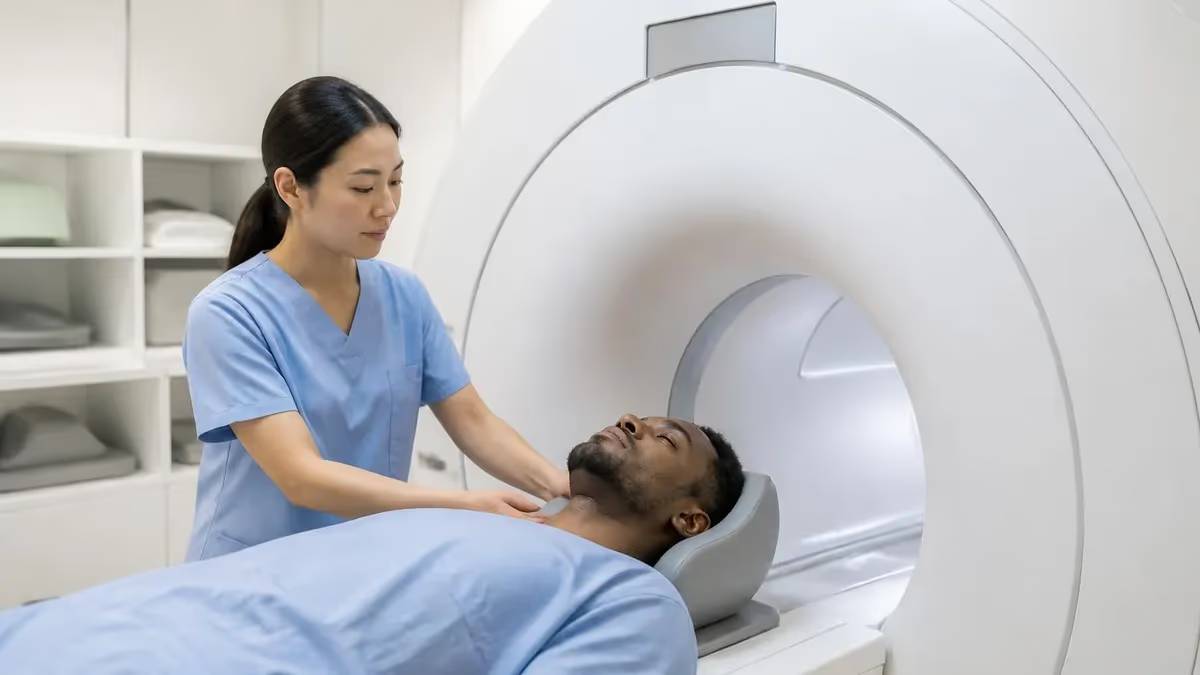
Walk into any midsize American city and you will find a dozen MRI centers within a thirty-minute drive. Some are tucked inside hospitals. Others sit in standalone outpatient buildings sharing a parking lot with a Starbucks. The scanner inside might be a 1.5 Tesla workhorse, a brand-new 3T machine, or an open-bore design that swallows even the most claustrophobic patient without complaint. Prices swing wildly between them. Wait times do too.
If your doctor just handed you a referral and said pick a facility, that choice matters more than most patients realize. The right MRI center delivers diagnostic-quality images, returns the report fast, and bills you a price that does not require a second mortgage. The wrong center loses your priors, runs an underpowered scanner that misses your finding, or surprises you with a four-figure bill weeks after the scan.
This guide walks through everything that separates a great MRI center from a mediocre one. We cover accreditation, equipment quality, technologist credentials, pricing structure, scheduling reality, and the practical details of scan day. We also share what to watch for if your insurance steers you toward a specific facility, because the lowest-cost option to your insurer is not always the highest-quality option for you.
By the end of this article you will have a checklist you can run through in fifteen minutes before booking, a price range you should expect, and a clear sense of when a hospital scanner makes sense versus when a freestanding center is the smarter pick. Let us start with what actually makes one MRI center different from another.
MRI Centers by the Numbers
MRI centers fall into three broad buckets. Hospital outpatient departments are the most common. They share the imaging equipment with the inpatient and emergency departments, which means scheduling can be tight and prices run high because hospitals carry the largest fixed overhead. The upside is that complex cases, sedated pediatric scans, and patients with serious comorbidities are easier to handle in a hospital setting because anesthesia and emergency response are minutes away.
Freestanding imaging centers are the second category. These are outpatient-only facilities, often owned by radiology groups or private equity, that compete on price, wait times, and patient experience. The scanners are usually the same quality as the hospital uses. Cash-pay prices typically run thirty to sixty percent below hospital fees for the identical CPT code. The trade-off is that freestanding centers cannot handle medically unstable patients and may transfer cases that turn out to need urgent intervention.
The third category is mobile MRI - a scanner mounted in a tractor-trailer that visits rural hospitals and clinics on a rotating schedule. Image quality on modern mobile units is excellent, but availability is limited to specific days of the week. Mobile units fill a real gap in underserved areas where a permanent installation cannot be justified financially.
Most patients in suburban and urban America have all three types within reach. The right answer depends on your insurance coverage, the body part being scanned, the urgency, and whether you need any add-ons like contrast, sedation, or specialty positioning. For a routine non-contrast joint study, a freestanding center is hard to beat on price and convenience.
Key Insight
The same CPT code can be billed for ten times the price across two facilities in the same zip code. Insurance covers some of that difference, but high-deductible plans expose patients directly to the price gap. Spending fifteen minutes calling three centers for cash-pay quotes before booking can save thousands of dollars on a single scan - and you will not pay a penalty for asking. Imaging centers expect price-shopping calls and most have a posted cash rate at the front desk.
Accreditation is the quickest filter when comparing MRI centers. In the United States, the gold standard is American College of Radiology (ACR) accreditation. ACR-accredited centers have passed independent review of their equipment performance, technologist qualifications, radiologist credentials, safety protocols, and image quality on sample cases. Most major insurers require ACR accreditation for reimbursement on certain studies, and Medicare requires it across the board for outpatient advanced imaging.
The Intersocietal Accreditation Commission (IAC) offers another widely accepted credential, particularly for cardiovascular MRI. Both ACR and IAC accreditation indicate a center has invested in the people, processes, and equipment maintenance that produce reliable diagnostic-quality scans. A center without any accreditation is a red flag - it does not necessarily mean bad imaging, but it removes the third-party guardrails that catch problems before they affect patients.
The Joint Commission accredits hospitals broadly, including their imaging departments. State health departments also license imaging facilities and conduct periodic inspections. None of these substitute for ACR or IAC accreditation but they layer on additional oversight.
Ask the center directly: Are you ACR accredited? When was your last review? What sequences did you submit? Any front-desk team that fumbles the answer is signaling that quality assurance is not a priority. A confident, specific response - we are ACR-accredited in MRI, last reviewed in 2024, and our protocols cover brain, spine, MSK, and body imaging - tells you the facility takes its credentials seriously and reviews them with the team.
What to Evaluate at Each MRI Center
Is the scanner 1.5T, 3T, or open MRI? Field strength affects image quality and which body parts the center can image well. For brain, spine, or fine MSK work, 3T usually wins. For most routine studies, 1.5T is equivalent.
ACR or IAC accreditation indicates third-party validation of equipment, staffing, and protocols. Required by Medicare and most major commercial insurers for advanced imaging reimbursement.
Is your scan read by a general radiologist or a fellowship-trained subspecialist? Neuroradiologists read brain and spine. MSK radiologists read joints. Subspecialty reads catch findings that general reads sometimes miss.
Does the center publish cash prices and accept your insurance? Are prior-authorization staff available to handle insurance paperwork? Hidden facility fees can double your out-of-pocket cost.
Equipment quality at an MRI center is more than just field strength. The age of the scanner matters too. A 1.5T installed in 2010 may produce noticeably softer images than a 1.5T installed in 2022, because gradient performance, coil design, and reconstruction software have all advanced significantly in the intervening decade. Ask how old the scanner is and when it was last upgraded. A reputable center will have this information at the front desk because patients and referring physicians ask regularly.
Coil inventory matters as much as the scanner itself. A center with dedicated breast coils, multi-channel head coils, flex extremity coils, and cardiac arrays can image almost anything. A center with a generic body coil and one head coil will struggle with specialty work like wrist injuries, breast cancer screening, or knee cartilage assessment. If your study requires a specific coil, confirm the center has it before booking.
Bore size affects patient comfort and clinical access. Standard bores are 60 centimeters wide. Wide-bore systems at 70 centimeters help large patients, claustrophobic patients, and certain off-center anatomy like shoulder or hip studies. Some centers also offer true open MRI units, which sacrifice image quality for an unobstructed view but allow scans for patients who absolutely cannot tolerate a closed bore.
Finally, ask whether the center has a quality assurance program. ACR-accredited facilities run daily phantom scans to verify image consistency. They calibrate gradients monthly. They check helium levels weekly. These routines are invisible to patients but they directly affect whether your scan is diagnostic on the first try or has to be repeated because of a hardware drift the team did not catch.
MRI Center Types Compared
Highest-quality clinical backup, full anesthesia and emergency support, broadest equipment lineup. Highest cash prices, longest wait times for routine scans, often charges facility fees on top of the imaging fee. Best for complex patients, sedated peds, and inpatients transitioning to outpatient follow-up.
How much does a scan at an MRI center actually cost? It depends on the body part, whether contrast is used, where the facility sits, and how the bill is structured. A non-contrast knee MRI runs $400 to $700 at a freestanding center in most US markets. The same study at a hospital outpatient department often bills $1,200 to $2,500. Add contrast and you might add $200 to $400. Add a facility fee and the hospital number climbs further.
Cash-pay rates almost always beat the insurance-negotiated rate for high-deductible plans. If you have not met your deductible, paying cash directly to the imaging center can cost less than running the same scan through insurance. The catch is that cash payments usually do not count toward your deductible. Doing the math depends on your specific plan, but many patients save several hundred dollars by going cash on routine non-contrast studies.
Bundled pricing is the freestanding-center innovation that hospitals have been slow to match. A bundled MRI price covers the technical fee (the scan itself) and the professional fee (the radiologist read) in a single number. With hospital outpatient billing, you often see one bill for the facility, another from the radiology group, and sometimes a third from an anesthesiologist if sedation was used. Asking up front whether the quoted price is bundled prevents nasty surprises in the mail two weeks later.
If you are uninsured, ask about a self-pay discount or charity care. Many hospital systems will discount sixty to seventy percent off the chargemaster price for patients without insurance who ask. Freestanding centers often quote you the discount automatically because that is their main customer base anyway. For a full pricing breakdown, see our guide on the cost of MRI without insurance.
Hospital outpatient departments often charge a facility fee on top of the imaging fee, even if the scan is identical to what a freestanding center offers. Some networks list both the hospital and a freestanding center as in-network but apply different cost-sharing structures - you might owe a copay at one and a much larger coinsurance at the other. Prior authorization is required by most commercial insurers for non-emergency outpatient MRI; if your center skips this step, the insurer can deny coverage entirely. Always confirm prior auth is on file before you walk in. And get the all-in price in writing before scanning, not after.
Scheduling at a busy MRI center can take anywhere from one day to several weeks. Hospital outpatient slots often run two to three weeks out for non-urgent studies because of inpatient demand on the same scanners. Freestanding centers usually offer slots within three to seven days. Urgent and STAT studies happen same-day or next-day at most centers, but the order has to be marked urgent by the referring physician and accompanied by clinical justification.
When you book, expect the scheduling team to ask about implants, allergies, claustrophobia, kidney function if contrast is ordered, and prior imaging. Bring your insurance card, photo ID, the order from your doctor, and a list of medications. If your referring office has not sent the order yet, the center cannot schedule you - call your doctor's office and confirm the fax went through.
The day before your scan, the center may call to confirm prep instructions. Most MRI studies require no fasting. abdominal mri cpt code typically asks for no food or drink for four hours beforehand. Pelvic MRI might want a partially full bladder. Brain and spine scans require nothing beyond emptying your pockets and changing into a gown.
Arrive fifteen to thirty minutes early to handle screening forms. Expect to fill out the MRI safety questionnaire even if you have had a previous scan - implants and surgeries since your last visit could affect safety. The technologist will go through the form with you in person before bringing you near the scanner room. This redundancy is by design and has driven serious magnet incidents to near zero.
How to Pick the Right MRI Center
- ✓Confirm ACR or IAC accreditation before booking
- ✓Ask the field strength (1.5T or 3T) and scanner age
- ✓Request a bundled cash price including the radiologist read
- ✓Verify the facility is in-network with your specific insurance plan
- ✓Confirm prior authorization is on file if your insurance requires it
- ✓Ask how soon the radiologist report is delivered to your doctor
- ✓Check whether subspecialty radiologists read your body part
- ✓Ask whether the center can handle your implants or sedation needs
- ✓Request the CPT code so you can compare apples-to-apples quotes
- ✓Bring prior images on disc if you have any for direct comparison
On scan day, the experience varies less than you might think between centers. You check in, fill out the safety form, change into a gown, lock up valuables, and wait for the technologist to call you. The technologist confirms your screening answers, reviews the order, and walks you to the scanner room. From there, the routine is largely identical regardless of facility.
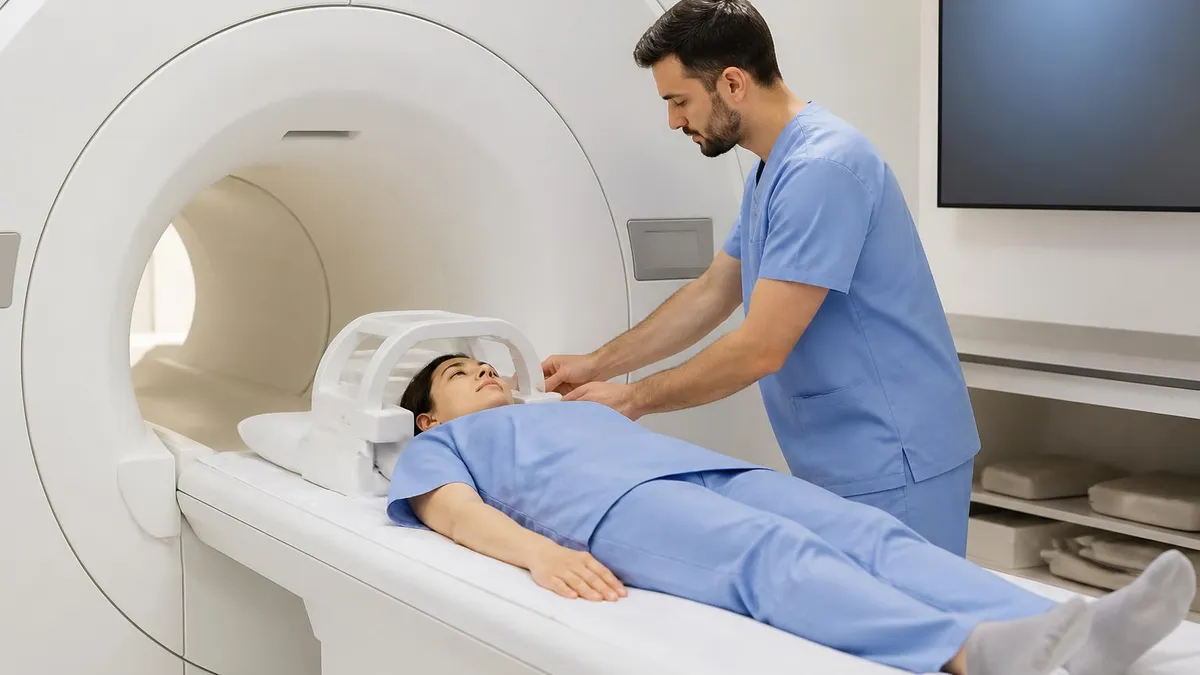
You lie on the padded table. The tech positions the appropriate receiver coil over the body part of interest - a helmet for brain studies, a flat array for the abdomen, a tube-shaped coil for joints. Earplugs go in. Headphones go on, sometimes with music if the center offers it. The table slides into the bore and the first sequence starts. Knocking and buzzing fill the room - the gradient coils flexing against the static field. Each sequence runs three to seven minutes. A typical exam involves five to eight sequences.
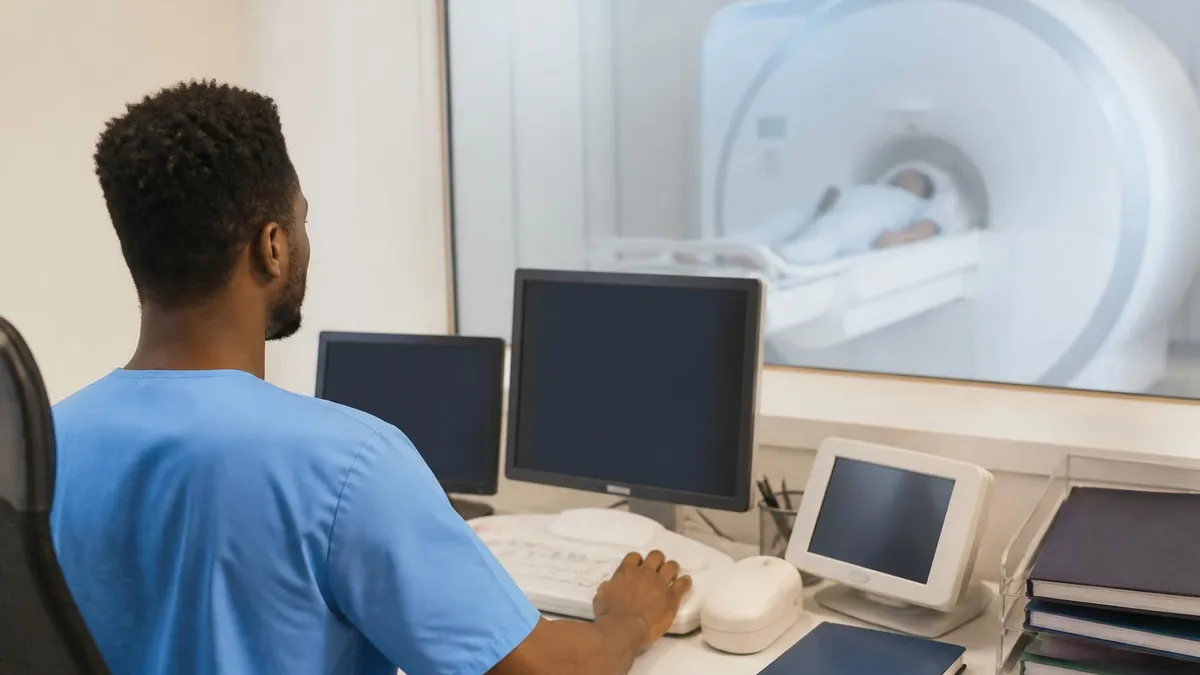
The technologist watches you and the images from the control room through leaded glass. You hold a squeeze ball that signals the tech to stop if you need a break. Communication runs through the headphones - the tech tells you what is coming next, how long the next sequence will be, and when to breathe normally versus hold a breath. Most patients are surprised by how loud the machine is and how quickly the time passes once they settle in.
If contrast is part of the protocol, the tech pulls you out of the bore midway, places an IV, injects gadolinium, and slides you back in for the contrast-enhanced sequences. The whole exam usually wraps in thirty to forty-five minutes from when you first lie down. You change back into your clothes, collect your belongings, and head out. The report arrives in the referring doctor's inbox within twenty-four hours for routine studies.
Freestanding vs Hospital MRI Centers
- +Freestanding centers cost 30-60% less for the same study
- +Shorter wait times for routine outpatient appointments
- +More flexible scheduling, including evenings and weekends
- +Bundled pricing eliminates separate professional fee bills
- +Often higher patient experience scores and amenities
- +Equipment quality usually matches hospital scanners
- −Cannot handle medically unstable or sedated complex patients
- −Limited or no anesthesia coverage for difficult cases
- −Some networks favor hospital systems with referral incentives
- −Subspecialty radiologist reads less common at smaller centers
- −Fewer coils and protocols available for niche body parts
- −Transfer required if scan reveals urgent finding needing intervention
Some patients need MRI centers with capabilities beyond the routine. Pediatric scans on children under seven usually require sedation or general anesthesia. A pediatric-capable center has anesthesia staff on site, pediatric monitoring equipment, and a recovery bay. Most freestanding centers refer pediatric cases to a hospital outpatient department.
Cardiac MRI is its own subspecialty. It requires gated sequences synchronized to the heartbeat, specialized coils, and a cardiothoracic radiologist to interpret. Breast MRI is similar - the ACR accredits breast imaging separately, so verify breast-specific accreditation if that is on your order.
For claustrophobia, options range from oral anxiolytics to wide-bore 3T scanners with 70-centimeter openings to true open MRI. Be honest about claustrophobia when scheduling so the center can match you with the right equipment. Learn more about MRI during pregnancy if that applies to your situation.
Specialty MRI Protocols Worth Asking About
Gated sequences, specialized coils, gadolinium contrast, and a cardiothoracic radiologist to read scar tissue, function, and viability after heart events.
Requires a dedicated breast coil and separate ACR accreditation. Used for high-risk screening, problem-solving on mammogram findings, and pre-operative planning.
Children under seven typically need anesthesia. Only centers with onsite anesthesia, pediatric monitoring, and recovery bays can offer this safely.
Intra-articular contrast injection before the scan for labral tears, ligament injuries, and cartilage assessment. Requires fluoroscopy or ultrasound suite alongside the MRI scanner.
MRI Questions and Answers
Choosing the right MRI center is one of the highest-leverage decisions you make in the outpatient imaging journey. The scanner, the technologist, the radiologist, and the billing structure all vary between facilities, and the variations directly affect both your clinical outcome and your wallet. Spend the fifteen minutes before booking to compare two or three options. Ask about accreditation, scanner age and field strength, bundled pricing, and prior-authorization handling. Confirm your insurance plan and verify the facility is in-network.
If you are paying cash, the freestanding center is almost always the better deal for routine non-contrast joint and spine work. If your scan is complex, requires sedation, or you have unstable medical cos, the hospital outpatient department's clinical backup justifies its higher cost. Mobile MRI fills the gap in rural areas and underserved communities. Open MRI is a clinical compromise for patients who absolutely cannot tolerate a closed bore.
Whichever center you pick, prepare for scan day by completing the safety screening honestly, leaving metal at home, and arriving early. Tell the technologist about claustrophobia or implant concerns before you are on the table. Request a copy of your images at checkout, even if you do not plan to look at them yourself - having priors available years from now can change how a future radiologist reads a comparison study.
For more on the technology behind modern imaging, read about MRI vs CAT scan to understand when each modality fits. If your provider mentioned contrast, our explanation of contrast MRI covers what to expect. Picking the right center is the first step in a chain of decisions that ends with a clear image, a confident read, and the answers your doctor needs to guide your next step in care.
About the Author

Medical Laboratory Scientist & Clinical Certification Expert
Johns Hopkins UniversityDr. Sandra Kim holds a PhD in Clinical Laboratory Science from Johns Hopkins University and is certified as a Medical Technologist (MT) and Medical Laboratory Scientist (MLS) through ASCP. With 16 years of clinical laboratory experience spanning hematology, microbiology, and molecular diagnostics, she prepares candidates for ASCP board exams, MLT, MLS, and specialist certification tests.
Join the Discussion
Connect with other students preparing for this exam. Share tips, ask questions, and get advice from people who have been there.
View discussion (8 replies)