
MEPS Swearing In: What to Expect at Your Ceremony 2026 October
✅ Pass the MEPS Swearing In: What to Expect at exam with confidence. Practice questions with detailed explanations and instant feedback on every answer.

What Is the MEPS Swearing In Ceremony?
The MEPS swearing-in ceremony — officially called the Oath of Enlistment — is the moment you formally commit to serving in the United States military. It takes place at your Military Entrance Processing Station (MEPS) after you've passed all medical exams, the ASVAB, and completed your paperwork. It's a brief ceremony, but it carries significant legal weight — from the moment you raise your right hand and recite the oath, you're bound by the Uniform Code of Military Justice (UCMJ).
Understanding what happens at the swearing-in helps you walk in prepared. You'll know what to expect, what you're committing to, and what comes next in the enlistment process.
When Does the Swearing In Happen at MEPS?
There are actually two swearing-in ceremonies for most recruits, and it's important to know the difference between them:
Preliminary Swear-In (Delayed Entry Program)
When you first complete MEPS processing and sign your enlistment contract, you take a preliminary oath and enter the Delayed Entry Program (DEP). This commits you to report for active duty on a specific future date — typically weeks or months later. DEP is used to allow recruits to finish school, complete personal affairs, or simply manage the backlog of recruits waiting to ship to basic training.
During the DEP period, you're technically in the military Reserve — subject to certain UCMJ provisions — but you haven't begun active duty service. Most recruits are in DEP for one to twelve months. You remain a civilian in your day-to-day life during this period.
Final Swear-In (Ship Day)
When your ship date arrives, you return to MEPS (or stay overnight from the previous day). After final medical checks and administrative processing, you take the formal Oath of Enlistment for the second time. This oath — the final swear-in — is the one that activates your active duty service. After this ceremony, you board a bus or flight to your basic training installation.
Many recruits are surprised to learn there are two ceremonies. The preliminary DEP oath is real and binding, but the final ship-day oath is what begins your military career in earnest.
The Oath of Enlistment: Word for Word
The Oath of Enlistment is the same for all branches of the military (Army, Navy, Air Force, Marine Corps, Coast Guard, Space Force). It reads:
'I, [name], do solemnly swear (or affirm) that I will support and defend the Constitution of the United States against all enemies, foreign and domestic; that I will bear true faith and allegiance to the same; and that I will obey the orders of the President of the United States and the orders of the officers appointed over me, according to regulations and the Uniform Code of Military Justice. So help me God.'
If you have a religious or conscientious objection to swearing an oath, you may 'affirm' instead of 'swear,' and the phrase 'So help me God' is optional. The administering officer leads you through the oath line by line, or recites it and you repeat after them — procedures vary slightly by MEPS.
What Happens During the MEPS Swearing-In Ceremony
The ceremony itself is typically brief — 10 to 15 minutes — and takes place in a designated room at the MEPS facility. Here's what to expect:
- Assembly — All recruits scheduled for the ceremony gather in the swearing-in room. There may be a few recruits or several dozen depending on the day and how busy your MEPS is.
- Introduction — A commissioned officer (typically of senior rank, sometimes a flag officer if available) presides over the ceremony. They may make brief remarks about the significance of the oath and military service.
- Oath Administration — The presiding officer instructs recruits to raise their right hand. The oath is then administered — either read line by line with recruits repeating, or read in full and recruits affirming.
- Photos — Family members who accompany recruits are typically allowed to take photos. This moment is significant for families, and MEPS facilities usually accommodate photography.
- Congratulations — The officer congratulates the recruits. Depending on the MEPS and the officer, there may be a brief handshake or applause.
- Continuation of Processing — After the ceremony, processing continues. For ship-day oath, recruits proceed to receive travel documents, baggage instructions, and final briefings before departure.
Can Family Attend the MEPS Swearing In?
Yes — and most recruits bring at least one family member. MEPS facilities allow family and friends to witness the swearing-in ceremony. This is actually one of the more emotional moments in the enlistment process for families; many parents bring cameras and consider it a milestone event.
The logistics depend on your MEPS location. Most facilities have a waiting area for families and allow them into the swearing-in room for the ceremony itself. Call your MEPS recruiter or the MEPS facility directly to confirm their specific policy for family attendance — procedures can vary.
For the final ship-day oath, family attendance at the ceremony itself may be more limited depending on scheduling, but goodbyes typically happen before recruits depart for basic training.
What Happens After You Swear In at MEPS?
What comes next depends on which ceremony you just completed:
After the DEP Oath (Preliminary Swear-In)
You return home and continue your civilian life until your ship date. During this period:
- Stay in contact with your recruiter — DEP meetings or check-ins may be required
- Maintain your physical fitness — basic training will be physically demanding
- Don't get arrested or get into legal trouble — legal issues during DEP can jeopardize your enlistment
- Don't gain significant weight — you'll be weighed again at final processing
- Don't get new tattoos in unauthorized locations — policies on tattoos are branch-specific
- Keep your recruiter informed of any changes to your health, legal status, or personal situation
The DEP period is your last extended opportunity to prepare. Use it. Physical fitness is the most practical investment — candidates who arrive at basic training in good cardiovascular shape and with functional strength have a significantly easier time.
After the Final Oath (Ship Day)
You're now on active duty. The rest of ship day typically involves:
- Final administrative paperwork and document verification
- Receiving travel documents (plane ticket, bus ticket, or vehicle assignment)
- Baggage drop-off (most of what you bring is shipped separately; you travel light)
- Transportation to the airport, bus station, or direct transportation to your basic training installation
- Reception and in-processing at your basic training installation — the start of military life
Can You Back Out After Swearing In at MEPS?
This is one of the most common questions recruits have — and the answer is more nuanced than a simple yes or no.
After the preliminary DEP oath, you're technically in the military Reserve, but dropping out of DEP is possible. Recruits who have a genuine change of heart or circumstances can request a DEP discharge before their ship date. It typically requires going through your recruiter and may involve paperwork. There's no straightforward legal mechanism to force you to ship if you don't want to — DEP discharges are granted regularly, though they may affect your ability to enlist in the future.
After the final oath on ship day, the situation changes substantially. You're on active duty, subject to the UCMJ, and formally bound to your service commitment. Leaving at that point — AWOL or desertion — is a serious legal offense. If you have concerns or second thoughts, the appropriate channel is to speak with your chain of command through legal military channels, not to simply walk away.
The important message: if you have serious doubts, address them before your ship date. The DEP period exists partly as a cooling-off window. It's far better to have a difficult conversation with your recruiter before shipping than to find yourself in a legal and military crisis afterward.
MEPS Swearing In: What to Wear and Bring
For the swearing-in ceremony specifically, the standard advice is business casual clothing — clean, neat, and appropriate. You're not in uniform yet, but you're representing yourself to military officers. Avoid clothing with offensive graphics, political statements, or excessive logos. Clean jeans and a collared shirt are fine; shorts and flip-flops are not appropriate.
For ship day in particular, bring:
- Government-issued photo ID
- Your Social Security card
- Any financial account information if you haven't already set up direct deposit
- Prescription glasses or contacts in their cases
- Any required medications in original pharmacy bottles
- A small bag with basic toiletries for travel (most of your items stay at MEPS or are shipped separately)
Leave valuables at home. Your recruiter will give you a specific packing list — follow it exactly. The list varies by branch and is updated periodically.
The Significance of the Oath
The Oath of Enlistment is not ceremonial window dressing. It's a legally binding commitment that places you under military jurisdiction and creates an obligation to the terms of your service contract — your branch, job classification (MOS/rating/AFSC), enlistment length, and any bonuses or benefits tied to specific performance.
Read your enlistment contract carefully before your ship date. Understand what you've committed to: service length, training pipeline, duty station assignment process, and any enlistment incentives. Your recruiter should explain every component, but the responsibility for understanding the contract rests with you. Ask questions before you ship — not after.

- +Industry-recognized credential boosts your resume
- +Higher earning potential (10-20% salary increase on average)
- +Demonstrates commitment to professional development
- +Opens doors to advanced career opportunities
- −Exam preparation requires significant time investment (4-8 weeks)
- −Certification fees can be $100-$400+
- −May require continuing education to maintain
- −Some employers may not require certification

Sample MEPS - Military Entrance Processing Stations Practice Questions
Try these questions from our free MEPS - Military Entrance Processing Stations practice tests. The correct answer and an explanation follow each question.
What formal ceremony occurs when a recruit officially enlists into the DEP at MEPS?
- A. An induction ceremony
- B. The Oath of Enlistment
- C. A commissioning ceremony
- D. A military occupational specialty assignment briefing
Answer: B. The Oath of Enlistment
Recruits take the Oath of Enlistment when they formally join the DEP, and they take it again when they ship to basic training.
What is a 'medical waiver' in the MEPS process?
- A. A document waiving the need for any physical exam
- B. An exception granted by a military branch allowing enlistment despite a disqualifying condition
- C. A form signed by the recruit declining a medical test
- D. A postponement of MEPS until a future date
Answer: B. An exception granted by a military branch allowing enlistment despite a disqualifying condition
A medical waiver is a branch-specific exception that allows enlistment when a recruit has a condition that would otherwise be disqualifying.
When an applicant has a history of asthma diagnosed after age 13, what documentation is typically required for MEPS review?
- A. No documentation is needed if the applicant reports no current symptoms
- B. A signed self-declaration that asthma is resolved
- C. Physician records documenting the diagnosis, treatment, and current status
- D. Only a recruiter's written statement
Answer: C. Physician records documenting the diagnosis, treatment, and current status
Asthma diagnosed after age 13 is a potentially disqualifying condition, and MEPS requires objective medical records to evaluate current status before a determination is made.
During the MEPS orthopedic examination, what specific movement is assessed to check for scoliosis?
- A. Standing at attention with arms raised overhead
- B. The Adams forward bend test where the recruit bends forward at the waist
- C. Lateral side bends while seated
- D. Walking on heels and toes across the examination room
Answer: B. The Adams forward bend test where the recruit bends forward at the waist
The Adams forward bend test causes spinal curvature to become visible as a rib hump if scoliosis is present.
Take the full MEPS - Military Entrance Processing Stations practice test



Preparing for MEPS and Beyond
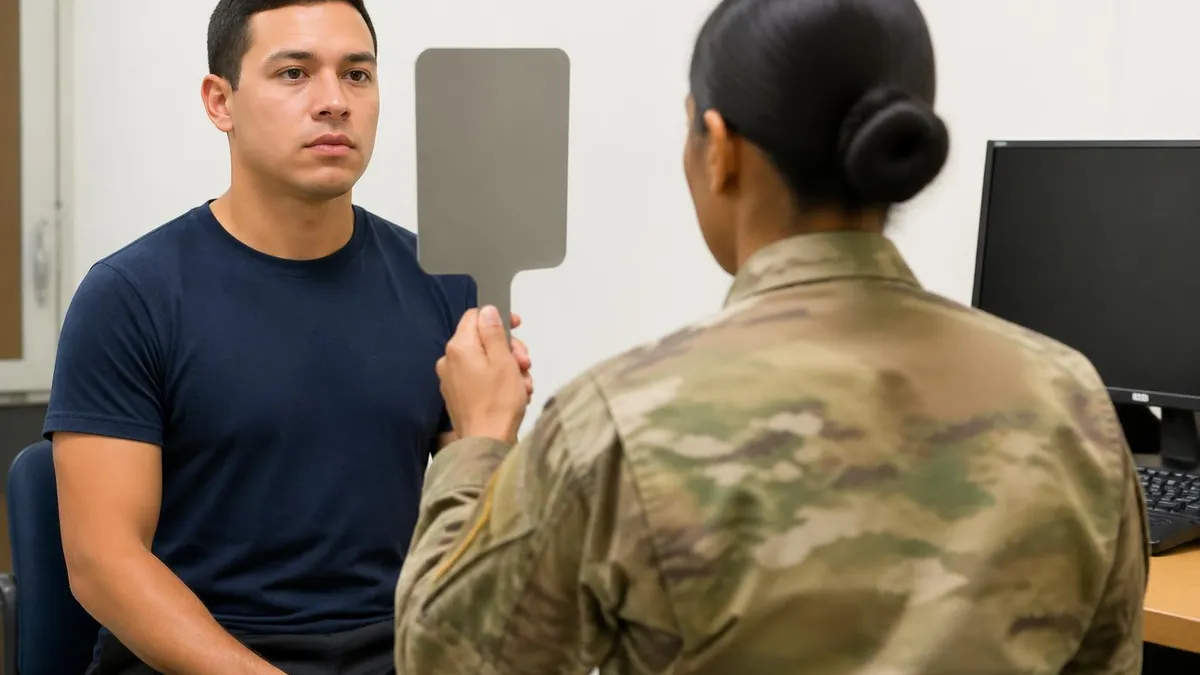
The swearing-in ceremony is a milestone, but MEPS itself involves several steps before you get there — medical exams, vision and hearing tests, the ASVAB, and detailed medical history review. Being well-prepared for each phase makes the process smoother and reduces the risk of delays.
Use our free MEPS practice tests to build familiarity with the types of questions and knowledge tested during MEPS processing. Understanding what the ASVAB covers, how medical standards work, and what the overall process involves helps you walk into MEPS confident rather than caught off guard. The better prepared you are before MEPS, the more smoothly everything from processing to swearing in will go.
About the Author
Retired Military Officer & Armed Forces Test Preparation Specialist
United States Army War CollegeColonel Steven Harris (Ret.) served 28 years in the US Army, earning a Master of Arts in Military Science from the Army War College and a Bachelor of Science in Criminal Justice. He has coached thousands of military enlistment and officer candidate program applicants through the ASVAB, AFQT, AFCT, OAR, and officer selection assessment processes across all military branches.
Join the Discussion
Connect with other students preparing for this exam. Share tips, ask questions, and get advice from people who have been there.
View discussion (8 replies)