
MEPS Process Army: What to Expect Step by Step 2026 September
🧠 Learn the full Army MEPS process — ASVAB testing, medical exam, job selection, and oath of enlistment. Know what happens at each step before you go.
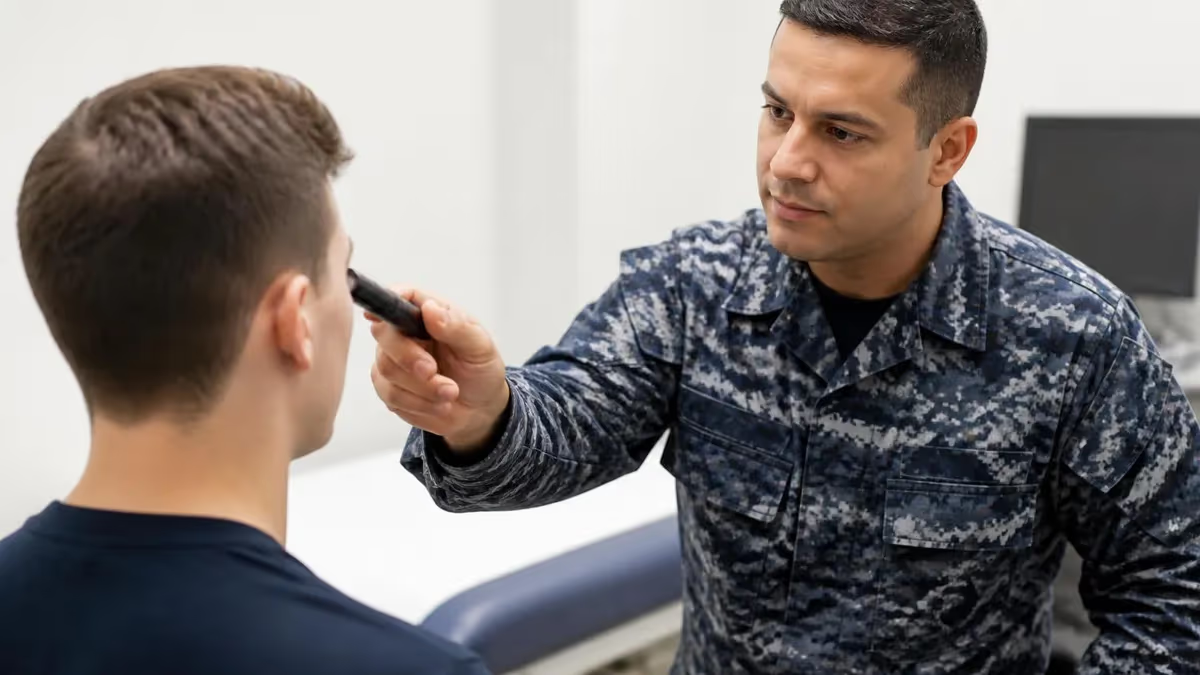
Going to MEPS for the Army is a pivotal day — possibly one of the most consequential days in your enlistment journey. What happens there determines whether you're medically qualified to serve, which Army jobs you're eligible for, and whether you'll raise your right hand and take the Oath of Enlistment before you leave. Understanding the process in advance removes the anxiety of not knowing what's coming and helps you show up prepared.
The MEPS process for Army applicants typically follows a structured sequence. Depending on your recruiter's schedule and your situation, you might complete everything in one long day, or you might split across two days with an overnight stay at a contracted hotel. Either way, the core steps are the same.
Before You Go: What Happens with Your Army Recruiter
The MEPS process doesn't start at the MEPS facility — it starts with your Army recruiter. Before you ever set foot in a processing station, your recruiter will have collected preliminary information, had you complete initial paperwork, and potentially administered a pre-screening test.
Many Army recruiters use the PiCAT (Pending Internet Computerized Adaptive Test) as a pre-screening tool. The PiCAT is a full-length ASVAB-equivalent test that you take in the recruiter's office or online, unproctored. If you score well on the PiCAT and your score is verified at MEPS (through a short, 30-question confirmation test), you may be able to skip the full ASVAB at MEPS — saving time during your processing day. Ask your recruiter whether PiCAT is an option for you.
Your recruiter will also walk you through the SF-86 or DD Form 2807 pre-screening health questionnaire. Answer all health history questions completely and accurately. Omitting health history — even conditions you think are minor or old — can create serious problems during the medical examination or later in your career. Disqualifying information is handled better upfront than discovered later.
Day 1 (or Morning): Arrival and Check-In
Most Army MEPS applicants arrive the evening before their scheduled processing day — MEPS facilities work with local hotels to house applicants. A MEPS shuttle typically picks you up from the hotel early in the morning (often 4:30–5:00 AM) for arrival at the station before it opens.
At check-in, you'll present your identification (valid government-issued ID — typically a state-issued ID or passport), provide your Social Security number, and be assigned to processing. Your paperwork from your recruiter will be waiting at MEPS in your file.
What to bring:
- Government-issued photo ID (valid, not expired)
- Social Security card (or number memorized)
- Glasses or contacts if applicable (and your prescription)
- Any medical records relevant to your health history
- Any required documents your recruiter specified
What to leave behind: phones are collected and stored during processing (in many MEPS facilities). You won't have access to it until your processing is complete. Dress business casual or smart casual — no offensive graphics, no clothing with drug or alcohol references.
ASVAB Testing
If you didn't complete the PiCAT pre-screen with your recruiter, you'll take the full ASVAB at MEPS on a computer (CAT-ASVAB). The testing session typically runs 1.5–3 hours depending on your pace.
Your AFQT score — derived from Arithmetic Reasoning, Math Knowledge, Word Knowledge, and Paragraph Comprehension — determines basic Army eligibility. The minimum AFQT for Army enlistment is 31 (with some waivers available down to 26 for high school graduates). But to access most Army jobs (MOSes), you'll need strong scores across the line score composites — especially GT (General Technical) for intelligence, signals, and combat roles.
Your scores are used for job matching later the same day. A higher score means more MOS options. A lower score still gets you in (if above minimums) but limits your choices. There's no point in strategizing on exam day — you've either prepared adequately or you haven't. What you can control is arriving rested, having eaten a real breakfast, and being mentally focused.
Medical Examination
The MEPS medical examination is the most extensive component for many applicants and the one most likely to generate a temporary or permanent disqualification. The exam is conducted by MEPS medical staff (doctors, nurses, and medical technicians) under Department of Defense medical standards.
The medical processing sequence typically includes:
Vision and hearing testing — Visual acuity, color vision (required for some MOSes), and audiometric testing. Corrected vision may qualify you; uncorrected vision requirements vary by MOS.
Blood and urine testing — Urinalysis for drugs, complete blood count, and other panels. You cannot cheat this test. If drugs show up, processing ends immediately and your enlistment opportunity is over — at least for the time being.
Physical measurements — Height, weight, and body composition screening against Army standards. Weight-for-height standards are enforced at MEPS. If you're over Army weight limits but within body fat standards, you may still qualify — but this is evaluated case by case.
Musculoskeletal examination — A series of movements the MEPS doctor observes to assess range of motion and identify orthopaedic issues. You'll be asked to squat, duck walk, jump, and perform other movements that reveal musculoskeletal problems that might disqualify you.
Physician consultation — A doctor reviews your health history and examines any areas of concern. If you have a history of any condition (asthma, depression, prior surgeries, broken bones, etc.), be prepared to discuss it honestly. The doctor may request additional records or order further evaluation.
Medical disqualifications fall into two categories: temporary (needs further documentation or treatment before clearing) and permanent (medically disqualifying under DoDI 6130.03). Permanent DQs can be waived in some cases depending on MOS and severity — your recruiter and a MEPS waver authority make that determination. Not every DQ is the end of the road, but dishonesty always is.
Job Selection and MOS Assignment
After medical and ASVAB processing, you'll meet with an Army guidance counselor at MEPS to discuss job options based on your ASVAB line scores, security clearance eligibility, medical qualification, and available Army needs.
The Army uses a computer system (MEPS USMEPCOM automated systems) to match your scores to available MOS options at that moment. MOS availability changes constantly based on Army manning needs — a job that was available yesterday may be full today, and vice versa. If a specific MOS is your priority, tell your recruiter before MEPS so they can coordinate timing with Army recruiting battalion.
Some MOSes require additional eligibility beyond ASVAB scores:
- Security clearance — Intelligence, signals intelligence, crypto, and some other roles require at least a Secret clearance. You'll begin the clearance application process at MEPS, but the clearance itself is granted later after investigation. Foreign nationals in your immediate family can complicate clearance eligibility.
- Physical profile requirements — Physically demanding MOSes (11B Infantry, 18X Special Forces Candidate, Ranger Preparatory School) have specific physical standards beyond basic MEPS qualification.
- ASVAB line scores — Each MOS has minimum line score requirements. If you want Ranger-specific or aviation-adjacent roles, check the line score requirements in advance and ensure your preparation targeted those composites.
Once you select an MOS and sign your contract (DA Form 4836 Enlistment/Reenlistment Agreement), you're locked into that MOS unless circumstances change. Read your contract carefully. Your ship date, enlistment term, MOS, and any bonus agreements are all documented there.

The Oath of Enlistment
If you pass medical, complete ASVAB, and sign your contract, the final step at MEPS is the Oath of Enlistment. This is a formal ceremony — usually conducted in a small group of other enlistees from all branches who processed the same day — presided over by a commissioned officer.
The oath is brief but binding. You're swearing to support and defend the US Constitution, obey the lawful orders of the President and officers appointed over you, and faithfully discharge your duties. After the officer administers the oath and you respond, you're a member of the United States Army.
Many MEPS facilities allow family members to watch the Oath of Enlistment ceremony. This is worth coordinating in advance if you want your family present. Let your recruiter know so they can make arrangements.
After the oath, the MEPS process for that day is complete. Your recruiter will pick you up or provide guidance on transportation. Your next major milestone is your ship date — the date you leave for Basic Combat Training (BCT).
Preparing Before Your MEPS Date
The things most likely to disqualify or limit you at MEPS — poor ASVAB scores, undisclosed health history, positive drug tests, or being outside height/weight standards — are all addressable with advance preparation.
For ASVAB, study the math, vocabulary, and reasoning sections systematically using practice tests and focused review. For health history, have an honest conversation with your recruiter about anything in your medical background before MEPS — not after. For weight, if you're close to the limit, work with your recruiter well in advance to get within standards rather than hoping for the best on processing day.
The MEPS practice tests here cover ASVAB content and MEPS-related knowledge to help you prepare for both the ASVAB and the broader processing knowledge you'll need. The more you understand about the process before you walk through those doors, the smoother your day will go.
- ✓Confirm your exam appointment and location
- ✓Bring required identification documents
- ✓Arrive 30 minutes early to check in
- ✓Read each question carefully before answering
- ✓Flag difficult questions and return to them later
- ✓Manage your time — don't spend too long on one question
- ✓Review flagged questions before submitting
About the Author
Retired Military Officer & Armed Forces Test Preparation Specialist
United States Army War CollegeColonel Steven Harris (Ret.) served 28 years in the US Army, earning a Master of Arts in Military Science from the Army War College and a Bachelor of Science in Criminal Justice. He has coached thousands of military enlistment and officer candidate program applicants through the ASVAB, AFQT, AFCT, OAR, and officer selection assessment processes across all military branches.
Join the Discussion
Connect with other students preparing for this exam. Share tips, ask questions, and get advice from people who have been there.
View discussion (8 replies)